
Orthopedic coding is accurate when three things line up: the global period of the procedure, the modifier on any same-day or follow-up visit, and the ICD-10-CM 7th character that shows the phase of fracture care. Check each code's global indicator, document why a visit was separate, and choose the 7th character by active treatment.
Orthopedic claims carry more rules per visit than most office specialties. A single visit can include an exam, an X-ray, a cast, an injection and a decision to operate. This guide covers the global package, same-day modifiers, fracture and cast rules, joint injections and 7th characters, each with its source so your coder can verify it.
Key takeaways
- Global periods differ by code: 0-day, 10-day (11 days in all) and 90-day (92 days in all) under Medicare.
- Modifier 57 marks the decision for major surgery; modifier 25 marks separate work with a minor procedure; MACs can differ on fracture visits.
- Fracture codes include the initial cast, so casting codes are added only in the cases NCCI lists.
- A joint injection is one unit per joint, and the visit needs separate, documented work to bill with modifier 25.
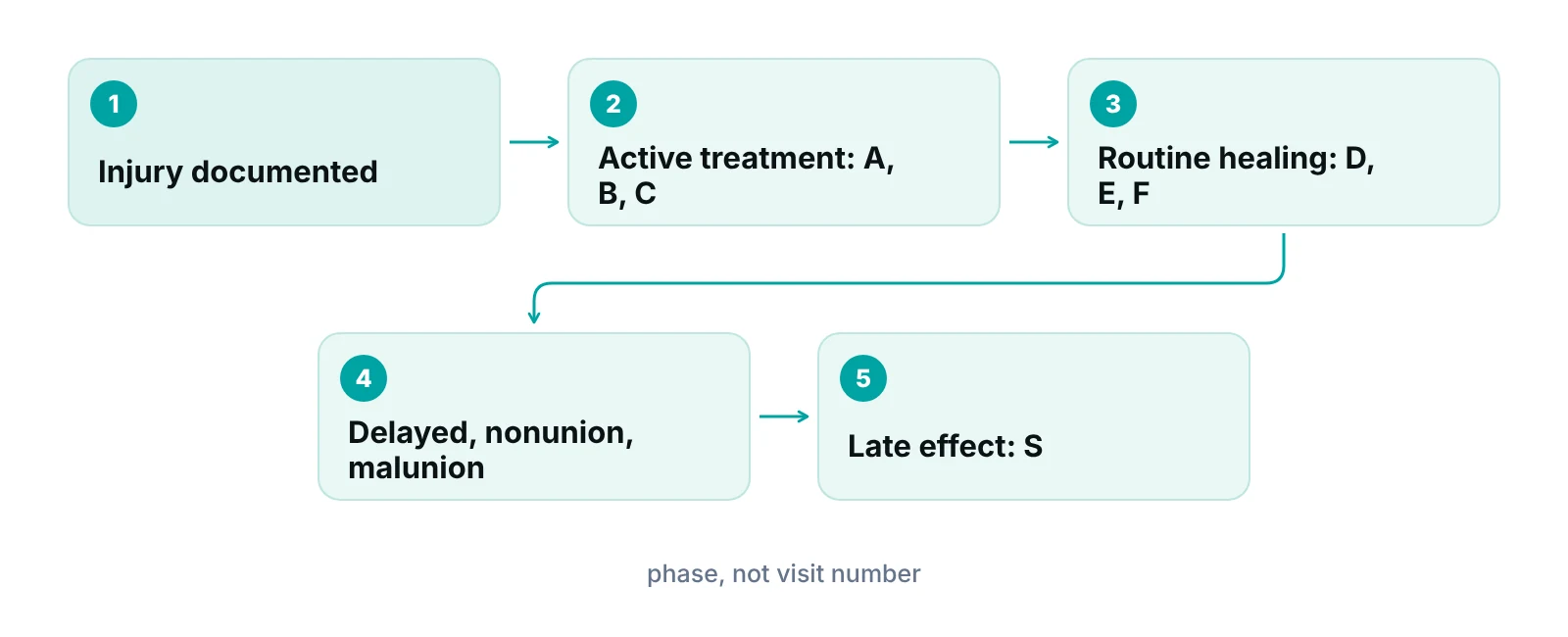
- The 7th character follows active treatment, not the visit count.
What makes orthopedic coding different from other specialties?
Orthopedic coding is harder because one visit can hold an exam, imaging, a cast, an injection and a surgery decision, and each piece follows a different rule. Most errors come from how these pieces interact, not from any single code. Three rule sets do most of the work: the global surgical package, the fracture care rules, and the ICD-10-CM 7th character.
The Medicare rules below come from the CMS Global Surgery booklet (MLN907166, December 2025) and the 2026 NCCI Policy Manual, Chapter 4. They are national CMS rules. Your Medicare Administrative Contractor (MAC) and each commercial payer can differ, and the choice between modifier 25 and 57 is known to vary. Read your own MAC’s guidance before you set a rule.
This post is about the office and fracture side of the specialty. Joint replacement claims have their own detail in our joint replacement billing guide. For billing operations and outsourcing, see orthopedic billing services.
How do 0-day, 10-day and 90-day global periods work?
A global period is the window in which the payment for a procedure already covers the related care. For Medicare, a 0-day code has no pre-operative or post-operative days, a 10-day code covers 11 days in total, and a 90-day code covers 92 days in total, according to the CMS Global Surgery booklet. Table 1 shows how each indicator treats visits.
| Indicator | Window | What the booklet says about visits | Orthopedic note |
|---|---|---|---|
| 000 | No pre-op or post-op days | A visit on the procedure day is generally not separately payable. Post-op visits after the procedure day are separately billable. | NCCI treats casting codes as 000-day minor procedures. |
| 010 | Procedure day plus 10 days (11 total) | No separate payment for routine recovery visits within 10 days. No pre-op period. | Check each code’s indicator in the fee schedule. |
| 090 | 1 day before, procedure day, 90 days after (92 total) | Routine post-op visits are included. The decision-for-surgery visit is excluded (modifier 57). | Closed fracture treatment can be reported with a 90-day code. |
| XXX | Global concept does not apply | Standard E/M rules apply. | Not a surgical package. |
| YYY | Set by the MAC (0, 10 or 90 days) | Contractor-priced codes; the MAC decides. | Ask your MAC. |
| ZZZ | Add-on code | The primary code’s global period applies. | Do not count a second window. |
Source: CMS, Global Surgery booklet MLN907166 (December 2025); CMS, NCCI Policy Manual Chapter 4 (2026); UCSF orthopaedic trauma CPT presentation (2018). Medicare rules; commercial payers may differ.
What the package includes matters as much as its length. Per the booklet, it covers pre-operative visits after the decision to operate, the intra-operative work, complications that do not need a return to the operating room, routine follow-up visits, post-surgical pain management, supplies, and minor items such as dressing changes and the removal of sutures, staples, drains, casts and splints.
Outside the package are diagnostic tests and radiology, treatment of an underlying condition, a distinct procedure that is not a re-operation, and a complication that needs a return to the operating room. The booklet defines that room as one equipped and staffed solely for procedures, so a patient room does not qualify. For each code’s own indicator, use the CMS Physician Fee Schedule lookup tool, as the Neolytix 2026 guide advises, rather than a memorised list.
Which modifier belongs on an orthopedic visit or return procedure?
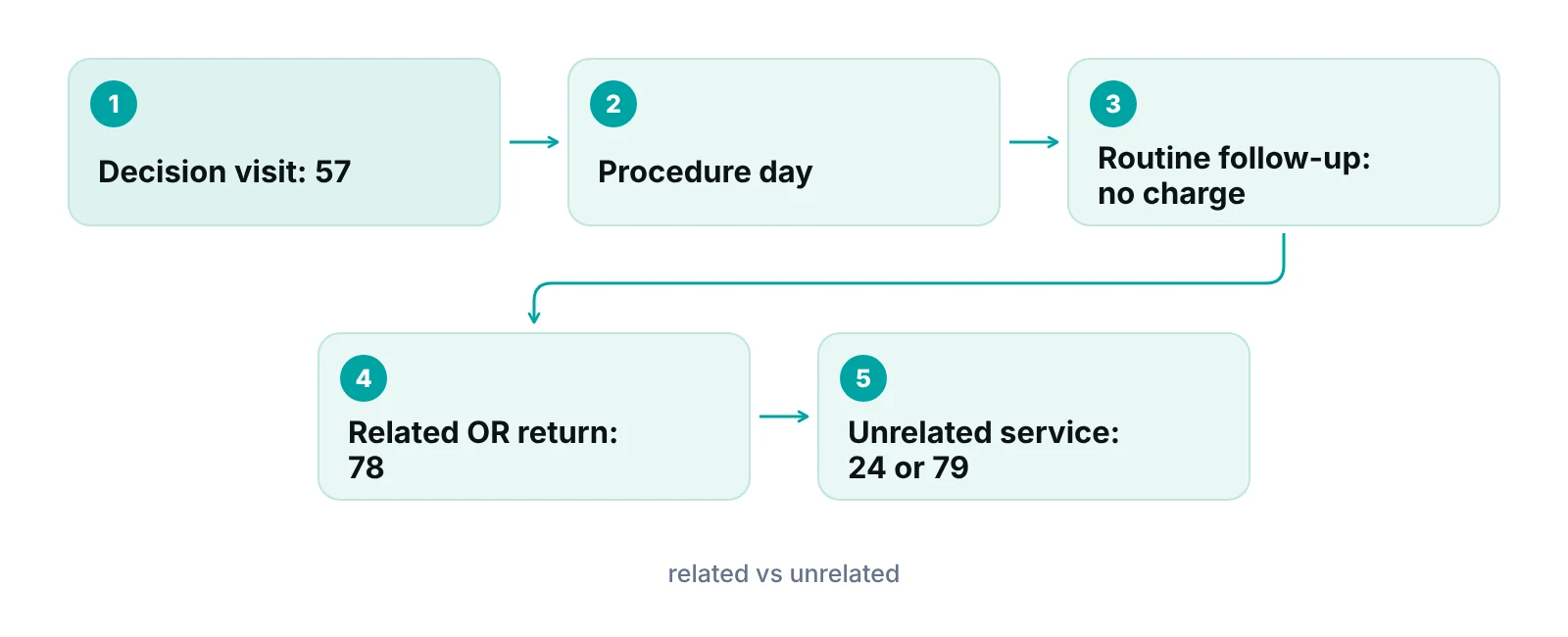
The modifier follows two facts: when the service happened relative to the procedure, and whether it relates to it. Table 2 sorts the five modifiers orthopedic practices use most, plus 24, by situation. The definitions come from the CMS booklet; the examples are illustrations, not payer rules.
| Modifier | Situation (CMS definition) | Orthopedic illustration | The note must show |
|---|---|---|---|
| 24 | Unrelated E/M by the same provider during the post-op period | A patient in a knee procedure’s global window is seen for a new, unrelated problem | The visit is unrelated to the operation |
| 25 | Significant, separately identifiable E/M on the day of a procedure | A new complaint is evaluated and a joint is injected in the same visit | Work beyond the usual pre- and post-procedure care |
| 57 | E/M that results in the decision for major surgery, day before or day of | Exam and imaging review that lead to a decision to operate on a fracture | The decision for surgery, made at this visit |
| 58 | Planned, staged or more extensive procedure after a diagnostic procedure, same provider | A planned second stage after a first procedure | A documented plan, not a surprise |
| 78 | Unplanned return to the operating room for a related procedure | Washout or revision for a complication | The complication and the return to the OR |
| 79 | Unrelated procedure by the same provider in the post-op period | A new, unrelated procedure on another body part | Why it is unrelated, with its own diagnosis |
Source: CMS, Global Surgery booklet MLN907166 (December 2025). Illustrations are examples only. Payer and MAC policy varies.
Modifier 25 versus 57
Use 57 when the visit decides on a major (90-day) procedure, and 25 for a separately identifiable visit with a minor procedure. The booklet says 57 should not be used with minor surgery, and that a MAC may not pay an E/M with 57 on the day before or day of a 000 or 010 procedure. It also says modifier 25 does not require a different diagnosis, but the documentation must be in the record.
Fracture care is where the two blur. An AAPC Part B Insider article (2020) says fracture care codes carry 90-day periods, so the pre-treatment E/M generally takes 57 rather than 25. An older AAPC Modifier Coding Alert (2015) warned that some MACs wanted 25 and that the answer “can change” by payer, and advised checking every contract. Treat both as secondary and dated. Confirm with your MAC.
The 2020 article also lists cases with no separate E/M: the patient came from the emergency department, which did the evaluation, or the surgeon only performs fixation of a known fracture. For more on these modifiers, see modifier 25 versus 59 and our modifier 79 guide.
How should fracture care, casts and splints be coded?
Report one fracture treatment code per anatomic site, and do not add a casting code on top of it. The NCCI Policy Manual says fracture and dislocation codes include the initial casting, strapping or splinting, and that only one repair code (closed, percutaneous or open) is reported per site. If a closed reduction fails and converts to open at the same encounter, only the open procedure is reported.
The same chapter sets out when casting codes do apply:
- If a physician applies an initial cast or splint and expects only initial care, an E/M, a casting code and a cast supply code (Q4001 to Q4051) may be reported. The E/M counts only if it is significant and separately identifiable.
- If the same physician applies the initial cast and also takes over follow-up care, the casting codes are not reported.
- Cast removal or repair codes (29700 to 29750) are not reported when the same entity applied the device. They are reportable only for a device someone else applied.
- One closed-treatment code without manipulation applies when a single cast treats several fractures.
Closed treatment can be reported two ways. A UCSF trauma conference presentation (2018) describes global reporting with the 90-day fracture code (for example, 25600 for a distal radius fracture or 23500 for a clavicle fracture, both closed treatment) or itemized reporting of each encounter. It states the AAOS position that the orthopaedist should have the option, and that CMS has no stated preference for closed nonmanipulative fracture services.
Prefabricated splints and braces
An older AAPC article advises that a prefabricated splint or brace is reported with the E/M and a HCPCS Level II L-code, and that casting and strapping codes are for custom-fabricated casts or splints. This is a dated secondary source, so confirm the current payer rule. Our guide to HCPCS versus CPT explains the code sets.
A worked claim from the 2020 AAPC article shows the pattern: 27752 (closed treatment of a tibial shaft fracture, with manipulation) with a 99214 visit carrying modifier 57, both pointing to S82.201A. Document the fracture type, location and treatment method, as the Neolytix guide (2026) also advises, because a note without them is a common reason a fracture claim is rejected.
How do ICD-10-CM 7th characters work for fractures?
The 7th character tells the payer which phase of care the visit belongs to. It is chosen by whether the patient is in active treatment, not by whether it is the first visit. The FY 2027 ICD-10-CM Official Guidelines (effective October 1, 2026 to September 30, 2027) say a code with a 7th character is invalid without it, and an X placeholder fills empty positions so the character sits in the 7th place.
| Letters | Meaning | Use it when |
|---|---|---|
| A | Initial encounter, closed fracture | The patient is in active treatment |
| B, C | Initial encounter, open fracture (B: type I or II; C: type IIIA, IIIB or IIIC) | Active treatment of an open fracture |
| D | Subsequent encounter, closed, routine healing | Routine care in the recovery phase, such as a cast change |
| E, F | Subsequent encounter, open fracture, routine healing (E: I/II; F: III) | Recovery-phase care of an open fracture |
| G, H, J | Subsequent encounter, delayed healing (closed; open I/II; open III) | Healing is delayed |
| K, M, N | Subsequent encounter, nonunion (closed; open I/II; open III) | The fracture has not united |
| P, Q, R | Subsequent encounter, malunion (closed; open I/II; open III) | The fracture healed in a poor position |
| S | Sequela | A condition that results from the injury, coded after the acute phase |
Source: UnitedHealthcare 7th character quick reference (2025, based on FY 2024 guidelines); CDC/NCHS ICD-10-CM Official Guidelines FY 2027. Confirm letters against the current Tabular List.
Active treatment includes surgical treatment, an emergency department encounter, and evaluation and continuing treatment by the same or a different physician, per the California Medical Association and the UTMB faculty practice newsletter (2025). Routine recovery care, such as a cast change or removal, uses D. The AAPC gives a clear sequence: an emergency visit that applies immobilization is A, the orthopedist’s next-day reduction is still A, and a later recheck by that orthopedist is D. If the plan of care changes, such as a setback, care becomes active again and A applies.
- “Initial” does not mean new patient. The AAOS resident coding guide (2021) says these have nothing to do with CPT visit definitions.
- If the note omits open or closed, the AAOS guide and an Independence Blue Cross sheet say to code closed, and displaced if alignment is unstated. Ask the physician to document it instead of leaning on defaults.
- Sequence multiple fractures by severity, per the Independence Blue Cross sheet (2025).
- Avoid unspecified laterality. The final digit carries the side, so the knee arthritis example in the Neolytix guide is M17.11 for the right knee.
How are joint injections and aspirations coded?
Joint injection and aspiration codes are reported once per joint, and the visit is separate only when real extra work was done. The 2026 NCCI manual says codes 20600 to 20611 apply with or without ultrasound guidance, with one unit per joint including its surrounding bursae. By joint size, 20600 is small, 20605 intermediate and 20610 major, per the Neolytix guide.
- Ultrasound guidance is built into the guided versions (20604, 20606 and 20611), according to the AAPC article. Payers often want a reason for guidance, such as a failed blind attempt.
- Local anesthesia used for the procedure is not separately reportable under NCCI.
- An arthrocentesis is not reported with an open or arthroscopic procedure on the same joint, but may be reported on a different joint.
- A separate guidance code is not reported when the procedure’s own descriptor or instructions include guidance.
E/M with an injection is the most-audited pairing. The AAPC article says not to bill a separate E/M for a repeat injection in a series when there is no significant new work-up, and that modifier 25 needs a new problem, an exacerbation, an unanticipated change or a change to the treatment plan. The CMS booklet says the evaluation for a minor procedure is part of the procedure unless it is significant and separately identifiable. Record the joint, side, drug name and dose.
Are injection visits denying with modifier 25?
Send a sample of denied same-day injection and visit claims with the notes behind them. A free practice audit shows whether the cause is the modifier, the documentation or the payer edit.
Where do laterality modifiers and arthroscopy bundling cause denials?
Side and digit modifiers, and arthroscopy bundling edits, cause quiet denials. Per the NCCI manual, a practitioner reports a bilateral procedure with modifier 50 and one unit on a single line unless the descriptor already says bilateral. An ambulatory surgery center reports it on two lines with LT and RT. Finger procedures use FA and F1 to F9, and toe procedures use TA and T1 to T9.
NCCI also limits the use of its bypass modifiers. Most pairs for bilateral structures allow an NCCI modifier only on the opposite side, not the same side. For arthroscopy, the 2026 manual says:
- Diagnostic arthroscopy is not reported separately with surgical arthroscopy on the same joint. If the case converts to open, only the open procedure is reported.
- A diagnostic arthroscopy that leads to a planned open procedure may be reported, and modifier 58 may apply if the procedures were staged.
- Limited shoulder debridement (29822) is included in other shoulder arthroscopy, and fluoroscopy (76000) is not reported with arthroscopy.
- Knee codes 29874 and 29877 are not reported with other knee arthroscopy codes.
For knee diagnoses behind these claims, our knee pain ICD-10 guide and ground-level fall coding guide cover the injury side.
What are the most common orthopedic coding errors?
The repeat errors are predictable and visible in the note before the claim goes out.
- Billing a routine post-operative visit inside a 90-day or 10-day window with no unrelated reason.
- Using 25 where the payer expects 57 on a visit that decides on major surgery, or the reverse.
- Adding a casting code and supply code to a fracture code that already includes the initial cast.
- Reporting cast removal when the same practice applied the cast.
- Choosing a 7th character from the visit number instead of active treatment.
- Reporting a joint injection twice for one joint, or adding a guidance code the injection code already includes.
- Unspecified laterality, or modifier 50 and RT/LT used together against the payer’s rule.
A periodic review catches these early. Our overview of medical coding audits describes what a review covers, and clean claim practices covers front-end checks. For the operations behind coding, see orthopedic revenue cycle management.
“Most orthopedic denials I see start with a note that does not say why a visit was separate. The code is rarely the problem. The sentence is missing.”
— Awais Afzal, Healthcare Operations & Data Analyst
Our recommendations
- Add the global indicator to the charge screen. Show each code’s 000, 010 or 090 indicator on the charge screen so a visit inside a window is flagged early.
- Write one rule for 25 versus 57, per payer. Record which modifier each major payer and your MAC expects on a visit before fracture care.
- Teach the physician one sentence. Ask for a line in the note that says why a visit was separate: a new problem, the decision to operate, or an unrelated condition.
- Decide global or itemized fracture reporting. Choose a method per payer for closed fracture care and apply it the same way every time.
- Build the 7th character from the care plan. Make coders pick A, D or S from active treatment and the plan of care, not from how many times the patient has been seen.
- Audit a small sample each quarter. Check a handful of injection, fracture and post-op claims against these rules, and fix the template behind each miss.
Bottom line
Orthopedic coding rewards a short checklist: know the global indicator, state why a visit was separate, code fracture care once per site, and choose the 7th character by phase of care. If claims keep returning, a review of your revenue cycle management process can show where they break, and you can ask for a free practice audit.
Frequently asked questions
What is the difference between modifier 25 and modifier 57?
Modifier 25 marks a significant, separately identifiable E/M on the day of a procedure. Modifier 57 marks the E/M that results in the decision for major surgery, on the day before or the day of it. CMS says not to use 57 with minor surgery. Some MACs have wanted 25 on fracture visits, so confirm your contractor’s rule.
Can I bill an office visit with a joint injection?
Only if the visit includes significant, separately identifiable work beyond the usual pre-procedure evaluation, shown by modifier 25 and a note that supports it. A repeat injection in a series with no new work-up usually does not qualify, according to an AAPC article. The decision to do a minor procedure is part of that procedure.
Are follow-up visits billable during a global period?
Routine follow-up visits for the same surgery are included under Medicare’s 10-day and 90-day packages and are not billed separately. An unrelated visit can use modifier 24, and an unrelated procedure can use 79. After a 0-day procedure, visits after the procedure day are separately billable, per the CMS booklet.
Do I bill casting codes with fracture care?
Usually not. NCCI says fracture and dislocation codes include the initial casting, strapping or splinting. Casting and cast supply codes may be reported when a physician applies only an initial cast and expects only initial care. If the same physician applies the cast and takes over follow-up, the casting codes are not reported.
Does 7th character D mean the patient is established?
No. The 7th character depends on the phase of care, not the visit count. A is used during active treatment, including a new physician’s evaluation. D is used for routine recovery care such as a cast change or removal. The AAOS guide states the characters have nothing to do with CPT new and established patient rules.
Should I use modifier 50 or RT and LT for both knees?
Medicare practitioners report a bilateral procedure on one line with modifier 50 and one unit, unless the code descriptor already says bilateral. An ambulatory surgery center uses two lines with RT and LT. Commercial payers differ, so follow each payer’s published instruction.
Get your free practice audit
Tell us about your practice. We will contact you using the details you give.
- A review of your recent claims, denials and A/R aging
- Where your front desk and prior authorizations slow payment
- A prioritized fix list you keep, whether or not you hire us
Pricing is quoted after the audit, based on your volume and the services you choose. Prefer to talk? Call +1 (302) 556-2288.
Sources
- CMS Global Surgery booklet (MLN907166) — CMS (2025)
- NCCI Policy Manual for Medicare Services, Chapter 4 (musculoskeletal) — CMS (2026)
- ICD-10-CM Official Guidelines for Coding and Reporting FY 2027 — CDC/NCHS (2026)
- Combat Common Denials in Orthopedic Coding — AAPC (2016)
- When Is an Injury Initial, Subsequent, or Sequela? — AAPC (2020)
- ICD-10 Resident Guide — AAOS (2021)
- Coding Corner: Initial vs. subsequent vs. sequela in ICD-10-CM coding — California Medical Association (2015)
- Choosing the correct ICD-10 7th digit — UTMB Faculty Group Practice (2025)
- CDI general coding tips: fractures — Independence Blue Cross (2025)
- 7th character quick reference guide — UnitedHealthcare (2025)
- Orthopaedic trauma CPT coding presentation — UCSF Orthopaedic Surgery (2018)
- E/M Modifiers: Let Payer Policy Guide Your Pre-Fracture Care E/M Decision — AAPC Modifier Coding Alert (2015)
- Part B Coding Coach: Scan Fracture Notes for Presurgical E/M Services — AAPC Part B Insider (2020)
- Orthopedics and Musculoskeletal Medical Billing and Coding Guide — Neolytix (2026)
Disclaimer: This article is educational and is not legal, coding, billing, medical or compliance advice. CPT codes are owned by the AMA, and code meanings, Medicare contractor policies and payer rules change and vary by payer, contractor and state. Verify current requirements with the official CPT manual, the ICD-10-CM Tabular List, your payers and your counsel before you act.
