
Orthopedic marketing works when two audiences are handled separately: referral sources such as primary care, urgent care, employers and trainers, and patients who search for a joint, spine or sports problem. Build service-line pages and local search, follow the advertising and privacy rules, then track every call through to a booked consult.
A knee surgeon can have a polished website and still lose a month of consults because the urgent care down the road does not know who to call, or because the new-patient line rings out at lunch. This guide is for orthopedic practice owners and administrators who want one plan for both the clinicians who send patients and the patients who search on their own.
It stays on marketing. Authorization, coding and payment for a booked case are covered in our orthopedic revenue cycle management guide, orthopedic billing services guide and orthopedic coding guide. The operations behind the front desk are in the orthopedic practice management guide.
Key takeaways
- Orthopedic marketing has two audiences, referral sources and direct patients, each with its own message, page and tracking.
- Treatment communications to other clinicians are not HIPAA marketing, but gifts or payments tied to referrals raise Anti-Kickback Statute questions.
- Build one page per service line (joint, spine, sports) and one Google profile per location.
- Reviews, patient stories and ad targeting each carry a federal or Google rule; state boards add rules on board-certification claims.
- Track inquiries, answered calls, booked consults and revenue by source, not clicks.
What does an orthopedic marketing plan need to cover?
It needs to cover two audiences: the clinicians and organizations that send patients, and the people who search for care themselves. The first group needs a reliable intake path and a reply. The second needs a page that matches the problem they typed.
Demand is large. The CDC reported that 53.2 million U.S. adults, 21.2% of those 18 and older, had diagnosed arthritis in 2019 to 2021 (CDC, MMWR). That says nothing about who chooses your practice, but it explains why joint pages and patient education belong in the plan.
Most orthopedic marketing guides are tactic lists. One vendor guide reviewed for this post lists 15 ideas, from SEO and reviews to billboards and giveaways, and an agency guide lists eight (Weave; WebFX). Neither covers advertising rules or HIPAA, and neither shows how to follow a call to a booked consult. Those gaps are the spine of this plan.
Which referral sources should an orthopedic practice build first?
Start with the sources that see musculoskeletal problems before you do: primary care, urgent care, employers and the trainers who watch athletes move. Each wants something different, and none wants a brochure.
| Source | What they need | What the practice offers | Rule to check |
|---|---|---|---|
| Primary care | A named intake contact | A direct line and a returned consult note | HIPAA treatment communications; Anti-Kickback Statute |
| Urgent care | A fast next step after an X-ray or splint | A published follow-up process: who answers, and when | No payment tied to referrals |
| Employers | Clarity on how injured workers are seen | One contact for work injuries | State workers’ compensation rules |
| Trainers and coaches | A way to ask and hear back | A short talk and a page on when to refer | Patient authorization; FTC disclosure |
Source: HHS (marketing), OIG (Anti-Kickback Statute), FTC (endorsements); needs and offers are RCM Finder’s practical framing.
Primary care and urgent care
HHS says a communication made for the treatment of an individual is not marketing, and gives a primary care physician referring a patient to a specialist as an example (HHS, HIPAA marketing). A consult note or a quick update on a shared patient therefore needs no marketing authorization. Promotional material is a separate question.
The work that earns repeat referrals is operational. Give each office one phone number and one fax or portal path, answer both the same day and send the note back. A physician who never hears back stops referring.
Employers and occupational health
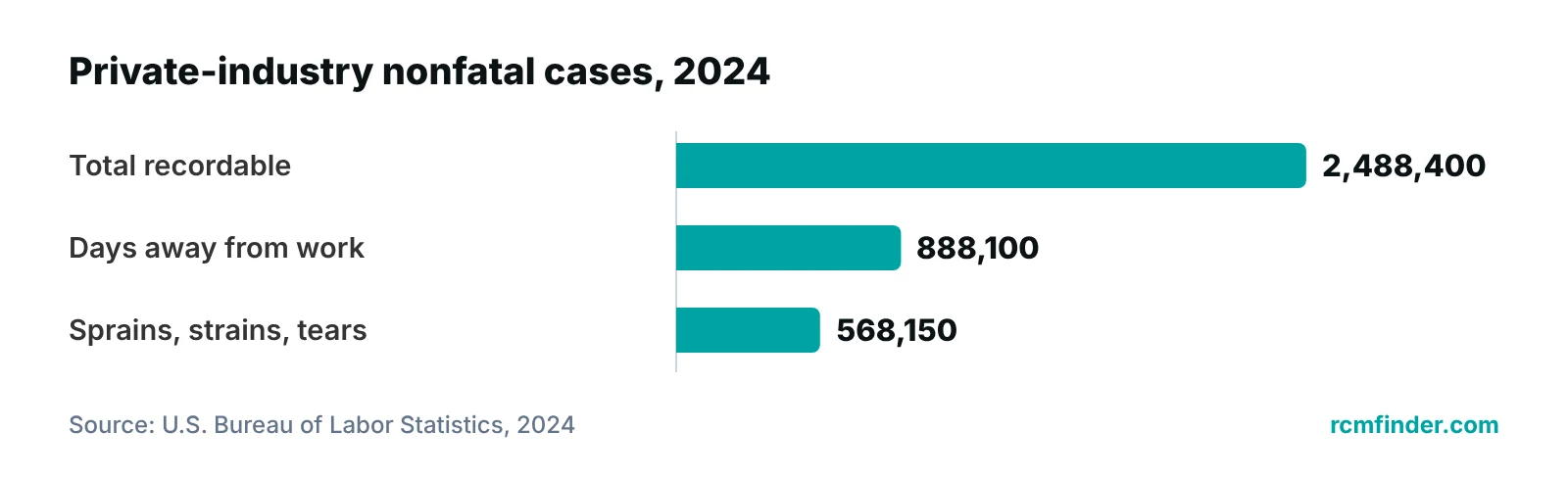
The Bureau of Labor Statistics counted 2,488,400 nonfatal recordable cases in private industry in 2024, 888,100 with days away from work and 568,150 of those involving sprains, strains or tears (BLS). By our arithmetic, that is nearly two in three days-away cases.
Employer outreach is slower and depends on state rules for who directs care and how visits are authorized. Build it after the primary care and urgent care paths work, and train the front desk to spot a work injury on the first call.
Trainers, coaches and therapists
Trainers see the sore shoulder in week one. A short talk on which complaints need an exam, plus a page they can send to an athlete, costs little. Do not pay a trainer per patient sent, and do not share patient details without the patient’s written permission. If a trainer or athlete posts about the practice and receives anything of value, the FTC says the connection must be disclosed in the post itself, not in a bio or a hashtag (FTC, Disclosures 101).
Gifts, meals and payments
The Anti-Kickback Statute is a criminal law against knowingly and willfully paying anything of value to induce or reward referrals of federally paid care. OIG says physicians who pay or accept kickbacks face civil penalties of up to $50,000 per kickback plus three times the remuneration (OIG). Have healthcare counsel review any meal, gift, staffing or payment arrangement with a referral source.
What should joint, spine and sports pages say?
Each service line gets its own page that answers what is wrong, who treats it, what a first visit involves and how to book. A search for a knee problem and a search for a back problem are different searches, so one long page about everything underperforms.
- Joint pages (hip, knee, shoulder): conditions, surgeons, first-consult steps and plans accepted. Our joint replacement billing and coding guide covers billing after the case is scheduled.
- Spine pages: separate neck and back problems, and state which services the practice provides and which it refers out.
- Sports medicine pages: write for the athlete and the parent or coach, and promise quick injury visits only if the schedule allows.
Every page needs the same working parts: a tap-to-call number, location and hours, plans accepted, a booking path and a plain statement of who the page is for. That is the substance of orthopedic website design; the colors matter less. For examples across specialties, see our medical website design roundup.
Orthopedic SEO starts with these pages
Google says content should be made primarily for people, not to manipulate rankings, and that authorship should be obvious, with bylines linked to the author’s background (Google Search Central). For a surgeon’s practice, that means surgeon-reviewed pages with a named author and a review date. Google also documents LocalBusiness markup, with name and address as the required basics (Google structured data). Our healthcare SEO guide covers ranking work in depth.
How should an orthopedic practice handle local search and reviews?
Keep one accurate Google profile per location and ask every patient for a review in the same way, with no incentive. Local search rewards a profile that matches the real practice, and review rules punish shortcuts.
Google’s guidelines say a practitioner should have a profile only if public-facing and reachable at the verified location during stated hours, and that practitioners should not create separate profiles for each specialization. They also say to choose as few, and as specific, categories as possible (Google Business Profile guidelines). Three service lines mean three pages on the site, not three profiles.
Google’s policy bars paid or discounted reviews and says owners may not “discourage or prohibit negative reviews, or selectively solicit positive reviews”; genuine, unincentivized requests are allowed (Google policy). The FTC reviews rule, effective October 21, 2024, adds federal bans on fake reviews, sentiment-conditioned incentives, undisclosed insider reviews and review suppression (FTC Q&A).
The routine: send the same plain request to every patient, give nothing in return, set no staff quotas and reply to reviews without confirming the reviewer is a patient. For more, see our guide to online reputation management for doctors.
What patient education content belongs in an orthopedic plan?
Content that answers the questions patients bring to a first consult, reviewed by a surgeon and free of promised results. It builds trust before the patient has booked anything.
- Condition guides: what the problem is, treatment options at a high level and when to be seen.
- Procedure explainers: before, day-of and after, written by the surgeon who performs it.
- Logistics pages: what to bring, and how referrals and prior authorizations work for accepted plans.
Google says topics that could significantly affect health must be highly accurate and consistent with established expert consensus (Google Search Central). Put the surgeon’s name and review date on each page and cite sources for factual claims.
Patient stories need more care. HHS requires authorization for most marketing communications, and a story, photo or recovery video tied to a real person is identifiable health information. Our conservative approach is a written, specific authorization filed with the chart before any patient appears in marketing. Have counsel confirm the form.
Which advertising and privacy rules apply to orthopedic marketing?
Several apply at once: the FTC for reviews and endorsements, HIPAA for marketing and website tracking, the Anti-Kickback Statute, Google’s policies and each state medical board’s rules.
| Rule or policy | What it covers | Practical effect |
|---|---|---|
| FTC reviews rule (effective Oct 21, 2024) | Fake reviews, sentiment-conditioned incentives, insider reviews, suppression | Never buy, write or gate reviews; disclose insider reviews |
| Google review policy | Incentives, selective solicitation, staff quotas | Same request to every patient; no rewards |
| HIPAA marketing | Promotional communications; treatment carved out | Treatment updates are fine; promotional use of patient information needs authorization |
| HHS tracking guidance | Pixels and scripts on booking and login pages | Vendors handling PHI need a business associate agreement |
| Google Ads health policy | Personalized ads for arthritis and surgical procedures | No customer lists, own-data segments or lookalikes |
| Anti-Kickback Statute | Value given to induce federal-program referrals | No payments or gifts tied to referrals |
| State medical board | Specialty and board-certification claims | Check your board before claiming “board certified” |
Source: FTC (2024), Google policy pages, HHS OCR (2024 bulletin and marketing guidance), OIG, Texas Medical Board.
On tracking, HHS OCR says tools on pages where a user schedules an appointment or enters data on a login or registration page can involve protected health information, and a vendor handling PHI needs a business associate agreement. A June 2024 court decision vacated the part of the guidance on pairing an IP address with a visit to a public page about a health condition, and HHS said it was evaluating next steps (HHS OCR). Audit booking and portal pages first.
On state rules, Texas lets a physician advertise as “board certified” only if the certifying board falls in defined categories, such as an American Board of Medical Specialties member board or one the state board has approved (Texas Medical Board). Other states differ.
Google’s health policy lists arthritis and invasive procedures such as surgery and injections as restricted, and bars advertiser-curated audiences for those ads (Google Ads policy). Build paid search on keywords and location.
How do you track a call all the way to a booked consult?
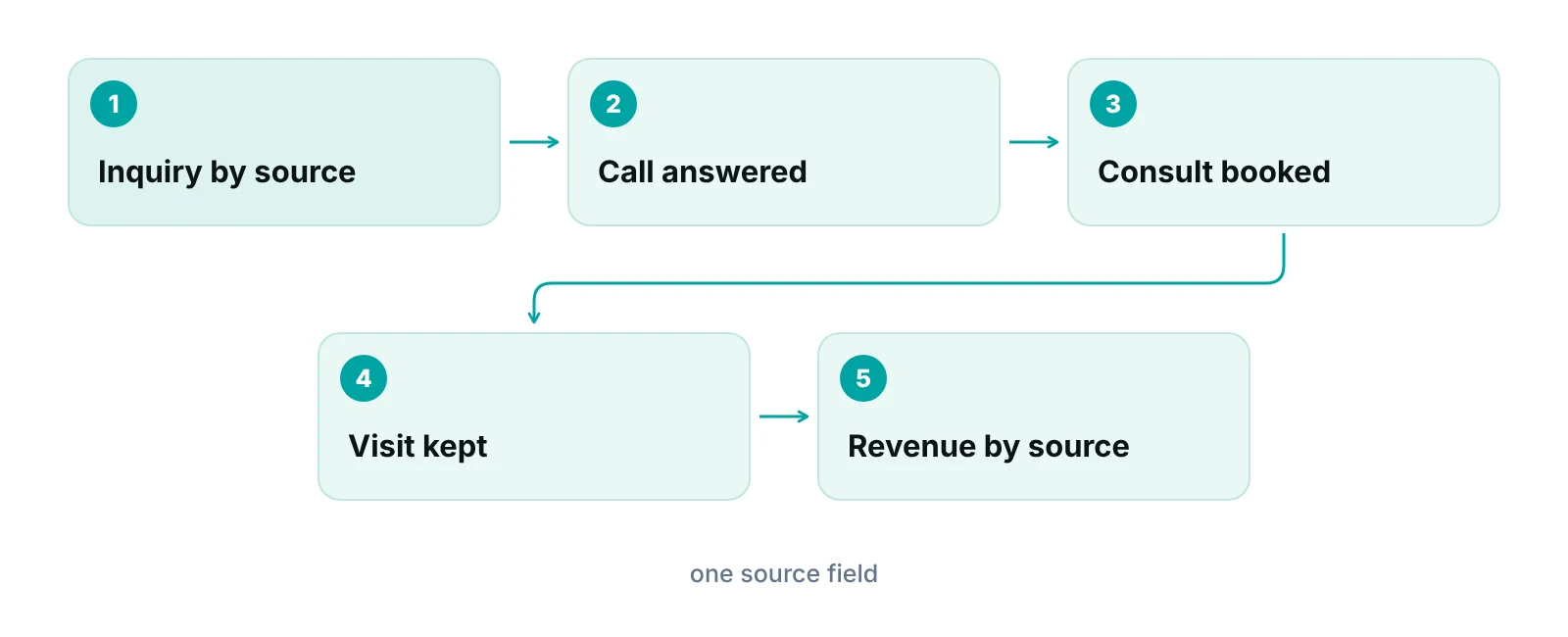
Record every inquiry with its source, mark whether it was answered and whether a consult was booked, and copy the source onto the patient record at registration. The number that matters is booked consults by source.
Google Ads can measure calls from call assets and from numbers on the website, and conversions from another system can be imported. The advertiser sets the minimum call duration that counts, and call recording applies only where both parties are in the U.S. or Canada (Google Ads Help). A long call is not a booked consult; the front desk records the outcome, and the practice can import it.
| Stage | What to record | Question it answers |
|---|---|---|
| Inquiry | Date, channel, service line | Which sources create demand |
| Answered | Live, voicemail or missed; return time | Is the phone losing inquiries |
| Consult booked | Booked, declined or waitlisted | Does demand convert at the desk |
| Visit kept | Seen, cancelled or no-show | Do bookings become visits |
| Revenue | Collected revenue by source | Which sources are worth the spend |
Source: RCM Finder framework; no benchmark values are given because they differ by practice and market.
Ask the referral source’s name at booking and store it in a required field. Read it monthly: a referrer whose patients never book is telling you the intake path is broken. Our medical marketing ROI guide explains how to read the revenue column.
See where new-patient inquiries stall
A free practice audit reviews how calls, referrals and claims move through the practice, and what to fix first.
Should the plan run in-house or with outside help?
Keep referral relationships, surgeon-reviewed content and final say on claims in the practice. Listing upkeep, review requests, call handling and reporting are repeatable and can be shared.
The front desk matters most: if calls go unanswered at 12:15, no campaign fixes it. Our virtual medical assistant service provides remote front-desk staff inside your EHR. With any vendor, ask for a business associate agreement before anyone sees patient data and ask for the source-to-consult report.
Our recommendations
- Write the practice's rules on one page. List the FTC review rule, Google policies, HIPAA marketing and tracking limits, the Anti-Kickback Statute and your state board’s rules. Date it and review yearly.
- Fix intake before adding outreach. Give referring offices one number and one fax or portal path, answer same day and return the consult note.
- Start with primary care and urgent care. Add employers and trainers once those two paths work.
- Publish one page per service line. Joint, spine and sports each get surgeons, conditions, plans accepted and a working phone link, plus a byline and review date.
- Run one review routine. Same plain request to every patient, no reward, and no confirming patient status in replies.
- Audit tags and ad targeting. List every pixel on booking and portal pages and get a business associate agreement or remove it.
- Report monthly on consults and revenue by source. Use one source field from first call to billing.
Bottom line
Orthopedic marketing pays off when referral sources, service-line pages and the front desk work as one chain, and when each step has a rule attached and a number beside it. Start with the intake path and the one-page rules sheet, then add pages, reviews and referral outreach in that order. For what happens after the consult, read the orthopedic revenue cycle management guide, the orthopedic billing services guide and the orthopedic coding guide. Practices that want help can start with RCM Finder’s healthcare digital marketing service.
Frequently asked questions
What is orthopedic marketing?
Orthopedic marketing is the work of bringing in patients and referrals for a musculoskeletal practice: referral relationships with primary care, urgent care, employers and trainers, service-line pages, local search, reviews and patient education. It also includes the advertising and privacy rules that apply, and the tracking that shows which efforts produce booked consults.
How do orthopedic practices get referrals from primary care and urgent care?
By making the next step easy: a named intake contact, a same-day answer on the phone or portal, a consult note returned to the referring office and a short written process for what to send. Educational outreach is the safe lane; anything of value tied to referrals needs counsel review.
Can a practice give meals or gifts to referring offices?
Be careful. The Anti-Kickback Statute bars paying anything of value to induce or reward referrals of federally paid business, and OIG lists civil penalties of up to $50,000 per kickback plus three times the remuneration. This is not legal advice; have healthcare counsel review any arrangement first.
Does an orthopedic practice need separate pages for joint, spine and sports?
Yes, in most cases. Each service line answers a different search and a different patient. Give each its own page with conditions, surgeons, plans accepted and a way to book. Keep one Google Business Profile per location instead of one per specialty, as Google’s guidelines advise.
Can we ask patients for Google reviews?
Yes, if the request is genuine and neutral. Google bars incentives and selective solicitation, and the FTC rule bans fake reviews and incentives conditioned on sentiment. Send the same plain request to every patient, offer nothing in return and reply to reviews without confirming the reviewer is a patient.
How do we know which marketing produced a booked consult?
Record the source on every inquiry, mark whether the call was answered, record whether a consult was booked and copy the source into the patient record. Google Ads can report calls and accept imported outcomes, but only the front desk knows if a call became a booking.
Get your free practice audit
Tell us about your practice. We will contact you using the details you give.
- A review of your recent claims, denials and A/R aging
- Where your front desk and prior authorizations slow payment
- A prioritized fix list you keep, whether or not you hire us
Pricing is quoted after the audit, based on your volume and the services you choose. Prefer to talk? Call +1 (302) 556-2288.
Sources
- Orthopedic marketing (SERP review) — Weave (2025)
- Orthopedic marketing guide (SERP review) — WebFX (2025)
- Consumer Reviews and Testimonials Rule: Questions and Answers — Federal Trade Commission (2024)
- FTC announces final rule banning fake reviews and testimonials — Federal Trade Commission (2024)
- HIPAA: Marketing — U.S. Department of Health and Human Services (2026)
- Fraud and Abuse Laws — HHS Office of Inspector General (2026)
- Use of Online Tracking Technologies by HIPAA Covered Entities and Business Associates — HHS Office for Civil Rights (2024)
- Guidelines to represent your business on Google — Google Business Profile Help (2026)
- Prohibited and restricted content: fake engagement and incentivized reviews — Google Maps contributed content policy (2026)
- Health in personalized advertising — Google Ads Policy Help (2026)
- Measure calls from ads — Google Ads Help (2026)
- Advertisement of board certification — Texas Medical Board (2010)
- IIF Latest Numbers: nonfatal injuries and illnesses, private industry — U.S. Bureau of Labor Statistics (2024)
- Prevalence of Diagnosed Arthritis, United States, 2019-2021 — CDC (MMWR) (2023)
- Disclosures 101 for Social Media Influencers — Federal Trade Commission (2026)
- Creating helpful, reliable, people-first content — Google Search Central (2026)
- Local business structured data — Google Search Central (2026)
Disclaimer: This article is educational and is not legal, coding, tax or compliance advice. Advertising, privacy, referral and payer rules differ by state and plan and change over time, so confirm current requirements with your state medical board, your healthcare attorney and each payer before acting. CPT is a registered trademark of the American Medical Association.
