

Most therapists learn the hard way: Insurance companies do not pay for venting.
If a frantic mother comes into your office to cry about her son’s behavior, your instinct is to listen and support her. That’s good therapy. But if you bill it wrong, that’s bad business.
Unless you understand the strict, often annoying boundaries of CPT Code 90846, you are working for free.
This isn’t just a billing code. It is the specific tool for “Family psychotherapy (without the patient present), 50 minutes.”
It sounds straightforward, but it’s the number one reason claims get flagged as “collateral contact” and rejected. Here is how you use it, how it fights with 90847, and exactly what you need to write in your notes to keep the revenue cycle moving.
The Cheat Sheet
- The Golden Rule: You are not treating the mom. You are treating the son through the mom. If the patient isn’t the focus, the claim dies.
- The Split: Patient in the room? 90847. Patient in the lobby or at school? 90846.
- The Clock: You need 26 minutes of face-to-face time. No exceptions.
- Couples: There is no “marriage counseling” code. You have to use 90846 or 90847, and there must be a diagnosis.
What 90846 Actually Means
Let’s look at the definition without the jargon.
According to the American Medical Association (AMA), CPT 90846 is defined as Family psychotherapy (without the patient present), 50 minutes.
Here is the thing most people miss: The preposition “without” does not change the “who.”
Even though the chair is empty, the session is still for the Identified Patient (IP).
If you spend 45 minutes talking about the dad’s stress at work, you have accidentally done an individual session for the dad. Since he isn’t the client on the file, that’s insurance fraud if you bill it under the kid’s name.
To bill 90846, every intervention must loop back to the primary client’s treatment plan. This is just as important as selecting the right Cognitive Behavioral Therapy CPT codes for their individual sessions—the family work must support the individual work.
90846 vs. 90847: The Showdown
These two codes are siblings. They have the same medical necessity rules, but they look totally different in practice.
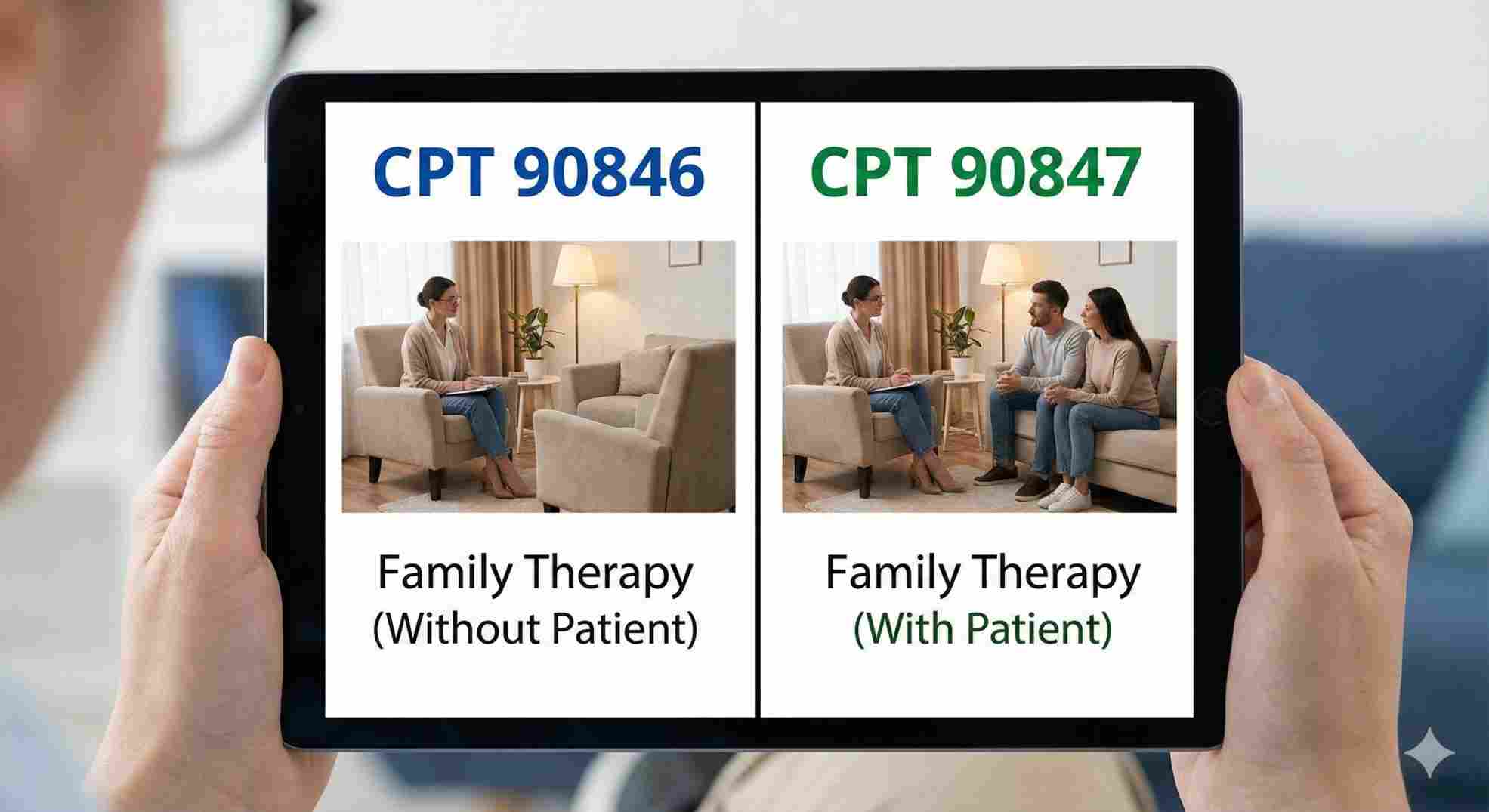
CPT 90847 is Family psychotherapy (with patient present), 50 minutes. This is your standard “family session” where everyone is sitting on the couch together.
If the kid is in the room, it’s 90847. If the kid is waiting in the car, it’s 90846.
Comparison Table
| Feature | CPT Code 90846 | CPT Code 90847 |
|---|---|---|
| Who is in the room? | Therapist + Family Member(s) | Therapist + Patient + Family |
| The Focus | Treating the Patient | Treating the Patient & Family Dynamics |
| Real World Example | Coaching parents on ADHD behaviors | Family conflict resolution |
| Minimum Time | 26 minutes | 26 minutes |
| Payout | Usually slightly lower or equal | Often the highest paying family code |
Warning: Do not try to bill both on the same day. The National Correct Coding Initiative (NCCI) edits usually prevent these two codes from being billed together for the same beneficiary on the same date. It rarely works.
The “Couples Therapy” Problem
Clients always ask: “Do you take insurance for marriage counseling?”
You want to say yes. But technically, “marriage counseling” doesn’t exist for insurance companies. They don’t care about the relationship; they care about the diagnosis.
How to Bill It Legitimately
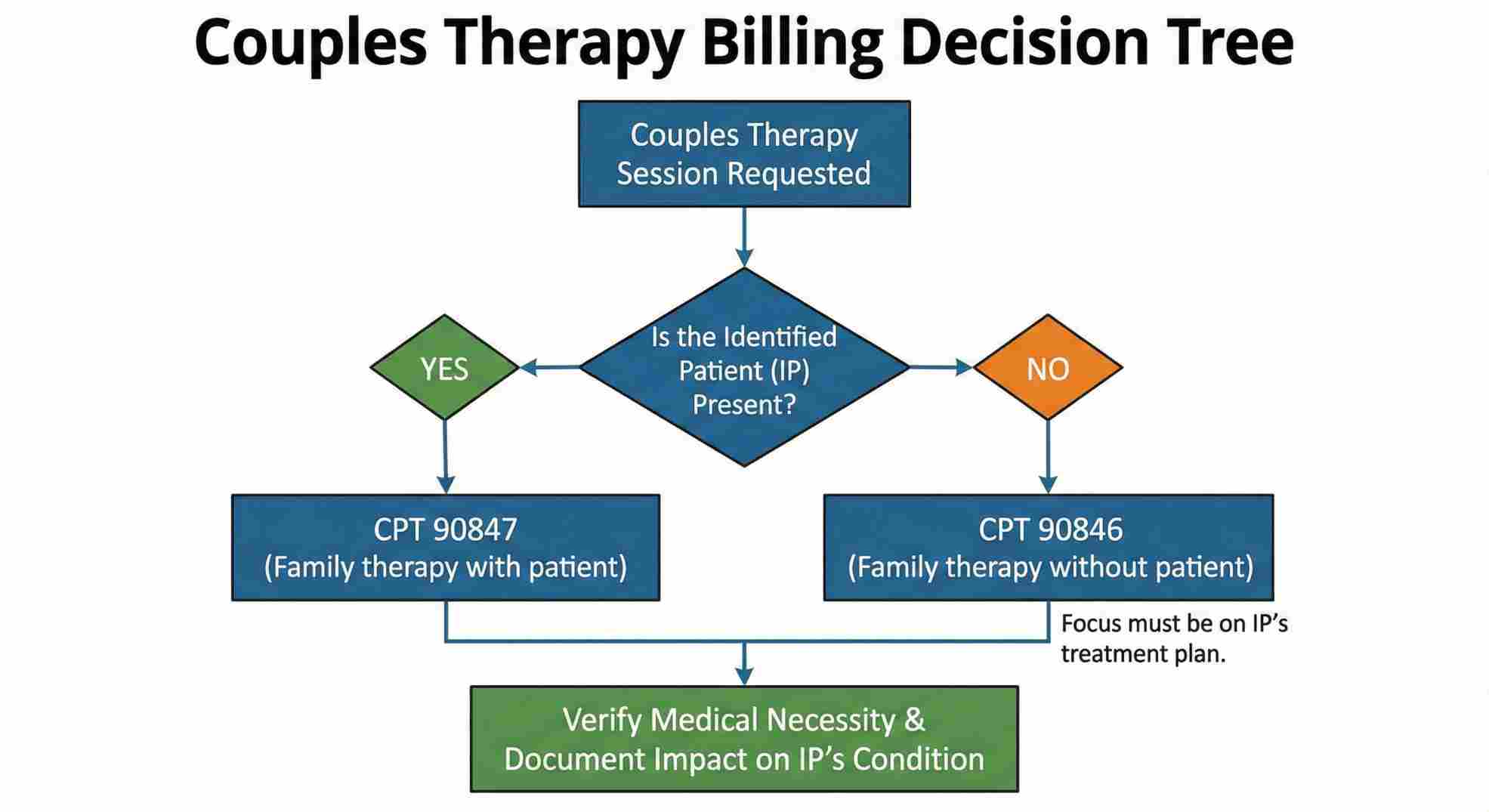
You can use 90847 (or 90846 if talking to one partner alone) for a couple, but you have to play by the rules:
- Pick a Patient: One person is the IP.
- Pick a Real Diagnosis: Anxiety, Depression, PTSD. A valid DSM-5 diagnosis is mandatory; “Relationship Distress” (Z63.0) usually gets denied if it stands alone.
- Draw the Line: You have to document that the relationship issues are making the Anxiety/Depression worse.
Watch The Clock: The 26-Minute Rule
Time documentation is the easiest way to fail an audit. You see “50 minutes” in the description and think you need to hit that number exactly.
Actually, you just need to pass the halfway mark.
Medicare and CPT guidelines follow the “midpoint rule.”
- Code Description: 50 Minutes
- Midpoint: 25 minutes
So, you must cross into the 26th minute to bill it.
Allowable Time Ranges
| Code | Label | Minimum Time | Typical Max |
|---|---|---|---|
| 90846 | 50 mins | 26 mins | ~60 mins |
| 90847 | 50 mins | 26 mins | ~60 mins |
Crisis Sessions: If you go over an hour, don’t assume you can just tack on extra codes. Prolonged service codes usually don’t attach to family therapy codes easily. You are generally capped at one unit per day.
Writing Notes That Don’t Get Denied
When you write a note for 90846, you have to reverse your brain. Usually, you document what the person in the room did. For this, you document how the person in the room is helping the person who isn’t there.
The “Golden Thread”
Connect the dots:
- Intervention: What did you teach the family member?
- Response: Did they get it?
- Impact: How does this help the Identified Patient?
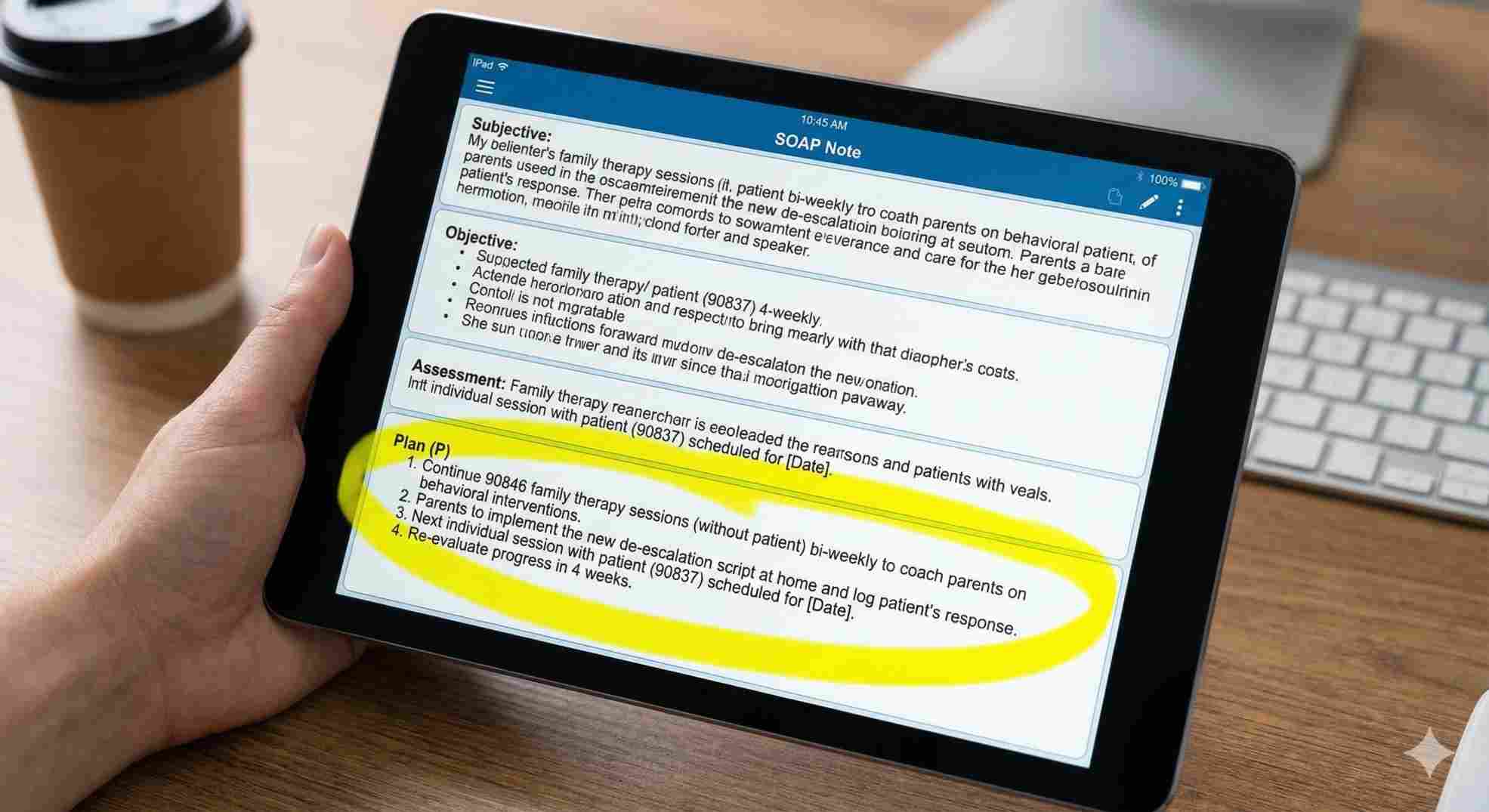
The “Deny Me” Note:
“Met with client’s mother. She is stressed about the divorce and feels overwhelmed. Discussed coping skills for her anxiety.”
(That is individual therapy for the mom. Denied.)
The “Pay Me” Note:
“Met with client’s mother (without client) regarding client’s recent aggression (Dx: ODD). Educated mother on de-escalation techniques. Mother demonstrated understanding of the new plan to stabilize client’s behavior at home.”
(That is treating the patient. Approved.)
Conclusion
Navigating the 90846 CPT code is about precision. It acknowledges a simple truth: mental health affects the whole house.
If you understand the difference between family therapy without the patient (90846) and conjoint therapy (90847), and you write your notes to prove the patient is the one benefiting, you won’t have to worry about recoupments.