
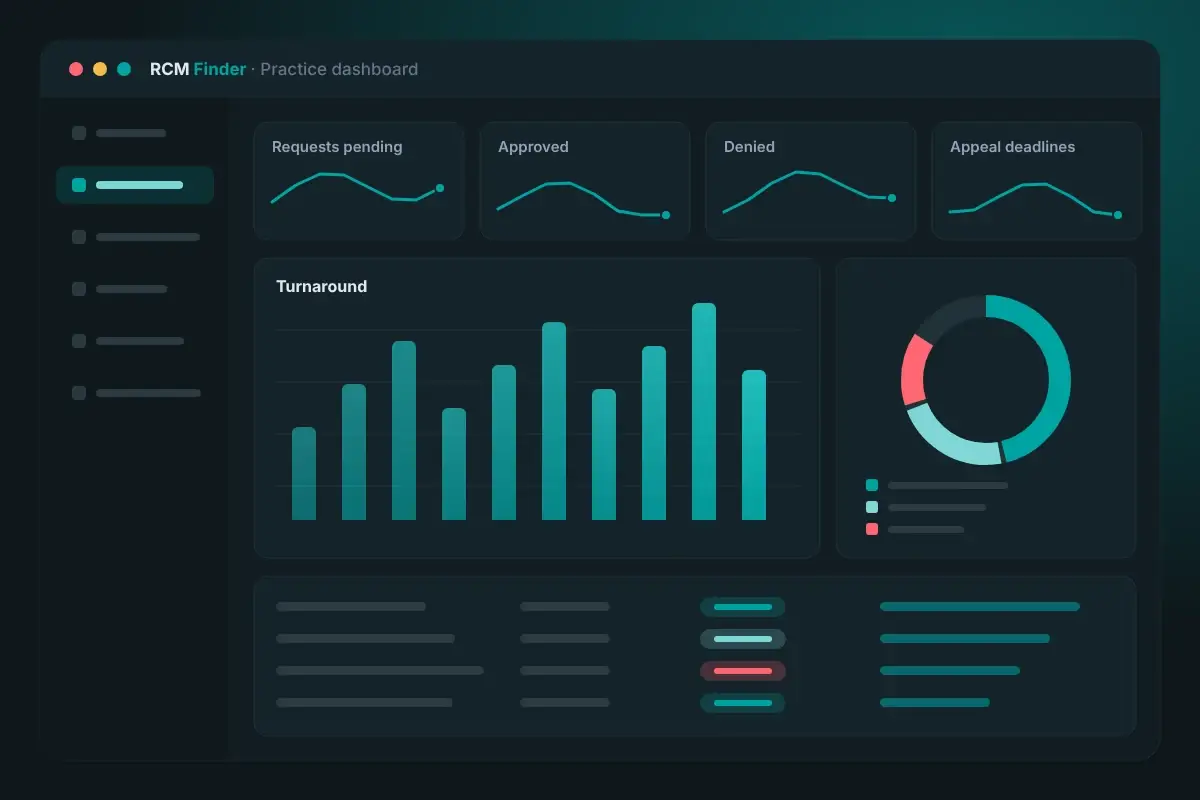
A dedicated team works inside the EHR you already use to submit requests, chase status, prepare peer-to-peer and appeal packets, and tie each approval to the claim. You keep your clinicians' time for patients.
By Awais Afzal | Healthcare Operations & Data Analyst
Published October 12, 2026 · Last reviewed October 12, 2026 · Next review April 12, 2027
Quick answer
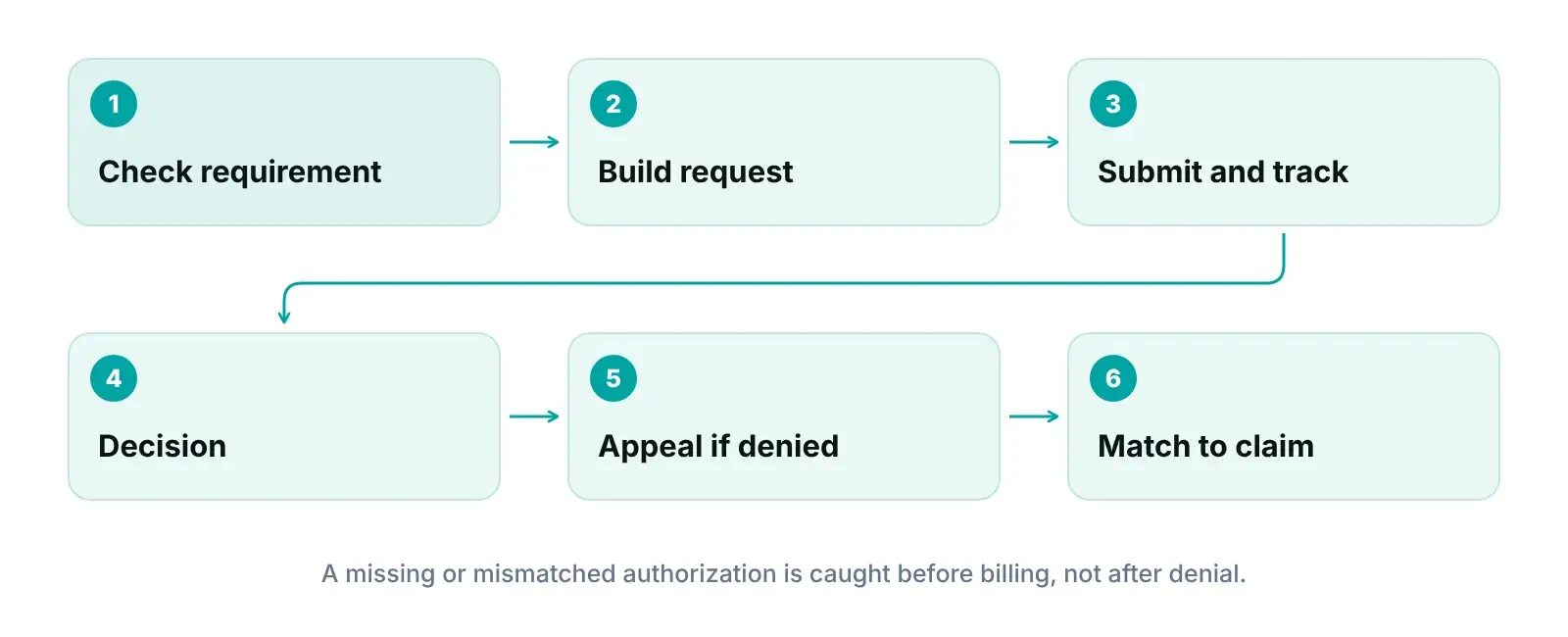
Prior authorization services take over the paperwork of getting payer approval before a service: checking whether approval is required, building the request with clinical notes, submitting it, tracking the decision, preparing peer-to-peer reviews and appeals, and recording the approval against the claim. Outsourcing moves that work from clinicians and front-desk staff to a specialist team.
On this page
Prior authorization services cover every step between the order and the approval: confirming a payer requires approval, building a complete request, submitting it, following up until there is a decision and recording the result where billing can use it. The aim is that no service is billed without a matching authorization and no required one is missed.
Our virtual medical assistants run this work inside your EHR (for example PrognoCIS, eClinicalWorks or athenahealth). For the definition and the general process, see our prior authorization guide for healthcare providers. This page covers what a service does, what the rules require and how to choose one.
See how many requests your team handles by hand
Our free audit reviews a sample of your authorizations and denials and shows where staff hours go.
Practices outsource prior authorization because the volume and the follow-up are heavy, and the work pulls clinicians and front-desk staff away from patients. A specialist team with a queue and deadlines handles it as a process, not as an interruption.
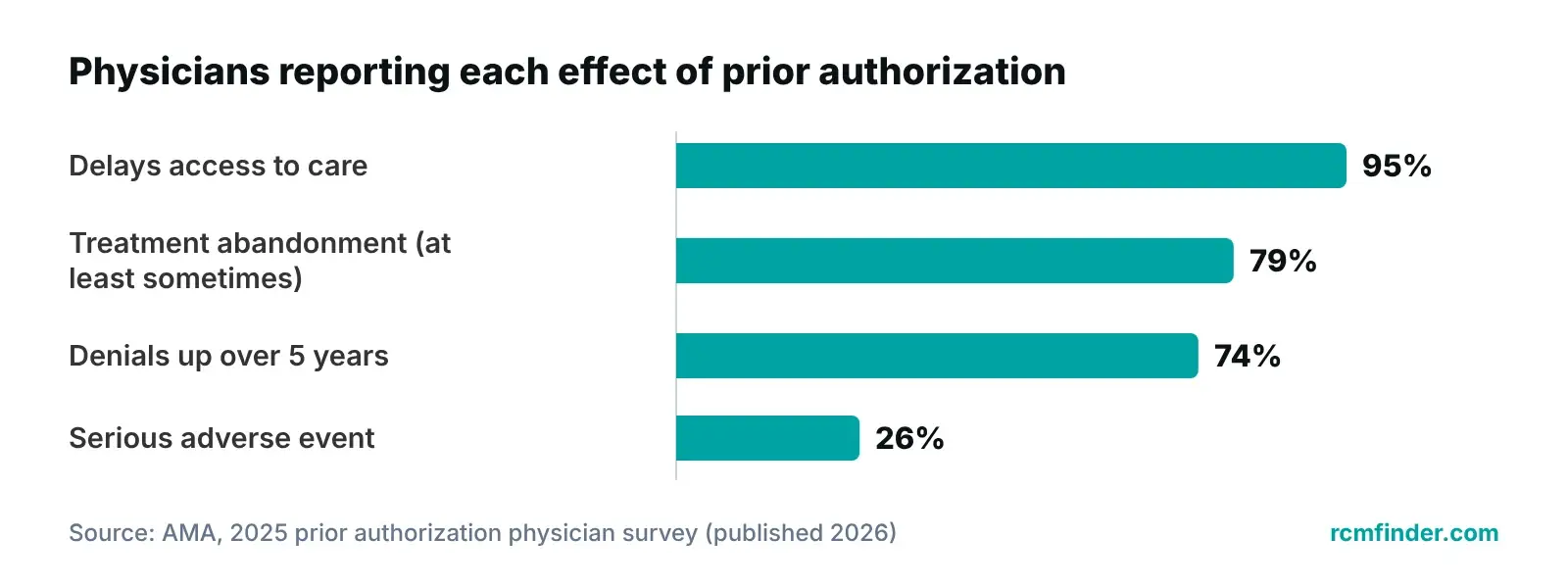
The AMA's 2025 prior authorization survey of 1,000 practicing physicians, fielded in December 2025 and published in May 2026, found physicians completing an average of 40 prior authorizations a week, with about 13 hours of physician and staff time spent on them. In the same survey, 95% said prior authorization delays access to necessary care, 79% said it can at least sometimes lead patients to abandon treatment and 26% reported a serious adverse event for a patient. The survey report also shows 74% saying denials have increased over five years.
Appeals are where the work often stops. In the AMA's 2025 report, the leading reasons physicians gave for not appealing were that they did not believe it would succeed based on past experience (59%) and that they lacked staff resources or time (52%). An appeal queue addresses the second reason directly.
Put a number on the time your staff spend on authorizations
Use our revenue calculator to estimate what delayed approvals and denials cost before your audit.
CMS-0057-F gives affected payers firm decision deadlines and a duty to explain denials from 2026, with electronic prior authorization interfaces due in 2027. It does not cover every plan or every service, so a practice still needs to know which payer rule applies to each request.
| Rule | What it says | Date | Who or what it covers |
|---|---|---|---|
| Decision timeframes (CMS-0057-F) | Decide within 72 hours for expedited requests and 7 calendar days for standard requests | Compliance from January 1, 2026 | Medicare Advantage, Medicaid and CHIP fee-for-service, Medicaid managed care, CHIP managed care. QHP issuers on the federal exchanges are excluded from the timeframes |
| Denial reasons and public metrics (CMS-0057-F) | Payers must give a specific reason for a denied request and post prior authorization metrics on their websites each year | From 2026; first metrics due by March 31, 2026 | The same impacted payers |
| Electronic interfaces (CMS-0057-F) | Prior Authorization API and other APIs must be in place | By January 1, 2027 | The same impacted payers; compliance dates vary by payer type |
| Drugs (CMS-0057-F) | The prior authorization provisions do not apply to decisions for drugs | Applies with the 2026 provisions | Drug requests follow other rules |
| Medicare Advantage timeframe (42 CFR 422.568, 422.572) | Standard decisions for items subject to prior authorization within 7 calendar days; standard Part B drug requests within 72 hours; expedited requests within 72 hours (24 hours for Part B drugs) | 7 days from January 1, 2026 | Medicare Advantage plans |
| Medicare Advantage approvals (42 CFR 422.112, 422.138) | Approval for a course of treatment stays valid as long as medically necessary; a 90-day minimum transition for enrollees new to the plan who are in an active course of treatment; an approved service cannot later be denied as not medically necessary except for good cause or fraud | In effect | Medicare Advantage plans |
| WISeR model (CMS) | Prior authorization for selected items and services, such as skin substitutes, electrical nerve stimulator implantation and knee arthroscopy for osteoarthritis | January 1, 2026 to December 31, 2031 | Original Medicare in New Jersey, Ohio, Oklahoma, Texas, Arizona and Washington; not Medicare Advantage |
Sources: CMS-0057-F fact sheet; 42 CFR 422.568, 422.572, 422.112, 422.138 (eCFR, October 2026); CMS WISeR page. WISeR examples are illustrative, not complete.
Three practical points follow. The CMS fact sheet lists Medicare Advantage, Medicaid, CHIP and exchange plans as covered payers; employer group plans are not on that list, so their rules come from the plan and the contract. A 7-day deadline is a ceiling, so we still track every request to its decision date. And the 2027 interfaces will reduce phone and fax work only as payers and EHRs make them available.
When you need a longer look at drugs, see our guide to expediting medication prior authorization. For denial code CO-197, see our CO-197 denial guide.
We start with a free audit, then take the authorization queue in stages inside your EHR. You keep your system, your payer contracts and the clinical decisions.
We review a sample of recent authorizations, denials and claims for services that needed approval, plus how requests are made today and who makes them. You get a written summary of where time and revenue slip. Pricing is quoted after the audit.
We put a Business Associate Agreement in place before accessing patient data, then set up role-based access limited to what each role needs.
We list which of your payers and services need approval and how each payer takes requests. The portal applies specialty-aware logic per claim, with 35 specialties grouped into shared billing-pattern archetypes.
Virtual medical assistants work your orders from the EHR schedule, submit requests, log reference numbers and follow up before each decision date. Your practice's time zone governs every shift.
For a denial, we pull the specific reason, prepare a clinical summary for your physician, and draft the appeal for physician review, tracked against the appeal deadline.
Approvals are recorded against the claim, and you get weekly KPI reporting on pending, approved, denied and appealed requests, with a fix for each recurring cause.
We build our billing pipeline around how claims actually move through a practice: registration, charge entry, submission, payment and follow-up. Claims in the RCM Finder portal are tracked by stage, with automation rules that can flag a claim for review or hold a stage. See our end-to-end revenue cycle management service for how this connects to billing.
When a request is denied, the practice has a short, rule-bound path: read the specific reason, decide between peer-to-peer and appeal, and file before the deadline. When approval was missed, retro authorization is a payer-policy question, not a federal right.
A peer-to-peer is a clinician-to-clinician call with the payer's reviewer. Your physician makes the call; we book it, assemble the chart evidence and criteria, and note the outcome. In the AMA's 2025 survey, only 16% of physicians who had been in peer-to-peer reviews said the plan's reviewer often or always had appropriate qualifications, so a prepared summary matters.
Some payers will review an authorization after the service, usually only inside a short window set by their policy or contract. We treat it as a last resort and log why the request was missed. Our retro authorization guide covers the process in detail.
What needs approval, who requests it and how long it stays valid depend on the service. The same team handles each, but the checks change.
| Specialty group | What usually needs approval | What changes in the work |
|---|---|---|
| Radiology and advanced imaging | Advanced imaging, which some plans route through a separate benefit manager | The ordering physician typically obtains approval (one plan's published FAQ). Medicare's appropriate use criteria program is paused and its rule was rescinded effective January 1, 2024. |
| Pain management | Procedures and implanted devices, depending on the payer | WISeR lists electrical nerve stimulator implantation among selected services in six states. For repeat procedures we check what each approval covers: codes, levels, sides and dates. |
| Oncology and infusion drugs | Part B drugs and administration | Medicare Advantage must decide standard Part B drug requests within 72 hours and expedited ones within 24 hours, with no extension, and CMS-0057-F's provisions do not apply to drugs. We match drug, dose, diagnosis and site of care to the request. |
| Orthopedics and surgery | Planned procedures, often tied to site of service and date | WISeR lists knee arthroscopy for knee osteoarthritis. Approvals name codes, facility and a date window, so a reschedule or added procedure means updating the approval. |
| Podiatry and DME or orthotics | Items on Medicare's Required Prior Authorization List, plus payer-specific items | For listed items, prior authorization is a condition of payment. CMS review is no more than 7 calendar days for standard requests and 2 business days for expedited since January 1, 2025. |
| Rehabilitation and therapy | Visit blocks on many commercial plans; Medicare tracks cost thresholds | For 2026, Medicare KX thresholds are $2,480 (PT and SLP combined) and $2,480 (OT), with a $3,000 medical review threshold. We track visits used against authorized visits. |
Sources: Johns Hopkins HealthCare/eviCore FAQ; CMS AUC, WISeR, DMEPOS and CY 2026 therapy pages; 42 CFR 422.568; CMS-0057-F fact sheet. Operational points are our process, not statistics.
Browse our specialty RCM pages for the billing side of each group.
Choose the model that can work every request to a decision, every day. In-house gives the most control, outsourced adds coverage and a dedicated queue, and a hybrid keeps the front desk local while a partner handles requests.
| Factor | In-house team | Outsourced team | Hybrid model |
|---|---|---|---|
| Control over requests | Highest | Shared, set by scope and reporting | Split by task |
| Coverage when staff are out | Gaps unless cross-trained | Vendor covers absences | Partner covers its tasks |
| Payer know-how | Limited to who you hire and train | Usually broader across payers | Partner fills gaps |
| Visibility | Your own tracking sheet or EHR | Ask for request-level status, not a monthly summary | Needs one shared tracker |
| Cost structure | Salaries, benefits, training, software | Contract fee (ours quoted after a free audit) | A mix of both |
| Usually suits | Larger groups with stable authorization staff | Practices short on staff or losing revenue to missing approvals | Practices keeping scheduling local |
Decision guide based on common operating models; no sourced statistics.
A common hybrid: keep your scheduler, add virtual medical assistants for eligibility and authorizations, and hand denials and appeals to a revenue cycle team. Ask who covers authorizations on a sick day and who owns each appeal deadline.
Not sure which model fits?
Talk it through with our team. If keeping prior authorization in-house makes more sense for your practice, we will say so.
Authorization problems usually start before the order and show up after the claim. We run this as one of four connected services.
Marketing decides which services and plans reach your schedule. We aim local SEO, Google Ads and reputation work at services your team can support.
Our virtual medical assistants handle eligibility, prior authorizations, scheduling and intake in your EHR.
Authorization numbers, approved codes and dates are checked at claim build, and denials are worked by reason with appeal deadlines tracked.
Our portal shows where every claim stands and who owns the next step, for practices and billing companies.
Any vendor that handles patient charts for authorizations is a HIPAA business associate and must sign a Business Associate Agreement. Beyond that, ask how access is limited, how requests are tracked and what happens to your data if you leave.
HHS guidance lists claims processing, billing and practice management among business associate functions, and the agreement must bar uses of patient data it does not permit and require safeguards. The minimum necessary standard limits uses and requests to what is needed, which matters when a request packet carries chart notes. Under 45 CFR 164.504(e), the agreement must also cover subcontractors and, if feasible, return or destruction of protected health information at termination.
Our own setup: role-based access, audit logging, encrypted HTTPS connections, and we put a Business Associate Agreement in place before accessing patient data. For your side, use our HIPAA compliance checklist.
We would rather tell you now than after you sign. Here is where we fit and where we do not.
A good fit if you are
Probably not a fit if you are
What we would do first if we were running your practice's revenue cycle tomorrow.
We list which services need approval for each of your top payers, with the source and review date. Payer rules change, so each line gets a recheck date.
We record the authorization number, approved codes, units and dates against the order so a mismatch is found before the claim is built.
Every open request carries a decision deadline. We follow up before it, using the CMS-0057-F timeframes where they apply and the payer's own terms where they do not.
We tag each denial with its specific reason and the step that caused it, then review the top reasons weekly so the front end changes.
For a peer-to-peer, we prepare a short clinical summary and the payer criteria. The physician decides what to say.
Medicare Advantage and employer-plan deadlines differ, so we log each denial's deadline on receipt and work the earliest first.
Payer portal accounts and request history should stay yours. Put access and data-return terms in any authorization contract, including ours.
A prior authorization service is a team that handles insurer approval before a service is provided. It checks whether approval is required, builds and submits the request with clinical notes, tracks the decision, supports peer-to-peer reviews and appeals, and records the approval so the claim matches. The practice's physicians still make every clinical decision.
Pricing depends on request volume, specialties, payer mix and whether appeals and old denials are included. Common models include a per-request fee, a monthly fee or a bundle with other revenue cycle work. We quote after a free practice audit so the price reflects your real workload. Ask any vendor exactly what each fee covers.
Some do. From January 1, 2026, Medicare Advantage, Medicaid, CHIP and covered payers must decide expedited requests within 72 hours and standard requests within 7 calendar days under CMS-0057-F. Qualified health plan issuers on the federal exchanges are excluded from those timeframes, and drugs are excluded. Employer plans follow their own rules.
We prepare the denial summary, the clinical packet for a peer-to-peer and a draft appeal for physician review, and we track the deadline. Deadlines differ: a Medicare Advantage reconsideration must be filed within 60 calendar days, and employer ERISA plans must allow at least 180 days. We cannot promise an outcome.
No. Our team works inside your existing EHR, for example PrognoCIS, eClinicalWorks or athenahealth, using the access you grant. We do not claim official partnerships with EHR vendors. We work in your system the way your own staff do, and your clinicians keep their normal workflow.
HIPAA lets practices use vendors as business associates, provided a Business Associate Agreement is in place and the vendor safeguards the data. Before sharing access, confirm the agreement is signed, access is limited by role, activity is logged and connections are encrypted. We put a Business Associate Agreement in place before accessing patient data. This is general information, not legal advice.
Tell us about your practice. A member of our operations team replies within one business day.
Pricing is quoted after the audit, based on your volume and the services you choose. Prefer to talk? Call +1 (302) 556-2288.
Tell us about your practice
About the author: Awais Afzal
Healthcare Operations & Data Analyst, RCM Finder
Awais has spent more than 16 years in healthcare digital marketing and clinical operations management. He builds data-driven revenue cycle blueprints for high-ticket medical practices and leads product development of the RCM Finder portal. More about our team.
How we write: every figure, code and rule on this page was checked against the primary source listed below and independently fact-checked before publishing. We re-review this page every six months. Last reviewed October 12, 2026; next review April 12, 2027.
We use cookies to understand how our site is used and to measure our advertising. You can accept or reject non-essential cookies. See our Privacy Policy.