
Global and itemized maternity claims, delivery-date rules, well-woman versus problem visits and LARC, plus front-desk assistants, patient marketing and a claims portal.
By Awais Afzal | Healthcare Operations & Data Analyst
Published October 12, 2026 · Last reviewed October 12, 2026 · Next review April 12, 2027
Quick answer
OB/GYN billing services turn pregnancy care, deliveries, well-woman visits and gynecology procedures into payable claims. That means choosing a global package or itemized claims by payer rule, using the right delivery date, separating preventive and problem visits with modifier 25, and billing contraception correctly. RCM Finder adds front-desk assistants, marketing and a claims portal.
On this page
OB/GYN billing is different because one pregnancy can be paid as a single package, as separate pieces, or as a mix, and the rule changes by payer. The same office also bills well-woman visits, procedures and contraception, each with its own overlap limits.
Two things drive most denials: a global package billed too early or split by mistake, and a preventive or problem visit that collides with a procedure on the same day. Both come down to dates and counts that someone has to track for months.
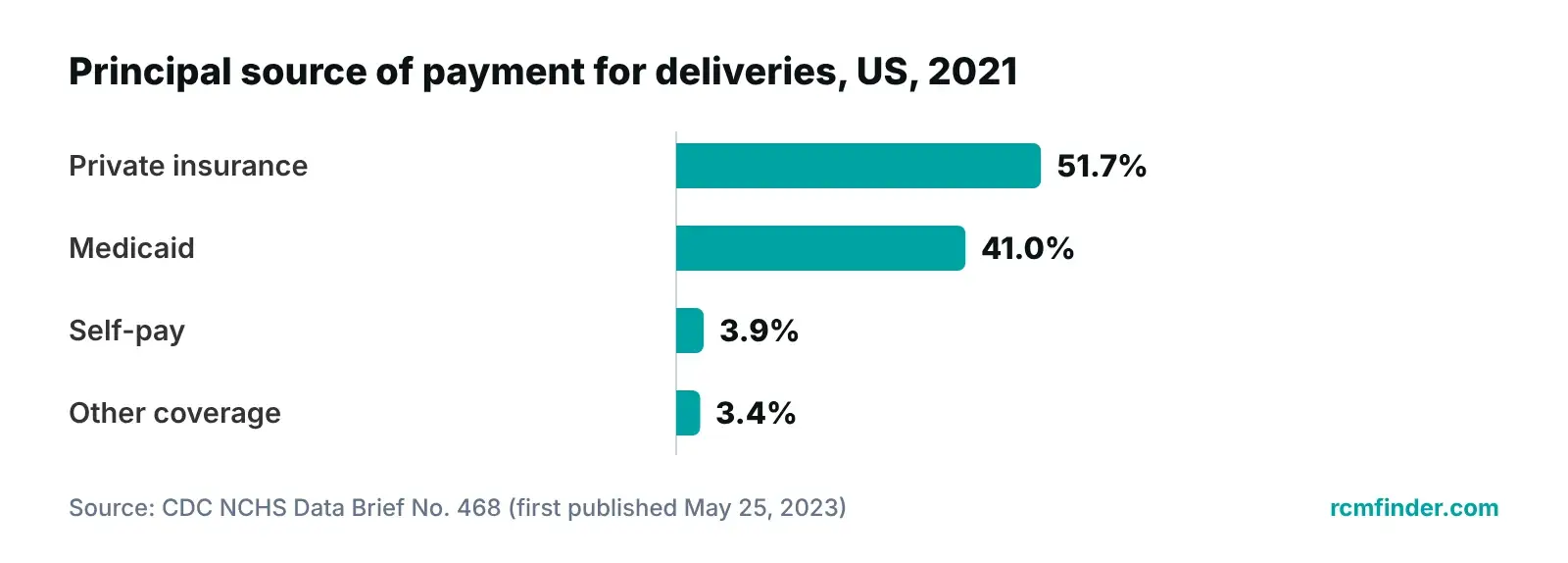
In CDC’s 2021 birth certificate data, private insurance was the main payer for 51.7% of deliveries and Medicaid for 41.0%. Your payer mix decides which maternity rules you work under.
The 2026 NCCI Policy Manual, chapter 7 says procedures with a global period of MMM are maternity procedures. The global obstetrical package covers antepartum care, the delivery and postpartum care. Ultrasound, amniocentesis, genetic screening, unrelated visits and extra high-risk visits fall outside it.
For background, see our OB/GYN billing technology guide and the outsourcing checklist.
An OB/GYN practice needs patients who book early, a front desk that tracks each pregnancy, and billing that waits for the right date.
Revenue leaks at handoffs, such as a transfer-in at 30 weeks or an unbooked postpartum visit. We run all four pillars on one set of payer rules.
Patients choose an obstetrician early, from search. Our healthcare digital marketing builds the pages and reviews they check, with tracking kept off health forms.
Our Virtual Medical Assistants work in your time zone and keep each pregnancy’s dates, visit count and coverage current, so billing starts clean.
Our end-to-end RCM bills the package or the pieces according to the payer’s rule, then works denials and A/R on both.
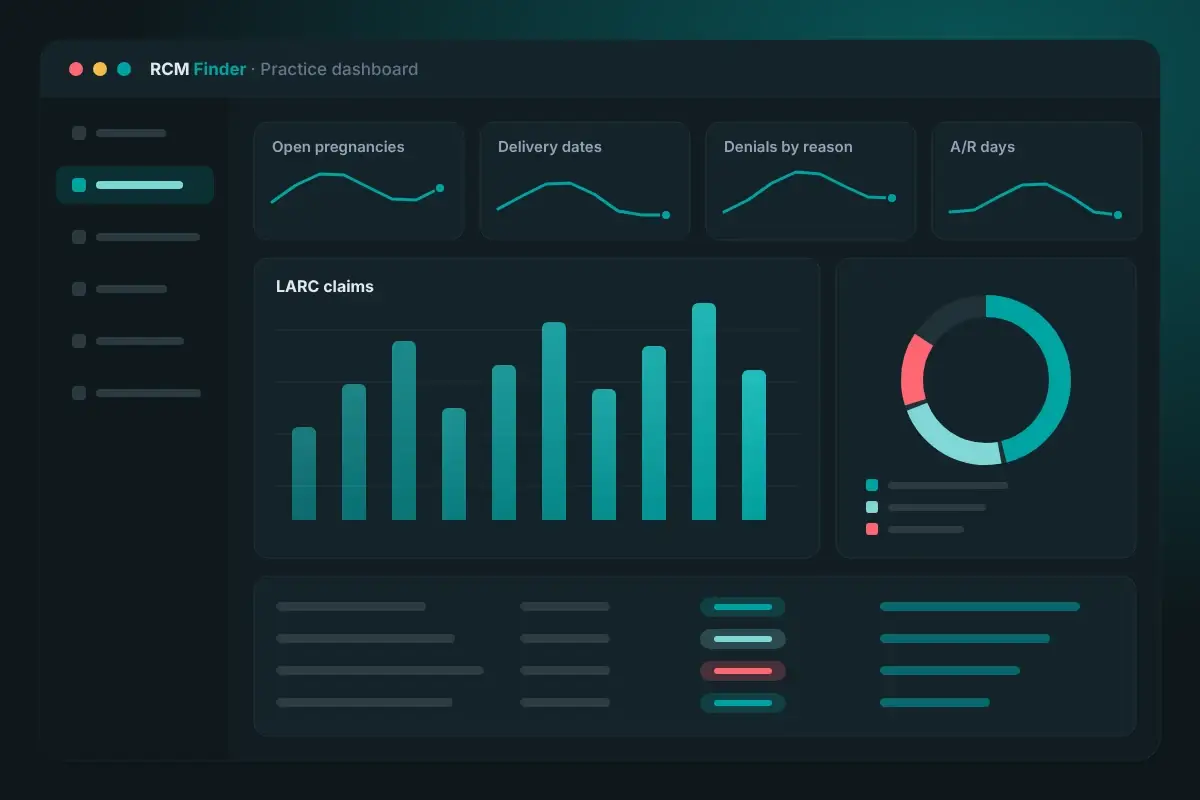
The RCM Finder portal tracks claims by stage and applies specialty-aware billing logic per claim, so an open maternity claim does not look like a stalled one.
Find where your OB/GYN claims leak
We review recent global packages, antepartum claims, well-woman visits and denials, then show what to fix first.
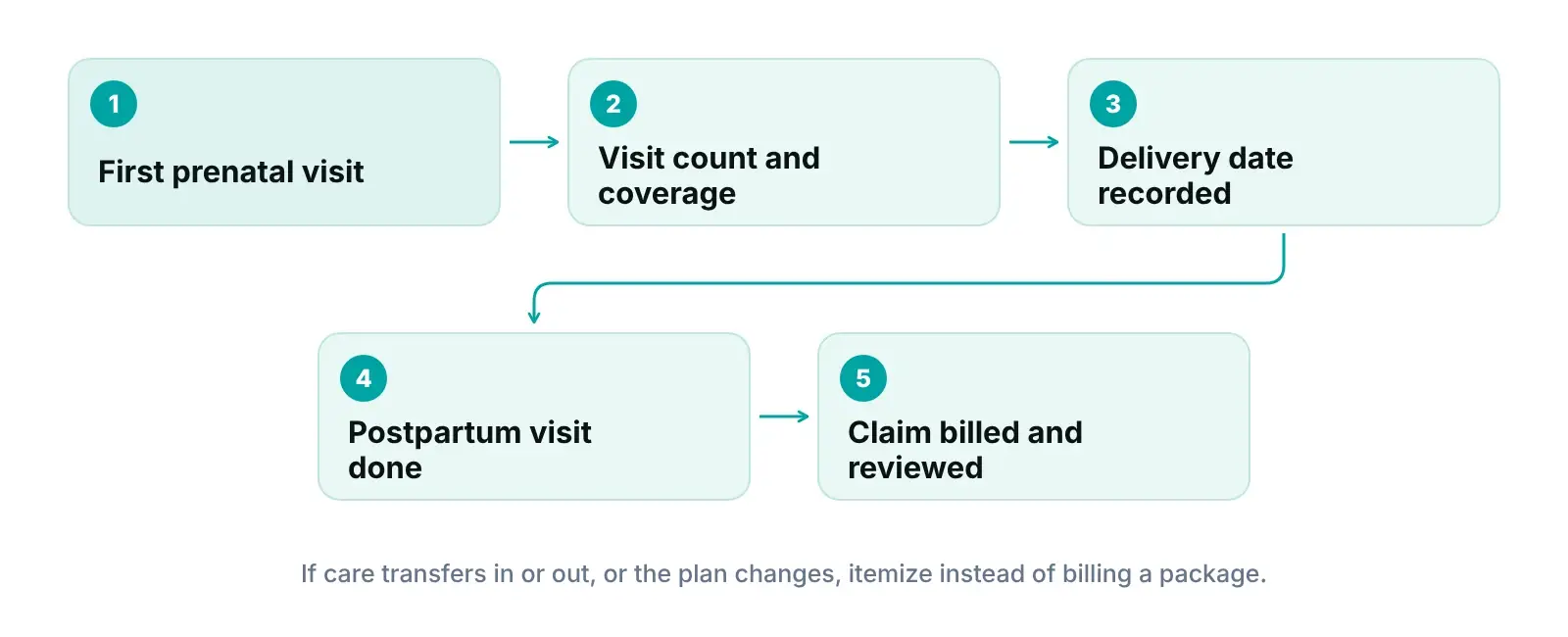
Bill the global package only when your group provides the prenatal care, the delivery and the postpartum care. Bill the pieces when care is split, the patient transfers or the plan covers only part of the pregnancy. Codes are described in our own words, because the AMA owns CPT descriptors.
| Service family | Code examples (our wording) | Billing rule to know | Typical denial trigger |
|---|---|---|---|
| Global package | 59400 vaginal; 59510 cesarean; 59610 and 59618 after a prior cesarean | One unit, billed after delivery, by the group that gave all three phases | Billed early; a different group delivered |
| Antepartum care only | 59425 (4 to 6 visits); 59426 (7 or more) | One claim with from and to dates; 1 to 3 visits go as office visits | Wrong visit threshold; billed with a package |
| Delivery only or postpartum only | 59409 vaginal; 59514 cesarean; 59430 postpartum care | Used when another group gave the other phases | Delivery-only code with a package for the same pregnancy |
| Delivery with postpartum care | 59410 vaginal; 59515 cesarean | Group delivered and gave postpartum care but not prenatal care | Prenatal visits left unbilled |
| Obstetric ultrasound | 76801, 76805 and related codes | Outside the package under NCCI; in-office scans often billed as technical part only | Routine repeat scans; scan-count limits |
| Labs in pregnancy | Routine urinalysis 81000 and 81002; other labs | Routine urinalysis is bundled; most other labs are separate | Urinalysis billed on top of the package |
| Well-woman and problem visits | Preventive medicine visits; G0101 and Q0091 for Medicare | Medicare does not pay G0101 on top of an E/M that required the pelvic exam; modifier 25 needs a separate problem | Modifier 25 missing or note shows one visit |
| Contraception | 58300 IUD insertion; 58301 removal; 11981 to 11983 implant; device codes such as J7298, J7307 | The procedure code excludes the device; a same-day visit needs modifier 25 | Device billed alone; sterilization consent missing |
Sources: Noridian Medicare Part B maternity services page (updated June 27, 2025); CMS 2026 NCCI Policy Manual chapters 7 and 12; Blue Cross and Blue Shield of Vermont global maternity policy (September 2026); UnitedHealthcare Commercial Obstetrical Policy (2026); Colorado Medicaid OB billing manual (revised August 25, 2026); UCSF LARC coding guide (undated).
Medicare contractor Noridian (Jurisdiction F Part B) says all surgical and obstetrical care, including prenatal and postnatal services, is considered incurred on the delivery date, whether the physician bills a package or itemizes. Colorado Medicaid also wants the delivery date in both date fields of a global claim. Other contractors and states may differ.
Antepartum-only claims work differently. UnitedHealthcare’s commercial policy and Blue Cross and Blue Shield of Vermont both ask for one unit with from and to dates that cover the period of care.
UnitedHealthcare, Blue Cross and Blue Shield of Vermont and Colorado Medicaid use the same split for antepartum-only billing: one to three visits as office visits, four to six as 59425, seven or more as 59426 (Colorado’s version applies to pregnancies before September 1, 2026). Noridian’s page lists office visits for one to three visits but gives no higher cutoffs, so check each payer.
Both commercial policies put a typical uncomplicated pregnancy at about 13 routine visits. Extra visits for a documented high-risk problem take modifier 25. Itemize when a patient transfers, delivers elsewhere, miscarries or changes insurers, as Vermont’s policy says.
NCCI treats ultrasound as outside the package, and the commercial policies agree. Vermont generally allows one routine ultrasound per pregnancy. UnitedHealthcare’s policy excludes ultrasound from the package and states no quantity limit. Colorado Medicaid covers a maximum of two for an uncomplicated pregnancy and wants documentation for more. Vermont wants in-office scans billed with the technical modifier only.
NCCI says urinalysis is included in antepartum care. Most other labs, such as Group B strep or antibody screening, are payable separately. Colorado also lists a second postpartum Pap smear as separately billable and depression screening as outside the global payment.
A preventive visit and a problem visit can both be paid on the same day, but only if the problem work is separate and documented. Modifier 25 marks that separation.
Noridian describes modifier 25 as a significant, separately identifiable service with its own history, exam and decision making in the record.
Non-grandfathered commercial plans must cover well-woman visits, contraception and cervical cancer screening without cost sharing under the HRSA-supported Women’s Preventive Services Guidelines. If a patient raises a new problem at that visit, the problem work is billed separately, and cost sharing may apply to it.
Medicare works differently. The Medicare Claims Processing Manual, chapter 12 treats preventive medicine visits (the 99381 to 99397 range) as noncovered, and a covered visit at the same time is paid as part of the preventive service. Screening pelvic and breast exam G0101 is covered once every two years, or yearly for high-risk patients, per Noridian, with the deductible and coinsurance waived.
The NCCI policy manual, chapter 12 adds two limits. G0101 is not reported in addition to an E/M visit that required the breast or pelvic exam. An E/M done only to obtain a screening Pap (Q0091) is not separately reportable. If a visit addresses a separate problem, report both and put modifier 25 on the E/M. See our modifier 25 vs 59 guide.
The UCSF LARC program’s coding guide lists 58300 for IUD insertion, 58301 for removal and 11981 to 11983 for the implant, and says the procedure codes do not include the device. The device is billed separately with a HCPCS code such as J7298 or J7307. A same-day problem or counseling visit needs modifier 25 and its own documentation.
Sterilization has its own consent rule for Medicaid. Under 42 CFR 441.253, the patient must be at least 21, and consent must come 30 to 180 days before the procedure. Narrow exceptions exist.
NCCI chapter 7 also bars separate reporting of a pelvic exam that is part of a gynecologic procedure. Our denial management guide shows how to track denials by reason.
Check coverage at the first visit and each trimester. Each payer has its own rule for what to bill and when.
Medicaid pays for about 4 in 10 births, per KFF’s postpartum coverage tracker (updated July 15, 2026). The rules sit in each state’s manual. Colorado’s calls for quality codes on global claims (0500F or 0501F for the first prenatal visit, 0503F for the first postpartum visit). Postpartum coverage also differs by state: Colorado covers 12 months, and your state may not.
Medicare maternity claims follow the contractor’s page and the NCCI manual. Commercial plans publish their own policies, which differ on thresholds, ultrasound limits and modifiers. Applying one payer’s rule to another causes quiet denials. For out-of-network deliveries, see our out-of-network billing guide.
A claim held for a postpartum visit that never happens ages quietly. We track open pregnancies by due date so claims are released or itemized before a filing limit is at risk.
| Rule | Source | What the VMA checks |
|---|---|---|
| Non-grandfathered plans cover well-woman visits and contraception without cost sharing | HRSA Women’s Preventive Services Guidelines (reviewed December 2025) | Plan type and grandfathered status |
| MA, Medicaid and CHIP plans decide prior approvals in 72 hours (urgent) or 7 calendar days (standard) | CMS-0057-F fact sheet; in effect January 1, 2026 | Request date and due date logged; follow-up on the due date |
| Medicaid sterilization needs consent 30 to 180 days before, with narrow exceptions | 42 CFR 441.253 | Consent date and age on file before the procedure is booked |
| Antepartum billing depends on visit count: 1 to 3, 4 to 6, 7 or more | UnitedHealthcare, Blue Cross and Blue Shield of Vermont, Colorado Medicaid | First visit date and running visit count |
| Medicare covers a screening pelvic and breast exam every two years, or yearly for high risk | Noridian (updated March 20, 2024) | Date of the last G0101 and the risk factor, if any |
| Some plans change prenatal billing from September 1, 2026 | Blue Cross and Blue Shield of Vermont; Colorado Medicaid | Whether the plan wants modifier TH and a pregnancy diagnosis |
Sources: HRSA (2025-2026); CMS (2024 fact sheet, rule in effect January 1, 2026); eCFR; payer policies as named; Noridian. Rules differ by plan and state, so verify against your contract.
For the general approval process, read our prior authorization guide and our eligibility verification guide.
See what held and denied claims cost you
Enter your claim volume and denial rate to estimate what your OB/GYN practice is losing.
OB/GYN growth comes from patients who search early in pregnancy and from primary care referrals. A tracking script on the wrong page can turn a lead into a privacy problem.
HHS’s guidance on online tracking technologies says booking and login pages can collect identifiable health information, and a vendor that handles it may need a Business Associate Agreement. A cookie banner does not count as authorization. A federal court vacated one part of that guidance in June 2024, so we keep tracking off booking and portal pages.
We build prenatal and gynecology service pages and delivery hospital pages. Review replies never confirm someone is a patient. See our healthcare SEO guide.
Related pages: family practice, urology and anesthesia (cesarean and labor cases).
Stay in-house if your team already tracks every open pregnancy and plan change. Use a billing-only vendor if claims are your only gap. Choose a four-pillar partner if problems start at the front desk or in new patient flow.
| Job | In-house team | Billing-only vendor | Four-pillar partner (RCM Finder) |
|---|---|---|---|
| Tracking open pregnancies | Spreadsheet or EHR report, often stale | Billed from what the practice sends | Visit count and dates logged by VMAs; claims held by rule |
| Coverage checks each trimester | Front desk, between calls | Often left to the practice | VMA checks at intake and each trimester |
| Package vs itemized decisions | Biller memory of each payer | Applied by payer policy | Rules built per payer and applied per claim |
| Ultrasound, lab and LARC lines | Coded after the visit | Coded after the fact | Checked for separate lines and modifier 25 support |
| Sterilization and approval tracking | Whoever remembers | Not included | Consent and approval dates tracked before booking |
| Patient growth | A separate agency, or nobody | Not included | Marketing tied to booked first visits |
| Cost structure | Salaries, benefits, turnover | Varies; ask how fees are set | Quoted after a free practice audit |
We start with a free audit and change nothing until you see findings. We build our billing pipeline around how claims actually move through a practice: registration, charge entry, submission, payment and follow-up. For OB/GYN, we add the checks on this page.
We review recent global packages, antepartum, well-woman and contraception claims, and denials.
We put a Business Associate Agreement in place before accessing patient data. Then we work inside your existing EHR (for example PrognoCIS, eClinicalWorks or athenahealth).
Your main plans and Medicare contractor’s guidance become a pre-visit checklist and portal rules, including visit thresholds and filing limits.
VMAs log each pregnancy and check coverage. Claims are scrubbed, submitted and followed up by stage in the portal, in your practice’s time zone.
We review denials, A/R days and open pregnancies with you.
Talk to us about your OB/GYN practice
Tell us your payer mix and hardest plan. We will say honestly whether we fit.
Any billing vendor that handles your patients’ data is a HIPAA business associate. HHS guidance lists claims processing and billing among business associate functions, and says a business associate needs a written agreement with any subcontractor that handles protected health information.
Reproductive care records are sensitive, so ask who can see them.
We use role-based access, audit logging and encrypted (HTTPS) connections, and we put a Business Associate Agreement in place before accessing patient data.
We would rather tell you now than after you sign. Here is where we fit and where we do not.
A good fit if you are
Probably not a fit if you are
What we would do first if we were running your practice's revenue cycle tomorrow.
Antepartum billing depends on a visit count. We log the first visit date and keep a running count.
Several policies say not to bill the package early. We hold it by rule.
Transfers, a different delivering group, a miscarriage or a plan change call for itemized claims. We flag each.
Modifier 25 needs its own history, exam and decision making. We read the note before the claim goes out.
We check the consent date and patient age before a Medicaid sterilization is booked, not after.
Some plans changed prenatal billing on September 1, 2026.
They cover coding support, claim scrubbing, submission, denial management and A/R follow-up for pregnancy care, deliveries, gynecology visits, procedures, ultrasound, labs and contraception. A good partner also tracks each pregnancy, checks coverage by trimester and knows when a payer wants a global claim or itemized claims. We add front-desk assistants, patient marketing and a claims portal, so one team owns the process.
Bill it when the same group gives the prenatal care, delivery and postpartum care. Blue Cross and Blue Shield of Vermont says it is reported after delivery only, and Colorado Medicaid says not to bill it until the postpartum visit has happened. Medicare contractor Noridian dates the care to the delivery. Check each payer’s own policy before you submit.
For Medicare, Noridian says all surgical and obstetrical care, including prenatal and postnatal services, is considered incurred on the delivery date. Colorado Medicaid asks for the delivery date in both the from and to fields. Antepartum-only claims use from and to dates that cover the care period. Other contractors, states and commercial plans may differ.
UnitedHealthcare’s commercial policy, Blue Cross and Blue Shield of Vermont and Colorado Medicaid all use four to six visits for 59425 and seven or more for 59426, with one to three visits billed as office visits. Some plans change prenatal billing for dates of service on or after September 1, 2026, so confirm each payer’s current rule.
Yes, if the problem is significant and separately documented. Put modifier 25 on the problem E/M. Medicare does not cover preventive medicine visits, and its NCCI policy bars G0101 on top of an E/M that required the pelvic exam. Commercial plans that are not grandfathered must cover well-woman visits without cost sharing, but a separate problem visit may carry cost sharing.
The IUD or implant procedure is billed with its own code, and the device is billed separately with a HCPCS code, per the UCSF LARC program’s coding guide. A same-day problem or counseling visit needs modifier 25 and its own note. Medicaid sterilization has a separate consent rule under 42 CFR 441.253. Confirm device codes against the current code set.
Tell us about your practice. A member of our operations team replies within one business day.
Pricing is quoted after the audit, based on your volume and the services you choose. Prefer to talk? Call +1 (302) 556-2288.
Tell us about your practice
About the author: Awais Afzal
Healthcare Operations & Data Analyst, RCM Finder
Awais has spent more than 16 years in healthcare digital marketing and clinical operations management. He builds data-driven revenue cycle blueprints for high-ticket medical practices and leads product development of the RCM Finder portal. More about our team.
How we write: every figure, code and rule on this page was checked against the primary source listed below and independently fact-checked before publishing. We re-review this page every six months. Last reviewed October 12, 2026; next review April 12, 2027.
We use cookies to understand how our site is used and to measure our advertising. You can accept or reject non-essential cookies. See our Privacy Policy.