Healthcare Digital Marketing Services, Tracked to the Paid Claim
Local SEO, Google Ads and reviews run by the same team that sees your billing data. Campaigns aim at the services and payers that actually get paid, and every inquiry is answered, checked for eligibility and followed to a paid claim.
By Awais Afzal| Healthcare Operations & Data Analyst
Published October 12, 2026 · Last reviewed October 12, 2026 · Next review April 12, 2027
Quick answer
Healthcare digital marketing services help a medical practice attract and convert local patients through Google Business Profile, local SEO, Google Ads, reviews and referral programs. Done well, every inquiry is answered quickly, checked for insurance eligibility and tracked to a paid claim, within HIPAA, Google's health-ad policies and the FTC's 2024 rule on reviews.
Disclaimer: This page is general information about healthcare marketing. It is not legal, coding or compliance advice. HIPAA guidance, advertising-platform policies and payer rules change and can vary by payer and state. Confirm decisions with your own counsel and compliance officer.
Why practice marketing should be judged at the paid claim, not the click
Marketing pays for itself only when an inquiry becomes a visit that someone actually pays for. Clicks, calls and form fills are early signals. Revenue is decided later: at the phone, the eligibility check and the claim.
Many agencies stop reporting at the lead. Months later, the practice finds that many leads were out of network or never got a call back. None of that shows in an ad dashboard. All of it shows in the billing data.
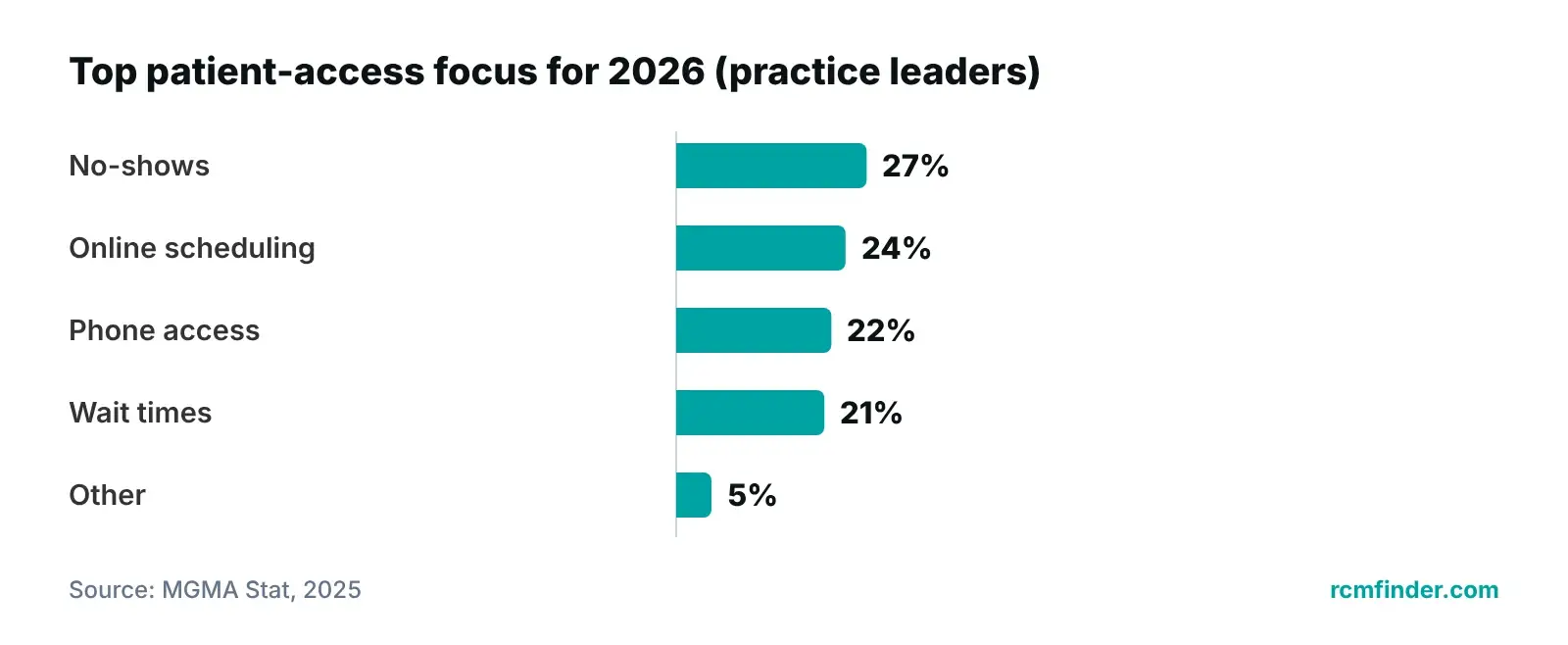
Practice leaders feel this at the front door. In a December 2025 MGMA Stat poll with 236 responses, online scheduling (24%) and phone access (22%) followed no-shows (27%) as top patient-access priorities for 2026. MGMA also cites a July 2025 poll in which 71% of medical groups said fewer than one in four patients book through digital tools. So at most groups, more than three in four patients still book without a digital tool, often by phone. An unanswered call is a lost lead, however good the ad was.
Phone access and online scheduling rank close behind no-shows as 2026 priorities. Source: MGMA Stat poll, December 2025 (236 responses).
A patient who reaches voicemail can simply call the next practice on the map. So we treat call handling as part of the campaign, not someone else's problem.
See where your inquiries leak
Our free audit reviews your Google Business Profile, ad accounts, call handling and a sample of recent claims, to show where new patients drop out between the first click and the payment.
What our healthcare digital marketing services include
We run the channels that bring local patients to a practice: Google Business Profile and local SEO, Google Ads, review requests and referral relationships. Each one routes the inquiry to a person who can book it.
Local SEO and Google Business Profile
Google says local results are mainly based on relevance, distance and popularity, which it explains as prominence: how well known a business is. It also says there is no way to request or pay for a better local ranking (Google Business Profile Help). So the work is steady: accurate profiles, correct categories and hours, real photos, genuine reviews, and a website that says clearly what you treat and where.
Practices have extra rules. Google's guidelines for representing your business allow a public-facing doctor to have a profile, but not one per specialty. The business name must match your signage, and adding extra words can get the profile suspended. We fix these issues first. Our healthcare SEO guide covers the on-site side.
Google Ads within Google's health rules
Search ads reach patients at the moment they look for care. We build campaigns around the services and areas your billing data says are worth growing, and exclude searches that won't become paid visits. Health ads have targeting limits and, for some services, certification rules, covered below.
Reviews and reputation
Google says the number of reviews you have feeds into prominence, and that more reviews and positive ratings can help your local ranking. We set up one review request, sent the same way to every patient, plus reply templates that never confirm someone is a patient. See our reputation management strategies for doctors.
Social media and referral relationships
Social media builds familiarity but rarely books a first visit alone, so we keep it lean and count inquiries, not likes. For many specialists, referring providers matter more; we make referrals easy to send and quick to book, and never tie them to payments or gifts.
Timeframes are our qualitative working view, not a benchmark. Local ranking factors: Google Business Profile Help (accessed 2026).
How billing data decides where your marketing budget goes
Because the same team works your claims, we can see which services, payers and patient types get paid cleanly, and which stall in denials, authorizations or unpaid balances. Campaigns aim at the first group and hold back on the second until the cause is fixed.
We start from claim history, not search volume, and look at five signals:
Payer mix. Which plans you are in network with, so ads speak to patients you can see.
Service-level payment. Which services are paid on first submission and which are often denied or underpaid.
Authorization load. Services that need prior authorization get front-desk steps in place before ads scale.
Patient balances. Whether a service leaves balances your team actually collects.
Capacity. Which providers have open slots, so ads don't fill a full schedule.
A common example: a high-value procedure is often denied for a missing authorization. More ads for it only produce more denials. So we fix the authorization step first, then scale the campaign. The same thinking drives our high-ticket patient acquisition work.
We build our billing pipeline around how claims actually move through a practice: registration, charge entry, submission, payment and follow-up. The same lesson applies to marketing: the most-searched services are not always the ones that get paid.
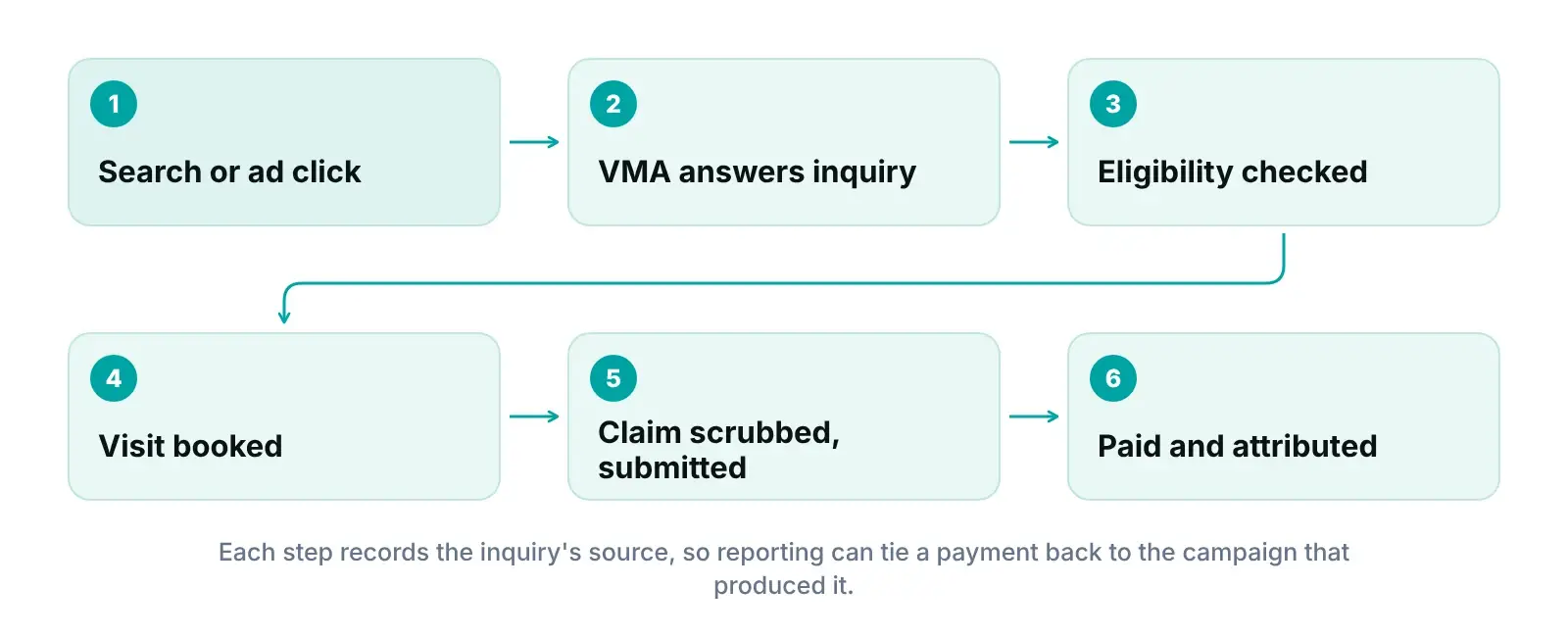
From click to clean claim: each inquiry is followed through the front desk and billing, so campaigns are credited with paid visits.
How marketing hands off to your front desk, billing and software
Marketing is the first of four connected services. Each inquiry moves to a Virtual Medical Assistant, then to billing, and the resulting claim is tracked by stage in our practice management portal.
Pillar 1 · Healthcare Marketing
Healthcare Marketing
Local SEO, Google Business Profile, Google Ads and review requests aimed at the services and payers your billing data supports.
Targets chosen from claim history
No tracking on portals or booking forms
Same review request for every patient
Reported by booked and paid visits
You are here
Pillar 2 · Virtual Medical Assistants
Virtual Medical Assistants
Remote front-desk staff answer calls and web inquiries on your time zone, check eligibility and book the visit in your EHR. See Virtual Medical Assistant services.
Our billing team scrubs and submits the claim, works denials and A/R, and reports which campaigns produced paid visits. See end-to-end revenue cycle management.
Our portal tracks each claim by stage, flags underpayments and keeps an audit log. Calendar booking is in early access. See the practice management system.
No EHR change is needed. Our team works inside your existing EHR (for example PrognoCIS, eClinicalWorks or athenahealth), on your practice's time zone. Eligibility is a common gap between a booked visit and a paid one; see our insurance verification guide.
What is a missed inquiry worth?
Estimate how much revenue slips away between first contact and paid claim at a practice like yours.
We start with a free audit of your marketing, front desk and billing together, launch only the channels your data supports, and report weekly on booked and paid visits.
1
Free practice audit
We review your Google Business Profile, website, ad accounts, call handling and recent claims to find where inquiries drop out.
2
Choose what to grow
We pick services, locations and payers to target, based on what gets paid cleanly and where providers have open time.
3
Fix the front door
Call routing, VMA scripts, forms and eligibility steps are set up before spend rises. Tracking keeps patient details away from ad platforms.
4
Launch the channels
Profile clean-up, local SEO, search ads and review requests go live in the order that fits your capacity.
5
Track each inquiry to a claim
Each inquiry is tagged by source and followed through booking, the visit and the claim.
6
Review weekly, adjust monthly
Weekly KPI reports show what booked and what paid. Budget moves to what produces paid visits.
Healthcare marketing compliance: HIPAA tracking, ad policies and reviews
Practice marketing must clear three sets of rules: HIPAA for patient data your website and tracking tools touch, Google's health ad policies, and the FTC's review rule. Settle them before launch.
HIPAA and online tracking technologies
In 2022, HHS's Office for Civil Rights published a bulletin on online tracking technologies, such as pixels and analytics scripts. On June 20, 2024, a federal court in Texas (American Hospital Association v. Becerra) vacated part of it. HHS's notice says the vacated part is the view that HIPAA applies when a tool links a person's IP address to a visit to a public page about specific health conditions or providers. HHS withdrew its appeal in August 2024, as the American Hospital Association reported.
The rest of the bulletin is still posted. It says tracking on logged-in pages, such as patient portals, generally has access to PHI, and a tracking vendor handling PHI is a business associate that needs a Business Associate Agreement. Details typed into a login, appointment request or symptom checker can be PHI, and a cookie banner is not a HIPAA authorization. Google states it does not offer Business Associate Agreements for Google Analytics.
Our working rule: no ad tags on patient portals, booking forms or confirmation pages. Form contents go to your intake team, not ad platforms. Conversions are counted from booking outcomes, not by sending patient details to Google or social networks. See also our HIPAA compliance checklist for medical practices.
HIPAA's definition of marketing (45 CFR 164.501) generally excludes messages about your own services and treatment, unless a third party pays you to send them. Other marketing that uses PHI generally needs written authorization, as HHS explains.
Google Ads rules for health advertisers
Google treats health as a sensitive interest category for personalized ads, covering physical and mental health conditions and their treatments. Ads in that category cannot use Customer Match, "your data" segments (formerly remarketing), audience expansion or lookalikes, per Google's restricted targeting policy. Predefined Google audiences and location targeting remain allowed, so health campaigns run on keywords, locations and clear landing pages.
Some services need certification first. Google's Healthcare and medicines policy requires Google certification for categories including addiction services. In the U.S., recovery-oriented drug and alcohol addiction services must first hold LegitScript certification, and not every service is eligible.
Reviews: the FTC rule and Google's policy
The FTC's rule on consumer reviews and testimonials, 16 CFR Part 465, took effect on October 21, 2024, per the Federal Register. It bans fake reviews, including AI-generated ones (FTC announcement). It also bans rewards tied to positive or negative sentiment, undisclosed reviews by officers and managers, and fake "independent" review sites. Suppressing reviews through threats is banned too. The FTC's Q&A says courts can impose civil penalties for knowing violations.
Google goes further. Its review guidance prohibits any incentive for reviews, and its Maps content policy bars discouraging negative reviews or asking only happy customers. Our rule: ask every patient the same way, offer nothing, and never let staff review the practice.
Healthcare marketing compliance checklist
Rule
What it covers
Source
Practical action
HHS OCR tracking technologies bulletin (2022)
Pixels and analytics on portals, logins, appointment requests, symptom checkers
HHS Office for Civil Rights
Keep ad tags off logged-in pages and forms; BAA with any vendor receiving PHI
AHA v. Becerra (N.D. Tex., June 20, 2024)
Vacated the IP-address-plus-public-page part of the bulletin
HHS notice; American Hospital Association
Not a blanket permission; review tracking with counsel
Google Ads: health in personalized advertising
Ads about health conditions and treatments
Google Ads policy help
No Customer Match, data segments or lookalikes; use keywords and location
Google Ads: addiction services
Recovery-oriented drug and alcohol addiction services
Google Ads policy help
LegitScript certification, then Google certification, before ads run
Same neutral request to every patient; no staff reviews
Google Maps content policy
Incentivized reviews, selective solicitation, conflicts of interest
Google Maps policy help
No incentives of any kind; never filter who gets asked
Sources: HHS OCR (2022 bulletin; notice updated 2024); American Hospital Association (2024); eCFR 16 CFR Part 465; Federal Register (2024); FTC (2024); Google Ads and Google Maps policy help pages (accessed October 2026).
What to ask any healthcare marketing vendor
Will you sign a Business Associate Agreement before touching patient data?
Which tracking tags run on which pages? Any on portal, booking or confirmation pages?
Do you upload patient lists to Google, Meta or any ad platform?
How do you ask for reviews? Any incentives or filtering?
Who owns the ad accounts, profile, website and data if we part ways?
Do you report booked and paid visits, or only clicks and leads?
Our own answers: our systems use role-based access, audit logging and encrypted (HTTPS) connections, and we put a Business Associate Agreement in place before accessing patient data.
How we measure healthcare marketing ROI: booked and paid visits
We judge marketing by cost per booked visit and cost per paid visit, not impressions or clicks. Fewer but eligible, in-network patients beat a flood of calls from people you cannot see.
Google Ads can track calls to a forwarding number on your website, counting only calls longer than a minimum length you set. That filters hang-ups, but a long call still isn't a patient. So our Virtual Medical Assistants tag each call outcome (booked, not eligible, wrong service), and it follows the inquiry to the claim.
Vanity metrics vs revenue metrics in practice marketing
Vanity metric
Why it misleads
Revenue metric we report
Where the data comes from
Impressions and reach
Counts views, not patients
New patients booked, by source
Scheduling records in your EHR
Clicks
Could be a job seeker, vendor or existing patient
Cost per booked new-patient visit
Ad account plus bookings
Total calls
Includes hang-ups and wrong numbers
Calls that ended in a booking
Call tracking plus VMA outcome tags
Form fills or leads
May be out of network
Eligibility pass rate on new inquiries
Eligibility checks at intake
Followers and likes
Rarely tied to a visit
Inquiries attributed to social
Intake source field
Cost per lead
Ignores denials and unpaid balances
Cost per paid visit; collections per campaign
Claims and payment posting
Our reporting framework, not sourced benchmark data.
We would rather tell you now than after you sign. Here is where we fit and where we do not.
A good fit if you are
Independent and multi-provider practices that want new patients and need to know which ones get paid
Specialty practices (for example pain management, neurology, cardiology, behavioral health or imaging) whose key services depend on eligibility or prior authorization
Practices losing calls or web inquiries because the front desk is stretched
Practices willing to share booking and billing outcomes so marketing is measured to the paid claim
Probably not a fit if you are
Practices that want social posting measured by likes and followers
Anyone expecting a promised ranking or a fixed number of new patients; no honest vendor can promise either
Addiction-treatment providers wanting Google Ads before they hold LegitScript certification
Practices that cannot share any booking or billing outcomes; we can run campaigns but cannot show what they returned
Expert recommendations from our operations team
What we would do first if we were running your practice's revenue cycle tomorrow.
01
Fix the phone before you buy more clicks
We check call answering and call-back times before raising ad budgets. More traffic into a busy line only means more missed patients.
02
Pick ad targets from claim data, not search volume
We grow the services and payers that pay cleanly, and hold back on those stuck in denials or authorizations until the cause is fixed.
03
Keep tracking off anything a patient logs into or fills out
No ad or analytics tags on portals, booking forms or confirmation pages, and a Business Associate Agreement with any vendor that receives PHI.
04
Ask every patient for a review the same way
One neutral request after each visit, with nothing offered, fits both the FTC rule and Google's stricter policy. Staff and family should never post reviews.
05
Reply to reviews without confirming anyone is a patient
Thank reviewers in general terms and move details offline. Confirming a visit can be a HIPAA disclosure.
06
Report cost per paid visit every month
Every channel faces the same test: what it cost to produce a paid visit. Clicks are diagnostics, not results.
07
Own your accounts
Your practice should own its Google Business Profile, ad account, analytics, website and domain, so your history stays with you.
Frequently asked questions
What do healthcare digital marketing services include?
For a medical practice, they usually cover Google Business Profile and local SEO, Google Ads, review requests, website improvements and sometimes social media and referral outreach. Our version adds the steps most agencies skip. Virtual Medical Assistants answer each inquiry and check insurance eligibility. Our billing team then follows the visit to a paid claim, so you can see which sources produced claims and what happened to them, not just leads.
How long does it take for practice marketing to bring in new patients?
It depends on the channel. Search ads can produce calls soon after they are approved, provided someone answers the phone. Local SEO and Google Business Profile work builds more slowly, over months, and keeps compounding. Reviews help gradually. We don't promise a timeline or a patient count. We show you weekly what booked and what paid, so you can judge progress yourself.
Can we still use tracking pixels on our medical website after the 2024 court ruling?
The June 2024 ruling in American Hospital Association v. Becerra vacated only part of HHS's tracking guidance: the part about IP addresses on unauthenticated public pages about health conditions or providers. HHS's bulletin still says tracking on patient portals and on forms that collect identifiable health details can involve PHI, and a vendor receiving PHI needs a BAA. Keep ad tags off those pages, and review your setup with counsel.
Is it legal to ask patients for Google reviews?
Yes, asking for genuine reviews is allowed. The FTC's rule, effective October 21, 2024, bans fake reviews, rewards tied to positive or negative sentiment, undisclosed insider reviews and review suppression. Google goes further: it prohibits any incentive for reviews and bars asking only happy patients. The safe approach is one neutral request to every patient, with nothing offered in return.
Can Google Ads target people who have a specific medical condition?
Not with your own audience lists. Google treats health as a sensitive category for personalized ads, so campaigns promoting treatments for conditions cannot use Customer Match, your data segments, audience expansion or lookalikes. You can still use search keywords, location targeting and Google's predefined audiences. Addiction-treatment ads in the U.S. also require LegitScript certification and Google certification first.
Do we need to switch our EHR or billing company to work with you?
No EHR switch is needed. Our team works inside your existing EHR, for example PrognoCIS, eClinicalWorks or athenahealth. Tracking marketing all the way to a paid claim works most completely when we also handle billing, but we can work alongside another billing team if we can see claim and payment outcomes. We will discuss the options during the free audit.
Free to request
Get your free practice audit
Tell us about your practice. We will contact you using the details you give.
A review of your recent claims, denials and A/R aging
Where your front desk and prior authorizations slow payment
A prioritized fix list you keep, whether or not you hire us
Pricing is quoted after the audit, based on your volume and the services you choose. Prefer to talk? Call +1 (302) 556-2288.
Tell us about your practice
AA
About the author: Awais Afzal
Healthcare Operations & Data Analyst, RCM Finder
Awais has spent more than 16 years in healthcare digital marketing and clinical operations management. He builds data-driven revenue cycle blueprints for high-ticket medical practices and leads product development of the RCM Finder portal. More about our team.
How we write: every figure, code and rule on this page was checked against the primary source listed below and independently fact-checked before publishing. We re-review this page every six months. Last reviewed October 12, 2026; next review April 12, 2027.
We use cookies to understand how our site is used and to measure our advertising. You can accept or reject non-essential cookies. See our Privacy Policy.