
Gastroenterology Specialty

Gastroenterology Billing Services, Front Desk and Growth in One Plan

Screening and diagnostic colonoscopy claims, anesthesia and pathology coordination, prior authorization, patient marketing and a claims portal for GI practices, built on CMS rules and your payers' own policies.
  • Works inside your current EHR
  • US practice time zone, every shift
  • Weekly KPI reporting, or on your schedule
Gastroenterology billing dashboard showing screening vs diagnostic colonoscopy claims, modifier checks, denials and A/R days

Quick answer

Gastroenterology billing services manage the claims a GI practice creates: screening colonoscopies that turn diagnostic (modifiers PT, 33 and KX), anesthesia and pathology that bill separately, ASC and hospital place of service, and prior authorization for items such as capsule endoscopy. RCM Finder pairs that billing with front-desk assistants, patient marketing and a claims portal.

Disclaimer: This page is educational and is not legal, coding or compliance advice. Medicare billing articles, LCDs, fee schedule rules and commercial payer policies change often and vary by contractor and plan. Verify every code, modifier, limit and cost-sharing rule against your Medicare contractor's current documents, your payer contracts and the current CPT and HCPCS code sets before billing.

Why gastroenterology billing is different

In gastroenterology, one colonoscopy can be a screening, a diagnostic procedure or both. What the doctor finds changes the codes, the modifiers and what the patient owes. Anesthesia and pathology usually bill on their own claims, so all three must agree.

Medicare uses its own screening codes: G0121 for patients who are not high risk and G0105 for high-risk patients, as Noridian's colorectal screening page lists. 42 CFR 410.37 defines high risk and sets the clock: a G0121 screening needs at least 119 months after the month of the last screening colonoscopy, and a G0105 screening needs 23.

Place of service matters too. Under the Medicare Claims Processing Manual, the physician gets the facility rate in an ASC (POS 24) or hospital outpatient department (POS 19 or 22) and the non-facility rate in the office (POS 11). Noridian article A57342 adds that office colonoscopy claims without validated equipment information do not meet coverage requirements. See our guides to ASC vs HOPD billing and ASC and hospital billing services.

What changed for GI payment in 2026

CMS's CY 2026 Physician Fee Schedule final rule fact sheet (October 31, 2025) set the conversion factor at $33.40 for clinicians who are not qualifying APM participants, up from $32.35. It applied a -2.5% efficiency adjustment to the work RVUs of non-time-based services (time-based codes such as E/M are exempt), and it now recognizes greater indirect costs for office-based work than for facility-based work. For 2027, the proposed rule fact sheet (July 14, 2026) projects $32.84. Check the final rule before budgeting.

Screening vs diagnostic colonoscopy: who pays what

For Medicare, a screening colonoscopy has no deductible or coinsurance. If the doctor removes a polyp or takes a biopsy, the claim carries modifier PT, the deductible stays waived and the patient pays reduced coinsurance: 15% through 2026, 10% from 2027 to 2029 and nothing from 2030.

The phase-down comes from section 122 of the Consolidated Appropriations Act, 2021. CMS's CY 2022 Physician Fee Schedule final rule fact sheet (November 2, 2021) set the schedule: 20% in 2022, 15% for 2023 through 2026, 10% for 2027 through 2029 and zero from 2030. CMS Transmittal 11772 applies it when PT is on a line with a procedure code from 10000 to 69999, anesthesia code 00811, G0500 or 99153. Pathology codes are not on that list.
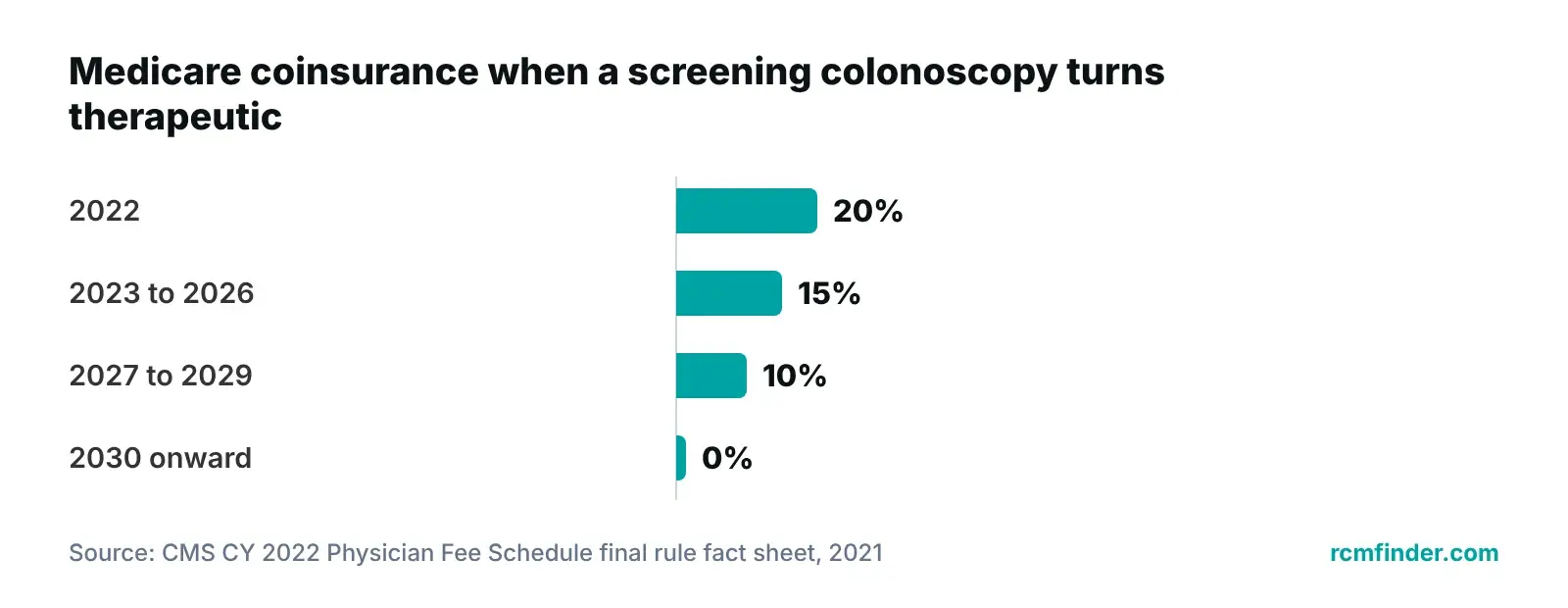
Bar chart of Medicare coinsurance when a screening colonoscopy becomes therapeutic: 20% in 2022 falling to 0% from 2030
Medicare coinsurance on a screening colonoscopy or sigmoidoscopy that needs a polyp removal or biopsy. The deductible is waived throughout.

Follow-on colonoscopy after a positive stool or blood test

Since January 1, 2023, a colonoscopy after a positive Medicare-covered stool-based test counts as screening. Per CMS MLN Matters MM13017, you add modifier KX to the screening code, frequency limits do not apply and the patient has no cost sharing. The CY 2025 PFS fact sheet extends this to a positive blood-based biomarker test. If polyps are removed, the AGA coding guide notes that Medicare treats the procedure as diagnostic and coinsurance applies.

Commercial plans: modifier 33

Commercial claims use modifier 33, which marks a preventive service with a USPSTF A or B rating (per Palmetto GBA). The AGA guide adds 33 to each polypectomy code and to a colonoscopy after a positive stool test. Federal ACA FAQs Part 51 (January 10, 2022) treat polyp removal, anesthesia and pathology on a polyp biopsy as part of a screening colonoscopy, so non-grandfathered plans cannot charge cost sharing for them. From plan years starting on or after May 31, 2022, that covers a follow-up colonoscopy after a positive stool-based test too.

The four pillars, built for a gastroenterology practice

A GI practice needs referrals coming in, procedures classified before the scope, consistent claims across three billers and software that shows every claim.

Revenue leaks at the handoffs: a diagnostic colonoscopy booked as screening, an anesthesia claim without PT, a capsule study booked before the EGD report arrives. We run all four pillars on one set of payer rules.

Pillar 1 · Healthcare Marketing

Healthcare Marketing for GI practices

Our healthcare digital marketing builds demand for screening and specialty care through local SEO, Google Ads, reputation work and a simple referral path for primary care offices.

  • Location pages for each office and site
  • Screening pages: stool tests vs colonoscopy
  • Tracking kept off scheduling forms without a BAA
  • KPI: booked consults and procedures by source
Explore Healthcare Marketing
Pillar 2 · Virtual Medical Assistants

Virtual Medical Assistants for GI front desks

Our virtual medical assistants for GI practices work on your practice's time zone. They verify eligibility, set the visit type from patient history, collect prior stool-test and scope reports, and start prior authorizations.

  • Screening, surveillance or diagnostic set at booking
  • Last colonoscopy date and family history recorded
  • Positive stool or blood test results on file
  • KPI: procedures cleared before the date of service
Explore Virtual Medical Assistants
Pillar 3 · End-to-End RCM

End-to-End RCM for GI claims

Our end-to-end gastroenterology revenue cycle management covers coding support, claim scrubbing, denial management and A/R follow-up, with extra GI checks: PT, 33 and KX, G0105 or G0121, modifier 53 and place of service.

  • Screening status matched across scope, anesthesia and pathology
  • In-house pathology billed per specimen
  • Appeals built from scope and pathology reports
  • KPI: denials by reason and A/R days
Explore End-to-End RCM
Pillar 4 · Practice Management System

Practice Management System for GI billing

Our practice management system tracks every claim by stage. It applies specialty-aware billing logic to each claim, checks that data is complete before submission and flags payments below the expected amount.

  • Claims tracked by stage, per claim
  • Workflow rules that flag or hold a claim for review
  • Client portal for practices and billing companies
  • Early access: appointment booking with a calendar view
Explore Practice Management System

Find where your scope claims leak

We review recent colonoscopy, EGD, anesthesia and pathology claims, then show where screening status, modifiers or place of service cost you. Pricing is quoted after the audit.

Get a Free Practice Audit

GI service families: codes, modifiers and denial triggers

Each GI service family has its own coding rule and common errors. Codes are described in our own words (the AMA owns CPT descriptors); check current code sets and your Medicare contractor's articles before billing.

Gastroenterology service families: code examples, billing nuance and typical denial or billing errors
Service familyCode examples (our wording)Billing nuanceTypical denial or billing error
Medicare screening colonoscopyG0121 (not high risk); G0105 (high risk)No cost sharing; 119 months between G0121 screenings, 23 for G0105Billed too early; G0105 without a documented high-risk condition
Screening that turns diagnostic or therapeutic45380 (biopsy) or 45385 (snare removal) with PT (Medicare) or 33 (commercial)Medicare: deductible waived; coinsurance 15% in 2026, 10% from 2027PT or 33 missing, so the patient is billed as diagnostic
Follow-on colonoscopy after a positive stool or blood testG0105 or G0121 with KX (Medicare); 33 (commercial)Part of screening; no frequency limit; no cost sharingBilled as diagnostic, so cost sharing is applied
Incomplete colonoscopy45378 (diagnostic), G0105 or G0121 with modifier 53Paid at one-half the value of the code's inputs (Noridian)Billed as complete; report missing the maximum depth reached
Anesthesia for colonoscopy00812 (screening); 00811 with PT (turned diagnostic); 00813 (upper and lower together)Medicare: no cost sharing on 00812; 00811 with PT has no deductible and reduced coinsurancePlan criteria for monitored anesthesia not documented
Surgical pathology from endoscopy88300 to 88309 series, e.g. 88305 (level IV tissue exam); 88342 (immunostain)One unit per specimen; several biopsies of one polyp are usually one specimenExtra units for tissue not sent for separate examination
Capsule endoscopy91110 (esophagus through ileum); 91111 (esophagus)Covered for listed indications, e.g. obscure bleeding after upper and lower endoscopy (Novitas)Upper and lower endoscopy not done first; used for colorectal screening

Sources: CMS Transmittal 11772 (2022); CMS MLN Matters MM13017 (2023) and MM10181 (2018); 42 CFR 410.37; Noridian colorectal screening page (2025) and article A57342 (2025); NCCI Policy Manual ch. X (2026); Novitas LCD L35089; Anthem CG-MED-34 (2026); AGA coding guide; Palmetto GBA; AAPC code summaries. Rules vary by contractor and payer.
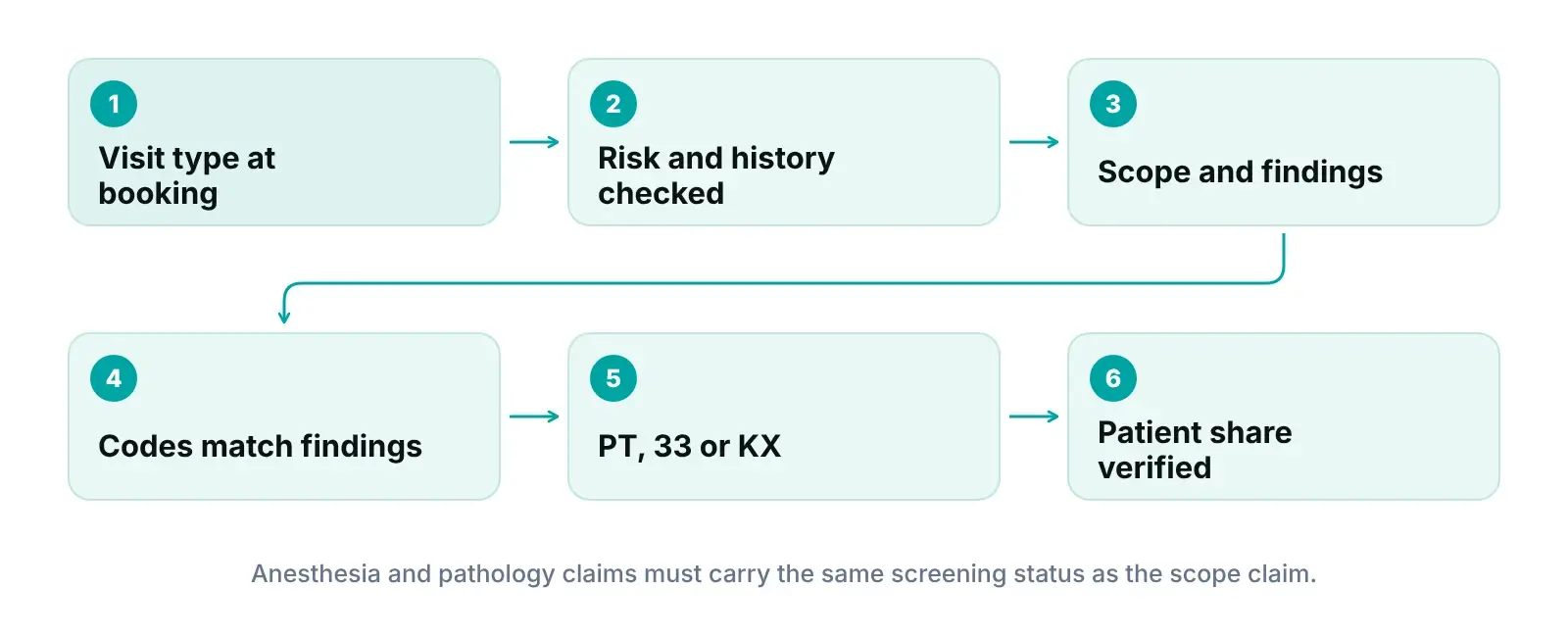
Diagram of a GI scope moving from visit type at booking through findings to PT, 33 or KX modifiers and patient cost check
How a colonoscopy's screening status follows it from booking to the patient's bill.

Anesthesia and pathology bill separately

For Medicare, MLN Matters MM10181 uses 00812 for anesthesia with a screening colonoscopy, with deductible and coinsurance waived, and 00811 with PT when the screening becomes diagnostic. Commercial plans may set criteria for monitored anesthesia; Anthem guideline CG-MED-34 lists situations such as ASA class III or higher, sleep apnea and age over 70. Our anesthesia billing guide explains time and base units.

Pathology is billed per specimen. The NCCI Policy Manual (2026) says several biopsies of the same polyp are usually one specimen, while two polyps at different sites may be separate when knowing which is malignant matters. Immunostains count per antibody per specimen. Our pathology CPT code guide covers code levels.

Prior authorization and payer rules to check before the procedure

Clear the visit type and any authorization before the scope is scheduled: screening status, the last procedure date and each plan's rules for EGD, colonoscopy, capsule endoscopy and anesthesia.

Plan rules move. UnitedHealthcare announced on September 1, 2026 that from October 1 it would stop requesting advance notification for EGD, capsule endoscopy and diagnostic and surveillance colonoscopy for commercial and Oxford New York and Connecticut members, and end GI site-of-service reviews. The AGA notes that ERCP and certain small-bowel services are not named and member-specific rules still apply.

Capsule endoscopy has its own rules. Novitas LCD L35089 covers it for listed indications, such as obscure bleeding after upper endoscopy and colonoscopy fail to find the source, and not for colorectal screening. Medicare Recovery Auditors have an approved review of capsule claims (topic 0227, March 2026). Washington's Health Care Authority uses a capsule authorization form that asks for the last EGD and colonoscopy findings.

Since January 1, 2026, the CMS-0057-F rule has required Medicare Advantage, Medicaid and CHIP plans to decide expedited requests within 72 hours and standard requests within seven calendar days, with a specific denial reason. In the AMA's 2025 survey of 1,000 physicians (released May 2026), physicians averaged 40 prior authorizations and 13 hours of staff and physician time per week.

Pre-procedure checklist: GI payer rules our VMAs check before scheduling
RuleSourceWhat the VMA checks
High risk: close relative with colorectal cancer or adenomatous polyp, hereditary syndromes, or personal history of adenomatous polyps, colorectal cancer or IBD42 CFR 410.37(a)(3)Family and personal history recorded; G0105 or G0121 flagged
Screening colonoscopy: 119 months (not high risk), 23 months (high risk), or 47 months after a screening sigmoidoscopy42 CFR 410.37(g)Date and type of the last colonoscopy or sigmoidoscopy
Follow-on colonoscopy after a positive stool or blood-based test is screening, with no cost sharing42 CFR 410.37(k); MLN MM13017; ACA FAQs Part 51Positive result on file; booked as follow-on screening
Medicare coinsurance if screening turns therapeutic: 15% in 2026, 10% from January 1, 2027CMS Transmittal 11772Patient told before the procedure what they may owe
Monitored anesthesia may need documented risk factorsAnthem CG-MED-34 (example)ASA class, sleep apnea and sedation history noted
Capsule study after upper and lower endoscopy; not for colorectal screeningNovitas L35089; Washington HCA form 13-0144Prior EGD and colonoscopy reports attached to the request
MA, Medicaid and CHIP decide in 72 hours (expedited) or 7 days (standard)CMS-0057-F; in effect Jan 1, 2026Request and due dates logged; follow-up on the due date
Commercial lists change; UnitedHealthcare ended GI advance notification Oct 1, 2026UnitedHealthcare notice (2026)Current plan rules checked at each booking

Sources: eCFR 42 CFR 410.37; CMS MLN Matters MM13017 (2023); DOL ACA FAQs Part 51 (2022); CMS Transmittal 11772 (2022); Anthem CG-MED-34 (2026); Novitas LCD L35089; Washington HCA form 13-0144 (rev. 12/24); CMS-0057-F fact sheet (2024); UnitedHealthcare (2026). Always check the member's current plan.

For the general workflow, read our prior authorization guide for providers.

See what misclassified scopes cost you

Enter your claim volume and denial rate to estimate what denials and slow A/R cost your GI practice.

Open the Revenue Calculator

Growing a GI practice without breaking privacy rules

GI growth comes from screening demand, referring physicians and local search, and the tracking behind it must respect HIPAA.

We build location pages, procedure pages and plain-language screening pages that compare stool tests and colonoscopy. Primary care offices get a simple referral path. We ask real patients for reviews, and our replies never confirm someone is a patient.

HHS guidance on online tracking says tracking tools on patient portals generally have access to protected health information, and tools on scheduling pages may collect it too. A cookie banner is not a HIPAA authorization. A June 20, 2024 court order vacated part of that guidance. Even so, we keep tracking off scheduling and referral forms unless the vendor signs a BAA.

  • Referral KPIs: new referrals by office; days from referral to procedure.
  • Patient KPIs: booked consults and procedures by source; missed calls.

In-house team, billing-only vendor or four-pillar partner?

Stay in-house if experienced GI coders and your front desk already handle screening history well. Use a billing-only vendor if claims are your only gap. Choose a combined partner when errors start at scheduling and end in patient bills.

Decision table: which model fits a gastroenterology practice?
JobIn-house teamBilling-only vendorFour-pillar partner (RCM Finder)
Visit type set at bookingFront desk, if trainedLeft to the practiceVMA asks history questions; coder confirms
PT, 33 and KX on scope claimsDepends on one coderFixed after a denial or complaintChecked before submission on every scoped claim
Anesthesia and pathology in stepSeparate billers, little contactScope claim onlyScreening status shared with each biller
Capsule and plan authorizationsFront desk, between callsLeft to the practiceVMA tracks each request to a decision
Screening and referral growthA separate agency, or nobodyNot includedMarketing pillar tied to booked procedures
Cost structureSalaries, benefits, turnoverVaries; ask how fees are setQuoted after a free practice audit

We will tell you in the audit if you need only one pillar. For general in-house tips, see our gastroenterology billing guide.

How it works

We start with a free audit and change nothing until you see the findings. We build our billing pipeline around how claims actually move through a practice: registration, charge entry, submission, payment and follow-up. For GI, we add the screening, modifier and specimen checks on this page.

  1. 1

    Free practice audit

    We review recent scope, anesthesia and pathology claims, denials and billing complaints, and map each procedure to its place of service.

  2. 2

    Business Associate Agreement and access

    We put a Business Associate Agreement in place before accessing patient data. Then we work inside your existing EHR (for example PrognoCIS, eClinicalWorks or athenahealth).

  3. 3

    Payer-rule map

    Your Medicare contractor's articles and main plans' rules become a pre-procedure checklist and portal workflow rules.

  4. 4

    Front desk and billing go live

    VMAs set visit types and start authorizations on your time zone. Claims are scrubbed, submitted and worked through denials and A/R.

  5. 5

    Weekly KPI review

    Each week we review denials by reason, A/R days, screenings turned diagnostic and referrals. Add Own Practice Management System for more depth.

Talk to us about your GI practice

Tell us your sites, procedure mix and hardest payer. We will tell you honestly whether we fit.

Call +1 (302) 556-2288

Compliance: what to ask any gastroenterology billing company

Any billing vendor that handles your patients' data is a HIPAA business associate. Get a Business Associate Agreement before any access, and check how access is limited and logged.

HHS guidance names billing, claims processing and practice management as business associate work; subcontractors need their own agreement. The minimum necessary standard limits uses and disclosures to what each task needs. The Security Rule's technical safeguards are access control, audit controls, integrity, person or entity authentication and transmission security.

  1. Will you and your subcontractors sign a Business Associate Agreement before any access?
  2. How do you limit each person's access, and can we see the audit log?
  3. Who codes our claims, and what GI experience and current coding credential do they have?
  4. When do you use G0105, G0121 or CPT codes, and when PT, 33 or KX?
  5. How do you keep anesthesia and pathology claims consistent with the scope claim?
  6. Can we export our data if we leave?

We use role-based access, audit logging and encrypted (HTTPS) connections, and we put a Business Associate Agreement in place before accessing patient data. For your own side, use our HIPAA compliance checklist for medical practices.

Who this is for, and who it is not for

We would rather tell you now than after you sign. Here is where we fit and where we do not.

A good fit if you are

  • Independent GI groups scoping in offices, ASCs and hospital outpatient departments
  • Practices with high screening volume and frequent screenings that turn therapeutic
  • Groups doing capsule endoscopy and other studies that need authorization
  • GI practices that want referrals, front desk and billing measured in one place
  • Billing companies serving GI clients that want a shared claims portal

Probably not a fit if you are

  • Hospital-employed gastroenterologists whose billing the hospital controls
  • Practices that want claims billed without changing any scheduling process
  • Practices looking for promised collection rates; we report measured KPIs instead
  • Groups that need a credentialing module or in-portal real-time eligibility today (coming next)

Expert recommendations from our operations team

What we would do first if we were running your practice's revenue cycle tomorrow.

  1. 01

    Set the visit type at booking

    We set screening, surveillance or diagnostic from the patient's history before the scope is scheduled. The coder then confirms it against the findings.

  2. 02

    Put PT, 33 and KX on one checklist

    Every scoped claim gets three questions: did it start as a screening, was tissue removed, and was there a positive stool or blood test first? Each answer maps to a modifier.

  3. 03

    Prepare patients for the 2027 change

    Medicare coinsurance on a screening that turns therapeutic drops from 15% to 10% for dates of service from January 1, 2027. We update cost estimates and scripts before then.

  4. 04

    Keep anesthesia and pathology in step

    We share the screening status with your anesthesia and pathology billers so all three claims match.

  5. 05

    Collect prior reports before capsule studies

    We attach the last EGD and colonoscopy reports to the request. The LCD we reviewed also expects the full image set to be kept.

  6. 06

    Re-read plan lists every quarter

    GI endoscopy rules changed in 2026. We recheck the main plans' lists and your contractor's articles each quarter.

Frequently asked questions

What do gastroenterology billing services include?

They cover coding support, claim scrubbing, submission, denial management and A/R follow-up for GI visits and procedures such as colonoscopy, EGD and capsule endoscopy. A good partner also sorts screening from diagnostic work before the scope, adds the right modifier (PT, 33 or KX), keeps anesthesia and pathology claims consistent, and handles prior authorization. RCM Finder adds front-desk assistants, patient marketing and a claims portal, so one team owns the process from referral to payment.

When does a screening colonoscopy become diagnostic for billing?

When the doctor does more than look, such as taking a biopsy or removing a polyp, the claim uses the code for what was done. For Medicare, add modifier PT to that code; for commercial plans, add modifier 33. The visit still began as a screening, so the patient keeps screening protections: no Medicare deductible, reduced Medicare coinsurance, and no cost sharing for polyp removal under non-grandfathered ACA plans.

How much does a Medicare patient pay if a polyp is removed during a screening colonoscopy?

The deductible is waived. Coinsurance is reduced under section 122 of the Consolidated Appropriations Act, 2021: 15% for 2023 through 2026, 10% for 2027 through 2029, and zero from 2030. So a procedure in 2026 carries 15% coinsurance, and dates of service from January 1, 2027 carry 10%. The claim must include modifier PT. A screening colonoscopy with no tissue removed has no cost sharing.

How do we bill a colonoscopy after a positive stool test?

For Medicare, bill the screening colonoscopy code (G0105 or G0121) with modifier KX. Since 2023 this follow-on colonoscopy counts as part of screening, frequency limits do not apply, and the patient has no cost sharing. Since 2025 the same applies after a positive blood-based biomarker test. If polyps are removed, coinsurance applies. Non-grandfathered commercial plans must cover the follow-up colonoscopy without cost sharing for plan years starting on or after May 31, 2022.

Does capsule endoscopy need prior authorization?

It depends on the payer. For Medicare, contractors set coverage rules: Novitas, for example, covers capsule studies for listed indications, such as obscure bleeding that upper endoscopy and colonoscopy did not explain, and not for colorectal screening, and Recovery Auditors review capsule claims. Some state programs use authorization forms. UnitedHealthcare stopped advance notification for capsule endoscopy for commercial members on October 1, 2026. Check each plan before scheduling.

Is it safe to outsource GI billing under HIPAA?

It can be, if the vendor is treated as a business associate. HHS lists billing and claims processing as business associate work, so you need a Business Associate Agreement before the vendor receives patient data, and the agreement must require safeguards. The Security Rule's technical safeguards include access control and audit controls. We put a Business Associate Agreement in place before accessing patient data, and we use role-based access, audit logging and encrypted (HTTPS) connections.

No cost, no commitment

Get your free practice audit

Tell us about your practice. A member of our operations team replies within one business day.

  • A review of your recent claims, denials and A/R aging
  • Where your front desk and prior authorizations slow payment
  • A prioritized fix list you keep, whether or not you hire us

Pricing is quoted after the audit, based on your volume and the services you choose. Prefer to talk? Call +1 (302) 556-2288.

Tell us about your practice

RCMFinder Master Intake Form
AA

About the author: Awais Afzal

Healthcare Operations & Data Analyst, RCM Finder

Awais has spent more than 16 years in healthcare digital marketing and clinical operations management. He builds data-driven revenue cycle blueprints for high-ticket medical practices and leads product development of the RCM Finder portal. More about our team.

How we write: every figure, code and rule on this page was checked against the primary source listed below and independently fact-checked before publishing. We re-review this page every six months. Last reviewed October 12, 2026; next review April 12, 2027.

Sources

  1. Colorectal Cancer Screening (JE Part A) — Noridian Healthcare Solutions (Medicare contractor) (2025 (last updated Oct 3, 2025))
  2. 42 CFR 410.37 Colorectal cancer screening tests: Conditions for and limitations on coverage — eCFR (current (accessed 2026-10-09))
  3. Medicare Claims Processing Manual, Chapter 12, section 20.4.2 Site of Service Payment Differential — CMS (Rev. 13753, 2026 (section rev. 2024))
  4. Place of Service Code Set — CMS (2026 (modified 02/17/2026))
  5. Billing and Coding: Diagnostic and Therapeutic Colonoscopy (A57342) — CMS Medicare Coverage Database (Noridian, JE/JF) (2025 (revision effective 11/06/2025))
  6. Calendar Year (CY) 2026 Medicare Physician Fee Schedule Final Rule (CMS-1832-F) fact sheet — CMS (2025)
  7. Calendar Year (CY) 2027 Medicare Physician Fee Schedule Proposed Rule fact sheet — CMS (2026)
  8. Calendar Year (CY) 2022 Medicare Physician Fee Schedule Final Rule fact sheet — CMS (2021)
  9. Transmittal 11772 (CR 12656): Changes to Beneficiary Coinsurance for Additional Procedures Furnished During the Same Clinical Encounter as Certain Colorectal Cancer Screening Tests — CMS (2022)
  10. Calendar Year (CY) 2025 Medicare Physician Fee Schedule Final Rule fact sheet — CMS (2024)
  11. MLN Matters MM13017: Removal of a National Coverage Determination & Expansion of Coverage of Colorectal Cancer Screening — CMS (via HHS guidance portal) (2023)
  12. MLN Matters MM10181: Anesthesia codes for colonoscopy — CMS (via HHS guidance portal) (2018 (revised Feb 9, 2018))
  13. Coding Guide: Free CRC Screening — American Gastroenterological Association (undated (accessed 2026-10-09))
  14. CPT Modifier 33 (Preventive Service) — Palmetto GBA (Medicare contractor) (2022)
  15. FAQs about Affordable Care Act Implementation Part 51 — US Department of Labor (with HHS and Treasury) (2022)
  16. CG-MED-34 Monitored Anesthesia Care for Gastrointestinal Endoscopic Procedures — Anthem (clinical UM guideline) (2026 (reviewed 02/19/2026))
  17. Medicare NCCI Policy Manual, Chapter X (CPT 80000-89999) — CMS (2026)
  18. LCD L35089 Wireless Capsule Endoscopy — CMS Medicare Coverage Database (Novitas) (2019 (revision in effect))
  19. RAC topic 0227: Wireless Capsule Endoscopy: Medical Necessity and Documentation Review — CMS Recovery Audit Program (2026)
  20. Capsule Endoscopy Authorization form (HCA 13-0144) — Washington State Health Care Authority (2024 (rev. 12/24))
  21. GI endoscopy advance notification update — UnitedHealthcare Provider (2026 (Sept 1, 2026))
  22. UnitedHealthcare to end GI endoscopy advance notification, site-of-service reviews — American Gastroenterological Association (AGA News) (2026)
  23. CMS Interoperability and Prior Authorization Final Rule (CMS-0057-F) fact sheet — CMS (2024)
  24. AMA survey: Prior authorization reform pledge falls short with physicians — American Medical Association (2026)
  25. Business Associates — HHS Office for Civil Rights (undated (accessed 2026-10-09))
  26. Minimum Necessary Requirement — HHS Office for Civil Rights (undated (accessed 2026-10-09))
  27. 45 CFR 164.312 Technical safeguards — eCFR (current (accessed 2026-10-09))
  28. Use of Online Tracking Technologies by HIPAA Covered Entities and Business Associates — HHS Office for Civil Rights (2024 (reviewed June 26, 2024))
  29. CPT 45378 code summary — AAPC (secondary; plain-language code meaning only) (accessed 2026-10-09)
  30. CPT 45380 code summary — AAPC (secondary; plain-language code meaning only) (accessed 2026-10-09)
  31. CPT 45385 code summary — AAPC (secondary; plain-language code meaning only) (accessed 2026-10-09)
  32. CPT 88305 code summary — AAPC (secondary; plain-language code meaning only) (accessed 2026-10-09)
  33. CPT 91110 code summary — AAPC (secondary; plain-language code meaning only) (accessed 2026-10-09)
  34. CPT 91111 code summary — AAPC (secondary; plain-language code meaning only) (accessed 2026-10-09)