
A/R follow-up and recovery

Accounts Receivable Management Services for Medical Practices

We work every open claim and balance to zero inside the EHR you already use: payer follow-up, underpayment checks and old A/R cleanup, each with an owner and a deadline.
  • Works inside your current EHR
  • US practice time zone, every shift
  • Weekly KPI reporting, or on your schedule
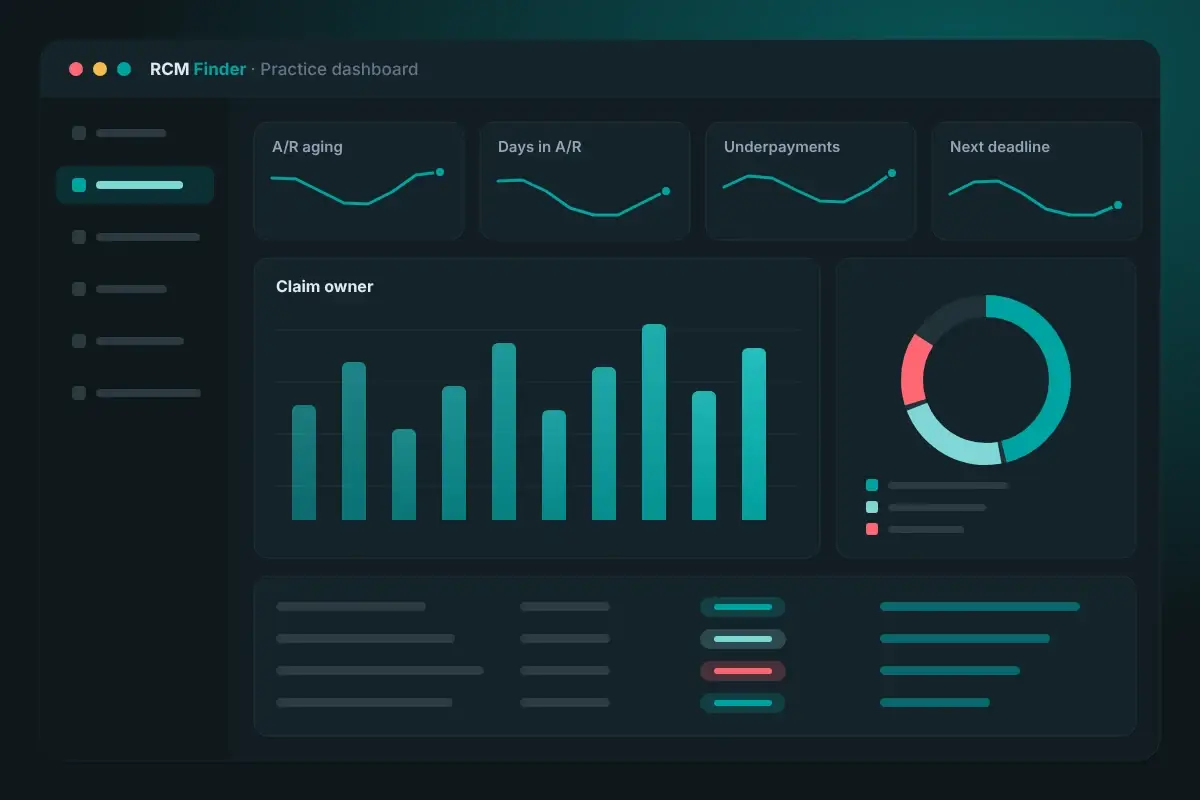
A/R management dashboard for a medical practice showing aging buckets, days in A/R and underpayments by payer

Quick answer

Accounts receivable management services work every unpaid claim and balance until it is paid, adjusted or written off with a reason. That means aging reports, payer follow-up, denial and appeal work, underpayment checks, legacy A/R cleanup and patient balance follow-up, each with a named owner and a deadline.

Disclaimer: This page is general educational information about revenue cycle operations. It is not legal, coding, billing-compliance or financial advice. Payer rules, filing limits, appeal deadlines and contract terms vary by payer, plan and state and change often. Confirm requirements with the payer, your contracts and qualified advisors before acting.

What do accounts receivable management services include?

Accounts receivable management services keep every unpaid claim and patient balance moving until it is paid, adjusted or written off for a documented reason. Billing creates the claim. A/R management starts after it is sent and ends when the balance reaches zero.

You may know it as medical A/R recovery services or A/R follow-up for medical practices. It is the same work, and we do it inside the EHR you already use.
  • Aging review: open balances sorted by payer, age, value and deadline.
  • Payer follow-up: status checks on unpaid claims, with the answer logged.
  • Denial and appeal work: denials corrected or appealed in time (basics in our denial management guide).
  • Underpayment review: each payment compared with the expected amount.
  • Legacy A/R cleanup: old balances sorted into collectible and not.
  • Patient balances: follow-up on patient responsibility.
  • Reporting: aging and days in A/R on published definitions.
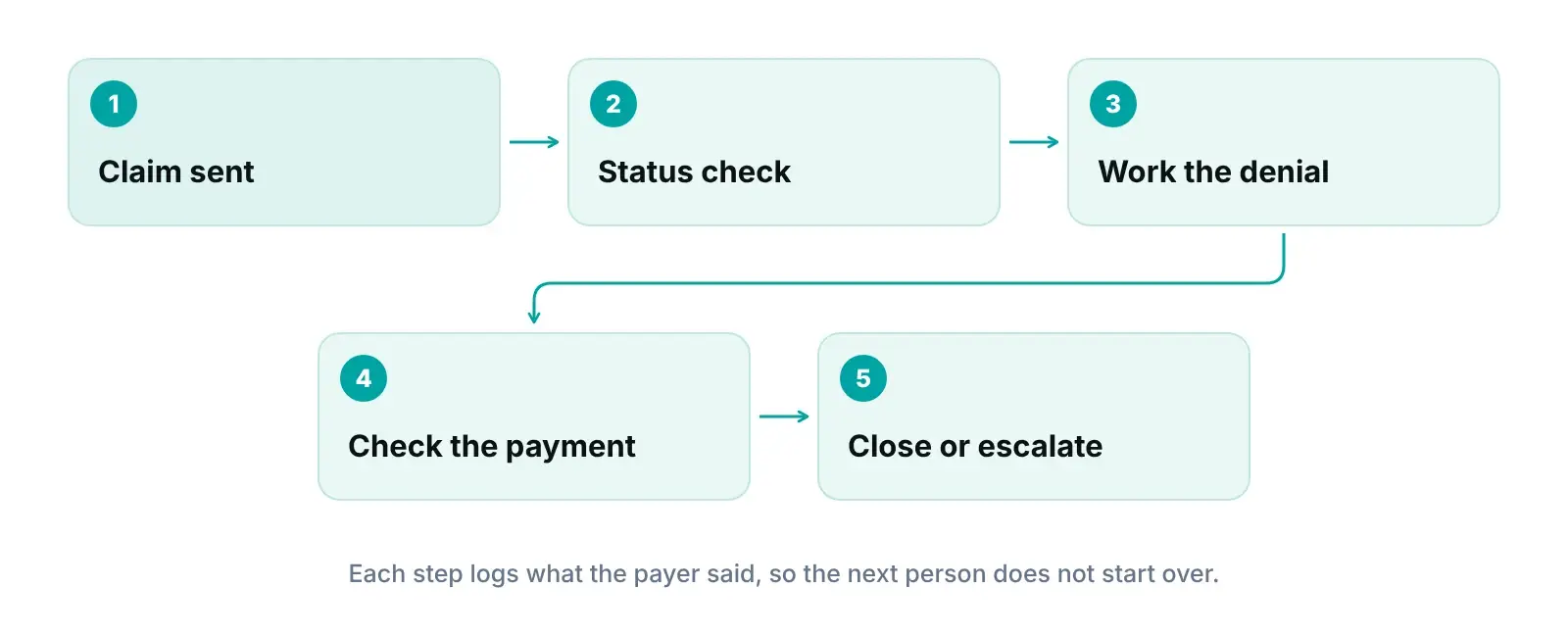
A/R management workflow from claim submission and payer status check to denial work, payment check and escalation
Every open claim has a next action, an owner and a date.

See what is sitting in your A/R

Our free audit reviews your aging report, sample denials and remittances, and who owns each queue.

Get a Free Practice Audit

Why does A/R age, and why does it matter?

A/R ages when claims are denied, short-paid or never followed up. Much of that money is still payable, but only if someone works it before a deadline passes.

In Premier's survey published in February 2025, hospitals and health systems reported a denial rate of nearly 15% on their 2023 claims. Fighting a denial cost an average of $57.23 per claim, and about 70% of denials were ultimately overturned and paid. These are hospital figures, so read them as a signal, not a benchmark for a physician group.

KFF's analysis of 2024 HealthCare.gov marketplace data, published in March 2026, found that fewer than 1% of denied claims were appealed, and insurers upheld 66% of the appeals that were filed. Marketplace plans are one payer type, but the gap is clear.

In practice, A/R sticks with claims nobody checks, denials nobody owns and short payments nobody compares with the contract.

How do aging buckets and days in A/R work?

Aging buckets group unpaid balances by how long they have been open. Days in A/R converts the open balance into days of charges or revenue. Use a published definition so the number means the same every month.

HFMA's MAP Keys (2023 edition) define aged A/R as the billed A/R in each bucket divided by total billed A/R. The buckets are 0 to 30, 31 to 60, 61 to 90, 91 to 120 and over 120 days, aged from the date of service for physician claims.

For days in A/R, MGMA's data definitions give days of adjusted fee-for-service charges in A/R as total A/R divided by daily adjusted FFS charges (adjusted FFS charges times 1/365). HFMA's net days in A/R (key FM-1) uses a different base: net A/R divided by average daily net patient service revenue over the most recent three months.

Buckets also show how close a claim is to a filing deadline. For more on the metrics, see our guide to A/R report metrics and our accounts receivable guide.

How should payer follow-up and work queues be organized?

Organize follow-up by next deadline and dollar value, and give every claim one named owner for its next action. Cadence differs by payer, so we set it from each payer's processing window and your contract.

Six queues, each with an owner

  1. Rejected claims: fix and resend the same day they are found.
  2. Open past the payer window: check status and log the answer.
  3. Denied: find the root cause, then correct, resubmit or appeal.
  4. Short-paid: compare with the expected amount and dispute the gap.
  5. Patient balance: statement, follow-up and payment plan where your policy allows.
  6. Aged and legacy: highest value and nearest deadline first.

In the RCM Finder portal, each claim sits in a named stage, and workflow rules flag a claim for review, hold or advance it, or assign an owner. Our team works inside your existing EHR (for example PrognoCIS, eClinicalWorks or athenahealth).

The 2024 CAQH Index (calendar-year 2023 data) put provider labor cost at $13.80 for a manual claim status inquiry versus $3.64 electronically. We use electronic checks where a payer offers them.
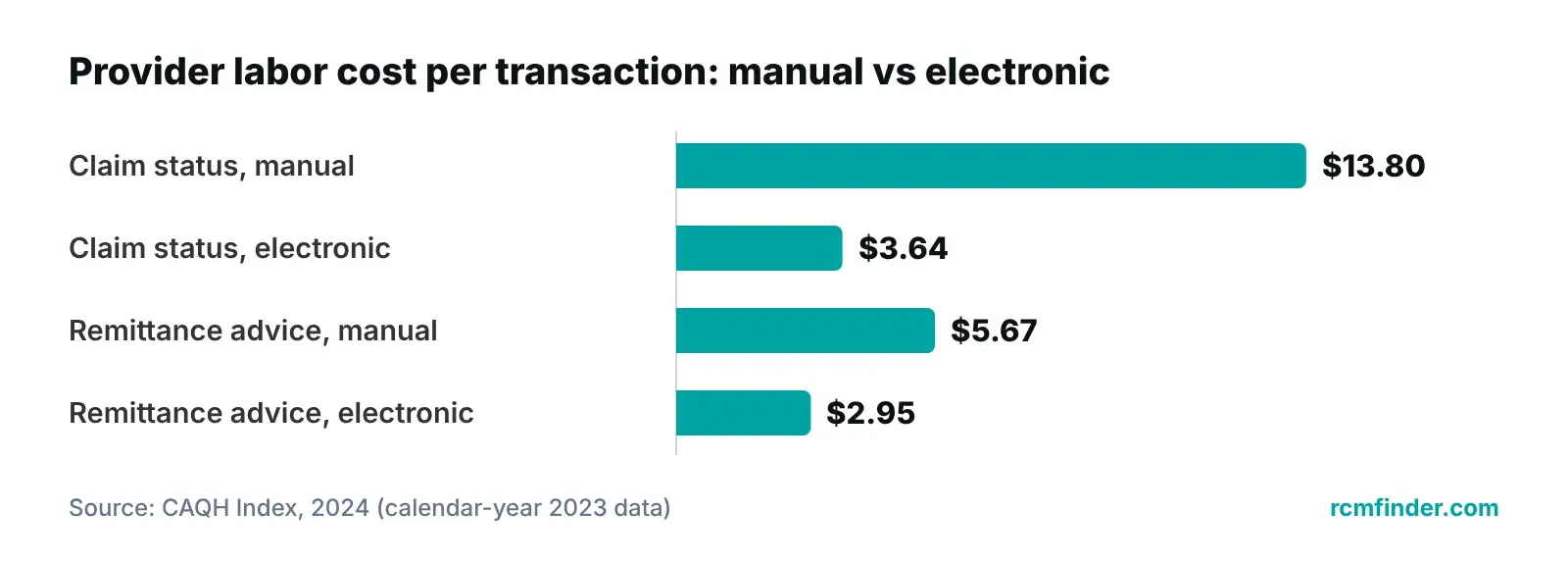
Bar chart of provider labor cost per manual versus electronic claim status inquiry and remittance advice
Provider labor cost per transaction, manual vs electronic (CAQH Index 2024, calendar-year 2023 data; labor time only).

Which deadlines decide whether A/R is still collectible?

Filing and appeal deadlines decide it. For Original Medicare, a claim must be filed within one calendar year after the date of service, and a denial can be appealed through five levels, each with its own clock.

Original Medicare timing that governs A/R follow-up
StepWho decidesTime limit to actDecision time
Claim filingMedicare contractor1 calendar year after date of service; limited exceptionsNot applicable
1. RedeterminationMedicare Administrative Contractor120 days from receipt of the initial determination (receipt presumed 5 days after notice)Generally 60 days
2. ReconsiderationQualified Independent Contractor180 days from receipt of the redetermination noticeGenerally 60 days
3. HearingOMHA (administrative law judge)60 days from receipt of the reconsideration decision; minimum amount in controversy ($200 in 2026)90 days
4. Council reviewMedicare Appeals Council60 days from receipt of the hearing decision90 days
5. Federal courtU.S. District Court60 days from receipt of the Council decision; minimum amount in controversy ($1,960 in 2026)Not specified

Sources: 42 CFR 424.44, eCFR (2026); CMS Medicare FFS appeals flowchart (2026 amounts in controversy); CMS MLN, Medicare Parts A and B appeals process. Receipt is presumed 5 days after the notice date. Medicare Advantage and commercial plans set their own deadlines in the plan rules and your contract.

Other payers set their own limits. We load each payer's windows into the work queue. For state-specific limits, start with our medical billing time limits guide and confirm against your contract.

Patient balances and good faith estimates

For uninsured or self-pay patients, 45 CFR 149.610 requires a good faith estimate within 1 business day of scheduling when the service is booked at least 3 business days ahead, and within 3 business days when it is booked at least 10 business days ahead or the patient asks. CMS explains that a bill at least $400 above the estimate can go to patient-provider dispute resolution. Build estimates into scheduling.

Size the gap before the audit

Enter your monthly claim volume and collections in our revenue calculator to estimate what slow A/R costs you.

Open the Revenue Calculator

How do underpayment checks and legacy A/R cleanup work?

An underpayment is a claim paid below what your contract or fee schedule says. It only shows up if each payment is compared with an expected amount. Legacy cleanup applies the same discipline to old balances.

Underpayment detection

Share your contracted rates or fee schedules. The portal compares each paid amount with the expected amount and flags the variance for review. Not every gap is an error. Reason code 45 means, per X12, that the charge exceeded the fee schedule, maximum allowable or contracted fee, so we confirm that adjustment matches your contract.

Legacy A/R cleanup

  1. Split the aged trial balance by payer.
  2. Separate balances past a filing or appeal deadline from those still open, with a reason for each.
  3. Rank the rest by dollars and deadline, then work the top, logging each payer response.
  4. Find credit balances. Under 42 CFR 401.305, an overpayment must be reported and returned within 60 days after it is identified, with a limited suspension for a timely, good-faith investigation.
  5. Have the owner approve each write-off, with a reason.

See our legacy A/R guide and A/R recovery tips for small practices. Some old claims will be past their deadlines. We tell you which early.

How our A/R management service works

We start with a free audit, then take over the queues in stages, inside your existing EHR. You keep your system and your data.

  1. 1

    Free practice audit

    We review your aging report, a sample of denials and remittances, and who owns each queue. You get a written summary of where A/R is stuck. Pricing is quoted after the audit.

  2. 2

    Business Associate Agreement and access

    We put a Business Associate Agreement in place before accessing patient data, then set role-based access.

  3. 3

    Load payer rules, fee schedules and deadlines

    We record each payer's filing and appeal windows and your expected amounts.

  4. 4

    Work inside your EHR and the portal

    Our team works in your EHR. Every claim sits in a named portal stage with an owner. Your time zone governs every shift.

  5. 5

    Work the queues by deadline and value

    Status checks, denial corrections, appeals and underpayment disputes, ordered by deadline and dollars at risk.

  6. 6

    Report weekly and fix root causes

    Weekly KPI reporting, or on your schedule on aging and days in A/R, plus a review of why claims stalled. Each repeat cause gets an owner.

We build our billing pipeline around how claims actually move through a practice: registration, charge entry, submission, payment and follow-up.

How accounts receivable management differs by specialty

The queues are the same in every specialty. What stalls in them is not.

What changes in A/R follow-up by specialty group
Specialty groupWhat changes in A/R workWhat we check first
Pain managementHigh-value procedure claims with authorization and medical-necessity edits. Same-day visit plus procedure raises modifier 25 questions. One Medicare Part B jurisdiction's epidural steroid injection LCD (L39240, April 2026) ties repeat injections to documented improvement.Denial reason, authorization on file, documentation for repeats
CardiologyMany services split into professional and technical parts, so a partial payment may be correct or short.Which component was paid, and against which expected amount
OrthopedicsSurgical claims sit inside global periods (000, 010 and 090 days in the NCCI manual), so a denial can be a global-package rule, not a payer error.Whether the visit falls inside a global period before disputing
OncologyHigh-value drug claims and frequent secondary coverage, so a primary payment is not the end.Secondary billing after primary payment; payment against expected amount
Behavioral healthTime-based codes, telehealth modifiers and many small patient balances. A code that does not match its modifier is a recognized denial reason (code 4).Modifier-to-code match; patient balance follow-up
RadiologyClaims depend on order and patient data created elsewhere, so a missing ordering provider stalls payment.Ordering provider, order on file, demographics
DermatologyInsured care plus self-pay services. A visit on the day of a minor procedure needs a clear reason for modifier 25.Modifier 25 support; estimate delivered and kept on file

Sources: CMS NCCI Policy Manual, Chapter 1 (2026); Noridian article for LCD L39240 (effective April 9, 2026); X12 claim adjustment reason codes; 45 CFR 149.610. Other cells describe operating logic, not statistics.

Start from our specialty RCM hub to find your specialty's page.

How A/R follow-up connects to the rest of your revenue cycle

A/R problems are usually created earlier. We run A/R management as one part of four connected services.

Pillar 1 · Healthcare Marketing

Healthcare Marketing: the payer mix you collect from

Marketing decides which plans reach your schedule. Slow-paying plans show up in aging first.

  • Campaigns built around contracted payers
  • Payer mix visible in aging reports
  • Insurance details collected up front
Explore Healthcare Marketing
Pillar 2 · Virtual Medical Assistants

Virtual Medical Assistants: fewer problems to chase

Many aging claims began with a wrong member ID or missing authorization. Our assistants handle scheduling, eligibility, prior authorizations and intake.

  • Insurance verified before the visit
  • Authorizations tracked to the codes billed
  • Your time zone, every shift
Explore Virtual Medical Assistants
Pillar 3 · End-to-End RCM

End-to-End RCM: A/R as part of one cycle

Coding support, claim scrubbing, denial management and A/R follow-up run by one accountable team.

  • Completeness checks before submission
  • Denials traced to root cause
  • Underpayments flagged
Explore End-to-End RCM
Pillar 4 · Practice Management System

Practice Management System: the shared view

The portal shows where each claim stands and who owns the next step, for practices and billing companies.

  • Claim pipeline by stage
  • Role-based permissions and audit log
  • Calendar booking and credentialing in early access
Explore Practice Management System

In-house, outsourced or hybrid A/R follow-up: which fits?

Choose the model that can work every open claim before its deadline. In-house gives control, outsourced adds capacity, and a hybrid splits the queues.

In-house vs outsourced vs hybrid A/R follow-up
FactorIn-houseOutsourcedHybrid
Control of each queueHighestSet by scope and reportingSplit by queue
Coverage when the biller is outGaps unless cross-trainedVendor covers absencesPartner covers its queues
Old A/R backlogCompetes with daily workCan be worked as a projectPartner takes the backlog
Cost structureSalaries, benefits, software, trainingContract fee (ours quoted after a free audit)A mix of both
Usually suitsLarger groups with stable billing staffPractices with aging A/R and thin staffPractices keeping patient calls in-house

Decision guide based on common operating models; no sourced statistics.

Ask two questions. Can your team work every denial before its appeal deadline? Who covers A/R when your biller is out? See also how front desk staff affect the revenue cycle.

Not sure which model fits?

Talk it through with our team. If keeping A/R in-house makes more sense for your practice, we will say so.

Call +1 (302) 556-2288

What to ask any A/R management company before you sign

Any company that works your claims is a HIPAA business associate and must sign a Business Associate Agreement. Beyond that, ask who works your queues.

HHS guidance lists billing and claims processing as business associate functions and says a business associate is directly liable for certain HIPAA provisions. The minimum necessary standard limits patient data use to what a task needs, and the Security Rule's technical safeguards (45 CFR 164.312) include access control, audit controls and transmission security.

Questions to ask any provider

  1. Will you sign our Business Associate Agreement before accessing patient data?
  2. Who owns each queue, and in which time zone do they work?
  3. Who approves a write-off, and is the reason recorded?
  4. Can we see claim-level status and the audit log, not only a monthly summary?
  5. How do you compare payments with expected amounts?
  6. Will you work old A/R, and how do you treat claims past a filing deadline?
  7. Are patient balances and low-dollar claims in scope, and how do we get our data back if we leave?

Our setup: role-based access, audit logging, encrypted HTTPS connections, and a Business Associate Agreement before we access patient data. For your side, use our HIPAA compliance checklist.

Who this is for, and who it is not for

We would rather tell you now than after you sign. Here is where we fit and where we do not.

A good fit if you are

  • Practices with aging A/R, short payments or denials nobody owns
  • Groups whose biller is overloaded or out
  • Practices with an old A/R backlog to sort
  • Billing companies that need claim-stage tracking across client practices
  • Owners who want aging and days in A/R on published definitions

Probably not a fit if you are

  • Practices that want a promised collection figure before anyone has seen their aging report
  • Practices replacing their EHR as part of this project
  • Buyers choosing only on the lowest price
  • Organizations requiring an official EHR vendor partnership or a third-party security attestation

Expert recommendations from our operations team

What we would do first if we were running your practice's revenue cycle tomorrow.

  1. 01

    Work A/R by deadline first, age second

    We sort open claims by nearest filing or appeal deadline, then by dollars. A younger claim near a deadline can matter more than an older one with time left.

  2. 02

    Give every claim one owner

    A claim with two owners has none. We assign a name and a next-action date to each.

  3. 03

    Load your contracted rates

    Underpayments cannot be found without an expected amount. Share your fee schedules.

  4. 04

    Set write-off rules before the cleanup

    Agree who approves a write-off and which reasons are allowed, or the cleanup becomes unexplained adjustments.

  5. 05

    Check credit balances every cleanup

    Overpayments have their own deadline. We list credit balances so refunds do not sit in A/R.

Frequently asked questions

What are accounts receivable management services?

They are the follow-up work that starts once a claim is sent and ends when the balance is paid, adjusted or written off with a reason. That includes aging review, payer status checks, denial and appeal work, underpayment review, legacy A/R cleanup and patient balance follow-up. Billing creates the claim. A/R management makes sure it is collected, and shows you where it is stuck when it is not.

How is days in A/R calculated?

It depends on the definition. MGMA's data definitions give days of adjusted fee-for-service charges in A/R as total A/R divided by daily adjusted FFS charges (adjusted FFS charges times 1/365). HFMA's net days in A/R divides net A/R by average daily net patient service revenue over the latest three months. The two will not match, so choose one and keep it.

How long do we have to file or appeal a Medicare claim?

Under 42 CFR 424.44, a Medicare claim must generally be filed within one calendar year after the date of service, with limited exceptions. A first-level appeal (redetermination) is due within 120 days of receiving the initial determination. Medicare Advantage and commercial plans set their own limits, so check the plan rules and your contract. We load each payer's window into the work queue.

Can you work our old A/R and past denials?

Yes. We pull the aged trial balance, separate claims past a filing or appeal deadline from those still open, and work the recoverable ones by dollar value and deadline. Some older claims will no longer be collectible, and we tell you which ones early so nobody spends time on them and the recoverable money is worked first.

How does underpayment detection work?

You share your contracted rates or fee schedules. The portal compares each paid amount with the expected amount and flags the difference for a person to review. We check the remittance first, because some differences are correct adjustments. Confirmed short payments are then disputed with the payer. Without an expected amount, underpayments cannot be found, so the fee schedule is the first thing we ask for.

How much do your A/R management services cost?

Pricing depends on claim volume, specialty, payer mix and the size of any old A/R backlog. We quote after a free practice audit so the price reflects your real workload. Whoever you choose, ask what is included, such as old A/R, patient balances, low-dollar claims and reporting.

No cost, no commitment

Get your free practice audit

Tell us about your practice. A member of our operations team replies within one business day.

  • A review of your recent claims, denials and A/R aging
  • Where your front desk and prior authorizations slow payment
  • A prioritized fix list you keep, whether or not you hire us

Pricing is quoted after the audit, based on your volume and the services you choose. Prefer to talk? Call +1 (302) 556-2288.

Tell us about your practice

RCMFinder Master Intake Form
AA

About the author: Awais Afzal

Healthcare Operations & Data Analyst, RCM Finder

Awais has spent more than 16 years in healthcare digital marketing and clinical operations management. He builds data-driven revenue cycle blueprints for high-ticket medical practices and leads product development of the RCM Finder portal. More about our team.

How we write: every figure, code and rule on this page was checked against the primary source listed below and independently fact-checked before publishing. We re-review this page every six months. Last reviewed October 12, 2026; next review April 12, 2027.

Sources

  1. Claims Adjudication Costs Providers $25.7 Billion - $18 Billion is Potentially Unnecessary Expense — Premier Inc. (2025)
  2. Claims Denials and Appeals in ACA Marketplace Plans in 2024 — KFF (2026)
  3. 2024 CAQH Index Report — CAQH (2024)
  4. MAP Keys, 2023 Edition — HFMA (2023)
  5. MGMA Data Definitions (DataDive glossary) — MGMA (2025)
  6. 42 CFR 424.44 - Time limits for filing claims — eCFR (National Archives) (2026)
  7. Medicare FFS Appeals Process flowchart — CMS (2026)
  8. Medicare Parts A and B appeals process (MLN) — CMS (2025)
  9. 45 CFR 149.610 - Good faith estimates for uninsured (or self-pay) individuals — eCFR (National Archives) (2026)
  10. Providers: payment resolution with patients — CMS (2026)
  11. 42 CFR 401.305 - Requirements for reporting and returning of overpayments — eCFR (National Archives) (2026)
  12. Medicare NCCI Policy Manual, Chapter 1 (2026) — CMS (2026)
  13. Epidural Steroid Injections for Pain Management (L39240) - R4 - Effective April 9, 2026 — Noridian Healthcare Solutions (2026)
  14. Claim Adjustment Reason Codes — X12 (2026)
  15. Business Associates — HHS Office for Civil Rights (2026)
  16. Minimum Necessary Requirement — HHS Office for Civil Rights (2026)
  17. 45 CFR 164.312 - Technical safeguards — eCFR (National Archives) (2026)