
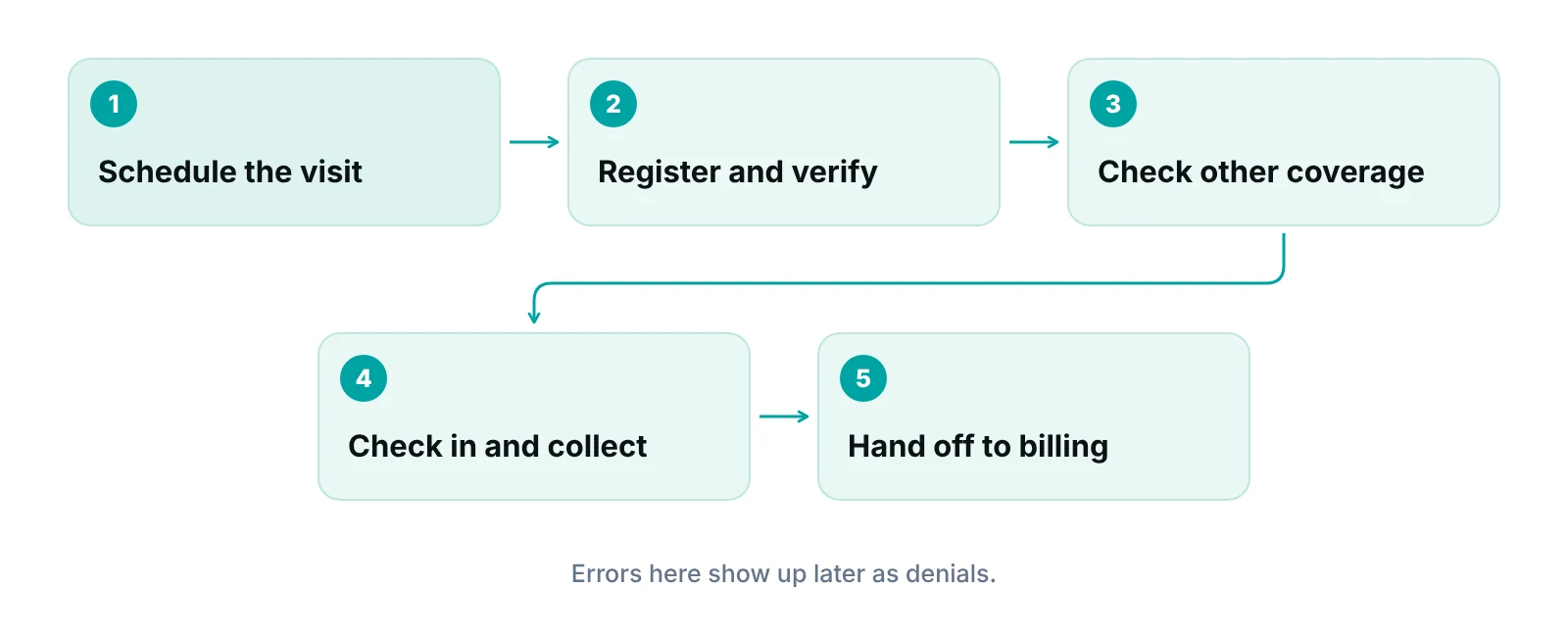
The front desk shapes payment before a claim exists. Staff schedule the visit, capture demographics and insurance, verify eligibility, ask about other coverage, collect what the patient owes and pass clean information to billing. Errors at those steps surface weeks later as denials, rework and unpaid balances.
Most denial work begins somewhere else. A transposed digit in a member ID, an inactive plan or a missed referral is made at the desk, then found by a payer long after the patient has gone home. Fixing it costs more than getting it right at check-in.
This guide covers the steps before and during the visit that the front desk owns, where they go wrong, what to measure and what to hand to someone else. Claim submission, payment posting and denial follow-up usually belong to billing, and we say where the line sits. For the insurance step in depth, see our guide to patient insurance verification.
Key takeaways
- The front desk owns six touchpoints: scheduling, registration, eligibility, other-coverage questions, collection at check-in and the hand-off to billing.
- In an Inovalon survey reported in August 2026, about four in five revenue cycle leaders tied denials to at least one front-end workflow.
- A manual eligibility check cost the medical industry $12.95 in the 2024 CAQH Index (2023 data), against $2.04 electronic.
- Do not routinely waive Medicare copays or deductibles; OIG treats routine waivers as a fraud risk.
- Measure the desk with HFMA MAP Key process rates, and set your own baseline before you set targets.
Where does the front desk touch the revenue cycle?
At six points: scheduling, registration, eligibility, other-coverage questions, collection at check-in and the hand-off to billing. Each one creates data or cash that billing depends on. A mistake at any of them travels forward with the claim and is usually found by a payer.
The revenue cycle has a front end (before and during the visit) and a back end (claims, payments, denials and A/R). Front desk staff own most of the front end. Billing owns most of the back end. The table shows where the two meet.
| Touchpoint | What the front desk does | What goes wrong downstream | Who else is involved |
|---|---|---|---|
| Scheduling | Books the visit, confirms visit type and provider, notes any referral or authorization need | Wrong visit type or a missing referral leaves the service unpayable | Clinical staff set the visit type |
| Registration | Captures legal name, date of birth, address, insurance IDs, subscriber and other coverage | A typo or wrong payer fails the payer’s edits and the claim is rejected or denied | Billing checks the data again at claim scrubbing |
| Eligibility check | Confirms active coverage, plan, copay and deductible status for the date of service | Inactive or changed coverage becomes a denial or a surprise patient bill | Billing resolves rejections |
| Other-coverage questions | Asks about other insurance, including Medicare Secondary Payer questions | The wrong payer is billed first and the claim has to be redone | Billing handles coordination of benefits |
| Check-in and collection | Explains and collects the copay or amount due, gets consents, gives estimates to self-pay patients | Uncollected balances move to statements and slow cash | Billing sends statements |
| Hand-off to billing | Confirms authorizations are on file and the encounter is complete | Billing cannot submit, or submits with gaps | Providers complete documentation and coding |
Where the line sits
Submitting claims, posting payments and working denials normally sit with billing. The front desk affects those steps through what it captures and hands off. Small practices sometimes combine the roles, but the work, and the way you measure it, is still different.
How much of the denial problem starts at the front desk?
A large share, according to the people who work claims. In an Inovalon survey of more than 400 revenue cycle leaders, reported by TechTarget in August 2026, about four in five respondents attributed denied claims to at least one front-end workflow. The top three contributors were insurance eligibility and benefits verification, authorization and pre-certification, and patient registration and demographic verification.
Treat that as directional. Inovalon sells revenue cycle technology, and the fielding dates were not published. For ambulatory organizations, HIT Consultant’s report on the same survey gave eligibility errors (33%) and patient registration discrepancies (19%) as the leading drivers. Your own denial log is better evidence than any survey: tag each denial with the step where it began.
What does a manual eligibility check cost?
More than an electronic one. The 2024 CAQH Index, which uses 2023 data, put the manual medical eligibility and benefit verification at $12.95 per transaction across plans and providers, against $2.04 electronic. The report estimated 12 minutes saved per transaction for medical providers that move to electronic checks.
| Topic | What the source says | Front-desk takeaway | Source |
|---|---|---|---|
| Cost of eligibility checks | In the 2024 CAQH Index (2023 data), a manual medical eligibility and benefit verification cost $12.95 per transaction across plans and providers, against $2.04 electronic. Provider cost alone was $8.57 manual and $2.00 electronic. | Hand-keyed phone and portal checks are the most expensive way to verify | CAQH |
| Time saved | The same report estimated 12 minutes saved per transaction for medical providers who switch to electronic | Minutes saved per check add up across a day’s schedule | CAQH |
| Other payers | CMS tells Part B providers to collect billing information at the time of service and says failing to keep a system for identifying other payers is a violation of the provider agreement | Ask the other-coverage questions at every visit, not once | CMS |
| Medicare filing limit | For services on or after January 1, 2010, a Medicare claim must be filed within 1 calendar year of the date of service, with limited exceptions | Registration errors that delay a claim use up that window | eCFR, 42 CFR 424.44 |
| Estimates for self-pay patients | A good faith estimate for an uninsured or self-pay patient is due within 1 to 3 business days of scheduling or of the patient’s request, depending on how far ahead the visit is | Know the clock when you book a self-pay visit | eCFR, 45 CFR 149.610 |
| Waiving copays | OIG says routinely waiving Medicare Part B copayments and deductibles can lead to false claims and anti-kickback violations; waiver for a patient’s genuine financial hardship must be occasional, not routine | Never waive as a habit; document hardship case by case | OIG Special Fraud Alert, 1994 |
Sources: CAQH Index (2024 report, 2023 data); CMS; eCFR (42 CFR 424.44; 45 CFR 149.610); HHS OIG (1994).
Find out where your denials start
Our free practice audit looks at your denial reasons and front-end workflow and shows which steps to fix first. Pricing for any service is quoted after the audit.
What should the front desk capture at scheduling and registration?
Capture the visit type, any referral or authorization need and a complete, correct registration record. HFMA’s MAP Keys count a pre-registration as successful only when at least all demographic and insurance fields are complete, which is a useful standard for your own desk.
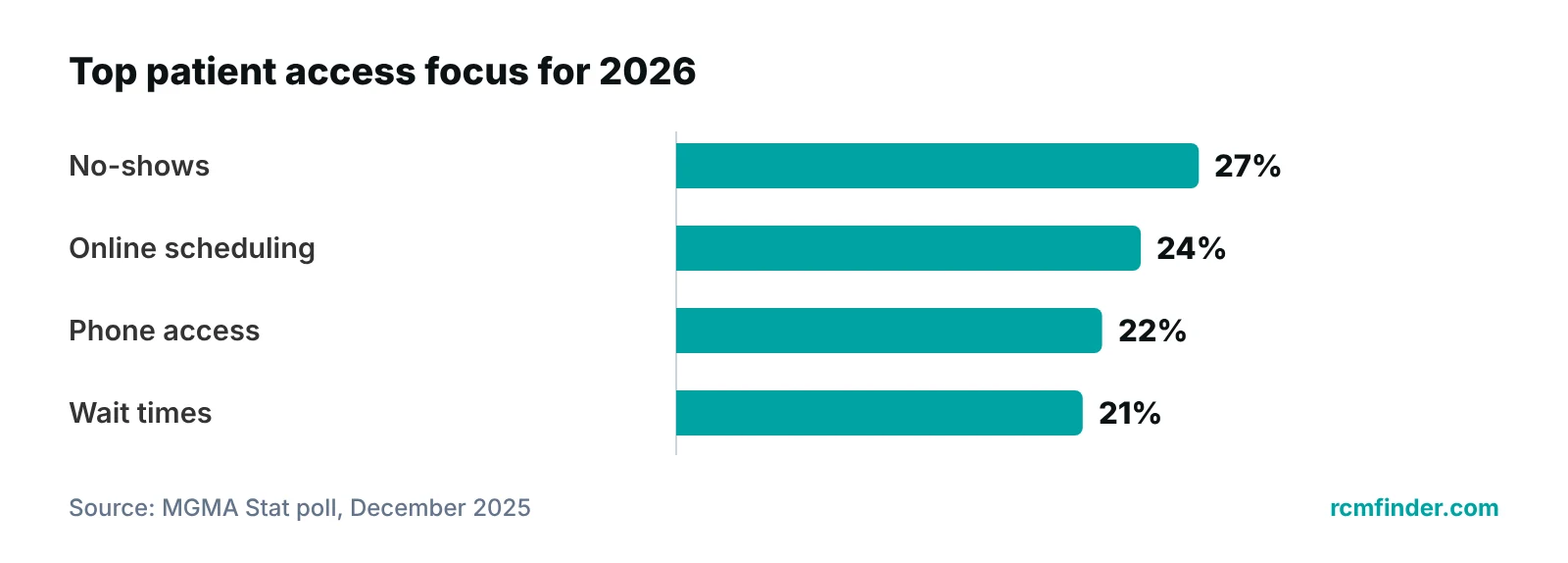
Scheduling is also a revenue step in its own right, because an empty slot cannot be billed. A 2018 systematic review of 105 studies in Health Policy found an average no-show rate of about 23%, with long lead times between booking and visit and a history of earlier no-shows among the most commonly reported significant factors. In a December 2025 MGMA Stat poll, no-shows were the top patient access focus for 2026 among practice leaders.
Reminders, short lead times and easy rescheduling are the practical levers. Our medical appointment scheduling services cover booking, reminders and rescheduling inside your own EHR (for example PrognoCIS, eClinicalWorks or athenahealth), and our post on online scheduling and billing explains how booking data flows into claims.
A registration checklist
- Insurance card (front and back) and photo ID at the first visit and whenever coverage changes.
- Subscriber name, date of birth and relationship when the patient is a dependent.
- The other-coverage question at every visit, not only the first.
- Referral or authorization need for the visit type, passed to someone who will track it to a decision.
- Signed consents, with a sign-in sheet that shows only what sign-in requires.
On the last point, HHS says practices may use sign-in sheets and call out names so long as the information disclosed is appropriately limited. Our HIPAA guidelines for the front desk cover the rest.
Other coverage and authorizations
For Medicare patients, CMS tells Part B providers to collect billing information at the time of service and to ask about other coverage, using the six-part CMS Questionnaire or a similar one. CMS also says that failing to keep a system for identifying other payers is a violation of the provider agreement.
When a service needs approval, the front desk should not be the only owner of it. A dedicated prior authorization service or trained coordinator tracks requests to a decision, so the visit is not held up at check-in.
Scripts differ by specialty. A pediatric desk works with guardians and dependents, and a behavioral health desk with recurring visits and authorizations. See how front-office and billing workflows vary across the specialties we support.
When and how should eligibility be verified?
Verify before the visit for scheduled patients, and again at check-in when the plan may have changed, the visit has moved or the patient is new. Use an electronic check where the payer supports it, since by hand it costs more and takes longer.
- Active coverage on the date of service, and the plan and payer.
- Copay, coinsurance and how much of the deductible is met.
- Referral or authorization requirements for the service.
- Whether the provider is in network for that plan.
Our patient insurance verification guide walks through each check.
The quiet cost of the wrong payer
Medicare claims must be filed within one calendar year of the date of service (42 CFR 424.44), with limited exceptions. Other payers set their own deadlines, so check each contract. A claim sent to the wrong payer, rejected and corrected uses up days of that window.
How should the front desk handle copays and patient balances?
Tell the patient what they are expected to owe before they pay, collect what is due at check-in and offer a clear way to pay the rest. Do not routinely waive copays or deductibles.
The HHS Office of Inspector General’s Special Fraud Alert on routine waivers says that routinely waiving Medicare Part B copayments and deductibles can lead to false claims and anti-kickback violations. A provider may forgive a copayment for a particular patient’s genuine financial hardship, but only occasionally, and otherwise has to make a good-faith effort to collect. Write down each hardship decision, and send questions to a qualified compliance adviser.
Self-pay patients have a separate rule. Under 45 CFR 149.610, an uninsured or self-pay patient must receive a good faith estimate within 1 to 3 business days of scheduling or of their request, depending on how far ahead the visit is. Booking staff need to know that clock.
Collecting well is mostly about wording. Quote one number, say what insurance has and has not been checked, and offer a payment plan before the patient has to ask. Our guide to improving patient collections has scripts and policies you can adapt. HFMA tracks the result as point-of-service cash collections.
Which front-desk tasks can move to a virtual medical assistant?
Repeatable, checklist-driven tasks: appointment reminders, eligibility and benefit checks, intake follow-up, prior authorization tracking and rescheduling. Conversations that need judgment in the room, such as a hardship request, a privacy question or anything clinical, stay with on-site staff and providers.
Our team works inside your existing EHR, and your practice’s time zone governs every staff member. If you use any outside staff, HHS says a covered entity must have a written contract with each business associate that limits how protected health information is used. Ask for individual logins, role-limited access and a signed agreement before anyone touches patient data.
Take repeatable front-desk work off your team
Our virtual medical assistants handle scheduling, reminders, eligibility checks and intake inside your existing EHR, on your practice's time zone.
How do you measure front-desk performance?
Track a few process measures you can trace to the front desk, then watch the outcomes they feed. HFMA publishes standard definitions in its MAP Keys, including four front-end measures and the denial and A/R outcomes.
| Measure | Formula (HFMA MAP Keys, 2023 edition) | Why it matters at the front | Usually owned by |
|---|---|---|---|
| Pre-registration rate (PA-2) | Encounters pre-registered divided by scheduled encounters; a pre-registration counts when at least all demographic and insurance fields are complete | Shows how often the record is complete before the visit | Front desk |
| Insurance verification rate (PA-3) | Verified encounters divided by registered encounters; your policy defines a successful verification | Shows how often coverage is checked | Front desk |
| Outpatient authorization rate (PA-5) | Outpatient encounters authorized divided by outpatient encounters requiring authorization | Shows whether needed approvals are in place before the visit | Front desk with authorization staff |
| Point-of-service cash collections (PA-7) | Patient point-of-service payments divided by total self-pay cash collected | Shows how much patient cash is collected at or near the visit | Front desk |
| Remittance denial rate (AR-5) | Claims denied divided by claims remitted; actionable denials only | The outcome front-end errors feed into | Billing, with front-desk feedback |
| Net days in A/R (FM-1) | Net A/R divided by average daily net patient service revenue (three-month average) | A slow-moving result of everything upstream | Billing |
Source: HFMA, MAP Keys, 2023 Edition. Formulas paraphrased.
This post gives no target values. Benchmarks vary by setting, and a number copied from a blog is not your baseline. Measure four weeks of your own data first, then set a goal for each rate. Our guide to revenue cycle KPIs covers the wider set, and the revenue calculator can help you size what leakage costs your practice.
Our recommendations
- Tag every denial by where it began. We start by sorting a month of denials into front-end and back-end causes. It shows whether you need training, tools or a different owner.
- Give registration a written checklist. Card, ID, subscriber, other coverage and referral need, in the same order every time. A checklist is easier to teach than a habit.
- Verify before the visit, then again if anything changed. Check eligibility when the visit is booked or the day before, and re-check at check-in for new patients or a changed plan.
- Script the money conversation. One estimate, one set of words, one payment option offered up front. Never promise to waive a balance to close the conversation.
- Close the loop with billing. Send the desk a short monthly list of denials traced to registration, eligibility or authorization. People fix what they can see.
- Move repeatable work off the desk. If reminders, eligibility checks and authorization tracking crowd out patient conversations, assign them to a person or a virtual assistant who owns them.
Front desk errors usually show up later as denials.
The portal's completeness checks run before submission, and role-based permissions let you control who can edit what.
See how the RCM Finder portal works · Create a portal account
Disclosure: RCM Finder builds and sells this portal. It is a practice management system, not an EHR.
Bottom line
The revenue cycle starts when the phone rings. Give the front desk a checklist, measure the handful of rates it controls and keep claims work with billing. If the desk is overloaded, our virtual medical assistants can take on scheduling, reminders and eligibility checks, and our appointment scheduling services cover the booking side.
Frequently asked questions
What is the role of front desk staff in the revenue cycle?
They own the front end: scheduling, registration, eligibility checks, other-coverage questions, collecting what the patient owes and handing a complete encounter to billing. They do not usually submit claims, post payments or work denials. Their accuracy decides how many claims are clean when billing receives them, so the desk and the billing team should review denials together.
Which front desk mistakes cause the most denials?
In an Inovalon survey reported by TechTarget in August 2026, the top front-end contributors were eligibility and benefits verification, authorization and pre-certification, and registration and demographic verification. It is a vendor survey, so check your own denial log for the pattern in your practice before you change anything.
Should the front desk submit claims?
Usually not. Claim submission, payment posting and denial follow-up are billing tasks that need coding and payer knowledge. The front desk supports them by capturing correct data and flagging gaps. Very small practices may combine roles, but the work should still be tracked separately so you can see where errors start.
Can we waive a copay when a patient cannot pay?
Only in a genuine, documented hardship, and only occasionally. OIG’s 1994 Special Fraud Alert says routine waivers of Medicare Part B copayments and deductibles can create false claims and anti-kickback risk. Otherwise you must make a good-faith effort to collect. Ask a compliance adviser about your policy.
How do I measure front desk performance?
Use process rates you can trace to the desk: pre-registration, insurance verification, authorization and point-of-service collections, as HFMA’s MAP Keys define them. Then watch denial rate and net days in A/R. Measure your own baseline first, because published targets vary by practice type.
Can a virtual medical assistant do front-desk revenue cycle tasks?
Many of the repeatable ones, yes: reminders, scheduling, eligibility checks, intake follow-up and authorization tracking, inside your EHR. Keep patient conversations that need judgment on site. Require a signed business associate agreement, individual logins and role-limited access before any outside staff see patient data.
Get your free practice audit
Tell us about your practice. We will contact you using the details you give.
- A review of your recent claims, denials and A/R aging
- Where your front desk and prior authorizations slow payment
- A prioritized fix list you keep, whether or not you hire us
Pricing is quoted after the audit, based on your volume and the services you choose. Prefer to talk? Call +1 (302) 556-2288.
Sources
- Survey: Front-end workflows to blame for most claim denials — TechTarget Revenue Cycle Management (2026)
- Inovalon research: claim denials and prior authorization drivers — HIT Consultant (2026)
- 2024 CAQH Index Report — CAQH (2024)
- No-shows in appointment scheduling: a systematic literature review — Health Policy (Elsevier), Dantas et al. (2018)
- Patient access priorities for 2026 — MGMA Stat (2025)
- MAP Keys, 2023 Edition — HFMA (2023)
- Medicare Secondary Payer: Your Billing Responsibilities — CMS (2026)
- 42 CFR 424.44 Time limits for filing claims — eCFR (2026)
- 45 CFR 149.610 Good faith estimates for uninsured (or self-pay) individuals — eCFR (2026)
- Special Fraud Alert: Routine Waiver of Copayments or Deductibles Under Medicare Part B — HHS Office of Inspector General (1994)
- May health care providers use sign-in sheets or call out patient names? — HHS Office for Civil Rights (n.d.)
- Sample Business Associate Agreement Provisions — HHS Office for Civil Rights (n.d.)
Disclaimer: This article is general educational information for medical practice owners and managers. It is not legal, compliance, coding or billing advice. Payer rules, filing limits and contract terms vary by payer, plan and state and change often. Confirm requirements with each payer and qualified advisers before acting.
