
Dental Specialty

Dental Billing Services for General and Specialty Dental Practices

CDT claims, benefit checks, predeterminations, secondary plans and patient balances, handled by virtual front-desk staff and a billing team, with a claims portal.
  • Works inside your current practice software
  • US practice time zone, every shift
  • Weekly KPI reporting, or on your schedule
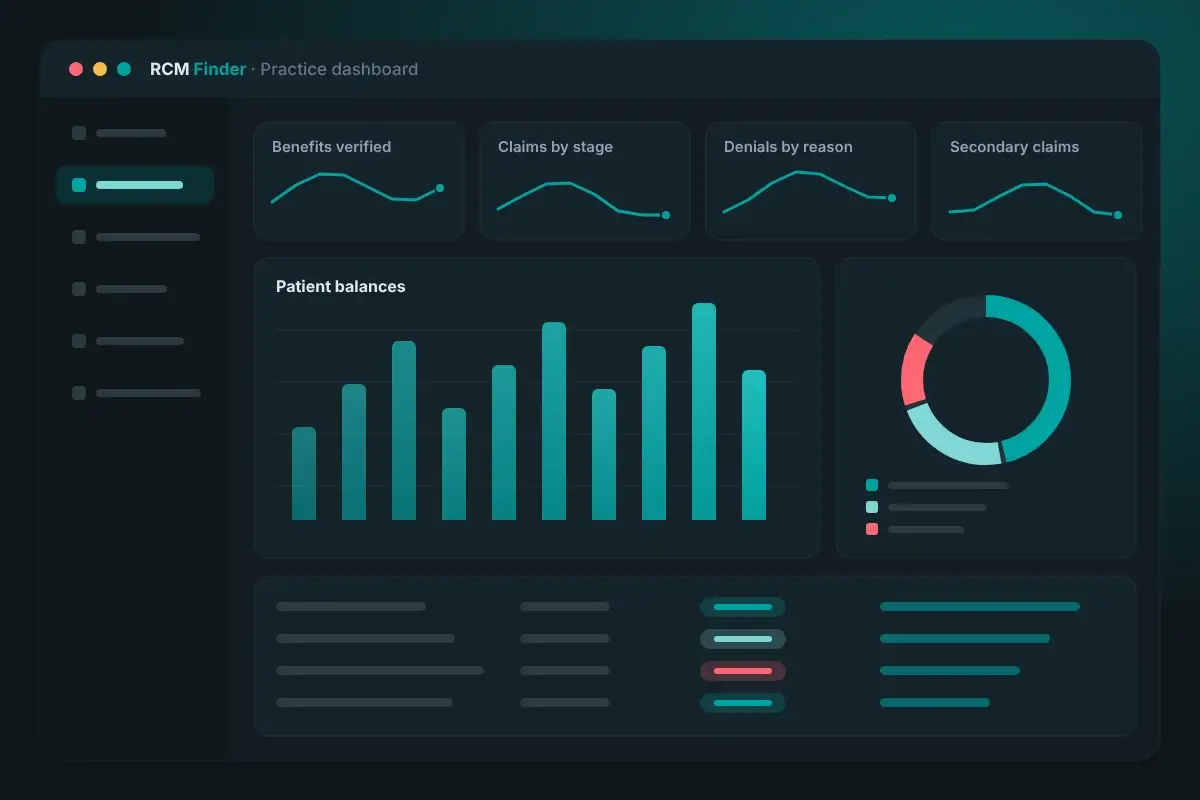
Dental billing dashboard with benefits verified, claims by stage, denials by reason, secondary claims and patient balances

Quick answer

Dental billing services turn each treatment into a payable claim: CDT codes on the right form, benefits checked for annual maximums, waiting periods and frequency limits, estimates before costly work, and secondary plans billed in order. RCM Finder adds virtual front-desk staff, A/R follow-up and a claims portal.

Disclaimer: This page is educational and is not legal, coding or compliance advice. CDT codes, Medicare contractor guidance, state law and dental plan contracts change and vary by payer, plan and state. Verify every code, modifier and rule against the current CDT manual, your payer contracts and your Medicare contractor's documents before billing.

Why dental billing is different from medical billing

Dental plans pay by contract limits as much as by clinical need. A claim can be coded correctly and still pay little or nothing because of an annual maximum, a waiting period, a frequency limit or an alternate-benefit clause.

Dental procedures are reported with the ADA's Code on Dental Procedures and Nomenclature (CDT), which HIPAA names as the code set for dental services in 45 CFR 162.1002. Electronic dental claims use the X12 837 dental standard under 45 CFR 162.1102, and the ADA's 2024 Dental Claim Form is the current version. Medical claims use CPT and HCPCS codes on professional or institutional claims. Our dental billing and coding guide is the primer.

Annual maximums bind fewer patients than owners fear

An ADA Health Policy Institute analysis from 2024 found that only 3.4% of dental patients reach a typical annual maximum, and another 3.3% come within $100 of common maximums such as $1,000 or $1,500, as ADA News reported in December 2025. The same article says many plans still use a $1,000 level set about 40 years ago. The cap matters most for patients with large treatment plans.

The four pillars, built for a dental practice

A dental practice needs new patients who know which plans you accept, a front desk that checks benefits before treatment, claims that match the plan's rules, and software that shows where each claim sits.

Revenue leaks at handoffs: a plan that changed in January, a second policy nobody asked about, a radiograph that never reached the payer.

Pillar 1 · Healthcare Marketing

Healthcare Marketing for dental practices

Dental patients search locally and often start with their plan. Our healthcare digital marketing covers local SEO, Google Ads and reputation. For the how-to, see our dental SEO marketing guide.

  • Location pages and Google Business Profile work
  • Plan-accepted pages that match what the front desk can verify
  • Review replies that never confirm someone is a patient
  • KPI: new-patient inquiries by source
Explore Healthcare Marketing
Pillar 2 · Virtual Medical Assistants

Virtual Medical Assistants for the dental front desk

Our virtual medical assistants work on your practice's time zone. They check eligibility and benefits, request predeterminations, take intake details and chase missing information. See also our dental virtual assistant guide.

  • Benefits checked before the visit, not after the claim
  • Second plans and their order recorded at intake
  • Predetermination requests tracked to a response
  • KPI: appointments with verified benefits
Explore Virtual Medical Assistants
Pillar 3 · End-to-End RCM

End-to-End RCM for dental claims

Our end-to-end revenue cycle management covers charge entry, coding support, claim scrubbing, submission, payment posting, denial management and A/R follow-up, with extra checks on attachments, secondary claims and patient balances.

  • Procedure codes matched to the chart note
  • Radiographs and narratives attached when a plan asks
  • Secondary claims sent with the primary EOB
  • KPI: denials by reason and A/R days
Explore End-to-End RCM
Pillar 4 · Practice Management System

Practice Management System for dental billing

Our practice management system tracks every claim by stage, checks data completeness before submission and flags underpayments against expected amounts. Billing companies serving several offices get a client portal.

  • Workflow rules that hold a claim missing information
  • Underpayment flags against expected amounts
  • Role-based permissions and an audit log
  • Early access: appointment scheduling. Coming next: in-portal eligibility checks
Explore Practice Management System

Find where your dental claims leak

We review recent claims, EOBs and denials, then show where benefits, attachments or secondary plans cost you.

Get a Free Practice Audit

Dental claim or medical claim: where each service goes

Most dental work goes to the dental plan on a dental claim. A few services, such as jaw fracture care, belong to the medical plan, and some oral surgery can go either way. Check the patient's plans before choosing.

The American Association of Oral and Maxillofacial Surgeons' coordination-of-benefits paper (2024) says a jaw fracture is typically billed only to medical, while a biopsy may go to dental, medical or both. If you try medical first, check the deductible and copayment. If you choose dental, confirm the annual maximum has room.

Order of benefits when a patient has two plans

The ADA's coordination-of-benefits guidance sets the order: the plan covering the patient as an employee or subscriber is primary. For a child on both parents' plans, the earlier birthday in the calendar year is primary, then the plan in force longer. If the only tie is one medical and one dental plan, medical is primary. State law can override these rules; some states use a different rule for children.

Bill the primary plan first. The secondary plan needs the primary plan's explanation of benefits and then pays up to its own benefit. Some self-funded employer plans use nonduplication clauses, under which a secondary plan may pay nothing. The AAOMS paper warns against filing with several plans at once for full payment, and against posting write-offs before every plan has paid. Our posts on coordination of benefits cover the medical side.
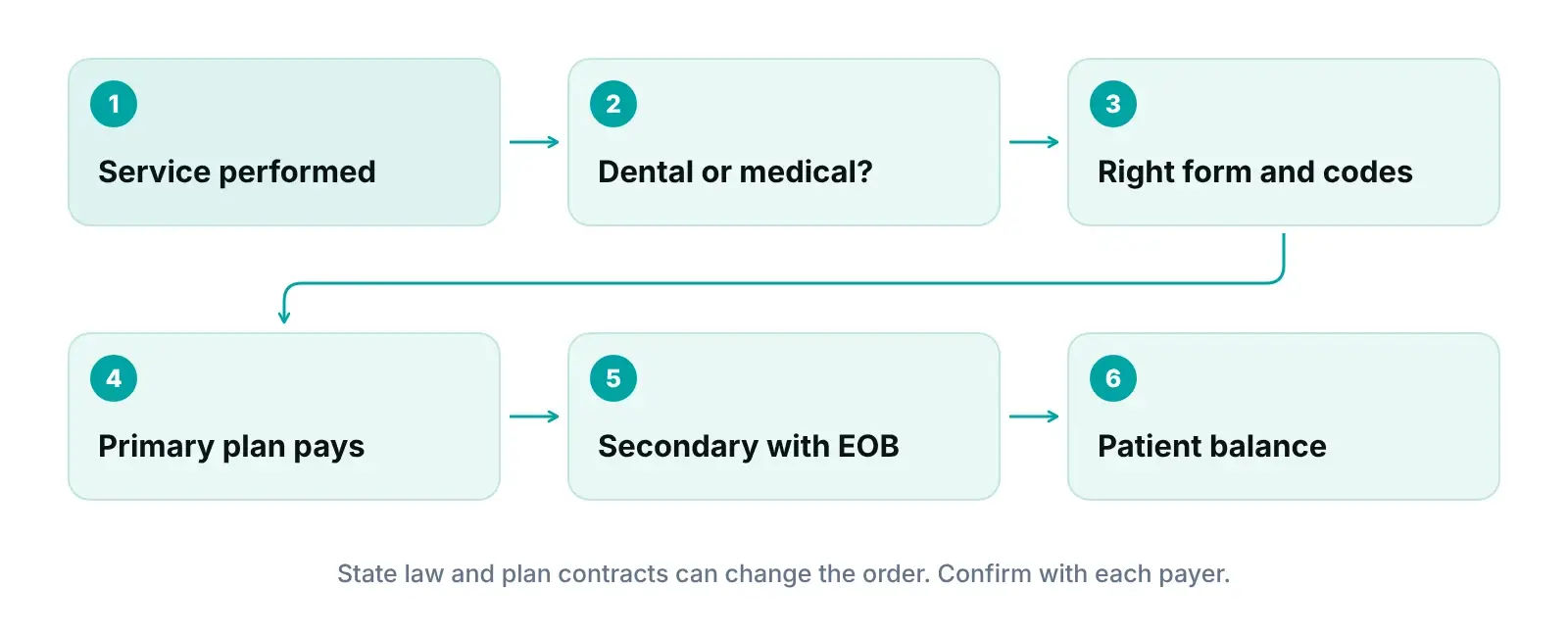
Diagram of a dental service routed to the right claim form, primary plan, secondary plan with EOB and patient balance
How one dental service reaches the right payer, in order.

Medicare dental limits: what Part B does and does not pay

Traditional Medicare excludes routine dental care. It pays only when a dental service is inextricably linked to a covered medical service, and the medical record must show the coordination.

The CMS dental coverage page (last modified March 2026) cites Social Security Act 1862(a)(12) and 42 CFR 411.15(i) for the exclusion. It lists exceptions: inpatient hospital dental services when the patient's condition or the procedure requires a hospital stay, and dental services tied to organ transplant, cardiac valve replacement, cancer chemotherapy, head and neck cancer treatment, and dialysis for end-stage renal disease. KFF's summary shows these were added in the 2023, 2024 and 2025 fee schedule rules. Not covered: routine care and preparing the mouth for dentures.

Cardiology, oncology and nephrology patients are where these claims start. See our page on cardiology billing for the medical side.

Claim rules for covered dental services

Noridian, the Medicare contractor for Jurisdiction F, updated its dental page in June 2025. It accepts dental (837D), institutional (837I) and professional (CMS-1500 or 837P) claims, with CDT or CPT/HCPCS codes. For claims received on or after July 1, 2025, a valid ICD-10 code is required, and the KX modifier is required on each dental line; a claim without KX may be denied as non-covered. Other contractors may differ.

The ADA's Medicare overview for dentists adds two practical points. Do not send radiographs, charting or proof of care coordination with the claim; the contractor asks in writing if it needs them. Keep the referral exchange in the chart.

Benefit verification, predetermination and the pre-visit checklist

Verify before treatment, and for costly work ask for a predetermination. Neither guarantees payment, but both let you quote the patient's share with real numbers instead of guesses.

The ADA says preauthorization and predetermination are different processes. Many dental HMO plans require preauthorization before a specialist referral. Most PPO and indemnity plans offer predetermination on a voluntary basis. The estimate reflects eligibility and remaining benefits on the day it is issued, and treatment that was preauthorized has still been denied for ineligibility or exhausted maximums. The ADA advises submitting predeterminations for complex, costly procedures as close to the service date as possible, and warns about ones that cross a calendar year.

Pre-visit benefit checklist for each dental patient
CheckWhy it mattersSourceWhat the VMA does
Plan type and network statusDental HMOs often require preauthorization before a specialist referral; PPOs offer voluntary predeterminationADA (pre-authorizations)Records plan type and whether you are in network
Remaining annual maximumThe plan stops paying at its cap, whatever the clinical needADA News (2025)Notes benefit used and remaining for the visit date
Waiting periodTime between enrollment and eligibility for a given benefitADA News (2026)Flags a service the patient is not yet eligible for
Frequency limitsSeveral radiographs can be treated as a full mouth series and count against the limitADA (bundling); ADA plan designRecords the date of the last service for each recurring code
Alternate benefit clauseA plan may pay for a cheaper option, leaving the patient the differenceADA (LEAT clause)Asks whether the clause applies and adds the difference to the estimate
Other coverage and orderWrong order delays payment; some plans use nonduplicationADA (COB); AAOMS (2024)Collects both cards, confirms order with the patient and payers
Predetermination for costly workEstimate is not a guarantee; benefits can change before the claimADA (pre-authorizations)Submits with radiographs and a narrative, then tracks the answer

Sources: ADA pre-authorizations, bundling and downcoding, LEAT and coordination-of-benefits pages; ADA News (December 2025; June 2026); AAOMS coordination-of-benefits paper (2024); ADA plan-design paper (undated). Plans differ; confirm each member's current terms.

Our insurance verification guide and prior authorization guide cover the general process.

See what denials and write-offs cost you

Enter your claim volume and denial rate to estimate what your dental practice is losing.

Open the Revenue Calculator

Dental denials, downcoding and patient balances

Most dental underpayments come from plan design, not errors: an alternate benefit, a downcode, a bundled film or a missing radiograph. Know which one you face before you appeal or bill the patient.

Common dental denial, downcoding and balance triggers
SituationRule or example (our wording)Denial or balance triggerSource
Medicare dental claimICD-10 required; KX required on each dental line from July 1, 2025Rejected without ICD-10; may be denied as non-covered without KXNoridian JF (2025)
Routine dental billed to MedicareExcluded by statute outside the linked-service exceptionsBenefit-category denial; patient may be liableCMS (2026); Noridian JF (2025)
Alternate benefitA posterior composite (D2394) paid at the amalgam (D2161) ratePatient owes the copayment plus the fee differenceADA (LEAT clause)
DowncodingPayers cite D4341 recoded to D4342 when one to three teeth are treated in a quadrantPaid below what you billed; seen only on the EOBADA (bundling and downcoding)
Bundled radiographsSeveral films may be treated as a full mouth seriesLater films denied under frequency limitsADA (bundling and downcoding)
Missing radiographs or narrativeScaling and root planing claims (D4341, D4342) tend to draw more denials and requests for more informationDenied or held for more information; payment delayedADA (claims FAQ)
Poor prognosisPlan disagrees with clinical needDenied; appeal in writing with rationaleADA (claims FAQ)
Preauthorized but deniedEstimates are not guaranteedDenial for ineligibility or exhausted maximumADA (pre-authorizations)

Sources: Noridian JF dental page (June 2025); CMS dental coverage page (2026); ADA LEAT, bundling and downcoding, claims FAQ and pre-authorizations pages. Codes described in our own words; check the current CDT manual.

A worked patient-balance example

The ADA's illustration uses a $90 composite and a $60 amalgam fee. The plan pays 80% of $60, or $48. The patient owes the $12 copayment plus the $30 fee difference, $42 in all, and the dentist receives the full $90. The ADA says the dentist can then charge the patient the difference, but plans apply the clause differently, so confirm the plan's terms before billing it.

Attachments and appeals

The ADA advises sending duplicate radiographs, not originals, and calls sending images from an unsecured personal phone highly inadvisable; it lists encrypted email and secure payer portals as options. When a claim is denied, include all supporting documents and appeal in writing. CMS's claims attachments final rule fact sheet gives an effective date of May 26, 2026 and a compliance date of May 26, 2028, and leaves prior authorization attachments out. See our denial management guide.
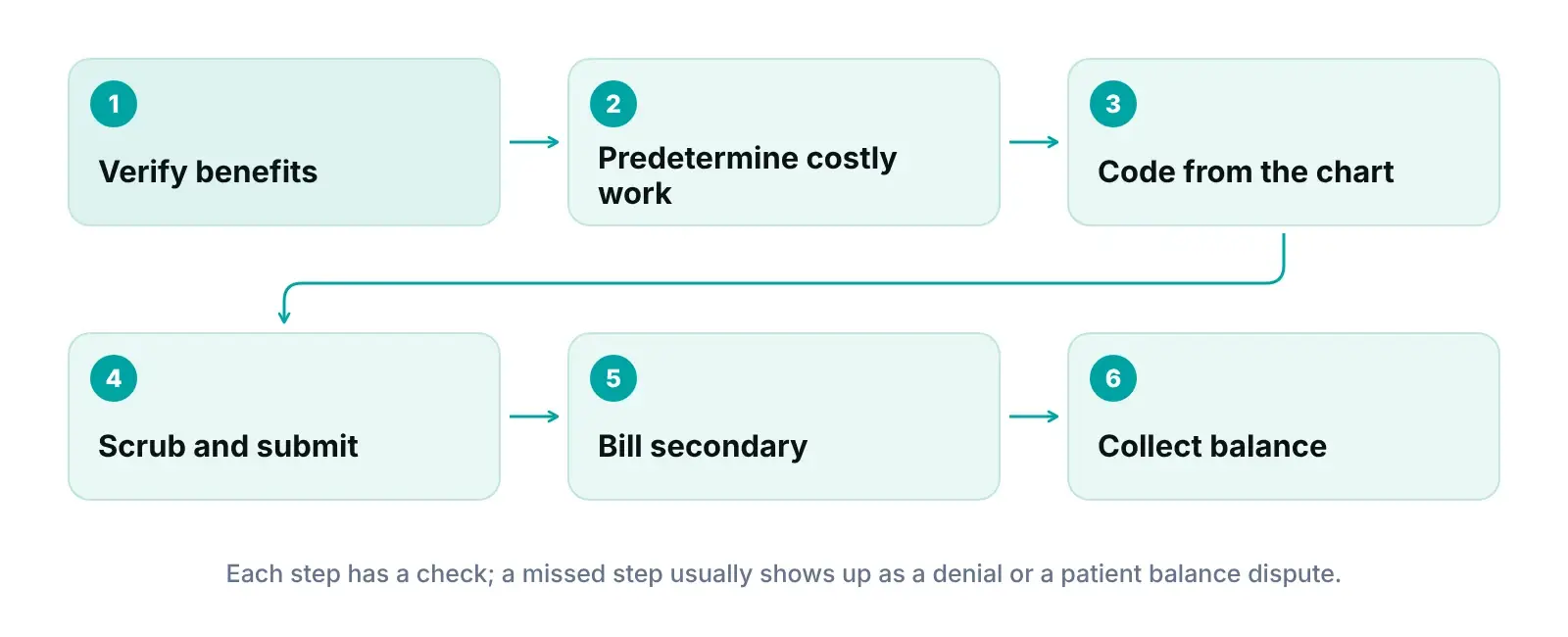
Diagram of a dental claim from benefit verification and predetermination to coding, submission, secondary billing and patient balance
The dental claim path we manage, from verification to patient balance.

Why dental verification and front-desk work suits a virtual assistant

Dental front-desk work is repetitive, rules-based and tied to dates, which makes it well suited to remote staff. The work is checking, recording and following up, and it repeats for every new plan and every plan year.

In its 2024 Index, using 2023 data, CAQH reported that dental eligibility and benefit verification spending rose 15% to $2.1 billion, and that switching to automated electronic checks could save $580 million, as ADA News summarized in March 2025.

  • A VMA can check benefits for tomorrow's schedule while the clinical team sees patients.
  • A VMA can keep a running record of annual maximum used, last radiograph dates and second plans.
  • The dentist keeps clinical judgment, treatment presentation and chairside care.

Our team works inside your existing practice software and your time zone. In-portal real-time eligibility is coming next, so today the checks are done by people, with a weekly report of what was found.

In-house team, billing-only vendor or four-pillar partner?

Keep billing in-house if one experienced person owns benefits and claims and nothing falls behind. Use a billing-only vendor if claims are your only gap. Choose a combined partner if problems start at the front desk.

Decision table: which billing model fits a dental practice?
JobIn-house teamBilling-only vendorFour-pillar partner (RCM Finder)
Benefit and eligibility checksFront desk, when time allowsUsually left to the practiceVMA checks before the visit
Predetermination for costly workDepends on one personRarely includedVMA submits and tracks the response
Coding and claim scrubbingStaff coder or dentistVendor coders, after the factCoding support and scrubbing against the chart note
Secondary claims and COBEasy to missBilled if the EOB is sentOrder confirmed at intake; EOB attached
Denials, downcodes and appealsHandled when someone has timeWorked after denialTracked by reason, with weekly review
New-patient demandRarely anyoneNot includedMarketing pillar for local search
Cost structureSalaries, benefits, turnoverVaries; ask how fees are setQuoted after a free practice audit

Whichever model you pick, review denials by reason and underpayments by plan every month.

How it works

We start with a free audit and change nothing until you see the findings. We build our billing pipeline around how claims actually move through a practice: registration, charge entry, submission, payment and follow-up. For dental, we add the benefit, predetermination and secondary-plan checks on this page.

  1. 1

    Free practice audit

    We compare recent claims, EOBs and denials with your schedule and plan mix.

  2. 2

    Business Associate Agreement and access

    We put a Business Associate Agreement in place before accessing patient data. Then our team works inside your existing practice software and our portal.

  3. 3

    Plan and payer map

    We list each plan's annual maximum rules, waiting periods, frequency limits, alternate-benefit clauses and attachment requests.

  4. 4

    Verification and billing go live

    VMAs check benefits before visits. Claims are coded from the chart, scrubbed, submitted and worked to payment.

  5. 5

    Weekly KPI review

    Each week we review denials by reason, A/R days and underpayments, and adjust the rules where claims stall.

Talk to us about your dental practice

Tell us your plan mix, your software and your hardest payer. We will tell you honestly whether we fit.

Call +1 (302) 556-2288

Compliance: what to ask any dental billing company

Any billing vendor that handles patient data is a HIPAA business associate. Get a Business Associate Agreement before any access, and ask how access is limited and logged.

HHS guidance lists billing and claims processing as business associate work, and subcontractors need their own agreement. The minimum necessary standard limits use to what each task needs. The Security Rule's technical safeguards cover access control, audit controls, integrity, authentication and transmission security.

Questions to ask before you sign

  1. Will you and your subcontractors sign a Business Associate Agreement before any access?
  2. How do you limit each person's access, and can we see the audit log?
  3. Who codes our claims, and what dental coding credential and experience do they hold?
  4. How do you handle attachments, secondary claims and nonduplication clauses?
  5. Can you work inside our practice software and send the ADA claim format our payers accept?
  6. Can we export our data if we leave?

We use role-based access, audit logging and encrypted (HTTPS) connections, and we put a Business Associate Agreement in place before accessing patient data. For your own side, use our HIPAA compliance checklist for medical practices.

Who this is for, and who it is not for

We would rather tell you now than after you sign. Here is where we fit and where we do not.

A good fit if you are

  • General and specialty dental practices that bill several dental plans
  • Offices whose front desk cannot check benefits before every visit
  • Practices that bill oral surgery or medically linked services to medical plans or Medicare
  • Groups with denials, downcodes or patient balances they cannot explain
  • Billing companies serving several dental offices from one portal

Probably not a fit if you are

  • Fee-for-service or membership-plan practices that file few insurance claims
  • Practices unwilling to share EOBs, charts and plan details
  • Offices looking for a promised collection rate; we report measured KPIs instead
  • Groups that need in-portal scheduling or eligibility checks today (early access and coming next, not live)

Expert recommendations from our operations team

What we would do first if we were running your practice's revenue cycle tomorrow.

  1. 01

    Verify before the visit, not after the claim

    We check benefits when the appointment is booked and again the day before. A plan can change in January, and a benefit used up in March changes the estimate.

  2. 02

    Quote the patient's share in writing

    For costly work, we ask for a predetermination and give the patient a written estimate that names the maximum, the plan's payment and the part left to them.

  3. 03

    Record the second plan at intake

    We ask for every card and the order of coverage on day one. A missing secondary plan is the easiest balance to lose.

  4. 04

    Treat alternate benefits as a patient conversation

    If a plan pays a composite at the amalgam rate, the difference is a balance the patient should hear about before treatment, not after the EOB.

  5. 05

    Attach what the payer will ask for

    For scaling and root planing and other documentation-heavy claims, we send duplicate radiographs and a short narrative the first time, through a secure channel.

  6. 06

    Keep Medicare dental claims separate

    Medicare-linked dental claims follow different rules: ICD-10, KX on each line, and no attachments. We flag them at scheduling and document the physician exchange in the chart.

Frequently asked questions

What do dental billing services include?

They cover benefit verification, charge entry, coding support, claim scrubbing, submission, payment posting, denial management, A/R follow-up and patient balances. For dental, that also means predeterminations for costly work, attachments such as radiographs, and secondary claims in the right order. RCM Finder adds virtual front-desk staff, local marketing and a claims portal.

Do dental claims use a different form than medical claims?

Usually yes. Dental services are reported with CDT codes on the ADA Dental Claim Form or the X12 837 dental transaction. Medical services use CPT and HCPCS codes on professional or institutional claims. Medicare accepts all three claim types for qualifying dental services, per Noridian. Some oral surgery goes to the medical plan, so check each patient's coverage.

Does Medicare pay for dental work?

Not routine dental care. CMS says traditional Medicare excludes it by statute, with exceptions when dental services are inextricably linked to covered care, such as exams before an organ transplant or cardiac valve replacement. Claims need an ICD-10 code and the KX modifier on each dental line from July 1, 2025. Medicare Advantage plans may add dental benefits.

Does a predetermination guarantee that the plan will pay?

No. The ADA says estimated payments are not guaranteed, because the estimate reflects eligibility and remaining benefits on the day it was issued. Coverage can end, or other claims can use up the maximum, before yours is filed. Treatment that was preauthorized has still been denied. Request one for costly work, close to the service date.

What happens when a patient has two dental plans?

One plan is primary and the other secondary. The employee's or subscriber's own plan is primary; for a child on both parents' plans, the parent with the earlier birthday is primary, though state law can differ. Bill the primary first, then send the secondary the primary's EOB. Some plans have nonduplication clauses, so the secondary may pay nothing.

Why did the plan pay less than the code we billed?

Often because of an alternate-benefit clause or downcoding. The ADA's example is a composite filling paid at the lower amalgam rate, leaving the patient the copayment plus the fee difference. Plans may also recode a service or bundle films into a full mouth series. Read the EOB, ask the plan for its policy, and appeal in writing if you disagree.

No cost, no commitment

Get your free practice audit

Tell us about your practice. A member of our operations team replies within one business day.

  • A review of your recent claims, denials and A/R aging
  • Where your front desk and prior authorizations slow payment
  • A prioritized fix list you keep, whether or not you hire us

Pricing is quoted after the audit, based on your volume and the services you choose. Prefer to talk? Call +1 (302) 556-2288.

Tell us about your practice

RCMFinder Master Intake Form
AA

About the author: Awais Afzal

Healthcare Operations & Data Analyst, RCM Finder

Awais has spent more than 16 years in healthcare digital marketing and clinical operations management. He builds data-driven revenue cycle blueprints for high-ticket medical practices and leads product development of the RCM Finder portal. More about our team.

How we write: every figure, code and rule on this page was checked against the primary source listed below and independently fact-checked before publishing. We re-review this page every six months. Last reviewed October 12, 2026; next review April 12, 2027.

Sources

  1. Dental coverage under Medicare — CMS (2026 (last modified 03/10/2026))
  2. Dental (JF Part B) — Noridian Healthcare Solutions (Medicare contractor) (2025 (last updated June 11, 2025))
  3. Overview of Medicare and dentistry — American Dental Association (current (accessed 2026-10-11))
  4. CMS highlights medical-dental integration in 2026 Medicare physician fee schedule — ADA News (2025 (November))
  5. Coverage of Dental Services in Traditional Medicare — KFF (accessed 2026-10-11)
  6. Bundling and downcoding — American Dental Association (current (accessed 2026-10-11))
  7. Least expensive alternative treatment clause — American Dental Association (current (accessed 2026-10-11))
  8. 12 dental benefit terms new dentists should know — ADA News (2026 (June))
  9. Coordination of benefits — American Dental Association (current (accessed 2026-10-11))
  10. Coordination of Benefits billing paper — American Association of Oral and Maxillofacial Surgeons (2024)
  11. Pre-authorizations — American Dental Association (current (accessed 2026-10-11))
  12. Improve claims success (FAQ) — American Dental Association (current (accessed 2026-10-11))
  13. Dental benefit plan design — American Dental Association (undated PDF)
  14. Dear ADA: annual maximums — ADA News (2025 (December))
  15. ADA Dental Claim Form — American Dental Association (current (accessed 2026-10-11))
  16. 45 CFR 162.1102 Standards for health care claims or equivalent encounter information transactions — eCFR (current (accessed 2026-10-11))
  17. 45 CFR 162.1002 Medical data code sets — eCFR (current (accessed 2026-10-11))
  18. Administrative simplification: claims attachments and electronic signatures final rule fact sheet — CMS (2026)
  19. Benefit verification drives increased administrative spending in dental offices — ADA News (2025 (March 24, 2025))
  20. Medicare Advantage plans — American Dental Association (current (accessed 2026-10-11))
  21. Business associates — HHS Office for Civil Rights (accessed 2026-10-11)
  22. Minimum necessary requirement — HHS Office for Civil Rights (accessed 2026-10-11)
  23. 45 CFR 164.312 Technical safeguards — eCFR (current (accessed 2026-10-11))