
Time-based psychotherapy codes, E/M add-ons, telehealth rules, carve-out and IOP/PHP checks, and payer follow-up, with intake marketing and a claims portal.
By Awais Afzal | Healthcare Operations & Data Analyst
Published October 12, 2026 · Last reviewed October 12, 2026 · Next review April 12, 2027
Quick answer
Behavioral health billing services turn each session into a payable claim: the right time-based psychotherapy code, the E/M plus add-on pairing when a prescriber also provides therapy, telehealth place of service and modifiers, eligibility and authorization checks, and denial follow-up. RCM Finder adds patient-intake marketing, virtual assistants and a claims portal.
On this page
Behavioral health is paid by time band, not by visit. The code depends on documented session minutes, who delivered the service, whether an E/M visit came with it, and how the patient attended. A gap in any one becomes a denial or an audit finding.
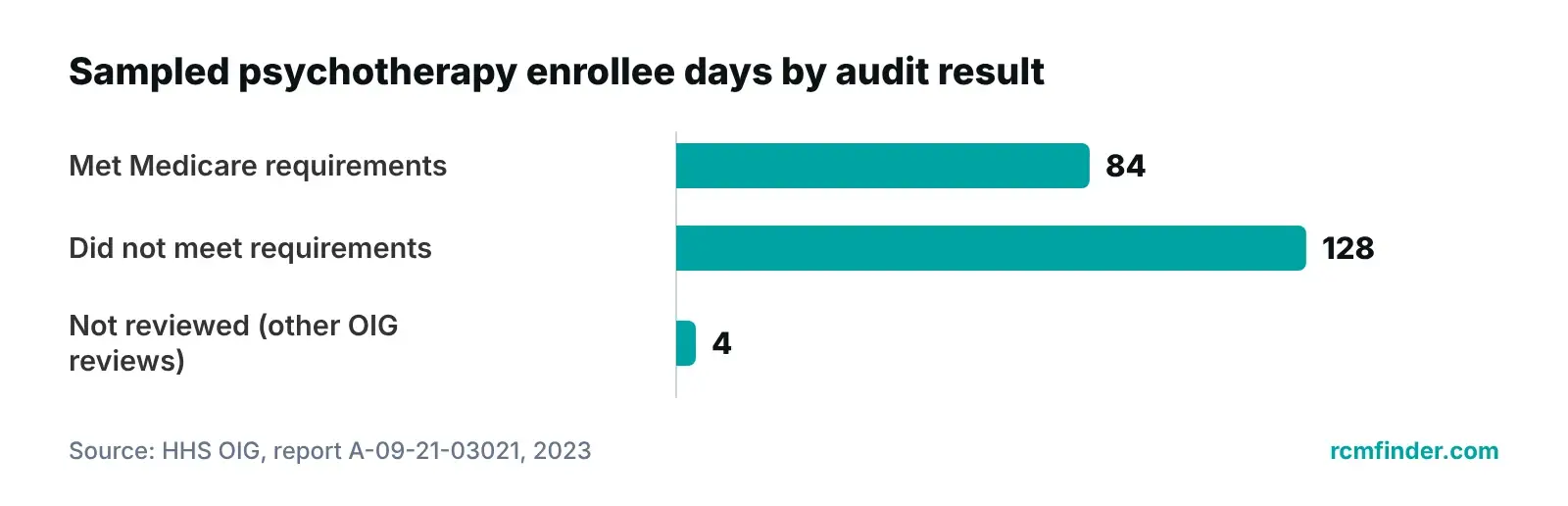
The audit risk is documented. In a HHS Office of Inspector General report issued May 2, 2023, auditors reviewed about $1 billion in Medicare Part B psychotherapy payments from March 2020 through February 2021. Of 216 sampled enrollee days, 128 did not meet Medicare requirements; one example was undocumented psychotherapy time. OIG estimated $580 million in improper payments over the period. That was Medicare during the public health emergency, but any payer expects the note to support the code.
Practices often mix psychiatrists, nurse practitioners, psychologists, social workers, counselors and marriage and family therapists. In its March 2026 Medicare mental health booklet, CMS says clinical psychologists are paid 100% of the fee schedule when they accept assignment, while clinical social workers, marriage and family therapists (MFTs) and mental health counselors (MHCs) are paid 75% and must accept assignment. Since January 1, 2024, MFTs and MHCs can enroll in Medicare and bill independently.
Carve-out plans, visit limits, program authorizations and stricter privacy rules add more. For a code primer, see our behavioral health coding cheat sheet; for the wider process, our behavioral health billing and RCM guide.
Revenue leaks at the handoffs: a patient booked without a verified benefit, a session coded from the calendar, a claim nobody can see. We run all four pillars on one set of rules.
Patients search privately and choose on trust and coverage. Our healthcare digital marketing builds clinician and insurance pages and intake paths, with no outcome promises. See our behavioral health marketing services page.
Our virtual medical assistants work in your time zone on intake, benefit checks, authorizations and scheduling, so the first session is already verified.
Our end-to-end revenue cycle management reviews each claim against the note: session minutes, add-on pairing, place of service and modifier, then works denials and A/R.
Our practice management system tracks claims by stage, checks data completeness before submission and flags underpayments. Scheduling is early access; credentialing and in-portal real-time eligibility are coming next, not live.
Find where your behavioral health claims leak
We review recent claims, remittances and denials, then show where time, modifiers or eligibility gaps cost you.
Psychotherapy codes are chosen by time with the patient or family, in three bands. Evaluations, E/M add-ons, interactive complexity and collaborative care add their own rules. We describe codes in our own words; check the current CPT manual and your payer's policy.
| Service | Codes (our wording) | Rule to apply | Common denial or audit trigger |
|---|---|---|---|
| Psychotherapy by time | 90832 (about 30 min), 90834 (about 45), 90837 (about 60) | Bands: 16 to 37, 38 to 52, 53 or more minutes | Minutes not documented, or note time below the band billed |
| Diagnostic evaluation | 90791 (no medical services), 90792 (with medical services) | A new-patient E/M can replace 90792 | Billed with medical services when none were provided, or the reverse |
| Therapy with an E/M visit | 90833, 90836, 90838 (add-ons to an E/M) | E/M leveled on its own; add-on carries the therapy band | Add-on without an E/M, or by a clinician who cannot bill E/M |
| Interactive complexity | 90785 (add-on) | One of four qualifying circumstances, documented | Used with crisis or family psychotherapy codes, or with an E/M alone |
| Collaborative care | 99492, 99493, 99494, G2214 | Monthly care manager time, consent, initiating visit, psychiatric consultant review | No consent or initiating visit, or time below threshold |
| General integration | 99484, G0323 | 99484 needs 20+ minutes of clinical staff time a month; G0323 counts 20+ minutes of clinical psychologist or clinical social worker time | Missing time log or consent |
Sources: APA CPT overview (2013) and interactive complexity summary (2012); AAPC code pages (secondary); CMS MLN909432 (January 2026), which names clinical psychologist or clinical social worker time for G0323. CPT is owned by the AMA; check the current code set.
When a prescriber sees a patient for medication and also provides therapy, the APA guidance says the E/M code is chosen by the level of service, not by time, and the timed psychotherapy add-on is reported with it. A therapist who cannot bill E/M uses the stand-alone codes. We suggest recording psychotherapy minutes in their own field.
Interactive complexity is not a way to bill for an interpreter alone. The APA summary notes that CMS generally says not to bill 90785 solely for translation or interpretation. Our 90834 and 90837 billing guide covers the stand-alone codes.
Per CMS's January 2026 MLN booklet, the collaborative care model uses a billing practitioner, a behavioral health care manager and a psychiatric consultant, with patient consent recorded first. The general integration code G0323 counts at least 20 minutes a month of clinical psychologist or clinical social worker time, with 90791 as its initiating visit. For the 2026 fee schedule, CMS finalized optional add-on codes to its advanced primary care management payment for these services. Primary care groups running this model may also want our family practice billing page.
Medicare's telehealth flexibilities run through December 31, 2027, per CMS's telehealth FAQ (updated October 8, 2026). Behavioral health telehealth to the home is permanent, but an in-person visit requirement starts after 2027.
Modifiers depend on your Medicare contractor. Noridian Medicare (Jurisdiction F) says modifier 95 marks a real-time audio-video service on the telehealth list, and modifier FQ marks an audio-only service; its FQ page says not to use 93. Other contractors and commercial payers may differ, so we apply each payer's rules at claim review. Our guides on telehealth billing and modifier 95 give the background.
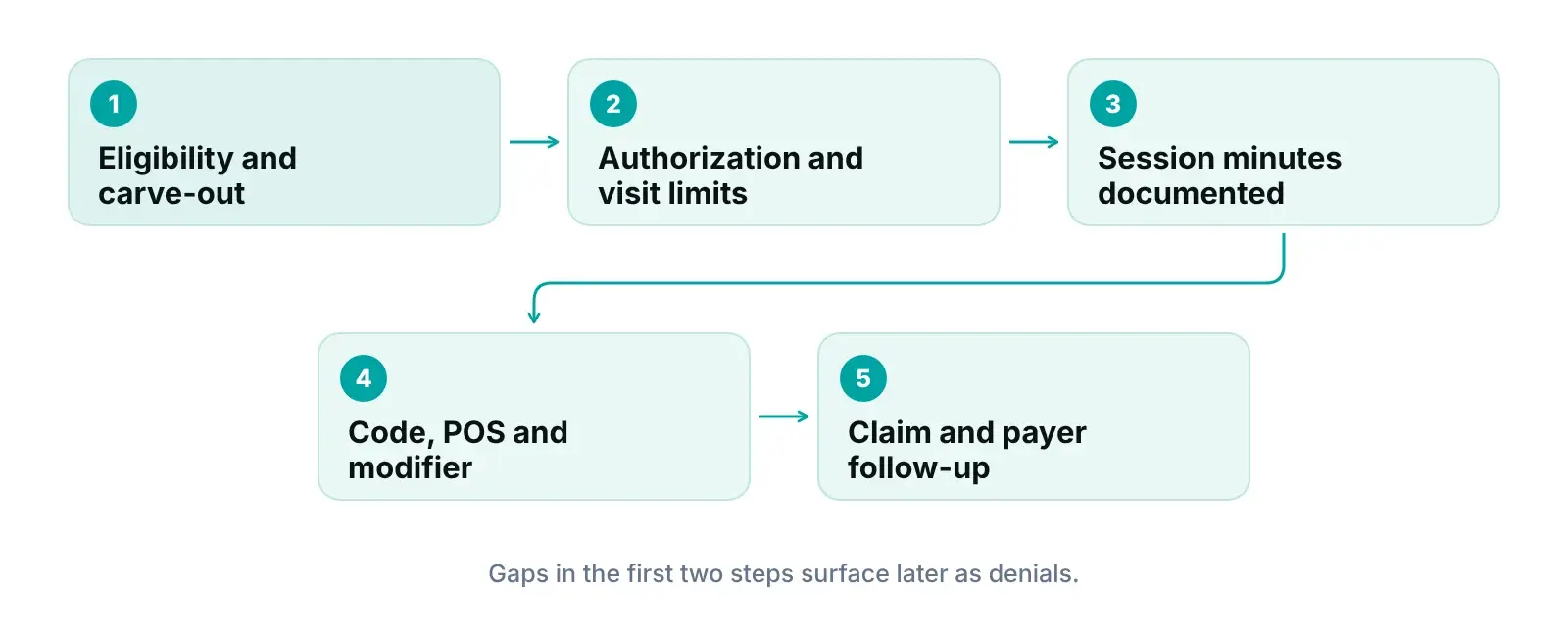
Check coverage, who administers the behavioral benefit, the network status and the remaining visits before the first session. Catch front-end gaps before they become denials.
A carve-out means a plan can send some mental health or substance use disorder benefits to a separate administrator, as one industry glossary describes it. The claim path, rules and network can differ from the medical plan's. Our behavioral health eligibility verification guide explains the check in detail.
| Check | Why it matters | Basis | What the VMA or biller does |
|---|---|---|---|
| Coverage, administrator and network status | A carve-out can move claims to another payer, and network status can differ | Industry glossary | Eligibility run; administrator, claim path and network recorded |
| Visit or session limits and counters | Plans may cap visits; parity law limits how | DOL parity overview | Remaining visits logged; alert before the limit |
| Telehealth benefit, POS and modifier rules | Payers set their own telehealth coding | CMS FAQ; Noridian (2025) | Visit type captured; rules applied at claim review |
| IOP and PHP authorization (Medicare: 9+ and 20+ hours a week) | Program care is certified against hours and a plan of care | 42 CFR 410.44 and 410.43; CMS MLN1986542 | Authorization requested; end dates on one worklist |
| Clinician type and enrollment | Medicare pays 100% or 75% by clinician type | CMS MLN1986542 | Rendering clinician matched to payer enrollment |
Sources: industry carve-out glossary (secondary); DOL parity overview; CMS Telehealth FAQ (October 2026); Noridian JF (2025); 42 CFR 410.43, 410.44; CMS MLN1986542 (2026). Commercial IOP and PHP rules are set by each plan.
For Medicare, 42 CFR 410.44 describes intensive outpatient care as for patients who need at least 9 hours of therapeutic services a week under a plan of care. 42 CFR 410.43 sets the partial hospitalization threshold at 20 hours a week. CMS's booklet adds that a physician recertifies partial hospital need at least every 30 days. Commercial plans write their own criteria and review cycles.
The Department of Labor says the parity law makes visit limits, prior authorization and medical necessity requirements for mental health comparable to those for medical and surgical benefits, for the plans it covers. A 2024 final rule added new requirements, but the federal departments said on May 15, 2025 they would not enforce the parts new since the 2013 rule. The statute and the 2013 rule still apply.
On September 8, 2026, DOL issued Field Assistance Bulletin 2026-03, naming three priorities: blanket mental health exclusions, medical necessity and review processes such as prior authorization, and network adequacy. When a plan's visit cap or review looks stricter than its medical equivalent, we flag it for you to raise.
See what denials cost your practice
Enter your volume and denial rate to estimate what eligibility gaps and coding errors are taking out of behavioral health revenue.
A clinician cannot bill a payer until enrolled and credentialed with it. Plan the sequence by payer and license type.
Per CMS, MFTs and MHCs have been able to enroll in Medicare and bill independently since January 1, 2024, and addiction counselors who meet MHC requirements can enroll as MHCs. Many commercial plans use CAQH ProView, where you authorize the organizations that may see your profile and keep it current. Someone must own upkeep.
Our guides to therapist credentialing and credentialing for group practices walk through the steps. Our portal's credentialing module is coming next, not live; today our team tracks applications and follow-up.
Keep billing in-house if you have an experienced behavioral health coder and clean front-end checks. Use a billing-only vendor if claim submission is your only gap. Choose a combined partner when problems start at intake or authorization.
| Job | In-house team | Billing-only vendor | Four-pillar partner (RCM Finder) |
|---|---|---|---|
| Code-to-minutes review | Biller or clinician self-check | Claim-level edits, often after submission | Review against the note and the add-on pairing before submission |
| Eligibility, carve-out and visit-limit checks | Front desk, if time allows | Usually left to the practice | VMA checks before session one and tracks limits |
| IOP and PHP authorizations | Utilization staff or the billing lead | Varies by vendor | VMA submits and tracks; billers watch end dates |
| Telehealth POS and modifier rules | Biller learns each payer | Rules in the vendor's scrubber | Payer rules applied at claim review |
| Credentialing follow-up | Office manager | Rarely included | Team tracks applications; portal module coming next |
| New patient demand | Separate marketing vendor | Not included | Healthcare marketing pillar |
| Cost model | Salaries, software and turnover | Fee model varies; ask | Quoted after a free audit |
Whichever model you choose, track denials by reason and payer every month.
We start with a free audit and change nothing until you see the findings. We build our billing pipeline around how claims actually move through a practice: registration, charge entry, submission, payment and follow-up. For behavioral health, we add the time, add-on and telehealth checks on this page.
We compare recent claims, remittances and denials with your notes and payer mix.
We put a Business Associate Agreement in place before accessing patient data. Then our team works inside your existing EHR (for example PrognoCIS, eClinicalWorks or athenahealth) and our portal.
We list payers, carve-out administrators, programs and clinician enrollment.
Virtual assistants verify benefits and authorizations; billers review codes against minutes before submission.
We work denials by reason, follow up on A/R and send weekly KPI reporting.
Talk to us about your practice
Tell us your clinician types, your payers and your hardest authorizations. We will tell you honestly whether we fit.
Any billing company that handles your patients' data is a HIPAA business associate. Get a Business Associate Agreement before access, and ask how they handle substance use disorder records and psychotherapy notes.
HHS guidance lists billing and claims processing as business associate work, and says subcontractors need their own agreements. The Security Rule's technical safeguards include access control, audit controls and transmission security.
If your practice runs a federally assisted substance use disorder program, Part 2 adds confidentiality rules. HHS's Part 2 page says the 2024 final rule took effect April 16, 2024, with a compliance date of February 16, 2026. It allows one patient consent for future treatment, payment and operations uses, and requires breach notification. Ask how a vendor flags Part 2 records and checks consent before a claim goes out.
Under 45 CFR 164.501, psychotherapy notes are a clinician's own analysis of counseling sessions, kept apart from the rest of the record. The definition excludes session start and stop times, treatment types, test results and summaries of diagnosis, plan and progress. Section 164.508 generally requires a signed authorization to use or disclose them, with narrow exceptions. A biller needs the progress note and time fields, not the psychotherapy notes.
We use role-based access, audit logging and encrypted (HTTPS) connections, and we put a Business Associate Agreement in place before accessing patient data. For your own side, use our HIPAA compliance checklist for medical practices.
We would rather tell you now than after you sign. Here is where we fit and where we do not.
A good fit if you are
Probably not a fit if you are
What we would do first if we were running your practice's revenue cycle tomorrow.
We ask practices to record start, stop and total minutes in a field billing can read. The time band sets the code, and undocumented psychotherapy time is the example OIG cited in its audit.
A 60-minute slot is not a 60-minute session. We compare documented minutes with the code billed and return gaps to the clinician.
The visit rules start after 2027. A date field and a provider field now save a retrofit later.
We confirm who administers the benefit, record the claim path, and re-check at plan-year turnover.
We track IOP and PHP certification and review dates in one place, so a lapse is caught before the denial.
Give billing the progress note and time fields. Store psychotherapy notes separately and release them only with a signed authorization or a listed exception.
They cover charge entry, coding review, claim scrubbing, submission, payment posting, denial management and A/R follow-up. For behavioral health that also means checking session minutes against the psychotherapy band, pairing add-on codes with E/M visits, applying telehealth place of service and modifiers, and tracking visit limits and authorizations. RCM Finder adds intake marketing, virtual assistants and a claims portal.
The code follows documented time with the patient or family. The APA's guidance puts 16 to 37 minutes in the 30-minute code (90832), 38 to 52 in the 45-minute code (90834) and 53 or more in the 60-minute code (90837). Document start, stop and total minutes. Payers can set their own policies, so check yours.
Yes, in general. A clinician who can bill E/M reports the E/M code, leveled on its own, plus a timed psychotherapy add-on (90833, 90836 or 90838) for the therapy portion, per APA guidance. Note the psychotherapy minutes separately. Therapists who cannot bill E/M use the stand-alone psychotherapy codes instead.
As of CMS's telehealth FAQ updated October 8, 2026, the flexibilities run through December 31, 2027. Behavioral health telehealth at home is permanent, but an in-person visit within 6 months before the first mental health telehealth service is required effective after December 31, 2027. Congress could change the dates, so verify before you bill.
A carve-out sends some mental health or substance use disorder benefits to a separate administrator. The claim path, rules and network can then differ from the medical plan's, and you may be in network for medical benefits but not behavioral ones. Verify the administrator, network status and authorization rules before the first session, not after a denial.
Yes. HHS lists billing and claims processing as business associate work, so sign a Business Associate Agreement before the company sees patient data. If you run a substance use disorder program, also ask how it handles 42 CFR Part 2 consent. We put a Business Associate Agreement in place before accessing patient data.
Guides from our operations team on topics covered on this page.
Tell us about your practice. We will contact you using the details you give.
Pricing is quoted after the audit, based on your volume and the services you choose. Prefer to talk? Call +1 (302) 556-2288.
Tell us about your practice
About the author: Awais Afzal
Healthcare Operations & Data Analyst, RCM Finder
Awais has spent more than 16 years in healthcare digital marketing and clinical operations management. He builds data-driven revenue cycle blueprints for high-ticket medical practices and leads product development of the RCM Finder portal. More about our team.
How we write: every figure, code and rule on this page was checked against the primary source listed below and independently fact-checked before publishing. We re-review this page every six months. Last reviewed October 12, 2026; next review April 12, 2027.
We use cookies to understand how our site is used and to measure our advertising. You can accept or reject non-essential cookies. See our Privacy Policy.