
Urgent Care Specialty

Urgent Care Billing Services for Walk-In, Occ-Med and Multi-Site Clinics

POS 20 claims, walk-in E/M levels, in-house x-ray and labs, workers’ compensation and new-location enrollment, plus coverage checks, local marketing and a claims portal.
  • Works inside your current EHR
  • US practice time zone, every shift
  • Weekly KPI reporting, or on your schedule
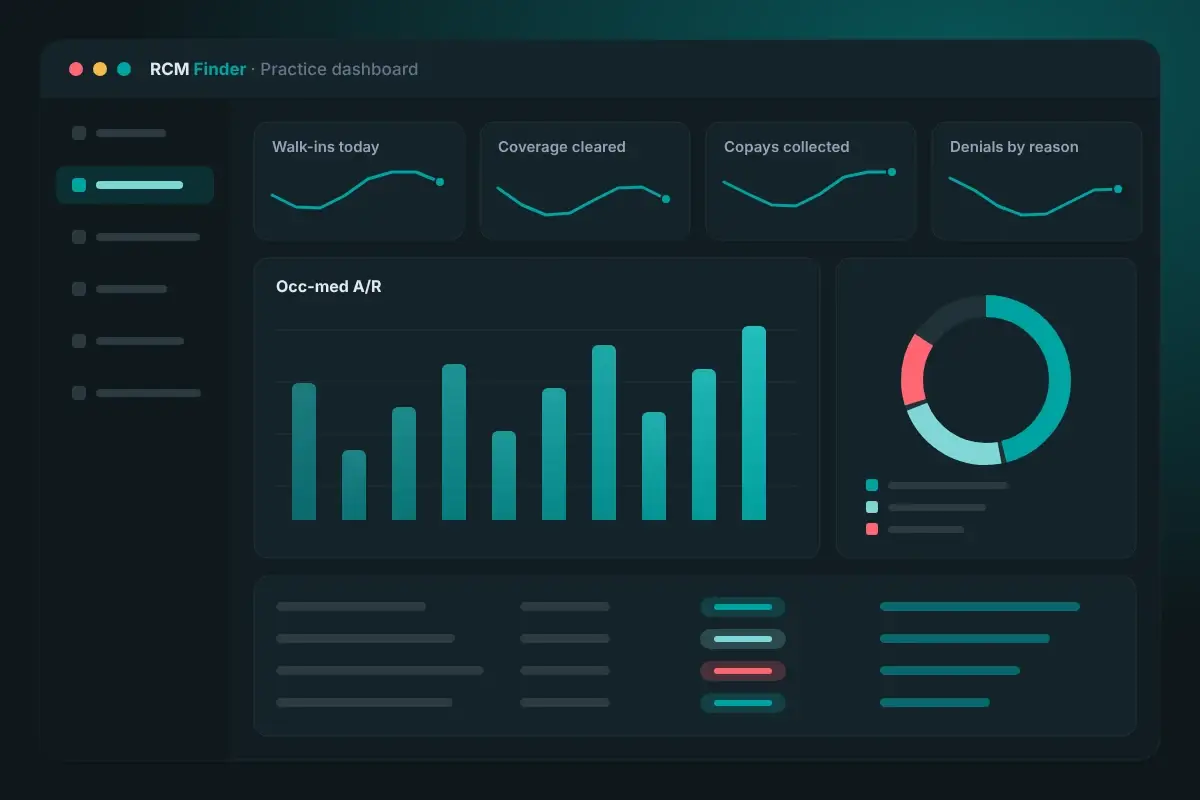
Urgent care billing dashboard showing walk-ins, coverage cleared, copays collected, denials by reason and workers’ comp A/R

Quick answer

Urgent care billing services handle the claims a walk-in clinic creates: place of service 20 visits, E/M levels chosen by decision-making or time, in-house x-ray and CLIA-waived labs, modifier 25 and workers’ compensation claims. RCM Finder adds remote front-desk assistants, local marketing and a claims portal.

Disclaimer: This page is educational and is not legal, coding or compliance advice. Medicare rules, NCCI policies and commercial payer policies change often and vary by contractor, plan and state, and workers’ compensation rules differ by state. Verify every code, modifier and rule against your Medicare contractor’s current documents, your payer contracts and the current CPT and HCPCS code sets before billing.

Why urgent care billing is different

Urgent care billing is different because patients walk in unannounced, you often meet them once, and one visit can combine an E/M visit, a procedure, an x-ray, a lab test and an employer or injury payer. Each part has its own rule, and a miss in any one can hold the whole claim.

The Urgent Care Association data page lists 15,101 urgent care centers in the US and shows an average of 33.96 patients per center per day in 2025. Coverage is also harder to read: in KFF’s 2026 enrollment update (June 2026), 35.2 million of the 64.2 million people with Medicare Parts A and B (55%) were in Medicare Advantage, so a Medicare card no longer tells you who pays.

If your clinic is closer to a scheduled primary care office, our family practice billing page may fit better. For fractures and sprains, see our orthopedic billing page.

What changed for 2026, and what is proposed for 2027

CMS’s CY 2026 Physician Fee Schedule final rule fact sheet (October 31, 2025) set the 2026 conversion factor at $33.40 for clinicians who are not qualifying APM participants. The CY 2027 proposed rule fact sheet (July 14, 2026) projects $32.84 and proposes that when a stand-alone E/M visit is billed the same day as a procedure with a 0-, 10- or 90-day global period, the higher-valued service is paid at 100% and the other at 50%. That is a proposal, not a rule. Check the final rule before you change workflows.

The four pillars, built for an urgent care clinic

An urgent care clinic needs patients who find the right location, coverage cleared in minutes, billing that understands walk-in coding and software that shows every claim. We run all four on one set of payer rules per location.

Pillar 1 · Healthcare Marketing

Healthcare Marketing for urgent care

Our healthcare digital marketing helps walk-in patients and local employers find each location through local SEO, Google Ads and reputation work.

  • A page and Google Business Profile for each location
  • Employer pages for occupational medicine
  • KPI: new patients and employer inquiries by location
Explore Healthcare Marketing
Pillar 2 · Virtual Medical Assistants

Virtual Medical Assistants for the walk-in queue

Our virtual medical assistants work on your practice’s time zone behind the front counter. They cannot greet a patient, but they can verify coverage, chase injury details and call patients about balances.

  • Coverage checked from the registration the desk sends
  • Injury visits: employer, claim number and adjuster chased
  • KPI: visits with coverage cleared before billing
Explore Virtual Medical Assistants
Pillar 3 · End-to-End RCM

End-to-End RCM for walk-in claims

Our end-to-end revenue cycle management covers coding support, claim scrubbing, denial management and A/R follow-up, with checks for place of service, E/M level and modifier 25.

  • Place of service checked against each payer’s rule
  • Workers’ compensation and health plan accounts kept apart
  • KPI: denials by reason and A/R days
Explore End-to-End RCM
Pillar 4 · Practice Management System

Practice Management System for multi-site billing

Our practice management system tracks every claim by stage, applies specialty-aware billing logic per claim, checks data completeness before submission and flags underpayments.

  • Claims tracked by stage, per location
  • Workflow rules that hold an injury claim missing a claim number
  • Early access: appointment booking with a calendar view
Explore Practice Management System

Find where your walk-in claims leak

We review recent claims and denials from each location, then show what to fix first. Pricing is quoted after the free audit.

Get a Free Practice Audit

Urgent care coding rules and denial triggers

Each part of a walk-in visit has its own coding rule. We describe codes in our own words because the AMA owns the CPT descriptors; check the current code sets and your contractor before billing.

Urgent care service areas: code examples, billing rules and typical denial triggers
Service areaCode examples (our wording)Billing rule to knowTypical denial trigger
Place of servicePOS 20 (urgent care); POS 11 (office)Medicare lists both as nonfacility; POS must match the settingMissing, invalid or conflicting POS
Visit level99202–99205 (new); 99211–99215 (established)Level by decision-making or total time; new means no service in 3 yearsLevel not supported by the note; wrong new or established status
Complexity add-onG2211Not paid with modifier 25, except wellness, vaccine or preventive servicesG2211 on a visit that had a procedure
After-hours add-on99051 (scheduled evening, weekend, holiday hours)Many payers bundle it; some pay only if the contract says soBilled to a payer that bundles it
In-house x-rayRadiology codes with global, TC and 26 versionsGlobal when you perform and read the study26 or TC added when you did the whole service
CLIA-waived labsWaived test codes with modifier QWMedicare edits labs by CLIA certificateMissing QW; test not on the location’s certificate
E/M with a procedureModifier 25; 59 or XE, XS, XP, XU25 needs a separate, documented E/M; 59 is a last resort and not for E/ME/M bundled into the procedure
Workers’ compensationState forms and fee schedulesThe employer’s carrier pays under state rulesBilled to the health plan; no claim number

Sources: CMS (POS code set, Claims Manual ch. 26, MLN006764, MM13546); 2026 NCCI Policy Manual; Premera and EmblemHealth policies; Noridian (2025); 42 CFR 411.40. Payer rules vary.

Place of service 20 or 11

The CMS place of service code set defines POS 20 as a location, distinct from a hospital emergency room, an office or a clinic, that treats unscheduled ambulatory patients seeking immediate attention. The Medicare Claims Processing Manual, chapter 26 lists both POS 20 and POS 11 as nonfacility, so Medicare pays the same rate under either, but a missing or invalid place of service makes a claim unprocessable. Other payers can key rules to it: EmblemHealth pays its after-hours codes 99050 and 99058 only for POS 11. See our POS 11 guide.

Choosing the E/M level for a walk-in

Per the CMS E/M services booklet (May 2026), most E/M visits are leveled by medical decision-making or total time, and history and exam no longer set the level. A new patient has had no services from you, or from a same-specialty physician in your group, in the previous three years, so search all your sites before coding. See our 99213 CPT code guide.

After-hours add-on 99051

99051 is an add-on for care during regularly scheduled evening, weekend or holiday hours. Treat it as contract-driven. The Premera Blue Cross payment policy (February 2026) does not separately pay it unless the contract allows, and calls it a Medicare status B (bundled) code. The EmblemHealth policy also groups it with bundled codes. The Urgent Care Association data page reports more than 5 million visits after 5 p.m. in a survey of 13 million encounters from January to March 2024.

Some commercial contracts ask for HCPCS S codes instead, such as S9088 (an urgent care add-on) or S9083 (a per-visit rate). Experity’s article on S codes, a vendor source, says they are not billed to Medicare.

In-house x-ray and CLIA-waived labs

CMS MLN Matters SE0587 (2005) splits imaging into a professional component (interpretation, modifier 26), a technical component (staff, supplies, equipment, modifier TC) and the global service, which is both. Noridian (May 2025) says a provider who performed the entire global service does not use modifier 26 separately.

CMS MLN Matters MM13546 (March 2024) says CMS edits laboratory claims at the CLIA certificate level and that new waived tests need modifier QW. Under 42 CFR 493.35, a laboratory performing only waived tests generally needs a separate certificate of waiver application for each location, so a new clinic needs its own.
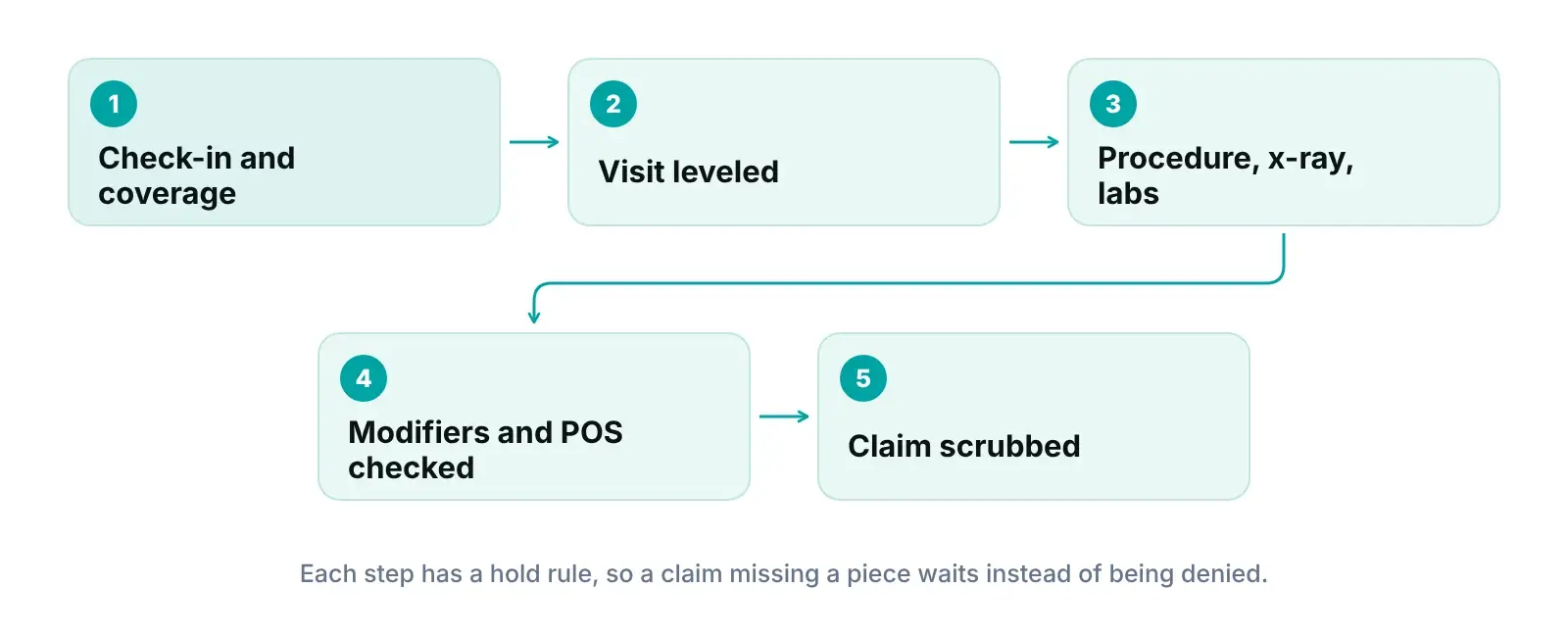
Diagram of an urgent care walk-in claim from check-in and coverage check to coding, x-ray and lab review, and submission
The path of a walk-in visit from the counter to a scrubbed claim.

Modifier 25 and modifiers 59 and X

The 2026 NCCI Policy Manual, chapter 1 (2026) allows a modifier only when the clinical circumstances justify it. Modifier 25 marks an E/M that is significant and separately identifiable from a procedure on the same date. For minor procedures, chapter 11 says the E/M must be separate from the decision to perform the procedure, and that being a new patient is not enough.

Modifier 59 marks a distinct procedural service. The manual says to use a more specific modifier (XE, XS, XP or XU) when one fits, and not to put 59 on an E/M. See our guides to modifiers 25 vs 59, modifier 59 and clean claims.

Occupational medicine and workers’ compensation billing

Workers’ compensation claims go to the employer’s carrier under state rules, not to the patient’s health plan, so they need their own intake, fee schedule and follow-up.

The U.S. Department of Labor sends workers injured on the job to their state workers’ compensation board. States set their own medical fee schedules. A New York Workers’ Compensation Board impact statement for proposed fee schedule updates, for example, says affected carriers and self-insured employers must use the schedules.

For Medicare patients, 42 CFR 411.40 says Medicare generally does not pay for a service that workers’ compensation has paid or can reasonably be expected to pay, and 411.43 requires the beneficiary to pursue that payment first.

A workflow that keeps injury claims out of the wrong queue

  1. Ask at check-in whether the injury happened at work, before coverage is entered.
  2. Capture the employer, injury date, claim number and adjuster, and whether the carrier accepted the claim.
  3. Bill the carrier on that state’s forms and fee schedule, and keep the account apart from health plan A/R.
  4. Invoice employer-paid occupational services to the employer account, not a patient’s insurance.
  5. Work denials by carrier. Our guide to the PR-3 denial code on workers’ compensation claims explains one common code.

In our portal, a workflow rule can hold an injury visit until a claim number is present. See also workers’ compensation and the revenue cycle.

Eligibility and patient collections at the walk-in

Check coverage and collect the patient’s share before the patient leaves; a patient who has gone home is harder to reach.

KFF’s 2025 Employer Health Benefits Survey found an average general annual deductible of $1,886 for single coverage in 2025 among covered workers with one, and 88% had one. In the same survey, 34% faced a deductible of $2,000 or more.

Walk-in checklist: what to confirm at the counter and what our VMAs do behind it
Check at the counterRule or fact behind itWhat the VMA does
Plan type, including Medicare AdvantageKFF 2026: 55% of Medicare beneficiaries in Medicare AdvantageVerifies the active plan; flags Advantage and secondary coverage
Work-related injury?42 CFR 411.40: Medicare generally does not pay what workers’ compensation coversCollects claim details; routes the visit to the carrier
Deductible and copay remainingKFF 2025: average single deductible $1,886; 88% have oneReports the amount to collect before the patient leaves
Self-pay patientCMS: self-pay patients can get a good faith estimate; a bill $400 or more above it may be disputedFlags self-pay and the practice’s estimate process
Medicare copay or coinsuranceOIG: routine waivers risk false-claim and kickback liability; hardship must be occasionalApplies the written collection policy; logs hardship decisions
New or established patientCMS: new means no service in 3 years from you or a same-specialty group physicianSearches all sites for a prior visit before coding

Sources: KFF (2025, 2026); 42 CFR 411.40; CMS good faith estimate page (2026); OIG Special Fraud Alert (1991, republished 1994); CMS MLN006764 (2026). Always check the member’s current plan.

The CMS good faith estimate page says uninsured and self-pay patients receive an estimate when they schedule at least three business days ahead or when they ask. For Medicare patients, the OIG Special Fraud Alert treats routine waiver of copayments as a risk and allows hardship forgiveness only occasionally.

Real-time eligibility inside our portal is coming next; today our team checks coverage through your existing EHR and payer portals. See our insurance verification guide and patient collection strategies.

Enrolling new locations with payers

File a new location’s Medicare enrollment before the clinic sees Medicare patients, and report it within 30 days at the latest. Commercial plans run their own processes, so start those earlier.

Under 42 CFR 424.516, a practice location change must be reported within 30 days, and other changes within 90. Clinics and groups enroll on the CMS-855B (12/2025), which asks for each practice location; a location outside your Medicare contractor’s jurisdiction needs a separate application. The CMS enrollment page points applicants to online PECOS.

Per 424.520(d), a physician organization’s billing privileges start on the later of the application filing date or the date services were first furnished at the new location. 424.521 allows billing back only 30 days, and only when circumstances prevented enrolling in advance.
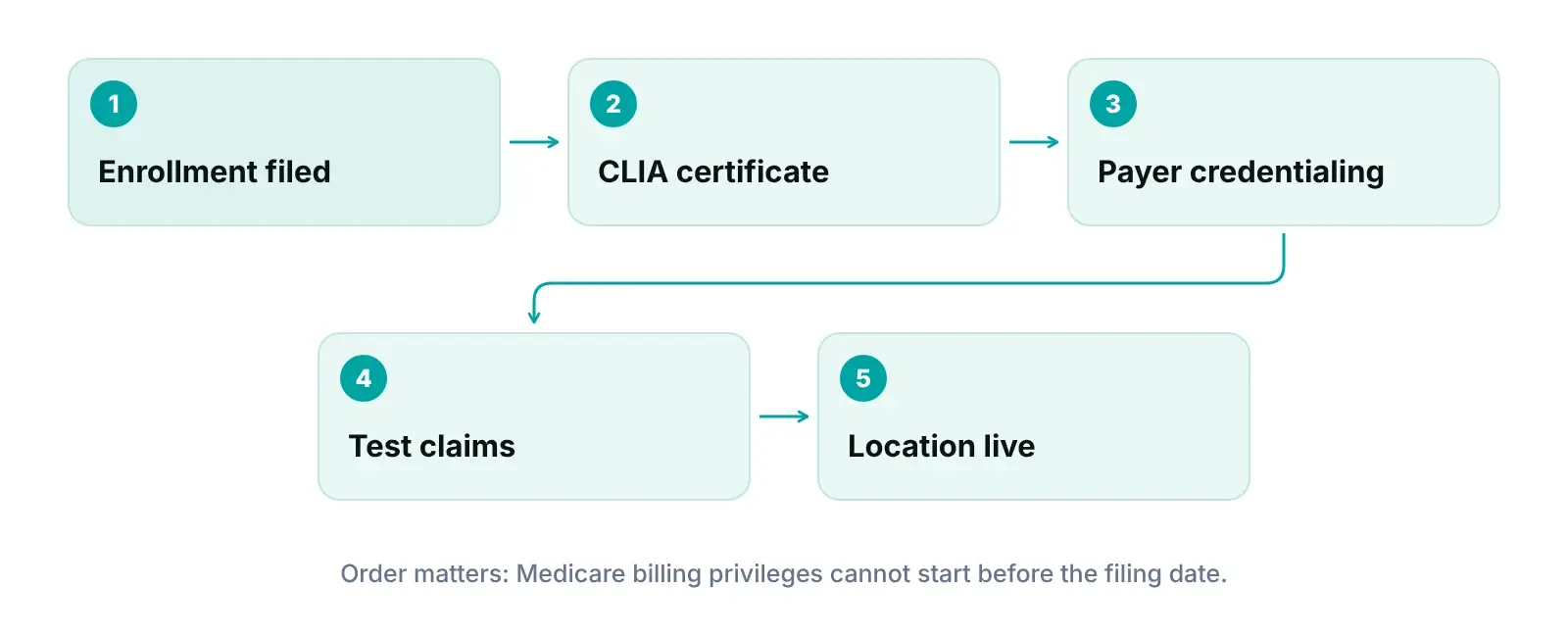
Diagram of opening an urgent care location: enrollment filed, CLIA certificate, payer credentialing, test claims and go-live
A new-location checklist that keeps claims from being denied on day one.

We track each location’s Medicare, Medicaid, commercial and CLIA status. The portal’s credentialing module is coming next, so today this is staff-run. Read our credentialing guide for group practices and payor enrollment strategies.

In-house team, billing-only vendor or four-pillar partner?

Stay in-house if your team already tracks denials by reason and keeps up with payer changes. Use a billing-only vendor if claims are the only gap. Choose a combined partner when problems start at the counter and end as denials.

Decision table: which model fits an urgent care clinic?
JobIn-house teamBilling-only vendorFour-pillar partner (RCM Finder)
Coverage checks and collectionsFront desk, between check-insUsually outside the scopeVMAs verify coverage; the desk collects
Coding: POS, E/M, modifiers, x-ray, labsYour coders and providersIncludedCoding support with payer rules per location
Workers’ compensation billingBuilt by your teamCheck the scopeSeparate intake and queue for injury accounts
Denials and A/RWhoever has timeIncludedIncluded, with reasons sent to the front desk
New-location enrollmentOwner or office managerOften separateStaff-run tracking; portal module coming next
Patient and employer growthSeparate marketerNot includedLocal SEO, Google Ads, reputation work
Fits whenA stable team that tracks denials by reasonClaims are your only gapProblems start at the counter and end as denials

For the cost view, read our guide to outsourcing urgent care billing and our revenue cycle KPI guide.

Estimate what denials cost your clinic

Enter your claim volume and denial rate to estimate the revenue you are leaving unbilled.

Open the Revenue Calculator

How it works

We start with a free audit and change nothing until you see the findings. We build our billing pipeline around how claims actually move through a practice: registration, charge entry, submission, payment and follow-up. For urgent care, we add the checks on this page.

  1. 1

    Free practice audit

    We review recent claims and denials from each location.

  2. 2

    Business Associate Agreement and access

    We put a Business Associate Agreement in place before accessing patient data. Then our team works inside your existing EHR (for example PrognoCIS, eClinicalWorks or athenahealth) and our portal.

  3. 3

    Payer and location map

    We list each payer’s rules for place of service, 99051 and S codes, and each state’s workers’ compensation schedule.

  4. 4

    Daily work

    VMAs verify coverage and chase injury details. Claims are coded, scrubbed, submitted and worked to payment.

  5. 5

    Weekly KPI review

    We review denials by reason, A/R days and underpayments, and adjust rules where claims stall.

Compliance: what to ask any urgent care billing company

Any billing vendor that handles your patients’ data is a HIPAA business associate. Get a Business Associate Agreement before any access, and ask how access is limited and logged.

The HHS sample business associate agreement provisions list what the agreement covers, including safeguards, breach reporting, return or destruction of data and subcontractors. Online check-in pages need care too. The HHS online tracking bulletin says pages that let users schedule appointments can involve protected health information, and a tracking vendor handling it needs a Business Associate Agreement. A June 2024 court decision vacated part of that guidance, but we keep tracking off scheduling forms unless the vendor signs one.

Questions to ask before you sign

  1. Will you and your subcontractors sign a Business Associate Agreement before any access?
  2. How do you limit each person’s access, and can we see the audit log?
  3. Who codes our visits, and what urgent care experience do they hold?
  4. How do you handle payers that bundle 99051 or require S codes?
  5. How do you keep workers’ compensation apart from health plan A/R?
  6. Can we export our data if we leave?

We use role-based access, audit logging and encrypted (HTTPS) connections, and we put a Business Associate Agreement in place before accessing patient data. For your side, use our HIPAA compliance checklist for medical practices.

Talk to us about your urgent care clinics

Tell us how many locations you run and where claims stall. We will tell you honestly whether we fit.

Call +1 (302) 556-2288

Who this is for, and who it is not for

We would rather tell you now than after you sign. Here is where we fit and where we do not.

A good fit if you are

  • Single and multi-site urgent care clinics billing under POS 20 or 11
  • Clinics with in-house x-ray and CLIA-waived labs
  • Clinics with occupational medicine or workers’ compensation injuries
  • Groups opening locations that need payer enrollment tracked
  • Billing companies serving several urgent care groups from one portal

Probably not a fit if you are

  • Hospital-owned urgent care whose billing the hospital controls
  • Clinics that want a promised collection rate; we report measured KPIs instead
  • Clinics needing the credentialing module or in-portal real-time eligibility today (coming next)
  • Clinics that need someone to greet patients at the front counter; our assistants work remotely

Expert recommendations from our operations team

What we would do first if we were running your practice's revenue cycle tomorrow.

  1. 01

    Write a payer rule sheet for every location

    List each payer’s position on POS 20 versus 11, 99051, S codes and workers’ compensation. It turns repeat denials into front-end fixes.

  2. 02

    Audit modifier 25 claims every quarter

    Read the notes on visits billed with a procedure. If the E/M does not stand apart from the decision to perform it, fix the documentation, not the modifier.

  3. 03

    Hold G2211 on procedure visits

    CMS does not pay it when the base E/M carries modifier 25, with narrow exceptions. A scrubber rule can stop that denial before submission.

  4. 04

    Confirm enrollment and the CLIA certificate before opening

    File Medicare enrollment for the location, hold its own certificate of waiver and test claims before the first patient.

  5. 05

    Ask about work first

    Put “work-related?” at the top of registration. Correcting an injury visit entered under a health plan costs more than the question.

  6. 06

    Quote the patient’s share at check-in, and review denials weekly

    Tell patients the copay and any deductible estimate, keep hardship waivers individual and recorded, and review denials by reason and location each week.

Frequently asked questions

What do urgent care billing services include?

They cover charge entry, coding, claim scrubbing, submission, payment posting, denial management and A/R follow-up for walk-in visits. For urgent care that also means place of service, E/M level, modifier 25, x-ray and lab components, workers’ compensation accounts and patient balances. RCM Finder adds remote assistants that verify coverage, local marketing for each location and a claims portal.

Should urgent care use place of service 20 or 11?

Use the code that matches your setting and each payer’s rules. CMS defines POS 20 as an urgent care facility for unscheduled patients and POS 11 as an office. Medicare lists both as nonfacility, so its rate is the same, but other payers may require one. Build a rule list by payer and confirm it in your contract.

Can urgent care bill 99051?

Sometimes. 99051 is an add-on for care during regularly scheduled evening, weekend or holiday hours. Premera’s 2026 policy treats it as bundled unless the contract allows separate payment, and EmblemHealth groups it with bundled codes. Check each commercial contract, and do not expect Medicare to pay it separately.

Why do urgent care claims get denied with modifier 25?

Usually because the note does not show a separate E/M from the procedure. Per the 2026 NCCI manual, the E/M must be significant and separate from the decision to perform a minor procedure, and a new patient is not enough by itself. CMS also proposes cutting payment for a same-day E/M and global procedure in 2027.

How is workers’ compensation billed in urgent care?

It goes to the employer’s workers’ compensation carrier, not the patient’s health plan, under that state’s fee schedule and forms. Capture the employer, injury date, claim number and adjuster at check-in. Medicare generally does not pay a service workers’ compensation covers, so ask about work-related injury first.

What does a new urgent care location need before billing?

At minimum a Medicare enrollment reported for the location, its own CLIA certificate of waiver if you run waived tests, and commercial payer enrollment. Medicare requires a new practice location to be reported within 30 days, and billing privileges start no earlier than the filing date. Start commercial credentialing earlier, because timelines differ by payer.

No cost, no commitment

Get your free practice audit

Tell us about your practice. A member of our operations team replies within one business day.

  • A review of your recent claims, denials and A/R aging
  • Where your front desk and prior authorizations slow payment
  • A prioritized fix list you keep, whether or not you hire us

Pricing is quoted after the audit, based on your volume and the services you choose. Prefer to talk? Call +1 (302) 556-2288.

Tell us about your practice

RCMFinder Master Intake Form
AA

About the author: Awais Afzal

Healthcare Operations & Data Analyst, RCM Finder

Awais has spent more than 16 years in healthcare digital marketing and clinical operations management. He builds data-driven revenue cycle blueprints for high-ticket medical practices and leads product development of the RCM Finder portal. More about our team.

How we write: every figure, code and rule on this page was checked against the primary source listed below and independently fact-checked before publishing. We re-review this page every six months. Last reviewed October 12, 2026; next review April 12, 2027.

Sources

  1. Place of service code set — CMS (2026)
  2. Medicare Claims Processing Manual, Chapter 26 — CMS (2026)
  3. Evaluation and Management Services (MLN006764) — CMS (2026 (May))
  4. 2026 Medicare NCCI Policy Manual, Chapter 1 — CMS (2026)
  5. 2026 Medicare NCCI Policy Manual, Chapter 11 — CMS (2026)
  6. CY 2026 Medicare Physician Fee Schedule final rule fact sheet (CMS-1832-F) — CMS (2025 (Oct 31))
  7. CY 2027 Medicare Physician Fee Schedule proposed rule fact sheet — CMS (2026 (Jul 14))
  8. Payment policy: CPT 99050, 99051, 99053, 99056, 99058, 99060 (CMI_051694) — Premera Blue Cross (2026)
  9. After Hours and Weekend Care policy (RP.MM.RE.02) — EmblemHealth (2019 (effective Oct 1))
  10. Handling Medicare and S Codes in Urgent Care Billing — Experity (vendor, secondary source) (2016 (modified 2026))
  11. MLN Matters SE0587 — CMS (2005)
  12. Modifier 26 — Noridian Healthcare Solutions (Medicare contractor) (2025)
  13. MLN Matters MM13546: new waived tests — CMS (2024)
  14. 42 CFR 493.35: Application for a certificate of waiver — eCFR (2026)
  15. Workers’ Compensation — U.S. Department of Labor (2026)
  16. Regulatory Impact Statement (Medical Fee Schedule Updates) — New York State Workers’ Compensation Board (2026)
  17. 42 CFR 411.40 — eCFR (2026)
  18. 42 CFR 411.43 — eCFR (2026)
  19. 2025 Employer Health Benefits Survey — KFF (2025)
  20. Medicare Advantage in 2026: Enrollment Update and Key Trends — KFF (2026 (Jun))
  21. Good faith estimate — CMS No Surprises Act (2026)
  22. Special Fraud Alert: Routine Waiver of Copayments or Deductibles Under Medicare Part B — HHS Office of Inspector General (1991 (republished 1994))
  23. 42 CFR 424.516 — eCFR (2026)
  24. 42 CFR 424.520 — eCFR (2026)
  25. 42 CFR 424.521 — eCFR (2026)
  26. Medicare Enrollment Application for Clinics/Group Practices (CMS-855B) — CMS (2025 (12/2025 version))
  27. Medicare enrollment for providers and suppliers — CMS (2026)
  28. Urgent Care Data — Urgent Care Association (2026)
  29. Sample business associate agreement provisions — HHS (2026)
  30. Use of Online Tracking Technologies by HIPAA Covered Entities and Business Associates — HHS Office for Civil Rights (2024 (reviewed June 2024))