
The 99213 CPT code is the level 3 office or outpatient visit for an established patient, supported by low medical decision making or at least 20 minutes of total time on the date of service. History and exam must be medically appropriate but no longer set the level. Moderate decision making belongs to 99214.
Many guides still call 99213 a moderate visit, quote a 20-to-29-minute range or print one Medicare dollar amount for every payer. This guide replaces those with the current rules a practice manager or coder needs to decide how to bill, document and audit the code.
It covers how to pick the level, what the note has to show, why claims are downcoded or denied, how modifier 25 and G2211 interact with the visit, and what is publicly known about 2026 Medicare payment. For related work, see our posts on modifier 25 vs 59 and medical coding audits.
Key takeaways
- 99213 is low medical decision making (MDM), or at least 20 minutes of total time on the date of service. Moderate MDM is 99214.
- Two of three MDM elements (problems, data, risk) must reach the low level.
- History and exam must be medically appropriate but do not set the level.
- G2211 is not paid with modifier 25 on the E/M, with a preventive-service exception from January 2025.
- No single dollar amount fits every payer: use the fee schedule for your locality and each contract.
What is the 99213 CPT code, and who can use it?
It is the third of five office or outpatient visit levels for an established patient. In plain terms, it describes a visit with a low level of medical decision making (MDM), or one that reaches at least 20 minutes of total time on the date of the encounter. A Medicare contractor describes it exactly that way: low MDM, or meeting or exceeding 20 minutes of total time (Noridian Healthcare Solutions).
Two words in that sentence matter. Established means the patient has received professional services from the clinician, or another clinician of the same specialty in the same group, within the previous three years (CMS MLN Evaluation and Management Services Guide, 2020). A new patient uses a different code family. Low means 99213 is not the moderate-complexity code. That is 99214, and it is the most common mix-up in older guides.
The AMA owns the official CPT wording, so this guide describes the code in its own words. For the exact descriptor and current guidelines, use the current CPT manual.
| Code | MDM level | Lower end of AMA 2021 time range | Typical example in AAFP's 2020 guidance |
|---|---|---|---|
| 99212 | Straightforward | 10 minutes | Minimal problem, minimal data and risk |
| 99213 | Low | 20 minutes | One stable chronic illness |
| 99214 | Moderate | 30 minutes | Prescription drug management as moderate risk |
| 99215 | High | 40 minutes | High-risk problem or management |
Source: American Academy of Family Physicians, Family Practice Management (2020); Oregon Rural Health Association office visit coding guide (2021). The 2021 guides printed ranges (99213 was 20-29 minutes). Current wording for 99213 is ‘meeting or exceeding 20 minutes’ (Noridian).
Where the old 'moderate' label came from
Some older articles call 99213 a moderate-complexity visit and give it a 15-minute or 20-to-29-minute duration. The AAFP and Oregon Rural Health tables above pair 99213 with low MDM, and the contractor page says the same. If a note or template still says ‘moderate’ for 99213, fix it first.
How do you pick 99213 by medical decision making?
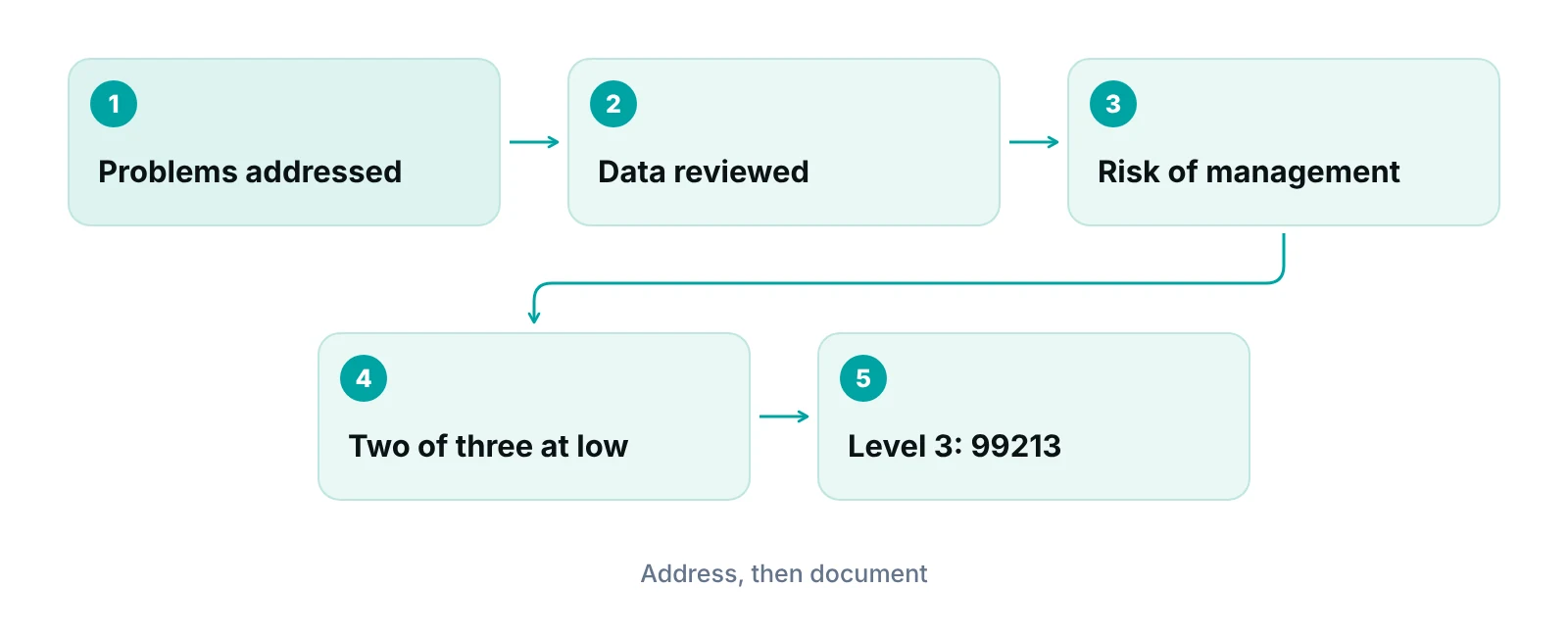
You pick it when the visit meets low MDM on at least two of three elements. The elements are the number and complexity of problems addressed, the amount and complexity of data reviewed and analyzed, and the risk of complications from patient management (Noridian; AAFP, 2020).
Problems: addressed, not just listed
A problem earns credit when the clinician addresses it, for example by ordering a study or considering treatment, including treatment the patient declines. A diagnosis that is listed without management, or a referral without any further workup or treatment decision, does not count (Oregon Rural Health Association, 2021). AAFP’s example of a low problem is one stable chronic illness (AAFP, 2020).
Data: tests and records the clinician actually used
Credit comes from ordering or reviewing tests, reviewing external notes, using an independent historian, or independently interpreting a study. Tests billed in-house on the date of service do not earn credit toward data (Oregon Rural Health Association, 2021). The note should name what was reviewed and what it led to.
Risk: what the management plan could cause
A plan with low risk, such as managing a stable problem with over-the-counter treatment, fits 99213. AAFP gives prescription drug management as an example of moderate risk, which points toward 99214 when the other elements support it (AAFP, 2020). The overall level needs two of the three elements, so one strong element alone does not raise the code.
“A visit level is a conclusion the note has to prove. The code should be the last thing chosen, after the problems, data and risk are on the page.”
Can you bill 99213 by time instead?
Yes. A visit can be coded by MDM or by total time, whichever is the better fit for the visit. For 99213 the time reference is 20 minutes of total time on the date of the encounter, and it includes both face-to-face and non-face-to-face time the clinician personally spends (Noridian).
What counts is broader than the exam room. Reviewing tests before the visit, taking the history, examining, counseling, ordering, documenting and coordinating care all count. Clinical staff time does not. Each minute counts once, so if two clinicians see the patient at the same moment, only one clinician’s time counts for that minute (Oregon Rural Health Association, 2021).
Why '20 to 29 minutes' is out of date
Older guides, including the earlier version of this post, quote 99213 as 20 to 29 minutes, and one table in that post said 15 minutes. The 2021 tables did print that range (AAFP, 2020). Current contractor wording is meeting or exceeding 20 minutes, so a 35-minute visit is not capped at 99213 by the clock. If the time supports a higher level, the time can be used to support that code. Check the current CPT time statements for 99214 and 99215 before you rely on a threshold.
Prolonged time is not a 99213 add-on
The 2021 Oregon Rural Health guide describes CPT 99417 as reported with 99205 or 99215 for time beyond the base code, with CMS using HCPCS G2212 and its own threshold (Oregon Rural Health Association, 2021). Prolonged time therefore applies after the top level is reached, not on top of 99213. Confirm the current rules in CPT and with each payer.
What does the note have to show for 99213?
The note has to support the level you bill, and a medically appropriate history and physical exam. The history and exam are still documented for care and for audits, but they no longer set the level. The Noridian page states that the level of history and physical examination is not considered when determining the level of service (Noridian).
That change also removes a trap in older guides. A checklist built around the old history elements (chief complaint, history of present illness, review of systems) does not decide whether the claim is supported today. The MDM or the time does.
- Problems addressed: each one named, with its status and what was decided about it.
- Data: which tests were ordered or reviewed, which outside records were read, and who gave history if not the patient.
- Risk: the treatment decision in plain words, including any option considered and declined.
- Time, if time is the basis: total minutes on the date of service and what the clinician did, not a stock sentence.
- Signature and credentials: a valid signature and the clinician’s credentials on the record.
A related point is that the same discipline helps on other visit-plus-service claims, such as an E/M with a psychotherapy add-on. See the 90836 CPT code guide for how a second documented service sits beside the visit level.
Why do 99213 claims get denied or downcoded?
The most common documented reason is that the record does not support the level billed. A Medicare contractor’s review of office visit claims (99212 to 99215) from January 1 to March 31, 2024 listed three top reasons: records not returned, documentation that supported a lower level of service, and a missing valid signature or credentials (Noridian).
| Reason in the review | What it usually means | Fix in the practice |
|---|---|---|
| Failure to return records | The records request went unanswered or came back incomplete | Name one owner for records requests and track the due date |
| Documentation supported a lower level of service | The note did not prove the MDM or time behind the code | Add MDM and time prompts to the template; sample-audit level 3 and level 4 visits |
| Missing valid signature or credentials | The record was unsigned or lacked the clinician’s credentials | Block claim release until the note is signed with credentials |
Source: Noridian Healthcare Solutions, 99212-99215 Office or Other Outpatient Visit review results (January 1 to March 31, 2024). The ‘what it means’ and ‘fix’ columns are RCM Finder’s practical reading, not Noridian’s text.
Most of these are process problems rather than coding mysteries, which is why a coding audit with a small sample often finds them quickly. Our guide to medical coding audits explains how to run one. When a denial does arrive, work it by cause. A practice that wants help with the follow-up can use denial management services to sort appeals by reason code.
Which modifiers and add-ons matter with 99213?
Three come up most often: modifier 25, the G2211 add-on and, for telehealth, modifier 95. Each one has a documentation test, and a payer may apply its own edits on top.
| Item | What it does | Rule to check before you bill |
|---|---|---|
| Modifier 25 | Marks an office visit as separately identifiable on a day it is billed with another service | Medicare will not pay G2211 when the E/M carries modifier 25, with one exception for listed preventive services from January 2025 |
| G2211 | Add-on for the complexity of longitudinal care, reported with office or outpatient E/M 99202-99215 | Records must show ongoing care with a care plan; templated language may not support it |
| Modifier 95 with POS 02 or 10 | Marks a synchronous telehealth visit | POS 02 when the originating site is not the patient’s home, POS 10 when it is the home |
| 99417 | Prolonged time add-on | Described with 99205 and 99215, not 99213 |
Source: Noridian Healthcare Solutions (G2211 page and 99212-99215 page); Oregon Rural Health Association (2021). Payer rules vary.
The modifier 25 test is the same on every claim: the visit must be a significant, separately identifiable service from the procedure done that day, and the note must show it. Our comparison of modifier 25 vs 59 walks through when each applies.
G2211 is the newer risk. The contractor warns that templated language may not support it and that a once-a-year visit without a care plan for an ongoing condition may be unlikely to qualify (Noridian, G2211 page). Beginning in 2026, G2211 also applies to home or residence E/M visits (codes 99341 to 99350), per the same page. For chronic-condition billing around these visits, see chronic care management coding and billing and, for remote visits, modifier 95 telehealth billing.
What does 99213 pay?
There is no single number. Medicare sets the payment in its fee schedule, and every other payer uses its own contract or fee schedule. The old table in this post showed one dollar figure for Medicare and the same figure for Medicaid in every row, which is not a safe assumption to make for any payer.
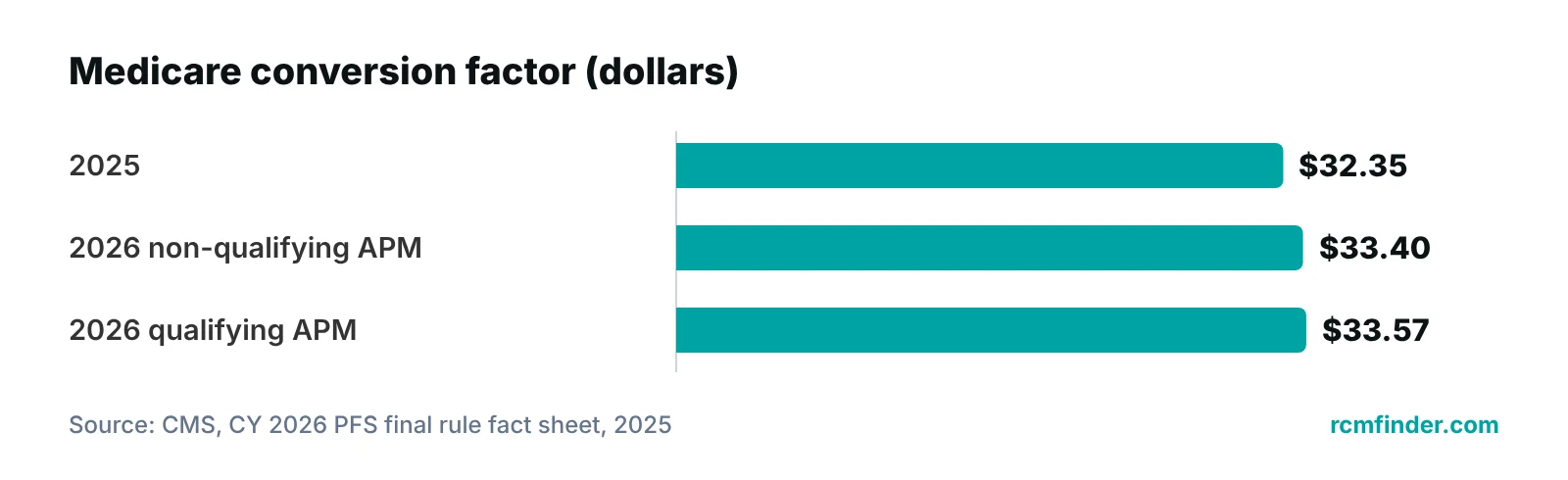
One fact is public and sourced. For 2026, CMS finalized two Medicare conversion factors: $33.40 for practitioners who are not qualifying APM participants and $33.57 for those who are, up from $32.35 in 2025 (CMS, CY 2026 Physician Fee Schedule final rule fact sheet, 2025). CMS also applied a -2.5% efficiency adjustment to some services for 2026 but excluded E/M services from it, so 99213 is not subject to that cut.
To see the Medicare amount for your area, use the CMS Physician Fee Schedule lookup tool and read your payer contracts for the rest. Plan on a rate for each payer, not one. The revenue calculator can help you turn your own payer rates and visit volume into a baseline.
Where does 99213 show up most in practice?
It is a follow-up code, so it appears wherever clinics see stable patients on a repeating schedule. Primary care is the clearest case, and the family practice billing and revenue cycle page covers the surrounding workflow. The same rules apply in any specialty that bills office E/M, but the documentation habits differ, so use your own specialty’s examples when you build templates.
A level 3 visit is where small habits add up: a note that states problems and decisions gets paid at the right level, while a note that cannot show them invites a downcode. If your coders are splitting time between charge entry and denials, medical billing services can take on the coding review and claim submission while your staff keep the clinical templates current.
Check your own level 3 visits
Want a second set of eyes on your E/M documentation?
A free practice audit looks at how your claims move from the visit note to payment and where level mismatches and denials start. Pricing, if you decide to go further, is quoted after the audit.
Our recommendations
- Correct every template that calls 99213 'moderate'. We recommend searching templates, cheat sheets and training slides for the old wording. 99213 is low MDM. Moderate belongs to 99214.
- Put MDM prompts ahead of the code. Add three short fields to the visit note: problems addressed with status, data reviewed or ordered, and management decision with risk. The code is then selected from what was written.
- Use time only when it is real. If a visit is coded by time, require a total-minutes entry on the date of service and a brief list of what the clinician did. A stock sentence is not evidence.
- Hold unsigned notes before billing. A missing signature or credentials is on a Medicare contractor’s top-three list for office visit review. A hold rule at claim release costs less than an appeal.
- Audit a small sample each quarter. Pull a handful of 99213 and 99214 visits per clinician and compare the note to the code billed. Share the findings with the clinician, not only with the coders.
- Keep a payer-by-payer edit list. Modifier 25, G2211 and telehealth rules are applied differently by payers. A one-page list reviewed each January keeps the front end and the coders aligned.
Bottom line
The 99213 CPT code is low MDM or at least 20 minutes of total time, and the note has to prove whichever one you used. Fix any template that calls it moderate, add MDM and time prompts, and audit a small sample each quarter. If denials and downcodes on these visits keep returning, our denial management services can work them by cause, or you can talk to our team or request a free practice audit.
Frequently asked questions
What is the 99213 CPT code?
It is the level 3 code for an office or outpatient visit with an established patient. It is supported by low medical decision making or by at least 20 minutes of total time on the date of the visit. A Medicare contractor describes it that way. Use the current CPT manual for the official wording.
Is 99213 low or moderate complexity?
Low. The AAFP and Oregon Rural Health tables pair 99213 with low medical decision making and 99214 with moderate. Older articles that call 99213 moderate are wrong on this point, so update any template or training material that still says so.
How many minutes does a 99213 visit need?
If you code by time, the reference is 20 minutes of total time on the date of the encounter, including non-face-to-face work done by the clinician. The 2021 tables printed 20 to 29 minutes, but current contractor wording is meeting or exceeding 20 minutes. Clinical staff time does not count.
Do history and exam still decide the level?
No. A medically appropriate history and exam must be documented, but the level is chosen by MDM or total time. Noridian states that the level of history and physical examination is not considered when determining the level of service. Missing support for the MDM is what leads to downcoding.
Can I bill modifier 25 or G2211 with 99213?
Both can appear on a claim, but check the rules. Medicare does not pay G2211 when the E/M has modifier 25, with an exception for certain preventive services from January 2025. G2211 also needs documentation of ongoing care, and templated language may not support it.
How much does Medicare pay for 99213?
The amount depends on the fee schedule and your locality, so no single figure applies everywhere. For 2026, CMS set conversion factors of $33.40 and $33.57, and excluded E/M services from its -2.5% efficiency adjustment. Look up your locality in the CMS fee schedule lookup and check each commercial payer’s contract.
Get your free practice audit
Tell us about your practice. We will contact you using the details you give.
- A review of your recent claims, denials and A/R aging
- Where your front desk and prior authorizations slow payment
- A prioritized fix list you keep, whether or not you hire us
Pricing is quoted after the audit, based on your volume and the services you choose. Prefer to talk? Call +1 (302) 556-2288.
Sources
- 99212-99215 Office or Other Outpatient Visit (review results) — Noridian Healthcare Solutions (Medicare Administrative Contractor) (2024)
- Complexity Add-on Code G2211 — Noridian Healthcare Solutions (Medicare Administrative Contractor) (2026)
- Calendar Year (CY) 2026 Medicare Physician Fee Schedule Final Rule (CMS-1832-F) fact sheet — Centers for Medicare & Medicaid Services (2025)
- 2021 Office Visit Coding — Oregon Rural Health Association (OHSU) (2021)
- Office E/M changes for 2021 — American Academy of Family Physicians, Family Practice Management (2020)
- Evaluation and Management Services Guide (ICN 006764) — CMS Medicare Learning Network (hosted by HHS) (2020)
Disclaimer: This article is educational and is not legal, coding, billing or compliance advice. CPT codes are owned by the AMA, and code descriptors, payer policies and federal rules change and vary by payer and state. Verify current requirements with the official CPT manual, your payers and your counsel before you act.
