
Internal Medicine Specialty

Internal Medicine Billing Services, Front Desk and Growth in One Plan

Visit leveling, add-on codes, care management, transitional care and remote monitoring for internists, plus front-desk staff, patient marketing and a claims portal, built on CMS rules and your payers' own policies.
  • Works inside your current EHR
  • US practice time zone, every shift
  • Weekly KPI reporting, or on your schedule
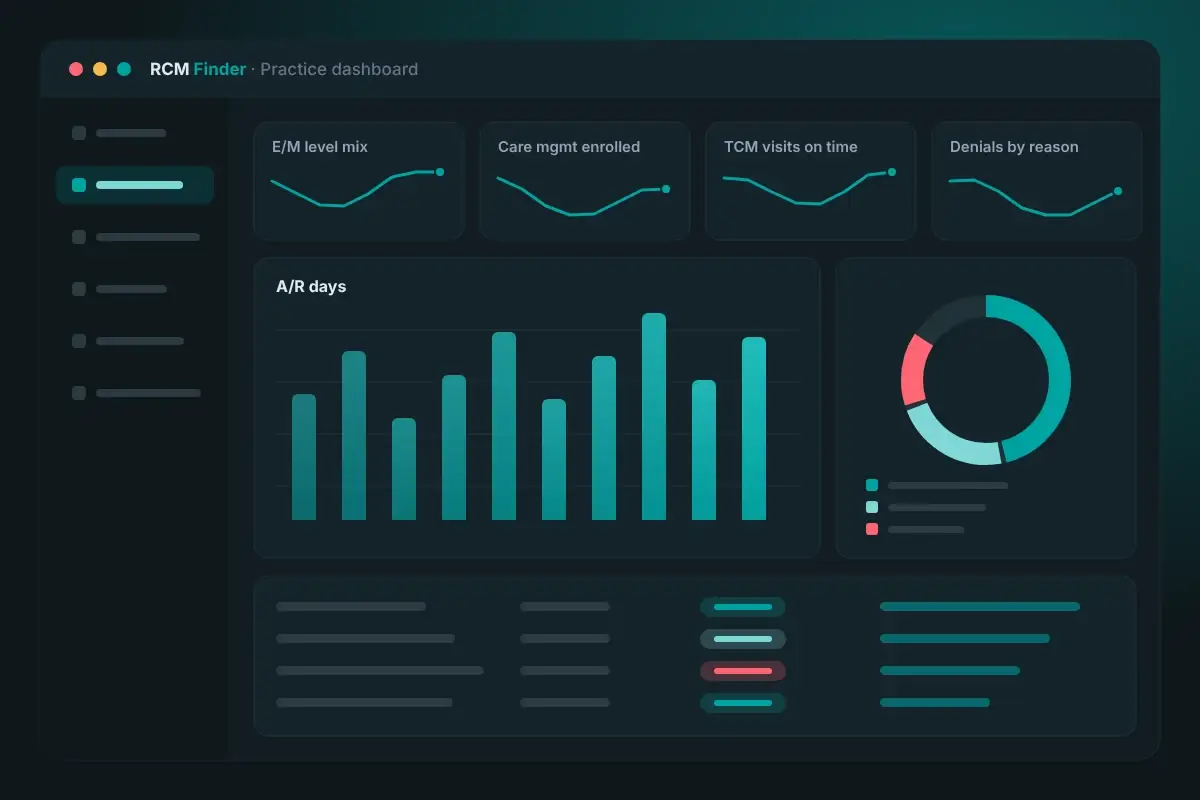
Internal medicine billing dashboard with E/M level mix, care management enrollment, TCM visits on time, denials and A/R days

Quick answer

Internal medicine billing services manage the claims an adult practice creates: office visits leveled by medical decision making or time, add-ons such as G2211 and G2212, split/shared hospital visits, and monthly care management, transitional care and remote monitoring. RCM Finder pairs that billing with front-desk assistants, patient marketing and a claims portal, starting with a free audit.

Disclaimer: This page is educational and is not legal, coding or compliance advice. Medicare guidance, fee schedule rules and commercial payer policies change often and vary by contractor and plan. Verify every code, time threshold and rule against your Medicare contractor's current guidance, your payer contracts and the current CPT and HCPCS code sets before billing.

Why internal medicine billing is different

Internal medicine is paid mainly for evaluation and coordination, not procedures. Visit levels, add-on codes, modifiers and monthly services decide what the practice collects.

Office visits have been leveled by medical decision making (MDM) or total time since 2021, Noridian notes. The Medicare Claims Processing Manual extends this to most E/M families from 2023 and requires the full time when time is used. Under the AMA's E/M guidelines, two of three MDM elements must meet the level: problems addressed, data reviewed and risk of management.

Then come the layers: add-on codes G2211 and G2212, and modifiers 25 and FS. Payers do not all treat them the same way.

Monthly services, from care management to remote monitoring, pay only when consent, timing and minutes are documented. This page covers adult internal medicine; see also family practice billing services and geriatrics billing services.

What changed for internal medicine payment in 2026

CMS's CY 2026 Physician Fee Schedule final rule fact sheet (October 31, 2025) set the conversion factor at $33.40 for clinicians who are not qualifying APM participants ($33.57 for those who are), up from $32.35. Its -2.5% efficiency adjustment applies to non-time-based services, and E/M visits and care management are exempt. Noridian adds that G2211 can be billed with home or residence visits from 2026.

The four pillars, built for an internal medicine practice

An internal medicine practice needs the right adult patients, a front desk that tracks consents and discharges, billing that levels visits correctly and software that shows every claim.

Revenue leaks between teams: a missed discharge, an uncharted consent, a G2211 sent on a modifier-25 sick visit. We run all four pillars against one set of payer rules.

Pillar 1 · Healthcare Marketing

Healthcare Marketing for internists

Our healthcare digital marketing fills the panel you want, from adults with chronic conditions to new Medicare enrollees, through local SEO, Google Ads and reputation work, with tracking set up to follow HHS guidance.

  • Location pages and a Google Business Profile per office
  • Tracking kept off patient forms without a BAA
  • KPI: new patients booked by source
Explore Healthcare Marketing
Pillar 2 · Virtual Medical Assistants

Virtual Medical Assistants for internal medicine

Our virtual medical assistants run your front desk on your practice's time zone. They verify eligibility, check wellness-visit dates, track consent and work discharge lists. Clinical calls go to your nurses.

  • Consent on file before care management or RPM starts
  • Post-discharge visits booked inside the TCM window
  • KPI: TCM visits booked on time
Explore Virtual Medical Assistants
Pillar 3 · End-to-End RCM

End-to-End RCM for internal medicine claims

Our end-to-end internal medicine revenue cycle management covers coding support, claim scrubbing, denial management and A/R follow-up, with added checks on visit levels, add-on and modifier pairs, FS on shared hospital visits and monthly service periods.

  • Level matched to MDM or documented time
  • G2211, G2212 and modifier 25 checked by payer
  • KPI: denials by reason and A/R days
Explore End-to-End RCM
Pillar 4 · Practice Management System

Practice Management System for internists

Our practice management system tracks every claim by stage, applies specialty-aware billing logic per claim, checks data completeness before submission and flags payments below the expected amount.

  • Workflow rules that hold incomplete claims
  • Underpayment flags against expected amounts
  • Early access: appointment booking with a calendar view
Explore Practice Management System

Find where your visit and care management claims leak

We review recent E/M claims, add-ons, care management logs and denials, then show what to fix first. Pricing is quoted after the audit.

Get a Free Practice Audit

Internal medicine service families: codes, rules and denial triggers

Each service family has one rule that decides payment. Codes are described in our own words (the AMA owns CPT descriptors); check the current code set and your contractor's guidance before billing.

Internal medicine service families: code examples, billing rules and typical denial triggers
Service familyCode examples (our wording)Billing ruleTypical denial or audit trigger
Office and outpatient visits99202–99205 (new); 99211–99215 (established)Level by MDM (2 of 3 elements) or the practitioner's total time that dayNote does not support the level; staff time counted
Prolonged office timeG2212 (Medicare); 99417 (CPT, some other payers)One G2212 from 69 minutes with 99215 or 89 with 9920599417 sent to Medicare; plan does not cover G2212
Visit complexity add-onG2211 with office visits, and home visits from 2026Record shows an ongoing care relationshipModifier 25 visit outside the preventive exception; templated notes
Hospital and split/shared visits99221–99223 (initial); 99231–99233 (subsequent); 99238, 99239 (discharge)One inpatient or observation code per date; FS on shared facility visitsNo FS; wrong billing practitioner; split/shared used in the office
Chronic and principal care management99490, 99439, 99491, 99437, 99487, 99489 (CCM); 99424–99427 (PCM)Consent and care plan; CCM: 2+ chronic conditions expected to last 12+ months; PCM: one high-risk conditionNo consent; complex and non-complex CCM in one month; minutes counted twice
Advanced primary care managementG0556, G0557, G0558 (by complexity)Monthly, not time-based; consent; one practitioner paid per monthLevel does not match conditions or QMB status
Transitional care management99495 (moderate MDM, visit within 14 days); 99496 (high MDM, within 7 days)Contact within 2 business days; medicines reconciled by the visitLate visit; visit also billed on its own; TCM billed elsewhere
Remote physiologic monitoring99453 (setup); 99445 (2–15 days); 99454 (16–30); 99457, 99470 (management time)Established patient; consent; FDA-defined device; one practitioner per 30 daysBilled with RTM; 99445 and 99454 together

Sources: CMS MLN006764 (May 2026); CMS Claims Processing Manual ch. 12, §30.6.1; AMA E/M guidelines; Noridian prolonged services, split/shared, G2211 and 2026 RPM pages; CMS MLN909188 (2025); CMS APCM page (2026); CMS MLN908628 (2025); CMS MLN901705 (2025); AAPC code summaries. Rules vary by contractor and payer.
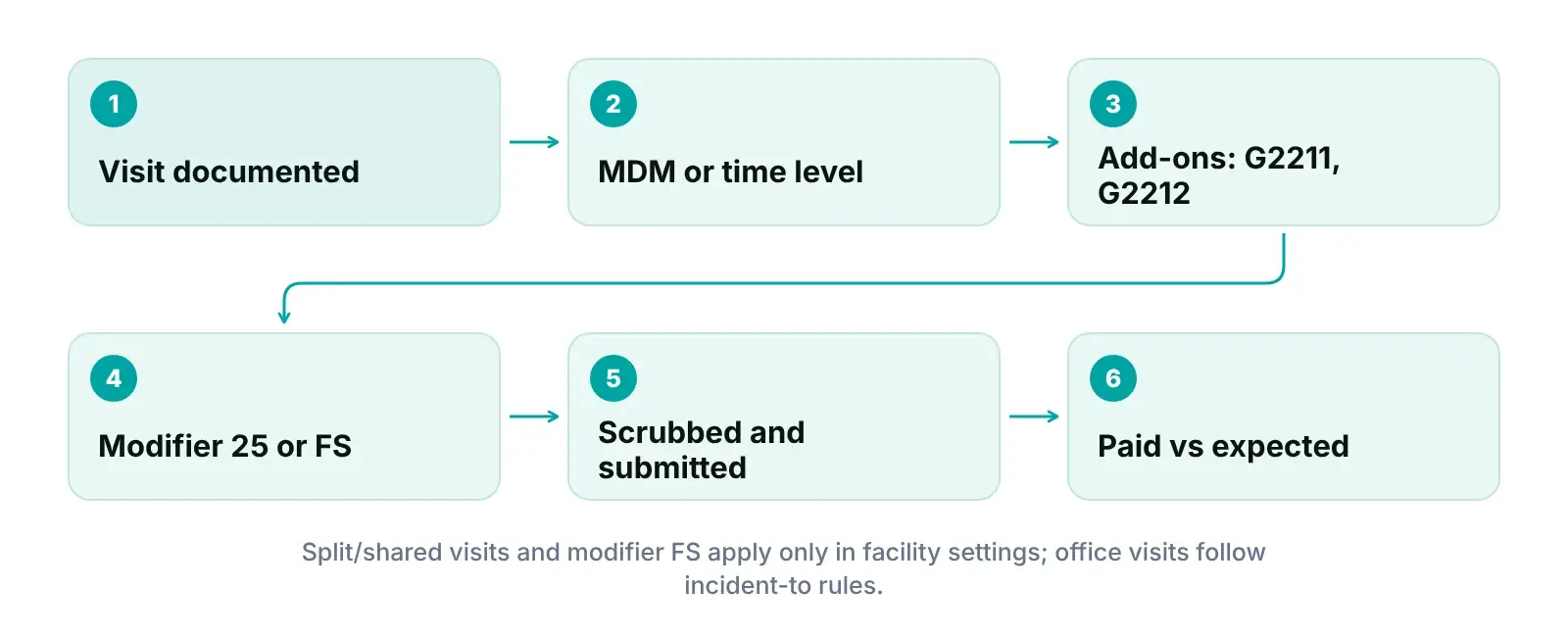
Diagram of an internal medicine visit moving from documentation to MDM or time leveling, add-on checks and payment review
How one internal medicine visit becomes a clean E/M claim.

Level by MDM or time, and say which

We level each visit the way the note supports it. CMS's E/M services booklet (May 2026) says history and exam must be medically appropriate but no longer set the level. Time covers the practitioner's own work that day, not clinical staff time.

G2212 for Medicare, 99417 for some others

Noridian lists 99417 as not valid for Medicare, which uses G2212 for each full 15 minutes past the base code's time range. Commercial plans differ: Ambetter Health's Kansas notice (December 31, 2025) said it would stop covering G2211 and G2212 on April 1, 2026. We keep a per-payer table.

G2211 and modifier 25

G2211 pays for the ongoing relationship. Noridian says the record must show ongoing care and that templated language may not support it. Medicare does not pay it on a modifier 25 visit, except, since 2025, on the same day as a wellness visit, initial preventive exam, vaccine or other Part B preventive service. See our explainer on modifiers 25 vs 59.

Hospital rounds and split/shared visits

CMS's E/M booklet allows one inpatient or observation code per calendar date. When a physician and an NP or PA in the same group share a facility visit, whoever did the substantive portion bills it with FS. For 2024 onward, Noridian defines that as more than half the total time or the substantive part of the MDM. Office visits cannot be split; see our incident-to billing guide.

Risk adjustment: document what you manage

Medicare Advantage plans are paid partly on the diagnoses you document. CMS's RADV program page says audits check whether submitted diagnoses are supported by the medical record, and CMS may collect overpayments; its risk adjustment page links to the lists of eligible codes and specialty types. Document each condition you assess with its status and plan, and code only what the note supports. We promise no risk score changes. See our diabetic HCC coding guide.

Care management, TCM and remote monitoring run on calendars

Monthly services pay only when consent, timing and minutes line up, so we keep each patient on one calendar and bill each service once.

Chronic, principal and advanced primary care management

CMS's chronic care management booklet (June 2025) requires two or more chronic conditions expected to last at least 12 months, documented consent, an electronic care plan and 24/7 access. Patients who are new or not seen in a year need an initiating visit first. Principal care management covers one high-risk condition. See our chronic care management coding guide.

Since January 1, 2025, advanced primary care management (G0556 to G0558) has paid monthly without counting minutes. Only one practitioner is paid per month, and the practice must report the Value in Primary Care MVP or join a listed ACO or model. We review APCM and time-based care management with you in the audit.

Transitional care management after a discharge

Under CMS's TCM booklet (August 2025), the 30-day period starts at discharge. The practice must reach the patient or caregiver within 2 business days, through staff who can address needs beyond scheduling; documented attempts can count. The visit must happen within 7 days for 99496 or 14 for 99495, with medicines reconciled by then. Only one practitioner can bill TCM per period.
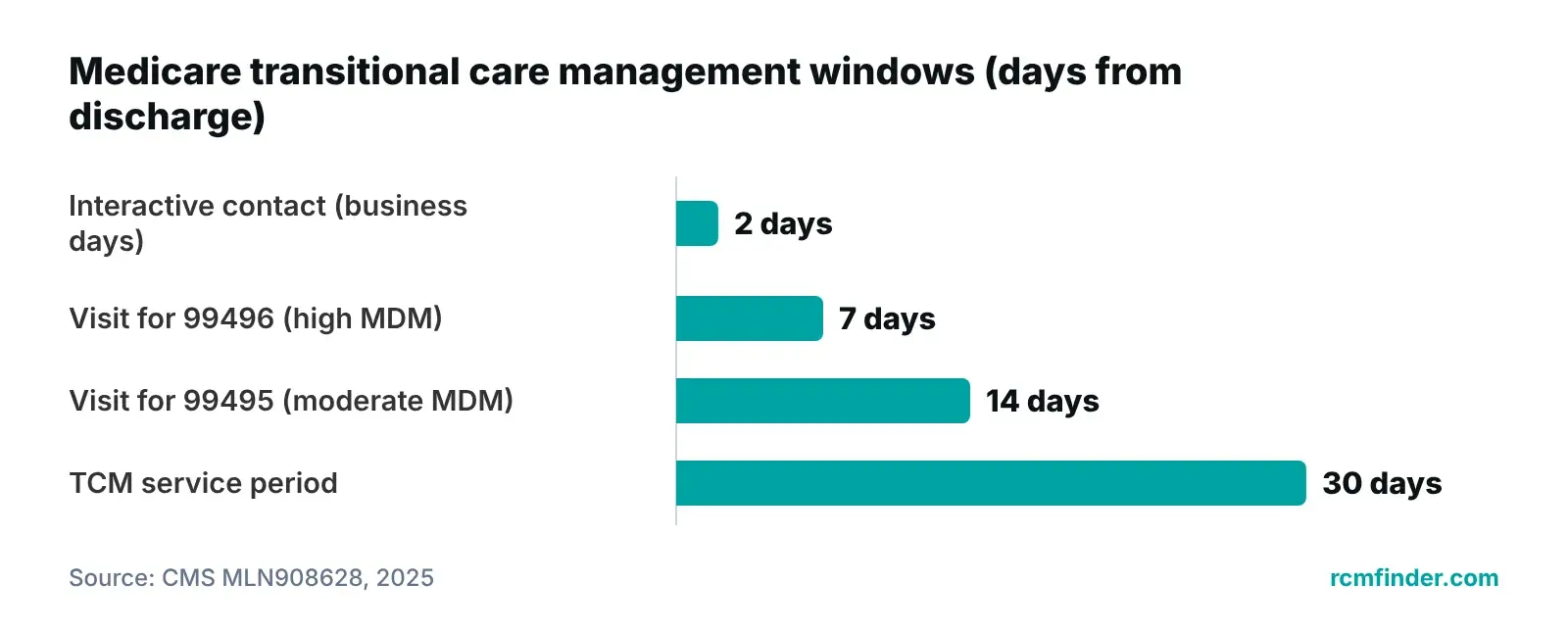
Bar chart of Medicare transitional care deadlines: contact in 2 business days, visit in 7 or 14 days, 30-day service period
Medicare TCM windows after a discharge. The contact deadline counts business days; the others count calendar days.

Remote physiologic and therapeutic monitoring

CMS's remote monitoring booklet (December 2025) requires an established patient for RPM, consent, an FDA-defined device and enough data days in each 30-day period. Only one practitioner can bill per patient in 30 days, and RPM and RTM cannot be billed together. Either can be billed with care management or TCM if time is not counted twice.

The AMA's CPT 2026 release added codes for 2 to 15 days of data and 10 minutes of management; Noridian names them 99445 and 99470. See our telehealth billing guide for virtual visits and endocrinology billing services for diabetes devices.

What to check before the visit: eligibility, consent and frequency rules

Check the plan, the last wellness visit, consent for monthly services and any recent discharge before the visit is booked.

The CMS annual wellness visit page allows one visit in a 12-month period; a significant, separately identifiable problem visit that day can be billed with modifier 25. Since January 1, 2026, the CMS-0057-F rule has required Medicare Advantage, Medicaid and CHIP plans to decide prior authorization requests within 72 hours (expedited) or seven calendar days (standard), with a specific denial reason. Drugs are excluded.

Pre-visit checklist: what our VMAs check before an internal medicine visit
RuleSourceWhat the VMA checks before booking
Wellness visit once in 12 months; not within 12 months of an initial preventive examCMS AWV page (2026)Last wellness or preventive exam date
CCM and APCM consent, including cost sharing and one practitioner per monthCMS MLN909188 (2025); CMS APCM page (2026)Consent on file; asks whether another office provides care management
CCM initiating visit if the patient is new or not seen within a yearCMS MLN909188 (2025)Last visit date; initiating visit booked first
TCM contact within 2 business days; visit within 7 or 14 daysCMS MLN908628 (2025)Discharges worked daily; nurse alerted; visit booked in the window
RPM: established patient, consent, one practitioner per 30 daysCMS MLN901705 (2025)Status and consent; other monitoring programs
MA, Medicaid and CHIP prior authorization decided in 72 hours or 7 daysCMS-0057-F (in effect Jan 1, 2026)Request and due dates logged; follow-up when due
Some plans do not cover G2211 or G2212Ambetter Health notice (2025)Plan recorded so billing applies its add-on rules

Sources: CMS annual wellness visit page (2026); CMS MLN909188 (2025); CMS APCM page (2026); CMS MLN908628 (2025); CMS MLN901705 (2025); CMS-0057-F fact sheet (2024); Ambetter Health provider notice (2025). Always check the member's current plan.

See what missed windows and denials cost you

Enter your claim volume and denial rate to estimate what your internal medicine practice is losing.

Open the Revenue Calculator

Growing an internal medicine panel without breaking privacy rules

Internal medicine growth comes from local search, reviews and a clear message about who you accept, and the tracking behind it must respect HIPAA.

We build location pages and pages for the conditions you manage, aimed at the panel you want, such as new Medicare enrollees. Review replies never confirm that someone is a patient.

HHS guidance on online tracking says tools on login and appointment pages can collect protected health information, vendors receiving it need a Business Associate Agreement, and a cookie banner is not a HIPAA authorization. A June 2024 court order vacated part of it; we still keep tracking off patient forms without a BAA.

  • Panel KPIs: new patients booked by source; Medicare and commercial mix.
  • Access KPIs: days to the next new-patient slot; missed calls.

In-house team, billing-only vendor or four-pillar partner?

Stay in-house if your coders know MDM leveling and your staff have time for consents and discharge calls. Use a billing-only vendor if claims are the only gap. Choose a combined partner when problems span teams.

Decision table: which model fits an internal medicine practice?
JobIn-house teamBilling-only vendorFour-pillar partner (RCM Finder)
Visit leveling and add-onsEach provider's habitsCoded from the note after the factLevel, add-ons and modifiers checked before submission
Care management consent and minutesA nurse or MA, between visitsBilled if the practice sends logsVMA tracks consent; RCM bills minutes your clinical team logs
Discharge follow-up (TCM)Whoever sees the hospital noticeUsually left to the practiceVMA works the discharge list; your nurse calls
Hospital split/shared visitsProvider remembers FSFixed after a denialFS checked per claim
Panel growth and reviewsA separate agency, or nobodyNot includedMarketing tied to new-patient bookings
Cost structureSalaries, benefits, turnoverVaries; ask how fees are setQuoted after a free practice audit

Whichever model you choose, track denials by reason, A/R days and visit levels by provider every month.

How it works

We start with a free audit and change nothing until you see the findings. We build our billing pipeline around how claims actually move through a practice: registration, charge entry, submission, payment and follow-up. For internal medicine, we add the leveling, add-on and monthly-service checks on this page.

  1. 1

    Free practice audit

    We review recent E/M claims, level patterns by provider, add-ons, care management logs and denials.

  2. 2

    Business Associate Agreement and access

    We put a Business Associate Agreement in place before accessing patient data. Then we work inside your existing EHR (for example PrognoCIS, eClinicalWorks or athenahealth).

  3. 3

    Payer-rule map

    We record how each plan treats G2211, G2212, 99417 and monthly services, then build them into a checklist and portal rules.

  4. 4

    Front desk and billing go live

    VMAs work eligibility, consents and discharge lists. Claims are scrubbed, submitted and worked through denials and A/R.

  5. 5

    Weekly KPI review

    We review denials by reason, A/R days, TCM visits booked on time and care management enrollment.

Talk to us about your internal medicine practice

Tell us your providers, hospital work and monthly services. We will tell you honestly whether we fit.

Call +1 (302) 556-2288

Compliance: what to ask any internal medicine billing company

Any billing vendor that handles your patients' data is a HIPAA business associate. Get a Business Associate Agreement before any access, and ask how the vendor limits and logs that access.

HHS guidance names billing, claims processing and practice management as business associate work and requires an agreement with safeguards, including for subcontractors. The minimum necessary standard limits use to what each task needs. The Security Rule's technical safeguards require access control, audit controls, integrity controls, person or entity authentication and transmission security.

  1. Will you and your subcontractors sign a Business Associate Agreement before any access?
  2. How do you limit each person's access, and can we see the audit log?
  3. Who codes our visits, and what coding credential and internal medicine experience do they have?
  4. How do you audit visit levels by provider?
  5. Which payers' rules for G2211, G2212 and 99417 do you track?
  6. Whose time counts toward our care management and monitoring minutes?

We use role-based access, audit logging and encrypted (HTTPS) connections, and we put a Business Associate Agreement in place before accessing patient data. For your own side, use our HIPAA compliance checklist for medical practices.

Who this is for, and who it is not for

We would rather tell you now than after you sign. Here is where we fit and where we do not.

A good fit if you are

  • Independent internal medicine groups billing office visits by MDM or time
  • Practices running or starting care management, APCM or remote monitoring
  • Internists who round in the hospital and share visits with NPs or PAs
  • Practices with many Medicare and Medicare Advantage patients
  • Billing companies serving internal medicine clients from one portal

Probably not a fit if you are

  • Hospital-employed internists whose billing the hospital controls
  • Practices that want visit levels raised without documentation to support them
  • Practices looking for promised collection rates or risk scores
  • Groups that need a credentialing module or in-portal real-time eligibility today (coming next)

Expert recommendations from our operations team

What we would do first if we were running your practice's revenue cycle tomorrow.

  1. 01

    Note whether MDM or time set the level

    A time-based visit needs total minutes for that date; an MDM-based visit needs problems, data and risk in the note.

  2. 02

    Keep one payer table for add-on codes

    Plans treat G2211, G2212 and 99417 differently. We keep a table per practice and update it when a plan changes.

  3. 03

    Put every monthly service on one calendar

    Care management, TCM and remote monitoring each have a period and a one-practitioner limit. One calendar per patient stops overlaps.

  4. 04

    Work the discharge list every business day

    TCM needs contact within 2 business days. We pull discharges daily so your nurses can call in time.

  5. 05

    Treat consent as a billing requirement

    No consent in the chart means no care management or RPM claim. We confirm it before the first month is billed.

  6. 06

    Document what you manage

    For risk-adjusted plans, each condition should show its status and plan. Audits check the record, not the claim.

Frequently asked questions

What do internal medicine billing services include?

They usually cover coding support, claim scrubbing, submission, denial management and A/R follow-up for office and hospital visits. For internists, a good service also checks visit levels against MDM or time, applies add-ons such as G2211 and G2212 by payer, and bills monthly services such as care management, transitional care and remote monitoring. We add front-desk assistants, patient marketing and a claims portal.

Should we choose E/M levels by medical decision making or by time?

Either is allowed for office visits, and for most other E/M families since 2023. Use whichever the note supports better. MDM looks at the problems addressed, the data reviewed and the risk of management; two of the three must meet the level. Time counts the practitioner's total time on the date of the visit, and Medicare requires the full time. Clinical staff time does not count.

Can we bill G2211 with modifier 25?

Usually not for Medicare. Medicare does not pay G2211 on a visit billed with modifier 25. Since January 1, 2025, the exception is a modifier-25 visit on the same day as an annual wellness visit, an initial preventive exam, vaccine administration or another Part B preventive service. The record must still show an ongoing care relationship. Some commercial plans do not cover G2211 at all.

Does Medicare pay CPT 99417 for long office visits?

No. Medicare treats 99417 as not valid and pays G2212 instead, for each full 15 minutes beyond the base visit's time range. With 99215, the first G2212 starts at 69 minutes of total time on the date of service; with 99205, at 89 minutes. Other payers may accept 99417, G2212 or neither, so check each plan's policy.

How do split/shared visits work for internists who round in the hospital?

A split or shared visit is a facility visit that a physician and an NP or PA in the same group both perform. Whoever performs the substantive portion bills it with modifier FS. For 2024 onward, Medicare defines that portion as more than half of the total time or the substantive part of the MDM. Office visits cannot be split or shared; incident-to rules apply there.

Can we bill chronic care management, TCM and remote monitoring for the same patient?

Often, yes, if you never count the same time twice. CMS allows chronic care management during the 30-day TCM period, and RPM or RTM, but not both, alongside care management or TCM. Only one practitioner can bill CCM in a calendar month, TCM in its period, or remote monitoring in 30 days. Consent and documentation rules apply to each.

No cost, no commitment

Get your free practice audit

Tell us about your practice. A member of our operations team replies within one business day.

  • A review of your recent claims, denials and A/R aging
  • Where your front desk and prior authorizations slow payment
  • A prioritized fix list you keep, whether or not you hire us

Pricing is quoted after the audit, based on your volume and the services you choose. Prefer to talk? Call +1 (302) 556-2288.

Tell us about your practice

RCMFinder Master Intake Form
AA

About the author: Awais Afzal

Healthcare Operations & Data Analyst, RCM Finder

Awais has spent more than 16 years in healthcare digital marketing and clinical operations management. He builds data-driven revenue cycle blueprints for high-ticket medical practices and leads product development of the RCM Finder portal. More about our team.

How we write: every figure, code and rule on this page was checked against the primary source listed below and independently fact-checked before publishing. We re-review this page every six months. Last reviewed October 12, 2026; next review April 12, 2027.

Sources

  1. Evaluation and Management Services (MLN006764) — CMS Medicare Learning Network (2026 (May 2026))
  2. Medicare Claims Processing Manual, Chapter 12: Physicians/Nonphysician Practitioners — CMS (accessed 2026-10-10 (§30.6.1 rev. 11842, effective 01-01-2023))
  3. CPT Evaluation and Management (E/M) Services Guidelines — American Medical Association (2023)
  4. Evaluation and Management (E/M) specialty page (JF Part B) — Noridian Healthcare Solutions (Medicare contractor) (2025 (last updated October 1, 2025))
  5. Prolonged Service Code (JF Part B) — Noridian Healthcare Solutions (Medicare contractor) (2025 (last updated July 11, 2025))
  6. Split or Shared Services (JF Part B) — Noridian Healthcare Solutions (Medicare contractor) (2025 (last updated July 21, 2025))
  7. Complexity Add-on Code G2211 (JF Part B) — Noridian Healthcare Solutions (Medicare contractor) (2026 (last updated September 18, 2026))
  8. Modifier 25 (JF Part B) — Noridian Healthcare Solutions (Medicare contractor) (2025 (last updated May 9, 2025))
  9. Annual Wellness Visit — CMS (2026 (last modified April 9, 2026))
  10. Calendar Year (CY) 2026 Medicare Physician Fee Schedule Final Rule (CMS-1832-F) fact sheet — CMS (2025)
  11. Calendar Year (CY) 2027 Medicare Physician Fee Schedule Proposed Rule fact sheet — CMS (2026)
  12. Chronic Care Management Services (MLN909188) — CMS Medicare Learning Network (2025 (June 2025))
  13. Advanced Primary Care Management Services — CMS (2026 (last modified January 26, 2026))
  14. Transitional Care Management Services (MLN908628) — CMS Medicare Learning Network (2025 (August 2025))
  15. Telehealth & Remote Patient Monitoring (MLN901705) — CMS Medicare Learning Network (2025 (December 2025))
  16. Remote Physiologic Monitoring (RPM): 2026 Evaluation and Management (E/M) Updates — Noridian Healthcare Solutions (Medicare contractor) (2025 (last updated December 26, 2025))
  17. AMA releases CPT 2026 code set — American Medical Association (2025 (September 11, 2025))
  18. CPT 99457 code summary — AAPC (secondary; used for plain-language code meaning only) (accessed 2026-10-10)
  19. CPT 99453 code summary — AAPC (secondary; used for plain-language code meaning only) (accessed 2026-10-10)
  20. CPT 99454 code summary — AAPC (secondary; used for plain-language code meaning only) (accessed 2026-10-11)
  21. Risk Adjustment — CMS (accessed 2026-10-10 (page last modified October 24, 2024; links 2026 and 2027 model files))
  22. Medicare Risk Adjustment Data Validation Program — CMS (2026 (last modified March 4, 2026))
  23. CMS Interoperability and Prior Authorization Final Rule (CMS-0057-F) fact sheet — CMS (2024)
  24. Ambetter Health billing code update for HCPC codes G2211 and G2212 (Kansas) — Ambetter Health (2025 (posted December 31, 2025; effective April 1, 2026))
  25. Business Associates — HHS Office for Civil Rights (accessed 2026-10-10)
  26. Minimum Necessary Requirement — HHS Office for Civil Rights (accessed 2026-10-10)
  27. 45 CFR 164.312 Technical safeguards — eCFR (current (accessed 2026-10-10))
  28. Use of Online Tracking Technologies by HIPAA Covered Entities and Business Associates — HHS Office for Civil Rights (2024 (content last reviewed June 26, 2024))