
Trained remote assistants take scheduling, eligibility checks, prior authorizations and intake inside your EHR. Request a free practice audit and we will show where your front desk hours go.
By Awais Afzal | Healthcare Operations & Data Analyst
Published October 12, 2026 · Last reviewed October 12, 2026 · Next review April 12, 2027
Quick answer
Virtual medical assistant services give a practice trained remote staff for the administrative front desk: scheduling and recalls, eligibility checks, prior authorizations and patient intake. They work inside your EHR, on your practice's time zone, under a Business Associate Agreement. They do not do clinical work.
On this page
Front-desk work does not stop when someone leaves. Calls, eligibility checks and authorizations keep arriving, and they land on whoever is still there.
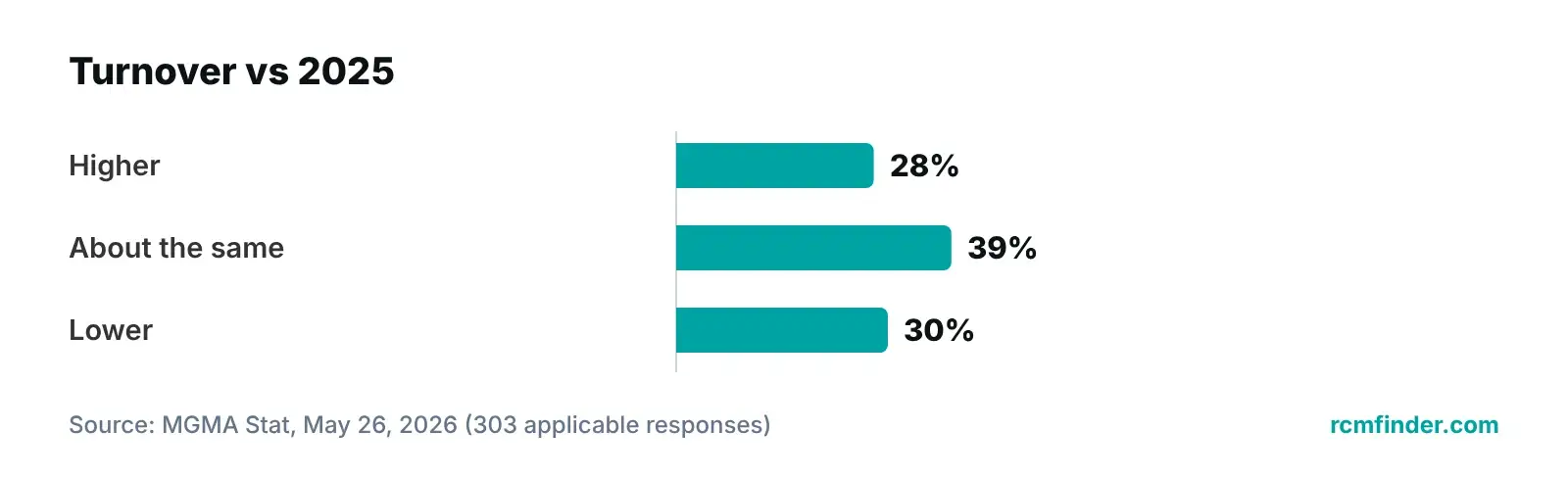
In a May 2026 MGMA Stat poll with 303 responses, 28% reported higher staff turnover than in 2025, 39% about the same and 30% lower. MGMA lists medical assistants, nursing and clinical support, and front-desk and administrative staff among the roles with the most common turnover.
The U.S. Bureau of Labor Statistics says medical assistants do administrative work, such as scheduling appointments and answering phones, and clinical work, such as taking vital signs. A virtual medical assistant covers only the administrative half.
Find out where your front-desk hours go
Our free audit reviews your calls, scheduling, eligibility checks and authorizations, and shows which queue to hand off first.
Four non-clinical jobs: scheduling and recalls, eligibility checks, prior authorizations and intake. Most practices start with one or two, then add more once the first is steady.
Answering new-patient and existing-patient calls, booking in your scheduling system, confirming visits and calling patients who are due back. Every booked visit carries the right insurance and visit type, so the visit does not fail later.
Coverage is checked before the visit, not at the window. A problem found two days ahead is a phone call. Found at check-in, it is a rescheduled visit or a denial. See our insurance verification guide. Real-time eligibility inside our portal is coming next; until then, the team checks in your existing systems.
Most authorization work is administrative: forms, portals, uploads and follow-up. In the AMA's 2025 survey of 1,000 physicians (reported May 2026), physicians averaged about 40 prior authorizations and 13 hours of physician and staff time a week, and 40% employed staff dedicated solely to prior authorization (AMA). A VMA submits when the order is ready and tracks each request by visit date. Our prior authorization guide covers the workflow.
Demographics, insurance details and forms collected before the visit, entered in your EHR, with gaps flagged. Clean intake means fewer claim edits later.
The VMA is the hinge between growth and revenue. Marketing brings in calls, the VMA turns them into registered, verified and authorized visits, and billing and our portal turn those visits into paid claims.
Local SEO, Google Ads and reviews send patients to your phones. A VMA makes sure those inquiries get answered.
Scheduling, eligibility checks, prior authorizations and intake, inside your EHR on your time zone.
Billing, coding support, claim scrubbing, denial management and A/R follow-up. Denial reasons flow back to the front desk.
Claims by stage, staff roles and an audit log. Appointment scheduling is in early access.
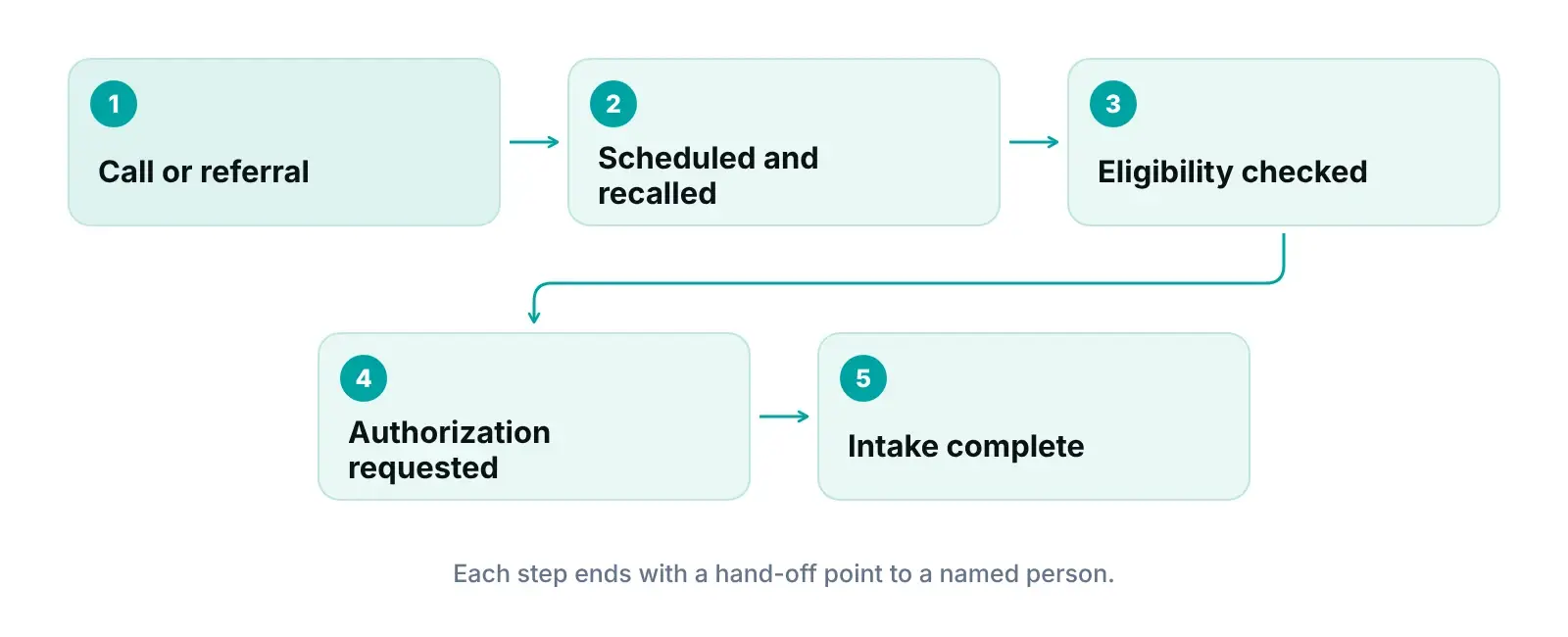
We start with a free audit, agree a written scope, set up access, and go live one queue at a time. Pricing is quoted after the audit.
We review one or two weeks of your calls, schedule, eligibility work and authorization requests. You get a plain list of the queues that cost you the most time.
We agree which tasks the VMA owns, which stay with your clinic and who takes over at each hand-off.
We put a Business Associate Agreement in place before accessing patient data. Each assistant gets a personal login and a role limited to the job.
The team learns your EHR (for example PrognoCIS, eClinicalWorks or athenahealth), payer mix, scripts and visit types.
Start with the queue that hurts most. Review each week, then add the next.
A VMA works to your clock, not ours. If your phones open at 8:00 a.m. Central, your assistant is logged in then, wherever the person sits.
This is not a promise of 24-hour coverage. Hours are set in the written scope, matched to your phone hours.
A vendor whose staff handle patient information for you is generally a HIPAA business associate. HHS lists billing and practice management among the functions, and says a covered entity may disclose PHI to a business associate only after satisfactory assurances, usually in a contract. Its page was last reviewed July 30, 2026.
Three controls matter most. A Business Associate Agreement before first access. Minimum necessary: HHS says policies should identify the people or classes of people who need access, and which categories of PHI each needs (HHS minimum necessary). A VMA who books visits and checks benefits needs demographics and insurance, not full clinical notes. Access controls: the Security Rule's 45 CFR 164.312 covers access control, which includes unique user identification, plus audit controls, integrity, person or entity authentication and transmission security. Shared logins defeat unique identification.
For remote work, HHS's 2006 Remote Use guidance covers the risks of offsite access to e-PHI and ways to reduce them, such as unique user names, role-based remote access and encryption. Offshore staff add one more question: in 2008, CMS told Medicare Advantage and Part D sponsors to report offshore subcontractors that use PHI and attest to protecting it (CMS guidance). Plans may ask you the same, so ask any vendor in writing where each person works. See our HIPAA compliance checklist.
| Item | Figure or rule | What it means for your front desk | Source |
|---|---|---|---|
| Staff turnover (May 2026 poll) | 28% of 303 respondents reported higher turnover than in 2025; 39% same; 30% lower. | Plan for gaps in phones and payer queues. | MGMA, 2026 |
| Prior authorization workload (2025 survey) | About 40 per week and 13 hours of physician and staff time; 40% have dedicated staff. | Authorization is a queue that needs an owner. | AMA, 2026 |
| Decision times, CMS-0057-F | Impacted payers: 72 hours expedited, 7 calendar days standard, from Jan 1, 2026. Drugs excluded; QHP issuers on the federal exchanges excluded from timeframes. | Track by decision date and escalate at deadline. | CMS, 2024 |
| Denial reasons, CMS-0057-F | From 2026, impacted payers must give a specific reason for a denied prior authorization. | Log the reason for appeals and patterns. | CMS, 2024 |
| Prior Authorization API | Generally Jan 1, 2027 for impacted payers. | Portals may change; keep the process documented. | CMS, 2024 |
| Business associate rule | Disclosure to a business associate needs satisfactory assurances, usually a contract. | Signed BAA before first login. | HHS, 2026 |
| Minimum necessary and unique user ID | Limit access by role; each user needs a unique ID and activity needs audit controls. | Role-based accounts, no shared logins. | HHS, 2013; eCFR |
Source: MGMA Stat (May 26, 2026); AMA (May 2026); CMS fact sheet on CMS-0057-F (2024); HHS OCR business associates (reviewed July 30, 2026) and minimum necessary (reviewed 2013); eCFR 45 CFR 164.312.
The CMS-0057-F rows above apply to the payers CMS lists: Medicare Advantage organizations, state Medicaid and CHIP fee-for-service programs, Medicaid managed care plans, CHIP managed care entities, and qualified health plan issuers on the federally facilitated exchanges, though those issuers are excluded from the decision timeframes. Commercial plans keep their own timelines.
The four queues are the same, but the weight shifts. Procedure-heavy specialties lean on authorization. Referral-driven ones lean on order intake. High-volume clinics lean on scheduling and recalls.
| Specialty | Heaviest front-desk work | What the VMA queue looks like | Hand-off to your clinic |
|---|---|---|---|
| Pain management | Authorization before procedures; repeat visits | Authorization tracking by visit date; eligibility rechecks for repeat visits | Clinical questions and urgent symptoms |
| Cardiology | Testing authorizations and referrals | Intake of orders, authorization requests for tests, scheduling by order | Test-readiness and clinical review |
| Orthopedics | Imaging and surgery authorizations | Authorization tracking before scheduled procedures; intake for injury visits | Surgical scheduling decisions |
| Dermatology | High scheduling volume; medical and cosmetic mix | Fast booking, recalls, eligibility for medical visits | Triage of urgent lesions |
| Gastroenterology | Procedure scheduling with prep and authorization | Scheduling plus authorization, with prep instructions from your clinical team | Prep and clinical questions |
| Behavioral health | Recurring visits; sensitive intake | Intake with extra privacy care; eligibility rechecks across a course of visits | Crisis or safety concerns go to your clinicians immediately |
| Pediatrics | High call volume, family insurance details | Scheduling, reminders, guarantor and coverage details at intake | Clinical advice and sick-visit triage |
| Radiology | Orders from referring offices | Order intake, authorization, scheduling by order | Protocol and clinical questions |
Operational logic, not statistics. Authorization rules differ by payer and service; see the CMS-0057-F rows above for covered payers.
Your specialty is not listed? See the full specialties hub.
None is always best. The right choice depends on who you want managing the work and how much of your own systems it needs to touch.
| Factor | In-house staff | Virtual medical assistant (RCM Finder) | Outsourcing agency or call center |
|---|---|---|---|
| Who manages daily work | Your practice manager | Your manager sets scope; we supervise the assistants and report weekly | The agency; your input may be limited to escalations |
| Access to your EHR | Full, in the building | Inside your EHR with personal logins and a limited role | Often a separate system or messages only |
| Hours | Your open hours; gaps when someone is out | Your time zone, hours set in a written scope | Agency's hours; check overnight and holidays |
| Scope | Anything you assign, including clinical | Administrative tasks only; clinical stays with you | Often messages and scripted calls |
| Prior auth and eligibility | Whoever has time | Defined queues with hand-offs | Varies; ask what is included |
| Best when | You can hire, train and keep staff | Turnover or backlog is hurting phones and payer queues | You only need after-hours message taking |
Put a number on front-desk leakage
Enter your claim volume and collections in our revenue calculator for a starting figure to bring to the audit.
If an answer is vague, ask for it in writing.
Our own answers: our systems use role-based access, audit logging and encrypted (HTTPS) connections, and we put a Business Associate Agreement in place before accessing patient data. Our team works inside your existing EHR on your practice's time zone.
Rather talk it through first?
Call our team on +1 (302) 556-2288 and tell us which queue is hurting. We will say plainly whether a VMA fits.
We would rather tell you now than after you sign. Here is where we fit and where we do not.
A good fit if you are
Probably not a fit if you are
What we would do first if we were running your practice's revenue cycle tomorrow.
Pick the queue costing the most time, often authorizations or eligibility. Get it steady before adding the next.
For each task, name the person who takes over and when. It keeps remote staff safe and makes the work easy to audit.
Shared accounts defeat unique user identification and audit controls. Limit access to what the job needs.
No demo with real patient data before the agreement is in place.
Under CMS-0057-F, covered payers owe a specific reason for denied prior authorizations. Patterns by payer and service tell you what to fix.
Look at hold times, queue age and hand-off misses. Adjust scope and hours before adding queues.
A virtual medical assistant is a trained remote team member who handles administrative front-desk work inside your EHR and phone system: scheduling and recalls, eligibility checks, prior authorizations and intake. A VMA does not do clinical work such as triage or medical advice. The scope and hand-off points are written down before the first shift.
HIPAA applies to the people and processes, so no one can be "HIPAA certified"; HHS does not endorse private certifications. Ask for a signed Business Associate Agreement, role-limited access with unique logins and audit controls, and where each person works. We put a Business Associate Agreement in place before accessing patient data.
Your practice's. If your phones open at 8:00 a.m. Central, your assistant logs in then, wherever the person sits. Shift hours, breaks, holidays and sick-day cover are agreed in the written scope, and reports use your time zone. We do not promise round-the-clock coverage unless it is in the scope.
Yes, the administrative part: forms, portal submissions, uploads and follow-up. Your providers still handle clinical judgment, peer-to-peer calls and appeals that need a physician. CMS-0057-F sets 72-hour and 7-day decision timeframes for most impacted payers from January 1, 2026 (not QHP issuers on the federal exchanges), but commercial plans keep their own rules, so each payer's requirements still need checking.
An in-house employee can do clinical and administrative work but must be hired, trained and kept. An answering service usually takes messages. A VMA works inside your EHR on defined administrative queues with written hand-offs, while your team keeps clinical work. The comparison table above sets out the differences.
It depends on the queues you hand off, hours per week, your EHR and your specialty. We quote pricing after a free practice audit so the number matches the work we find in your calls, schedule and authorization requests. The audit itself is free, and you decide afterwards whether to continue.
Tell us about your practice. A member of our operations team replies within one business day.
Pricing is quoted after the audit, based on your volume and the services you choose. Prefer to talk? Call +1 (302) 556-2288.
Tell us about your practice
About the author: Awais Afzal
Healthcare Operations & Data Analyst, RCM Finder
Awais has spent more than 16 years in healthcare digital marketing and clinical operations management. He builds data-driven revenue cycle blueprints for high-ticket medical practices and leads product development of the RCM Finder portal. More about our team.
How we write: every figure, code and rule on this page was checked against the primary source listed below and independently fact-checked before publishing. We re-review this page every six months. Last reviewed October 12, 2026; next review April 12, 2027.
We use cookies to understand how our site is used and to measure our advertising. You can accept or reject non-essential cookies. See our Privacy Policy.