
We file, track and renew payer enrollments so new providers can bill on their start date, and our billers know exactly when each payer's effective date begins.
By Awais Afzal | Healthcare Operations & Data Analyst
Published October 12, 2026 · Last reviewed October 12, 2026 · Next review April 12, 2027
Quick answer
Medical credentialing services verify a provider's qualifications and enroll them with Medicare, Medicaid and commercial payers so claims can be paid. Our team files applications, keeps CAQH current and tracks each payer's effective date alongside your billing, because the effective date decides which visits you can bill.
On this page
Medical credentialing services cover four jobs that practices often lump into one: credentialing, payer enrollment, privileging and contracting. Each has a different owner and a different finish line. Mixing them up is how a new provider ends up seeing patients before any payer can pay for the visit.
Our team performs this work alongside your billing, so the person chasing a payer application is looking at the same claims queue as the biller. If you want the longer education piece first, read our guide to insurance credentialing for group practices.
Verifying a clinician's qualifications from the source: license, education, training, certification, work and malpractice history. NCQA describes verification as done through the primary source, a recognized source or a contracted agent of the primary source. Payers and facilities each run their own.
Applying to a specific payer so the provider can be paid: Medicare, a state Medicaid program or a commercial plan. This is the step that produces a billing number and an effective date.
A hospital or surgery center deciding which procedures a clinician may perform there. Under federal hospital rules the medical staff examines the credentials of candidates, and bylaws set criteria for privileges.
The fee schedule and terms a commercial payer offers once it accepts the provider. Enrollment alone does not tell you what each service will pay.
The federal references behind those descriptions are NCQA's credentialing page and 42 CFR 482.22 (eCFR, current as of October 2026). Our post on credentialing, privileging and enrollment goes deeper on the differences. For why it all matters to cash flow, see the importance of medical credentialing.
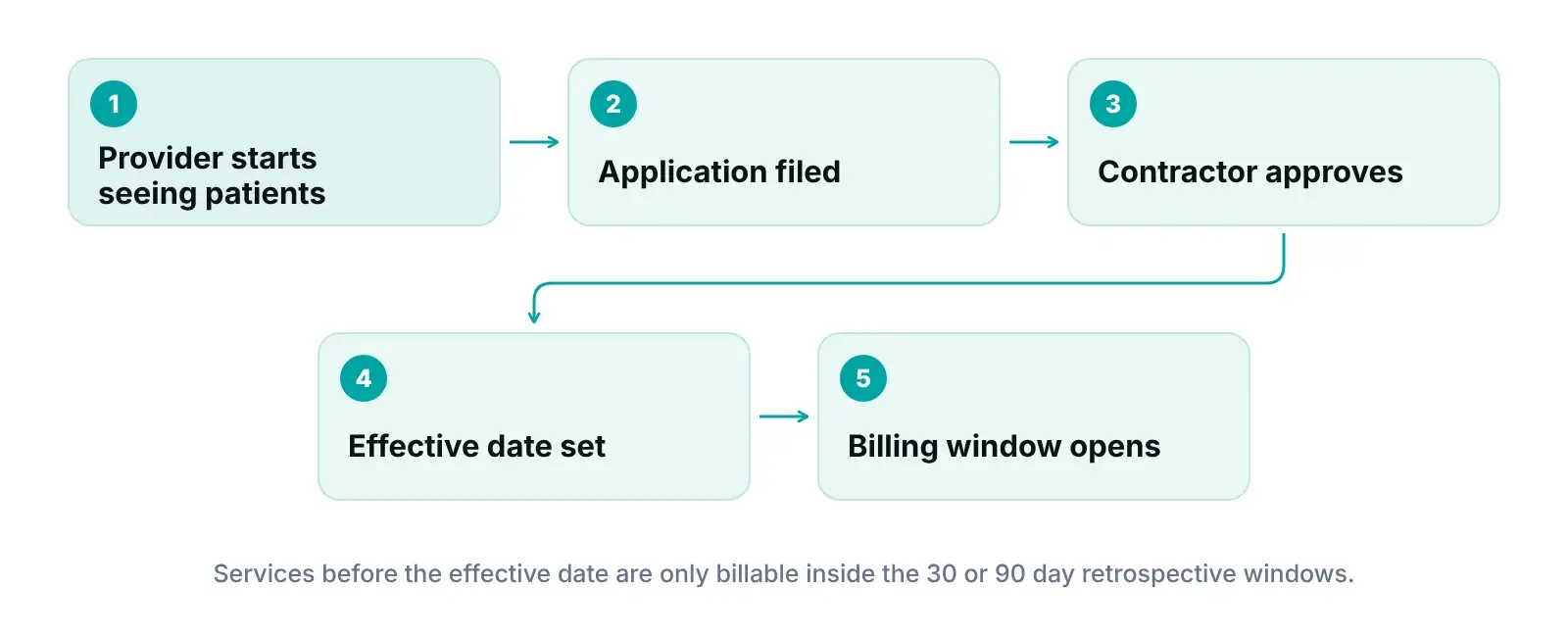
A provider who is not enrolled cannot be paid by that payer, and for Medicare the start date is set by when you file, not when you hope to start. Every week between the first patient visit and an approved effective date is revenue you may not be able to bill.
Under 42 CFR 424.505, a provider or supplier must be enrolled in Medicare, and once enrolled receives billing privileges and a billing number. For physicians and non-physician practitioners, 42 CFR 424.520(d) sets the effective date as the later of two dates: the filing date of an application that is later approved, or the date the provider first began furnishing services at a new practice location.
There is a narrow window for back-billing. 42 CFR 424.521(a) allows retrospective billing up to 30 days before the effective date if circumstances precluded enrollment in advance, and up to 90 days when a Presidentially-declared disaster did. The provider must have met all program requirements, including state licensure. Both figures are from the eCFR as of October 2026.
Deactivation is the second leak. Per CMS's December 2025 enrollment booklet, a late revalidation can bring a stay of enrollment and deactivation of billing privileges, and unanswered documentation requests can also lead to deactivation. CMS's 2024 enrollment conference slides add that reactivation requires a complete CMS-855 and that its effective date is based on the receipt date of the application.
Commercial plans set their own effective-date rules, and whether one back-dates approval is a contract question, not a federal one. We do not quote a lost-revenue figure here because we have no primary source for one.
See what one month of delay is worth to your practice
Put your average monthly collections per provider into our revenue calculator. It gives you a starting number to bring to a credentialing conversation.
Medicare is one federal process, Medicaid is fifty state processes, and many commercial payers draw on one shared profile in CAQH. Knowing which clock belongs to which system is half the job.
According to CMS's December 2025 booklet, most physicians and non-physician practitioners apply on the CMS-855I, and clinics and group practices on the CMS-855B. CMS describes PECOS as the online Medicare enrollment system. Reassignment of benefits, which lets a group bill for a clinician, now lives on the 855I. The separate CMS-855R was discontinued effective October 31, 2023, per CMS's 2024 conference slides.
Revalidation is generally every five years for most provider types. CMS can also ask for off-cycle revalidation, and 42 CFR 424.515 gives you 60 calendar days to respond once notified. Changes also have clocks. Under 42 CFR 424.516(d), a change of ownership, an adverse legal action and a change, addition or deletion of a practice location must be reported within 30 days, and all other changes within 90 days.
Medicaid enrollment is run by each state, so forms, portals and timelines differ. Federal rules set a floor. 42 CFR 455.414 requires states to revalidate every provider at least every five years, and 455.410 requires ordering and referring professionals to be enrolled. Our Medicaid credentialing guide covers the steps; we check your state's current rules before we file.
CAQH ProView holds one provider profile that authorized health plans read, so you enter data once. CAQH rebranded as DataSpring in June 2026, and the provider portal is now called the CAQH Provider Data Portal, at the same proview.caqh.org address. Re-attestation is generally every 120 days, or every 180 days for providers practicing in Illinois, according to CAQH's current resources page (2026). A 2022 Priority Health notice warns that a plan may be unable to recredential a provider who has not re-attested, and the contract may be terminated. If you miss the window, the profile status changes to Expired. Some plans word it differently; one Blue plan's FAQ says every four months. Check each plan's current wording.
| System | What the rule says | Where it comes from |
|---|---|---|
| Medicare initial enrollment | Most physicians and non-physician practitioners file CMS-855I, groups and clinics CMS-855B, online through PECOS or on paper | CMS MLN booklet (Dec 2025) |
| Medicare effective date | Later of the filing date of an application later approved, or first service at a new location | 42 CFR 424.520(d) (eCFR, Oct 2026) |
| Medicare retrospective billing | Up to 30 days if circumstances precluded advance enrollment; 90 days after a Presidentially-declared disaster | 42 CFR 424.521(a) (eCFR, Oct 2026) |
| Medicare revalidation | Generally every 5 years; off-cycle requests possible; 60 days to respond | 42 CFR 424.515; CMS MLN (Dec 2025) |
| Medicare changes | Ownership, adverse legal action, location: 30 days. Other changes: 90 days | 42 CFR 424.516(d) (eCFR, Oct 2026); CMS conference slides (Aug 2024) |
| Medicaid revalidation | State must revalidate all providers at least every 5 years | 42 CFR 455.414 (eCFR, Oct 2026) |
| Medicaid ordering and referring | Ordering or referring professionals must be enrolled participating providers | 42 CFR 455.410 (eCFR, Sep 2026) |
| CAQH ProView | Re-attest generally every 120 days (180 in Illinois); plan wording can differ | CAQH resources (2026); Priority Health (2022) |
Sources: eCFR (current as of October 2026), CMS MLN9658742 (December 2025), CMS National Provider Enrollment Conference slides (August 2024), CAQH resources page (2026), CAQH ProView quick reference (2015), Priority Health provider notice (2022). Rules change; confirm with each payer.
We do not publish a typical number of days. Turnaround differs by payer, state, provider type and how complete the application is, and we found no primary source we would stand behind. Ask each payer for its current timeline in writing and file early. That is the one lever you control.
The core process is the same, but a specialty changes which licenses, registrations and facility approvals have to line up first. The table lists what we check by specialty group.
| Specialty | What changes | What we line up first |
|---|---|---|
| Behavioral health | Several license types (psychologists, counselors, social workers, therapists) with separate state boards. Medicare began paying MFTs and mental health counselors on January 1, 2024, with a separate CMS-855I for each state. | The exact license title, supervision hours and state, before any payer application |
| Pain management | Controlled-substance prescribing adds DEA registration, which is tied to each location where controlled substances are handled (with an exception for offices that only prescribe), plus facility privileges for procedures. | DEA registration by location, state license, facility approvals |
| Cardiology | Hospital privileges for catheterization or device work are granted by the facility and are separate from payer enrollment. | Facility privilege dates, payer enrollment and group reassignment together |
| Orthopedics | Surgery depends on privileges at each hospital or surgery center, and each facility runs its own review. | A privileging timeline per facility so the surgery calendar can open |
| Family practice | Nurse practitioners and PAs are enrolled in their own right on the CMS-855I, and APRNs hold a license in each state where they practice. | Individual enrollments for every clinician, not only the physician |
| Neurology | Telehealth consults across state lines raise the question of which state license applies to the patient's location. | State licenses for every state where patients will be located |
| Radiology | Multi-site coverage means many practice locations, and location changes have their own reporting clock. | One clean list of locations before filing |
Sources: CMS MFT/MHC enrollment FAQ (May 2024); 21 CFR 1301.12 (eCFR, Oct 2026); 42 CFR 482.22 (eCFR, Oct 2026); CMS MLN9658742 (Dec 2025); Nurse Licensure Compact FAQs; HHS Telehealth licensing pages (2025). Operational notes are RCM Finder's own.
See the full list on our specialties hub to find the billing patterns that sit next to each of these credentialing differences.
HHS states that a telehealth appointment occurs in the state where the patient is located at that time, and that compact participation is voluntary. Compacts exist for physicians, nurses, psychologists and several therapy professions (HHS page, December 2025). The Nurse Licensure Compact covers RN and LPN/VN licenses only, so APRNs need a license in each state. A compact simplifies licensure. It does not enroll anyone with a payer.
It starts with a free practice audit of every provider, payer and expiration date. Then we collect documents, file applications, follow up with each payer and hand the effective date to billing. Pricing is quoted after the audit.
We list every provider, payer, location and current status, plus license, DEA, malpractice and CAQH dates. You get a plain list of gaps and a filing order.
We put a Business Associate Agreement in place before accessing patient data. Provider documents are collected through a secure channel, not email attachments.
We prepare Medicare, Medicaid and commercial applications and bring the CAQH profile current. The provider reviews and attests, because the attestation is theirs.
We track each application, answer payer questions and escalate stalled files. Every open item has an owner and a date.
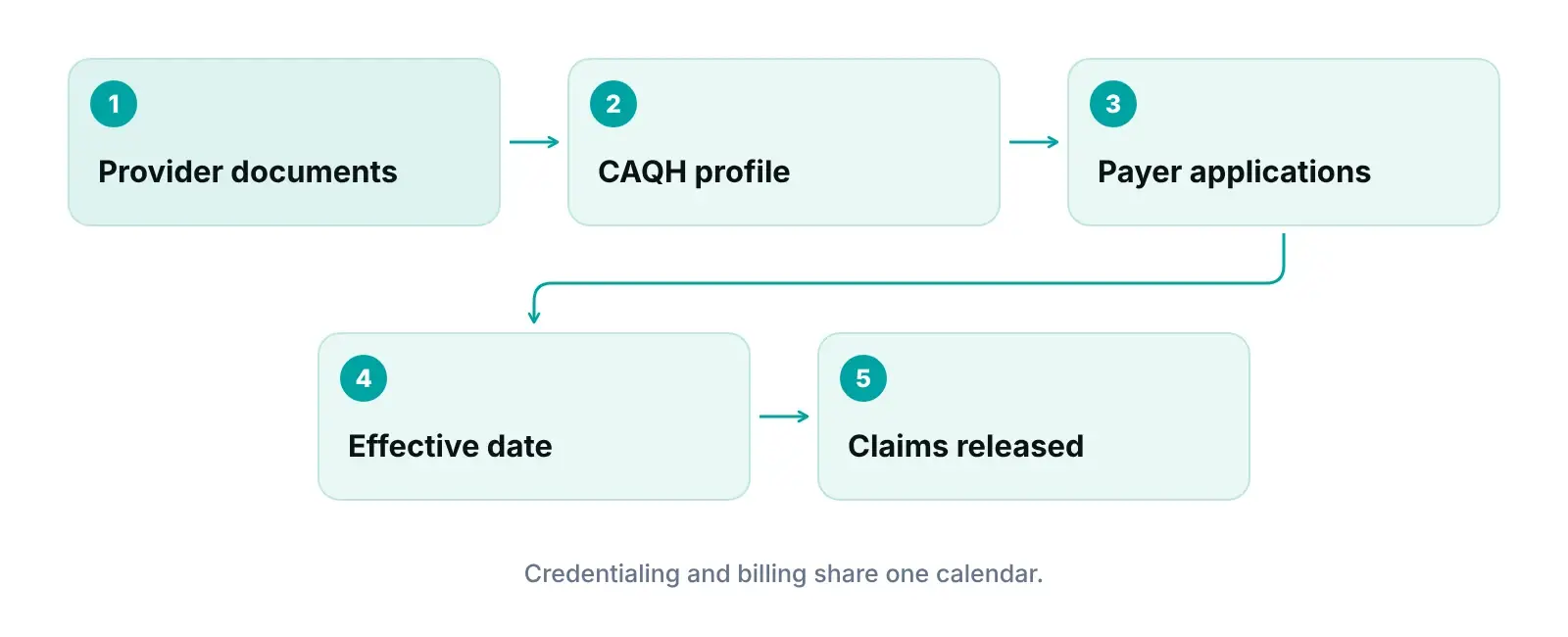
When a payer confirms approval, we record the effective date and tell the billing team which dates of service can go out and which stay on hold.
We keep a calendar of CAQH attestations, license and DEA renewals, and Medicare and Medicaid revalidations, so none of them lapse quietly.
Start with a free practice audit
Send us your provider list and payer mix. We will show you which enrollments are open, which are at risk and what to file first.
Credentialing sits at the start of the revenue cycle. Nothing downstream works until the provider is enrolled, so each pillar depends on it.
New-provider campaigns work well when the provider's payer status is known, so ads promise only what the schedule can deliver.
Our assistants use enrollment status so front-desk scheduling and eligibility checks match who is in network.
Billing needs the effective date for each payer to know what can go out and what must wait.
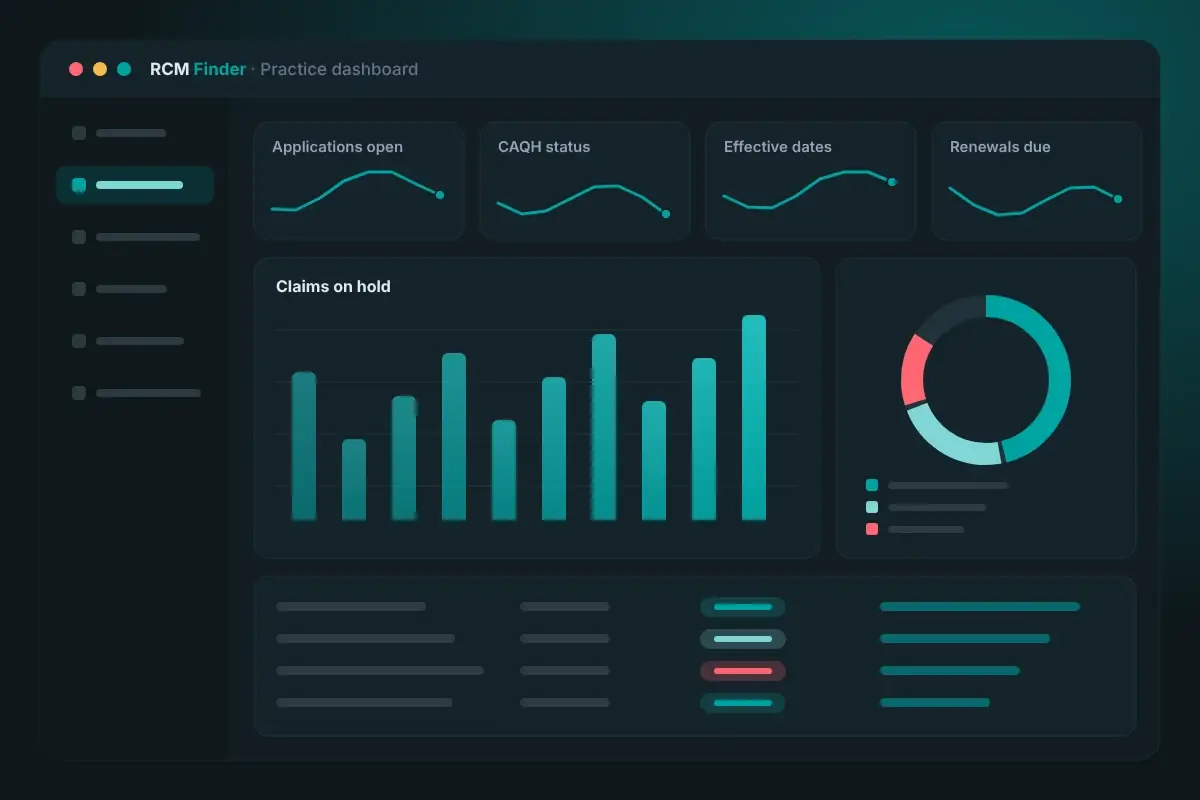
The portal tracks claims by stage today. A provider credentialing module is coming next and is not live yet.
Small practices with one new provider can often file in-house. Groups adding clinicians, opening locations or entering new states usually need dedicated hours. The table compares the options without a thumb on the scale.
| Question | In-house staff | Stand-alone credentialing vendor | RCM Finder team alongside billing |
|---|---|---|---|
| Best for | One or two providers a year | Large volume, many facilities | Practices that want enrollment tied to claim release |
| Who knows the claims impact | Often the biller, informally | Rarely; hand-off needed | The same team reads both queues |
| Main risk | Application sits behind daily work | Status reports lag billing reality | Scope must be agreed in writing up front |
| Ongoing calendar | Spreadsheet or memory | Vendor tracker | Shared calendar with billing |
| What you should still own | Provider attestations | Provider attestations and account logins | Provider attestations and account logins |
Our guide to delegated vs non-delegated credentialing explains a related choice some payers offer larger groups.
Ask who owns your accounts, how documents are protected and what happens when a payer asks a question. Credentialing files hold sensitive personal and professional data, and a vendor that handles patient or claim data is generally a business associate.
HHS lists claims processing, billing and practice management as business associate activities and requires satisfactory assurances, in the form of a contract, before protected health information is shared. Be wary of any vendor selling a HIPAA "certification": HHS does not endorse or recognize private Security Rule certifications.
At RCM Finder, we put a Business Associate Agreement in place before accessing patient data. We work with your documents under role-based access, and the practice keeps ownership of its accounts. A provider credentialing module in our portal is coming next; it is not live today.
Talk through your provider roster with our team
Tell us who is joining, where and with which payers. We will say what we can take on and what your team should keep.
We would rather tell you now than after you sign. Here is where we fit and where we do not.
A good fit if you are
Probably not a fit if you are
What we would do first if we were running your practice's revenue cycle tomorrow.
For Medicare, the effective date follows the filing date, not the start date. We build the filing order from your hire or location-opening date.
Licenses, DEA registrations, malpractice policies, CAQH attestations and revalidations fail separately. We track them together.
CAQH, PECOS and NPPES accounts should belong to the provider or practice, with named delegates. That makes a vendor change painless.
A claim sent too early becomes a denial and a rework item. We tell billing which dates of service are safe.
State requirements change. We confirm the current Medicaid process and patient-location licensure rules for each state first.
Nurse practitioners, PAs and behavioral health clinicians have their own enrollment and license requirements. Skipping them stalls the schedule.
Credentialing verifies a clinician's qualifications, such as license, training and history. Payer enrollment is the application that lets a specific payer, such as Medicare, Medicaid or a commercial plan, pay that clinician's claims. Credentialing supports enrollment but does not replace it. Our team handles both and tracks each payer's effective date for billing.
It varies by payer, state and how complete the application is, and we do not publish a typical number because we found no primary source for one. Medicare's effective date follows the filing date, so filing early is the main lever. We ask each payer for its current timeline in writing during the audit.
For Medicare, only within narrow windows: 42 CFR 424.521(a) allows up to 30 days before the effective date when circumstances precluded enrollment in advance, or 90 days after a Presidentially-declared disaster, if all requirements were met. Commercial plans set their own rules, so check each contract before scheduling.
CAQH re-attestation is generally every 120 days (180 in Illinois), though plan wording can differ. Medicare revalidation is generally every five years for most provider types, with possible off-cycle requests and 60 days to respond. Medicaid programs must revalidate providers at least every five years under 42 CFR 455.414. We keep one calendar.
Yes, as a service our team performs alongside your billing, beginning with a free practice audit. It is not a self-serve product, and a credentialing module in our portal is coming next but is not live today. Pricing is quoted after the audit, based on providers, payers and states.
Yes. CMS's booklet says most physicians and non-physician practitioners complete the CMS-855I, so each clinician is generally enrolled individually. State licensure also matters: the Nurse Licensure Compact covers RNs and LPN/VNs only, so APRNs need a license in each state where they practice. We check both before filing.
Tell us about your practice. A member of our operations team replies within one business day.
Pricing is quoted after the audit, based on your volume and the services you choose. Prefer to talk? Call +1 (302) 556-2288.
Tell us about your practice
About the author: Awais Afzal
Healthcare Operations & Data Analyst, RCM Finder
Awais has spent more than 16 years in healthcare digital marketing and clinical operations management. He builds data-driven revenue cycle blueprints for high-ticket medical practices and leads product development of the RCM Finder portal. More about our team.
How we write: every figure, code and rule on this page was checked against the primary source listed below and independently fact-checked before publishing. We re-review this page every six months. Last reviewed October 12, 2026; next review April 12, 2027.
We use cookies to understand how our site is used and to measure our advertising. You can accept or reject non-essential cookies. See our Privacy Policy.