
General Surgery Specialty

General Surgery Billing Services, Prior Auth and Growth in One Plan

Global-period tracking, bundling-aware coding, prior authorization for elective cases, patient marketing and a claims portal for general surgery practices, built on CMS rules and your payers' own policies.
  • Works inside your current EHR
  • US practice time zone, every shift
  • Weekly KPI reporting, or on your schedule
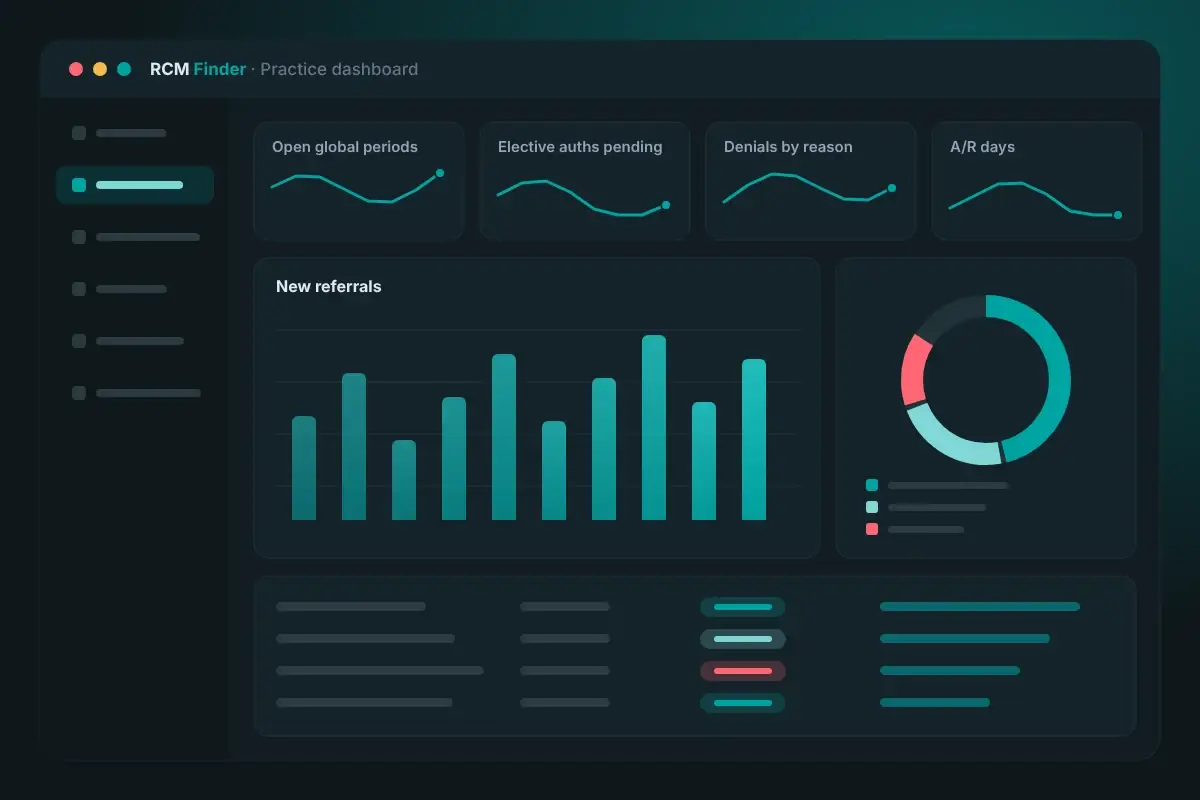
General surgery billing dashboard showing open global periods, elective authorizations, denials by reason and A/R days

Quick answer

General surgery billing services code, submit and follow up claims for office procedures, outpatient cases and major operations. The work centers on 0-, 10- and 90-day global periods, modifiers such as 57, 58, 78 and 79, NCCI bundling edits and prior authorization for elective cases. RCM Finder adds front-desk assistants, patient marketing and a claims portal.

Disclaimer: This page is educational and is not legal, coding or compliance advice. Medicare manuals, NCCI edits, coverage determinations, fee schedule rules and commercial payer policies change often and vary by contractor and plan. Verify every code, modifier, limit and rule against your Medicare contractor's current documents, your payer contracts and the current CPT and HCPCS code sets before billing.

Why general surgery billing is different

General surgery billing is different because one practice bills office procedures, outpatient cases and major operations, each with its own global period, site rate and bundling rules. Most lost revenue starts with a modifier or bundling decision, not a typo.

CMS's Global Surgery Booklet (December 2025) sets three windows: 0 days for endoscopies and some minor procedures, 10 days after other minor procedures, and 90 days after major operations, plus the day before. The package applies in every setting, and same-specialty surgeons in one group bill as one physician.

What is changing for surgical payment

The CY 2026 Physician Fee Schedule final rule fact sheet (October 31, 2025) set a $33.40 conversion factor for clinicians who are not qualifying APM participants and a -2.5% efficiency adjustment to work RVUs of services that are not time-based. E/M visits are exempt.

For 2027, CMS's proposed rule (July 14, 2026) would pay the most expensive service at 100% and others at 50% when one practice bills an office or outpatient E/M visit on the same day as a 0-, 10- or 90-day global procedure. It also says post-op visits in global periods are not occurring. Check the final rule.

We build our billing pipeline around how claims actually move through a practice: registration, charge entry, submission, payment and follow-up. For general surgery, we add the global-period, bundling and site-of-service checks on this page.

The four pillars, built for a general surgery practice

Each pillar closes one handoff where surgical revenue leaks: referrals, elective case clearance, coding against bundling rules and claim visibility. We run all four against one set of payer rules.

Pillar 1 · Healthcare Marketing

Healthcare Marketing for general surgery practices

Our healthcare digital marketing builds demand from referring offices and local patients searching for hernia, gallbladder or skin lesion care, through local SEO, Google Ads and reputation work. Tracking follows HHS guidance on online tracking.

  • Procedure pages that say who is a candidate
  • Referral path for primary and urgent care
  • No tracking on forms without a BAA
  • KPI: consults and booked cases by source
Explore Healthcare Marketing
Pillar 2 · Virtual Medical Assistants

Virtual Medical Assistants for surgical front desks

Our virtual medical assistants for surgical practices run your front desk on your practice's time zone. They verify eligibility, start elective prior authorizations, collect the records plans ask for and book post-op visits.

  • Authorizations tracked to a decision
  • Approval matched to code, side, site and date
  • Bariatric program records gathered
  • KPI: cases cleared before the OR date
Explore Virtual Medical Assistants
Pillar 3 · End-to-End RCM

End-to-End RCM for general surgery claims

Our end-to-end general surgery revenue cycle management covers coding support, claim scrubbing, denial management and A/R follow-up, with checks for open global periods, post-op modifiers, NCCI pairs and fee schedule indicators.

  • Global window checked before post-op claims
  • Multi-surgeon rules applied by indicator
  • Appeals built from operative notes
  • KPI: denials by reason and A/R days
Explore End-to-End RCM
Pillar 4 · Practice Management System

Practice Management System for surgical billing

Our practice management system tracks every claim by stage, applies specialty-aware billing logic per claim, checks data completeness before submission and flags payments below the expected amount.

  • Claims tracked by stage, per claim
  • Holds on claims missing an auth number
  • Underpayment flags against expected amounts
  • Early access: appointment booking with a calendar view
Explore Practice Management System

Find where your surgical claims leak

We review recent surgical claims, denials and your authorization log, then show what to fix first. Pricing is quoted after the audit.

Get a Free Practice Audit

The global surgical package: what it covers and which modifier applies

Routine care from the decision to operate through the end of the global window is paid once, inside the surgical fee. Anything billed separately in that window needs a modifier the note supports.

Per the Global Surgery Booklet, the fee covers pre-op visits after the decision to operate, the operation, complications treated without a return to the OR, follow-up visits and routine wound care. Diagnostic tests, unrelated visits, new distinct procedures and returns to the OR are separate.

  • 57: the visit that led to the decision for major surgery, the day before or the day of it.
  • 25: a significant, separately identifiable E/M on the day of a minor procedure; diagnoses need not differ.
  • 24: an unrelated E/M in the post-op period.
  • 58: a staged, planned or more extensive procedure, or therapy after a diagnostic one; a new global period starts.
  • 78: an unplanned, related return to the OR. Noridian, a Medicare contractor, pays the intraoperative portion only.
  • 79: an unrelated procedure; a new global period starts, as Noridian confirms.
  • 54 and 55: surgery only, and post-op care only, when care is shared.

Since 2025, modifier 54 applies to every 90-day package where the surgeon expects to provide only the surgery, even informally, per the CY 2025 final rule fact sheet. Whoever bills 55 must provide a post-op service first, and add-on G0559 pays for post-op visits by a practitioner who did not operate. See our guides to modifier 79 and co-managed post-op care.
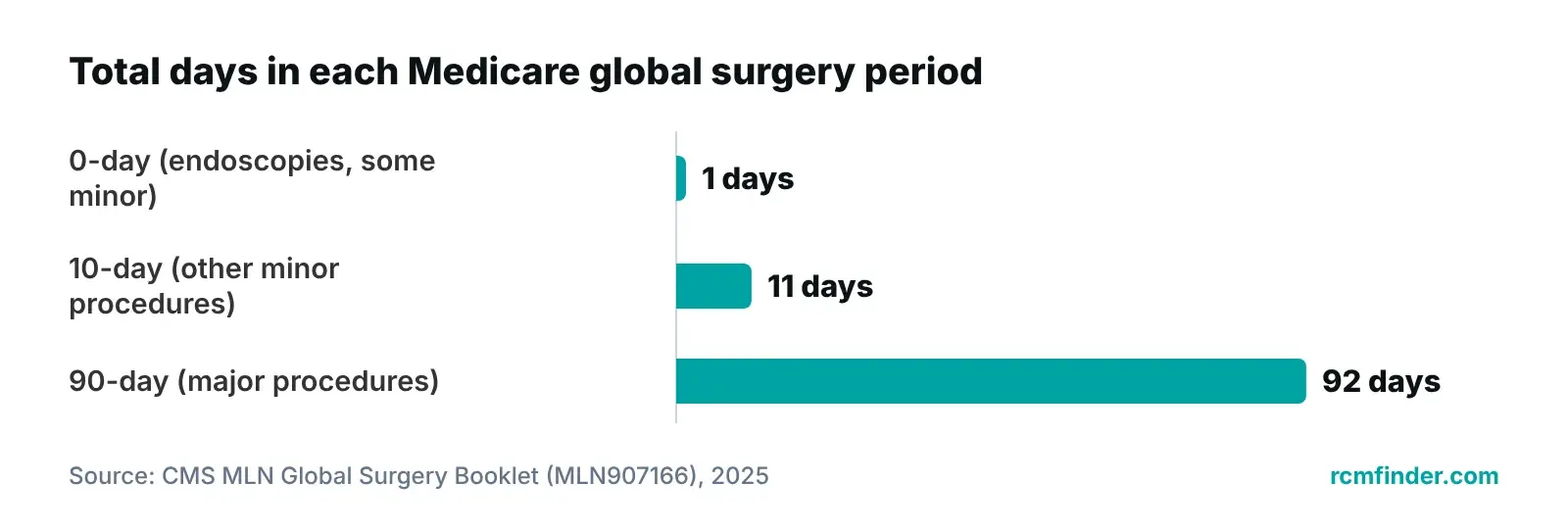
Bar chart of total days in Medicare 0-day, 10-day and 90-day global surgery periods for general surgery procedures
Each window counts the procedure day; the 90-day window also counts the day before. Check each code's global indicator in the fee schedule.

General surgery procedures: codes, bundling rules and denial triggers

Most general surgery denials come from bundling: billing what the main procedure already includes, coding two approaches to one operation, or using a modifier to pass an edit.

Codes are examples in our own words (the AMA owns CPT descriptors), with rules from the 2026 NCCI Policy Manual chapters on general policy, the integumentary system and the digestive system.

General surgery procedure families: code examples, bundling rules and where claims break
Procedure familyCode examples (our wording)Rule to knowWhere claims break
Inguinal hernia49505 (open, first repair, age 5+, reducible); 49650 (laparoscopic, first repair)Bilateral: 50 on one line, one unit, if allowed. No mesh code unless CPT allows it.Two lines without 50; a mesh code added
Ventral and incisional hernia49591 to 49596 (first repair, by defect size and whether incarcerated); 49613 (recurrent, under 3 cm)A repair at another operation's incision, or an incidental repair, is not billed.Total defect size missing from the note
Gallbladder47562 (laparoscopic); 47563 (with cholangiography)Diagnostic laparoscopy and incision closure are included. After conversion, bill only the open procedure.Diagnostic laparoscopy added; both approaches billed
Appendix44970 (laparoscopic); 44950 (open)Removing a normal appendix during another abdominal operation is not billed.Incidental appendectomy added to another case
Colon resection44140 (open partial colectomy); 44204 (laparoscopic)Adhesion lysis is included (extensive lysis may support 22), as is endoscopy within an open colectomy.44005 or 44180 billed with the resection
Breast19301 (partial mastectomy); 19303 (simple mastectomy); 38525 (deep axillary node removal)A biopsy that decided the surgery takes 58 on the excision. Codes are generally unilateral.Biopsy billed when the diagnosis was already known
Skin lesions and repairs11402 (benign, trunk or limbs, 1.1 to 2.0 cm with margins); 11602 (malignant, same size); 12032 (intermediate repair); 13101 (complex repair)Simple closure is included; intermediate or complex repair may be billed unless it closes a benign excision of 0.5 cm or less.Simple repair billed with the excision
Abscess and wound infection10060 (simple drainage); 10061 (complicated or multiple); 10180 (postoperative wound infection)Not billed within another procedure at that site; 10180 never at the encounter that caused the infection.E/M with 25 for the visit that led to the drainage

Sources: CMS NCCI Policy Manual for Medicare Services, Chapters 1, 3 and 6 (effective January 1, 2026); Noridian modifier 50 page (2026); AAPC code summaries (plain-language meanings only). Rules vary by MAC and payer; check the current CPT code set.

Multiple, bilateral and multi-surgeon claims

Per First Coast, a Medicare contractor, multiple procedure indicator 2 ranks same-day procedures by fee schedule amount: 100% for the first, 50% for the next four. Bilateral indicator 1 pays up to 150% of one side. Noridian wants bilateral procedures on one line with one unit, and Medicare's system adds modifier 51 itself.

Co-surgery needs indicator 1 (with documentation) or 2. Noridian pays co-surgeons of different specialties 62.5% each with modifier 62, and assistants 16% with 80, 81 or 82; a PA, NP or clinical nurse specialist billing AS gets 85% of that. Assistant indicator 1 means no payment, and the claims processing manual bars payment where physicians assist in under 5% of cases nationally.

NCCI edits and the X modifiers

Under procedure-to-procedure edits, the column two code is denied unless a proper modifier applies. CMS's April 2026 MLN booklet defines XE, XS, XP and XU (separate encounter, structure or practitioner, or an unusual non-overlapping service) and reserves 59 for when none fits. Different diagnoses alone justify none of them. See modifiers 25 vs 59 and when modifier 59 applies.

Wound repair basics

CPT sorts repairs into simple, intermediate and complex, and under NCCI chapter 3 a global procedure's own incision is not billed as a repair. ACEP's wound repair FAQ (February 2026), from the emergency physicians' society, adds two conventions: sum the lengths of repairs with the same complexity and anatomic group, and list the most complex repair first. Confirm both in the current CPT code book before billing.

For diagnoses, see ICD-10 codes for abdominal surgery. Surgeons who scope will find colonoscopy rules on our gastroenterology billing services page.

Office, ASC or hospital: how place of service changes the claim

The place of service code decides whether Medicare pays the surgeon the non-facility or the facility rate, so a wrong code changes payment even when the procedure code is right.

Under section 20.4.2 of the Medicare Claims Processing Manual, Chapter 12, the office (POS 11) gets the non-facility rate. Inpatient hospital (21), outpatient hospital (22 and 19), emergency room (23) and ASC (24) get the facility rate, as does any registered hospital patient, wherever seen.

The CY 2026 OPPS and ASC final rule fact sheet (November 21, 2025) began a three-year phase-out of the inpatient-only list and added 289 procedures, plus 271 former inpatient-only codes, to the ASC covered list. We confirm the site at booking, because it also decides who needs prior authorization. See ASC vs HOPD billing for the facility side.

Prior authorization for elective general surgery

Start prior authorization when the case is booked, and hold the OR date until the approval is on file. Whether a case needs one depends on the plan, procedure and site.

  1. Check the plan's list for the planned codes and site.
  2. Collect what the policy asks for.
  3. Submit, log the due date and follow up that day.
  4. Match the approval's code, side, site and dates to the booking.
  5. Put the authorization or tracking number on the claim.

In hospital outpatient departments, Original Medicare has required prior authorization for panniculectomy and vein ablation since July 1, 2020; standard decisions now take up to 7 calendar days, per the CMS OPD program page. The CMS OPD FAQ (2024) says a hospital claim denied for no affirmation also denies related physician and anesthesia services. Physicians may submit for the hospital.

CMS's ASC prior authorization demonstration covers five services, including panniculectomy and vein ablation, in ASCs in 10 states from early 2026; without a request, claims face prepayment review. The WISeR model (six states, 2026 to 2031) includes skin and tissue substitutes.

For bariatric surgery, Medicare's NCD 100.1 covers named procedures when the patient has a BMI of 35 or more, an obesity-related comorbidity (type 2 diabetes counts) and prior unsuccessful medical treatment. Aetna's obesity surgery policy (reviewed July 2026), for example, also asks for a program of 12 or more sessions on separate dates, with the last session within two years before surgery, and a behavioral health assessment.

Since January 1, 2026, the CMS-0057-F rule has required Medicare Advantage, Medicaid and CHIP plans to decide expedited requests in 72 hours and standard ones in seven calendar days. In the AMA's 2025 survey (released May 2026), physicians averaged 40 prior authorizations and 13 hours of staff and physician time a week.

Pre-surgery checklist: payer rules our VMAs check for elective cases
Payer ruleSourceWhat the VMA checks
OPD panniculectomy (15830, 15847, 15877) and vein ablation need Medicare prior authorization; no affirmation denies the surgeon's claim tooCMS OPD page, code list and FAQ (2024)Site; one request per vein ablation; tracking number within its 120-day window
ASC demonstration in 10 states: voluntary request or prepayment reviewCMS ASC demonstration page (2026)The ASC's state and its chosen path
WISeR states: skin and tissue substitutes reviewedCMS WISeR page (2026)Patient's state and the planned service
Bariatric: BMI 35+, comorbidity, prior unsuccessful treatmentNCD 100.1All three documented in the chart
Commercial example: 12+ program sessions, the last within 2 years of surgery; behavioral health assessmentAetna CPB 0157 (2026)Program records and assessment before the request
MA, Medicaid and CHIP: 72-hour or 7-day decisions with a specific reasonCMS-0057-F (from Jan 1, 2026)Due date logged; denial reason saved for appeal

Sources: CMS OPD prior authorization page (modified 2026), OPD code list and FAQ (2024); CMS ASC prior authorization demonstration page (2026); CMS WISeR page (2026); NCD 100.1 (version effective 2013); Aetna CPB 0157 (2026); CMS-0057-F fact sheet (2024). Always check the member's current plan.
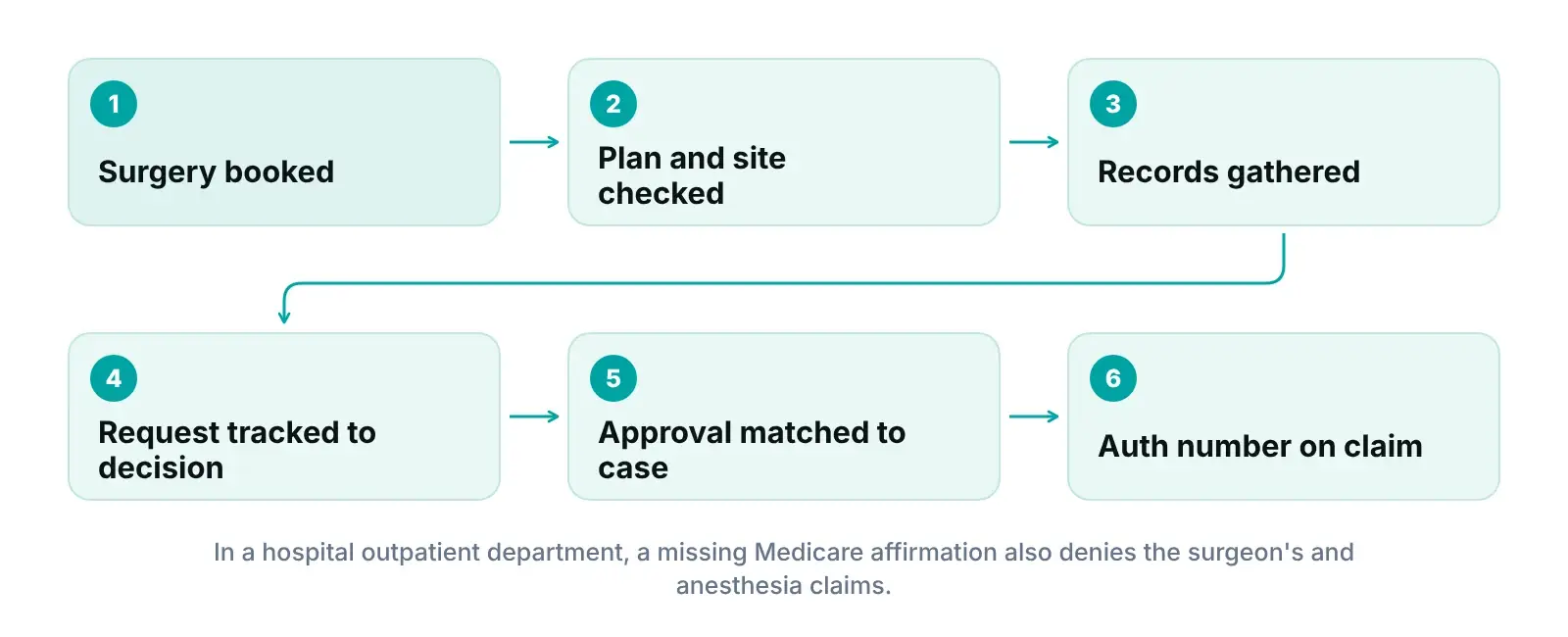
Diagram of an elective general surgery case moving from booking and plan check to prior authorization and a claim
How an elective case is cleared before the OR date and carries its approval onto the claim.

See our prior authorization guide for providers for the general workflow.

See what delays and denials cost you

Enter your claim volume and denial rate to estimate what denials and slow payment cost you.

Open the Revenue Calculator

In-house team, billing-only vendor or four-pillar partner?

Stay in-house if you have experienced surgical coders and time for authorizations. Use a billing-only vendor if claims are the only gap. Choose a four-pillar partner when problems start before the OR date.

Decision table: which billing model fits a general surgery practice?
JobIn-house teamBilling-only vendorFour-pillar partner (RCM Finder)
Tracking open global periodsCoder memory or EHR flagsChecked when a denial arrivesWindow logged per patient; modifiers checked before submission
Elective case prior authorizationSurgery scheduler, between callsUsually left to the practiceVMA tracks each request to the OR date
Multi-surgeon and bilateral claimsDepends on one experienced billerHandled on the claimIndicators checked at booking; payments compared with expected
Referral growthA separate agency, or nobodyNot includedMarketing tied to booked cases
ReportingEHR reportsClaim reports onlyPortal and dashboards, referral to paid claim
Cost structureSalaries, benefits, turnoverVaries; ask how fees are setQuoted after a free practice audit

The audit will show if you need only one pillar; each can be contracted alone.

How it works

We start with a free audit and change nothing until you see the findings.

  1. 1

    Free practice audit

    We review recent surgical claims, denials and your authorization log, and map each case type to its site.

  2. 2

    Business Associate Agreement and access

    We put a Business Associate Agreement in place before accessing patient data. Then we work inside your existing EHR (for example PrognoCIS, eClinicalWorks or athenahealth).

  3. 3

    Payer-rule map

    Your main plans' authorization lists and the fee schedule indicators for your top codes become a pre-surgery checklist and portal rules.

  4. 4

    Front desk and billing go live

    VMAs clear elective cases. The billing team scrubs, submits and works denials and A/R.

  5. 5

    Weekly KPI review

    Each week we review denials by reason, A/R days, cases cleared before the OR date and consults by source.

Talk to us about your surgical practice

Tell us your sites, case mix and hardest payer. We will tell you honestly whether we fit.

Call +1 (302) 556-2288

Compliance: what to ask any general surgery billing company

Any vendor that handles your claims is a HIPAA business associate. Get a Business Associate Agreement before it has access, and check how it limits and logs access.

HHS guidance names billing, claims processing and practice management as business associate work; subcontractors need their own agreement. The minimum necessary standard limits use to what each task needs. The Security Rule's technical safeguards cover access control, audit controls, integrity, person or entity authentication and transmission security.

  1. Will you and your subcontractors sign a Business Associate Agreement before any access?
  2. Who codes our operative notes, and what credential and surgical experience do they have?
  3. How do you track open global periods and choose between 58, 78 and 79?
  4. Do you check fee schedule indicators before billing co-surgeon or assistant claims?
  5. Can we see the audit log of who accessed our claims?
  6. Can we export our data if we leave?

We use role-based access, audit logging and encrypted (HTTPS) connections, and we put a Business Associate Agreement in place before accessing patient data. For your own side, use our HIPAA compliance checklist for medical practices.

Who this is for, and who it is not for

We would rather tell you now than after you sign. Here is where we fit and where we do not.

A good fit if you are

  • Independent general surgery groups operating in offices, ASCs and hospitals
  • Practices whose elective hernia, gallbladder or bariatric cases wait on authorizations
  • Surgeons who share post-op care and bill 54 or 55
  • Groups that want referrals, front desk and billing measured in one place
  • Billing companies serving surgical clients that want a shared claims portal

Probably not a fit if you are

  • Hospital-employed surgeons whose billing the hospital controls
  • Practices looking for promised collection rates; we report measured KPIs instead
  • Practices that want claims billed without changing any front-desk process
  • Groups that need a credentialing module or in-portal real-time eligibility today (coming next)

Expert recommendations from our operations team

What we would do first if we were running your practice's revenue cycle tomorrow.

  1. 01

    Log the global window on the day of surgery

    We log the procedure date, global days and surgeon, then check later claims for that patient against the open window.

  2. 02

    Pick 58, 78 or 79 from the operative note

    Planned or more extensive work is 58, an unplanned return to the OR is 78, and an unrelated procedure is 79. Surgeons should say which in the note.

  3. 03

    Check indicators before a second surgeon scrubs in

    Assistant and co-surgeon indicators decide whether that claim can pay. We check them at booking.

  4. 04

    Treat an unapproved elective case as unscheduled

    We hold the OR date until the approval is on file and matches the code, side and site.

  5. 05

    Document size the way the code needs it

    Ventral hernia codes turn on total defect size, excisions on diameter with margins, and repairs on summed length. We give surgeons a short note template.

  6. 06

    Re-run your numbers when the 2027 rule is final

    If CMS finalizes the same-day E/M reduction, a visit and procedure on one day would no longer both pay in full. We will model your exposure.

Frequently asked questions

What do general surgery billing services include?

They cover coding support, claim scrubbing, submission, denial management and A/R follow-up for surgical procedures and visits. For general surgery, that means tracking 0-, 10- and 90-day global periods, choosing the right modifiers, applying NCCI bundling edits and handling bilateral, multiple-procedure and assistant claims. We add front-desk assistants who clear elective cases, patient marketing and a claims portal. Pricing is quoted after a free practice audit.

What is the difference between modifiers 58, 78 and 79?

All three apply when the same surgeon operates again during a post-op period. Use 58 for a staged or planned procedure, a more extensive one, or therapy after a diagnostic procedure; a new global period starts. Use 78 for an unplanned return to the operating room for a related problem; Noridian pays the intraoperative portion only. Use 79 for an unrelated procedure; a new global period starts.

Can a surgeon bill an E/M visit on the same day as surgery?

Sometimes. For a major (90-day) procedure, the visit where the decision to operate was made, on the day before or the day of surgery, is billed with modifier 57. For a minor procedure, the decision is included, and only a significant, separately identifiable visit is billed, with modifier 25. Being a new patient alone does not justify it. CMS has also proposed reduced payment for same-day visits and procedures from 2027.

How does Medicare pay bilateral hernia repairs and multiple procedures?

It depends on each code's fee schedule indicators. With bilateral indicator 1, a bilateral procedure on one line with modifier 50 pays up to 150% of one side. With multiple procedure indicator 2, procedures are ranked by fee schedule amount: the first pays 100% and the next four 50% each. Noridian says Medicare's system adds modifier 51 itself. Some codes already describe both sides, so check before billing.

Does Medicare require prior authorization for bariatric surgery or panniculectomy?

Panniculectomy needs prior authorization in hospital outpatient departments under CMS's OPD program, and ASCs in 10 states can request it under a voluntary demonstration. For bariatric surgery, Medicare's NCD 100.1 sets coverage criteria: a BMI of 35 or more, an obesity-related comorbidity and unsuccessful medical treatment. Medicare Advantage and commercial plans set their own prior authorization rules, so check each plan.

Is it safe to outsource general surgery billing under HIPAA?

It can be, if the vendor is treated as a business associate. HIPAA requires a Business Associate Agreement before the vendor receives patient data, and the agreement must require the vendor to safeguard it. The Security Rule's technical safeguards include access control and audit controls. We put a Business Associate Agreement in place before accessing patient data and work inside your existing EHR, for example PrognoCIS, eClinicalWorks or athenahealth.

No cost, no commitment

Get your free practice audit

Tell us about your practice. A member of our operations team replies within one business day.

  • A review of your recent claims, denials and A/R aging
  • Where your front desk and prior authorizations slow payment
  • A prioritized fix list you keep, whether or not you hire us

Pricing is quoted after the audit, based on your volume and the services you choose. Prefer to talk? Call +1 (302) 556-2288.

Tell us about your practice

RCMFinder Master Intake Form
AA

About the author: Awais Afzal

Healthcare Operations & Data Analyst, RCM Finder

Awais has spent more than 16 years in healthcare digital marketing and clinical operations management. He builds data-driven revenue cycle blueprints for high-ticket medical practices and leads product development of the RCM Finder portal. More about our team.

How we write: every figure, code and rule on this page was checked against the primary source listed below and independently fact-checked before publishing. We re-review this page every six months. Last reviewed October 12, 2026; next review April 12, 2027.

Sources

  1. Global Surgery Booklet (MLN907166) — CMS Medicare Learning Network (2025 (December 2025))
  2. Calendar Year (CY) 2025 Medicare Physician Fee Schedule Final Rule fact sheet — CMS (2024)
  3. Calendar Year (CY) 2026 Medicare Physician Fee Schedule Final Rule (CMS-1832-F) fact sheet — CMS (2025)
  4. Calendar Year (CY) 2027 Medicare Physician Fee Schedule Proposed Rule fact sheet — CMS (2026)
  5. Transforming Episode Accountability Model (TEAM) — CMS Innovation Center (accessed 2026-10-10 (page modified 2026-09-23))
  6. Medicare NCCI Policy Manual — CMS (2026 (effective January 1, 2026))
  7. NCCI Policy Manual for Medicare Services, Chapter 1: General Correct Coding Policies — CMS (2026)
  8. NCCI Policy Manual for Medicare Services, Chapter 3: Surgery, Integumentary System (10000-19999) — CMS (2026)
  9. NCCI Policy Manual for Medicare Services, Chapter 6: Surgery, Digestive System (40000-49999) — CMS (2026)
  10. Medicare NCCI Procedure to Procedure (PTP) Edits — CMS (2026 (Q4 files effective October 1, 2026))
  11. Proper Use of Modifiers 59, XE, XP, XS & XU (MLN1783722) — CMS Medicare Learning Network (2026 (April 2026))
  12. Medicare Physician Fee Schedule Payment Policy Indicators — First Coast Service Options (Medicare contractor) (2024)
  13. Assistant at Surgery and Co-Surgery: Understanding the Differences — Noridian Healthcare Solutions (Medicare contractor) (2025 (updated January 9, 2025))
  14. Modifier 51 (JF Part B) — Noridian Healthcare Solutions (Medicare contractor) (2025 (updated September 30, 2025))
  15. Modifier 50 (JF Part B) — Noridian Healthcare Solutions (Medicare contractor) (2026 (updated July 6, 2026))
  16. Modifier 78 (JF Part B) — Noridian Healthcare Solutions (Medicare contractor) (2024 (updated November 18, 2024))
  17. Modifier 79 (JF Part B) — Noridian Healthcare Solutions (Medicare contractor) (2025 (updated May 9, 2025))
  18. Medicare Claims Processing Manual, Chapter 12: Physicians/Nonphysician Practitioners — CMS (2026 (Rev. 13753, issued 05-07-26))
  19. Place of Service Code Set — CMS (accessed 2026-10-10 (page modified 2026-02-17))
  20. CY 2026 Hospital Outpatient Prospective Payment System (OPPS) and Ambulatory Surgical Center (ASC) Payment System Final Rule (CMS-1834-FC) fact sheet — CMS (2025)
  21. Prior Authorization for Certain Hospital Outpatient Department (OPD) Services — CMS (2026 (page modified 2026-09-25))
  22. Final List of Outpatient Department Services That Require Prior Authorization — CMS (undated (circa 2024))
  23. OPD Prior Authorization Frequently Asked Questions — CMS (2024 (November 14, 2024))
  24. Prior Authorization Demonstration for Certain Ambulatory Surgical Center Services — CMS (2026 (page modified 2026-09-25; last dated update 2025-11-20))
  25. Prior authorization program initiatives — First Coast Service Options (Medicare contractor) (2026 (dated August 12, 2026))
  26. WISeR (Wasteful and Inappropriate Service Reduction) Model — CMS Innovation Center (2026 (page modified 2026-09-30))
  27. NCD 100.1 Bariatric Surgery for Treatment of Co-Morbid Conditions Related to Morbid Obesity — CMS Medicare Coverage Database (2013 (version 5, effective 09/24/2013))
  28. Obesity Surgery (Clinical Policy Bulletin 0157) — Aetna (2026 (last reviewed July 21, 2026))
  29. CMS Interoperability and Prior Authorization Final Rule (CMS-0057-F) fact sheet — CMS (2024)
  30. AMA survey: Prior authorization reform pledge falls short with physicians — American Medical Association (2026 (released May 13, 2026))
  31. Wound Repair (Reimbursement FAQ) — American College of Emergency Physicians (specialty society; secondary) (2026 (updated February 2026))
  32. Business Associates — HHS Office for Civil Rights (2026 (content last reviewed July 30, 2026))
  33. Minimum Necessary Requirement — HHS Office for Civil Rights (2013 (content last reviewed July 26, 2013))
  34. 45 CFR 164.312 Technical safeguards — eCFR (current (accessed 2026-10-10))
  35. Use of Online Tracking Technologies by HIPAA Covered Entities and Business Associates — HHS Office for Civil Rights (2024 (reviewed June 26, 2024))
  36. CPT 49505 code summary — AAPC (secondary; used for plain-language code meaning only) (accessed 2026-10-10)
  37. CPT 49650 code summary — AAPC (secondary; used for plain-language code meaning only) (accessed 2026-10-10)
  38. CPT 49591 code summary — AAPC (secondary; used for plain-language code meaning only) (accessed 2026-10-10)
  39. CPT 49592 code summary — AAPC (secondary; used for plain-language code meaning only) (accessed 2026-10-10)
  40. CPT 49596 code summary — AAPC (secondary; used for plain-language code meaning only) (accessed 2026-10-10)
  41. CPT 49613 code summary — AAPC (secondary; used for plain-language code meaning only) (accessed 2026-10-10)
  42. CPT 47562 code summary — AAPC (secondary; used for plain-language code meaning only) (accessed 2026-10-10)
  43. CPT 47563 code summary — AAPC (secondary; used for plain-language code meaning only) (accessed 2026-10-10)
  44. CPT 44970 code summary — AAPC (secondary; used for plain-language code meaning only) (accessed 2026-10-10)
  45. CPT 44950 code summary — AAPC (secondary; used for plain-language code meaning only) (accessed 2026-10-10)
  46. CPT 44140 code summary — AAPC (secondary; used for plain-language code meaning only) (accessed 2026-10-10)
  47. CPT 44204 code summary — AAPC (secondary; used for plain-language code meaning only) (accessed 2026-10-10)
  48. CPT 19301 code summary — AAPC (secondary; used for plain-language code meaning only) (accessed 2026-10-10)
  49. CPT 19303 code summary — AAPC (secondary; used for plain-language code meaning only) (accessed 2026-10-10)
  50. CPT 38525 code summary — AAPC (secondary; used for plain-language code meaning only) (accessed 2026-10-10)
  51. CPT 11402 code summary — AAPC (secondary; used for plain-language code meaning only) (accessed 2026-10-10)
  52. CPT 11602 code summary — AAPC (secondary; used for plain-language code meaning only) (accessed 2026-10-10)
  53. CPT 12032 code summary — AAPC (secondary; used for plain-language code meaning only) (accessed 2026-10-10)
  54. CPT 13101 code summary — AAPC (secondary; used for plain-language code meaning only) (accessed 2026-10-10)
  55. CPT 10060 code summary — AAPC (secondary; used for plain-language code meaning only) (accessed 2026-10-10)
  56. CPT 10061 code summary — AAPC (secondary; used for plain-language code meaning only) (accessed 2026-10-10)
  57. CPT 10180 code summary — AAPC (secondary; used for plain-language code meaning only) (accessed 2026-10-10)