
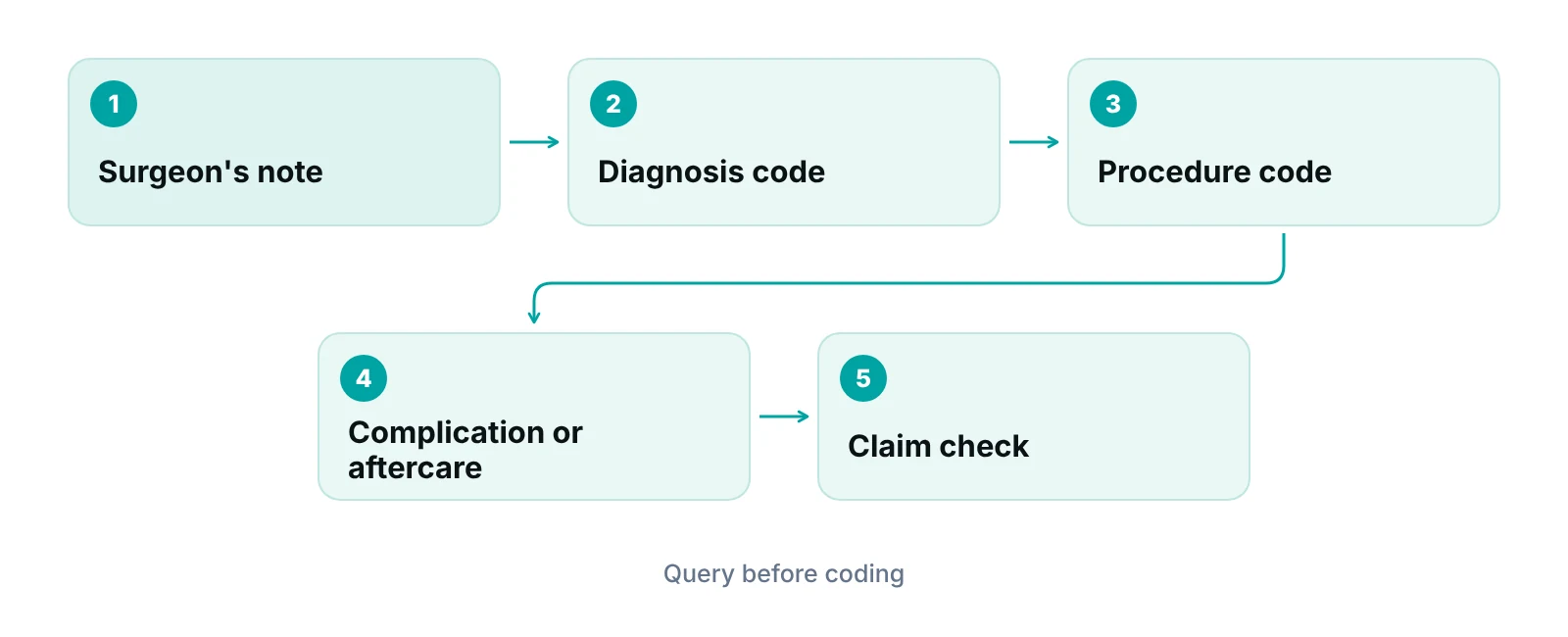
ICD-10 codes for abdominal surgery fall into three groups: the diagnosis that led to the operation (for example K35 appendicitis, K40 to K43 hernias, K80 gallstones), complication codes (K91 and T81), and aftercare or status codes (Z48.815, Z90.49, Z98.890). Pick the group by the stage of care, then the code the provider's note supports. Several parent codes are not billable alone.
Most abdominal surgery claims go wrong in one of two places. The note is vague, so the biller falls back to an unspecified code. Or an old code list includes a parent code that needs more characters. This guide is for coders, billers and practice managers. It follows the claim through the stages of care and shows which code family applies at each one.
It is not clinical advice, and it does not tell surgeons what to document. The provider’s note controls the code. We checked codes against the CMS 2027 ICD-10-CM page and the FY 2027 Official Guidelines where those sources could be read, and list every gap under the factcheck and sources.
Key takeaways
- Think in stages: the diagnosis treated, complications after the procedure, then aftercare or status.
- K91.3, K91.8, T81.4 and Z48.2 are not complete codes on their own. Use the full-length child code.
- Hernia and appendicitis codes change with laterality, obstruction, gangrene, perforation or peritonitis, so the note must say which applies.
- Z48.815 is aftercare after digestive system surgery. Aftercare after surgery for a neoplasm goes to Z48.3 instead.
- A complication code needs the provider to document the complication and its link to the procedure.
Which ICD-10 codes apply to abdominal surgery?
There is no single list of ICD-10 codes for abdominal surgery. A surgical case touches three kinds of diagnosis codes, and each one answers a different question on the claim.
- Reason for surgery: the disease or defect the surgeon treated, such as appendicitis, a hernia or gallstones. These sit mostly in Chapter 11, the K codes.
- Complications: something that went wrong because of the procedure, such as a bowel obstruction, bleeding, a seroma or a surgical site infection. These sit in K91 and T81.
- Aftercare and status: the recovery visit, or the fact that a body part is now absent. These sit in Z48, Z90 and Z98.
The year matters. CMS states that the 2027 ICD-10-CM code set applies to discharges occurring from October 1, 2026 through September 30, 2027. The FY 2027 Guidelines carry the same effective period. Older lists, including the earlier version of this post, were not built for that code set.
These are diagnosis codes only. The procedure itself is reported with a separate code set, which our CPT, ICD-10 and HCPCS explainer walks through.
Why some codes fail as written
The CDC Guidelines state that a code is invalid if it is not coded to the full number of characters required, and that a three-character code is used only if it is not further subdivided. That is why K91.3, K91.8 and T81.4 cannot go on a claim by themselves. Each has child codes, covered below.
Pre-op: the diagnosis that justifies the operation
The diagnosis on the surgical claim is the condition the surgeon treated, as documented in the operative and clinic notes. Codes for the visit before surgery, such as the consult or the clearance exam, follow different rules and are covered in our preoperative ICD-10 codes guide.
| Condition | Example code and title | What changes the code |
|---|---|---|
| Acute appendicitis | K35.80 Unspecified acute appendicitis | Peritonitis, perforation, gangrene or abscess in the note moves the code into K35.2- or K35.3-, for example K35.30 (localized peritonitis, without perforation or gangrene). |
| Inguinal hernia | K40.90 Unilateral inguinal hernia, without obstruction or gangrene, not specified as recurrent | Bilateral or unilateral, obstruction, gangrene and recurrence. Bilateral without obstruction or gangrene is K40.20. |
| Ventral or incisional hernia | K43.2 Incisional hernia without obstruction or gangrene; K43.9 Ventral hernia without obstruction or gangrene | Incisional, parastomal or other ventral type, plus obstruction or gangrene (for example K43.0 and K43.1). |
| Gallstones | K80.20 Calculus of gallbladder without cholecystitis without obstruction | Acute or chronic cholecystitis (K80.00 acute, K80.10 chronic), bile duct stones, and obstruction. |
Source: Vero Scribe, FY 2027 U.S. ICD-10-CM category pages K35, K40, K43 and K80 (2026), which republish the CDC/NCHS and CMS code files. Confirm against the CMS 2027 files before publishing.
Specificity drives both payment and denials. The Guidelines say unspecified codes should be reported when they most accurately reflect what is known, and that it is inappropriate to select a specific code that the record does not support (CDC, FY 2027). So K35.80 is correct when the note says only acute appendicitis. It is wrong when the pathology or operative report documents perforation and the coder never reads it.
Hernia codes: four questions the note must answer
- Which type: inguinal (K40), incisional or other ventral (K43), or another abdominal hernia?
- One side or both sides, for inguinal hernias?
- Was there obstruction, gangrene, or neither?
- Is it recurrent?
An operative note that says only “hernia repair” answers none of these. The coder should query the surgeon before choosing a code. Practices with a heavy general surgery mix can see how this fits a wider billing workflow on our general surgery billing and RCM page.
Gallstones and the retained-stone exception
K80 covers gallstones in the gallbladder or bile duct, split by cholecystitis, cholangitis and obstruction. It carries an Excludes1 note for retained cholelithiasis following cholecystectomy, which belongs to K91.86 instead (Vero Scribe, FY 2027; Tabular List K91). Stones found after the gallbladder is out are a postprocedural code, not a K80 code.
After surgery: complication codes in K91 and T81
A complication code says the problem followed the procedure. The Guidelines state that code assignment is based on the provider’s documentation of the relationship between the condition and the care or procedure (CMS, FY 2027 Guidelines, I.B.16). A coder cannot decide on their own that a fever or a fluid collection is a surgical complication. The surgeon has to say so.
| Code | Title (shortened) | Watch for |
|---|---|---|
| K91.30, K91.31, K91.32 | Postprocedural intestinal obstruction: unspecified, partial, complete | K91.3 alone is a category. The note must say partial, complete or neither. |
| K91.840, K91.841 | Postprocedural hemorrhage of a digestive system organ following a digestive system procedure, or following other procedure | Choose by whether the bleeding followed a digestive system procedure. |
| K91.870 to K91.873 | Postprocedural hematoma (870, 871) or seroma (872, 873) of a digestive system organ following a digestive system or other procedure | Hematoma and seroma have separate codes. The note must name which one. |
| K91.89 | Other postprocedural complications and disorders of digestive system | Use-additional-code note: add a code to further specify the disorder. Excludes2 for postprocedural retroperitoneal abscess (K68.11). |
| T81.31XA | Disruption of external surgical wound, not elsewhere classified, initial encounter | 7th character A, D or S. Describes the surgical wound coming apart, not an injury wound. |
| T81.41XA, T81.42XA, T81.43XA | Surgical site infection: superficial incisional, deep incisional, organ or space; initial encounter | T81.4 alone is not billable. Pick the depth the provider documents. Sepsis following a procedure is a separate code, T81.44XA. |
Source: Vero Scribe FY 2027 K91 page (2026); Tabular List K91 (ICD-10-CM, 2025 edition); AAPC K91.89 page; Find-A-Code T81 group; Unbound Medicine T81.4 (listed as non-billable). T81 rows rest on secondary sources; confirm against the CMS 2027 files.
Do not confuse wound disruption with an open wound
The earlier version of this post titled a table “open abdominal wound codes” and listed T81 infection and complication codes under it. Those codes describe a surgical wound that came apart or became infected after the procedure. They are complication codes, and the 7th character (A, D or S) tells the payer which episode of care the claim covers.
Pain after surgery has its own rule
We removed the postprocedural pain codes from this version because the pain guideline could not be read in full during our check. The FY 2027 Guidelines point to Section I.C.6 for coding encounters for pain control and management (CDC). Read that section before you code expected recovery pain versus a documented complication.
“A complication code is a statement about cause. If the note does not link the problem to the procedure, a query comes before the code.”
Aftercare and status: Z48, Z90 and Z98
Z48.815 is the aftercare code for a recovery visit after digestive system surgery. It has exclusions that send some cases elsewhere, so check the notes before defaulting to it.
| Code | Title | Use and watch-outs |
|---|---|---|
| Z48.815 | Encounter for surgical aftercare following surgery on the digestive system | The recovery visit. Parent Z48.81 excludes aftercare for injury, aftercare after neoplasm surgery, transplant aftercare and orthopedic aftercare. |
| Z48.3 | Aftercare following surgery for neoplasm | Goes here, not to Z48.815, when the surgery was for a neoplasm (Excludes1 at Z48.81). |
| Z48.2- | Aftercare following organ transplant | A category with more characters. Look up the full code before use. |
| Z90.49 | Acquired absence of other specified parts of digestive tract | Status after part of the digestive tract was removed, when no more specific code applies. |
| Z98.890 | Other specified postprocedural states | Billable status code. Use only when the documentation supports a postprocedural state with no more specific code. |
Source: AAPC Z48.815 page and Medcode Z48.81 (ICD-10-CM 2018 listing of the same notes); Codebooks Z90.49 (FY2026); Unbound Medicine Z98.890 (billable). Secondary sources; confirm against the CMS 2027 files.
Our follow-up ICD-10 codes guide explains how follow-up visits are coded across specialties. Whether a post-op visit is separately billable at all is a payer and global-period question, covered in our post on getting paid for post-op care.
Why Z87.19 is no longer on this list
The earlier version used Z87.19 for a history of abdominal surgery. We could not confirm that code describes a past operation, so we removed it. For a surgical history or status entry, look up “absence” or “status post” in the Alphabetic Index and match the entry to the provider’s documentation. Z90.49 and Z98.890 above are examples of status codes, not a replacement rule.
Where abdominal surgery claims go wrong
Most problems are documentation and code-length errors, and they are cheap to catch before the claim leaves the office.
- Parent code on the claim. K91.3, K91.8, T81.4 or Z48.2 submitted without the full-length child code.
- Unspecified code by habit. K35.80 or K40.90 used when the operative or pathology report supports a more specific code.
- Complication without a link. A K91 or T81 code used when the surgeon never wrote that the problem resulted from the procedure.
- Wrong aftercare code. Z48.815 used after surgery for a neoplasm, which belongs to Z48.3.
- Stale templates. A superbill or EHR favorites list built on an earlier fiscal year.
A claim scrubber catches the first and last of these. It cannot judge whether the note supports a code, so coding review still has to read the record. Our guides to claim scrubbing and clean claims show where those checks sit in the workflow. When a surgical claim does deny, a documented medical billing service process for coding review and resubmission shortens the loop.
Size the gap before you change anything
If you do not know how many surgical claims are denied or underpaid, start with the revenue calculator to estimate what denials cost your practice.
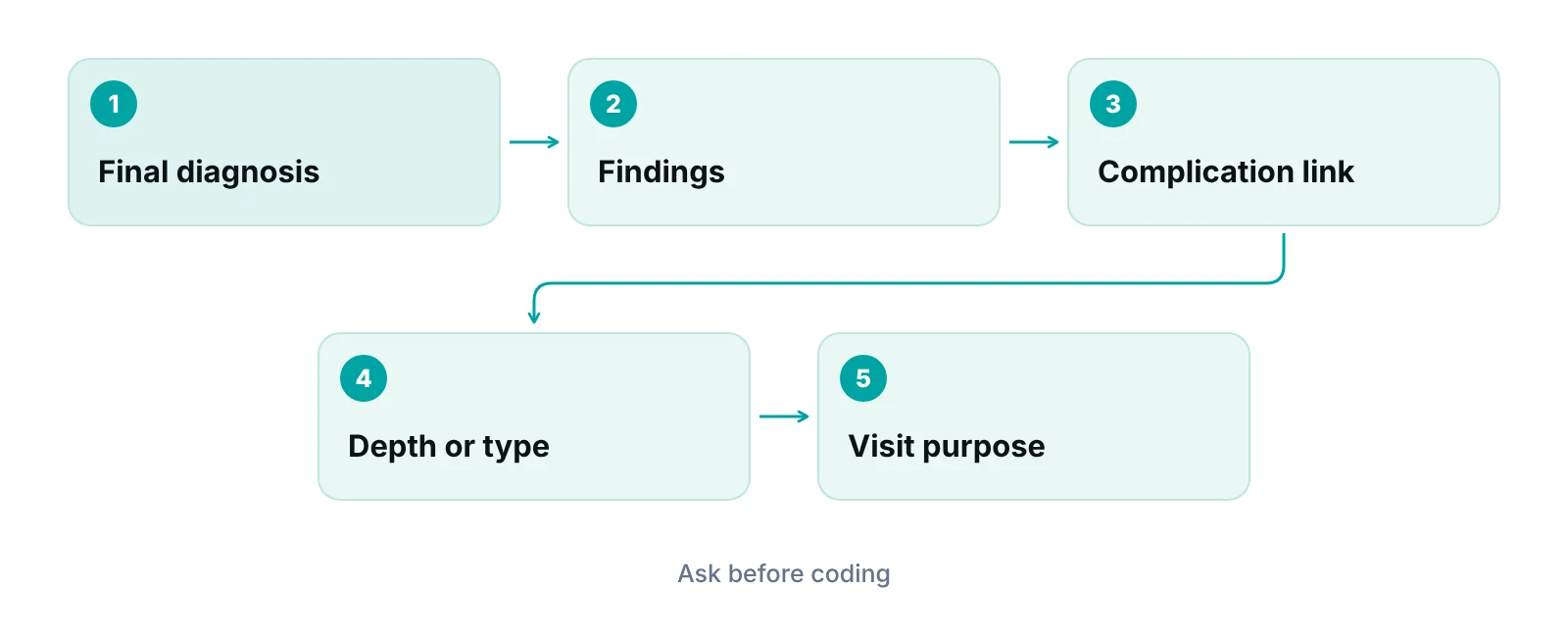
What to ask the surgeon to document
Coders cannot add clinical detail that is not in the record. The most useful habit is a short list of questions the practice asks whenever the note leaves a gap.
- What was the final diagnosis after surgery, including findings such as perforation, abscess, gangrene or obstruction?
- For hernias: type, side or sides, obstruction, gangrene and whether the hernia is recurrent.
- For any post-op problem: is it a complication of the procedure, and what exactly is it (obstruction, hemorrhage, hematoma, seroma, infection)?
- For infections: how deep (superficial, deep incisional, organ or space)?
- For follow-up visits: was the visit for routine recovery, or to treat a complication?
Want a second set of eyes on your surgical claims?
A free practice audit looks at how diagnosis codes, documentation and denials connect in your current workflow.
Our recommendations
- Rebuild code lists from the current code set. We recommend replacing any abdominal surgery cheat sheet or EHR favorites list each October with the new fiscal year’s files. Check every code is complete, not a category.
- Add a hard stop for parent codes. Ask whoever maintains your billing system to flag K91.3, K91.8, T81.4 and Z48.2 when submitted without the required characters.
- Keep a one-page query form. Use the checklist above so every query to the surgeon asks the same questions and the answer is saved with the encounter.
- Code from the final record, not the schedule. The diagnosis booked for surgery can differ from the operative and pathology findings. Wait for the final documentation before assigning specificity.
- Review denied surgical claims by code family. Group denials into diagnosis, complication and aftercare codes. The pattern shows whether the fix is documentation, a template or training.
Bottom line
Bottom line: choose the code family by stage, use the full-length code, and let the surgeon’s documentation decide the detail. If surgical claims keep coming back, our denial management services or a conversation with our team is a practical next step.
Frequently asked questions
What ICD-10 codes are used for abdominal surgery?
There is no single set. Use the K codes for the condition treated (for example K35 appendicitis, K40 to K43 hernias, K80 gallstones), K91 or T81 codes for documented complications, and Z48.815, Z90.49 or Z98.890 for aftercare and status. The provider’s note decides which apply.
Is Z48.815 the right code for a post-op visit?
Z48.815 is titled encounter for surgical aftercare following surgery on the digestive system. It does not apply to aftercare for injury, aftercare after neoplasm surgery (Z48.3), transplant aftercare (Z48.2-) or orthopedic aftercare (Z47.-), per the notes at Z48.81.
Can I bill K91.3 or T81.4 as written?
No. Each is a category that has child codes. K91.3 expands to K91.30, K91.31 and K91.32, and T81.4 needs more characters plus a 7th character of A, D or S. The FY 2027 Guidelines say a code is invalid if it lacks the full number of characters required.
When can I use an unspecified code like K35.80 or K40.90?
Only when the record does not support more detail. The Guidelines say unspecified codes should be reported when they most accurately reflect what is known, and that choosing a specific code the record does not support is inappropriate. If findings like perforation or obstruction are documented, use the more specific code.
Who decides whether something is a surgical complication?
The provider. The Guidelines base code assignment on the provider’s documentation of the relationship between the condition and the care or procedure. If the note is unclear, send a query to the surgeon rather than assuming.
Which code year applies to this guide?
CMS states the 2027 ICD-10-CM code set applies to discharges from October 1, 2026 through September 30, 2027. Confirm each code in the current Tabular List and your payer’s policy before billing, because the code set changes every fiscal year.
Get your free practice audit
Tell us about your practice. We will contact you using the details you give.
- A review of your recent claims, denials and A/R aging
- Where your front desk and prior authorizations slow payment
- A prioritized fix list you keep, whether or not you hire us
Pricing is quoted after the audit, based on your volume and the services you choose. Prefer to talk? Call +1 (302) 556-2288.
Sources
- ICD-10 codes (2027 ICD-10-CM) — CMS (2026)
- FY 2027 ICD-10-CM Coding Guidelines — CMS (2026)
- ICD-10-CM Official Guidelines FY 2027 — CDC/NCHS (2026)
- FY 2027 ICD-10-CM category pages K35, K40, K43, K80, K91 — Vero Scribe (2026)
- ICD-10-CM Tabular List, K91 (2025 edition) — Skyscape/ICD-10-CM (2025)
- K91.89 code page — AAPC (2026)
- Z48.815 code page — AAPC (2026)
- Z48.81 (ICD-10-CM 2018 listing) — Medcode (2018)
- ICD-10-CM diagnosis codes, group T81 — Find-A-Code (2026)
- T81.4 Infection following a procedure — Unbound Medicine (2024)
- Z90.49 Acquired absence of other specified parts of digestive tract — Codebooks (RapidClaims) (2026)
- Z98.890 Other specified postprocedural states — Unbound Medicine (2026)
Disclaimer: This article is educational and is not clinical, legal, coding or compliance advice. ICD-10-CM is maintained by the CDC National Center for Health Statistics and CMS, and the code set changes each fiscal year. Payer rules vary, and the provider's documentation controls code assignment. Confirm each code in the current Tabular List and your payer's policy before you bill.
