
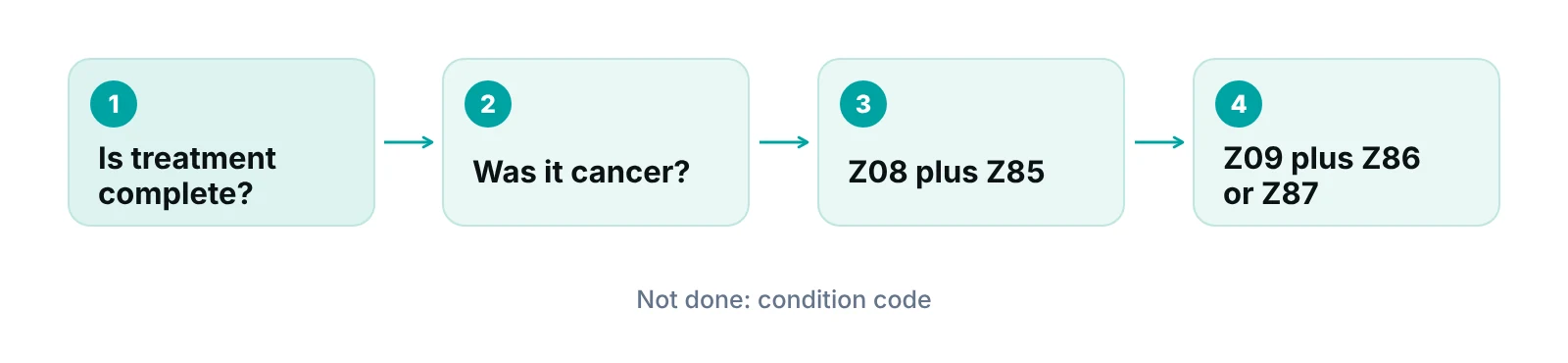
Follow-up ICD-10 codes are Z09, for a check-up after completed treatment of any condition except cancer, and Z08, when the treated condition was a malignant neoplasm. Neither has subcodes in the US code set, and both are paired with history codes. If treatment is not finished, aftercare codes or the condition's own code may apply instead.
The most common mistakes with follow-up coding are using a code that does not exist (Z09.0 to Z09.9 appear on many web pages, but Z09 has no subcodes in the US ICD-10-CM), skipping the history code that should accompany it, and using a follow-up code when the patient is still being treated. This guide is for billers, coders and practice managers. It covers the code choice first, then what changes when the visit follows a hospital stay. We checked the code titles and notes against the FY 2027 ICD-10-CM release (valid October 1, 2026 to September 30, 2027) on October 14, 2026.
Key takeaways
- Z09 is the follow-up code for completed treatment of conditions other than cancer. Z08 is the one for completed cancer treatment.
- Z09 and Z08 are complete codes. There is no Z09.0, Z09.1 or Z09.9 in the FY 2027 ICD-10-CM.
- Both codes tell you to add history codes: Z86 or Z87 with Z09, and Z85 and Z90 with Z08.
- Aftercare categories (Z43 to Z49 and Z51) carry an Excludes1 note against both follow-up codes, so do not report them together for the same condition.
- A visit after a hospital stay is often billed as transitional care management (99495 or 99496), which has its own timing rules.
What follow-up ICD-10 codes are
Follow-up codes explain why a patient came back to a clinician after treatment of a condition had finished. They sit in Chapter 21 of ICD-10-CM, the chapter for factors that influence health status and contact with health services. The patient has no active problem to report at that visit. The visit exists to check that the earlier problem has not returned.
In the FY 2027 code set there are two follow-up codes that matter for most practices. Z09 is titled “Encounter for follow-up examination after completed treatment for conditions other than malignant neoplasm” (code reference). Z08 is titled “Encounter for follow-up examination after completed treatment for malignant neoplasm” (code reference). The split is by condition type: cancer goes to Z08, everything else goes to Z09.
The rules in the official guidelines are updated every year and take effect each October 1. The FY 2027 ICD-10-CM Official Guidelines are published on the CDC site. Chapter 21 follow-up and aftercare instructions are in Section I.C.21.c.7 and I.C.21.c.8. Read them directly when you set up a coding policy.
Z09 and Z08: how to report each one
Report Z09 or Z08 as the reason for the visit, then add the history codes the tabular list tells you to add. These codes are never enough on their own, because the history code is what tells the payer which earlier condition is being watched.
| Code or range | Use it for | Add or avoid |
|---|---|---|
| Z09 | Follow-up exam after completed treatment of a condition that is not cancer | Add Z86.- or Z87.- (history of disease). Excludes1 note for aftercare Z43 to Z49 and Z51 |
| Z08 | Follow-up exam after completed treatment of cancer | Add Z85.- (personal history of malignant neoplasm) and Z90.- if an organ is absent. Same aftercare Excludes1 note |
| Z85.- | Personal history of malignant neoplasm | Only for the former site of a primary malignancy (guideline, Section I.C.2.m) |
| Z86.- and Z87.- | History of disease | Pair with Z09 to name the earlier condition |
| Z90.- | Acquired absence of organs | Add with Z08 when the cancer surgery removed an organ |
| Z43 to Z49 and Z51 | Aftercare categories | Do not report with Z08 or Z09 for the same condition unless the conditions are unrelated |
Source: icd-10codes.com Z09 and Z08 pages, reflecting the FY 2027 ICD-10-CM tabular list (2026); CDC FY 2027 Official Guidelines (2026).
The Excludes1 note says these codes generally should not be reported together unless the conditions are unrelated. That is a real denial risk. A claim that lists Z09 and an aftercare code for one condition tells the payer two different stories about the same visit, and a claim scrubber should be set to catch the pair. Our claim scrubbing guide explains what that check looks like.
There is no Z09.0 to Z09.9 in the US code set
Z09 has no subcodes in ICD-10-CM. It is a three-character category that is valid for billing as it stands. Lists with Z09.0 for surgery, Z09.1 for radiotherapy or Z09.9 for unspecified treatment are not part of the FY 2027 US code set, and a claim that carries one can be rejected as an invalid diagnosis code.
Check any follow-up code list you did not build yourself
The old version of this article listed Z09.0 to Z09.9 as if they were billable. They are not. If your superbill, EHR favorites list or training sheet contains a Z09 with a decimal, replace it with Z09 and add the right history code (Z86.- or Z87.-) to say what was treated.
The practical fix is simple. Put the type of treatment in the note and the history code, not in the follow-up code. A patient seen after completed treatment of a fracture gets Z09 plus the history code that matches the documentation. The follow-up code does not change for surgery, radiotherapy or chemotherapy. For cancer, Z08 plus Z85.- (and Z90.- if an organ is absent) carries that meaning.
Follow-up, aftercare or the condition's own code?
The deciding question is whether treatment is finished. Follow-up codes are for surveillance after treatment has ended. Aftercare codes (the Z43 to Z49 and Z51 categories) belong to the care that comes after an acute event while the patient is still being cared for. If the problem is still being treated, the condition’s own code usually describes the visit better than any Z code.
The tabular list backs up the separation. Both Z09 and Z08 carry an Excludes1 note for the aftercare categories. The full guideline wording sits in Section I.C.21.c.7 (aftercare) and I.C.21.c.8 (follow-up) of the FY 2027 guidelines. Use the table below to orient, then confirm unusual cases against those sections.
| Visit | Look at first | Why |
|---|---|---|
| Skin check a year after the lesion was removed and cancer treatment is done | Z08 with Z85.- | Cancer is the treated condition and treatment is complete |
| Routine recheck after a healed infection with no active problem | Z09 with Z86.- | Treatment is complete and the condition is not cancer |
| Visit during recovery after surgery, still receiving care for the healing | Aftercare category or the condition code | Treatment has not ended, so a follow-up code does not fit |
| Patient returns and the problem is back or still present | The condition’s own code | The visit is for an active condition, not surveillance |
| First visit after a hospital stay for a managed condition | The documented condition, and possibly a TCM code | The physician is managing the condition, so see the next section |
Source: code titles and Excludes1 notes from the FY 2027 ICD-10-CM tabular list (icd-10codes.com, 2026). Examples are our own illustrations, not guideline text.
“If the note does not say whether treatment has ended, the code choice is a guess. Ask for the sentence before you pick the Z code.”
Hospital follow-up visits: the diagnosis question and the TCM question
A visit after a hospital stay is usually not a Z09 visit. The patient has just left care for a significant problem, and the physician is typically still managing it. The diagnosis on that claim should come from the documentation of what is being managed, not from a follow-up code chosen because the word “follow-up” is in the note.
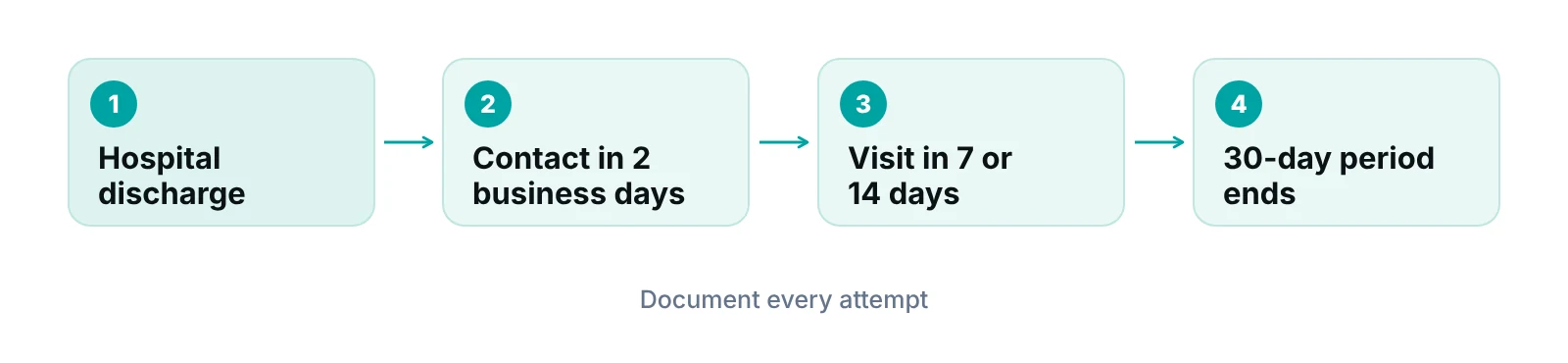
What changes is the visit code. CMS describes a bundle for these visits called transitional care management, billed with CPT 99495 or 99496. The CMS MLN Transitional Care Management Services booklet (August 2025) sets out the conditions.
| Element | 99495 | 99496 |
|---|---|---|
| Contact with patient or caregiver | Within 2 business days of discharge | Within 2 business days of discharge |
| Face-to-face visit | Within 14 calendar days of discharge | Within 7 calendar days of discharge |
| Medical decision making | At least moderate complexity | High complexity |
| Service period | 30 days starting on the day of discharge | 30 days starting on the day of discharge |
| Who may report | One physician or eligible non-physician practitioner, once per patient in the period | Same |
| Global surgery overlap | Cannot be reported if the 30 days fall within a global period for a procedure by the same practitioner | Same |
Source: CMS, Transitional Care Management Services, MLN908628 (August 2025).
Two details cause most TCM denials. The two-business-day contact can be a phone call, an email or a visit, and two documented attempts that fail can still meet the requirement. The face-to-face visit cannot be on the same day as discharge day management. The booklet also says certain care management codes, including chronic care management, can be reported at the same time when the work is medically necessary and the same time is not counted twice. Our chronic care management coding and billing guide covers that side.
TCM covers discharges from settings that include an inpatient acute care hospital, a skilled nursing facility and hospital outpatient observation, among others listed in the booklet. Payers other than Medicare may set their own rules, so check each contract. For a practice that sees many discharged patients, such as internal medicine and primary care practices, a TCM tracking sheet is worth building.
What keeps follow-up claims clean
Most follow-up denials trace back to documentation that does not match the code, not to the code itself. The visit note needs to say what was treated, that treatment is finished (or is not), and why the patient was seen. Coders can only report what the clinician documents.
- Keep the code list current. Update your superbill and EHR favorites each October 1 when the new code set takes effect, and remove any Z09 with a decimal.
- Link the history code. Require a Z85, Z86 or Z87 code on every Z08 and Z09 claim.
- Scrub for Excludes1 pairs. Flag claims that list a follow-up code with an aftercare category for the same condition.
- Track TCM clocks. Log discharge date, contact attempts and visit date so the 2-day, 7-day and 14-day marks are visible.
- Audit a sample. A short review of follow-up visits each quarter finds template errors early. See our guide to medical coding audits.
See where follow-up claims are slipping
A free practice audit looks at your coding, denial patterns and workflow, and tells you what is worth fixing first. There is no obligation.
When a diagnosis error does reach a payer, it usually returns as a rejection or a denial that someone must rework. Our overview of medical billing denial management shows how to sort those by cause. If your team also handles pain or musculoskeletal visits, the same discipline applies to our back pain ICD-10 codes guide and chest pain ICD-10 codes posts. For wider examples, start with the medical coding examples guide.
Our recommendations
- Delete every Z09 with a decimal from your templates. Search superbills, EHR favorites and training documents for Z09.0 through Z09.9. Replace them with Z09 and the matching history code.
- Add a treatment-status line to the follow-up note template. One line that says treatment is complete, ongoing or recurred lets a coder choose between a follow-up code, an aftercare code and the condition code without calling the provider.
- Make the history code mandatory. Set a rule that Z08 requires Z85.- and Z09 requires Z86.- or Z87.-, so the claim names the earlier condition.
- Keep a separate path for post-discharge visits. Give hospital follow-up visits their own checklist: discharge date, contact within 2 business days, visit within 7 or 14 days, and who is reporting TCM.
- Re-check code lists every October. The code set and the guidelines change on October 1. Add a yearly task to review follow-up and aftercare codes in your billing system.
Bottom line
Follow-up coding comes down to three questions: is treatment finished, was it cancer, and which history code explains the earlier condition. Z09 and Z08 answer the first two, and there is no Z09 subcode to hunt for. Hospital follow-up adds a timing layer through TCM. If your claims still come back on diagnosis errors, our medical billing services and denial management services show how a second review works, and you can start with a free practice audit. For a rough sense of what rework costs you, try the revenue calculator.
Frequently asked questions
What is the ICD-10 code for a follow-up visit after treatment?
Use Z09 for a follow-up exam after completed treatment of a condition other than cancer, and Z08 after completed cancer treatment. Add the history code the tabular list calls for: Z86.- or Z87.- with Z09, and Z85.- with Z08. If treatment is not complete, a different code fits better.
Does Z09 have subcodes like Z09.0 or Z09.9?
No. In the US ICD-10-CM, Z09 is a three-character code with no subcodes in the FY 2027 release. Lists showing Z09.0 to Z09.9 are not valid for US claims. Put the treated condition in a history code instead, and check the note says treatment was completed.
What is the difference between aftercare and follow-up codes?
Follow-up codes (Z08, Z09) are for surveillance after treatment has ended. Aftercare categories (Z43 to Z49 and Z51) cover care in the period after treatment of a condition. The tabular list carries an Excludes1 note between them, so do not report both for the same condition.
What ICD-10 code do I use for a hospital follow-up visit?
It depends on the documentation. If the physician is still managing the condition that put the patient in hospital, report that condition, not Z09. The visit itself may qualify as transitional care management, billed with CPT 99495 or 99496 when the contact and timing requirements are met.
When can a practice bill TCM codes 99495 and 99496?
Under Medicare, TCM needs contact within 2 business days of discharge, a face-to-face visit within 14 days (99495, moderate complexity) or 7 days (99496, high complexity), and only one practitioner reporting per 30-day period. Other payers may have different rules, so check each contract.
Can I report Z08 or Z09 as the first diagnosis on a claim?
Yes, they describe the reason for the encounter when the visit is a surveillance check. Chapter 21 and the Z00 to Z13 range notes govern sequencing, so read Section I.C.21 of the current guidelines. Add the history code, and do not pair the claim with an aftercare category for the same condition.
Get your free practice audit
Tell us about your practice. We will contact you using the details you give.
- A review of your recent claims, denials and A/R aging
- Where your front desk and prior authorizations slow payment
- A prioritized fix list you keep, whether or not you hire us
Pricing is quoted after the audit, based on your volume and the services you choose. Prefer to talk? Call +1 (302) 556-2288.
Sources
- ICD-10-CM Official Guidelines for Coding and Reporting, FY 2027 (effective October 1, 2026) — CDC / NCHS (2026)
- ICD-10-CM FY 2027 release files — CDC / NCHS (2026)
- Z09 Encounter for follow-up examination after completed treatment for conditions other than malignant neoplasm — icd-10codes.com (reference to the FY 2027 tabular list) (2026)
- Z08 Encounter for follow-up examination after completed treatment for malignant neoplasm — icd-10codes.com (reference to the FY 2027 tabular list) (2026)
- Transitional Care Management Services (MLN908628) — CMS (2025)
Disclaimer: This article is educational and is not legal, coding, billing or compliance advice. CPT is a trademark of the American Medical Association, and the code descriptions here are our own summaries. ICD-10-CM codes, guidelines and payer rules change and vary by payer. Check the current CDC, CMS and payer sources, and ask a certified coder, before you bill.