Chest pain ICD-10 codes sit in category R07, and the right one depends on what the provider documented. Use R07.9 only when the note gives no more detail. Use R07.1, R07.2, R07.81, R07.82 or R07.89 when it does. Once the provider confirms a cause, code that diagnosis instead.
If you code or bill for a practice that sees chest pain, the question is rarely “which code exists.” It is “how specific does the note have to be, and when does the symptom stop being the right code?” This post answers both using the ICD-10-CM Official Guidelines for FY 2027. It is written for coders, billers and practice managers. It is not clinical advice, and chest pain can be an emergency.
Key takeaways
- Chest pain codes come from category R07; R07.9 is the unspecified code.
- R07.9 is correct when the note lacks detail; the fix is better documentation, not a guessed code.
- A confirmed diagnosis replaces the symptom code in most cases (Guidelines I.B.4 and I.B.5).
- There is no R07.4 in the R07 list; do not use it.
- Outpatient notes that say “rule out” follow a separate guideline (Section IV.H).
The chest pain codes in category R07
Chest pain codes live in category R07, “Pain in throat and chest.” Within it, six codes describe chest pain itself: R07.1, R07.2, R07.81, R07.82, R07.89 and R07.9. R07.0 is throat pain, so it is not a chest pain code. The table below lists each chest pain code with the detail the record needs to support it. Titles and inclusion terms come from the tabular list entries for category R07.
| Code | Title | What the provider's note needs to say |
|---|---|---|
| R07.1 | Chest pain on breathing | Pain that comes with breathing. “Painful respiration” is an inclusion term. |
| R07.2 | Precordial pain | Pain over the front of the chest, at the heart. |
| R07.81 | Pleurodynia | Pleurodynia is documented. Epidemic pleurodynia is excluded (B33.0). |
| R07.82 | Intercostal pain | Pain between the ribs. |
| R07.89 | Other chest pain | Chest pain with a stated detail that has no code of its own. “Anterior chest-wall pain NOS” is an inclusion term. |
| R07.9 | Chest pain, unspecified | Chest pain with no further detail in the record. |
Source: ICD-10-CM tabular list, category R07 (copy of the NCHS/CDC tabular list; check against the current CDC release).
Two notes keep coders out of trouble. First, the R07 category carries an Excludes 2 note for jaw pain (R68.84) and pain in the breast (N64.4), so those are reported with their own codes, not with an R07 code. Second, some older guides list a code R07.4 for “chest pain, left side.” That code is not in the R07 list. Where the pain sits on the chest is useful detail for the clinical record, but it does not create a code on its own.
The code set is updated each October. The current ICD-10-CM Official Guidelines for FY 2027 apply to discharges and encounters from October 1, 2026 through September 30, 2027. Check the code and the guidelines for the date of service you are billing.
When R07.9 is the right code, and when it is a documentation problem
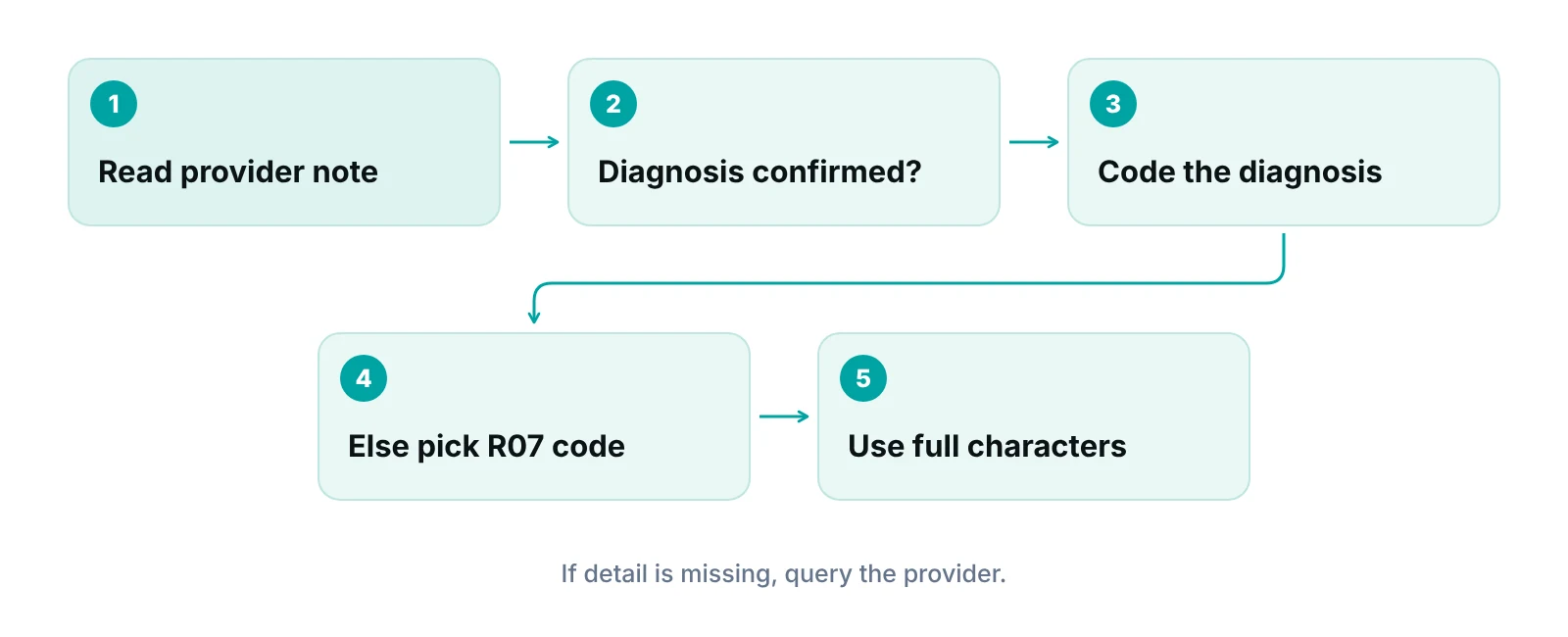
R07.9 is correct when the provider’s note gives no more detail. It becomes a problem only when the detail existed but never reached the note. The ICD-10-CM Official Guidelines for FY 2027 say “unspecified” codes are for use when the information in the medical record is insufficient, and that diagnosis codes are to be reported at their highest number of characters available.
That wording answers a common worry. A coder is not wrong to assign R07.9 to a note that says only “chest pain.” A coder is wrong to guess a more specific code to avoid it. The fix for a vague code lives upstream, in the note.
Here is the practical difference between the two paths.
- Note says “chest pain” and nothing else. R07.9 is accurate. Send a documentation question to the provider if the visit looks like it should have more detail.
- Note says pain with deep breaths. The record supports R07.1, because chest pain on breathing has its own code.
- Note says anterior chest-wall pain. The record supports R07.89 under the inclusion term.
- Note says “atypical chest pain.” Look the exact words up in the ICD-10-CM Alphabetic Index before choosing. Do not assume the index path from memory or from a blog post, including this one.
Never code from a remembered answer
Many articles state that a given phrase always maps to a given code. The only safe route is the Alphabetic Index and Tabular List for the date of service, then the provider’s own words.
Symptom code or diagnosis code: the rule that decides most claims
Report a chest pain code only while the provider has not confirmed what is causing the pain. The ICD-10-CM Official Guidelines for FY 2027 (Section I.B.4) say codes that describe symptoms and signs are acceptable for reporting when a related definitive diagnosis has not been established by the provider. Section I.B.5 says signs and symptoms associated routinely with a disease process should not be assigned as additional codes, unless the classification instructs otherwise.
| What the provider documented | How to code it | Why |
|---|---|---|
| Chest pain, no cause established | Report the best-fitting R07 code | Section I.B.4 allows a symptom code when no definitive diagnosis is established. |
| A confirmed diagnosis that routinely causes chest pain | Report the diagnosis. Do not add the R07 code | Section I.B.5: signs and symptoms routinely associated with a disease are not coded in addition, unless the classification says otherwise. |
| “Possible,” “suspected” or “rule out” in an outpatient note | Read the outpatient uncertain-diagnosis guideline (Section IV.H) before coding | Outpatient settings have their own guideline for uncertain diagnoses. |
| Cause confirmed at a later visit | Report the diagnosis on that date of service; stop using R07 | Section I.B.4 applies only while no definitive diagnosis has been established. |
Source: CDC NCHS, ICD-10-CM Official Guidelines for Coding and Reporting, FY 2027 (Sections I.B.4, I.B.5; Section IV.H is cited by title only). Verify against the full guideline text.
The third row deserves attention. The outpatient guideline on uncertain diagnoses (Section IV.H) is the outpatient rule. Read it in full before building a coding policy around notes that say “rule out.” This post cites its title only; the full text is on the CDC site.
This also explains why the cardiac cluster is a separate topic. Once a provider documents a heart event, the claim is coded to that diagnosis, not to R07. For the type 1 versus type 2 myocardial infarction question, read our post on NSTEMI type 1 versus type 2 coding. For cholesterol-related diagnoses that often appear alongside chest pain visits, see our hyperlipidemia ICD-10 guide.
What the note needs so the code can be specific
A coder can only use what is written. The details below help in two ways. Some decide which R07 code applies. Others support the visit as a whole when a payer reviews the claim.
Details that change the R07 code
- Relation to breathing. Pain with breathing points to R07.1 or, if pleurodynia is documented, R07.81.
- Location in the chest. Precordial pain points to R07.2. Intercostal pain points to R07.82. Anterior chest-wall pain points to R07.89.
- Any stated diagnosis. If the provider names a cause, the diagnosis replaces the symptom code.
Details that support the visit but do not change the R07 code
- Character of the pain, such as sharp, dull, pressure or burning.
- Duration, onset and whether it comes and goes.
- Associated symptoms, such as shortness of breath, sweating or palpitations.
- What makes it better or worse, such as exertion or rest.
- Tests ordered and the reason each test was ordered.
The second list matters because a payer decides whether a test or a visit level fits the documented problem. Those rules differ by payer and by service, so check the payer’s policy for each test you bill rather than assuming a chest pain code covers it.
How this plays out in a cardiology practice
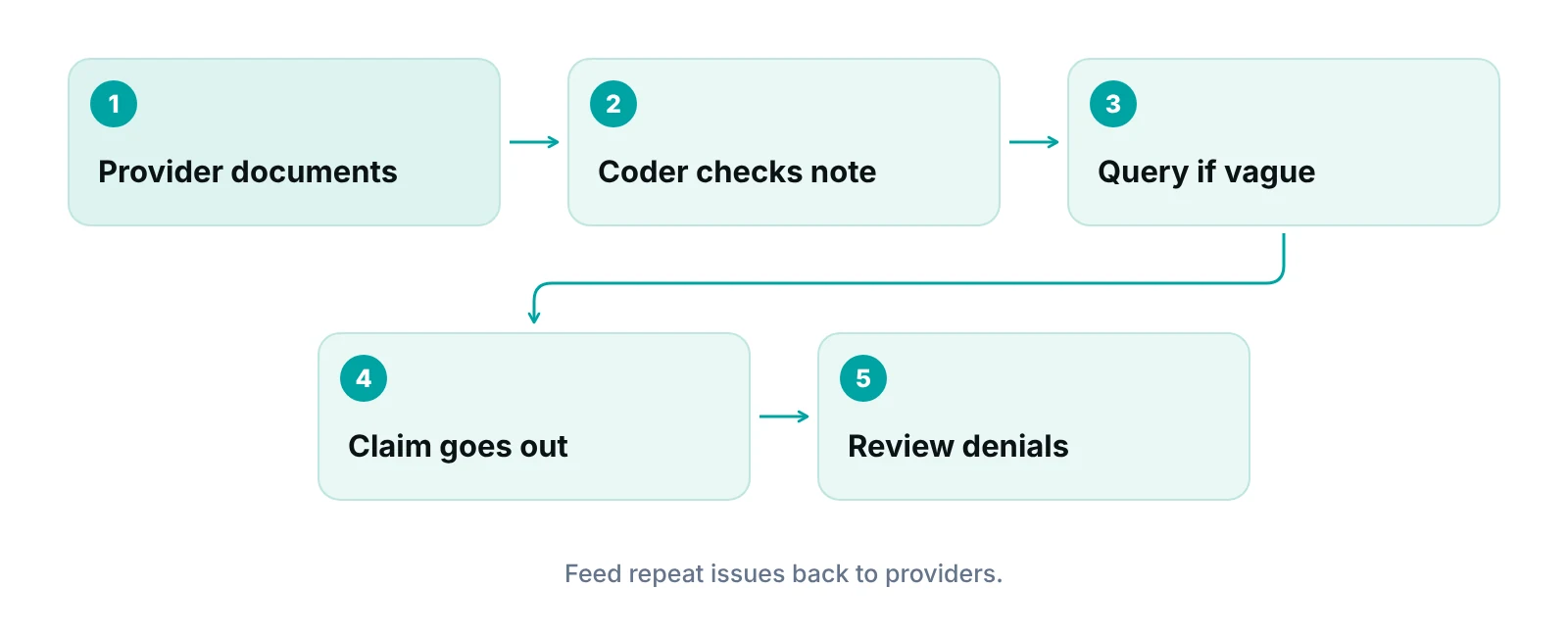
In a cardiology office, chest pain is often a reason for the visit, not the final answer. A new patient may arrive with chest pain and no diagnosis. Testing follows. A later visit reports the confirmed finding. Each claim should reflect what was known on that date of service.
Three habits keep those claims clean. Code the first visit to the symptom the provider documented. Switch to the diagnosis once the provider confirms it. Do not carry R07 forward on later visits just because it was on the first claim. Our cardiology billing page covers how these workflows fit together for cardiology practices.
Chest pain also appears in other specialties, such as primary care, pulmonology and urgent care, where the same R07 codes apply. The pattern is the same: the symptom stands in until a diagnosis is documented. For a parallel example from a different symptom, see our guide to back pain ICD-10 codes.
A pre-bill review for chest pain claims
A short review before the claim goes out catches most coding gaps. Assign each check to a role so it does not depend on one person’s memory.
| Check | Who owns it | If it fails |
|---|---|---|
| Does the note name a diagnosis, or only the symptom? | Coder | Code the diagnosis, or keep R07 if none is confirmed. |
| Is the R07 code the most specific one the note supports? | Coder | Send a written documentation query to the provider. |
| Is the code reported to its full available characters? | Biller | Correct the line before submission. |
| Does the payer’s policy support each billed test with this diagnosis? | Biller | Hold the claim and check the policy or ask the payer. |
| Are code set and guideline year right for the date of service? | Coding lead | Update the code table in your billing system. |
These checks sit inside a broader claim-scrubbing routine. Our guide to clean claims in medical billing explains how to build that routine, and our post on medical coding audits shows how to test whether coders and providers are following it.
“A vague diagnosis code is usually a documentation problem first and a coding problem second.”
Not sure where your coding gaps start?
Our free practice audit reviews a sample of your claims and notes and shows where diagnosis codes lose detail before billing.
Why the code matters to a practice
Chest pain is a common reason to seek care. The CDC NCHS Data Brief No. 43 (September 2010) reported that chest pain was the primary reason for 9.0% of adult noninjury emergency department visits in 2007 to 2008, and that 13.0% of those visits had a diagnosis of acute coronary syndrome. The data are old, and they cover emergency departments, not office practice, but they show the pattern: most chest pain visits end without an acute coronary diagnosis, so many claims carry a symptom code.
When a claim is denied, the diagnosis line is one of several places to look. Eligibility, authorization and billing errors also cause denials. Our posts on medical billing denial management and medical coding examples show how to trace a denial back to its source.
If you want a second set of eyes on coding and claim review, our medical billing services include coding support and claim checks before submission. To see how coding fits into the full cycle, start with our overview of revenue cycle management.
Our recommendations
- Code from the provider's words, not from a cheat sheet. We recommend looking up each documented phrase in the Alphabetic Index and Tabular List for the date of service. A remembered code list will drift out of date.
- Keep R07.9 for notes that truly lack detail. We recommend treating R07.9 as accurate when the record is thin, and treating the thin record as the problem to fix.
- Stop coding the symptom once the provider names the cause. We recommend building a rule into your coding checklist: a confirmed diagnosis replaces the symptom code, unless the classification instructs otherwise.
- Send written queries, and keep them neutral. We recommend asking the provider an open question, such as what detail the note can add, instead of suggesting a code.
- Update code tables every October. We recommend assigning one person to load the new ICD-10-CM release and guidelines before October 1 each year.
- Review a sample of chest pain claims each quarter. We recommend pulling a small sample, checking code against note, and sharing what you find with providers.
Bottom line
The right chest pain code is the most specific R07 code the provider’s note supports, and a confirmed diagnosis replaces it. Most coding trouble starts in the note, not at the keyboard. If denials are costing your team time, denial management services can help trace repeat problems back to their source, and our free practice audit is the place to start.
Frequently asked questions
What is the ICD-10 code for chest pain?
There is no single code. Chest pain is reported with a code from category R07. R07.9 is chest pain, unspecified. R07.1 is chest pain on breathing, R07.2 is precordial pain, R07.82 is intercostal pain and R07.89 is other chest pain. Choose the code the provider’s documentation supports.
When should a coder use R07.9?
Use R07.9 when the record does not give enough information for a more specific code. The Official Guidelines say unspecified codes are for use when the information in the medical record is insufficient. If the provider likely knew more, send a documentation query.
What is the ICD-10 code for atypical chest pain?
Do not assume a code from the phrase alone. Look the exact words up in the ICD-10-CM Alphabetic Index for the date of service, then confirm the result in the Tabular List. If the index sends you to a code, check the inclusion terms and notes before assigning it.
Is R07.4 a valid chest pain code?
R07.4 does not appear in the category R07 list we checked, so do not use it. Some older guides show it as left-sided chest pain. Where the pain sits can matter clinically, but only the codes in the current Tabular List can go on a claim.
Do I code chest pain when the provider documents a diagnosis?
Usually not. The Official Guidelines say signs and symptoms that are routinely associated with a disease process should not be assigned as additional codes, unless the classification instructs otherwise. Code the confirmed diagnosis instead.
How should an outpatient claim handle a "rule out" chest pain note?
Outpatient coding has its own guideline for uncertain diagnoses, Section IV.H of the Official Guidelines. Read it before coding from words like possible, suspected or rule out, and ask your compliance lead if the note is unclear.
Get your free practice audit
Tell us about your practice. We will contact you using the details you give.
- A review of your recent claims, denials and A/R aging
- Where your front desk and prior authorizations slow payment
- A prioritized fix list you keep, whether or not you hire us
Pricing is quoted after the audit, based on your volume and the services you choose. Prefer to talk? Call +1 (302) 556-2288.
Sources
- ICD-10-CM Official Guidelines for Coding and Reporting, FY 2027 (Oct 1, 2026 – Sep 30, 2027) — CDC / NCHS (2026)
- ICD-10-CM tabular list, category R07 (vendor copy of the CDC tabular list) — Skyscape (copy of CDC ICD-10-CM tabular list) (2025)
- Emergency Department Visits for Chest Pain and Abdominal Pain: United States, 1999-2008 (NCHS Data Brief No. 43) — CDC / NCHS (2010)
Disclaimer: This article is general educational information about diagnosis coding and revenue cycle operations. It is not medical, legal, coding or compliance advice. Code sets and guidelines change each October, and payer rules vary. Confirm every code against the current official code set and the payer's policy before billing.