
Professional and technical splits, specimen and stain units, molecular date-of-service rules and denial follow-up, built on Medicare rules and your own contracts, with requisition checks and a claims portal.
By Awais Afzal | Healthcare Operations & Data Analyst
Published October 12, 2026 · Last reviewed October 12, 2026 · Next review April 12, 2027
Quick answer
Pathology billing services turn each accession into a payable claim: global, professional (26) or technical (TC) billing set by who did the work, units counted per specimen, stain or antibody, the correct date of service, a CLIA number and a diagnosis the payer accepts. RCM Finder adds requisition checks, client-facing marketing and a claims portal.
On this page
A pathology claim often joins work done by different people in different places. A lab prepares the slide, a pathologist reads it, and the specimen may come from a hospital patient. One wrong modifier can send the claim to the wrong payer.
Physician pathology services are paid on the Medicare physician fee schedule. Clinical laboratory tests are paid on the clinical laboratory fee schedule (CLFS). Molecular tests add coverage rules. For code primers, read our pathology CPT codes guide and our pathology modifiers explainer.
CMS says the 2026 PAMA reporting period ran from May 1 to July 31, 2026, using private payor data from January 1 to June 30, 2025. Section 6226 of the Consolidated Appropriations Act, 2026, passed February 3, 2026, delayed the phase-in of cuts. There is no phase-in reduction in 2026. From January 1, 2027 through 2029, a test's payment may not fall more than 15% a year. The ADLM reported the same delay.
Reporting applies to independent, physician office and hospital outreach labs that meet CMS's Medicare revenue thresholds, including at least $12,500 in laboratory fee schedule revenue in the collection period. CMS has posted preliminary CY 2027 data and wants feedback before October 21, 2026.
Revenue leaks at the handoffs: a requisition with no diagnosis, a technical component billed by the wrong entity, a stain counted twice. A pathology practice needs referrers who trust it, complete requisitions, correct splits and software that shows where each case stands.
Pathology volume comes from referring practices and hospitals, not patient ads. Our healthcare digital marketing builds what a practice manager or lab director checks before sending specimens. Clear any referral-source outreach with your compliance counsel.
Our virtual medical assistants for pathology work on your practice's time zone. They chase what a requisition left out, check eligibility and answer patient billing calls.
Our end-to-end pathology revenue cycle management covers charge entry, coding support, claim scrubbing, denials and A/R follow-up, with pathology checks on the split, units, date of service and CLIA number.
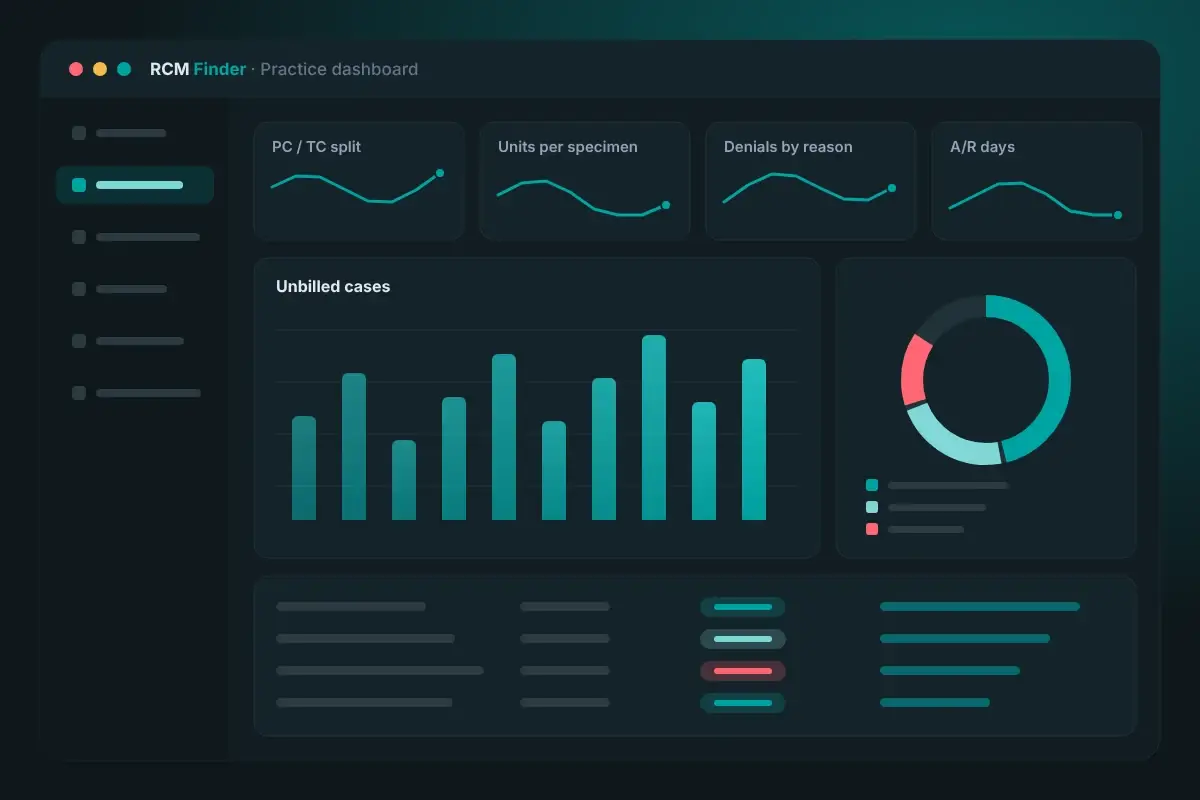
Our practice management system tracks every case by claim stage, applies specialty-aware billing logic per claim, checks data completeness before submission and flags underpayments. Billing companies get a client portal.
Find where your pathology claims leak
We review recent accessions, remittances and denials, then show where splits, units or missing data cost you.
Bill the global service only when one entity performs both the technical work and the interpretation. Otherwise the pathologist bills 26 for the reading and the entity that did the technical work bills TC.
Noridian defines modifier 26 as interpretation only. It says not to use 26 when the provider performed the global service, and to bill the two parts separately when they come from different enrolled locations. CMS's SE0587, an article about imaging, uses the same split: the professional component is the physician's interpretation and the technical component is practice expense: staff, supplies and equipment.
Under 42 CFR 415.102, Medicare pays a physician's services to hospital patients on the fee schedule only if the physician personally furnishes them, they contribute directly to diagnosis or treatment, and they ordinarily require a physician. Services that fall short but relate to care the hospital furnishes are paid through the hospital under its own payment rules, and neither the hospital nor the physician may seek payment from the carrier, the patient or another insurer.
Fee schedule pathology under 42 CFR 415.130 includes surgical pathology, specific cytopathology, hematology and blood banking services, and qualifying clinical consultations. For services after June 30, 2012, an independent lab may not bill the Medicare contractor for the technical component of physician pathology services for hospital inpatients or outpatients. Noridian says the facility pays the technical portion. Read each hospital contract. Our post on pathology claim documentation covers records contractors request.
Each code counts a different unit: a specimen, a stain on a block or an antibody stain on a specimen. Count the wrong unit and you over-bill or under-bill.
The 2026 NCCI policy manual, chapter 10, defines a specimen as tissue submitted for individual and separate attention, examination and diagnosis. Separate containers usually mean separate specimens, but several biopsies of one polyp are usually one. Code 88305 is a level IV exam and 88307 a level V exam, per AAPC (secondary).
| Situation | Code or modifier (our wording) | Medicare rule | Typical denial or overpayment trigger |
|---|---|---|---|
| Pathologist reads slides prepared elsewhere | 26 on the reading | Interpretation only; no 26 if the same provider did the global service (Noridian) | 26 added to a global service |
| Independent lab, hospital patient | TC | Not billable to the Medicare contractor after June 30, 2012 (42 CFR 415.130(d)(2)) | TC billed for a hospital inpatient or outpatient |
| Surgical pathology specimens | 88305 (level IV), 88307 (level V) | Unit is the specimen; gross exam is included (NCCI ch. X, sections M.8, L.9) | Units counted by container or slide |
| Prostate needle biopsies | G0416 | One unit for all needle biopsies, not 88305 (NCCI section L.10) | 88305 billed for each core or site |
| Special stains | 88312 and 88313 (stain groups I and II) | One unit per stain per tissue block; controls are not billable (NCCI section M.9) | Extra units for one stain on one block |
| Immunohistochemistry | 88342 (first antibody), 88341 (each additional) | Each antibody stain per specimen; several blocks of one specimen count once (NCCI section M.9) | Units counted per block or per slide |
| Molecular pathology, Tier 1 or 2 | 81xxx codes | One unit per specimen from one source; one unit if one procedure covers several genes (NCCI sections M.4, F.8) | Stacked codes; duplicate gene testing |
Sources: CMS NCCI Policy Manual ch. 10 (2026); eCFR 42 CFR 415.130 (2026); Noridian JF modifier 26 page (2025); AAPC (secondary, code meanings). Rules vary by payer.
Set the unit rule per code in the billing system and compare billed units with the accession and block count.
A laboratory test usually takes the specimen collection date. For a hospital outpatient's molecular test, the test date replaces it only if all five conditions in 42 CFR 414.510(b)(5) are met.
Under 42 CFR 414.510, the date of service is generally the collection date. A specimen stored more than 30 days is archived, and its date is the day it was retrieved. CMS's date-of-service page says that when the molecular exception applies, the performing lab bills Medicare directly. The exception covers molecular pathology tests (not those run by blood banks) and certain advanced diagnostic tests. All five must be met:
The same policy applies to the technical component of physician pathology specimens (42 CFR 415.130(d)(3)). We flag every hospital outpatient specimen for a date review.
Noridian's MolDX policy, LCD L35160 (revision effective February 5, 2026), requires each molecular diagnostic test to carry a unique test identifier as extra claim documentation and covers only tests that pass MolDX's technical assessment. Novitas's billing article A58917 (revision effective July 1, 2026) adds these points:
Other MACs may differ. First Coast lists pathology and laboratory codes whose claims must carry medical records, and a listed code without them rejects (September 2026 page). Oncology practices often order tumor testing; see our oncology billing services.
Most avoidable denials start before the specimen is cut: a thin requisition, no diagnosis, no ABN or a missing CLIA number.
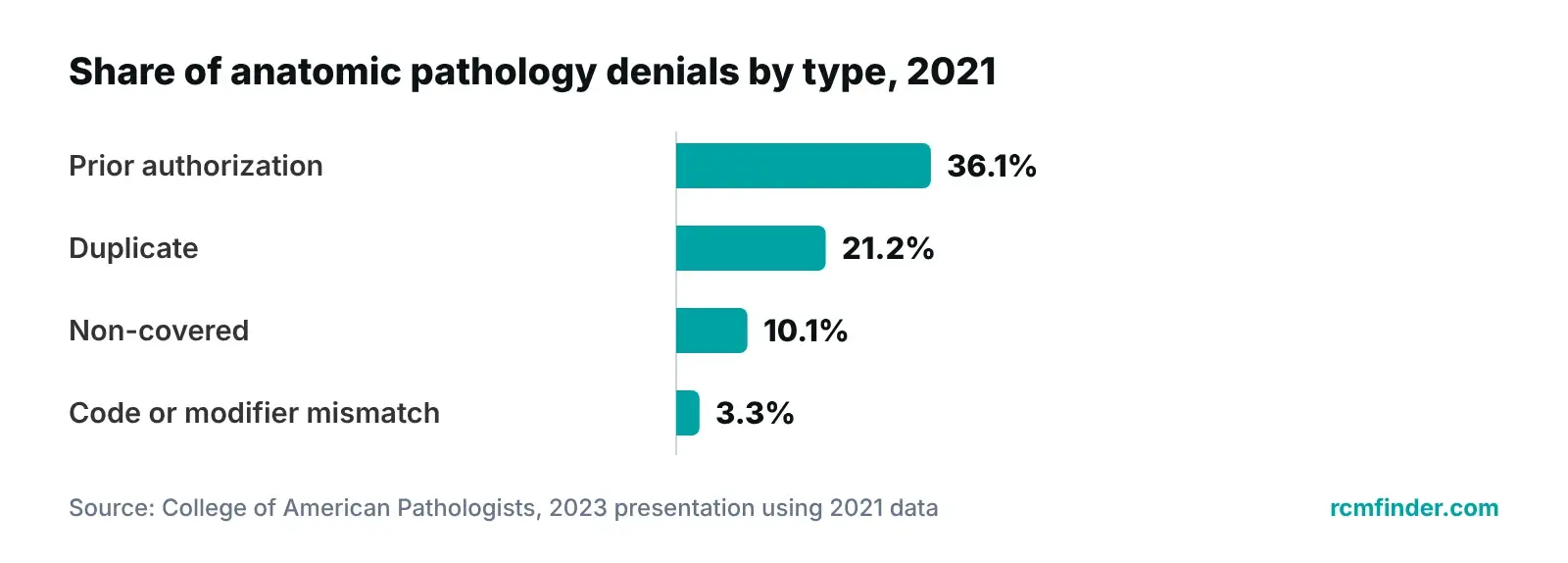
In a College of American Pathologists presentation (May 2023), prior authorization was the top anatomic pathology denial reason, rising from 28.9% of total denials in 2018 to 36.1% in 2021. Our prior authorization guide covers the process.
Under 42 CFR 493.1241, the requisition must ask for the requester, patient identifier, sex and age, tests, specimen source and collection date. Under 42 CFR 410.32, the claim must reflect what the orderer supplied.
If CMS asks, the submitter must produce the diagnosis or narrative the orderer supplied. If it does not show the test was necessary, CMS requests the orderer's records and denies the claim if they do not arrive (42 CFR 410.32(d)(3)). MM14536 says MACs apply uniform edits to 23 laboratory NCDs; the October 2026 update changed ICD-10 lists for 11. Return requisitions with no diagnosis to the ordering practice.
Noridian says an ABN is required when a service is expected to be denied, physicians should forward ABNs to labs, and routine ABNs are prohibited. See also claims manual chapter 16, section 40.7, and our ABN guide.
Under 42 CFR 493.3, a lab must hold a certificate covering its tests or be CLIA-exempt, and CMS says labs must be certified to receive Medicare or Medicaid payment. First Coast says a missing or invalid CLIA number returns a claim (CO 16 tips).
See what denials and underpayments cost you
Enter your volume and denial rate to estimate what your pathology practice is losing.
| Check | Why it matters | Source | What the VMA or biller does |
|---|---|---|---|
| Requisition complete | Lab needs requester, patient identifiers, tests, specimen source and collection date | 42 CFR 493.1241 (2026) | Gaps chased with the ordering practice |
| Ordering practitioner, diagnosis, coverage edits | Claim must match what the orderer sent; MACs apply NCD edits using ICD-10 lists | 42 CFR 410.32; CMS MM14536 (2026) | Orderer's diagnosis saved; checked against the NCD or LCD |
| ABN when non-coverage is expected | Needed before a test believed not reasonable and necessary; not routine | Noridian (2026); CMS manual ch. 16, 40.7 | Ordering practice asked for the ABN |
| CLIA number on the claim | Missing or invalid number returns the claim | First Coast (2025); CMS manual ch. 16, 40.1.1 | Certificate matched to the performing lab |
| Date of service | Collection date unless a rule moves it | 42 CFR 414.510 (2026) | Hospital outpatient and stored specimens flagged |
| Molecular and MAC documentation | Identifiers and records differ by contractor | Noridian L35160; Novitas A58917; First Coast (2026) | Rules loaded per MAC and reviewed each quarter |
Sources: eCFR 42 CFR 493.1241, 410.32 and 414.510 (current as of 10/08/2026); CMS MM14536 (2026); Noridian JF ABN page (March 2026); CMS Claims Processing Manual ch. 16 (April 2026); First Coast (2025, 2026); Novitas A58917; Noridian L35160. Check your own MAC.
For Medicare patients, a lab bills Medicare on assignment. Check who owes what before sending a statement.
CMS's chapter 16 says Part B pays for laboratory fee schedule tests only if the laboratory, physician or group accepts assignment (section 30.1). Neither the Part B deductible nor coinsurance applies to assigned clinical laboratory tests (section 30.2). That covers clinical laboratory tests; check how cost sharing applies to physician fee schedule pathology before you bill a patient.
For other payers, client billing (invoicing the ordering practice or hospital) and patient billing depend on the payer contract and state law. Have your attorney confirm the rules for each account.
Keep billing in-house if you have an experienced pathology coder and clean requisitions. Use a billing-only vendor if claims are your only gap. Choose a combined partner when problems start before the specimen arrives.
| Job | In-house team | Billing-only vendor | Four-pillar partner (RCM Finder) |
|---|---|---|---|
| Requisition and ordering-provider follow-up | Staff chase practices by phone | Bills what the lab sends | VMA chases gaps; portal holds incomplete cases |
| Professional, technical and global split | Depends on one experienced coder | Vendor coders, after the fact | Split checked against who did the work |
| Units for specimens, stains and antibodies | Manual checks against the report | Billed from the charge sheet | Unit rule per code; units compared with accession counts |
| Molecular tests and MAC rules | Hard to track across contractors | Often generic rules | Rules loaded per MAC, reviewed quarterly |
| Referring-practice and hospital visibility | Rarely anyone | Not included | Marketing pillar for client and recruiting pages |
| Cost structure | Salaries, benefits, turnover | Varies; ask how fees are set | Quoted after a free practice audit |
Whichever model you choose, track denials by reason and underpayments by payer monthly.
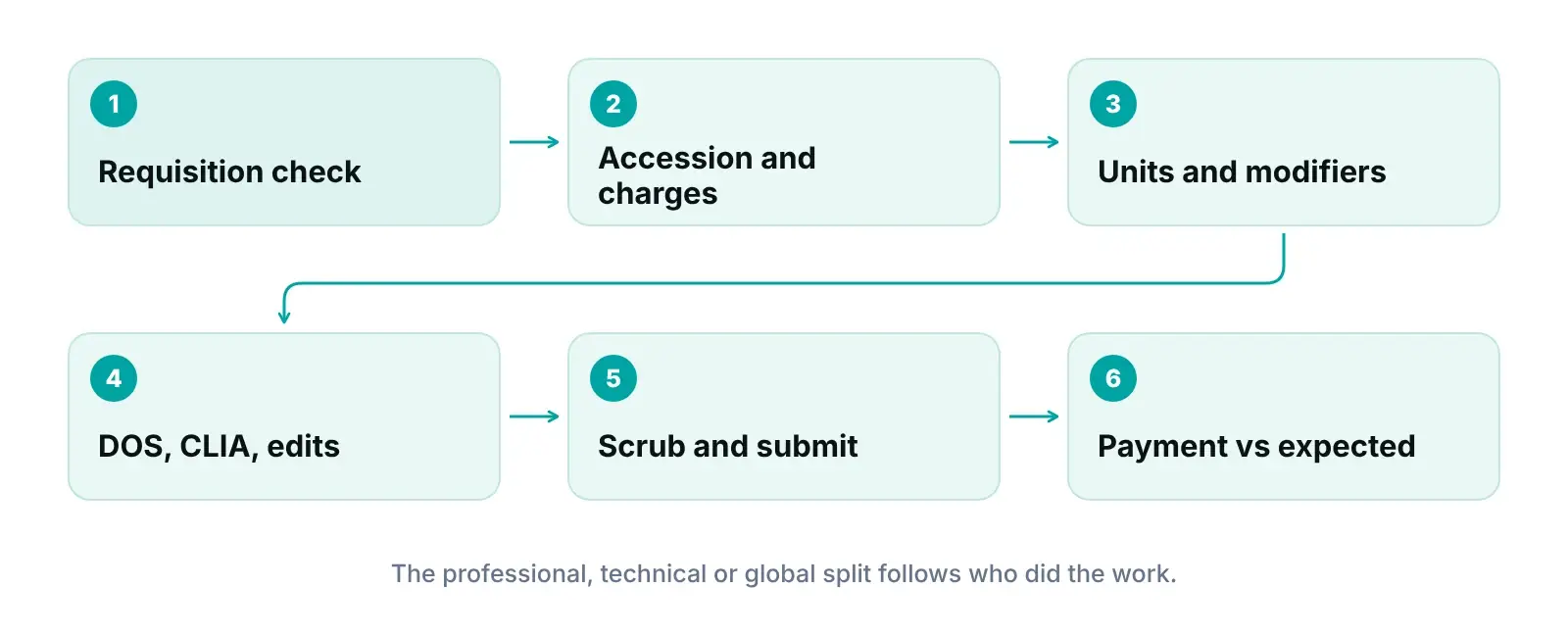
We start with a free audit and change nothing until you see the findings. We build our billing pipeline around how claims actually move through a practice: registration, charge entry, submission, payment and follow-up. For pathology, we add the checks on this page.
We compare recent accessions, remittances and denials with your reports.
We put a Business Associate Agreement in place before accessing patient data. Then our team works with the billing data your lab or EHR system provides.
We list each client account's billing route, each hospital contract's billing split and each payer's rules.
VMAs close requisition gaps. Claims are coded from the report, scrubbed, submitted and worked to payment.
Each week we review denials by reason, A/R days, unbilled accessions and underpayments, and adjust rules.
Talk to us about your pathology practice
Tell us your client mix, hospital arrangements and hardest payer. We will tell you honestly whether we fit.
Any billing vendor that handles your patients' data is a HIPAA business associate. Get a Business Associate Agreement before any access.
HHS guidance names claims processing, billing and practice management as business associate work, and subcontractors need their own agreement. The minimum necessary standard limits use to what each task needs. The Security Rule's technical safeguards cover access control, audit controls, integrity, authentication and transmission security.
We use role-based access, audit logging and encrypted (HTTPS) connections, and we put a Business Associate Agreement in place before accessing patient data. For your own side, use our HIPAA compliance checklist for medical practices.
We would rather tell you now than after you sign. Here is where we fit and where we do not.
A good fit if you are
Probably not a fit if you are
What we would do first if we were running your practice's revenue cycle tomorrow.
For each accession we record who prepared the slide and who read it. That sets global, 26 or TC.
Specimens, blocks and antibodies are different units. We load the rule per code and compare billed units with the accession.
A requisition missing the ordering practitioner, specimen source or diagnosis goes back before billing.
Hospital outpatient, stored and molecular specimens can carry a date other than collection. We flag them at intake.
Policies such as L35160 and A58917 differ by contractor. We review them each quarter and note revision dates.
Pull your top tests by volume and compare them with CMS's preliminary CY 2027 data.
They cover charge entry from the accession, coding, claim scrubbing, submission, payment posting, denial management and A/R follow-up. For pathology, that also means choosing global, 26 or TC for each claim, counting units per specimen, stain or antibody, setting the right date of service and putting the CLIA number on the claim. RCM Finder adds requisition follow-up, client-facing marketing and a claims portal.
The professional component is the pathologist's interpretation, billed with modifier 26. The technical component is the lab work, such as staff, supplies and equipment, billed with TC. The global service combines both and needs no modifier. Noridian says not to use 26 when the provider performed the global service. After June 30, 2012, an independent lab may not bill the Medicare contractor for the technical component for hospital patients.
As of October 2026, CMS says there is no phase-in reduction in 2026 after Section 6226 of the Consolidated Appropriations Act, 2026. From January 1, 2027 through 2029, a test's payment may not fall more than 15% a year. The 2026 reporting period ended July 31, 2026. CMS posted preliminary CY 2027 data and wants feedback before October 21, 2026.
Under the 2026 NCCI policy manual, a special stain is one unit per stain on a single tissue block. Immunohistochemistry is one unit per antibody stain per specimen, and multiple blocks from one specimen count once. A cocktail that gives one result counts as one stain. Controls are not billable. Payers and contractors may add their own edits, so check them as well.
Usually the date the specimen was collected. For a hospital outpatient, the test date replaces it only if the test happens after discharge, the specimen was collected during an encounter, collecting then was medically appropriate, the results do not guide treatment during it, and the test is reasonable and necessary (42 CFR 414.510(b)(5)). Hospital outpatient specimens deserve a date review before billing.
Medicare requires the claim to reflect the diagnosis information the ordering practitioner supplied, and the submitter must produce it if CMS asks. If it does not show the test was reasonable and necessary, CMS requests the orderer's records, and a claim is denied if they do not arrive. Return requisitions without a diagnosis to the ordering practice. Do not assign one yourself.
Tell us about your practice. A member of our operations team replies within one business day.
Pricing is quoted after the audit, based on your volume and the services you choose. Prefer to talk? Call +1 (302) 556-2288.
Tell us about your practice
About the author: Awais Afzal
Healthcare Operations & Data Analyst, RCM Finder
Awais has spent more than 16 years in healthcare digital marketing and clinical operations management. He builds data-driven revenue cycle blueprints for high-ticket medical practices and leads product development of the RCM Finder portal. More about our team.
How we write: every figure, code and rule on this page was checked against the primary source listed below and independently fact-checked before publishing. We re-review this page every six months. Last reviewed October 12, 2026; next review April 12, 2027.
We use cookies to understand how our site is used and to measure our advertising. You can accept or reject non-essential cookies. See our Privacy Policy.