
Medicare fee schedule changes for pathology billing in 2026 raised the conversion factor to $33.40, or $33.57 for qualifying APM participants, but CMS now proposes $32.84 and $33.17 for 2027. The 2027 numbers are proposals, not final. Your own change depends on your codes.
This page replaces an earlier version written about the proposed 2025 rule. That version contained figures that did not match CMS, so they were removed. What follows uses CMS fact sheets only, with every year and rule status stated. For the wider fee schedule picture across specialties, see our broader Medicare fee schedule cuts post.
Key takeaways
- CY 2026 final conversion factors were $33.40 and $33.57, up from $32.35.
- The CY 2027 proposal is $32.84 and $33.17, mainly because a one-year 2.50% increase expires.
- The CY 2026 efficiency adjustment of -2.5% covers non-time-based work RVUs; CMS’s fact sheet does not mention pathology.
- Clinical laboratory tests have a separate fee schedule, with cuts proposed for CY 2027.
- Model your own codes; a national percentage will not match your mix.
Where the fee schedule stands in October 2026
The Medicare conversion factor, the dollar amount that multiplies every service’s relative value units, rose for CY 2026 and is proposed to fall again for CY 2027. CMS finalized the CY 2026 conversion factors on October 31, 2025: $33.57 for qualifying APM participants and $33.40 for everyone else, up from $32.35 (CMS fact sheet on the CY 2026 final rule). CMS released the CY 2027 proposed rule on July 14, 2026, with proposed factors of $33.17 and $32.84 (CMS fact sheet on the CY 2027 proposed rule).
A proposed rule is not final. As of this writing, the CY 2027 payment rates are proposals. CMS usually finalizes the rule in the fall, but the final text and any changes from comments have not been confirmed here. Treat every CY 2027 number in this post as a proposal until you see the final rule.
Old figures to ignore
An earlier version of this post listed a CY 2025 conversion factor near $35.10 and dollar payments for specific pathology codes. Those figures did not match CMS. CMS reported a CY 2024 factor of $33.29 and a CY 2025 factor of $32.35. This post no longer prints per-code dollar amounts, because they should come from the CMS fee schedule files for your locality.
The conversion factor from CY 2024 to the CY 2027 proposal
The conversion factor fell 2.83% for CY 2025, rose for CY 2026 and is proposed to drop again for CY 2027. In the CMS fact sheet on the CY 2025 final rule, CMS set the CY 2025 factor at $32.35, down $0.94 from $33.29 in CY 2024. CMS tied the drop mainly to the end of a temporary 2.93% statutory increase that applied in CY 2024.
For CY 2026, the statute added a one-year 2.50% increase. CMS also finalized two factors for the first time. The qualifying APM factor reflects a +0.75% statutory update, and the other factor reflects +0.25%. The totals also include an estimated +0.49% adjustment tied to finalized work RVU changes.
| Year | Qualifying APM participants | Other clinicians | Status |
|---|---|---|---|
| CY 2024 | $33.29 | $33.29 | Final |
| CY 2025 | $32.35 (-2.83%) | $32.35 (-2.83%) | Final |
| CY 2026 | $33.57 (+3.77%) | $33.40 (+3.26%) | Final |
| CY 2027 | $33.17 (-1.19%) | $32.84 (-1.68%) | Proposed, July 14, 2026 |
Source: CMS fact sheets on the CY 2025 final rule (2024), the CY 2026 final rule (2025) and the CY 2027 proposed rule (2026). CY 2025 had a single factor. Percent changes are as CMS reported them against the prior year’s factor.
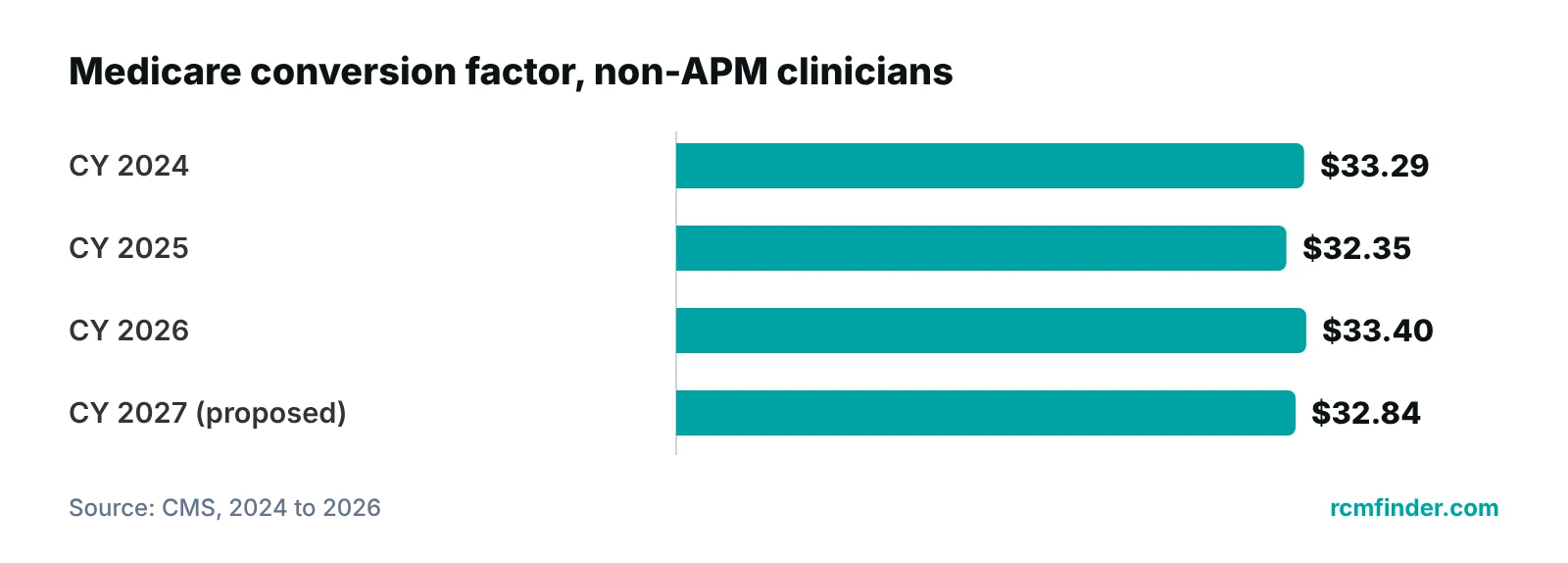
The CY 2027 proposal drops mainly because the one-year 2.50% increase expires. CMS says that expiry, written into Public Law 119-21, is the main reason for the decrease. The proposal also includes an estimated +0.53% adjustment tied to proposed work RVU changes.
The CY 2026 efficiency adjustment and pathology
CMS finalized a -2.5% efficiency adjustment for CY 2026 on the work RVUs of non-time-based services. According to the CMS fact sheet on the CY 2026 final rule, it applies to work RVUs and the matching intraservice time, and it excludes time-based services such as E/M, care management, behavioral health, telehealth-list services and some maternity codes.
The fact sheet does not mention pathology. Whether a particular pathology code is covered depends on CMS’s list of exempt codes, which was updated in the final rule. Do not assume your codes are in or out. Check each high-volume code against the exempt list in the final rule and compare your CY 2026 rate with your CY 2025 rate in the CMS fee schedule files.
The CY 2027 fact sheet does not describe an efficiency adjustment, so no CY 2027 position is stated here. If the full proposed rule discusses one, that detail was not checked for this post.
Practice expense changes that can move lab and pathology rates
CMS finalized practice expense changes for CY 2026 that shift more indirect cost toward office-based practitioners. It did not adopt the AMA’s new survey data for rate setting. It cited small samples, low response rates, measurement error and incomplete submissions (CMS fact sheet on the CY 2026 final rule).
For CY 2027, CMS proposes to phase out part of the method that keeps specialty-level practice expense RVUs tied to older data, replacing it with a stabilizer. It also asks for comment on whether the facility versus non-facility payment difference is still appropriate (CMS fact sheet on the CY 2027 proposed rule). The fact sheet lists no pathology-specific proposals, so the effect on your practice depends on your site-of-service mix.
“A conversion factor is only one half of the payment formula. Relative value units decide the other half.”
What changed each year, side by side
The fee schedule moved in three different directions over three rule years. Reading them together shows why one year’s headline does not describe your own change.
| Lever | CY 2025 final | CY 2026 final | CY 2027 proposed |
|---|---|---|---|
| Conversion factor | $32.35, down 2.83% | $33.40 or $33.57, up | $32.84 or $33.17, down |
| Statutory update | 0% overall, temporary 2.93% increase ended | One-year +2.50% plus +0.25% or +0.75% | One-year +2.50% expires |
| Efficiency adjustment | Not described in the fact sheet | -2.5% on non-time-based work RVUs | Not described in the fact sheet |
| Practice expense | Not described in the fact sheet | Survey data not adopted; office-based indirect cost shifted | Stabilizer proposed; site-of-service differential under review |
| Clinical laboratory | Not described in the fact sheet | Not described in the fact sheet | Reporting and phased cuts proposed, up to 15% per year through CY 2029 |
Source: CMS fact sheets on the CY 2025, CY 2026 and CY 2027 rules (2024 to 2026). “Not described” means the fact sheet is silent, not that nothing changed.
The separate clinical laboratory fee schedule
Clinical laboratory tests are paid under a different fee schedule from the physician fee schedule, and CMS proposes cuts there for CY 2027. In its CMS fact sheet on the CY 2027 proposed rule, CMS says payment reductions based on private payor rate data would phase in at up to 15% per year through CY 2029, starting in CY 2027. It also describes a request for information on duplicate laboratory and imaging testing.
The AMA’s summary says Congress must act to permanently reform the underlying law, the Protecting Access to Medicare Act (PAMA), and address potential payment reductions (AMA summary of the CY 2027 proposed rule). If your practice bills both interpretation services and laboratory tests, track the two fee schedules separately. The laboratory billing and coding guide covers how lab claims differ.
Quality reporting and MIPS in this cycle
The AMA’s summary reports that CMS proposes to keep the MIPS performance threshold at 75 points through the CY 2028 performance year (AMA summary of the CY 2027 proposed rule). The CMS payment fact sheets do not cover MIPS scoring, so confirm that figure in the Quality Payment Program rule before you plan around it.
Pathologists who report to MIPS should check which measures and pathways apply to their practice each year. Our MIPS categories and scoring guide explains the categories and how adjustments are applied.
Proposed versus final: how to budget while the rule is open
Budget on the final rule, and plan for a range until it arrives. A proposed rule can change after comments, and a figure that was proposed in July may not match the figure in effect on January 1.
- Final today: the CY 2025 and CY 2026 conversion factors, the CY 2026 efficiency adjustment and the CY 2026 practice expense decisions.
- Proposed only: the CY 2027 conversion factors, the CY 2027 practice expense stabilizer and the clinical laboratory payment reductions.
- Not confirmed here: pathology-specific percentage changes, the CY 2027 final release date and any CY 2027 efficiency adjustment.
For a practice with thin margins, a sensible approach is to prepare two cases. The first holds rates at the CY 2026 level. The second applies the proposed non-APM factor of $32.84 with your own code mix. Neither is a forecast. Together they show how much room the practice has and which cost or collection issue needs attention first.
Finance and billing leads should share one version of this model. When the final rule posts, replace the proposed inputs, record the date and keep the earlier version so the team can see what changed.
How to model the effect on your own practice
A practical model starts with your own claims, not a national percentage. The conversion factor changes every code the same way, but relative value units differ by code, so your mix decides your result.
| Year | Factor used | Payment if RVUs do not change | Change from prior year |
|---|---|---|---|
| CY 2025 | $32.35 | $100.00 | Baseline |
| CY 2026 | $33.40 | $103.25 | +3.25% |
| CY 2027 (proposed) | $32.84 | $101.51 | -1.68% |
Source: RCM Finder arithmetic on the CMS non-APM conversion factors ($32.35, $33.40, $32.84). Hypothetical amount. Real payments also change with RVUs and the efficiency adjustment. Rounded to the cent.
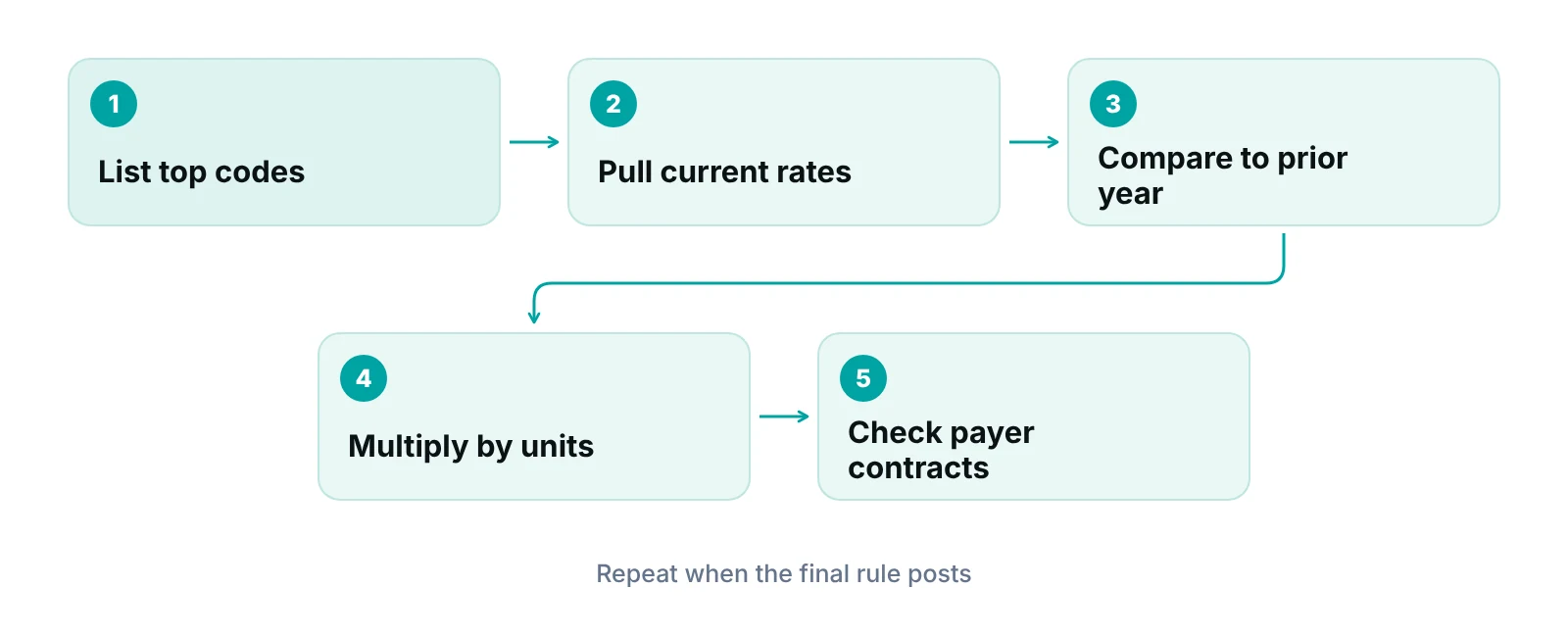
- List your top ten pathology and laboratory codes by volume for the last twelve months.
- Pull each code’s CY 2025 and CY 2026 payment for your locality from the CMS fee schedule files and note the change.
- When CMS publishes the CY 2027 final rule, repeat the pull and compare the same codes.
- Multiply the change per code by your annual units to estimate the revenue effect.
- Check each payer contract: some commercial rates are set as a percentage of Medicare and will move too.
Our revenue calculator can help you size the gap once you know your numbers. If you want a second reader on your claims, our pathology billing and revenue cycle support and medical billing services are built around this kind of review.
Protecting revenue while rates move
Rate changes hurt most when claims are also leaking through denials and slow follow-up. Fixing those leaks is within a practice’s control. Our denial management services and the pathology CPT codes billing guide focus on the errors that cost money on every rule year.
See where your pathology claims lose money
Request a free practice audit. We review a sample of recent claims and denials and show where coding, documentation or follow-up is costing you. Pricing is quoted after the audit.
Also review the documentation rules for pathology and laboratory claims and CPT codes and modifiers for pathology billing. Modifier and documentation errors turn into denials regardless of the conversion factor. For the wider picture across specialties, see our broader Medicare fee schedule cuts post.
Our recommendations
- Track the rule status, not just the headline. Record whether a figure is proposed or final. Update your budget only when CMS publishes the final rule.
- Build a code-level revenue model. Use your top codes by volume and the CMS fee schedule files for your locality. A national percentage hides your real change.
- Check the efficiency adjustment code by code. Compare each high-volume code against the CMS exempt list and against last year’s rate before assuming any effect.
- Separate the two fee schedules. Keep physician fee schedule services and clinical laboratory tests in different reports. Their rules and timelines differ.
- Review payer contracts that key off Medicare. Find contracts that pay a percentage of Medicare and note the date their rates reset.
- Reduce avoidable denials first. Coding, modifier and documentation errors lose revenue in every year. Audit denial reasons monthly and assign an owner to each type.
- Document the reporting calendar. Put the CMS comment period, final rule release, January 1 effective date and MIPS deadlines in one shared calendar.
Track pathology claims by stage with an owner on each.
Our portal tracks each claim by stage with an assigned owner, runs data-completeness checks before submission and flags underpayments against expected amounts. Expected amounts still need your own fee schedule inputs.
See how the RCM Finder portal works · Create a portal account
Disclosure: RCM Finder builds and sells this portal. It is a practice management system, not an EHR.
Bottom line
The fee schedule rose in 2026 and is proposed to fall in 2027, and the final CY 2027 rule is still to come. Model your own top codes, keep proposed and final figures apart, and fix avoidable denials in the meantime. If you want help, see our pathology billing and revenue cycle support and medical billing services, or track claims with a practice management system that tracks claims by stage.
Frequently asked questions
What are the Medicare fee schedule changes for pathology billing in 2026?
For CY 2026, CMS finalized a conversion factor of $33.40 for most clinicians and $33.57 for qualifying APM participants, up from $32.35. It also finalized a -2.5% efficiency adjustment on non-time-based services and a one-year 2.50% statutory increase. Check your own codes in the CMS fee schedule files.
What does CMS propose for 2027?
The CY 2027 proposed rule, released July 14, 2026, would set conversion factors of $33.17 for qualifying APM participants and $32.84 for others, decreases of 1.19% and 1.68%. CMS attributes the drop mainly to the expiring one-year 2.50% increase. The rule is not final until CMS publishes it.
Is the 2025 conversion factor $35.10, as an older version of this post said?
No. That figure did not match CMS. CMS reported a CY 2025 conversion factor of $32.35, down $0.94 or 2.83% from $33.29 in CY 2024. The older post’s per-code dollar amounts were also removed because they could not be verified.
Does the efficiency adjustment cut pathology payments?
CMS applied a -2.5% adjustment to work RVUs of non-time-based services in CY 2026 and exempted time-based categories. Its fact sheet does not mention pathology. Whether a specific pathology code is affected depends on the exempt list, so compare each code’s rates yearly.
Are clinical laboratory tests paid under the same fee schedule?
No. Clinical laboratory tests are paid under the clinical laboratory fee schedule. For CY 2027, CMS proposes payment reductions based on private payor data, phased in at up to 15% per year through CY 2029. Track it separately from physician fee schedule services.
When will the CY 2027 final rule be published?
This has not been confirmed. The comment deadline in the AMA’s summary was September 14, 2026. CMS has finalized this rule in the late fall in recent years, for example on October 31, 2025. Watch the CMS newsroom and the Federal Register.
Get your free practice audit
Tell us about your practice. We will contact you using the details you give.
- A review of your recent claims, denials and A/R aging
- Where your front desk and prior authorizations slow payment
- A prioritized fix list you keep, whether or not you hire us
Pricing is quoted after the audit, based on your volume and the services you choose. Prefer to talk? Call +1 (302) 556-2288.
Sources
- Calendar Year (CY) 2026 Medicare Physician Fee Schedule Final Rule (CMS-1832-F) fact sheet — CMS (2025 (accessed 2026-10-17))
- Calendar Year (CY) 2027 Medicare Physician Fee Schedule Proposed Rule fact sheet — CMS (2026 (accessed 2026-10-17))
- Calendar Year (CY) 2025 Medicare Physician Fee Schedule Final Rule fact sheet — CMS (2024 (accessed 2026-10-17))
- AMA summary of the CY 2027 Medicare physician fee schedule proposed rule — American Medical Association (2026 (accessed 2026-10-17))
Disclaimer: This article is educational and is not legal, coding, billing or compliance advice. CPT is a trademark of the American Medical Association. Payer rules and contracts vary, and CMS may change the figures cited, including the CY 2027 proposals. Check current CMS and payer sources before you act.
