
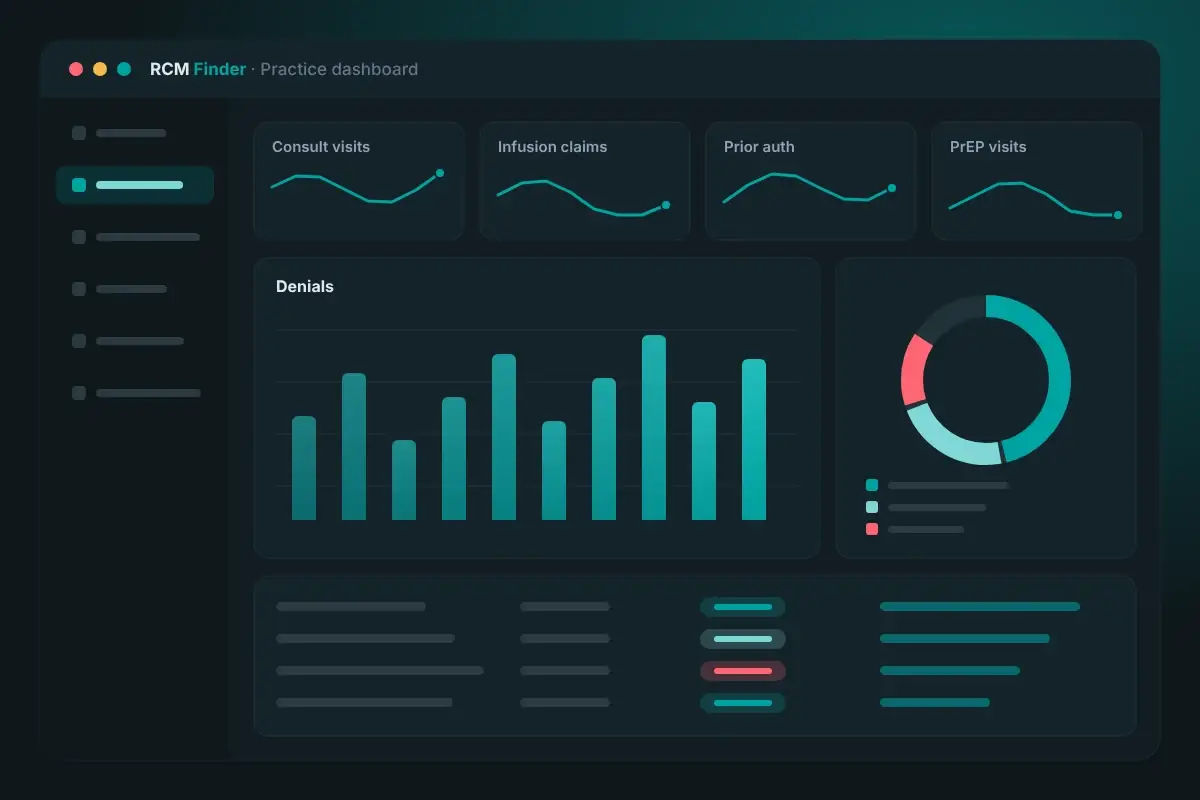
Consults, hospital visits, infusions, long-acting injectables and PrEP, plus benefit checks, prior authorization, patient marketing and a claims portal for infectious disease practices.
By Awais Afzal | Healthcare Operations & Data Analyst
Published October 12, 2026 · Last reviewed October 12, 2026 · Next review April 12, 2027
Quick answer
Infectious disease billing services manage the claims an ID practice creates: hospital and clinic visits, infusions and injections, drug lines, OPAT oversight and PrEP services. They also check drug benefits and prior authorization before each dose. RCM Finder adds front-desk assistants, marketing and a claims portal.
On this page
Infectious disease billing is different because one physician can bill a hospital visit, a clinic visit, an infusion, an injection and prevention counseling in the same week, each under its own rules. Medicare also does not pay the standard consultation codes.
In the CMS Evaluation and Management Services booklet (MLN006764, May 2026), Medicare does not recognize the inpatient consultation codes 99252 to 99255 or the office consultation codes 99242 to 99245 for Part B payment. You report the visit code that fits the service instead. Other payers set their own consult policy.
If your work is mostly cancer infusion or allergy injections, see oncology billing or allergy and immunology billing. For hospital rounding, see internal medicine billing.
Medicare has covered HIV pre-exposure prophylaxis (PrEP) under Part B since September 30, 2024, per CMS Change Request 13843.
An infectious disease practice needs referrals, a front desk that checks drug benefits early, billing that understands drug lines, and software that shows where each claim sits.
Revenue leaks at handoffs, such as an infusion started before the benefit check. We run all four pillars from one set of payer rules.
Our healthcare digital marketing helps referrers and patients find you through local search pages, referral pages and reputation work.
Our Virtual Medical Assistants work inside your existing EHR (for example PrognoCIS, eClinicalWorks or athenahealth). They check drug benefits and chase prior authorizations before the dose.
Our end-to-end revenue cycle management covers coding support, claim scrubbing, denial management and A/R follow-up for visit, drug and PrEP lines.
Our Practice Management System tracks each claim by stage and checks data completeness before submission. Appointment booking is in early access. Credentialing and in-portal real-time eligibility are coming next.
Find where your infectious disease claims leak
We review recent visit, infusion, injection and PrEP claims with their denials, then show what to fix first.
Each service family has its own payment rule. Codes are described in our own words, because the AMA owns CPT descriptors. Check the current code set and your Medicare contractor.
| Service family | Code examples (our wording) | Billing rule to know | Typical denial trigger |
|---|---|---|---|
| Office or outpatient visits | 99202 to 99205 (new), 99211 to 99215 (established), G2211 add-on | Medicare does not pay CPT consult codes; bill the visit code. G2211 applies to office and home codes | Consult code sent to Medicare |
| Hospital inpatient or observation | 99221 to 99223 (initial), 99231 to 99233 (subsequent), 99238 and 99239 (discharge) | One hospital visit code per patient per date; no discharge code under 8 hours | Two visit codes on one date |
| Prolonged services | G2212 (office, with 99205, 99215 or 99483), G0316 (inpatient or observation) | At least 15 extra minutes; not with ED or critical care | Total time not documented |
| Visits shared with an NP or PA | Hospital visit codes with modifier FS | The practitioner doing the substantive part bills; not allowed in the office | Missing FS |
| Drug administration | 96365 and 96366 (IV infusion), 96372 (shot), 96374 (IV push) | One initial code; 99211 not paid with infusions; modifier 25 on a separate E/M | Second initial code; E/M without modifier 25 |
| Drug supply | J-codes with units; JW or JZ for single-dose containers | Part B pays most separately payable drugs at ASP plus 6% | Missing JW or JZ |
| HIV PrEP services | G0011 and G0013 (counseling), G0012 (injection), J0739 (cabotegravir 1 mg) | Up to 8 counseling visits and 8 HIV screens per 12 months; no cost sharing | Over the limit; no allowed diagnosis |
Source: CMS MLN006764 (May 2026); CMS Claims Processing Manual Chapter 12 section 30.5; CMS Change Request 13843 and NCD 210.15; CMS JW/JZ instructions (R12067CP); CMS Part B ASP page (modified August 2026); AAPC code pages for 96365, 96372 and 96374. Other Medicare contractors and payers may differ.
The CMS booklet allows one hospital inpatient or observation code per patient per calendar date. Discharge codes 99238 and 99239 apply when discharge falls on a different date than admission, not for stays under 8 hours.
For long visits, the booklet describes G2212 for office care and G0316 for inpatient or observation care once total time passes the top visit's time by 15 minutes. Its table sets thresholds such as 90 minutes for 99223 and 65 minutes for 99233. When an NP or PA shares a facility visit, modifier FS is required.
Chapter 12 of the Medicare Claims Processing Manual (section 30.5) says to report one initial administration code, the one that best describes the main reason for the visit, unless protocol needs two IV sites. The extra-hour code applies only when the infusion runs more than 30 minutes past a full hour.
The drug itself is a second line. Part B pays most separately payable drugs at average sales price plus 6 percent, per the CMS ASP page. For single-dose containers, CMS instructions require JW on a line for discarded units, or JZ when none was discarded, for dates of service from July 1, 2023. Claims without them can be audited.
If your practice runs even one test in-house, CMS's CLIA guidance says you generally need a certificate that matches the test complexity. Our laboratory billing guide covers lab claims.
Outpatient parenteral antimicrobial therapy (OPAT) splits billing across parties. The ID physician bills visits and oversight. A home infusion supplier bills the drug, nursing and equipment.
The 2018 IDSA guideline coverage in Healio says an ID physician, nurse or pharmacist should check every OPAT order before therapy starts, and patients should be monitored regularly. That oversight reaches your claims only through the visits you document.
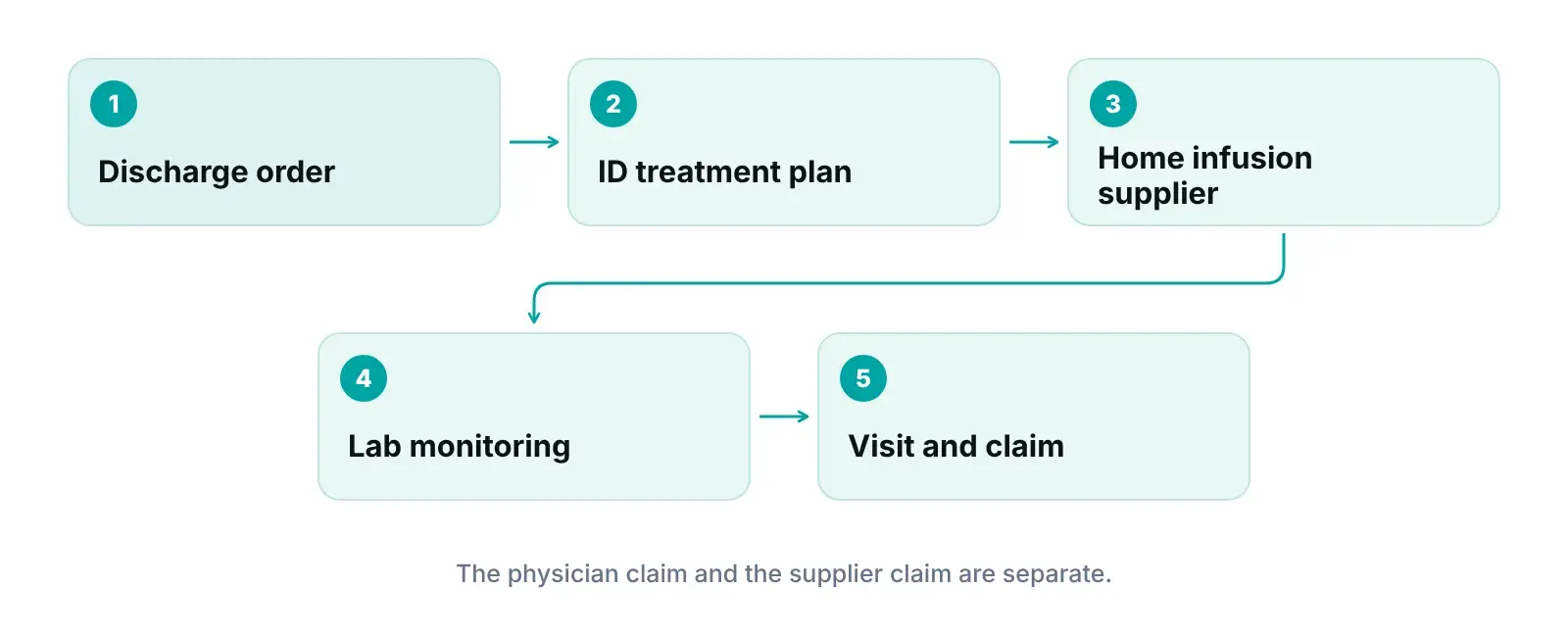
The Medicare home infusion therapy benefit began January 1, 2021, per CMS. It pays qualified suppliers for nursing, training and monitoring for certain drugs given through a pump that is durable medical equipment. CMS's CY 2026 rate file lists G0068 for home administration of anti-infective and other infusion drugs.
The drug list is narrow. In the External Infusion Pumps LCD (L33794), the antifungal and antiviral indication names acyclovir, foscarnet, amphotericin B and ganciclovir, and its general criteria include a prolonged infusion of at least 8 hours (revision effective July 1, 2026). This is a DME contractor policy. Other contractors and Medicare Advantage plans may differ.
Under 42 CFR 486.520, a home infusion supplier requires a physician-established plan of care with the type, amount and duration of services, reviewed periodically. Track the signature and review date, because the supplier's claim can stall without them. Our home infusion coding post covers home infusion billing in general.
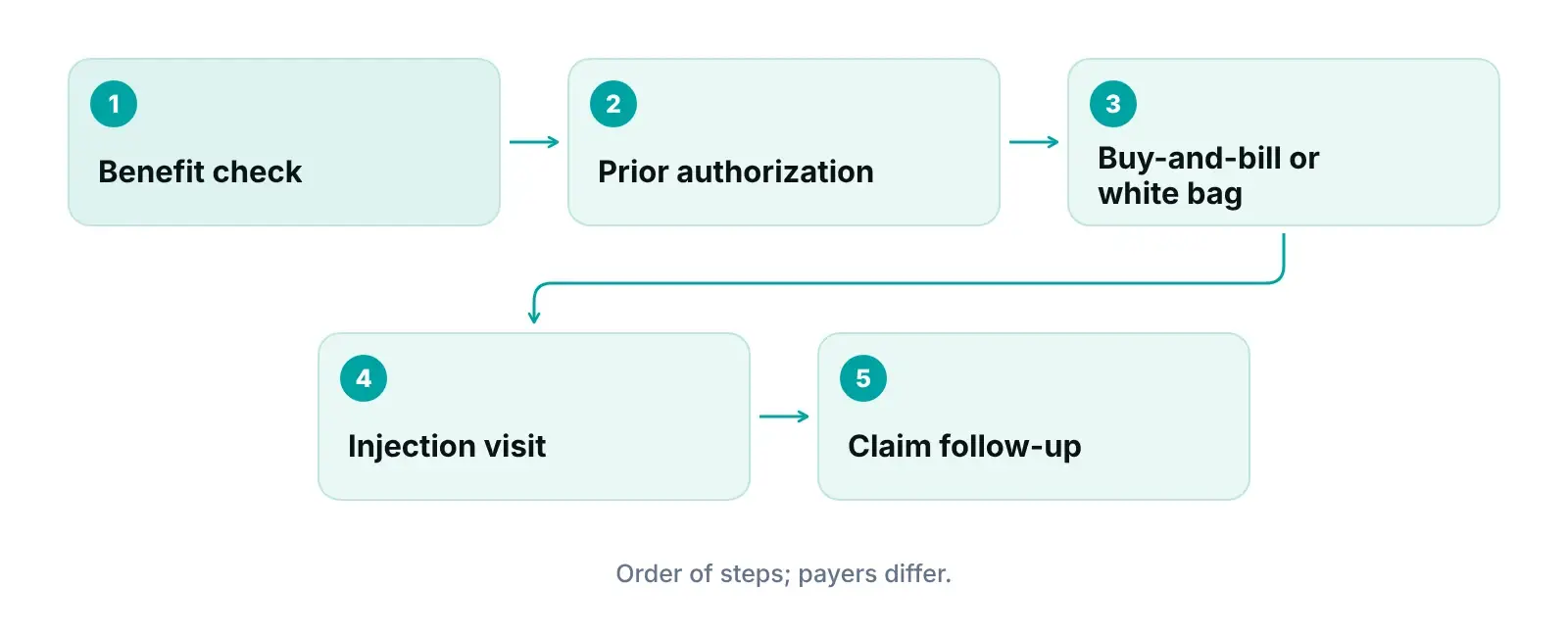
Check the drug benefit before you schedule the first dose. The first question is whether the payer treats the drug as a medical or pharmacy benefit, because that sets who buys it and who carries the loss if it is denied.
A June 2022 long-acting antiretroviral considerations document says most insurers cover Cabenuva as a medical benefit, and the payer may decide whether the clinic buys and bills or receives the drug from a specialty pharmacy. In buy-and-bill, the provider carries the drug cost. It is dated, so verify current terms. California's ADAP list shows J0741 for Cabenuva.
| Check | Why it matters | What our VMA records |
|---|---|---|
| Medical or pharmacy benefit | Sets buy-and-bill or specialty pharmacy supply (HIVMA, 2022) | Benefit type and supply route |
| Prior authorization and reauthorization | Plans may need approval for the drug. CMS-0057-F decision windows (72 hours expedited, 7 calendar days standard) do not apply to drug decisions, so ask each plan for its drug timeline | Reference number, units, end date |
| Original Medicare or Medicare Advantage | Plan type changes who approves | Plan type each visit |
| Diagnosis fit for PrEP services | PrEP codes need an allowed diagnosis, such as Z29.81 (CMS CR 13843) | Diagnosis and 12-month visit count |
| Single-dose container plan | JW or JZ is required on applicable claims (CMS) | Vial size, dose, discarded amount |
| Home infusion drug and supplier | Drug must fit the LCD list; physician plan of care needed (LCD; 42 CFR 486.520) | Supplier, pump, plan-of-care date |
| Appeal readiness | KFF found 80.7% of appealed Medicare Advantage denials fully or partly overturned (2024 data) | Denial reason, due date, clinical note |
Source: HIVMA long-acting antiretroviral considerations (June 2022); CMS-0057-F fact sheet; CMS Change Request 13843; CMS JW/JZ instructions; External Infusion Pumps LCD L33794; 42 CFR 486.520; KFF (January 2026). The KFF figures cover all Medicare Advantage services, not infusion alone.
On timing, the CMS-0057-F fact sheet sets decision windows of 72 hours (expedited) and 7 calendar days (standard) for Medicare Advantage, Medicaid and CHIP plans. It also says its policies, including the denial-reason provision, do not apply to prior authorization decisions for drugs, so ask each plan how long an infusion or injectable drug decision takes. In KFF’s analysis of 2024 data (January 2026), Medicare Advantage insurers denied 7.7% of 52.8 million determinations and 11.5% of denials were appealed. KFF says it cannot split these by service type. See our prior authorization guide and insurance verification guide.
See what denied infusions and injectables cost you
Enter your claim volume and denial rate to estimate what an infectious disease practice is losing.
Medicare covers PrEP drugs and related services under Part B with no deductible or coinsurance, within set limits. CMS NCD 210.15 guidance makes the effective date September 30, 2024.
Per CMS, covered services include up to eight counseling visits and eight HIV screening tests every 12 months, plus one hepatitis B screening. G0011 reports counseling by a physician or qualified professional (15 to 30 minutes) and G0013 by clinical staff. G0012 reports a PrEP injection, J0739 cabotegravir 1 mg, and J0750 and J0751 the oral drugs. The transmittal says claims need an allowed diagnosis, with Z29.81 as the primary diagnosis for screening edits.
The USPSTF gave PrEP a Grade A recommendation (clinician summary dated August 22, 2023) for people at increased risk of HIV. For private plans, KFF reports that the Supreme Court upheld the ACA no-cost-sharing rule for USPSTF services in June 2025, and that changes could still come. Verify each plan's terms.
Most ID work is thinking, so your note has to show it. The visit level rests on medical decision making (MDM) or total time.
The AMA's 2023 E/M guidelines say an MDM level needs two of three elements. High risk includes drug therapy requiring intensive monitoring for toxicity, and moderate includes prescription drug management. The AMA says that monitoring must target adverse effects, rely on a lab, physiologic test or imaging, and be considered during the encounter. Long-term means at least quarterly. Whether a given antimicrobial meets that test is a coding call for your team and payer.
For data, the AMA counts outside notes reviewed, each unique test reviewed or ordered, an independent historian, and a direct discussion of management with an outside clinician. Sending chart notes is not discussion.
Modifier choices also decide payment. Our posts on modifier 25 versus 59 and clean claims explain how same-day lines survive review.
Stay in-house if your staff track drug benefits and PrEP limits well. Use a billing-only vendor if claims are your only gap. Choose a combined partner when problems begin at the front desk and end as denials.
| Job | In-house team | Billing-only vendor | Four-pillar partner (RCM Finder) |
|---|---|---|---|
| Consult and E/M coding | Biller reads each payer's consult rule | Coding support after the visit | Coding support with payer rules checked first |
| Drug benefit and prior authorization | Front desk, between calls | Often left to the practice | VMA checks and follows up before the dose |
| Infusion and injection claim lines | Biller checks codes, units, JW and JZ | Scrubs claims it receives | Scrubbing with data-completeness checks in our portal |
| PrEP visit and screening limits | Manual tracking | Usually reviews denials only | Visit counts kept with the patient record |
| OPAT and home infusion coordination | Nurse or physician follows up | Not covered | VMA tracks plan-of-care paperwork |
| Referral growth | Separate marketing vendor | Not covered | Healthcare marketing under the same plan |
| Reporting | Spreadsheets | Monthly reports | Dashboards and weekly KPI reporting |
We start with a free audit and change nothing until you see the findings. We build our billing pipeline around how claims actually move through a practice: registration, charge entry, submission, payment and follow-up. For infectious disease, we add the checks on this page.
We review recent visit, infusion, injection and PrEP claims, denials and eligibility notes.
We put a Business Associate Agreement in place before accessing patient data. Then we work inside your existing EHR with role-based access.
We map your payers' consult, drug benefit and prior authorization rules, and your supply route for each drug.
VMAs check benefits and send requests. Our billing team scrubs claims, works denials and follows A/R.
You see KPI reporting each week, with open denials and authorizations listed by owner.
Talk to us about your infectious disease practice
Tell us where you see patients and which drugs you give. We will tell you honestly whether we fit.
Any vendor that handles patient data for billing is a HIPAA business associate. Get a Business Associate Agreement before access, and ask how access is limited and logged.
HHS guidance lists claims processing, billing and practice management among business associate functions. A business associate must have a Business Associate Agreement with its own subcontractors before sharing patient data. On your website, HHS online tracking guidance says trackers on scheduling pages may access protected health information, and a cookie banner is not a valid authorization.
We use role-based access, audit logging and encrypted (HTTPS) connections, and we put a Business Associate Agreement in place before accessing patient data. For your own side, use our HIPAA compliance checklist for medical practices.
We would rather tell you now than after you sign. Here is where we fit and where we do not.
A good fit if you are
Probably not a fit if you are
What we would do first if we were running your practice's revenue cycle tomorrow.
Medical or pharmacy benefit decides who buys the drug. We confirm it before the first dose is scheduled.
Medicare wants the visit code. Other payers differ. We record each payer's rule once and apply it at coding.
Administration, drug, units and JW or JZ should be reviewed together. We scrub them as a set.
The eight-visit and eight-screen limits run per 12 months. We keep the count where billing can see it.
Plan-of-care dates, lab orders and supplier names belong in one place. We keep them tied to the episode.
Record outside notes reviewed, tests ordered, who gave history and total time. Those entries support the level you bill.
In KFF's 2024 data, most appealed Medicare Advantage denials were overturned, so we attach the clinical note and work the deadline.
They cover coding support, claim scrubbing, submission, denial management and A/R follow-up for visits, infusions, injections and PrEP services. A good partner also checks drug benefits and prior authorization before the dose. We add front-desk assistants, referral marketing and a claims portal, so one team handles the work from the first call to payment.
No. CMS's May 2026 E/M booklet says Medicare does not recognize the office consultation codes 99242 to 99245 or the inpatient consultation codes 99252 to 99255 for Part B payment. You bill the visit code that fits the service. Other payers set their own policy, and some may still accept consultation codes, so check each contract before choosing a code.
Sometimes. CMS's Claims Processing Manual says a significant, separately identifiable E/M service takes modifier 25 when billed with an injection or infusion, and 99211 is not payable with infusion codes. The note should show a separate evaluation, not only the pre-infusion check. Payer rules vary, so confirm them with each plan.
Since September 30, 2024, Part B has covered PrEP drugs and related services under NCD 210.15, with no deductible or coinsurance. CMS allows up to eight counseling visits and eight HIV screening tests every 12 months, plus one hepatitis B screening. Claims need an allowed diagnosis, such as Z29.81 for screening edits.
Usually two parties bill. The infectious disease physician bills visits and oversight. A home infusion supplier bills the drug, nursing and equipment, where covered. Original Medicare covers only certain pump drugs, and Part D covers drugs without supplies or nursing. Check each patient's plan, keep the physician plan of care current, and tell patients early about possible out-of-pocket costs.
Confirm whether the payer treats the drug as a medical or pharmacy benefit, then confirm who supplies it. Get any prior authorization, record approved units and dates, and plan for JW or JZ if a single-dose container applies. Then schedule the injection visit. Terms differ by payer and change often, so check them each time.
Tell us about your practice. A member of our operations team replies within one business day.
Pricing is quoted after the audit, based on your volume and the services you choose. Prefer to talk? Call +1 (302) 556-2288.
Tell us about your practice
About the author: Awais Afzal
Healthcare Operations & Data Analyst, RCM Finder
Awais has spent more than 16 years in healthcare digital marketing and clinical operations management. He builds data-driven revenue cycle blueprints for high-ticket medical practices and leads product development of the RCM Finder portal. More about our team.
How we write: every figure, code and rule on this page was checked against the primary source listed below and independently fact-checked before publishing. We re-review this page every six months. Last reviewed October 12, 2026; next review April 12, 2027.
We use cookies to understand how our site is used and to measure our advertising. You can accept or reject non-essential cookies. See our Privacy Policy.