
Coding and claims for office procedures, physician-administered drugs and in-office labs, plus prior authorization, patient marketing and a claims portal, built on CMS rules and your payers' own policies.
By Awais Afzal | Healthcare Operations & Data Analyst
Published October 12, 2026 · Last reviewed October 12, 2026 · Next review April 12, 2027
Quick answer
Urology billing services manage the claims a urology practice creates: office cystoscopy and urodynamics, prostate biopsy and pathology, physician-administered drugs billed by unit with the JW or JZ modifier, CLIA-certified lab tests, screening limits and prior authorization. RCM Finder pairs that billing with front-desk assistants, patient marketing and a claims portal.
On this page
Urology billing is different because one practice runs several revenue streams at once: office procedures, diagnostic tests, physician-administered drugs, an in-office lab and preventive screening. Each stream has its own coding rule.
One morning can bring a cystoscopy with a global period, a urodynamic study with professional and technical parts, a hormone injection billed by unit and a screening PSA that depends on the date of the last one. For a plain-language checklist, see our do's and don'ts of urology billing.
The AMA's CPT 2026 code set made 418 changes, including 84 deletions, effective January 1, 2026. CMS's CY 2026 fee schedule final rule (Federal Register, November 5, 2025) confirms that CPT deleted prostate needle biopsy code 55700 and added nine new codes, 55707 to 55715, that separate transrectal, transperineal, MRI-fusion and in-bore CT- or MRI-guided biopsy.
CMS's CY 2026 Physician Fee Schedule final rule fact sheet (October 31, 2025) set the conversion factor at $33.40 for clinicians who are not qualifying APM participants, up from $32.35, and $33.57 for those who are. It also cuts work RVUs of services that are not time-based by a -2.5% efficiency adjustment; E/M and other time-based services are exempt.
A urology practice needs patients coming in, a front desk that clears each visit, billing that gets units and modifiers right, and software that shows every claim.
Revenue leaks at the handoffs: a screening PSA drawn a month early, an injection billed without JZ, a prosthesis booked in a WISeR state with no request. We run all four pillars on one set of payer rules.
Our healthcare digital marketing builds demand for kidney stone, prostate, incontinence and vasectomy care through local SEO, Google Ads and reputation work that fits Google's drug and sexual health ad policies.
Our virtual medical assistants for urology run your front desk on your practice's time zone, check eligibility and the last screening date, and start imaging, drug and WISeR authorizations.
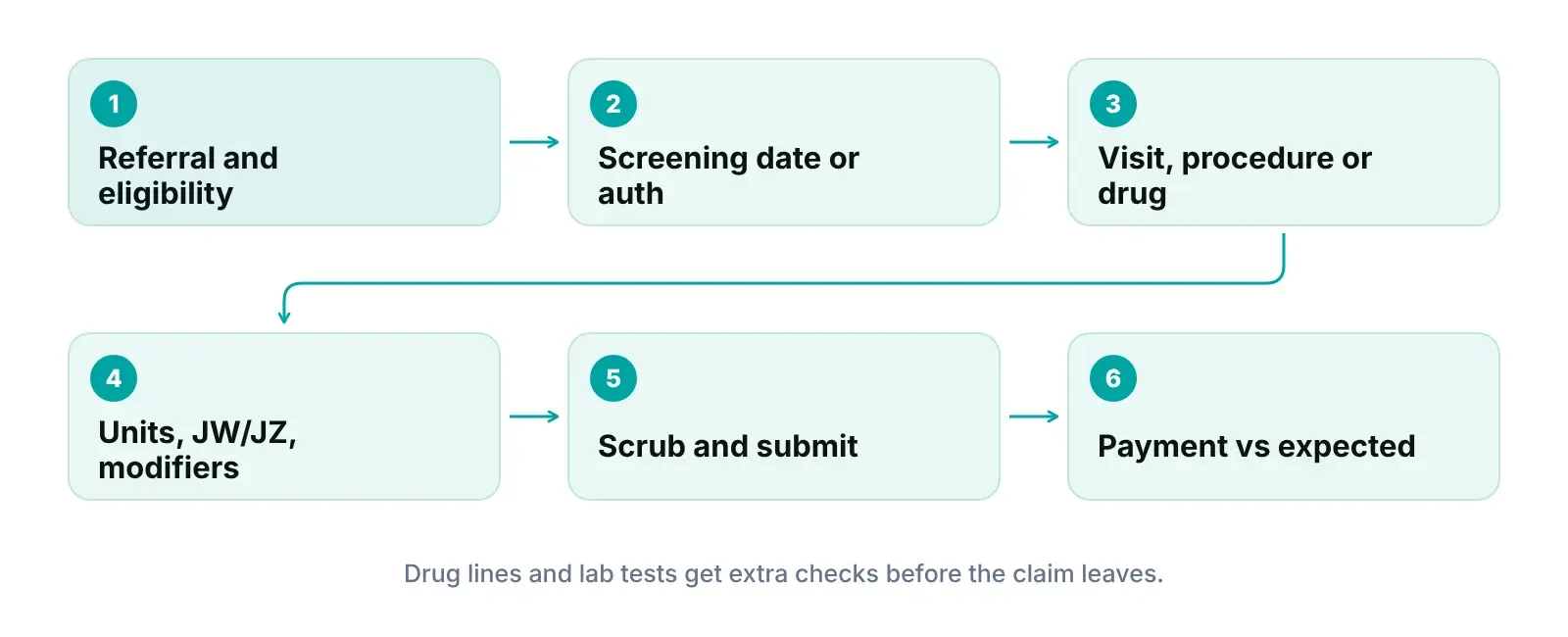
Our end-to-end urology revenue cycle management covers coding support, claim scrubbing, denials and A/R, with extra checks for cystoscopy bundling, drug units, JW or JZ, modifier 26 and CLIA on lab lines.
Our practice management system tracks every claim by stage, applies specialty-aware billing logic per claim, checks data completeness before submission and flags payments below the expected amount.
Find where your urology claims leak
We review recent procedure, drug and lab claims, denials and authorization logs, then show what to fix first. Pricing is quoted after the audit.
Most urology denials trace to a few rules: cystoscopy bundling, same-day visits, drug units, screening frequency and lab certificate level. Codes are in our own words (the AMA owns CPT descriptors); check the current code set before billing. For diagnoses, see our ICD-10 urinary tract infection codes guide.
| Service family | Code examples (our wording) | Billing rule to check | Typical denial trigger |
|---|---|---|---|
| Prostate cancer screening | G0102 (screening rectal exam); G0103 (screening PSA) | Men over 50; at least 11 months after the month of the last paid test | Test inside the 11-month window |
| Office cystoscopy | 52000 (diagnostic); 52332 (stent placement); 52310 (stent or stone removal from bladder or urethra) | Diagnostic look included in surgical cystoscopy; 52310 not billed with other cystoscopy codes | Both billed together; catheter insertion (51701-51703) billed on top |
| Urodynamics | 51728, 51729 (pressure study with voiding pressures); 51741 (complex uroflow); 51797 (add-on) | Highest-value study first, others with 51; residual included; 26 for hospital readings | Separate residual or second flow charge; EMG billed with biofeedback |
| Prostate biopsy and pathology | 55707 (transrectal); 55708 (with MRI fusion); 55709 (transperineal); G0416 (pathology) | 55700 deleted for 2026; no separate guidance code if included | 55700 on a 2026 claim; guidance billed twice |
| Hormone therapy | J9217 (leuprolide depot, 7.5 mg); J9155 (degarelix, 1 mg); 96402 (injection) | Whole billing units; JZ, or a JW line, on single-dose containers | Missing JW or JZ; units that do not match the dose |
| Bladder instillation | 51720 (instillation); J9030 (BCG, 1 mg) | 0-day procedure; routine pre-instillation check is not a separate visit | Modifier 25 visit on routine instillation days |
| Bladder botulinum toxin | 52287 (cystoscopy with bladder injection); J0585 (onabotulinumtoxinA, 1 unit) | Covered diagnosis group (Noridian A57185); dose given and discarded recorded | Discarded units undocumented or not on a JW line |
| In-office lab | Dipstick urinalysis (waived); urine sediment microscopy (PPM) | Certificate covers the highest complexity test you run | Test above the certificate's level |
Sources: 42 CFR 410.39; NCD 210.1; CMS NCCI Policy Manual Ch. VII (2026); CMS MLN907166 (2025); CMS CY 2026 PFS final rule, Federal Register (2025); AUA News (2023); AUGS (2018); Noridian modifier 26 page; Noridian A57185 (2026); CMS JW/JZ FAQ; 42 CFR 493; AAPC code summaries. Rules vary by contractor and payer.
CMS's global surgery booklet (December 2025) puts endoscopies and some minor procedures in a 0-day global period; other minor procedures carry 10 days and major ones 90. AUA News lists bladder instillation (51720) and urodynamics as 0-day office procedures. Confirm each code in CMS's fee schedule look-up tool.
The 2026 NCCI Policy Manual includes a same-day E/M, and the decision to do the procedure, in a minor procedure's payment. A significant, separately identifiable visit takes modifier 25, and new-patient status alone is not enough. For a 90-day procedure, the decision visit takes modifier 57. See our guide to modifiers 25, 59 and 91.
The AUGS coding fact sheet (last updated January 2018) lists the highest-value study first, with modifier 51 on the others except add-on 51797. Post-void residual is included and one flow study is allowed per day. For a study done in a hospital, Noridian has the physician bill the reading with modifier 26 while the hospital bills the technical part. AUGS says the billing physician must be in the office; CMS's 2026 final rule now permanently allows direct supervision of diagnostic tests by real-time audio and video.
For 2026 dates of service, stop using 55700. In CMS's CY 2026 final rule, 55707 is a transrectal, ultrasound-guided sextant biopsy, 55708 is the transrectal version with MRI-fusion guidance and 55709 is the transperineal, ultrasound-guided version. Later codes in the family cover transperineal fusion, targeted-lesion-only and in-bore CT- or MRI-guided biopsy. NCCI bars a separate guidance code when the descriptor includes it. HCPCS G0416 covers pathology for a prostate needle biopsy; check which payers accept it. Reading your own slides needs a CLIA certificate above waiver or PPM. See our pathology CPT codes guide.
Drugs are billed by HCPCS unit, not by vial, with JW or JZ on single-dose containers. Lab tests are paid only when the CLIA certificate covers them.
Per AAPC's summaries, leuprolide depot J9217 is billed per 7.5 mg and onabotulinumtoxinA J0585 per unit, so units must match the dose. CMS does not use fractional units. Administration is coded separately, such as 96402 for a hormonal cancer drug injection or 51720 for a bladder instillation. Our J-codes guide covers the basics.
Per CMS's JW and JZ FAQ, JZ has been required since July 1, 2023, when nothing is discarded from a single-dose container. Since October 1, 2023, claims without the right modifier may be returned. For waste, bill the dose on one line and the discarded amount on a second JW line, and document it in the record. Multiple-dose containers and packaged hospital or ASC drugs are out of scope.
Noridian's article A57185 (revision effective April 9, 2026) applies the same rules to bladder botulinum toxin injections.
Under CMS's CLIA program, a lab must be certified to be paid by Medicare or Medicaid, and the application page says to match the certificate to your highest complexity test. Dipstick urinalysis is waived (42 CFR 493.15); urine sediment exams are provider-performed microscopy (42 CFR 493.19).
Per the CLIA definitions, a waiver covers only waived tests, a PPM certificate adds microscopy, and higher complexity needs registration, compliance or accreditation. Medicare edits lab claims at the certificate level, per MLN Matters MM14273 (November 2025). See our laboratory billing and coding guide.
Clear authorizations and frequency limits before scheduling: advanced imaging, specialty drugs, implants in WISeR states and Medicare screening dates.
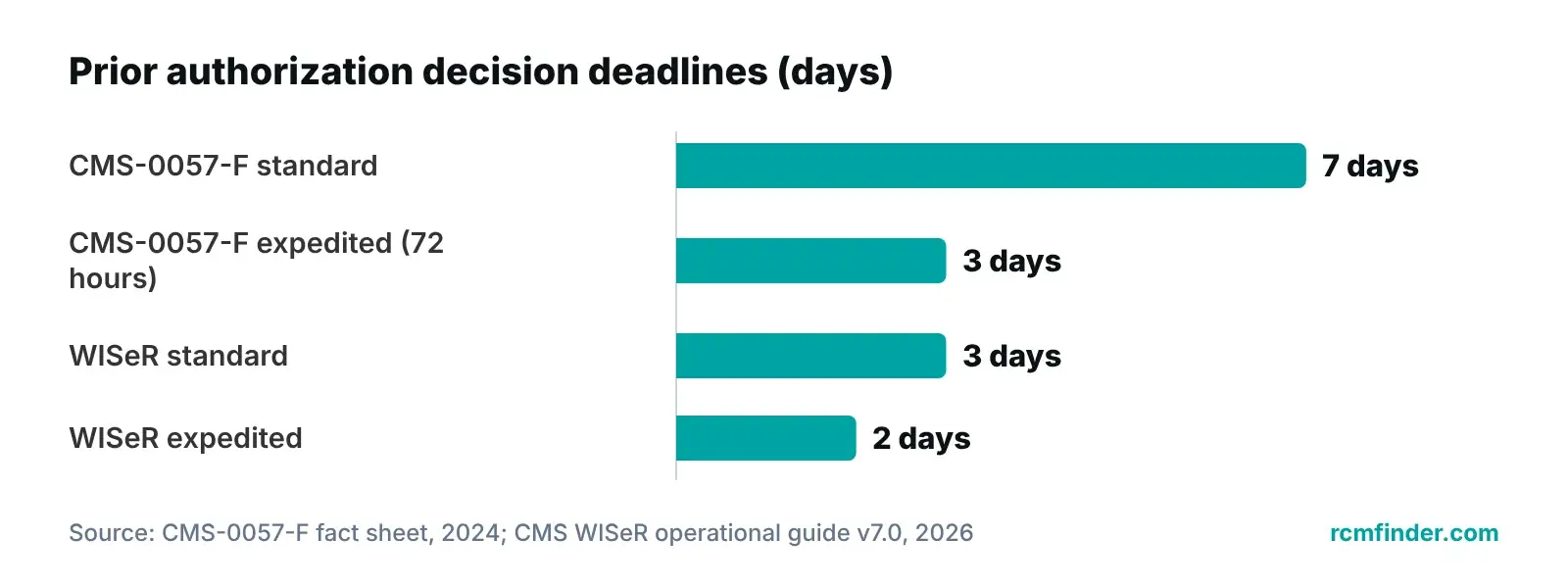
Since January 1, 2026, the CMS-0057-F final rule has required Medicare Advantage, Medicaid and CHIP plans to decide expedited requests within 72 hours and standard ones within seven calendar days, with a specific reason for any denial. Exchange plans are excluded from these timeframes, and drugs from the rule.
The WISeR guide sets decisions within 3 days (standard) or 2 days (expedited). The tracking number goes on the claim; without a request, the claim goes to pre-payment review.
UnitedHealthcare says CT, MRI, MRA and PET may need prior authorization outside emergency, observation, urgent care and inpatient settings; its Medicare Advantage plans exempt CT, MRI and MRA.
In the AMA's 2025 survey of 1,000 physicians, released May 13, 2026, physicians averaged 40 prior authorizations and 13 hours of staff and physician time a week.
| Rule | Source | What the VMA checks before the visit |
|---|---|---|
| Screening PSA and rectal exam: men over 50; 11 months after the month of the last paid test | 42 CFR 410.39; NCD 210.1; CMS ABN page | Last paid screening date; an ABN when Medicare is expected to deny |
| MA, Medicaid and CHIP: 72-hour expedited and 7-day standard decisions with a specific denial reason | CMS-0057-F (from Jan 1, 2026) | Request and due dates logged; follow-up on the due date |
| WISeR states: penile prostheses, sacral nerve stimulators and incontinence devices need a request or face pre-payment review | CMS WISeR guide v7.0 (2026) | Patient's state and Original Medicare status; tracking number saved |
| CT, MRI, MRA and PET may need plan approval outside emergency, observation, urgent care and inpatient care | UnitedHealthcare radiology page (2026) | Ordered study checked against the member's plan |
| Listed specialty drugs given in the office need approval; without it, claims may deny | UnitedHealthcare specialty drug program (2026) | Approval on file before the injection |
Sources: 42 CFR 410.39; NCD 210.1; CMS ABN page (2026); CMS-0057-F fact sheet (2024); CMS WISeR guide v7.0 (2026); UnitedHealthcare radiology and specialty drug pages (2026). Always check the member's current plan.
For the full workflow, read our prior authorization guide for providers.
See what denials and delays cost you
Enter your claim volume and denial rate to estimate what your urology practice is losing.
Urology marketing should promote conditions, procedures and access to care, not prescription drugs, and keep tracking away from patient data.
Google's Healthcare and medicines policy restricts prescription drug terms in ads, keywords and landing pages. Its sexual health and wellness policy allows prescription erectile dysfunction drug ads only in limited cases, only to users 18 or older, and not with a focus on sexual pleasure or enhancement.
HHS guidance on online tracking says tracking on appointment pages can collect protected health information, the vendor then needs a Business Associate Agreement, and a cookie banner is not a HIPAA authorization. A June 2024 court order vacated part of it. We keep tracking off appointment and referral forms unless the vendor signs a BAA.
Stay in-house if you have experienced urology coders and front-desk time for authorizations. A billing-only vendor fits when claims are the only gap. A combined partner fits when problems start at scheduling.
| Job | In-house team | Billing-only vendor | Four-pillar partner (RCM Finder) |
|---|---|---|---|
| Screening dates and frequency limits | Front desk, if someone checks | Usually found at denial | VMA checks the last paid date before the test |
| Drug, imaging and WISeR authorizations | Clinical staff between patients | Usually left to the practice | VMA starts each request and logs the decision |
| Drug units and JW or JZ | Depends on who enters charges | Fixed on the claim after the fact | Checked against the dose before submission |
| Lab claims and CLIA | Lab manager | Billed as sent | Certificate level checked on lab lines |
| Referral growth and reviews | A separate agency, or nobody | Not included | Marketing pillar tied to booked consults |
| Cost structure | Salaries, benefits, turnover | Varies; ask how fees are set | Quoted after a free practice audit |
Whichever model you choose, ask for denials by reason and payer. If you need only one pillar, the audit will say so.
We start with a free audit and change nothing until you see the findings. We build our billing pipeline around how claims actually move through a practice: registration, charge entry, submission, payment and follow-up. For urology, we add the checks on this page.
We review recent procedure, drug and lab claims, denials and authorization logs, and check charge templates for deleted codes.
We put a Business Associate Agreement in place before accessing patient data. Then we work inside your existing EHR (for example PrognoCIS, eClinicalWorks or athenahealth).
Your contractor's articles, plan authorization lists, WISeR status and CLIA certificate become a pre-visit checklist and portal workflow rules.
VMAs check screening dates and start authorizations. Claims are scrubbed, submitted and worked through denials and A/R.
We review denials, A/R days, drug-line underpayments and visits cleared in advance. Add Own Practice Management System for more depth.
Talk to us about your urology practice
Tell us your procedure mix and hardest payer. We will tell you honestly whether we fit.
Any billing vendor that handles your patients' data is a HIPAA business associate. Get a Business Associate Agreement before any access, and check how access is limited and logged.
HHS guidance names billing as business associate work; subcontractors need their own agreement. The minimum necessary standard limits use to what each task needs. The Security Rule's technical safeguards require access control, audit controls, integrity controls, person or entity authentication and transmission security.
We use role-based access, audit logging and encrypted (HTTPS) connections, and we put a Business Associate Agreement in place before accessing patient data. For your own side, use our HIPAA compliance checklist for medical practices.
We would rather tell you now than after you sign. Here is where we fit and where we do not.
A good fit if you are
Probably not a fit if you are
What we would do first if we were running your practice's revenue cycle tomorrow.
We check charge templates for deleted codes first. Biopsy notes should state the approach and any MRI fusion.
Medicare pays for a screening PSA or rectal exam only after at least 11 months have passed since the month of the last paid one. We look it up before the visit.
For each single-dose drug, the note should show the dose given and any amount discarded, to support units and JW or JZ.
Routine pre-procedure checks belong to a 0-day procedure. We add 25 only for a significant, separately identifiable visit.
In the six WISeR states, we list your services in the model and save each tracking number for the claim.
We load the CY 2026 conversion factor and efficiency adjustment into expected amounts for underpayment flags.
They cover coding support, claim scrubbing, submission, denial management and A/R follow-up for urology visits, procedures, drugs and lab tests. A good service also checks screening dates, prior authorizations, drug units with the JW or JZ modifier and the lab's CLIA certificate before claims go out. RCM Finder adds front-desk assistants, patient marketing and a claims portal, so one team owns the process from referral to payment.
Once every 12 months for men over 50. Federal rules let Medicare pay only after at least 11 months have passed since the month of the last paid screening of that type. Medicare.gov says patients pay nothing for the screening PSA blood test, while the rectal exam is subject to the Part B deductible and 20% coinsurance. G0103 is the screening PSA code and G0102 the screening rectal exam.
Only when the visit is significant and separately identifiable. CMS's NCCI manual says a same-day E/M is included in a minor procedure's payment, including the decision to do it, and new-patient status alone is not enough. A separate problem, documented on its own, can be billed with modifier 25. For a 90-day procedure, the visit that leads to the decision to operate uses modifier 57.
Use them on separately payable Part B drugs from single-dose containers. JZ says nothing was discarded. JW goes on a second claim line, with the same drug code, for the discarded amount. CMS has required JZ since July 1, 2023, and claims missing the right modifier may be returned. Document the discarded amount in the medical record. The modifiers do not apply to multiple-dose containers.
In six states, some do. Since January 1, 2026, CMS's WISeR Model has required prior authorization, or pre-payment review, for selected Original Medicare services in Arizona, New Jersey, Ohio, Oklahoma, Texas and Washington. Its list includes penile prostheses, sacral nerve stimulators for urinary incontinence and incontinence control devices. Medicare Advantage plans set their own lists, now with 72-hour and seven-day decision limits.
Yes. Our team works inside your existing EHR, for example PrognoCIS, eClinicalWorks or athenahealth. HIPAA treats a billing vendor as a business associate, so a Business Associate Agreement must be in place before it receives patient data. We put a Business Associate Agreement in place before accessing patient data, and we use role-based access, audit logging and encrypted (HTTPS) connections. Pricing is quoted after a free practice audit.
Tell us about your practice. A member of our operations team replies within one business day.
Pricing is quoted after the audit, based on your volume and the services you choose. Prefer to talk? Call +1 (302) 556-2288.
Tell us about your practice
About the author: Awais Afzal
Healthcare Operations & Data Analyst, RCM Finder
Awais has spent more than 16 years in healthcare digital marketing and clinical operations management. He builds data-driven revenue cycle blueprints for high-ticket medical practices and leads product development of the RCM Finder portal. More about our team.
How we write: every figure, code and rule on this page was checked against the primary source listed below and independently fact-checked before publishing. We re-review this page every six months. Last reviewed October 12, 2026; next review April 12, 2027.
We use cookies to understand how our site is used and to measure our advertising. You can accept or reject non-essential cookies. See our Privacy Policy.