
ICD-10 codes for UTI start with N39.0, urinary tract infection, site not specified, which fits only when the note names no site. If the provider documents cystitis, use an N30 code with its fifth character instead. There is no separate recurrent UTI code to look for; code the current infection from the note.
UTI is one of the most common diagnoses a practice bills, so small coding habits repeat on a lot of claims. The ICD-10-CM guidelines for fiscal year 2027, which took effect October 1, 2026, are published by the CDC’s National Center for Health Statistics. This post walks through the codes people actually search for, the documentation each one needs, and a short check to run before the claim leaves your office.
Key takeaways
- N39.0 means the infection is a UTI and the note does not say where. It is not a default for every UTI visit.
- A cystitis note points to category N30, and the code needs a fifth character such as N30.00 or N30.01.
- N39.0 carries an Excludes1 note for cystitis (N30.-), so the two are not reported together.
- Recurrent UTI is coded from the current infection. Z87.440 is a personal history code and does not set the E/M level.
- Check whether the note names an organism: N30 has a note to add a code from B95-B97.
Which ICD-10 code fits a UTI note
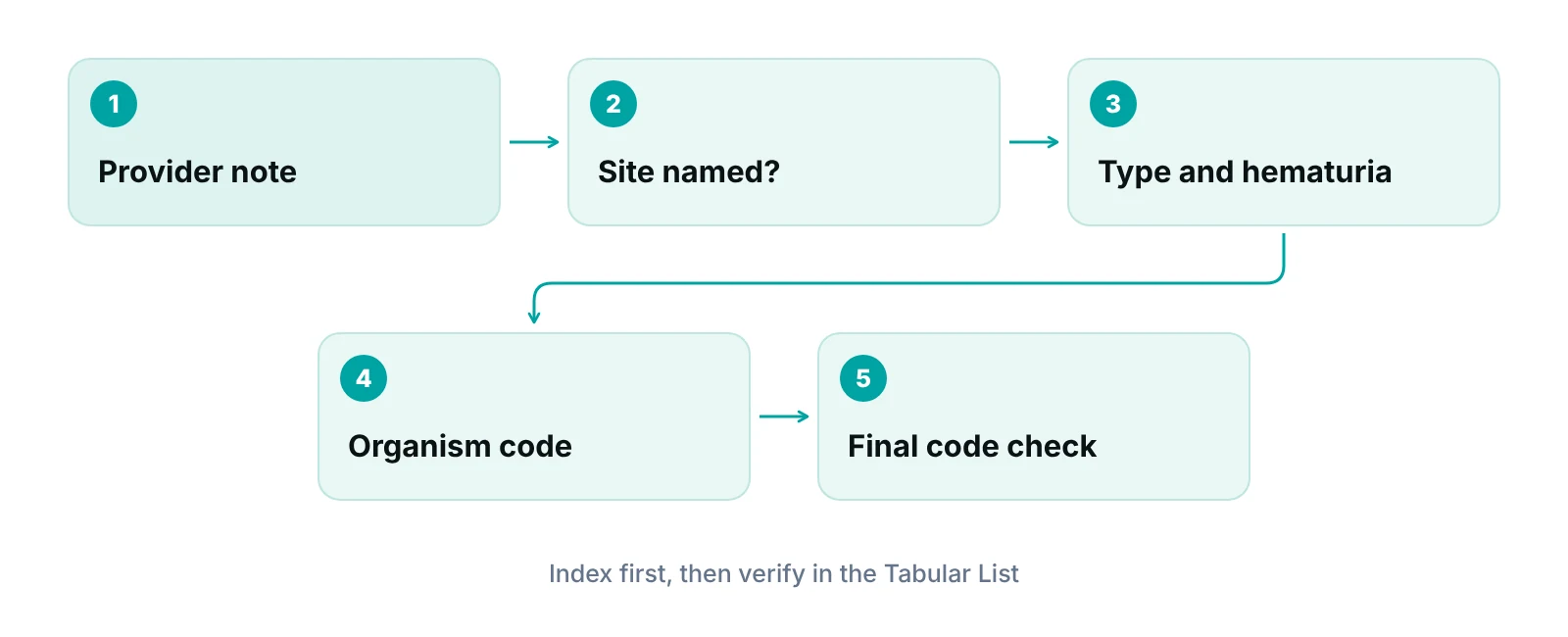
Pick the code that matches the most specific site the provider documents. Start in the Alphabetic Index, then confirm the code in the Tabular List. The CMS ICD-10-CM lesson on choosing codes shows this two-step path with acute cystitis with hematuria, which lands on N30.01. The table below lists the codes that come up most often in UTI notes.
| Code | Title (as we read it in the tabular list) | What the note needs to say |
|---|---|---|
| N39.0 | Urinary tract infection, site not specified | A UTI is diagnosed and no site (bladder, kidney, urethra) is documented. |
| N30.00 | Acute cystitis without hematuria | Acute cystitis (bladder infection) with no blood in the urine documented. |
| N30.01 | Acute cystitis with hematuria | Acute cystitis with hematuria documented. |
| N30.10 / N30.11 | Interstitial cystitis (chronic), without / with hematuria | Interstitial cystitis documented, with or without hematuria. |
| N30.20 / N30.21 | Other chronic cystitis, without / with hematuria | Chronic cystitis that is not interstitial, with or without hematuria. |
| N10 | Acute pyelonephritis | Kidney infection documented as acute pyelonephritis. |
| Z87.440 | Personal history of urinary (tract) infections | Past UTIs documented. This is a history code, not an infection code. |
Source: ICD-10-CM code sets via codebooks.rapidclaims.ai (N30), icd-10codes.com (N30), Unbound Medicine (Z87.440) and AAPC (N10). Vendor copies of the CDC/CMS tabular list; check each code against the current CDC release.
N39.0: use it when the note names no site
N39.0 is titled urinary tract infection, site not specified. It is the right code when the provider writes “UTI” and nothing in the record says where the infection is. The AAPC notes that N39.0 is the code the index returns for a plain “urinary tract infection” and that unspecified codes are a common source of denials, so the usual advice is to query the provider when the note is unclear.
The code is not wrong. The risk is using it by habit. If the provider documented a bladder infection two lines earlier, N39.0 throws away detail the record already has. If the note truly says only “UTI,” N39.0 is the accurate code, and a query should ask for the site only when it would change care or coding.
N39.0 and cystitis are not reported together
The tabular list puts an Excludes1 note at N39.0 for cystitis (N30.-), per the N30 code page. An Excludes1 note means the two conditions are not coded together. If the note says cystitis, use the N30 code and leave N39.0 off the claim.
When pregnancy is involved
The N30-N39 block carries an Excludes2 note for urinary infection complicating pregnancy (O23.-), according to the code range listing. If a UTI is documented in a pregnant patient, route it through the obstetric codes and the Tabular List instructions rather than assuming N39.0 applies.
Cystitis codes in N30 need a fifth character
Category N30 is cystitis, and the codes under it are built to a fifth character. N30.0 is acute cystitis and splits into N30.00 (without hematuria) and N30.01 (with hematuria). N30.1 is interstitial cystitis (chronic), N30.2 is other chronic cystitis, and each of those also splits by hematuria. Submitting the four-character N30.0 alone gives the payer an incomplete code.
| Subcategory | Title | Fifth-character split we confirmed |
|---|---|---|
| N30.0 | Acute cystitis | N30.00 without hematuria; N30.01 with hematuria |
| N30.1 | Interstitial cystitis (chronic) | N30.10 without hematuria; N30.11 with hematuria |
| N30.2 | Other chronic cystitis | N30.20 without hematuria; N30.21 with hematuria |
| N30.3 | Trigonitis | Check the tabular list for the current fifth characters |
| N30.4 | Irradiation cystitis | Check the tabular list for the current fifth characters |
| N30.8 | Other cystitis | Check the tabular list for the current fifth characters |
| N30.9 | Cystitis, unspecified | N30.90 is the index default for “cystitis”; check the tabular list for the rest |
Source: ICD-10-CM tabular list, category N30 (via icd-10codes.com and codebooks.rapidclaims.ai); CMS ICD-10-CM lesson for N30.01 and N30.90. Check against the current CDC release.
A related trap is the index default. When the note says only “cystitis,” the index points to N30.90, as the CMS lesson shows. That code is accurate for a vague note, but it is the cystitis equivalent of N39.0: if the record says acute, or says hematuria is present, a more specific N30 code is available.
Category N30 also has a “use additional code” note to identify the infectious agent (B95-B97). That ties cystitis to the lab result, which the next sections cover.
Kidney and urethra infections have their own codes
Upper tract and urethral infections do not belong under N39.0 when the site is documented. Acute pyelonephritis, a kidney infection, is coded to N10, and urethritis sits in category N34, as described in the AAPC UTI coding review. Each has its own title and its own documentation needs.
- Kidney: the note should say pyelonephritis and whether it is acute. A vague “UTI with flank pain” does not support N10 on its own.
- Urethra: look in category N34 and confirm the exact subcode in the Tabular List before billing.
- Prostate and other male sites: check the index entry for the documented condition rather than defaulting to N39.0.
The coding question is the same for every site: does the record name it, and does the note say enough to pick the subcode? If not, a short provider query is cheaper than a denial.
Recurrent UTI: code the current infection
There is no separate recurrent UTI code to chase. In the sources we checked, the entries for N39.0 and N30 do not offer a “recurrent” variant. The visit is coded for the infection being treated, using N39.0 or the specific site code, and the history stays in the record.
Z87.440 is titled personal history of urinary (tract) infections and is billable, according to Unbound Medicine’s ICD-10-CM listing. Because its title describes history, it is worth asking your coders and the payer’s policy whether a currently active, repeating infection supports it. Some practices add it when past infections are documented and relevant to the visit. Others treat it as optional.
“A history code explains the background. The current diagnosis and the work done at the visit still carry the claim.”
A history code does not set the E/M level
Office and outpatient E/M visits can be leveled by medical decision making or by total time on the date of the encounter, as the Noridian Medicare E/M page explains. Adding Z87.440 does not raise the level. If a higher level is billed for a UTI visit, the note must show the decision making or time that supports it.
Skip integral symptoms and check for an organism code
Symptoms that routinely come with a UTI are not coded on top of it. The FY2027 ICD-10-CM Official Guidelines say in Section I.B.5 that signs and symptoms routinely associated with a disease process are not assigned as additional codes. Section I.B.6 says additional signs and symptoms that are not routinely associated with the disease should be coded when present.
In practice, burning or frequent urination documented as part of the UTI is not reported separately. A symptom that is not routine for the infection, or one that remains after the provider has not confirmed a UTI, is a different decision. The AAPC review lists the R30, R33, R35 and R39.1 groups as symptom codes that may point toward a UTI without being one. Uncertain, “rule out” language also needs care: check the outpatient section of the guidelines before coding a suspected UTI as if it were confirmed.
Organisms are the other add-on. The guidelines in Section I.C.1.b say that where an infection code has an instructional note, a code from B95, B96 or B97 is used as an additional code to identify the organism. Category N30 carries that note. If a urine culture result is in the record and the provider links it to the infection, find the organism code in the index and report it after the N30 code.
From the note to the code: a quick decision guide
| What the note says | Coding route | What to do before billing |
|---|---|---|
| “UTI” with no site | N39.0 | Check the full note for any site clue; query only if it would change coding. |
| “Acute cystitis” or “bladder infection” | N30.00 or N30.01 | Confirm hematuria is documented or absent; do not add N39.0. |
| “Cystitis” only | N30.90 (index default) | Ask whether acute or chronic is stated elsewhere in the record. |
| Chronic or interstitial cystitis | N30.1- or N30.2- | Confirm the type and hematuria status; pick the fifth character. |
| Pyelonephritis | N10 if acute | Confirm the exact subcode in the Tabular List. |
| Culture names an organism | Add B95-B97 code | Confirm the provider links the organism to the infection. |
| Patient with prior UTIs | Current infection code; Z87.440 per policy | Confirm payer or coder policy on the history code. |
Source: ICD-10-CM tabular list and index, category N30 and N39 (CMS lesson and vendor copies); ICD-10-CM Official Guidelines FY2027 (CDC/NCHS); AAPC (2020).
A pre-bill check for UTI claims
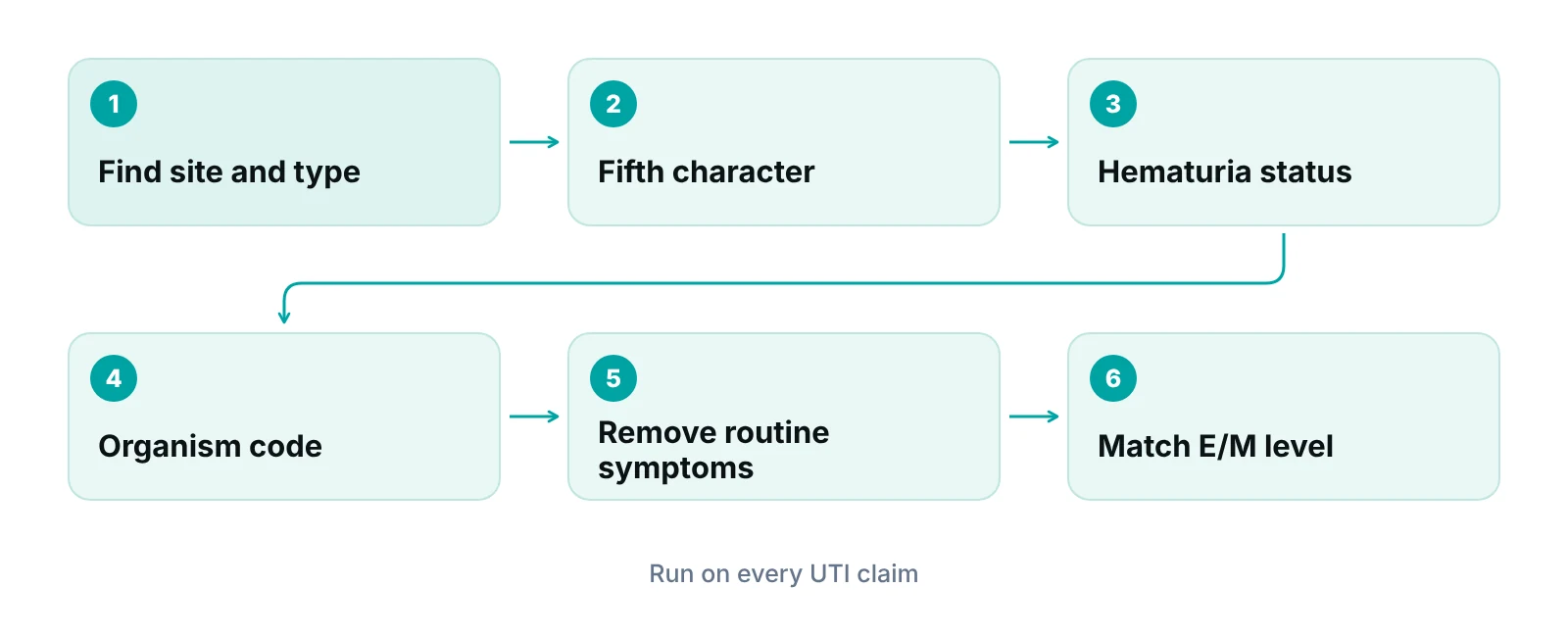
A short review catches most UTI coding errors before submission. It works best as a rule in your claim scrubbing step, so it runs on every UTI claim instead of depending on memory. Our guides on clean claims in medical billing and claim scrubbing explain how these checks fit into the wider workflow.
- Read the assessment, not just the problem list, to find the site and type.
- Confirm that any N30 code has its fifth character and that N39.0 is not on the same claim.
- Check hematuria: is it documented as present or absent?
- Look for a culture result and an organism the provider ties to the infection.
- Remove symptom codes that are routine parts of the UTI.
- Match the E/M level to the documented decision making or time, not to the diagnosis.
When a UTI claim does come back denied, the first question is whether the diagnosis, the documentation or the service level is the problem. Our overview of medical billing denial management covers how to sort those causes and when to appeal.
Where specialty and billing support fit
UTI codes show up across primary care, urgent care and urology, but the documentation habits differ. Urology notes tend to carry more site detail, which makes N30 and N10 codes easier to support. For specialty-specific workflows, see urology billing and coding support and the urology billing dos and don’ts.
If coding errors repeat across many claims, a review of your process may help more than fixing claims one at a time. Medical billing services can cover coding support, claim submission and follow-up. To see where denials start in your own workflow, try the revenue calculator or contact the team.
Want a second look at your UTI claims?
A free practice audit reviews how your diagnosis codes, documentation and denials line up. Pricing for any service is quoted after the audit.
For a wider view of how the code sets fit together, read our guide to how ICD-10, CPT and HCPCS codes differ.
Our recommendations
- Code from the assessment. Use the provider’s assessment as the main source for site and type. A problem list entry from an older visit does not describe this encounter.
- Treat N39.0 as a deliberate choice. Use it when the record truly names no site. If a site is documented anywhere in the note, use the specific code.
- Never submit a four-character N30 code. Add a scrubber rule that rejects N30.0, N30.1 and N30.2 without a fifth character.
- Keep N39.0 and N30 apart. The Excludes1 note means they are not coded together. A claim edit can catch the pair automatically.
- Decide your history-code policy once. Agree with your coders and your main payers whether Z87.440 is added for recurrent infections, and write the rule down.
- Ask for the organism when a culture exists. A short query linking the culture to the infection lets the coder add the B95-B97 code.
- Level the visit on decision making or time. Do not use the diagnosis to justify an E/M level. Check the note for the elements that do.
Bottom line
For ICD-10 codes for UTI, let the documented site decide: N39.0 when no site is named, N30 with a fifth character for cystitis, N10 for acute pyelonephritis. Keep N39.0 off cystitis claims, code recurrent UTI from the current infection and set a clear policy for Z87.440. If the same errors keep returning, our denial management services can help trace them to the source.
Frequently asked questions
What is the ICD-10 code for a urinary tract infection?
N39.0, urinary tract infection, site not specified, is the code when the provider diagnoses a UTI and documents no site. If the note names the bladder, use an N30 cystitis code. If it names the kidney, check N10 for acute pyelonephritis. Match the code to the most specific site the record supports.
What is the ICD-10 code for cystitis?
Cystitis is category N30, and the codes need a fifth character. Acute cystitis is N30.00 without hematuria and N30.01 with hematuria. Interstitial and other chronic cystitis have their own subcodes, split the same way. When the note says only cystitis, the index default is N30.90.
Is there an ICD-10 code for recurrent UTI?
In the entries we checked, there is no dedicated recurrent UTI code. The visit is coded for the infection being treated, such as N39.0 or an N30 code. Z87.440, personal history of urinary (tract) infections, exists, but confirm your coder’s and payer’s policy before adding it to an active infection claim.
Can I report N39.0 and N30.00 on the same claim?
No. N39.0 has an Excludes1 note for cystitis (N30.-), which means the two are not coded together. If the provider documents cystitis, report the N30 code. If the note names no site, report N39.0 alone. A claim edit can flag the pair before submission.
Do I code dysuria or frequency with a confirmed UTI?
Usually not. Section I.B.5 of the ICD-10-CM guidelines says signs and symptoms routinely associated with a disease are not coded as additional codes. Code a symptom separately only when it is not routine for the UTI, or when no UTI is confirmed. Check your payer’s rules too.
Does adding Z87.440 raise the E/M level?
No. Office and outpatient E/M levels are set by medical decision making or total time on the date of the encounter. A history code does not change either. If a higher level is billed, the note must show the decision making or time that supports it.
Get your free practice audit
Tell us about your practice. We will contact you using the details you give.
- A review of your recent claims, denials and A/R aging
- Where your front desk and prior authorizations slow payment
- A prioritized fix list you keep, whether or not you hire us
Pricing is quoted after the audit, based on your volume and the services you choose. Prefer to talk? Call +1 (302) 556-2288.
Sources
- ICD-10-CM Official Guidelines for Coding and Reporting FY 2027 — CDC / NCHS (2026)
- Choosing ICD-10-CM codes (MLN lesson) — CMS (n.d.)
- N30 Cystitis — codebooks.rapidclaims.ai (copy of ICD-10-CM) (2026)
- N30 Cystitis — icd-10codes.com (copy of ICD-10-CM) (2026)
- N30.11 Interstitial cystitis with hematuria — codebooks.rapidclaims.ai (copy of ICD-10-CM) (2026)
- N30-N39 range — icd-10codes.com (copy of ICD-10-CM) (2026)
- Z87.440 Personal history of urinary (tract) infections — Unbound Medicine (2026)
- ICD-10 deep dive: illuminate UTI coding through anatomy — AAPC (2020)
- PFS payment for office and outpatient E/M visits — Noridian Medicare (JE Part B) (n.d.)
Disclaimer: This article is educational. It is not coding, legal, compliance or medical advice, and payer rules vary. Check codes against the current ICD-10-CM Tabular List and Official Guidelines, and confirm payer policy with your coders. Last reviewed October 2026.
