
Urology billing comes down to three checks: look up each procedure's global period, use modifier 25 or 57 only when the visit is truly separate and documented, and follow NCCI bundling rules for cystoscopy, prostate and stone procedures. Many avoidable denials trace back to one of those three.
Urology practices bill visits, office procedures and surgery together, so small coding mistakes repeat quickly. Below are the do’s and don’ts that matter most, each tied to a Medicare rule you can check, plus a table of common procedures, a modifier guide and a checklist to run before claims go out. For help with the full billing cycle, see our medical billing services.
Key takeaways
- A procedure’s global period decides whether a same-day or follow-up visit can be billed.
- Modifier 25 needs a separate, documented evaluation; modifier 57 is for the visit that decides on major surgery.
- NCCI bundles biopsies, irrigation, fluoroscopy and several small steps into the main urology procedure.
- Stone procedure units follow the ureter or kidney, not the number of stones.
- Group your own denials by cause and fix the biggest group first.
What makes urology billing different
Urology billing mixes office visits, in-office procedures and operating-room surgery, often in the same week for the same patient. A cystoscopy can follow an evaluation visit on the same day. A prostate biopsy can lead to a surgical decision a few days later. A kidney stone can mean a consult, a stent and a lithotripsy, each with different rules.
That mix creates three recurring risks: an evaluation and management (E/M) visit billed on top of a procedure without support, a procedure billed inside a global period it belongs to, and a bundled step billed as if it were separate. This guide covers those risks as a list of do’s and don’ts, with the Medicare rules behind each one. It replaces an earlier version of this post that listed no urology procedure codes and used statistics we could not verify.
The rules below are Medicare rules. Commercial payers may differ, so treat them as the starting check, then confirm payer-specific policy. If you want the specialty overview first, see our page on urology billing support.
Common urology procedures and where claims go wrong
The table lists some common urology procedures: what each one is, in plain words, and the rule that most often decides whether the line is paid. Code descriptors are paraphrased; check the current AMA CPT book for the official wording.
| Code | In plain words | Rule to check before you bill |
|---|---|---|
| 52000 | Cystoscopy (looking into the bladder) | Endoscopies are generally 0-day global procedures, so a same-day visit is bundled unless it is separate and documented |
| 52204 | Cystoscopy with biopsy | NCCI says it includes all biopsies taken during the procedure, reported with one unit |
| 52601 | Transurethral resection of the prostate (TURP) | Includes meatotomy, urethral calibration or dilation and urethroscopy; do not bill those separately |
| 55700 | Prostate biopsy | Ultrasound guidance codes 76872 and 76942 are bundled when they cover the same region on the same date, so report one |
| 55250 | Removal of sperm duct(s), the vasectomy code | Check the global indicator in the fee schedule; a visit in the global period is bundled unless it is unrelated |
| 52353 | Cystoscopy and ureteroscopy with lithotripsy | One unit per ureter, regardless of how many stones are treated |
| 50590 | Kidney stone fragmenting (shock wave lithotripsy) | Renal stone destruction counts as one unit of service, not one per stone |
Sources: CMS Medicare NCCI Policy Manual, Chapter VII (rev. 1/1/2026); AUA prostate procedures coding page; code names from the 2025 Medicare Physician Fee Schedule urology table (CMS-1807-P) as reproduced by the AUA.
Two points about this table. First, the descriptions in the old version of this post gave one broad range of procedure codes as if it were urology-only. CMS titles its surgery chapter for CPT 50000-59999 as covering urinary, male genital, female genital and maternity care together (CMS NCCI Policy Manual, Chapter VII, 2026), so a range alone does not tell you whether a code belongs on a urology claim. Second, NCCI edits change. The manual in force was revised on January 1, 2026, and the edits file is updated by quarter.
Global periods and modifiers: the center of urology billing
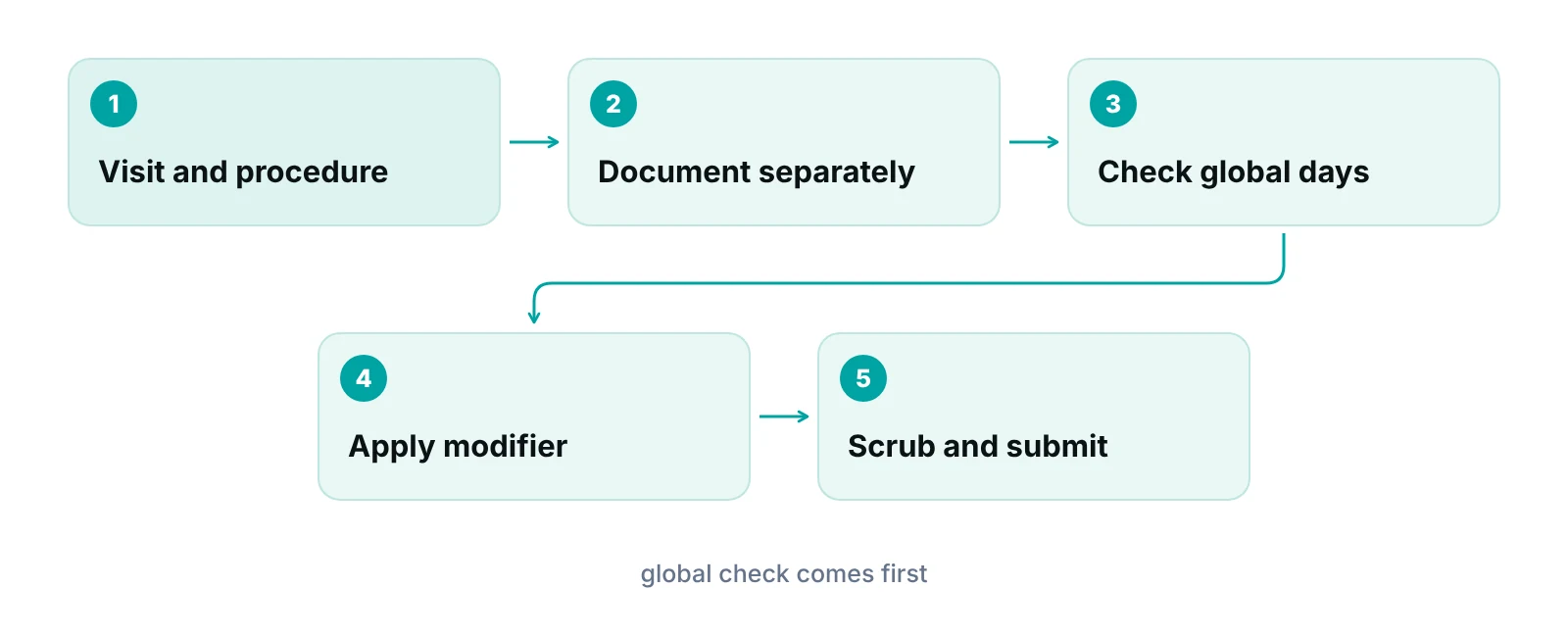
Medicare pays for most surgery as a package: the procedure plus the usual care before and after it. The length of that package is the global period. CMS defines three: 0-day, 10-day and 90-day (CMS MLN Global Surgery booklet, December 2025).
- 0-day (indicator 000): endoscopies and some minor procedures. There is no pre-op period or post-op days, and the visit on the procedure day is generally not separately payable.
- 10-day (indicator 010): other minor procedures, with a total global period of 11 days including the day of surgery.
- 90-day (indicator 090): major procedures, including one pre-op day and 90 days after, a total of 92 days.
The global indicator belongs to the code, not to the specialty. You find it in the Medicare Physician Fee Schedule look-up tool by choosing the Payment Policy Indicators option, which CMS says includes global surgery days (CMS PFS quick reference search guide). Look it up for each code your practice bills often, then keep the result in your charge master notes.
The modifiers urology claims use most
| Modifier | What it states | Typical urology situation |
|---|---|---|
| 25 | A significant, separately identifiable E/M by the same provider on the day of a procedure, beyond usual pre- and post-procedure care | A new problem is worked up and managed at the same visit as an in-office cystoscopy |
| 57 | The E/M visit that resulted in the first decision to perform major surgery | A visit the day before or day of a 90-day surgery where the decision is made |
| 58 | A staged or related procedure during the post-op period, planned at the start or more extensive than the original | A planned second stage of a treatment within the global period |
| 78 | Unplanned return to the operating room or procedure room for a related procedure in the post-op period | A return for bleeding after a procedure |
| 79 | An unrelated procedure by the same provider in the post-op period; a new post-op period starts | An unrelated procedure for a different condition within the global period |
| 24 | An unrelated E/M by the same provider in the post-op period; documentation must support it | A visit for a new, unrelated problem during a global period |
Source: CMS MLN Global Surgery booklet (MLN907166, December 2025). Urology situations are illustrations, not payer rules.
Modifier 57 does not apply to minor surgery, and a Medicare contractor may not pay an E/M billed with 57 on the day of, or the day before, a 0-day or 10-day procedure (CMS). Modifier 25 covers that situation instead. For a longer comparison of modifiers 25 and 59, see our guide to modifiers 25 vs 59, and for an unrelated procedure in a post-op period, our modifier 79 guide.
The do's of urology billing
These are the habits that prevent the most avoidable urology denials. Each one rests on a rule you can check.
1. Do look up the global period before every new procedure code
The answer to “can we bill the visit?” starts with the code’s global indicator. A 0-day or 10-day procedure treats a same-day visit as part of the package unless it is a significant, separately identifiable service. A 90-day procedure treats the decision visit differently. Add the indicator to your fee schedule so the biller sees it at charge entry.
2. Do document the visit and the procedure separately
If you add modifier 25, the chart must show a problem-focused evaluation that stands apart from the usual pre-procedure review. First Coast Service Options, a Medicare contractor, says the E/M must go beyond the usual pre- and post-procedure care in the procedure’s global package, and that routine care for the procedure is not enough (First Coast modifier 25 fact sheet, March 2026). Write the separate history, findings and plan in their own section of the note. See why clear documentation matters in billing.
3. Do report the most comprehensive endoscopic code and leave bundled steps off
NCCI rules for the urinary system bundle many small steps into the main procedure. In the 2026 manual, cystourethroscopy with biopsy (52204) includes all biopsies taken and is reported with one unit. TURP includes meatotomy, calibration or dilation and urethroscopy. Fluoroscopy is integral to cystourethroscopy and transurethral procedures, and catheter insertion codes 51701 to 51703 are not reported with a procedure that has a 0, 10 or 90-day global period (CMS NCCI Policy Manual, Chapter VII).
4. Do count units the way the rule is written
For stone treatment, units follow the ureter or kidney, not the stone. NCCI says cystoscopy with lithotripsy (52353) is reported with one unit per ureter regardless of the number of stones, and that renal calculus destruction or removal is one unit of service (CMS). Bilateral renal procedures are reported with modifier 50 and one unit in that chapter’s example. Litholapaxy codes 52317 and 52318 apply to stones that originated in the bladder, not to stones moved down from higher in the urinary tract.
5. Do run a claim scrub before submission
A scrub catches missing modifiers, incompatible code pairs and incomplete patient data before the payer sees them. Read our explainers on claim scrubbing and on what makes a clean claim, and use them to decide what your scrub should check for urology specifically.
The don'ts of urology billing
These are the mistakes that cost money or create audit risk.
1. Don't add modifier 25 to every visit with a procedure
Modifier 25 attached by habit is an audit signal, not a shortcut. First Coast says it is not appropriate on CPT 99211, not appropriate on a related follow-up within a global period, and not appropriate where the visit led to a decision for a major procedure within 24 hours, where 57 applies (First Coast). It also says that for dates of service on or after January 1, 2025, HCPCS G2211 with modifier 25 on an office or outpatient E/M denies unless a qualifying preventive service, immunization administration or annual wellness visit is also on the claim that day.
“A modifier is a statement of fact about the visit. If the chart cannot back it up, leave it off.”
2. Don't bill two methods of removing prostate tissue together
NCCI lists the prostate removal and destruction codes as mutually exclusive: 52601 to 52649, 53850 to 53855, 55801 to 55845, 55866 and 55880. Two codes from those ranges should not be reported together (CMS NCCI Policy Manual, Chapter VII). If a surgeon changes approach mid-case, report what was completed and ask the surgeon to document why.
3. Don't bill both ultrasound guidance codes for a prostate biopsy
The AUA says NCCI bundles transrectal ultrasound (76872) and ultrasonic needle-placement guidance (76942) when they cover the same anatomic region on the same date, and advises reporting one based on the procedure and the chart. It also says a modifier should not be used to unbundle this pair (AUA prostate procedures coding page). That page also notes that 55700 is the standard transrectal biopsy code and 55706 is the transperineal template-guided code.
4. Don't bill a catheter, fluoroscopy or irrigation step as its own line
Bladder irrigation through a catheter is part of the global package, and 51700 is not used to report it (CMS NCCI Policy Manual, Chapter VII). The same chapter says a temporary stent placed during the listed cystourethroscopy procedures is not reported with 52332. Billing these as extras produces denials and, if repeated, a pattern a payer can review.
5. Don't code lower than the work to stay clear of audits
Coding below the documented service is also an accuracy error. It underreports the work and can distort your data for payers and for your own reviews. The fix is the same as for overcoding: code from the documentation, and audit a sample on a schedule. See our upcoding guide and types of medical coding audits.
Why this post no longer quotes savings and rate statistics
The earlier version said accurate coding raises revenue by 15% and that outsourcing lifts collections by up to 98%. It also carried a before and after table with denial rates and days in A/R. None of those figures had a source, and the table was repeated from an unrelated specialty post. They were removed. Measure your own denial rate and days in A/R before you change anything.
Where urology denials usually start
Urology denials often trace back to a short list of causes. Check each against your own remittance data instead of relying on an industry average.
- Visit denied as included in the procedure: modifier 25 missing, or the note does not show a separate evaluation.
- Bundled step denied: irrigation, fluoroscopy, catheterization or a second guidance code billed on its own.
- Visit denied inside a global period: a related follow-up visit billed during a 10 or 90-day period.
- Units denied or reduced: lithotripsy billed per stone instead of per ureter or kidney.
- Front-end errors: wrong policy number, expired coverage or missing authorization, which a scrub or a registration check should catch.
Pull your last 90 days of denials, group them under these headings and count each group. The largest group tells you where to fix the process first. For appeal steps and reason codes, read our post on medical billing denial management, and for authorization rules see our prior authorization guide.
Doing it in-house, outsourcing or splitting the work
A urology practice can keep billing in-house, hand it to a billing company or split it. The right choice depends on how much coding skill you can hire and keep, not on a promised percentage. The table compares the three on practical points.
| Option | Works best when | Watch out for |
|---|---|---|
| In-house team | You have a coder who knows urology and time to train backups | One person leaving can stall claims; edits and modifier rules need constant upkeep |
| Outsourced billing | Volume is steady and you want specialty coding without hiring | Ask who codes, how denials are worked and which reports you will see each month |
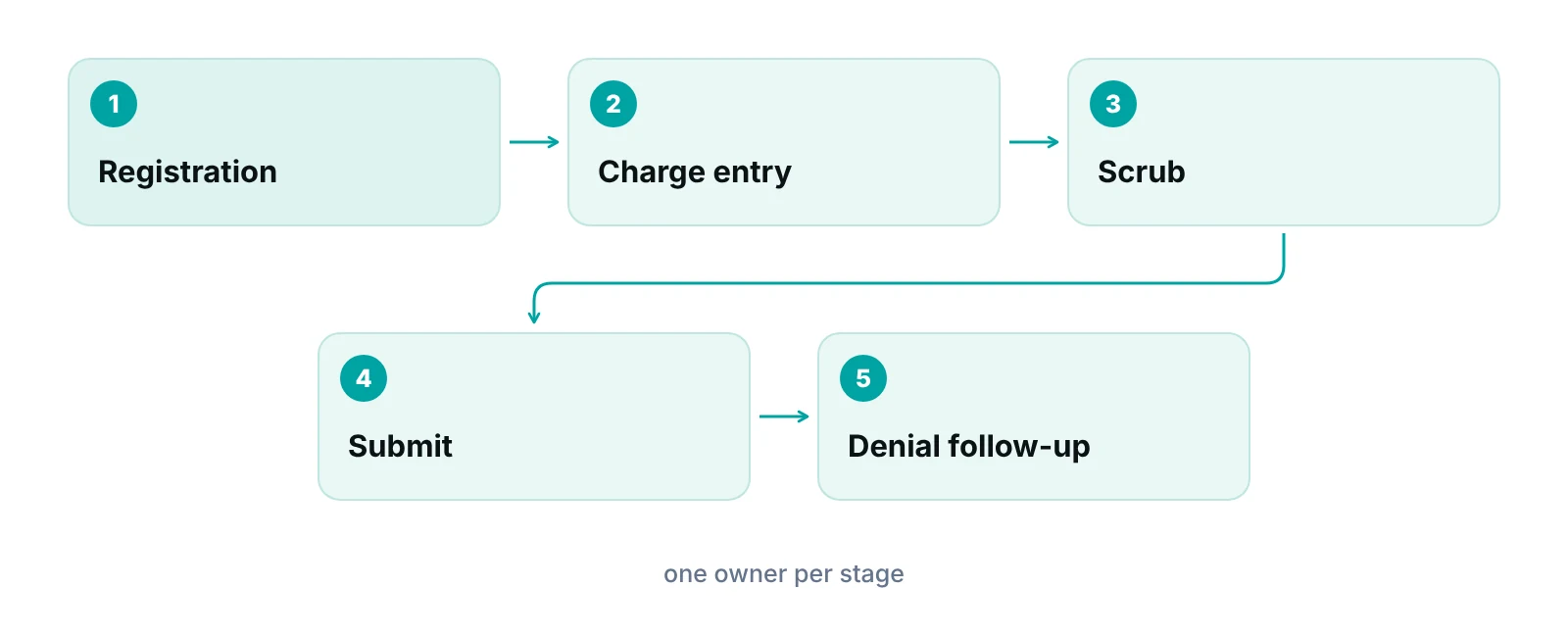
| Hybrid | Your front desk handles registration and charges, a partner handles coding review and denials | Unclear hand-offs; define who owns each claim stage |
Whichever you choose, ask any partner for a sample monthly report, how they handle modifier 25 and global-period checks, and whether they will sign a Business Associate Agreement before they see patient data. Our medical billing services page describes how RCM Finder supports practices, and a practice management system that tracks claims by stage gives you one place to see which claims are waiting, with an owner on each.
Want a second reader on your urology claims?
Book a free practice audit and we will review how your visits, procedures and modifiers line up before claims go out.
A pre-bill checklist for urology claims
Run this list on any claim that has a visit and a procedure on the same date, or a procedure inside a global period.
- Confirm the global indicator for each procedure code.
- Check whether the note supports a separate, significant evaluation before adding modifier 25.
- If the visit led to a major-surgery decision, check that modifier 57 is on the visit rather than 25.
- Remove bundled steps: irrigation, fluoroscopy, catheterization and duplicate guidance codes.
- Count units by ureter or kidney for stone procedures, and confirm bilateral reporting.
- Check that no two mutually exclusive prostate codes are on the same claim.
- Confirm coverage, policy number and any needed authorization before the date of service.
Keep this list near charge entry or build it into your claim scrub. If claims keep failing the same step, contact us to talk through your denial reasons.
Our recommendations
- Add the global indicator to your fee schedule. Look up the global days for your top 25 billed codes in the CMS fee schedule tool and store them next to each code. It takes an afternoon and removes a daily guess.
- Teach one rule for modifier 25 and one for 57. Use 25 for a separate evaluation on the day of a minor procedure. Use 57 for the visit that results in the decision for a major surgery. Review any claim that does not fit either.
- Write separate notes for separate services. Ask providers to document the visit and the procedure in distinct sections, so the evidence for a modifier is easy to find during review.
- Build bundling checks into the scrub. Add rules for irrigation, fluoroscopy, catheterization and duplicate ultrasound guidance so the scrub flags them before submission.
- Audit a small sample every month. Pick a set of procedure claims, compare chart to codes and record the errors by type. Share the results with the providers who document.
- Review denials by cause, not by dollar amount. Group denied claims under a short list of causes and fix the largest group first.
Track urology claims by stage, with an owner on each.
RCM Finder's practice management portal shows each claim's stage and owner, runs data-completeness checks before submission and flags payments below the expected amount.
See how the RCM Finder portal works · Create a portal account
Disclosure: RCM Finder builds and sells this portal. It is a practice management system, not an EHR.
Bottom line
Urology billing is mostly about matching the claim to the chart: the right global period, the right modifier and no bundled extras. If you want help with that, see our denial management services or start with a free practice audit.
Frequently asked questions
What are the most common urology CPT codes?
Common ones include 52000 for cystoscopy, 52204 for cystoscopy with biopsy, 52601 for TURP, 55700 for prostate biopsy, 55250 for vasectomy and 52353 for ureteroscopy with lithotripsy. Your mix depends on your providers and patients. Check each code in the current AMA CPT book and the CMS fee schedule before billing, since descriptors and edits change.
When can I bill an E/M visit with a urology procedure on the same day?
When the visit is significant, separately identifiable and goes beyond the usual care for the procedure, add modifier 25 to the E/M and document the evaluation separately. For a major surgery decision, use 57 instead. Contractors review these claims, so the chart has to support the modifier.
Does a cystoscopy have a global period?
Medicare treats endoscopies generally as 0-day global procedures, which means no pre-op or post-op days and a same-day visit bundled unless it is separate. The exact indicator belongs to each code, so look it up in the Medicare Physician Fee Schedule look-up tool under Payment Policy Indicators.
Can I bill ultrasound guidance with a prostate biopsy?
Not both common guidance codes. The AUA says NCCI bundles 76872 and 76942 when they cover the same anatomic region on the same date, so report one based on the procedure and the documentation. It advises against using a modifier to bypass that edit.
How are units counted for kidney stone procedures?
NCCI says renal calculus destruction or removal is one unit of service, not one per stone, and that 52353 is reported with one unit per ureter regardless of the number of calculi. Check the current chapter and your payer’s policy for bilateral cases.
Should a urology practice outsource its billing?
It can help if you cannot hire and retain a coder who knows urology. It does not fix poor documentation, and results depend on the partner. Ask who codes, how denials are worked, which reports you receive and whether a Business Associate Agreement is signed before any patient data is shared.
Get your free practice audit
Tell us about your practice. We will contact you using the details you give.
- A review of your recent claims, denials and A/R aging
- Where your front desk and prior authorizations slow payment
- A prioritized fix list you keep, whether or not you hire us
Pricing is quoted after the audit, based on your volume and the services you choose. Prefer to talk? Call +1 (302) 556-2288.
Sources
- Global Surgery booklet (MLN907166) — CMS (2025)
- Medicare NCCI Policy Manual, Chapter VII (rev. 1/1/2026) — CMS (2026)
- Modifier 25 fact sheet — First Coast Service Options (Medicare) (2026)
- Prostate procedures coding page — American Urological Association (undated (accessed 2026-10-14))
- Physician Fee Schedule quick reference search guide — CMS (2026)
- 2025 Proposed Physician Fee Schedule urology payment table (CMS-1807-P) — AUA (reproducing CMS data) (2024)
Disclaimer: This article is educational and is not legal, coding, billing or compliance advice. CPT is a trademark of the American Medical Association. Payer rules vary and change, and the policy summaries cited here may have been updated. Check the current CPT book, the CMS NCCI edits and your payer's policy before you bill.
