
Audiology Specialty

Audiology Billing Services for Hearing, Balance and Hearing Aid Practices

Orders and direct access, test and implant coding, hearing aid sales and plan benefit checks, with front-desk support, patient marketing and a claims portal.
  • Works inside your current EHR
  • US practice time zone, every shift
  • Weekly KPI reporting, or on your schedule
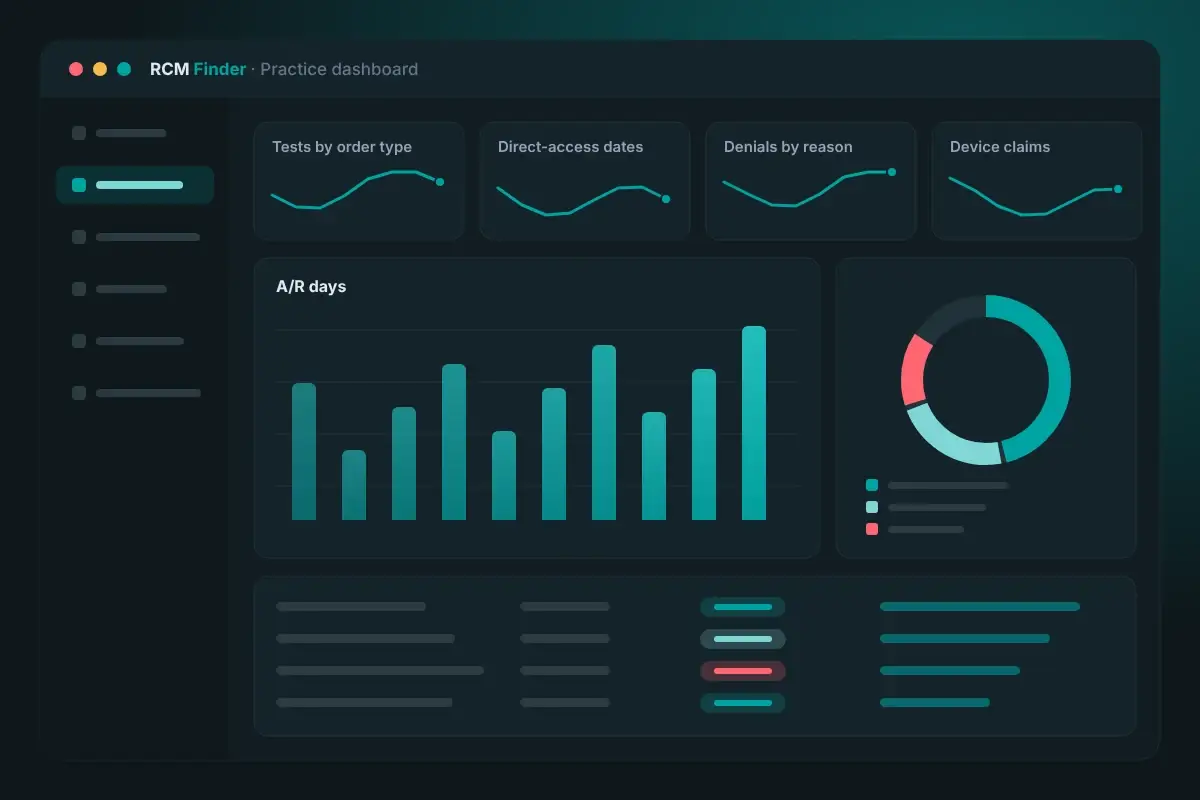
Audiology billing dashboard showing tests by order type, direct-access dates, denials by reason, device claims and A/R days

Quick answer

Audiology billing services turn each hearing or balance test into a payable claim: an order or direct-access record, the right bundled codes and modifiers, and payer follow-up. They also keep hearing aid sales, implant programming and plan benefits straight, because Medicare excludes hearing aids. RCM Finder adds front-desk checks, marketing and a claims portal.

Disclaimer: This page is educational and is not legal, coding or compliance advice. Medicare rules, CPT code sets, NCCI edits, state laws and payer policies change often and vary by contractor, state and plan. Verify every code, limit and rule against current CMS documents, your Medicare contractor’s guidance, your payer contracts and the current CPT and HCPCS code sets before billing.

Why audiology billing is different

Audiology billing is different because Medicare pays for diagnostic hearing and balance tests but never for hearing aids, and a hearing aid sale can be billed in several ways. One day in an audiology practice can include a Medicare diagnostic claim, a hearing-benefit claim and a cash device sale.

Under CMS’s audiology services page, Medicare defines audiology services as hearing and balance assessments by a qualified audiologist. Audiology is generally paid under the Physician Fee Schedule (hospital outpatient services are paid under the hospital outpatient system), and coverage depends on why the test was ordered or accessed, not on diagnosis. CMS also says therapeutic services, such as auditory rehabilitation, are not covered, and audiology cannot be billed “incident to” a physician.

  • Orders and direct access. Most tests need an order. A narrow direct-access path exists once every 12 months.
  • A hard line on devices. Original Medicare excludes hearing aids and the exams to prescribe, fit or change them. Cochlear and similar implants are an exception.
  • Code bundles. Several hearing, middle-ear and balance codes replace one another on the same day.

Before a visit, the plan check matters as much as the order. See our insurance verification guide.

The four pillars, built for an audiology practice

An audiology practice needs patients who find you, a front desk that sorts orders and benefits, billing that knows which tests and devices go to which payer, and software that shows every claim. These pieces fail at the handoffs, so we run them on one set of rules.

Pillar 1 · Healthcare Marketing

Healthcare Marketing for audiology

Our healthcare digital marketing builds local search pages for hearing tests, balance testing and hearing aid evaluations and reputation work.

  • Local pages for hearing evaluations and balance testing
  • Honest pages on over-the-counter versus prescribed devices
  • Tracking kept off forms that collect health details
  • KPI: booked evaluations by source
Explore Healthcare Marketing
Pillar 2 · Virtual Medical Assistants

Virtual Medical Assistants for audiology

Our virtual medical assistants work in your practice’s time zone. They capture orders and referrals, check the plan and its hearing-benefit vendor, and record the patient’s last direct-access visit.

  • Order and referral capture before the visit
  • Plan, hearing benefit and prior approval checks
  • Direct-access date check before any test
  • Device quote and financial responsibility paperwork
Explore Virtual Medical Assistants
Pillar 3 · End-to-End RCM

End-to-End RCM for audiology

Our end-to-end revenue cycle management covers coding support, scrubbing, submission, denials and A/R for tests, implant programming and device claims.

  • Test, bundle and modifier checks before submission
  • Device and fitting lines matched to each payer’s method
  • Denial work by reason code
  • Weekly KPI report
Explore End-to-End RCM
Pillar 4 · Practice Management System

Practice Management System for audiology

Our practice management system gives practices and billing companies a claim pipeline by stage, data-completeness checks, underpayment detection, workflow rules, role-based access and an audit log.

  • Claim stages from charge to payment
  • Rules that hold claims missing an order or modifier
  • Underpayment flags against expected amounts
  • Early access: appointment booking
Explore Practice Management System

Find where your audiology claims leak

We review recent test, implant and device claims and denials, then show what to fix first.

Get a Free Practice Audit

What Medicare covers, what it excludes, and how direct access works

Medicare Part B covers diagnostic hearing and balance tests when a provider orders them. It does not cover hearing aids or the exams used to fit them. Medicare.gov says patients pay 20% of the approved amount after the Part B deductible, plus a hospital copayment in outpatient hospital settings.

The order rule and the narrow direct-access exception

The general rule in 42 CFR 410.32 is that diagnostic tests must be ordered by the treating physician, and nonphysician practitioners can order within their state and Medicare scope. Since 2023, subsection (a)(4) lets an audiologist personally furnish diagnostic tests without an order once per patient in a 12-month period, for non-acute hearing conditions. It excludes balance disorders and hearing aid exams.

CMS Change Request 13055 (Transmittal 12091, June 15, 2023) turns that into claim edits. The claim carries modifier AB on each listed code, and the rendering NPI must belong to an audiologist. The list has 36 CPT codes. A second direct-access visit inside 12 months is denied under reason code 119 with a contractual-obligation group code. AB on a vestibular code is unpayable, and AB with a technical or professional component modifier is returned as unprocessable, except on 92587 and 92588.

ASHA’s guidance adds a documentation point: record that the loss is non-acute. Billing AB for an acute loss can lead to post-payment denial and recoupment.

Hearing aids, implants and the ABN

The hearing aid exclusion is in 42 CFR 411.15(d). It does not apply to devices that replace the function of the middle ear, cochlea or auditory nerve, such as cochlear implants, auditory brainstem implants and osseointegrated implants.

An Advance Beneficiary Notice is not required for care Medicare excludes by statute. The Medicare Claims Processing Manual, chapter 30 still encourages providers to give one for never-covered care as a courtesy, and says a voluntary notice should not ask the patient to choose an option box or sign. For a repeat direct-access denial, ask your Medicare contractor whether the patient can be billed.

For why audiologists cannot bill under a physician’s number, see our Medicare incident-to billing guide.

Audiology service families: codes, rules and denial triggers

Each audiology service family has a bundling or documentation rule that drives denials. Codes are described in our own words because the AMA owns CPT descriptors. Check the current code set and your contractor’s guidance before billing.

Audiology service families: code examples, billing rules and typical denial triggers
Service familyCode examples (our wording)Billing rule to knowTypical denial trigger
Hearing tests92552, 92553, 92555, 92556 (components); 92557 (full battery)92557 only when air and bone tone, speech threshold and speech recognition are all done92557 billed with its components
Middle-ear testing92567 (pressure), 92568 (reflex threshold), 92550 (both), 92570 (immittance with reflex decay)Use 92550 when both pressure and reflex threshold are done; do not add 92567 or 92568 to itComponent codes billed beside the combined code
Otoacoustic emissions92587 (limited), 92588 (comprehensive)Screening OAE 92558 is not covered; check the CPT guidance for these twoScreening billed as diagnostic
Central auditory and tinnitus92620, 92621 (added time); 92625Do not bill 92571, 92572 or 92576 with 92620; 92621 is an add-on for each added 15 minutesBattery tests billed beside 92620
Vestibular and balance92540 (basic evaluation); 92537, 92538 (caloric); 92517-92519 (VEMP); 92548-92549 (posturography)92540 replaces the four nystagmus codes billed together; -52 for reduced caloric irrigationsBundled codes billed separately; AB used on a vestibular code
Cochlear implant programming92601-92604; age split at 7Neural response telemetry 92584 is bundled with these on the same day92584 billed with programming; no order or device record
Hearing aid servicesV5011 for fitting and checking (Medicaid example); V-codes for devicesMedicare excludes hearing aids and fitting exams; prior approval varies by payerDevice billed to Medicare; exam billed as diagnostic
Direct accessModifier AB on the 36 listed codesOne visit per 12 months; audiologist NPI; non-acute hearing onlySecond AB visit in 12 months; AB on technical component

Sources: ASHA Medicare coding rules for audiology (2026 page); CMS Change Request 13055 (2023); MassHealth Audiologist Manual transmittal AUD-21 (2024); CMS audiology services page. Medicare Administrative Contractors and other payers may differ.

The ASHA coding page treats modifier 52 as the usual way to show unilateral testing, because audiology codes assume both ears unless the descriptor says otherwise. It says to use modifier 59 only when the payer instructs it, and to use modifier 22 sparingly with a written explanation. Modifier 22 is not used with timed codes. See also modifiers 25 and 59.

Vestibular testing is a different code family

Balance testing uses the 925xx codes, not the 927xx series. The 927xx range matters here only for 92700, the unlisted service code, which ASHA says to use for a covered service with no CPT code. Balance tests need an order and never carry AB.
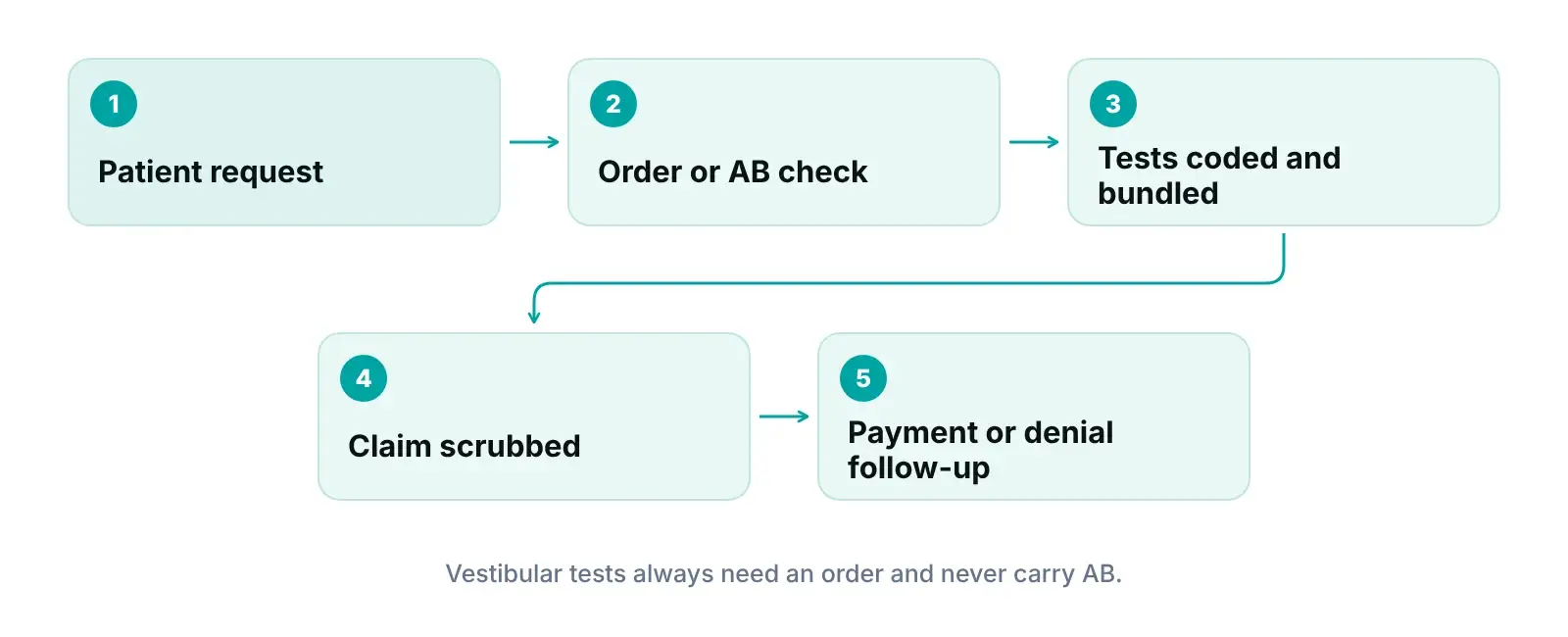
Diagram of an audiology test claim from patient request and order or AB check to coding, scrubbing and payment follow-up
How a hearing test becomes a payable claim: the order or direct-access check comes first.

Implant programming and mapping

Cochlear implant programming has its own codes, split by whether the patient is under 7, and by first programming versus later reprogramming, per ASHA. Medicare’s national coverage determination for cochlear implantation (NCD 50.3) requires bilateral moderate-to-profound sensorineural hearing loss and limited benefit from amplification, defined as 60% correct or less on recorded open-set sentence tests with the best-aided condition. Check the Medicare Coverage Database for the current version. Keep device records and test scores in the audiology chart before programming claims go out.

Hearing aid sales: cash, bundled and unbundled billing

A hearing aid sale is billed as cash, as a bundled package or as separate device and service lines, depending on the payer’s contract. Pick the method before the visit so the quote, consent and claim match.

  • Cash or retail. The patient pays the practice, with a receipt, consent and clear return terms.
  • Bundled. One price covers the device plus fitting and follow-up visits for a stated period.
  • Unbundled. The device and each professional service are priced and billed on their own lines. This helps when a plan pays the device and the services under different rules.

MassHealth’s audiologist manual update (March 2024) shows how a state Medicaid program treats a device claim. It lists V5011 for fitting and checking, separate device V-codes, LT or RT modifiers on monaural purchases, and separate dispensing-fee codes. Prior authorization applies above $500 acquisition cost for monaural devices and $1,000 for binaural ones. Other payers differ. It shows how many lines one sale can need.

ASHA reports that the hearing aid exam, selection, check and electroacoustic evaluation codes 92590 to 92595 were deleted and replaced starting January 1, 2026, and that some payers may still accept the old codes. The American Academy of Audiology’s billing toolkit lists an itemizing guide and a hearing aid prior authorization template. Confirm which codes each payer accepts in 2026.
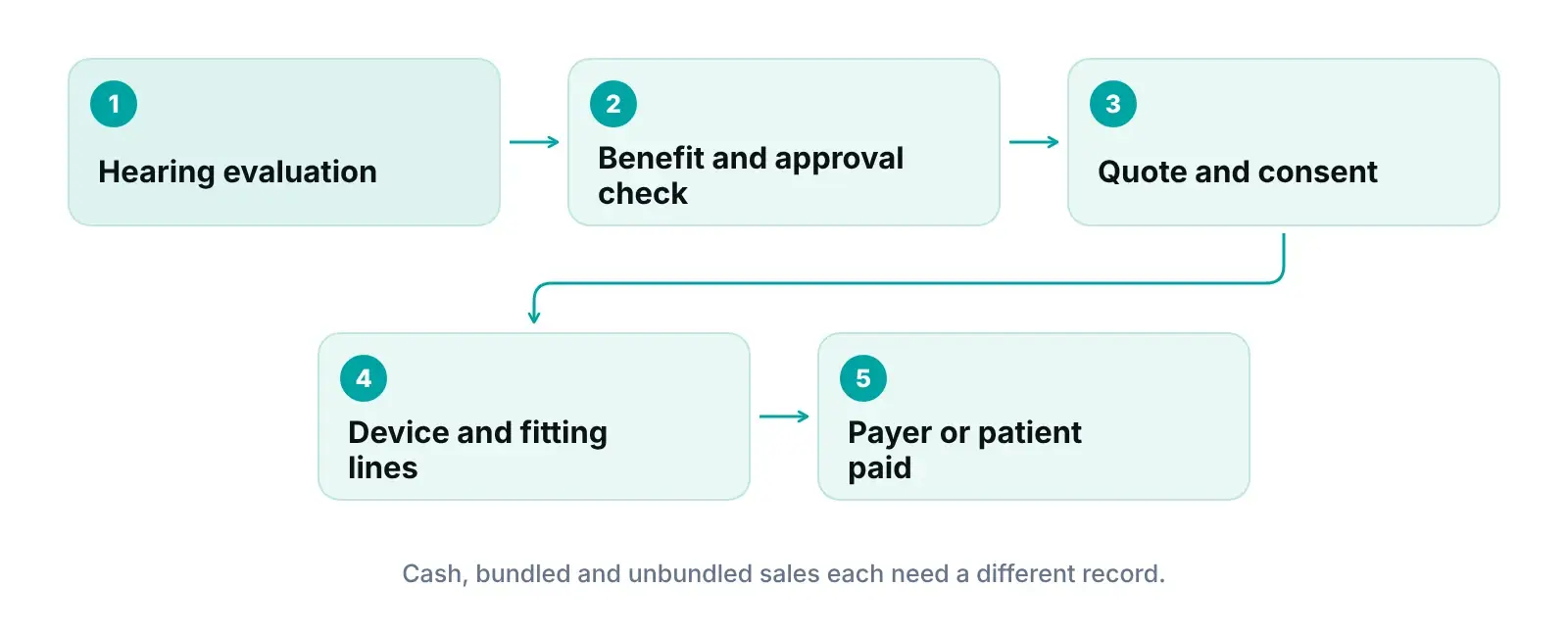
Diagram of a hearing aid sale from evaluation and benefit check to quote, device and fitting lines and payment
A hearing aid sale needs the billing method chosen before the fitting, not after.

For cash collection, see our self-pay billing guide.

Medicare Advantage hearing benefits and commercial mandates

Medicare Advantage and commercial plans decide hearing aid coverage themselves, so verify each patient’s benefit before the evaluation. Medicare.gov says some Medicare Advantage plans offer hearing as an extra benefit and tells patients to contact the plan to find out.

Ask every plan three things: who delivers the hearing benefit (the plan or a separate vendor), whether your practice must be in that vendor’s network to be paid, and whether devices are limited to a list.

Under CMS-0057-F, Medicare Advantage, Medicaid and CHIP plans must decide expedited prior authorization requests in 72 hours and standard ones in seven calendar days, and give a specific reason for a denial. It excludes drugs, and commercial plans are not named as covered payers. The decision timeframes and denial reasons generally began January 1, 2026.

State mandates differ: two examples

Some states require commercial plans to cover hearing aids, and the terms vary a lot. Minnesota’s section 62Q.675 says a health plan must cover hearing aids for all individuals with hearing loss not correctable by other covered procedures, limited to one aid in each ear every three years. Rhode Island’s section 27-18-60 requires coverage of $1,750 per hearing aid, per ear, for policies issued or renewed on or after January 1, 2026. These are illustrations only; whether a mandate reaches a patient depends on the state and plan.

Pre-visit checklist: coverage, order and approval rules our VMAs check for audiology
RuleSourceWhat the VMA checks before the visit
Most diagnostic tests need an order from a physician or nonphysician practitioner42 CFR 410.32Order on file, with ordering practitioner and reason
Direct access: one visit per 12 months, non-acute hearing, no balance testing, AB modifier42 CFR 410.32(a)(4); CMS CR 13055 (2023)Date of last AB visit; booking choice of order or direct access
Original Medicare excludes hearing aids and fitting exams; implants are an exception42 CFR 411.15(d); Benefit Policy Manual ch. 16Patient told in writing which services are not covered
Voluntary ABN for never-covered care; no option box for a voluntary noticeClaims Processing Manual ch. 30Notice given for excluded services; copy saved
Some Medicare Advantage plans offer hearing benefitsMedicare.govPlan type; hearing vendor; vendor network status
MA, Medicaid and CHIP decide in 72 hours (expedited) or 7 calendar days (standard)CMS-0057-F (2024)Request and due dates logged; follow-up on due date

Sources: 42 CFR 410.32 and 411.15; CMS Change Request 13055 (2023); Medicare Benefit Policy Manual ch. 16; Medicare Claims Processing Manual ch. 30; Medicare.gov; CMS-0057-F fact sheet (2024). Always check the member’s current plan.

For the general approval workflow, read our prior authorization guide and our insurance verification guide.

See what denied tests and unbilled devices cost you

Enter your claim volume and denial rate to estimate what your audiology practice is losing.

Open the Revenue Calculator

Documentation that supports an audiology claim

A clean audiology claim needs an order or direct-access record, test results by ear, and a reason for any modifier.

  • Order or direct access. Keep the order, or note the loss is non-acute and this is the one direct-access visit in 12 months.
  • Results by ear. Record each test and ear so modifier 52 matches the report.
  • Time. Record start and stop times for timed central auditory codes.
  • Devices. Keep the quote, consent, serial numbers, ear and fitting date together.

In-house team, billing-only vendor or four-pillar partner?

Stay in-house if staff already track orders, direct-access dates and device approvals well. Use a billing-only vendor if claims are your only gap. Choose a combined partner when problems start before the claim.

Decision table: which model fits an audiology practice?
JobIn-house teamBilling-only vendorFour-pillar partner (RCM Finder)
Order and direct-access checksFront desk, between callsOften left to the practiceVMA checks order and last AB date before the visit
Hearing benefit and vendor network checksAudiologist or front desk, per patientOften left to the practiceVMA checks plan, vendor and approval first
Test, vestibular and implant codingOne coder or the providerCoded from the report receivedBundles and modifiers checked before submission
Device sales: cash, bundled, unbundledMixed in the practice softwareOnly the payer-billed partMethod set per payer; cash posted apart from claims
Patient growthA separate agency, or nobodyNot includedMarketing tied to booked evaluations
Cost structureSalaries, benefits, turnoverVaries; ask how fees are setQuoted after a free practice audit

How it works

We start with a free audit and change nothing until you see the findings. We build our billing pipeline around how claims actually move through a practice: registration, charge entry, submission, payment and follow-up. For audiology, we add the checks on this page.

  1. 1

    Free practice audit

    We review recent test, implant and device claims, denials and eligibility records.

  2. 2

    Business Associate Agreement and access

    We put a Business Associate Agreement in place before accessing patient data. Then we work inside your existing EHR (for example PrognoCIS, eClinicalWorks or athenahealth).

  3. 3

    Payer-rule map

    Your main plans, hearing vendors and Medicare contractor guidance become a pre-visit checklist and portal rules.

  4. 4

    Front desk and billing go live

    VMAs check orders, direct-access dates and benefits. Claims are scrubbed, submitted and worked through denials and A/R.

  5. 5

    Weekly KPI review

    We review denials by reason, A/R days, unbilled tests and device claims awaiting approval.

Talk to us about your audiology practice

Tell us your payer mix and how you sell devices. We will tell you honestly whether we fit.

Call +1 (302) 556-2288

Compliance: what to ask any audiology billing company

Any billing vendor that handles your patients’ data is a HIPAA business associate. Get a Business Associate Agreement before access, and ask how access is limited and logged.

HHS guidance lists billing, claims processing and practice management among business associate functions, and says a business associate must have its own agreement with any subcontractor before sharing protected health information.

  1. Will you and your subcontractors sign a Business Associate Agreement before any access?
  2. How do you limit access, and can we see the audit log?
  3. What coding experience do your staff have with audiology bundles and direct access?
  4. How do you handle cash sales and device claims differently?

Marketing needs the same care. HHS guidance on online tracking says tracking on scheduling pages can disclose protected health information if it collects an email address or the reason for care. A court vacated one part of that guidance in 2024. We keep tracking off forms that collect health details. We use role-based access, audit logging and encrypted (HTTPS) connections, and we put a Business Associate Agreement in place before accessing patient data. For your side, use our HIPAA compliance checklist.

Who this is for, and who it is not for

We would rather tell you now than after you sign. Here is where we fit and where we do not.

A good fit if you are

  • Audiology practices that bill Medicare, Medicare Advantage and commercial plans for diagnostic tests
  • Practices that sell hearing aids and want cash, bundled and unbundled sales kept clean
  • Clinics that program cochlear implants and need device and test records together
  • ENT-affiliated audiology groups with several providers
  • Billing companies serving audiology clients that want a shared claims portal

Probably not a fit if you are

  • Hospital-employed audiologists whose employer controls billing
  • Practices that want claims billed without changing any front-desk step
  • Practices looking for promised collection rates; we report measured KPIs
  • Groups that need a credentialing module or in-portal real-time eligibility today; those are coming next

Expert recommendations from our operations team

What we would do first if we were running your practice's revenue cycle tomorrow.

  1. 01

    Choose the order path at booking

    Decide whether each visit runs on an order or on direct access. We check the last AB date before the slot is held.

  2. 02

    Never mix excluded and covered work

    Fitting exams for hearing aids are excluded from Medicare. We keep them off diagnostic claims.

  3. 03

    Set the device billing method first

    Cash, bundled or unbundled, the quote and the claim must match. We confirm it per payer before the fitting.

  4. 04

    Use combined codes only when complete

    Bill the combined code when every part is done. We scrub for pairs that replace each other.

  5. 05

    Ask the plan who runs the hearing benefit

    A vendor may hold the benefit and the network. We check it before the evaluation, not after the claim.

  6. 06

    Keep the implant chart together

    Test scores, device records and programming notes belong in one place before claims go out.

Frequently asked questions

What do audiology billing services include?

They cover coding support, claim scrubbing, submission, denial management and A/R follow-up for hearing and balance tests, implant programming and device sales. A good partner also checks orders, direct-access dates and hearing benefits before each visit. We add front-desk assistants, local marketing and a claims portal, so one team owns the process from first call to payment.

Can Medicare pay for a hearing test without a doctor’s order?

Sometimes. Since 2023, an audiologist may personally furnish listed diagnostic tests without an order once every 12 months for a non-acute hearing condition, billed with modifier AB. Balance testing and hearing aid exams are excluded. A second AB visit inside 12 months is denied. Your Medicare contractor’s guidance applies, and it can differ.

Does Medicare pay for hearing aids?

No. Original Medicare excludes hearing aids and the exams to prescribe, fit or change them. Cochlear implants, auditory brainstem implants and osseointegrated implants are covered as prosthetic devices when hearing aids cannot be used. Some Medicare Advantage plans offer hearing benefits, so the plan must be checked for each patient. An ABN for never-covered care is voluntary.

When should we bill 92557 instead of the separate hearing test codes?

Bill 92557 only when all parts of the comprehensive battery are done: air and bone tone testing, speech threshold and speech recognition. If any part is missing, bill the parts that were done. Billing 92557 with its components on the same day is a common denial. Confirm the current rules with your contractor and the NCCI edits.

What is the difference between bundled and unbundled hearing aid billing?

Bundled billing prices the device with fitting and follow-up visits in one package. Unbundled billing prices the device and each professional service on separate lines. Which one fits depends on the payer contract and the state. The quote, consent and claim must all use the same method, or the payer or the patient may dispute the charge.

Can you work inside our audiology practice software?

Our team works inside your existing EHR (for example PrognoCIS, eClinicalWorks or athenahealth). For other software, we confirm in the free audit what access and reports we can use before any work starts. We put a Business Associate Agreement in place before accessing patient data.

No cost, no commitment

Get your free practice audit

Tell us about your practice. A member of our operations team replies within one business day.

  • A review of your recent claims, denials and A/R aging
  • Where your front desk and prior authorizations slow payment
  • A prioritized fix list you keep, whether or not you hire us

Pricing is quoted after the audit, based on your volume and the services you choose. Prefer to talk? Call +1 (302) 556-2288.

Tell us about your practice

RCMFinder Master Intake Form
AA

About the author: Awais Afzal

Healthcare Operations & Data Analyst, RCM Finder

Awais has spent more than 16 years in healthcare digital marketing and clinical operations management. He builds data-driven revenue cycle blueprints for high-ticket medical practices and leads product development of the RCM Finder portal. More about our team.

How we write: every figure, code and rule on this page was checked against the primary source listed below and independently fact-checked before publishing. We re-review this page every six months. Last reviewed October 12, 2026; next review April 12, 2027.

Sources

  1. Audiology Services (Physician Fee Schedule) — CMS (2026 (page modified 2026-03-10; HCPCS list updated 2023-11-24))
  2. 42 CFR 410.32 Diagnostic x-ray tests, diagnostic laboratory tests, and other diagnostic tests — eCFR (current)
  3. 42 CFR 411.15 Particular services excluded from coverage — eCFR (current)
  4. CR 13055 / Transmittal 12091: Allowing audiologists to furnish certain diagnostic tests without a physician order — CMS (2023 (June 15, 2023))
  5. CY 2023 Medicare Physician Fee Schedule final rule fact sheet — CMS (2022)
  6. Medicare CPT Coding Rules for Audiology Services — ASHA (2026 (page current when fetched))
  7. Medicare Hearing Assessments Provided by Audiologists Without a Physician Order — ASHA (2023)
  8. Hearing and balance exams — Medicare.gov (2026)
  9. Hearing aids — Medicare.gov (2026)
  10. Medicare Benefit Policy Manual, Chapter 16, section 100 — CMS (current)
  11. Cochlear Implantation (NCD 50.3) — CMS Medicare Coverage Database (2022 (effective 09/26/2022 as displayed))
  12. MassHealth Audiologist Manual transmittal AUD-21, Subchapter 6 — MassHealth (Commonwealth of Massachusetts) (2024)
  13. Over-the-Counter Hearing Aids: What You Should Know — FDA (current)
  14. Medicare Claims Processing Manual, Chapter 30 — CMS (current)
  15. Advance Beneficiary Notice of Non-coverage — CMS (current)
  16. CMS Interoperability and Prior Authorization final rule (CMS-0057-F) fact sheet — CMS (2024)
  17. Business Associates guidance — HHS (current)
  18. Use of Online Tracking Technologies by HIPAA Covered Entities and Business Associates — HHS OCR (2022 (reviewed 2024))
  19. Minnesota Statutes section 62Q.675 Hearing aids — Minnesota Office of the Revisor of Statutes (current)
  20. Rhode Island General Laws section 27-18-60 — Rhode Island General Assembly (current)
  21. Audiology Billing Toolkit — American Academy of Audiology (current)