
Nephrology Specialty

Nephrology Billing Services, Front Desk and Growth in One Plan

ESRD monthly capitation claims, payer order for dialysis patients, kidney disease education and referral growth for nephrology practices, built on CMS rules and your Medicare contractor's guidance.
  • Works inside your current EHR
  • US practice time zone, every shift
  • Weekly KPI reporting, or on your schedule
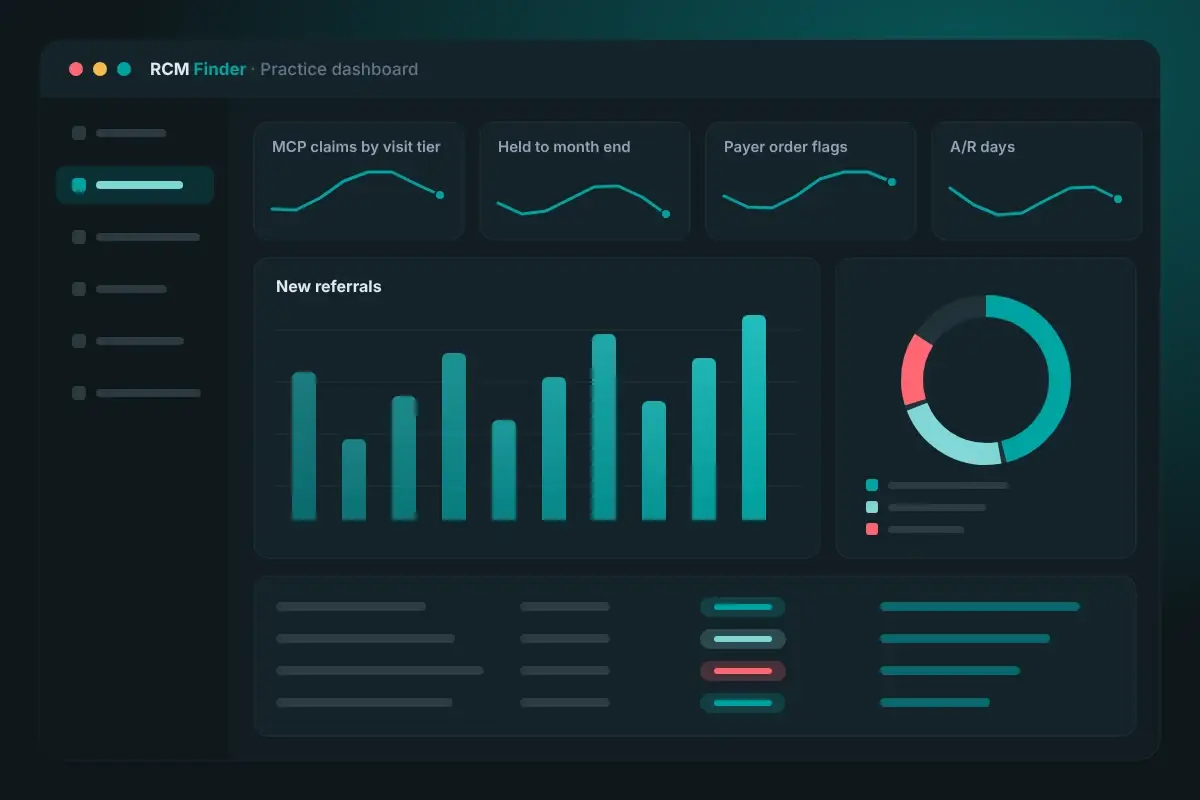
Nephrology billing dashboard showing MCP claims by visit tier, payer order flags, A/R days and new referrals

Quick answer

Nephrology billing services handle the claims a kidney practice creates: monthly ESRD capitation codes chosen by age, visit count and dialysis setting, per-day codes for partial months, dialysis access procedures, CKD diagnosis coding and payer order for dialysis patients. RCM Finder pairs that billing with front-desk assistants, referral marketing and a claims portal, starting with a free audit.

Disclaimer: This page is educational and is not legal, coding or compliance advice. Medicare contractor guidance, eCFR rules, telehealth policy and commercial payer policies change often and vary by contractor and plan. Verify every code, limit and rule against your Medicare contractor's current documents, your payer contracts and the current CPT, HCPCS and ICD-10-CM code sets before billing.

Why nephrology billing is different

For dialysis patients, Medicare pays the nephrologist through one monthly claim instead of a claim per visit. The code depends on the patient's age, the number of visits that month and whether the patient dialyzes in a center or at home.

Medicare pays these ESRD-related services through a monthly capitation payment (MCP). First Coast, a Medicare contractor, groups the codes into three sets: 90951–90962 for a full month in a facility, 90963–90966 for a full home dialysis month, and 90967–90970 for less than a full month. Noridian lists adult facility tiers of four or more visits, two or three, or one. The code is billed once a month, after the month ends, using the patient's age at month end. These rules come from Noridian and First Coast guidance; other Medicare contractors may word them differently.

Payer order is the second difference: employer coverage can make Medicare pay second for up to 30 months.

  • One visit must examine the access. Noridian says at least one visit in a facility month must include a vascular access exam.
  • Timing is fixed. First Coast cannot pay MCP claims dated before month end.
  • Some work sits outside the capitation. Under 42 CFR 414.314, surgery such as shunt declotting and documented care unrelated to the kidneys are paid separately.

What changed for nephrology payment in 2026

CMS's CY 2026 Physician Fee Schedule final rule fact sheet (October 31, 2025) set the conversion factor at $33.40 for clinicians who are not qualifying APM participants, up from $32.35. The CY 2027 proposed rule (July 14, 2026) proposes $32.84 for the same group; it is a proposal, so check the final rule before budgeting. CMS ended the mandatory ESRD Treatment Choices Model as of December 31, 2025. The voluntary Kidney Care Choices Model runs through 2027 for current participants.

The four pillars, built for a nephrology practice

A nephrology practice needs early referrals, a front desk that knows each patient's payer order, billing that closes every month cleanly and software that shows every claim. Each pillar handles one.

Revenue leaks at the handoffs: a fourth visit never logged, an employer plan billed second. We run all four pillars against one set of payer rules.

Pillar 1 · Healthcare Marketing

Healthcare Marketing for nephrology practices

Our healthcare digital marketing reaches the offices that refer kidney patients and the patients searching for kidney care nearby, through local SEO, Google Ads and reputation work.

  • Location pages and a Google Business Profile
  • Referring-clinician pages with a referral path
  • No tracking on forms without a BAA
  • KPI: new referrals by source
Explore Healthcare Marketing
Pillar 2 · Virtual Medical Assistants

Virtual Medical Assistants for nephrology front desks

Our virtual medical assistants for nephrology run your front desk on your practice's time zone. They verify eligibility, ask about employer coverage, log dialysis and transplant dates and book the in-person visits home dialysis patients need.

  • Payer order set before the first claim
  • Visits and access exams logged per patient
  • Education referrals and sessions tracked
  • KPI: payer order confirmed by month start
Explore Virtual Medical Assistants
Pillar 3 · End-to-End RCM

End-to-End RCM for nephrology claims

Our end-to-end nephrology revenue cycle management covers coding support, claim scrubbing, denial management and A/R follow-up, with extra checks on MCP tiers, per-day units, global periods and CKD staging.

  • MCP claims held until the month closes
  • Care management checked against MCP months
  • Secondary claims billed in the right payer order
  • KPI: denials by reason and A/R days
Explore End-to-End RCM
Pillar 4 · Practice Management System

Practice Management System for nephrology billing

Our practice management system tracks every claim by stage. It applies specialty-aware billing logic to each claim, checks that data is complete before submission and flags payments below the expected amount.

  • Claims tracked by stage, per claim
  • Workflow rules that hold, flag or assign a claim
  • Underpayment flags against expected amounts
  • Early access: appointment booking with a calendar view
Explore Practice Management System

Find where your dialysis claims leak

We review recent MCP claims, denials and visit records, then show where counts, payer order or timing cost you.

Get a Free Practice Audit

Nephrology service families: codes, rules and denial triggers

Each service family has its own counting, timing or eligibility rule. Codes are described in our own words (the AMA owns CPT descriptors); check current code sets before billing.

Nephrology service families: code examples, billing rules and typical denial triggers
Service familyCode examples (our wording)Billing ruleTypical denial or audit trigger
In-facility dialysis, full month90951–90962: four age bands, each split by 4+, 2–3 or 1 visits; adults 90960, 90961, 90962One claim per month after it ends; age at month end; one visit includes an access examClaim dated before month end; visits not documented; duplicate MCP within a team
Home dialysis, full month90963–90966 by age; 90966 for adultsComplete monthly assessment and at least one face-to-face visitTelehealth used in place of a required in-person assessment
Less than a full month90967–90970 per day, by age; 90970 for adultsUnits equal dialysis days (14 home days, then hospitalized: 14 units)Full-month code for a partial month; units not matching dialysis days
Dialysis procedure with evaluation90935 (hemodialysis); 90945 (other than hemodialysis)A related same-day E/M by the same provider is includedSeparate E/M for the same dialysis evaluation
Access surgery and circuit work36821 (direct artery-to-vein fistula); 36901 (circuit imaging); 36902 (imaging plus angioplasty)Paid outside the MCP; each code has a global periodGlobal-period visits without modifier 24, 25 or 57
Kidney disease educationG0420 (individual); G0421 (group); per one-hour sessionStage IV CKD; referral; up to 6 sessionsPatient not at stage IV; a seventh session; billed by a dialysis facility
Chronic care managementCCM codesTwo or more chronic conditions; consent before billingCCM billed in the same service period as 90951–90970
CKD diagnosis codingN18.1–N18.5 by stage (stage 3a N18.31, 3b N18.32); N18.6 (ESRD); N18.9 (unspecified)Code the documented stage; when diabetes or hypertension is linked, follow the N18 sequencing notes in the current tabular; record transplant statusUnspecified stage when the note states one; linked diabetes or hypertension left uncoded

Sources: Noridian MCP and the Medical Record (2025); First Coast ESRD MCP claims (2026); eCFR 42 CFR 414.314 and 410.48 (2026); CMS NCCI Policy Manual ch. XI (2026); CMS MLN Global Surgery booklet (2025) and CCM booklet MLN909188 (2025); CDC ICD-10-CM 2021 tabular addenda and FY 2027 ICD-10-CM guidelines; ICD10Data (secondary) for the N18 list; AAPC code summaries and an Iowa HHS code table for plain-language code meanings. MCP rules come from Medicare contractor guidance and vary by contractor and payer.
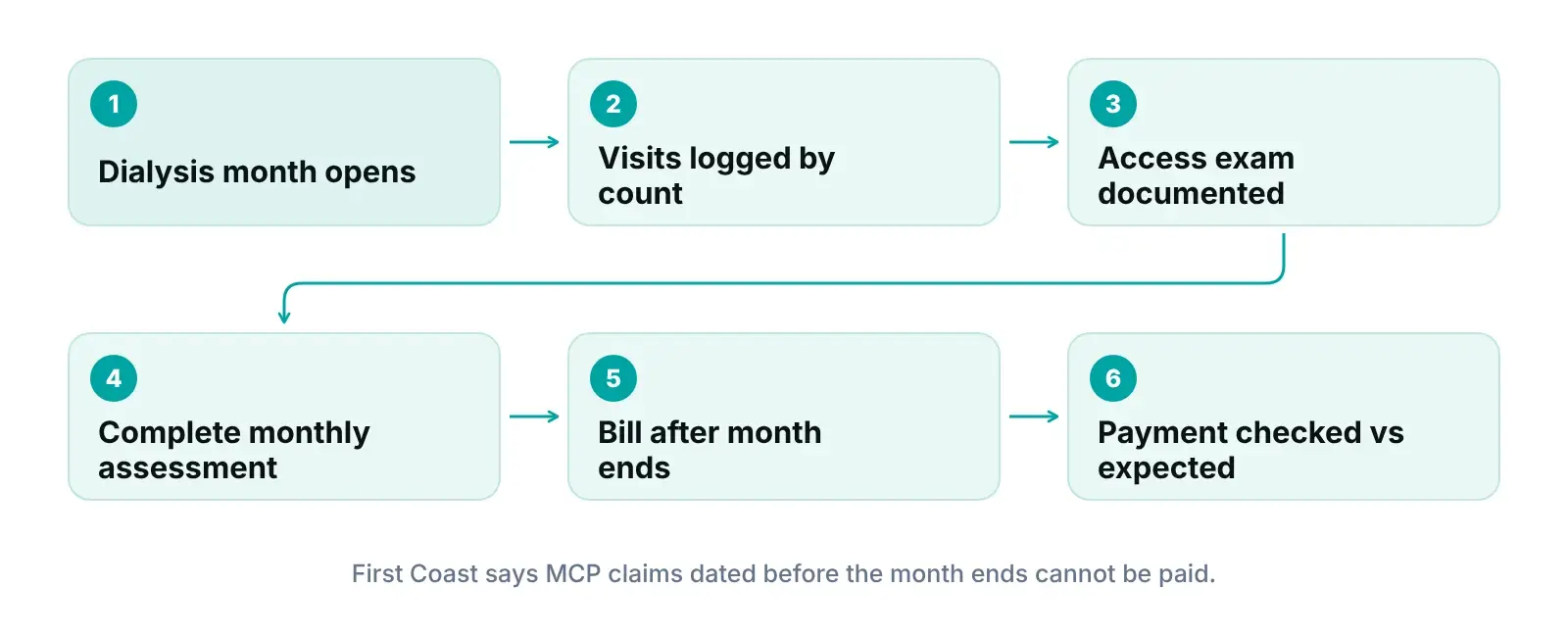
Diagram of the monthly ESRD capitation claim cycle from visit logging and access exam to month-end billing and payment review
How one dialysis month becomes one MCP claim. The tier follows the patient's age at month end and the documented visit count.

Count visits as they happen, bill after the month closes

Noridian says to bill the first dialysis month from the first treatment through month end, and later months as the full calendar month. A partner or employee in the same group can furnish some visits, but the billing practitioner performs the complete assessment and sets the plan of care. Its ESRD documentation list includes dialysis treatment sheets.

Home dialysis, partial months and hospital stays

First Coast says to bill a full home dialysis month when the practitioner provides a complete monthly assessment and at least one face-to-face visit, even if the patient was hospitalized. After 14 home dialysis days and a hospital stay for the rest of the month, the age-appropriate per-day code is billed with 14 units. Other Medicare contractors may word these rules differently.

Dialysis access procedures and global periods

Access surgery and circuit interventions are billed outside the MCP, and each code carries its own global period. CMS's Global Surgery booklet (December 2025) defines 0-, 10- and 90-day periods and the modifiers for work inside them: 24 for an unrelated visit, 25 for a separate same-day visit, 57 for the decision for major surgery, and 58, 78 or 79 for later procedures. Check each code's global indicator before billing a follow-up visit.

CKD staging, diagnosis pairing and risk adjustment

ICD-10-CM codes chronic kidney disease by stage, from N18.1 to N18.6; since 2021, stage 3 has separate 3a and 3b codes (N18.31, N18.32). The FY 2027 official coding guidelines presume a link between conditions joined by 'with' in the classification, so documented diabetes or hypertension changes how CKD is coded; follow the N18 sequencing notes in the current tabular. Diagnoses also feed risk adjustment: CMS's Medicare Managed Care Manual, chapter 7 (2014 revision) uses diagnoses from documented face-to-face visits and runs a separate ESRD model. See our HCC coding guide, diabetic HCC coding guide and chronic care management billing guide. Our endocrinology billing page covers the diabetes side.

Transplant care basics

Under 42 CFR 406.13, ESRD-only Medicare ends after the 36th month following the transplant month. Since January 1, 2023, people who lose it may enroll in Part B for immunosuppressive drug coverage only.

If your group owns dialysis units

This page covers professional claims. Under chapter 8 of the Medicare Claims Processing Manual, facilities bill on the institutional claim (type of bill 72X), and the ESRD payment system has included the drugs and biologicals used to treat ESRD since January 1, 2011. Noridian requires the KX modifier for sessions above the monthly maximum.

Payer order, eligibility and prior authorization to check before the month starts

Check who pays first before the first dialysis claim, not after a denial: the Medicare start date, employer coverage, transplant dates and plan authorization rules.

Under 42 CFR 406.13, ESRD-based Medicare usually starts on the first day of the third month after dialysis begins: a January start means April 1 coverage. Self-dialysis training or a transplant admission can move it earlier.

CMS's Medicare Secondary Payer Manual, chapter 2 makes Medicare secondary to group health plan coverage for up to 30 months, whatever the employer's size and whether the patient still works. Medicare's booklet for kidney patients (November 2025) says the period starts in the first month of eligibility, usually the fourth month of dialysis, even if the patient has not enrolled. See our coordination of benefits guide.

Since January 1, 2026, the CMS-0057-F final rule has required Medicare Advantage, Medicaid and CHIP plans to decide expedited prior authorization requests within 72 hours and standard ones within seven calendar days, with a specific denial reason. In the AMA's 2025 survey of 1,000 physicians (released May 2026), physicians averaged 40 prior authorizations and about 13 staff and physician hours a week.

Pre-month checklist: payer and eligibility rules our VMAs check for nephrology patients
RuleSourceWhat the VMA checks
ESRD Medicare usually starts the third month after dialysis begins; sooner with self-dialysis training or a transplant42 CFR 406.13Dialysis start and Medicare effective dates on file
Group health plan pays first for up to 30 months, regardless of employer size or employmentCMS MSP Manual ch. 2, §20Employer coverage asked about at intake; coordination end month logged
ESRD-only Medicare ends after the 36th month following a transplant; a Part B benefit for immunosuppressive drugs only is available42 CFR 406.13Transplant date and coverage end date logged
Home dialysis telehealth needs in-person assessments monthly for 3 months, then every 3 consecutive monthsSocial Security Act §1881(b)(3)(B)In-person dates booked before any telehealth month
Telehealth anywhere in the US through Dec 31, 2027; POS 10 at home, POS 02 elsewhereCMS telehealth FAQ (Feb 2026)Patient location and place of service recorded
Kidney disease education: stage IV CKD, a referral, up to 6 one-hour sessions42 CFR 410.48Stage in the note; referral on file; sessions counted
MA, Medicaid and CHIP plans decide in 72 hours (expedited) or 7 days (standard)CMS-0057-F; from Jan 1, 2026Request and due dates logged; denial reason saved
No chronic care management in the same service period as 90951–90970CMS MLN909188 (2025)MCP status checked before CCM enrollment

Sources: eCFR 42 CFR 406.13, 410.48 and 410.78 (2026); Social Security Act §1881; CMS Medicare Secondary Payer Manual ch. 2 (2022); Medicare booklet 10128 (2025); CMS telehealth FAQ (2026); CMS-0057-F fact sheet (2024); CMS MLN909188 (2025). Always check the member's current plan.
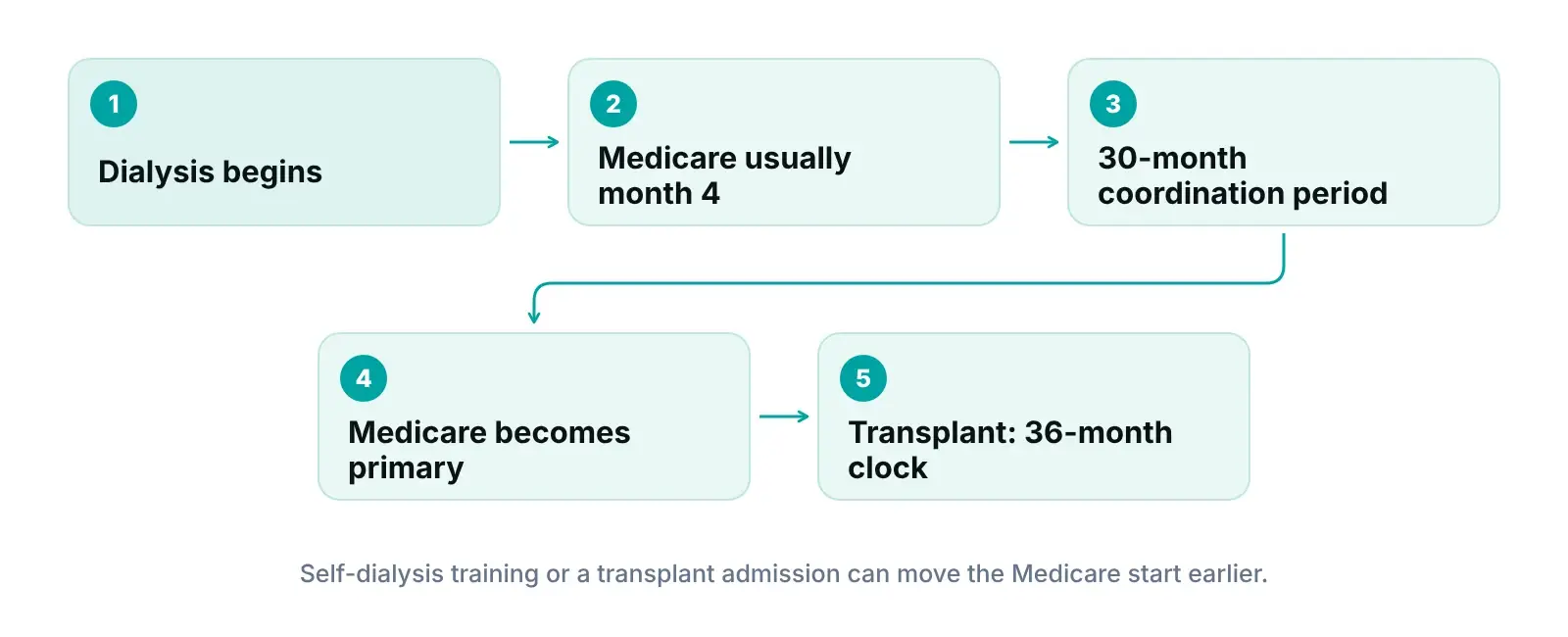
Timeline diagram of ESRD Medicare start, the 30-month coordination period and the 36-month post-transplant clock
The dates that decide who pays first for a dialysis or transplant patient.

Monthly ESRD visits by telehealth, now and after 2027

Medicare's telehealth flexibilities run through December 31, 2027, according to CMS's telehealth FAQ updated February 26, 2026. Until then, patients can receive telehealth anywhere in the United States, including at home. From January 1, 2028, most non-behavioral telehealth again requires a medical facility in a rural area.

Home dialysis is the lasting exception. Since 2019, 42 CFR 410.78 has counted the home and renal dialysis facilities as originating sites for the monthly home dialysis ESRD clinical assessment, with no geographic limit, as CMS's telehealth booklet (December 2025) confirms. Section 1881(b)(3)(B) of the Social Security Act requires in-person assessments monthly for the first 3 months of home dialysis, then at least once every 3 consecutive months. We plan the monthly access exam in person. See our telehealth billing guide and prior authorization guide.

See what slow or denied claims cost you

Enter your claim volume and denial rate to estimate what your nephrology practice is losing each month.

Open the Revenue Calculator

Growing a nephrology practice through referrals

Nephrology marketing has two audiences: referring clinicians and patients looking for kidney care nearby. Both need clear pages, and tracking must respect HIPAA.

We build location pages, plain-language pages on CKD stages and treatment options, and a simple referral path that lists the records you want, such as recent labs. Earlier referrals matter: Medicare's education benefit starts at stage IV. Our cardiology billing page covers one common referral source.

HHS guidance on online tracking says tracking tools on login, appointment or symptom pages can collect protected health information, and a cookie banner is not a HIPAA authorization. A June 2024 court order vacated part of that guidance. We still keep tracking off referral and appointment forms unless the vendor signs a BAA.

  • Referral KPIs: new referrals by office; days from referral to first visit.
  • Patient KPIs: first visits by source; missed calls.

In-house team, billing-only vendor or four-pillar partner?

Stay in-house if your staff track visits and payer order well. Use a billing-only vendor if claims are your only gap. Choose a combined partner when problems start at the front desk.

Decision table: which model fits a nephrology practice?
JobIn-house teamBilling-only vendorFour-pillar partner (RCM Finder)
Counting MCP visits and access examsRounding notes, if someone tallies themBilled from what the practice sendsVMA logs visits; claim held to month end
Payer order for dialysis patientsFront desk, if trainedFixed after a denialCoordination and transplant dates logged first
Home dialysis telehealth scheduleProvider calendarsNot in scopeIn-person dates booked on the required cadence
Kidney education and care managementCase by caseBilled if the practice tracks itStage, referral, sessions and MCP conflicts checked
Referral growthA separate agency, or nobodyNot includedMarketing tied to referrals and first visits
ReportingEHR reportsClaim reports onlyPortal dashboards, referral to paid claim
Cost structureSalaries, benefits, turnoverVaries; ask how fees are setQuoted after a free practice audit

We will tell you in the audit if you need only one pillar.

How it works

We start with a free audit and change nothing until you see the findings. We build our billing pipeline around how claims actually move through a practice: registration, charge entry, submission, payment and follow-up. For nephrology, we add the checks on this page.

  1. 1

    Free practice audit

    We review recent MCP, procedure and education claims, denials, and how visits and payer order are recorded.

  2. 2

    Business Associate Agreement and access

    We put a Business Associate Agreement in place before accessing patient data. Then we work inside your existing EHR (for example PrognoCIS, eClinicalWorks or athenahealth).

  3. 3

    Payer-rule map

    Your Medicare contractor's ESRD guidance and your plans' authorization lists become a monthly checklist and portal workflow rules.

  4. 4

    Front desk and billing go live

    VMAs log visits and confirm coverage. Claims go out after month end and are worked through denials and A/R.

  5. 5

    Weekly KPI review

    Each week we review denials by reason, A/R days, MCP claims by visit tier and new referrals.

Talk to us about your nephrology practice

Tell us how many dialysis units you round at and your hardest payer. We will tell you honestly whether we fit.

Call +1 (302) 556-2288

Compliance: what to ask any nephrology billing company

Any billing vendor handling your patients' data is a HIPAA business associate. Get a Business Associate Agreement before any access, and check how access is limited and logged.

HHS guidance names billing and claims processing as business associate work; subcontractors need their own agreement. The minimum necessary standard limits use to what each task needs. The Security Rule's technical safeguards require access control, audit controls, integrity controls, person or entity authentication and transmission security.

  1. Will you and your subcontractors sign a BAA before any access?
  2. How do you limit access, and can we see the audit log?
  3. What coding credential and nephrology experience do your coders have?
  4. How do you count MCP visits and confirm the access exam?
  5. How do you track coordination periods and transplant dates?
  6. Can we export our data if we leave?

We use role-based access, audit logging and encrypted (HTTPS) connections, and we put a Business Associate Agreement in place before accessing patient data. For your own side, use our HIPAA compliance checklist for medical practices.

Who this is for, and who it is not for

We would rather tell you now than after you sign. Here is where we fit and where we do not.

A good fit if you are

  • Independent nephrology groups rounding at several dialysis units
  • Practices with home dialysis programs that use telehealth
  • CKD clinics billing kidney education and care management
  • Groups that want referrals, front desk and billing measured together
  • Billing companies serving nephrology clients from one portal

Probably not a fit if you are

  • Nephrologists whose hospital or dialysis employer controls billing
  • Dialysis facilities seeking only institutional (72X) billing
  • Practices wanting promised collection rates; we report measured KPIs
  • Groups needing a credentialing module or in-portal real-time eligibility today (coming next)

Expert recommendations from our operations team

What we would do first if we were running your practice's revenue cycle tomorrow.

  1. 01

    Log visits when they happen

    We record each MCP visit, who furnished it and whether it included the access exam on the day it happens. Month-end reconstruction is where tiers get lost.

  2. 02

    Hold every MCP claim until the month closes

    Claims dated before month end cannot be paid, so we hold them and bill the full date span.

  3. 03

    Ask about employer coverage at the first dialysis visit

    The 30-month coordination period starts whether or not the patient enrolls. We log its end month so Medicare becomes primary on time.

  4. 04

    Book in-person home dialysis visits first

    Before any telehealth month, we calendar the required in-person assessments: monthly for three months, then at least every three months.

  5. 05

    Code the stage and the cause

    We check that the CKD stage in the note matches the code and that linked diabetes or hypertension is coded in the order the tabular instructs.

  6. 06

    Start kidney education at stage IV

    With a referral, Medicare covers up to six one-hour sessions for stage IV patients. We count sessions so none is billed past the limit.

Frequently asked questions

What do nephrology billing services include?

They cover coding support, claim scrubbing, submission, denial management and A/R follow-up for nephrology visits, ESRD monthly capitation claims, dialysis access procedures and kidney disease education. A good service also tracks visit counts, payer order for dialysis patients and transplant dates. We add front-desk assistants, referral marketing and a claims portal. Pricing depends on your patient mix and which pillars you need, so we quote it after a free practice audit.

How do we pick the right ESRD monthly capitation code?

Start with the setting. For a full month in a dialysis facility, codes 90951–90962 depend on the patient's age at the end of the month and the number of face-to-face visits: four or more, two or three, or one. Full home dialysis months use 90963–90966 by age. Partial months use per-day codes 90967–90970, with units for the dialysis days. In facility months, one visit must include a vascular access exam. Bill after the month ends. These rules follow Noridian and First Coast guidance; other contractors may differ.

Can monthly ESRD visits be done by telehealth?

Through December 31, 2027, Medicare telehealth is available anywhere in the US, including at home. After that, most non-behavioral telehealth again needs a medical facility in a rural area. Home dialysis is the lasting exception: the home and dialysis facilities are allowed sites for the monthly home dialysis assessment, with no geographic limit. The patient still needs in-person assessments monthly for the first three months, then at least once every three consecutive months.

Who pays first for a dialysis patient with employer insurance?

During the 30-month coordination period, the employer or union group health plan pays first and Medicare pays second. That holds regardless of employer size or whether the patient still works. Medicare's booklet says the period starts in the first month the patient would be eligible because of kidney failure, usually the fourth month of dialysis, even if not enrolled. After the 30th month, Medicare becomes primary.

Does Medicare cover kidney disease education?

Yes, for patients with stage IV chronic kidney disease who are referred by the physician managing their kidney condition. Part B pays for up to six one-hour sessions, individual (G0420) or group (G0421, two to 20 people). Physicians, physician assistants, nurse practitioners and clinical nurse specialists can furnish them; renal dialysis facilities cannot. Content must cover managing other conditions, treatment options including transplant, and an outcomes assessment.

Can we bill chronic care management for a dialysis patient?

Not for the same service period as the ESRD monthly codes. CMS's chronic care management booklet (June 2025) says CCM cannot be billed during the same service period as CPT 90951–90970. For CKD patients who are not on dialysis, CCM can apply when they have two or more chronic conditions expected to last at least 12 months, with the patient's consent obtained before billing.

No cost, no commitment

Get your free practice audit

Tell us about your practice. A member of our operations team replies within one business day.

  • A review of your recent claims, denials and A/R aging
  • Where your front desk and prior authorizations slow payment
  • A prioritized fix list you keep, whether or not you hire us

Pricing is quoted after the audit, based on your volume and the services you choose. Prefer to talk? Call +1 (302) 556-2288.

Tell us about your practice

RCMFinder Master Intake Form
AA

About the author: Awais Afzal

Healthcare Operations & Data Analyst, RCM Finder

Awais has spent more than 16 years in healthcare digital marketing and clinical operations management. He builds data-driven revenue cycle blueprints for high-ticket medical practices and leads product development of the RCM Finder portal. More about our team.

How we write: every figure, code and rule on this page was checked against the primary source listed below and independently fact-checked before publishing. We re-review this page every six months. Last reviewed October 12, 2026; next review April 12, 2027.

Sources

  1. Monthly Capitation Payment and the Medical Record (JF Part B) — Noridian Healthcare Solutions (Medicare contractor) (2025 (last updated Jul 11, 2025))
  2. End-stage renal disease (ESRD) monthly capitation payment (MCP) claims — First Coast Service Options (Medicare contractor) (2026 (page dated August 25, 2026))
  3. 42 CFR 414.314 Monthly capitation payment method — eCFR (current (accessed 2026-10-10))
  4. Social Security Act §1881 (Medical care for end stage renal disease beneficiaries) — Social Security Administration (current (accessed 2026-10-10))
  5. 42 CFR 410.78 Telehealth services — eCFR (current (accessed 2026-10-10))
  6. Medicare Telehealth FAQ (updated 02/26/2026) — CMS (2026)
  7. Telehealth & Remote Patient Monitoring (MLN901705) — CMS Medicare Learning Network (2025)
  8. 42 CFR 410.48 Kidney disease education services — eCFR (current (accessed 2026-10-10))
  9. 42 CFR 406.13 Individual's entitlement to Medicare Part A when ESRD is the basis — eCFR (current (accessed 2026-10-10))
  10. Medicare Secondary Payer Manual, Chapter 2, Section 20 (ESRD) — CMS (2022 (Rev. 11755))
  11. Social Security Act §1862 (Exclusions from coverage and Medicare as secondary payer) — Social Security Administration (current (accessed 2026-10-10))
  12. Medicare Coverage of Kidney Dialysis & Kidney Transplant Services (CMS Product No. 10128) — CMS / Medicare.gov (2025 (November 2025))
  13. Global Surgery Booklet (MLN907166) — CMS Medicare Learning Network (2025 (December 2025))
  14. Chronic Care Management Services (MLN909188) — CMS Medicare Learning Network (2025 (June 2025))
  15. 2027 ICD-10-CM Codes N18* (Chronic kidney disease) — ICD10Data.com (secondary; code list and tabular notes only) (2027 code set (accessed 2026-10-10))
  16. ICD-10-CM Tabular List of Diseases and Injuries, 2021 Addenda — CDC National Center for Health Statistics (2020 (FY 2021 code set, effective October 1, 2020))
  17. ICD-10-CM Official Guidelines for Coding and Reporting FY 2027 — CMS and CDC NCHS (2026 (FY 2027, October 1, 2026 - September 30, 2027))
  18. Medicare Managed Care Manual, Chapter 7: Risk Adjustment — CMS (2014 (Rev. 118))
  19. Risk Adjustment — CMS (2024 (last modified 10/24/2024))
  20. ESRD Treatment Choices (ETC) Model — CMS Innovation Center (accessed 2026-10-10)
  21. Kidney Care Choices (KCC) Model — CMS Innovation Center (2026 (last updated 09/21/2026))
  22. Calendar Year (CY) 2026 Medicare Physician Fee Schedule Final Rule (CMS-1832-F) fact sheet — CMS (2025)
  23. Calendar Year (CY) 2027 Medicare Physician Fee Schedule Proposed Rule fact sheet — CMS (2026)
  24. CMS Interoperability and Prior Authorization Final Rule (CMS-0057-F) fact sheet — CMS (2024)
  25. AMA survey: Prior authorization reform pledge falls short with physicians — American Medical Association (2026 (May 13, 2026))
  26. Medicare Claims Processing Manual, Chapter 8: Outpatient ESRD Hospital, Independent Facility, and Physician/Supplier Claims — CMS (2026 (Rev. 13740, issued 04-17-26))
  27. National Correct Coding Initiative Policy Manual for Medicare Services, Chapter XI: Medicine, Evaluation and Management Services — CMS (2026 (revision date 1/1/2026))
  28. Hemodialysis In-Facility or Home Setting — Noridian Healthcare Solutions (Medicare contractor) (2025 (last updated Jul 11, 2025))
  29. ESRD Documentation Requirements — Noridian Healthcare Solutions (Medicare contractor) (2025 (last updated Mar 24, 2025))
  30. Business Associates — HHS Office for Civil Rights (2026 (content last reviewed July 30, 2026))
  31. Minimum Necessary Requirement — HHS Office for Civil Rights (2013 (content last reviewed July 26, 2013))
  32. 45 CFR 164.312 Technical safeguards — eCFR (current (accessed 2026-10-10))
  33. Use of Online Tracking Technologies by HIPAA Covered Entities and Business Associates — HHS Office for Civil Rights (2024 (reviewed June 26, 2024))
  34. Telehealth code table including ESRD codes 90951-90970 — Iowa HHS (secondary; undated) (undated (about 2023; accessed 2026-10-10))
  35. CPT 90951 code summary — AAPC (secondary; plain-language code meaning only) (accessed 2026-10-10)
  36. CPT 90954 code summary — AAPC (secondary; plain-language code meaning only) (accessed 2026-10-10)
  37. CPT 90957 code summary — AAPC (secondary; plain-language code meaning only) (accessed 2026-10-10)
  38. CPT 90966 code summary — AAPC (secondary; plain-language code meaning only) (accessed 2026-10-10)
  39. CPT 90970 code summary — AAPC (secondary; plain-language code meaning only) (accessed 2026-10-10)
  40. CPT 90935 code summary — AAPC (secondary; plain-language code meaning only) (accessed 2026-10-10)
  41. CPT 90945 code summary — AAPC (secondary; plain-language code meaning only) (accessed 2026-10-10)
  42. CPT 36821 code summary — AAPC (secondary; plain-language code meaning only) (accessed 2026-10-10)
  43. CPT 36901 code summary — AAPC (secondary; plain-language code meaning only) (accessed 2026-10-10)
  44. CPT 36902 code summary — AAPC (secondary; plain-language code meaning only) (accessed 2026-10-10)
  45. HCPCS G0420 code summary — AAPC (secondary; plain-language code meaning only) (accessed 2026-10-10)
  46. HCPCS G0421 code summary — AAPC (secondary; plain-language code meaning only) (accessed 2026-10-10)