

Coordination of benefits (COB) decides which health plan pays first when a patient has more than one, and how much the second plan adds. Commercial plans follow an order-of-benefits sequence, while Medicare follows Medicare Secondary Payer rules based on age, work status, employer size and kidney disease. Bill the primary plan first, then the secondary.
This guide is for practice managers, billers and front-desk leads. It explains how the order of payers is decided, shows the Medicare Secondary Payer rules in one table, and walks through the claim steps. It replaces two older posts on the same topic. The rules come from the NAIC model regulation and CMS, which you can check yourself.
Key takeaways
- The primary plan pays first; the secondary plan pays under its own terms on what is left.
- Commercial order follows rules like employee before dependent and the birthday rule for children.
- For Medicare, employer size, work status, disability and ESRD decide who pays first.
- Bill the primary first and send the secondary the primary’s payment details.
- Ask about other coverage at every visit and record the answer with the date.
What is coordination of benefits, and why does it matter to a practice?
Coordination of benefits is the rule set that puts a patient’s plans in order so each one pays its share and no more. Medicare.gov describes the basic mechanics: the primary payer pays up to the limits of its coverage, then sends the rest of the balance to the secondary payer. For a practice, the work lands at the front desk and in billing, because the claim must go to the right plan first.
A wrong order does not usually cost money on day one. It shows up weeks later as a denial, a request for the other plan’s explanation of payment, or a payment that has to be returned. The fix is cheaper at registration than at the A/R stage.
Key terms
- Primary payer: the plan that processes the claim first.
- Secondary payer: the plan that considers what the primary left unpaid, under its own terms.
- Tertiary payer: a third plan, billed after the first two have paid.
- Allowable expense: under the NAIC model rules, a health care expense that includes coinsurance and copayments, counted without reduction for a deductible.
How do commercial plans decide which one pays first?
Most commercial plans follow an order-of-benefits sequence in which the first rule that fits decides the answer. The NAIC Model Regulation 120 is the model many states build on, so it is a good map, but states can adopt different versions. Confirm the rule in the plan’s own policy when the case is close.
| Situation | Which plan pays first | Model section |
|---|---|---|
| Patient is the employee or policyholder on one plan and a dependent on another | The plan covering the patient as an employee, member or policyholder | 6.D(1) |
| Child covered by both parents, parents married or living together | The plan of the parent whose birthday falls earlier in the calendar year (the birthday rule) | 6.D(2)(a) |
| Same birthday for both parents | The plan that has covered the parent longer | 6.D(2)(a) |
| Divorced or separated parents, and a court decree makes one parent responsible for health care | That parent’s plan, if the plan has actual knowledge of the decree | 6.D(2)(b) |
| Divorced or separated parents, no decree | Custodial parent’s plan, then that parent’s spouse, then the non-custodial parent’s plan, then that parent’s spouse | 6.D(2)(b) |
| Active employee on one plan, retired or laid-off on the other | The plan covering the person as an active employee | 6.D(3) |
| COBRA or state continuation coverage on one plan | The plan covering the person as an employee, member, subscriber or retiree | 6.D(4) |
| None of the above decides it | The plan that covered the person for the longer time; if still undecided, allowable expenses are shared equally | 6.D(5), 6.D(6) |
Source: NAIC Model Regulation 120 (Coordination of Benefits), Section 6.D. States may adopt different versions.
Two details trip up front desks. The birthday rule looks at the month and day of the parents’ birthdays, not the year they were born, so the older parent is not automatically primary. And two plans in a row count as one when the second starts within 24 hours of the first ending, which matters when you compare how long each plan has covered someone.
If the plans cannot agree on the order within 30 calendar days of receiving all the information they need, the model says they pay in equal shares and settle their relative liability later. In practice, that gives you a way to get paid while the plans sort it out. Check whether the plans involved follow that provision.
When Medicare is one of the plans, who pays first?
Medicare follows federal Medicare Secondary Payer (MSP) rules, not the commercial sequence. The deciding facts are usually the patient’s age, whether they are still working, the employer’s size, and whether the patient has end-stage renal disease. The CMS Medicare Secondary Payer booklet (MLN006903, July 2025) states that any entity providing items and services to Medicare patients must determine whether Medicare is the primary payer.
| Situation | Who pays first | Notes |
|---|---|---|
| Age 65 or older, working, group health plan (GHP) through an employer with 20 or more employees | GHP primary, Medicare secondary | Also applies to a multi-employer group with at least one employer of 20 or more |
| Age 65 or older, working, employer with fewer than 20 employees | Medicare primary, GHP secondary | |
| Under 65 with a disability, GHP through own or a family member’s current employment | GHP primary if the employer has 100 or more employees; Medicare primary if fewer than 100 | Qualifying multi-employer groups count toward the 100 |
| Age 65 or older, not working, with retiree coverage | Medicare primary, retiree plan secondary | Retiree plans may require Part B enrollment |
| End-stage renal disease (ESRD) | GHP primary for the first 30 months when it was primary before ESRD-based eligibility, then Medicare | With ESRD-only eligibility, Medicare pays secondary to any GHP |
| Medigap or Medicaid alongside Medicare | Medicare primary | Medicaid pays after other coverage |
| Workers’ compensation, liability or no-fault insurance for the same injury | That insurance pays first | Medicare may make a conditional payment if the other insurer does not pay within 120 days |
| TRICARE or VA | TRICARE depends on status; Medicare does not pay for VHA-authorized services | Active-duty status: TRICARE primary |
Source: CMS, Medicare Secondary Payer booklet (MLN006903), July 2025; Medicare.gov; Medicaid.gov. Medicare Advantage: contact the plan for billing guidance.
Practices that treat many older adults, such as those in geriatrics, see the working-aged rule often. A patient who keeps a job past 65 and is covered through a large employer is the case where Medicare is secondary, which surprises staff who assume Medicare always goes first.
Do not collect patient payments on a hunch
The CMS booklet says providers may not accept copayments or other payments from the patient when another primary insurer applies, and a refund is owed if this happened. It also says you cannot deny Part A or Part B services because of an open or closed MSP record. Sort out the order of payers; do not turn the patient away over it.
For Medicaid, Medicaid.gov states that other available third-party resources must meet their legal obligation to pay claims before the Medicaid program pays. Treat Medicaid as secondary to any other coverage, including Medicare. If you check Medicare coverage for your own patients, our guide to verifying Medicare coverage shows where that lookup fits.
How much does the secondary plan actually pay?
The secondary plan does not automatically pay the whole leftover balance. Under NAIC Model 120, Section 7, the secondary plan works out what it would have paid with no other coverage and applies that amount to the allowable expenses the primary left unpaid. It may reduce its payment so that total benefits from all plans do not exceed 100 percent of the total allowable expense.
A simple, hypothetical example shows the logic. Suppose the allowed amount is $1,000. The primary pays $800 and leaves $200 as coinsurance. If the secondary plan would have paid $800 on its own terms, it applies that to the $200 and pays up to $200, so the patient owes nothing. If the secondary plan has an unmet deductible or a lower allowed amount, it pays less, and the patient owes the difference. The numbers are illustrative only.
Medicare calculates its secondary payment from the primary payer’s payment plus any applicable deductible and coinsurance. The formulas are in Chapter 5, section 40.8.3 of the Medicare Secondary Payer Manual, as referenced in the MSP booklet. Do not estimate a patient’s balance until the primary’s explanation of payment is in hand.
“A patient balance estimated before the primary plan has paid is a guess. Wait for the explanation of payment, then calculate what is left.”
How do you bill a claim when a patient has two plans?
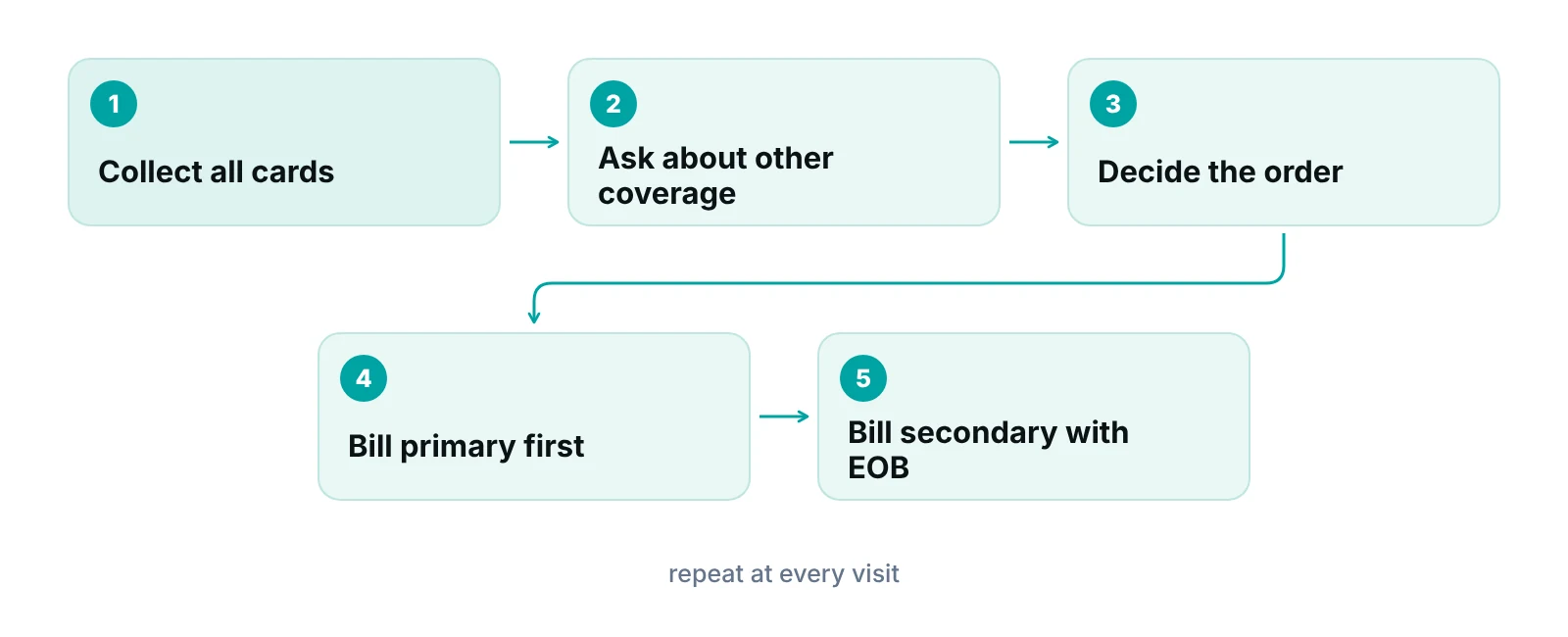
Bill the primary payer first, then send the secondary the primary’s payment details. The CMS Medicare Secondary Payer booklet (MLN006903, July 2025) puts it plainly for Medicare: “Bill the primary payer before billing us,” and identify all known primary payers on the claim.
- Confirm the order at registration. Ask about other coverage at every visit, not only on the first one. Record the answer with the date.
- Submit to the primary payer with the patient’s subscriber details exactly as shown on that plan’s card.
- Read the primary’s explanation of payment or remittance advice. Note the paid amount, the patient responsibility and any adjustment reason codes.
- Submit to the secondary payer with the primary’s payment information. For Medicare as secondary, CMS says to submit the primary’s EOB or remittance advice with the MSP data, and to use the correct claim adjustment reason code in the 835 or 837 adjustment segment, or Medicare may deny the claim.
- Bill the patient last, only for what neither plan assigned to the patient.
- Keep the records. CMS says to keep MSP question responses, positive and negative, for 10 years after the service date.
Timely filing limits are set by each payer and by the contract, so the clock on the secondary claim can be tight. Look up the limit in each payer’s provider manual and note it in your worklist. For general claim quality, see our clean claims guide.
If a patient will not give other-insurance information, the booklet says the payer order is “to be determined” by the MSP contractor. Document the refusal and what you asked. Work this through the medical billing services team or billing lead rather than guessing.
Where does coordination of benefits go wrong?
Most COB trouble comes from stale or missing coverage information, not from billing mistakes. The table below pairs each failure point with a practical fix. These are operational patterns, not statistics.
| Failure point | What it looks like | Fix |
|---|---|---|
| Coverage not asked about at each visit | Claim goes to a plan that ended or is now secondary | Ask the other-coverage question every visit and record the date |
| Medicare assumed primary | Claim denied or a recovery request arrives later | Use the MSP questions and the working-aged, disability and ESRD rules before billing |
| Child’s plan order guessed | Wrong parent’s plan billed first | Apply the birthday rule, then the decree or custody rule if parents are divorced |
| Secondary claim sent without primary payment details | Secondary denies or delays | Attach the primary’s EOB or remittance data and adjustment codes |
| Patient balance billed too early | Patient pays, then insurance pays; refund needed | Hold the patient statement until both plans have processed |
| Coverage change not reported | Medicare keeps wrong MSP record | Report changes to the Benefits Coordination and Recovery Center (BCRC) |
Denial codes that point to other coverage are easier to read once you know the order of payers. Our CO-22 denial code guide covers one such code in detail, and the denial management overview shows how to work denials as a process. After the secondary pays, follow the balance through your accounts receivable follow-up.
Report coverage changes to Medicare
CMS says changes in a beneficiary’s other coverage, such as employment changes, accidents, illness or injury, should be reported directly to the BCRC. Medicare.gov lists the BCRC at 1-855-798-2627 (TTY 1-855-797-2627). Have the beneficiary’s full name and Medicare Number or SSN ready, plus your own provider number.
Medicare can recover payments made in error
The MSP booklet says providers must return payments Medicare made incorrectly as primary. It adds that the primary payer has 60 days to reimburse Medicare, that late reimbursement can bring interest and double damages, and that Medicare may fine providers who knowingly, willfully and repeatedly give inaccurate other-coverage information.
Should you handle COB in-house, with software, or outsource it?
Choose by volume and by how often your patients have two plans. A small practice with few dual-coverage patients can run COB with a written checklist. A busy practice benefits from tools that flag missing data and a named owner for every secondary claim.
- In-house with a checklist: fits low volume. The risk is that coverage questions are skipped when the front desk is busy.
- Software support: a practice management system that tracks claims by stage lets a billing lead see which claims are waiting on the primary and which are ready for the secondary, with an owner on each. Data-completeness checks before submission catch missing payer fields.
- Outsourced billing or front-desk support: fits practices that cannot staff the follow-up. Ask the vendor how it asks about other coverage at every visit and how it handles secondary claims. See our front desk and revenue cycle article for the link between registration and collections.
Not sure where COB breaks down in your practice?
A free practice audit reviews how coverage information, claim order and secondary billing move through your revenue cycle, and shows where claims stall.
Our recommendations
- Ask the other-coverage question at every visit. We recommend a fixed question on the check-in form and a dated record. Coverage can change between visits, and the MSP booklet expects the question before services are provided.
- Put the order of payers in the chart, not in someone's head. Record primary, secondary and the rule you used (for example, birthday rule or working-aged). The next staff member should not have to rebuild the reasoning.
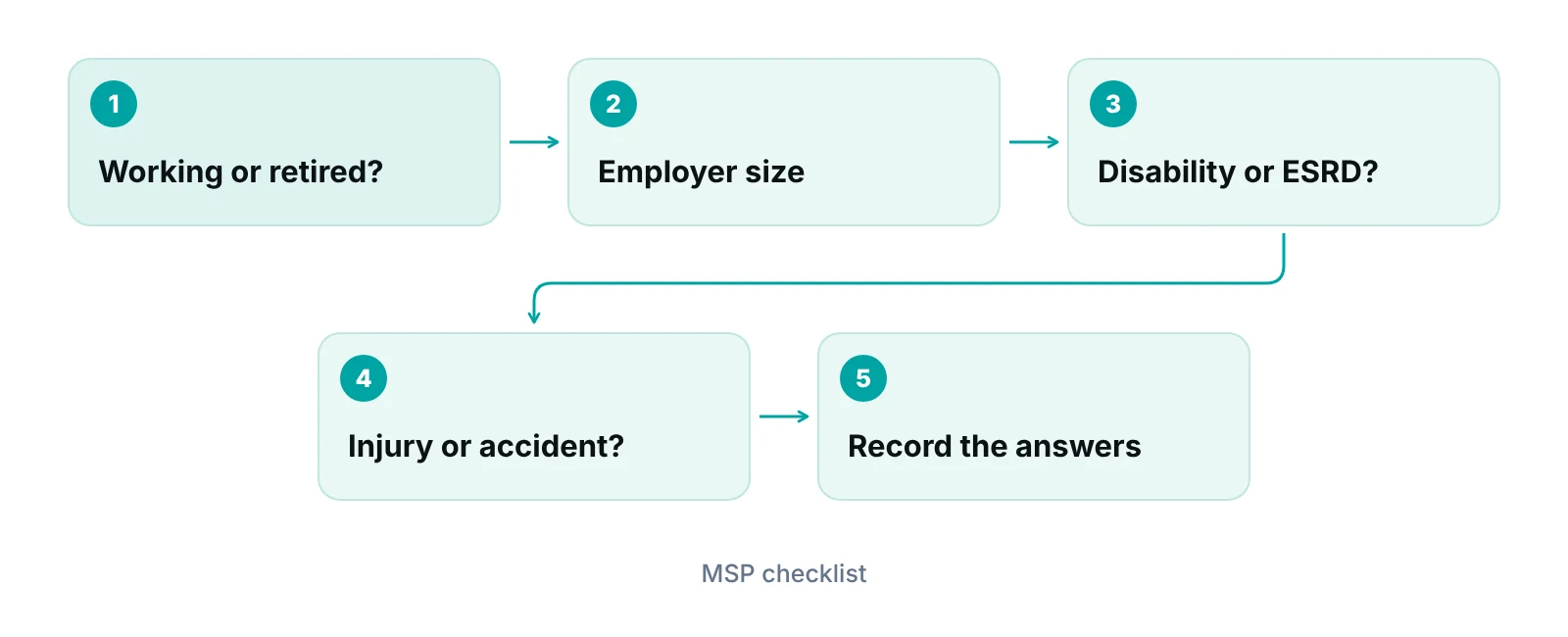
- Build a Medicare-secondary checklist. List the employer-size questions, the disability and ESRD questions, and where to look up the answer. Use it every time a Medicare patient says they also have other coverage.
- Do not send the secondary claim without the primary's payment data. Attach the explanation of payment or remittance details and the adjustment codes. For Medicare as secondary, CMS says missing codes can lead to a denial.
- Hold patient statements until both plans have processed. A statement sent after only the primary has paid often shows too much owed. A refund later costs more than waiting.
- Review secondary claims weekly. Give every unpaid secondary claim an owner and a date. Our insurance verification guide covers the front-end checks that feed this list.
Track primary and secondary claims in one place.
The RCM Finder portal tracks claims by stage with an owner, runs data-completeness checks before submission and applies workflow rules, so a secondary claim does not sit unseen after the primary pays.
See how the RCM Finder portal works · Create a portal account
Disclosure: RCM Finder builds and sells this portal. It is a practice management system, not an EHR.
Bottom line
Coordination of benefits works when someone owns it at registration and again at the secondary claim. Learn the commercial order, apply the Medicare Secondary Payer rules before you bill Medicare, and wait for the primary’s payment details before you bill the secondary or the patient. If COB denials are piling up, our denial management services can help work them, and the revenue calculator shows what stalled claims cost. Or start with a free practice audit.
Frequently asked questions
What is coordination of benefits?
Coordination of benefits (COB) is the process that decides which of a patient’s health plans pays first and how the second plan pays after that. The primary payer pays up to its limits, then the remaining balance goes to the secondary payer. The aim is to keep total payment within the allowable expense.
How does COB decide which insurance is primary?
It depends on the plans. Commercial plans typically use an order of rules, such as employee before dependent, the birthday rule for children, active employee before retiree, and COBRA after the employer plan. Medicare follows Medicare Secondary Payer rules based on age, work status, employer size and ESRD.
What is the birthday rule?
When a child is covered by two married or cohabiting parents, the plan of the parent whose birthday falls earlier in the calendar year is primary. The year of birth does not matter. If both parents share a birthday, the plan that has covered the parent longer pays first, under the NAIC model.
Is Medicare always primary for patients over 65?
No. If the patient is still working and has a group health plan through an employer with 20 or more employees, the group plan is primary and Medicare is secondary. If the employer has fewer than 20 employees, Medicare is primary. Retiree coverage is secondary to Medicare.
Does the secondary insurance pay whatever the primary leaves unpaid?
Not always. The secondary plan figures what it would have paid without other coverage and applies that to the unpaid allowable expenses. Total payment from all plans should not exceed the total allowable expense, so the patient can still owe a balance, depending on the second plan’s terms.
What should we do if a claim is denied because of a COB issue?
Contact the patient to confirm current coverage and the order of payers, then correct the claim and resubmit to the right plan. If the plans dispute the order, ask each for its determination in writing. Check the denial reason on the remittance advice first.
Get your free practice audit
Tell us about your practice. We will contact you using the details you give.
- A review of your recent claims, denials and A/R aging
- Where your front desk and prior authorizations slow payment
- A prioritized fix list you keep, whether or not you hire us
Pricing is quoted after the audit, based on your volume and the services you choose. Prefer to talk? Call +1 (302) 556-2288.
Sources
- Medicare Secondary Payer (MLN006903) — CMS (2025)
- Model Regulation 120: Coordination of Benefits — NAIC
- How Medicare works with other insurance — Medicare.gov
- Coordination of Benefits and Third Party Liability — Medicaid.gov
- Provider Services: Coordination of Benefits and Recovery — CMS
Disclaimer: This post is general educational information about revenue cycle operations. It is not legal, coding, billing-compliance or financial advice. Payer rules, plan terms, state laws and federal requirements vary and change over time. Confirm requirements with each payer and qualified advisors before acting.
