
Family Practice Specialty

Family Practice Billing Services, Front Desk Support and Patient Growth

Wellness visits, same-day problem visits, care management, vaccines and telehealth billed to each payer's rules, with front-desk assistants, patient marketing and a claims portal for family medicine practices.
  • Works inside your current EHR
  • US practice time zone, every shift
  • Weekly KPI reporting, or on your schedule
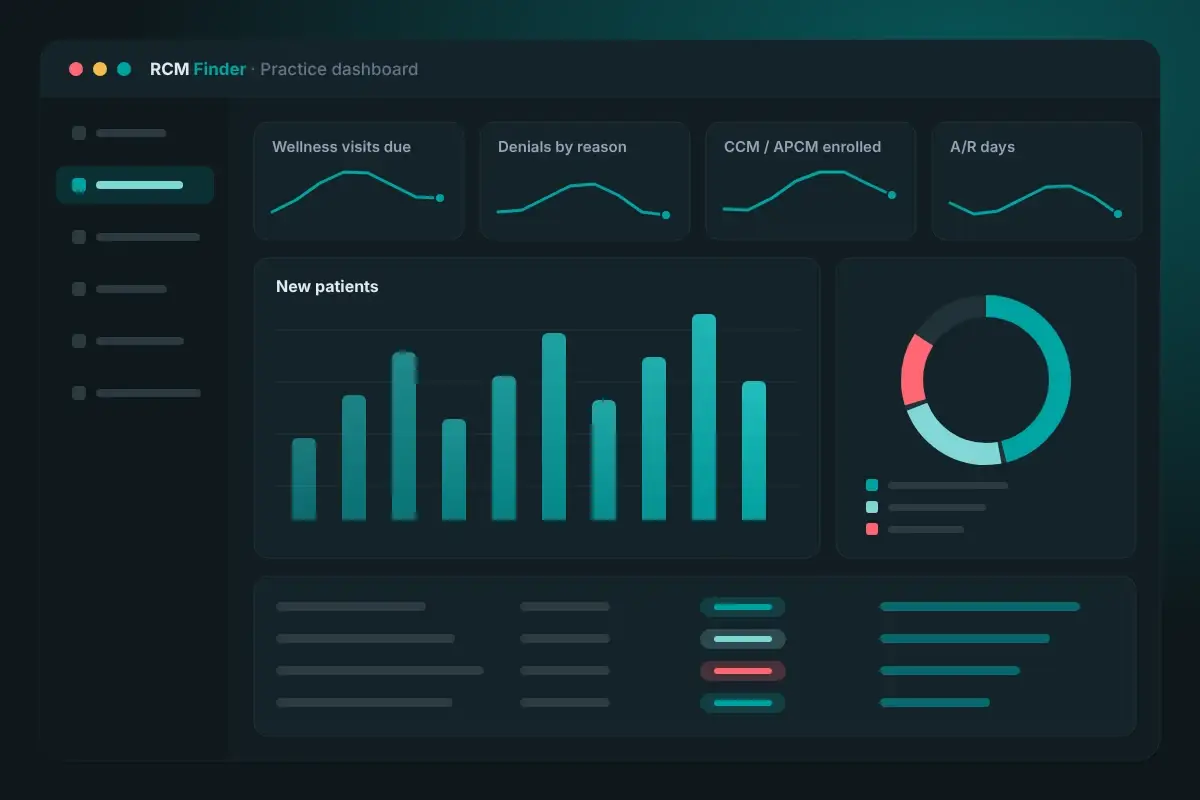
Family practice billing dashboard with wellness visits due, denials by reason, care management, A/R days and new patients

Quick answer

Family practice billing services handle the claims a family medicine office creates every day: preventive and problem visits on the same date, Medicare wellness visits, the G2211 add-on, chronic and transitional care management, and vaccines billed to Part B or Part D. RCM Finder pairs that billing with front-desk assistants, patient marketing and a claims portal.

Disclaimer: This page is educational and is not legal, coding or compliance advice. Medicare guidance, contractor articles, fee schedule rules and commercial payer policies change often and vary by contractor and plan. Verify every code, frequency limit and rule against your Medicare contractor's current documents, your payer contracts and the current CPT and HCPCS code sets before billing.

Why family practice billing is different

Family practice billing is different because one office bills every age group, almost every payer and several kinds of care on the same day. One visit can combine a preventive exam, a new problem, a vaccine and care management, and each part follows its own rule.

Adult-only practices should see our internal medicine billing page, and children-only practices our pediatric billing page.

Preventive rules split by payer. Medicare does not cover a routine physical, per CMS. It pays for an Initial Preventive Physical Exam (IPPE) in the first 12 months of Part B, then Annual Wellness Visits (AWVs), at no cost to the patient under assignment. Under 45 CFR 147.130, commercial plans must cover USPSTF A and B services, ACIP-recommended vaccines and HRSA-supported guidelines without cost sharing, though grandfathered plans are exempt.

What changed in 2026

CMS's CY 2026 fee schedule final rule fact sheet (October 31, 2025) raised the conversion factor to $33.40 for clinicians who are not qualifying APM participants, from $32.35. A new -2.5% efficiency adjustment to work RVUs spares time-based services, such as E/M visits, care management and behavioral health.

The four pillars, built for a family practice

A family practice needs patients finding you, a front desk that checks benefits and wellness timing, billing that separates preventive and problem work, and software that shows every claim.

Revenue leaks at the handoffs, such as care management billed with no consent on file. We run all four pillars against one set of payer rules.

Pillar 1 · Healthcare Marketing

Healthcare Marketing for family practices

Our healthcare digital marketing helps local families and new Medicare patients find you through local SEO, Google Ads and reviews, with tracking set up to follow HHS guidance.

  • A Google Business Profile per office
  • Pages for wellness, chronic care and sick visits
  • No tracking on booking forms without a BAA
  • KPI: new patients by source
Explore Healthcare Marketing
Pillar 2 · Virtual Medical Assistants

Virtual Medical Assistants for family practice front desks

Our virtual medical assistants for family practices work on your time zone. They verify eligibility, check IPPE and AWV timing, sort vaccines by Medicare part and confirm care management consent is on file.

  • Wellness timing checked before booking
  • Vaccines sorted by Part B or Part D
  • Discharges flagged for clinical staff
  • KPI: visits cleared before the visit date
Explore Virtual Medical Assistants
Pillar 3 · End-to-End RCM

End-to-End RCM for family medicine claims

Our end-to-end family practice revenue cycle management covers coding, claim scrubbing, denials and A/R follow-up, with extra checks for modifier 25, G2211, wellness frequency and care management overlaps.

  • Modifier 25 and G2211 checked together
  • Wellness codes matched to patient history
  • Monthly care management overlaps caught
  • KPI: denials by reason and A/R days
Explore End-to-End RCM
Pillar 4 · Practice Management System

Practice Management System for family practice billing

Our practice management system tracks every claim by stage, applies specialty-aware billing logic per claim, checks data completeness before submission and flags underpayments.

  • Claims tracked by stage
  • Underpayment flags against expected amounts
  • Workflow rules that flag or hold claims
  • Early access: appointment booking with a calendar view
Explore Practice Management System

Find where your family practice claims leak

We review recent claims, denials and front-desk workflow, then show where wellness, modifier 25 or care management rules cost you.

Get a Free Practice Audit

Family practice service lines: codes, payer rules and denial triggers

Each service line has its own frequency, consent or same-day rule. Codes are examples in our own words (the AMA owns CPT descriptors); check current code sets before billing.

Family practice service lines: code examples, payer rules and typical denial triggers
Service lineCode examples (our wording)Rule to followTypical denial trigger
Preventive plus problem visit (commercial)99381–99387 (new); 99391–99397 (established); 99202–99215 with modifier 25Problem visit only if it needed significant extra work, with its own note; cost sharing may apply to itModifier 25 on a minor problem handled in the exam
Medicare IPPE and AWVG0402 (IPPE); G0438 (first AWV, once per lifetime); G0439 (later AWVs); 99497-33 (advance care planning)IPPE within 12 months of Part B; AWV 12 months after the last IPPE or AWV; never both on one dayIPPE after the window; repeat G0438; missing AWV elements
Visit complexity add-onG2211 with 99202–99215; from 2026, home visitsContinuing focal point of care, or ongoing care for one serious conditionModifier 25 visit paired with a service other than an AWV, vaccine administration or allowed preventive service
Chronic and principal care management99490, 99439, 99491, 99437, 99487, 99489 (CCM); 99424–99427 (PCM)Two or more chronic conditions (CCM); documented consent; one practitioner a monthNo consent; complex and non-complex CCM in one month
Advanced Primary Care ManagementG0556; G0557 (two or more chronic conditions); G0558 (plus QMB status)Monthly bundle, no time threshold; consent once; one provider a monthTwo providers in one month; G0558 without QMB status
Transitional care management99495 (visit within 14 days); 99496 (within 7 days)Contact within 2 business days; one practitioner per 30 daysLate contact or visit; visit on the day of discharge management
Behavioral health integration99484 (general BHI); 99492–99494 (collaborative care); G0568–G0570 (with APCM)Consent and an initiating visit; cost sharing appliesGeneral BHI and collaborative care in one month
VaccinesG0008 (flu), G0009 (pneumococcal), G0010 (hepatitis B), 90480 (COVID-19); shingles, RSV, Tdap go to Part DPart B preventive vaccines have no cost sharing; Part D vaccines bill the Part D planPart D shot billed to Part B; office visit for a vaccine-only encounter

Sources: AAFP; 45 CFR 147.130; Noridian (2026); 42 CFR 410.15; CMS MM13473 (2025), MLN006559 (2026), MLN909188 (2025), MLN908628 (2025), MLN909432 (2026), MLN908764 (2026); CMS APCM page (2026); Claims Processing Manual ch. 18 (2026); AAPC. Rules vary by contractor and payer.

Preventive and problem visits on the same day

The American Academy of Family Physicians advises billing the problem visit with modifier 25 only when the problem needed significant extra work, documenting its medical necessity and making each service supportable on its own. A trivial problem is not billed separately.

Under 45 CFR 147.130, a plan may charge cost sharing for a separately billed office visit; the preventive service stays free. Noridian, one Medicare contractor, allows a medically necessary E/M with an IPPE using modifier 25, bars an IPPE and AWV together, and says to bill an E/M if a required AWV element under 42 CFR 410.15 is missing. Advance care planning with modifier 33 on the AWV claim has no cost sharing. Other MACs may differ. See our modifier 25 and 59 explainer.

G2211 rewards the relationship, not the diagnosis

MLN Matters MM13473 ties G2211 to practitioners who are the patient's continuing focal point for care, or who give ongoing care for one serious or complex condition; its example is a primary care patient with sinus congestion. Since 2025 it pays on a modifier 25 visit only alongside an AWV, vaccine administration or Part B preventive service, though the preventive services chart excludes glaucoma screening. The STFM handbook says G2211 does not fit a one-time visit with no ongoing care.
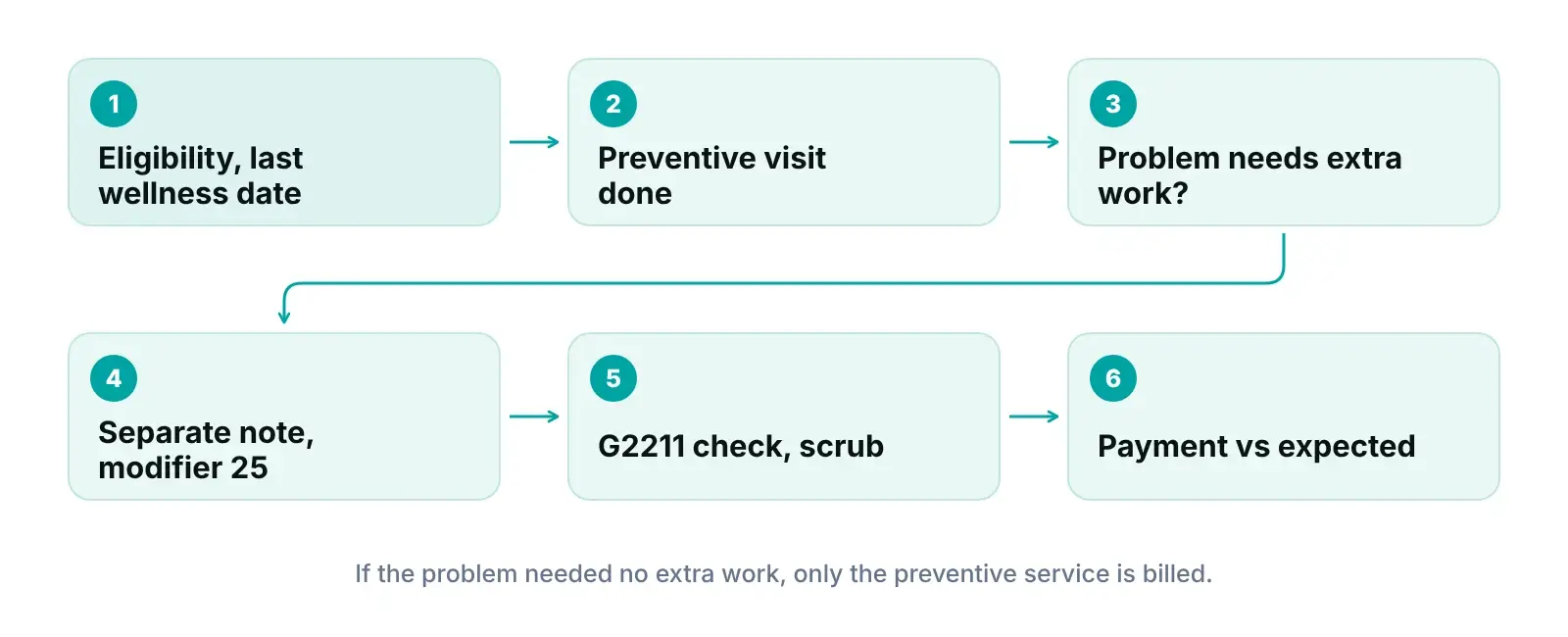
Family practice same-day preventive and problem visit flow from eligibility check to modifier 25, G2211 and payment review
How a same-day preventive and problem visit becomes one or two clean claim lines.

Vaccines: Part B, Part D or a pharmacy

CMS's Part D vaccines booklet (July 2026) puts flu, pneumococcal, COVID-19 and risk-based hepatitis B shots under Part B, and others, such as shingles, RSV and Tdap, under Part D. Part B administration codes come from chapter 18 of the claims manual and CMS's vaccine pricing page. For a Part D shot, an out-of-network prescriber can bill the plan by portal or standard claim and accept its payment in full, or the patient can use an in-network pharmacy. Chapter 18 also bars a routine office visit charge for a vaccine-only encounter. See our RSV vaccine coding guide.

Chronic, transitional and behavioral care management

Care management codes pay for work between visits; billing depends on consent, timing and avoiding overlaps.

Chronic and principal care management

CMS's CCM booklet (June 2025) requires two or more chronic conditions expected to last at least 12 months, documented verbal or written consent, and an initiating visit for new patients and those not seen within the past year. One practitioner bills per month. CCM can run during a TCM period, with RPM or RTM but not both. Our CCM coding guide goes deeper.

Advanced Primary Care Management

APCM, available since January 1, 2025, lets the practice responsible for a patient's primary care bill one monthly bundle in place of separate care management services, with no time threshold. Consent is collected once. An initiating visit is needed unless the practice saw the patient within 3 years or gave another care management service within a year.

Transitional care management

Under CMS MLN908628 (August 2025), the TCM period runs 30 days from discharge. Clinical staff must make interactive contact within 2 business days, and the visit, which can be by telehealth, must follow within 14 days (99495) or 7 days (99496). Only one practitioner can bill the period.
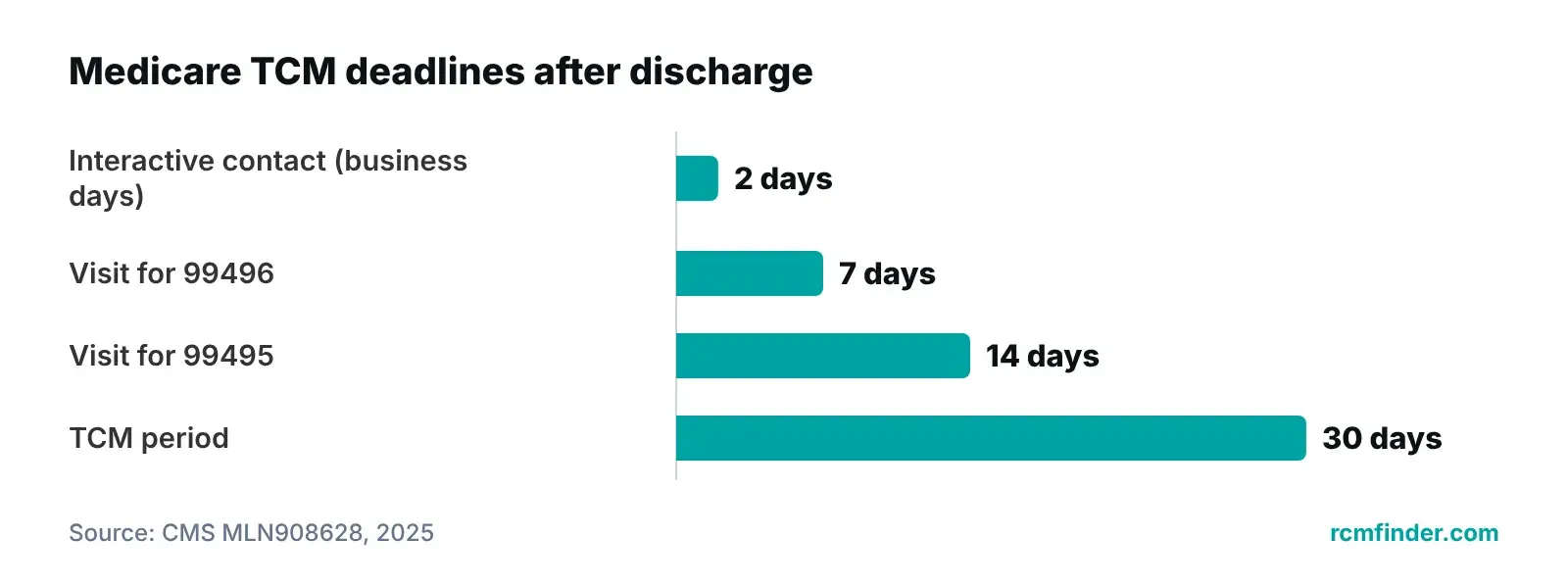
Bar chart of Medicare transitional care management deadlines after hospital discharge for family practices
Medicare TCM clock after discharge. Contact is counted in business days; the rest in calendar days.

Behavioral health integration

The CMS BHI booklet (January 2026) describes 99484 as at least 20 minutes of clinical staff time a month. In the Collaborative Care Model, 99492, 99493 and 99494 cover the first 70 minutes, the first 60 minutes and each extra 30 minutes of care manager time. An AWV, IPPE, comprehensive E/M or TCM visit can start the service, and since 2026, G0568–G0570 add it to APCM. See our behavioral and mental health RCM page.

What to check before the patient arrives

Several common family practice denials start before the visit: a wellness code that does not fit the patient's history, a vaccine sent to the wrong benefit, or missing consent.

Since January 1, 2026, the CMS-0057-F rule has required Medicare Advantage, Medicaid and CHIP plans to decide expedited requests within 72 hours and standard requests within seven calendar days; drugs are excluded. In the AMA's 2025 survey of 1,000 physicians, released in May 2026, physicians averaged 40 prior authorizations and 13 hours of physician and staff time a week.

Pre-visit checklist: what our VMAs check before a family practice visit
CheckRuleSourceWhat the VMA does
Medicare patient wants a physicalNot covered; IPPE in the first 12 months of Part B, then AWVsCMS (2026); Noridian (2026)Books the right wellness visit
Last wellness visitNo IPPE or AWV in the past 12 months; G0438 once per lifetime42 CFR 410.15; Noridian (2026)Confirms the last date, including other offices
Commercial preventive benefitCovered preventive care is free; a separate problem visit may not be45 CFR 147.130Checks the benefit; warns of a possible copay
Vaccines duePart B: flu, pneumococcal, COVID-19, hepatitis B. Part D: the restCMS MLN908764 (2026)Sorts each shot; confirms the Part D billing path
Care managementConsent documented; initiating visit when requiredCMS MLN909188 (2025); APCM page (2026)Confirms both are on file
Hospital dischargeContact within 2 business days; visit within 7 or 14 daysCMS MLN908628 (2025)Logs it, alerts clinical staff, books the visit
Prior authorizationMA, Medicaid, CHIP: 72 hours expedited, 7 days standard; drugs excludedCMS-0057-F (2024)Logs due dates; follows up; saves denial reasons
Telehealth visitFlexibilities through Dec 31, 2027; POS 10 at home, 02 elsewhereHHS (2026); CMS FAQ (2026)Records the patient's location

Sources: CMS wellness visit page (2026); Noridian (2026); 42 CFR 410.15; 45 CFR 147.130; CMS MLN908764 (2026), MLN909188 (2025), MLN908628 (2025); CMS APCM page (2026); CMS-0057-F fact sheet (2024); HHS telehealth page (2026); CMS Telehealth FAQ (2026). Always check the patient's current plan.

Medicare telehealth for primary care through 2027

HHS (February 2026) and CMS's telehealth FAQ (February 2026) say Medicare's broader telehealth flexibilities, including home visits without geographic limits and audio-only care, run through December 31, 2027. The FAQ adds that from January 1, 2028, patients generally must be in a medical facility in a rural area for telehealth other than behavioral health. See our telehealth billing guide and prior authorization guide.

See what denials and slow A/R cost you

Enter your visit volume and denial rate to estimate what your family practice is losing.

Open the Revenue Calculator

Growing a family practice without breaking privacy rules

Family practice growth depends on local search, reviews and easy booking, and the tracking behind it must follow HIPAA.

We build location pages, a Google Business Profile per office and pages for wellness, chronic care and sick visits. We ask real patients for reviews, never confirm a patient relationship in replies, and invite Medicare patients to a wellness visit, not a free physical.

HHS tracking guidance says tracking on portals, appointment pages and symptom checkers can collect protected health information, and a cookie banner is not a HIPAA authorization. A 2024 court order vacated part of that guidance; we still keep tracking off booking pages without a vendor BAA.

  • KPIs: new patients booked by source, missed calls returned and Medicare patients due for an AWV.

In-house team, billing-only vendor or four-pillar partner?

Stay in-house if you have experienced coders and front-desk time for wellness checks. Use a billing-only vendor if claims are your only gap. Choose a combined partner when problems start at the front desk.

Decision table: which billing model fits a family practice?
JobIn-house teamBilling-only vendorFour-pillar partner (RCM Finder)
Wellness-visit timing and benefitsFront desk, between callsVaries; ask what is includedVMA checks dates and benefits before booking
Same-day preventive and problem visitsEach provider's habitsAsk how it is checked before submissionModifier 25 and G2211 checked before submission
Monthly care managementDone when staff have timeAsk how time and consent are documentedConsent and discharges tracked; overlaps checked monthly
Vaccines (Part B or Part D)Split across staffDepends on the contractSorted before the visit
New-patient growth and reviewsA separate agency, or nobodyNot includedMarketing measured by booked new patients
Cost structureSalaries, benefits, turnoverVaries; ask how fees are setQuoted after a free practice audit

The audit shows if you need only one pillar. Our revenue cycle management services and virtual medical assistant services can be contracted separately.

How it works

We start with a free audit and change nothing until you see the findings. We build our billing pipeline around how claims actually move through a practice: registration, charge entry, submission, payment and follow-up. For family practice, we add the checks on this page.

  1. 1

    Free practice audit

    We review recent claims, denials and booking patterns, from wellness visits to vaccines.

  2. 2

    Business Associate Agreement and access

    We put a Business Associate Agreement in place before accessing patient data, then work inside your existing EHR (for example PrognoCIS, eClinicalWorks or athenahealth).

  3. 3

    Payer-rule map

    Your Medicare contractor's guidance and plans' preventive benefits become a pre-visit checklist and portal rules.

  4. 4

    Front desk and billing go live

    VMAs run pre-visit checks; claims are scrubbed, submitted and worked through denials and A/R.

  5. 5

    Weekly KPI review

    We review denials by reason, A/R days, wellness visits due, care management enrollment and new patients.

Talk to us about your family practice

Tell us your payer mix and where claims stall. We will tell you honestly whether we fit.

Call +1 (302) 556-2288

Compliance: what to ask any family practice billing company

Any billing vendor that handles your patients' data is a HIPAA business associate. Get a Business Associate Agreement before any access, and check how they limit and log it.

HHS guidance names billing, claims processing and practice management as business associate work; subcontractors need their own agreement. The minimum necessary standard limits data use to what each task needs. The Security Rule's technical safeguards require access control, audit controls, integrity, person or entity authentication and transmission security.

  1. Will you and your subcontractors sign a BAA before any access?
  2. Can we see the audit log for our claims?
  3. Who codes our claims, and what coding credential and primary care experience do they have?
  4. How do you decide when modifier 25 and G2211 apply?
  5. How do you stop monthly care management codes overlapping?
  6. Can we export our data if we leave?

We use role-based access, audit logging and encrypted (HTTPS) connections, and we put a Business Associate Agreement in place before accessing patient data. For your side, use our HIPAA compliance checklist for medical practices.

Who this is for, and who it is not for

We would rather tell you now than after you sign. Here is where we fit and where we do not.

A good fit if you are

  • Independent family medicine practices seeing all ages and payer types
  • Practices adding or cleaning up CCM, APCM, TCM or BHI
  • Offices where wellness, same-day visits and vaccines cause repeat denials
  • Groups that want new patients, front desk and billing measured together
  • Billing companies serving family practices that want a shared claims portal

Probably not a fit if you are

  • Hospital-employed physicians whose billing the health system controls
  • Practices that want billing without front-desk changes
  • Practices wanting promised collection rates; we report measured KPIs
  • Groups needing a credentialing module or in-portal real-time eligibility today (coming next)

Expert recommendations from our operations team

What we would do first if we were running your practice's revenue cycle tomorrow.

  1. 01

    Book wellness visits by date, not by habit

    We check the Part B start date and the last IPPE or AWV before any Medicare wellness booking.

  2. 02

    Split the note when a problem needs real work

    If a problem needs significant extra work at a preventive visit, we ask for a separate note and add modifier 25.

  3. 03

    Treat G2211 as a relationship code

    We confirm the practice is the patient's continuing focal point, then check the modifier 25 pairing. G2211 can pair with an AWV or vaccine administration, not a procedure.

  4. 04

    Choose one care management lane per month

    APCM or separate care management, general BHI or collaborative care, RPM or RTM. We keep consent and initiating-visit dates in one place.

  5. 05

    Sort vaccines by Medicare part before ordering stock

    Part B vaccines bill to your Medicare contractor; we confirm the Part D billing path before any Part D shot.

  6. 06

    Plan for 2027 and 2028 now

    Watch the CY 2027 final rule for the G2211 modifier proposal; plan for telehealth flexibilities ending December 31, 2027.

Frequently asked questions

What do family practice billing services include?

They usually cover coding support, claim scrubbing, submission, denial management and A/R follow-up for office visits, preventive and wellness visits, vaccines and care management. A good partner also handles same-day preventive and problem visits, Medicare wellness timing, G2211 and monthly care management rules. We add front-desk assistants, patient marketing and a claims portal, so one team owns the process from booking to payment.

Can we bill a preventive visit and a sick visit on the same day?

Yes, when the problem needed significant extra work beyond the preventive exam. Bill the problem-oriented visit with modifier 25 and document it so it stands on its own. A minor problem handled within the exam is not billed separately. Commercial plans may apply a copay or deductible to the separately billed visit, while the preventive service stays free. Medicare does not allow an IPPE and an AWV on the same day.

How often does Medicare pay for a wellness visit?

The Initial Preventive Physical Exam is a once-in-a-lifetime visit within the first 12 months of Part B. After that, Medicare pays for an Annual Wellness Visit when the patient has had no IPPE or AWV in the past 12 months. The first AWV uses G0438, once per lifetime, and later visits use G0439. Medicare does not cover a routine physical exam.

When can a family practice bill G2211?

G2211 is a Medicare add-on to office visits, and from 2026 to home or residence visits, when your practice is the patient's continuing focal point for care or gives ongoing care for a serious or complex condition. It is not payable when the visit carries modifier 25, unless the other service is an AWV, vaccine administration or allowed Part B preventive service. CMS has proposed turning it into a modifier for 2027.

Which vaccines go to Medicare Part B and which to Part D?

Part B covers flu, pneumococcal and COVID-19 vaccines, plus hepatitis B for people at intermediate or high risk, with no deductible or coinsurance. Part D covers other commercially available vaccines, such as shingles, RSV and Tdap. For a Part D vaccine, your office can bill the plan through a web-based portal or a standard claim as an out-of-network prescriber, or send the patient to an in-network pharmacy.

Can Medicare patients still have telehealth visits with our practice?

Yes, for now. HHS and CMS say Medicare's broader telehealth flexibilities run through December 31, 2027, including visits at home and audio-only care. From January 1, 2028, under current law, patients generally must be in a medical facility in a rural area for telehealth other than behavioral health. Report POS 10 for a patient at home and POS 02 elsewhere.

No cost, no commitment

Get your free practice audit

Tell us about your practice. A member of our operations team replies within one business day.

  • A review of your recent claims, denials and A/R aging
  • Where your front desk and prior authorizations slow payment
  • A prioritized fix list you keep, whether or not you hire us

Pricing is quoted after the audit, based on your volume and the services you choose. Prefer to talk? Call +1 (302) 556-2288.

Tell us about your practice

RCMFinder Master Intake Form
AA

About the author: Awais Afzal

Healthcare Operations & Data Analyst, RCM Finder

Awais has spent more than 16 years in healthcare digital marketing and clinical operations management. He builds data-driven revenue cycle blueprints for high-ticket medical practices and leads product development of the RCM Finder portal. More about our team.

How we write: every figure, code and rule on this page was checked against the primary source listed below and independently fact-checked before publishing. We re-review this page every six months. Last reviewed October 12, 2026; next review April 12, 2027.

Sources

  1. How to use modifier 25 — American Academy of Family Physicians (AAFP) (undated (© 2026; accessed 2026-10-10))
  2. Modifiers and add-on code G2211 (Practice Management Handbook) — Society of Teachers of Family Medicine (STFM) (undated (© 2026; accessed 2026-10-10))
  3. MLN Matters MM13473: How to Use the Office & Outpatient Evaluation and Management Visit Complexity Add-on Code G2211 — CMS (2025 (revised May 1, 2025; initial January 18, 2024))
  4. Medicare Preventive Services (MLN006559) — CMS Medicare Learning Network (2026 (July 2026))
  5. Medicare Wellness Visits — CMS Medicare Learning Network (2026 (last modified 04/08/2026))
  6. 42 CFR 410.15 Annual wellness visits providing Personalized Prevention Plan Services — eCFR (current (up to date as of 10/06/2026))
  7. 42 CFR 410.16 Initial preventive physical examination — eCFR (current (up to date as of 9/16/2026))
  8. Annual Wellness Visit (JF Part B) — Noridian Healthcare Solutions (Medicare contractor) (2026 (last updated Feb 6, 2026))
  9. Initial Preventive Physical Examination (JF Part B) — Noridian Healthcare Solutions (Medicare contractor) (2026 (last updated Feb 6, 2026))
  10. IPPE and AWV (JF Part B) — Noridian Healthcare Solutions (Medicare contractor) (2026 (last updated March 4, 2026))
  11. 45 CFR 147.130 Coverage of preventive health services — eCFR (current (up to date as of 10/07/2026))
  12. 45 CFR 147.140 Preservation of right to maintain existing coverage — eCFR (current (up to date as of 9/25/2026))
  13. Chronic Care Management Services (MLN909188) — CMS Medicare Learning Network (2025 (June 2025))
  14. Transitional Care Management Services (MLN908628) — CMS Medicare Learning Network (2025 (August 2025))
  15. Advanced Primary Care Management Services — CMS (2026 (last modified 01/26/2026))
  16. Behavioral Health Integration Services (MLN909432) — CMS Medicare Learning Network (2026 (January 2026))
  17. Calendar Year (CY) 2026 Medicare Physician Fee Schedule Final Rule (CMS-1832-F) fact sheet — CMS (2025 (October 31, 2025))
  18. Calendar Year (CY) 2027 Medicare Physician Fee Schedule Proposed Rule fact sheet — CMS (2026 (July 14, 2026))
  19. Telehealth policy changes after the COVID-19 public health emergency — HHS (telehealth.hhs.gov) (2026 (last updated February 5, 2026))
  20. Medicare Telehealth FAQ (updated 02/26/2026) — CMS (2026)
  21. Medicare Part D Vaccines (MLN908764) — CMS Medicare Learning Network (2026 (July 2026))
  22. Medicare Claims Processing Manual, Chapter 18: Preventive and Screening Services — CMS (2026 (Rev. 13709, issued 04-02-26))
  23. Vaccine Pricing — CMS (2026 (seasonal file updated 08/27/2026))
  24. CMS Interoperability and Prior Authorization Final Rule (CMS-0057-F) fact sheet — CMS (2024 (January 17, 2024))
  25. AMA survey: Prior authorization reform pledge falls short with physicians — American Medical Association (2026 (May 13, 2026))
  26. Business Associates — HHS Office for Civil Rights (2026 (content last reviewed July 30, 2026))
  27. Minimum Necessary Requirement — HHS Office for Civil Rights (undated (last modified March 18, 2026))
  28. 45 CFR 164.312 Technical safeguards — eCFR (current (up to date as of 10/07/2026))
  29. Use of Online Tracking Technologies by HIPAA Covered Entities and Business Associates — HHS Office for Civil Rights (2024 (reviewed June 26, 2024))
  30. CPT 99396 code summary — AAPC (secondary; used for plain-language code meaning only) (accessed 2026-10-10)
  31. CPT 99381 code summary — AAPC (secondary; used for plain-language code meaning only) (accessed 2026-10-10)
  32. CPT 99497 code summary — AAPC (secondary; used for plain-language code meaning only) (accessed 2026-10-10)