
Split professional and technical claims, prior authorization for imaging and cath, patient marketing and a claims portal for cardiology practices, built on CMS rules and your payers' own policies.
By Awais Afzal | Healthcare Operations & Data Analyst
Published October 12, 2026 · Last reviewed October 12, 2026 · Next review April 12, 2027
Quick answer
Cardiology billing services manage the claims a heart practice creates: split professional and technical billing (modifiers 26 and TC), prior authorization for echo, nuclear and cath studies, device and remote monitoring cycles, and denial appeals. RCM Finder pairs that billing work with front-desk assistants, patient marketing and a claims portal, starting with a free practice audit.
On this page
In cardiology, one test often turns into two claims. The physician's reading is billed with modifier 26 and the equipment and staff side with modifier TC. The place of service decides who can bill each part.
CMS MLN Matters SE0587 defines the professional component as the physician's interpretation. The technical component is the practice expense: clinical staff, supplies and equipment. A global claim covers both. Noridian, a Medicare contractor, says not to split a service you performed in full, and not to use modifier 26 on E/M codes. For a catheterization in a hospital, Medicare pays the physician only for the professional component, according to Wellpoint billing article A52850. CMS's claims processing manual applies the same limit to radiology for hospital patients.
In its CY 2026 Physician Fee Schedule final rule fact sheet (October 31, 2025), CMS set the conversion factor at $33.40 for clinicians who are not qualifying APM participants, up from $32.35. Qualifying APM participants get $33.57. Part of the increase is a one-year 2.50% raise set by statute. The rule also applies a -2.5% efficiency adjustment to work RVUs for services that are not time-based. Time-based codes such as E/M and care management are exempt. It also permanently allows direct supervision by real-time audio and video for diagnostic tests and cardiac rehabilitation.
For 2027, CMS's proposed rule fact sheet (July 14, 2026) projects $32.84 for clinicians who are not qualifying APM participants and proposes an initiating visit before remote monitoring. These are proposals; check the final rule before budgeting.
A cardiology practice needs referrals coming in, tests approved before they happen, split claims billed correctly and software that shows every claim. Each pillar handles one.
Revenue leaks at the handoffs: a stress echo booked before approval, a missed 90-day device-check window, a hospital reading sent without modifier 26. We run all four pillars against one set of payer rules.
Our healthcare digital marketing builds demand from two sides: local patients searching for heart care, and the primary care offices that refer to you. That means local SEO, Google Ads and reputation work, with website tracking set up to follow HHS guidance.
Our virtual medical assistants for cardiology run your front desk on your practice's time zone. They verify eligibility and start prior authorizations for echo, stress, nuclear and cath studies. They also collect outside results before repeat tests and keep monitoring calendars current.
Our end-to-end cardiology revenue cycle management covers coding support, claim scrubbing, denial management and A/R follow-up. Cardiology claims get extra checks: 26, TC or global billing by site, the ordering provider's NPI and diagnosis pairing.
Our practice management system tracks every claim by stage. It applies specialty-aware billing logic to each claim, checks that data is complete before submission and flags payments below the expected amount.
Find where your cardiology claims leak
We review your recent claims, denials and authorization logs, then show where split billing, missing orders or frequency rules cost you.
Each cardiology service family has its own split-billing, frequency or documentation rule, and the table shows where claims often break. Codes are described in our own words (the AMA owns CPT descriptors), so check the current code set and your contractor's article before billing.
| Service family | Code examples (our wording) | Billing nuance | Typical denial trigger |
|---|---|---|---|
| 12-lead ECG | 93000 (tracing and reading); 93005 (tracing only); 93010 (reading only) | Global or split depends on who owns the machine and who reads. Medicare generally pays one reading per ECG. | Screening ECG; routine ECG on the day of a pre-scheduled stress test |
| Transthoracic echo | 93306 (complete); 93308 (limited or follow-up) | Formal report kept with the images; ordering NPI on the claim | Repeat study without a documented change in clinical status |
| Stress test and stress echo | 93015 (stress test, all parts); 93350, 93351 (stress echo) | Document why stress echo was chosen, the supervision, and a reading for every part | Yearly test without an individual reason; incomplete referral order |
| Nuclear perfusion imaging | 78451 to 78454, e.g. 78452 (multiple SPECT studies) | Record must show the LCD coverage criteria were met | Pre-op stress study for a moderate-risk patient without symptoms when no listed at-risk condition is documented |
| Cardiac catheterization | 93451 (right heart); 93458 (left heart with coronary imaging) | Hospital setting: professional component only. Injections and report are included. | Included parts billed separately; no report or stored images |
| Implanted device remote checks | 93294 (pacemaker); 93295 (defibrillator); 93296 (technical support), each up to 90 days | Physician review and technical support use separate codes; reader signs own report | Defibrillator remote check billed more than once per 90 calendar days (CGS) |
| Remote physiologic monitoring | 99453 (setup); 99445 (2–15 data days); 99454 (16–30); 99457, 99470 (management time) | Established patient, consent and an FDA-defined device; one data-day code per period | Two practitioners billing one patient in 30 days; RPM billed with RTM |
| Cardiac rehabilitation | 93797, 93798 (standard); G0422, G0423 (intensive) | Covered diagnoses only; 36 sessions (72 intensive); plan signed every 30 days | Extra sessions without KX modifier and support; unsigned plan |
Sources: CMS MLN Matters SE0587; Noridian; Medicare Coverage Database articles A57326, A56781, A57183, A56476, A52850, A57038 (versions checked October 2026); CMS MLN901705 (2025); 42 CFR 410.49; First Coast; AAPC code summaries. Rules vary by contractor and payer.
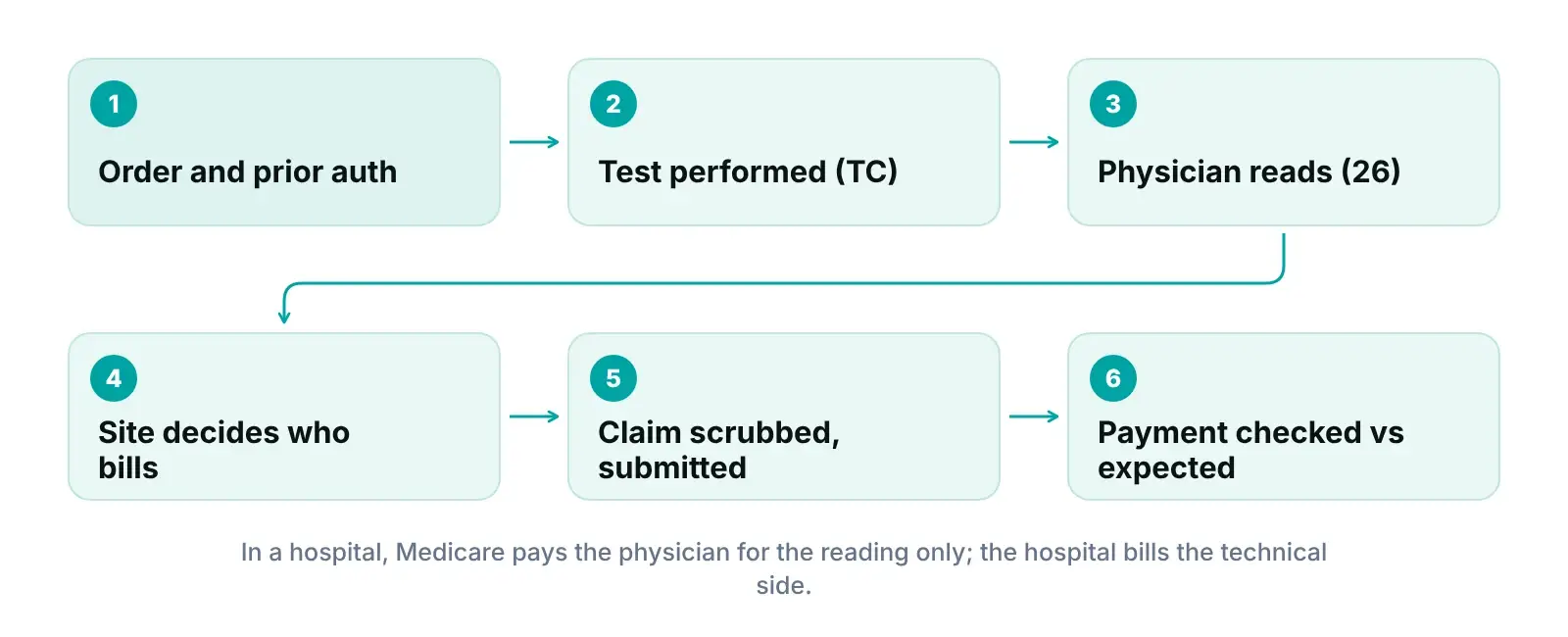
We map each test to where it happens and who owns the equipment. An office echo on your own machine is usually global. A hospital reading is professional-only. A test on your equipment read by another group is technical-only. A wrong map means denied or underpaid claims.
CGS article A57038 allows remote defibrillator checks no more than once every 90 calendar days. For remote physiologic monitoring, the CMS remote monitoring booklet (December 2025) requires 2 to 15, or 16 or more, data days out of 30, depending on the code. Only one practitioner can bill per patient in a 30-day period. Noridian notes that the new 2026 code 99470 covers the first 10 minutes of monthly management. Under 42 CFR 410.49, a physician must sign the cardiac rehab plan every 30 days. For virtual visits, see our telehealth billing guide.
For diagnostic tests, Wellpoint article A56781 says to report the result if it is known, and otherwise the symptoms that prompted the test. See our guides to chest pain ICD-10 codes, NSTEMI type 1 vs type 2 and hyperlipidemia ICD-10 coding. Medicare Recovery Auditors have approved review topics for transthoracic echo and cardiac rehab. For supervised NP and PA visits, see our incident-to billing guide.
Get prior authorization before the test goes on the schedule, not after a denial. In cardiology that usually means echo, stress, nuclear and cath studies, with rules that differ by plan.
Since January 1, 2026, the CMS-0057-F final rule has required Medicare Advantage, Medicaid and CHIP plans to decide expedited requests within 72 hours and standard requests within seven calendar days. They must also give a specific reason for any denial. Exchange plans are excluded from these timeframes, and drug prior authorizations are excluded from the rule.
Plans publish their own lists. UnitedHealthcare, for example, lists stress echo, diagnostic cath and electrophysiology implants. Some plans send cardiac imaging to a benefit manager, and in one Johns Hopkins HealthCare FAQ the ordering physician must get approval first.
Original Medicare claims should not carry AUC consultation information. CMS paused the Appropriate Use Criteria program and rescinded its regulations (42 CFR 414.94) effective January 1, 2024, and has not set a restart date.
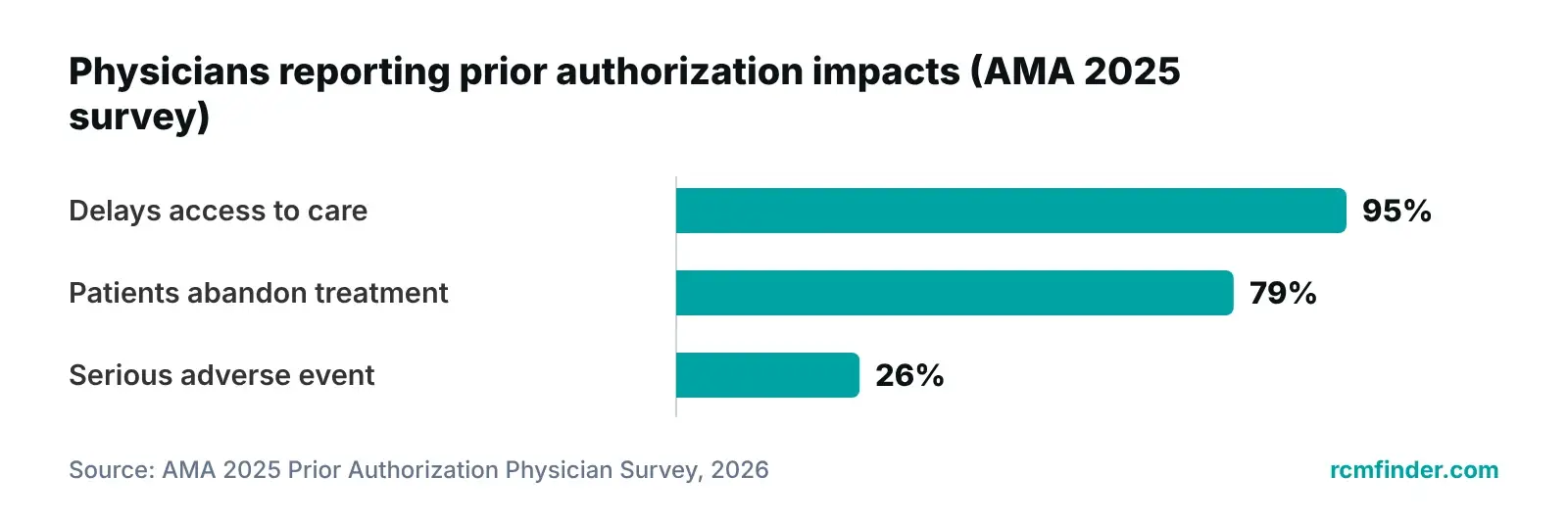
The workload is heavy. In the AMA’s 2025 survey of 1,000 physicians, released in May 2026, physicians reported an average of 40 prior authorizations per physician each week, taking 13 hours of physician and staff time.
| Rule | Source | What the VMA checks before scheduling |
|---|---|---|
| MA, Medicaid and CHIP plans decide in 72 hours (expedited) or 7 days (standard) and give a specific denial reason | CMS-0057-F; in effect Jan 1, 2026 | Request date and due date logged; follow-up on the due date; denial reason saved for appeal |
| Plan lists name stress echo, diagnostic cath and EP implants | UnitedHealthcare cardiology page (2026) | Ordered code checked against the member's plan list; approval matched to the order |
| Some plans route cardiac imaging to a benefit manager; the ordering physician requests approval | Johns Hopkins HealthCare FAQ | Who submits, the rendering site's details, and whether the approval covers that site |
| No AUC consultation on Original Medicare claims | CMS AUC program page | No AUC data added; time goes to plan approvals instead |
| Yearly stress testing needs an individual reason; complete referral order | Noridian A57183 (2026) | Last stress test date; order with date, physician and reason |
| Repeat echo needs a change in clinical status | Wellpoint A56781 (2026) | Last echo date and outside reports; repeat flagged for provider review |
| RPM: established patient, consent, one billing practitioner per 30 days | CMS MLN901705 (2025) | Consent on file; patient asked if another office already monitors them |
Sources: CMS-0057-F fact sheet (2024); UnitedHealthcare (2026); Johns Hopkins HealthCare FAQ (© 2019); CMS AUC page; Medicare Coverage Database A57183, A56781 (2026); CMS MLN901705 (2025). Always check the member's current plan.
For the full workflow, read our prior authorization guide for providers.
See what delays and denials cost you
Enter your claim volume and denial rate to estimate what your cardiology practice is losing.
Cardiology growth depends on referring physicians and local search, not only ads, and your tracking must respect HIPAA.
We build location pages, patient pages for the conditions you treat and a simple referral path for primary care offices. We ask real patients for reviews and write responses that never confirm someone is a patient.
HHS guidance on online tracking says tracking tools on login or appointment pages can collect protected health information. A vendor that handles that information needs a Business Associate Agreement, and a cookie banner is not a HIPAA authorization. A 2024 court order vacated part of that guidance. Even so, we keep tracking off appointment and referral forms unless the vendor signs a BAA.
Stay in-house if you have experienced cardiology coders and front-desk time for authorizations. Use a billing-only vendor if claims are your only gap. Choose a combined partner when problems span several teams.
| Job | In-house team | Billing-only vendor | Four-pillar partner (RCM Finder) |
|---|---|---|---|
| Imaging and cath prior authorization | Front desk, between calls | Usually left to the practice | VMA starts each request and tracks it to a decision |
| 26, TC or global by site | Depends on one coder | Fixed on the claim, after the fact | Mapped by site, checked before submission |
| Device, RPM and rehab cycles | Spreadsheets or EHR reminders | Billed when the practice sends data | VMA keeps the calendar; RCM bills on eligible dates |
| Referral growth and reviews | A separate agency, or nobody | Not included | Marketing pillar tied to booked consults |
| Reporting | EHR reports | Claim reports only | Portal and dashboards, referral to paid claim |
| Cost structure | Salaries, benefits, turnover | Varies; ask how fees are set | Quoted after a free practice audit |
Whichever model you choose, track denials by reason. Our denial management guide shows how.
We start with a free audit and change nothing until you see the findings. We build our billing pipeline around how claims actually move through a practice: registration, charge entry, submission, payment and follow-up. For cardiology, we add the checks on this page.
We review recent claims, denials and authorization logs, and map each test to its site and billing model.
We put a Business Associate Agreement in place before accessing patient data. Then we work inside your existing EHR (for example PrognoCIS, eClinicalWorks or athenahealth).
Your plans' authorization lists and your Medicare contractor's articles become a pre-test checklist and portal workflow rules.
VMAs start authorizations and keep monitoring calendars. Claims are scrubbed, submitted and worked through denials and A/R.
Each week we review denials by reason, A/R days, tests cleared in advance and referrals. Add Own Practice Management System for more depth.
Talk to us about your cardiology practice
Tell us your sites, test mix and hardest payer. We will tell you honestly whether we fit.
Any billing vendor that handles your patients' data is a HIPAA business associate. Get a Business Associate Agreement before they have any access, and check how they limit and log that access.
HHS guidance names billing and claims processing as business associate work; subcontractors need their own agreement. The minimum necessary standard limits use to what each task needs. The Security Rule's technical safeguards require access control, audit controls, integrity controls, person or entity authentication and transmission security.
We use role-based access, audit logging and encrypted (HTTPS) connections, and we put a Business Associate Agreement in place before accessing patient data. For your own side, use our HIPAA compliance checklist for medical practices.
We would rather tell you now than after you sign. Here is where we fit and where we do not.
A good fit if you are
Probably not a fit if you are
What we would do first if we were running your practice's revenue cycle tomorrow.
Before we fix a single denial, we list each test, where it happens, who owns the equipment and who reads it. That map decides global, 26 or TC, and it removes most split-billing errors.
We treat an unapproved echo, stress test or cath as unscheduled. For plans covered by CMS-0057-F, we log the decision due date and follow up that day.
Device checks, RPM periods and rehab plan signatures each run on their own clock. One calendar per patient keeps them from being billed early, twice or not at all.
We gather outside reports and the last test date first, so the provider can document the clinical change or skip the test.
When a result is known, the diagnosis should reflect it. We review diagnosis pairing on every diagnostic claim.
Check 2026 payments against the new conversion factor and efficiency adjustment, watch for the 2027 final rule, and confirm whether the Ambulatory Specialty Model applies to you.
Cardiology billing services usually cover coding support, claim scrubbing, submission, denial management and A/R follow-up for cardiology tests and visits. A good partner also handles split professional and technical billing, prior authorization for imaging and cath, and monitoring cycles for implanted devices and remote physiologic monitoring. We add front-desk assistants, patient marketing and a claims portal, so one team owns the process from referral to payment.
Bill globally when your practice performs the whole test on its own equipment and your physician reads it. Use modifier 26 when your physician only reads a test, such as a hospital study. Use TC when you provide the equipment and staff but someone else reads it. For hospital patients, Medicare generally pays the physician only for the professional component. Check each code's rules in the fee schedule first.
Yes. Since January 1, 2026, the CMS-0057-F rule requires Medicare Advantage organizations, Medicaid and CHIP fee-for-service programs and Medicaid and CHIP managed care plans to decide expedited requests within 72 hours and standard requests within seven calendar days. They must also give a specific reason for a denial. Exchange plans are excluded from these timeframes, and drug prior authorizations are excluded from the rule.
Not for Original Medicare right now. CMS paused the Appropriate Use Criteria program and rescinded its regulations effective January 1, 2024. It says claims should not include AUC consultation information and has not set a restart date. Commercial and Medicare Advantage plans can still require their own prior authorization for cardiac imaging, sometimes through a benefit manager, so check each plan.
For implantable defibrillators, one Medicare contractor's article (CGS) allows remote interrogation no more than once every 90 calendar days, and the codes for pacemaker and defibrillator remote checks each cover up to 90 days. For remote physiologic monitoring, CMS says only one practitioner can bill per patient in a 30-day period. Data must cover 2 to 15 days or 16 or more days, depending on the code. The patient must be established and must consent.
It can be, if the vendor is treated as a business associate. HIPAA requires a Business Associate Agreement before the vendor receives patient data, and that agreement must require the vendor to safeguard the data. The Security Rule's technical safeguards include access control and audit controls. We put a Business Associate Agreement in place before accessing patient data, and we use role-based access, audit logging and encrypted (HTTPS) connections.
Tell us about your practice. A member of our operations team replies within one business day.
Pricing is quoted after the audit, based on your volume and the services you choose. Prefer to talk? Call +1 (302) 556-2288.
Tell us about your practice
About the author: Awais Afzal
Healthcare Operations & Data Analyst, RCM Finder
Awais has spent more than 16 years in healthcare digital marketing and clinical operations management. He builds data-driven revenue cycle blueprints for high-ticket medical practices and leads product development of the RCM Finder portal. More about our team.
How we write: every figure, code and rule on this page was checked against the primary source listed below and independently fact-checked before publishing. We re-review this page every six months. Last reviewed October 12, 2026; next review April 12, 2027.
We use cookies to understand how our site is used and to measure our advertising. You can accept or reject non-essential cookies. See our Privacy Policy.