
Neurosurgery Specialty

Neurosurgery Billing Services, Prior Auth and Growth in One Plan

Global-period coding, co-surgeon and assistant claims, spine prior authorization, referral marketing and a claims portal for neurosurgery practices, built on CMS rules and your payers' own policies.
  • Works inside your current EHR
  • US practice time zone, every shift
  • Weekly KPI reporting, or on your schedule
Neurosurgery billing dashboard with denials by reason, prior auths pending, global period visits, A/R days and referrals

Quick answer

Neurosurgery billing services code and collect for spine and cranial surgery: 90-day global periods, co-surgeon and assistant claims, multi-level add-on codes, neuromonitoring, and prior authorization from Medicare programs and commercial benefit managers. RCM Finder pairs that billing with front-desk assistants, referral marketing and a claims portal, starting with a free practice audit.

Disclaimer: This page is educational and is not legal, coding or compliance advice. Medicare programs, LCDs, NCCI edits, fee schedule rules and commercial payer policies change often and vary by contractor, state and plan. Verify every code, indicator, limit and rule against your Medicare contractor's current documents, the current Physician Fee Schedule, your payer contracts and the current CPT and HCPCS code sets before billing.

Why neurosurgery billing is different

Neurosurgery billing is different because each case is a package. One spine or cranial surgery can bring a 92-day global period, a second surgeon or an assistant, several add-on codes and prior authorization from more than one program.

CMS's Global Surgery Booklet (December 2025) sets the major-surgery global period at the day before, the day of and 90 days after surgery. The fee covers pre-op visits after the decision to operate, the operation, routine post-op care and complications that do not need a return to the operating room. The decision visit, unrelated visits, diagnostic tests and a return to the OR are billed separately, with the right modifier where one applies.

Spine patients often move between pain management, neurology and surgery, and the same coverage rules follow them. We build our billing pipeline around how claims actually move through a practice: registration, charge entry, submission, payment and follow-up. For neurosurgery, we add the global-period, multi-surgeon and add-on checks on this page. See also our pain management billing services.

2026 changes and 2027 proposals

CMS's CY 2026 fee schedule final rule (October 31, 2025) set a $33.40 conversion factor for clinicians who are not qualifying APM participants and a -2.5% efficiency adjustment to work RVUs of non-time-based services; E/M and other time-based codes are exempt. The CY 2027 proposed rule (July 14, 2026) would pay a same-day office or outpatient E/M and a 0-, 10- or 90-day global procedure by the same physician or practice at 100% for the most expensive service and 50% for the others. Check the final rule before budgeting.

The four pillars, built for a neurosurgery practice

A neurosurgery practice needs steady referrals, a front desk that clears each case before it reaches the OR schedule, billing that codes the whole surgical package, and software that shows every claim. Revenue leaks at the handoffs, so we run all four pillars against one set of payer rules.

Pillar 1 · Healthcare Marketing

Healthcare Marketing for neurosurgery practices

Our healthcare digital marketing builds two referral paths: physicians who send spine and cranial cases, and patients who search after a diagnosis. We use local SEO, Google Ads and reputation work.

  • Referring-physician pages and a referral path
  • Condition pages on when surgery is considered
  • Tracking off appointment forms without a BAA
  • KPI: referrals and booked consults by source
Explore Healthcare Marketing
Pillar 2 · Virtual Medical Assistants

Virtual Medical Assistants for neurosurgery front desks

Our virtual medical assistants run your front desk on your practice's time zone. They verify eligibility, collect imaging and conservative care history, and start prior authorizations with the right program or benefit manager.

  • Site of service and patient state checked first
  • Approvals matched to the OR date
  • Outside imaging gathered before the consult
  • KPI: cases cleared before surgery
Explore Virtual Medical Assistants
Pillar 3 · End-to-End RCM

End-to-End RCM for neurosurgery claims

Our end-to-end neurosurgery revenue cycle management covers coding support, claim scrubbing, denial management and A/R follow-up, with added checks for global-period modifiers, add-on pairing, and co-surgeon and assistant rules.

  • Modifiers 24, 25, 57, 58, 78 and 79 checked
  • Add-ons paired with the right primary
  • Appeals built from operative notes
  • KPI: denials by reason and A/R days
Explore End-to-End RCM
Pillar 4 · Practice Management System

Practice Management System for neurosurgery billing

Our practice management system tracks every claim by stage, applies specialty-aware billing logic to each claim, checks data completeness before submission and flags payments below the expected amount.

  • Rules that flag, hold or assign a claim
  • Role-based permissions and an audit log
  • Client portal for practices and billing companies
  • Early access: calendar-view appointment booking
Explore Practice Management System

See where your surgical claims stall

We review recent surgical claims, global-period denials and authorization logs, then show what to fix first. Pricing is quoted after the audit.

Get a Free Practice Audit

Neurosurgery procedures, codes and denial triggers

Most neurosurgery denials trace to a few rules: a missing authorization, an add-on without its primary, decompression billed with a fusion at the same level, a second surgeon on a code that does not allow one, or monitoring billed by the surgeon. Codes are examples in our own words (the AMA owns CPT descriptors); check the current code set and the 2026 NCCI Policy Manual.

Neurosurgery procedure families: code examples, billing rules and frequent denial triggers
Procedure familyCode examples (our wording)Billing rule to knowFrequent denial trigger
Anterior cervical fusion22551 (fusion with disc removal, first interspace below C2); add-on 22552; 22554 (fusion outside the OPD list)Hospital OPD cases with 22551 or 22552 need a Medicare affirmation; 22554 is in WISeRNo affirmation: hospital, surgeon and anesthesia claims denied
Lumbar fusion22630, 22633 (first interspace, by technique); add-ons 22632, 22634One primary, then an add-on per added interspace63042 or 63047 with 22630 or 22633 at the same interspace
Lumbar decompression63030 + add-on 63035 (laminotomy); 63047 + add-on 63048 (laminectomy)Each add-on only with its own primaryAdd-on sent alone; laminotomy and laminectomy on one vertebra
Instrumentation and bone graft22840 to 22847 (instrumentation); 22853, 22854 (interbody devices); 20931, 20937, 20938 (graft)One instrumentation code per skin incision; built-in device anchoring not billedGraft codes billed per level, not once per procedure
Spinal cord stimulator63650 (percutaneous electrodes); 63685 (generator insertion or replacement); 63688 (revision or removal)63650 in a hospital OPD needs prior authorizationReplacement billed when the same generator was reinserted
Cranial surgery61304, 61305 (exploration); 61781 to 61783 (navigation add-ons); 69990 (microscope)Flap replacement and dural repair are includedBurr hole at the same site; 69990 outside listed ranges
Neuromonitoring95940 (in the OR, per 15 minutes); G0453 (Medicare remote, one patient, per 15 minutes)Billed only by a provider other than the surgeonSurgeon bills it; 95941 sent to a payer that takes only G0453
Two surgeons or an assistant62 (co-surgeons); 80, 81, 82 (assisting physician); AS (PA, NP, CNS)Co-surgeon indicator 1 or 2; both bill the same code with 6262 on one claim only; assistant on a code with indicator 1

Sources: CMS OPD prior authorization code list and FAQ (2024); CMS WISeR Operational Guide v7.0 (2026); CMS NCCI Policy Manual 2026, Chapters IV and VIII; CMS remote IONM FAQ (2020); Highmark RP-077 (2026); Noridian (2025); First Coast (2024); AAPC code summaries. Rules vary by MAC and payer.

For diagnosis coding, see our guides to ICD-10 codes for back pain and neck pain ICD-10 coding.

Add-on codes and levels

The NCCI musculoskeletal chapter says to report one primary code for contiguous levels and an add-on for each added level. A second primary code may be reported for a noncontiguous region reached through a separate incision. Graft codes 20931, 20937 and 20938 take one unit per operative procedure. CMS's add-on code edits page says add-ons are rarely payable alone and generally carry the ZZZ global, tied to the primary code.

Co-surgeons, assistants and fee schedule indicators

Each code's fee schedule indicators decide who can be paid. Per First Coast, a Medicare contractor, co-surgeon indicator 0 means not permitted, 1 means permitted with documentation and 2 means permitted. Assistant indicator 1 means no payment and 2 means payment is allowed. Noridian pays co-surgeons 62.5% each when both bill the same code with 62, physicians who assist 16%, and PAs, NPs or clinical nurse specialists billing with AS 85% of that. CMS's claims processing manual bars assistant payment where physicians assist in fewer than 5% of cases nationally.
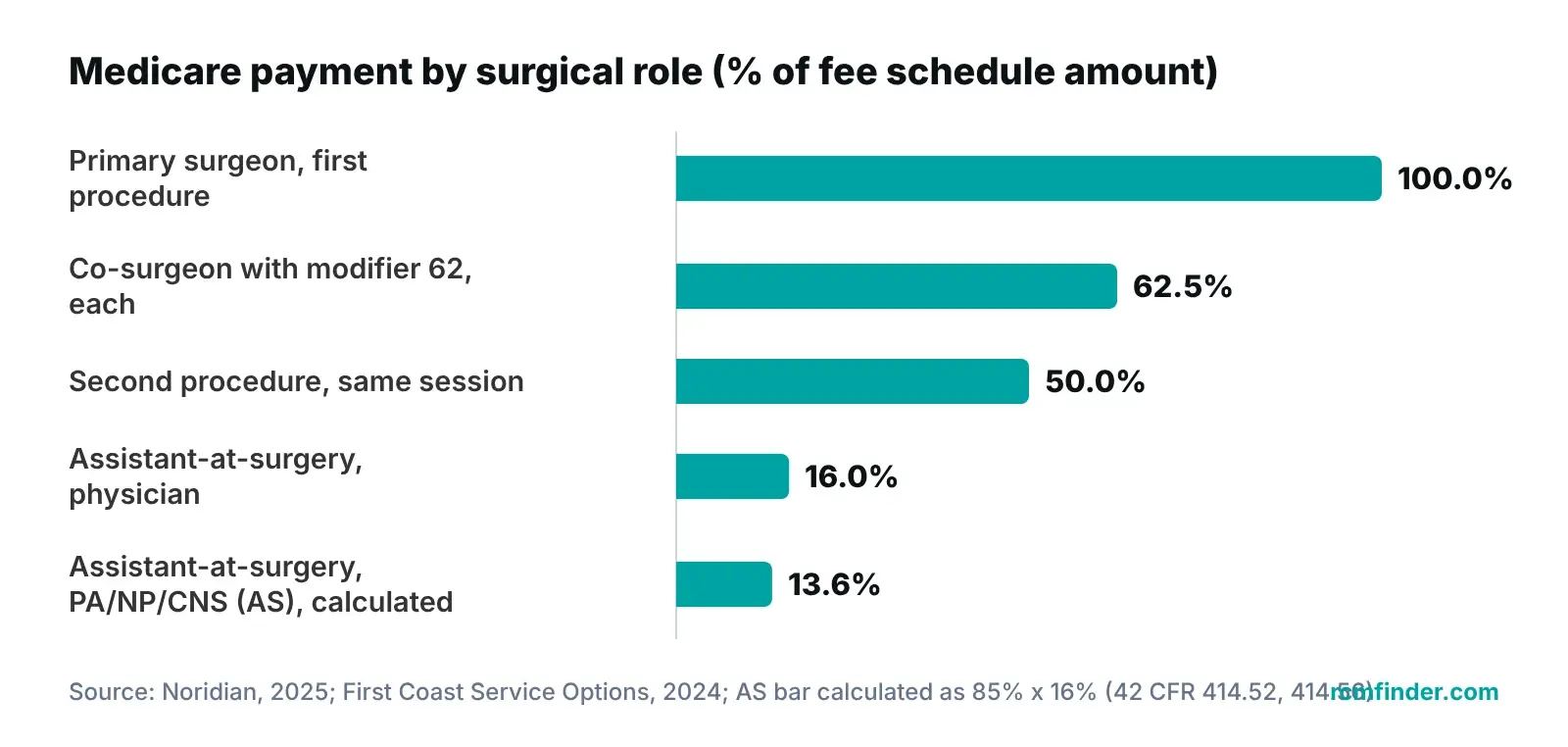
Bar chart of Medicare payment by surgical role: primary surgeon, co-surgeon, second procedure, assistant and AS assistant
Medicare payment as a share of the fee schedule amount, by surgical role. The AS bar is our calculation: Noridian and 42 CFR 414.52 and 414.56 set AS payment at 85% of the 16% physician assistant-at-surgery amount, which equals 13.6%.

Neuromonitoring belongs to a separate provider

The NCCI nervous system chapter treats 95940, 95941 and G0453 as part of the surgeon's global package, so only a different provider who monitors may bill them. For Medicare, CMS's remote monitoring FAQ (2020) describes G0453 as one patient at a time, in 15-minute units, up to four an hour. Highmark policy RP-077 (2026) does not pay 95941 and asks for G0453.

The 90-day global period and its modifiers

A neurosurgery global package covers the day before surgery, the surgery and 90 days of routine follow-up. Anything outside routine care needs the right modifier and a note that supports it. CMS's Global Surgery Booklet lists them:

  • 57: the visit that led to the decision for major surgery.
  • 25: a significant, separate E/M on the day of a procedure.
  • 24: an unrelated E/M during the post-op period.
  • 58 or 79: a staged or related procedure (58) or an unrelated one (79); each starts a new global period.
  • 78: an unplanned return to the operating room for a related procedure.
  • 54 and 55: surgical care only, or post-op care only, when care is split.

Since January 1, 2025, CMS has applied modifier 54 to every 90-day package when the surgeon expects to furnish only the surgery, even with an informal transfer of care. The CY 2025 final rule also created add-on G0559 for post-op visits by a practitioner who did not operate. See our guides to modifier 79, modifiers 25 vs 59 and co-managed post-op care.

Prior authorization for spine and cranial cases

Check the site of service and the patient's state before the code. For Original Medicare, hospital outpatient cervical fusion and spinal neurostimulator electrodes need prior authorization, and six states add more under WISeR. Commercial and Medicare Advantage plans keep their own lists, often run by a benefit manager.

Under CMS's hospital outpatient prior authorization program, cervical fusion with disc removal (22551, 22552) and implanted spinal neurostimulators have needed approval since July 1, 2021; the code list now shows 63650 for that group. The OPD FAQ (November 2024) says unaffirmed claims are denied, along with related physician and anesthesia claims. Physicians may submit for the hospital, an affirmation lasts 120 days, and ASCs and offices are outside the program.

CMS's WISeR model (2026 to 2031) covers Original Medicare in Arizona, New Jersey, Ohio, Oklahoma, Texas and Washington. Its operational guide (version 7.0, July 2026) includes cervical fusion 22554, permanent spinal cord stimulators, initial vagus nerve stimulator implants, trigeminal nerve lesioning and vertebral augmentation; deep brain stimulation is delayed. In hospitals and ASCs, WISeR reviews the facility claim, not the surgeon's.

Every MAC has a cervical fusion LCD, as UnitedHealthcare’s Medicare Advantage spine policy lists. For radiculopathy, CGS L39741 and Novitas L39793 require arm pain of 4 or more for at least 12 weeks despite conservative care, with matching imaging; other MACs may differ. Commercial plans often delegate review: in an April 2024 FAQ, HMSA's benefit manager, Evolent, reviewed non-emergent spine surgery in hospitals and ASCs.

Under CMS-0057-F, Medicare Advantage, Medicaid and CHIP plans must decide standard requests within 7 calendar days and expedited ones within 72 hours. In the AMA’s 2025 survey (released May 2026), physicians averaged 40 prior authorizations and 13 hours of physician and staff time a week. See our prior authorization guide and ASC vs HOPD billing guide.

Pre-surgery checklist: payer rules our VMAs check before a neurosurgery case is scheduled
Payer ruleSourceWhat the VMA checks
OPD cervical fusion (22551, 22552) and spinal neurostimulator electrodes (63650) need a provisional affirmationCMS OPD program, since July 1, 2021Site of service; affirmation and UTN logged; surgery inside the 120-day window
OPD decisions: 7 calendar days standard, 2 business days expeditedCMS OPD FAQ (2024)Request and due dates logged
WISeR states: cervical fusion 22554, permanent spinal cord stimulators, initial vagus nerve stimulator implants, trigeminal lesioningCMS WISeR guide v7.0 (2026)Patient's state; request sent or pre-payment review chosen; UTN on the claim
Cervical radiculopathy fusion: arm pain 4+ for 12+ weeks, failed conservative care, matching imagingCGS L39741; Novitas L39793; Noridian request checklistExam, pain history, daily-living limits, imaging and dated conservative care
Benefit managers review spine surgery in hospitals and ASCs; approval windows vary (90 days in one FAQ, 30 days for outpatient cases in another)Evolent FAQs for HMSA (2024) and BlueChoice (undated), examplesPlan's delegate; most complex procedure as primary; window vs OR date
MA, Medicaid and CHIP: 72 hours expedited, 7 days standard, specific denial reasonCMS-0057-F, from January 1, 2026Due date tracked; denial reason saved for appeal

Sources: CMS OPD program page, code list and FAQ (2024); CMS WISeR Operational Guide v7.0 (2026); CMS Medicare Coverage Database (CGS L39741, Novitas L39793); Noridian (2025); Evolent FAQs for HMSA (2024) and BlueChoice (undated); CMS-0057-F fact sheet (2024). Always check the member's current plan.
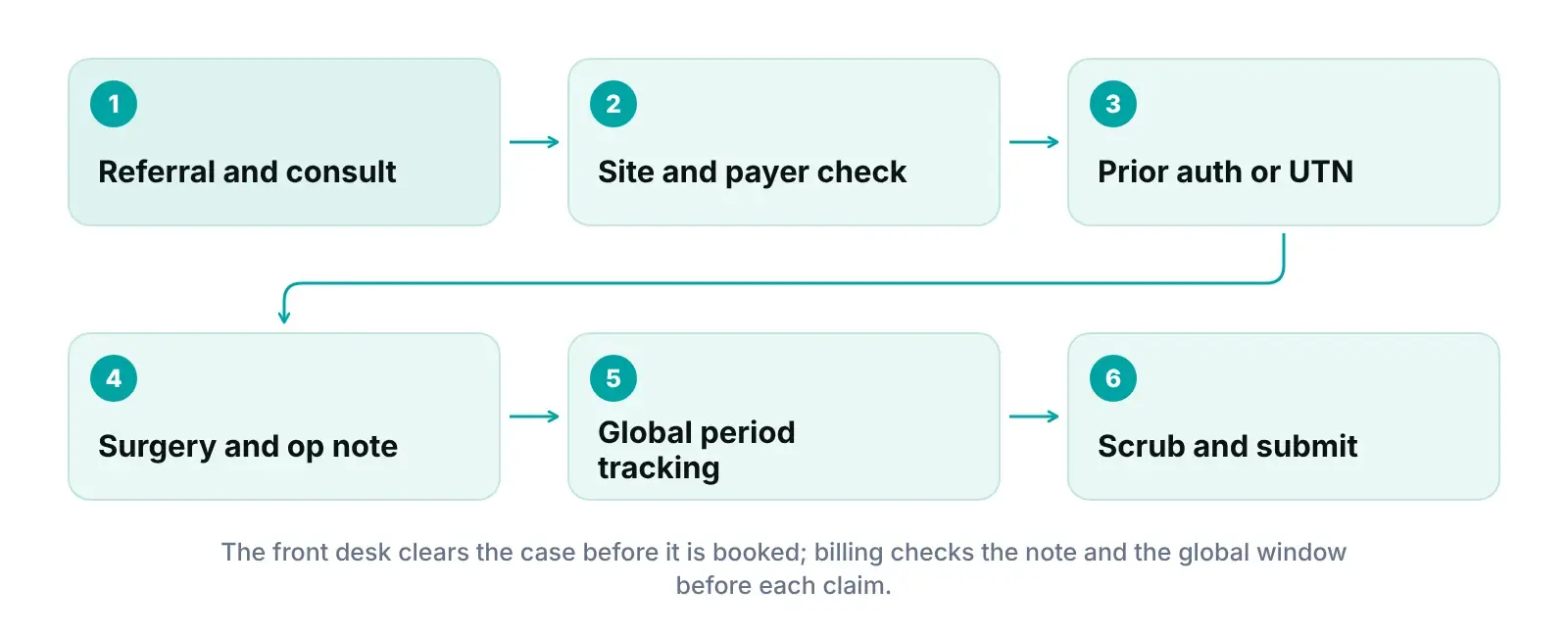
Neurosurgery case flow from referral and payer check to prior authorization, surgery, global period tracking and claims
How a neurosurgery case is cleared before surgery and tracked through the global period.

Estimate what a delayed or denied case costs

Model how denials and slow A/R affect a surgical practice, then bring the numbers to your audit.

Open the Revenue Calculator

Growing a neurosurgery practice through referrals

Neurosurgery growth usually comes from referring physicians and from patients who search after a diagnosis. Build for both, and keep website tracking within HIPAA.

We build referral pages for pain management, neurology, primary care and physical therapy offices that list what to send: imaging, conservative care history and the reason for referral. Patient pages explain when surgery is considered, so fewer consults fail coverage criteria. HHS tracking guidance says tools on appointment pages can collect protected health information and a cookie banner is not a HIPAA authorization; a June 2024 court order vacated part of it. We keep tracking off forms unless the vendor signs a BAA.

In-house team, billing-only vendor or four-pillar partner?

Stay in-house if you have experienced surgical coders and front-desk time for authorizations. Use a billing-only vendor if claims are your only gap. Choose a combined partner when problems start at scheduling and end at the claim.

Decision table: which billing model fits a neurosurgery practice?
JobIn-house teamBilling-only vendorFour-pillar partner (RCM Finder)
Spine prior authorizationSurgical scheduler, between callsUsually left to the practiceVMA starts each request and tracks it to a decision
Global-period visits and proceduresDepends on one coderFixed on the claim, after the factCalendar per patient; modifiers checked before submission
Co-surgeon and assistant claimsEach office bills its own partVaries; ask how indicators are checkedIndicators checked at booking; payments compared with expected amounts
Add-on and level codingCoder reads the operative noteVendor coders and scrubberRCM coders plus portal completeness checks
Referral growthA separate agency, or nobodyNot includedMarketing pillar tied to booked consults
Cost structureSalaries, benefits, turnoverVaries; ask how fees are setQuoted after a free practice audit

We will tell you in the audit if you need only one pillar; each can be contracted separately.

How it works

We start with a free audit and change nothing until you see the findings.

  1. 1

    Free practice audit

    We review recent surgical claims, global-period denials and authorization logs, and give you a prioritized fix list.

  2. 2

    BAA and access setup

    We put a Business Associate Agreement in place before accessing patient data, then set role-based access in your EHR (for example PrognoCIS, eClinicalWorks or athenahealth).

  3. 3

    Payer-rule map

    We map each surgeon's sites, your MACs, any WISeR exposure and your plans' benefit managers into a checklist and portal workflow rules.

  4. 4

    Front desk and billing go live

    VMAs start authorizations on your time zone. The RCM team codes, scrubs, submits and works denials and A/R.

  5. 5

    Weekly KPI review

    Each week we review denials by reason, A/R days, cases cleared before surgery and underpayments.

Talk through your neurosurgery workflow

Tell us your sites, case mix and hardest payer. We will tell you honestly whether we fit.

Call +1 (302) 556-2288

Compliance: what to ask any neurosurgery billing company

Any vendor that handles your claims is a HIPAA business associate. Get a Business Associate Agreement before any access, then check how access is limited and logged.

HHS names billing and claims processing as business associate work, and subcontractors need their own agreement. The minimum necessary standard limits uses to what each task needs. The Security Rule's technical safeguards require access control, audit controls, integrity controls, person or entity authentication and transmission security.

  1. Will you and your subcontractors sign a BAA before any access?
  2. What current coding credential do your surgical coders hold?
  3. How do you choose between modifiers 58, 78 and 79?
  4. How do you check co-surgeon and assistant indicators?
  5. Which prior authorization programs do you track for our states?
  6. Can we see the audit log and export our data if we leave?

We use role-based access, audit logging and encrypted (HTTPS) connections, and we put a Business Associate Agreement in place before accessing patient data. For your side, use our HIPAA compliance checklist for medical practices.

Who this is for, and who it is not for

We would rather tell you now than after you sign. Here is where we fit and where we do not.

A good fit if you are

  • Independent neurosurgery and spine groups billing fusions, decompressions and stimulator implants
  • Practices operating in hospital outpatient departments and ASCs
  • Groups in Arizona, New Jersey, Ohio, Oklahoma, Texas or Washington facing WISeR reviews
  • Practices with co-surgeon or assistant-at-surgery arrangements
  • Billing companies serving neurosurgery clients that want a shared claims portal

Probably not a fit if you are

  • Hospital-employed neurosurgeons whose billing the hospital controls
  • Practices that want a fixed price before any audit
  • Groups that need a credentialing module or in-portal real-time eligibility today (coming next)
  • Practices unwilling to give the team EHR access

Expert recommendations from our operations team

What we would do first if we were running your practice's revenue cycle tomorrow.

  1. 01

    Check the site and the state first

    Hospital outpatient, ASC and WISeR-state fusions follow different prior authorization paths. We confirm site and state before the code.

  2. 02

    Build the conservative-care record at the consult

    LCDs and benefit managers want symptom duration, pain scores, imaging and dated conservative care. We collect it at the first visit.

  3. 03

    Treat every add-on as a pair

    Each add-on needs its primary code, contiguous levels use one primary, and graft codes carry one unit.

  4. 04

    Read the indicators when the case is booked

    We check co-surgeon and assistant indicators before surgery, so the note explains the need.

  5. 05

    Keep one global-period calendar per patient

    We check every visit and procedure in the 92 days and choose 24, 58, 78 or 79 from the operative note.

  6. 06

    Keep monitoring off the surgeon's claim

    We confirm who bills neuromonitoring, which code each payer accepts and that recorded times do not overlap.

Frequently asked questions

What do neurosurgery billing services include?

They cover coding support, claim scrubbing, submission, denial management and A/R follow-up for spine and cranial surgery. A good service also tracks 90-day global periods, applies co-surgeon and assistant rules, pairs add-on codes with their primary codes and confirms prior authorization before the case is scheduled. RCM Finder adds front-desk assistants, referral marketing and a claims portal, so one team owns the process from referral to payment.

How does the 90-day global period work for spine surgery?

For major surgery, Medicare's global period runs 92 days: the day before surgery, the day of surgery and 90 days after. Routine post-op visits and complications that do not need a return to the operating room are included. The visit where you decide to operate (modifier 57), unrelated visits (24), staged procedures (58), returns to the OR (78) and unrelated procedures (79) can be billed with the right modifier and documentation.

When do we use modifier 62 instead of 80 or AS?

Use 62 when two surgeons of different specialties work on the same patient in the same session, each using their own skills, and the code's co-surgeon indicator is 1 or 2. Both bill the same code with 62, and Medicare pays each 62.5%. Use 80, 81 or 82 when a physician assists; Medicare pays 16%. A PA, NP or clinical nurse specialist uses AS and is paid 85% of that amount.

Does Medicare require prior authorization for spine surgery?

Only in certain settings and states. Since July 1, 2021, hospital outpatient departments have needed a provisional affirmation for cervical fusion with disc removal (22551, 22552) and percutaneous spinal neurostimulator electrodes (63650). In Arizona, New Jersey, Ohio, Oklahoma, Texas and Washington, the WISeR model adds services such as cervical fusion code 22554 and permanent spinal cord stimulator implants. Medicare Advantage and commercial plans set their own rules.

Can the operating surgeon bill intraoperative neuromonitoring?

No. CMS's NCCI manual treats neuromonitoring as part of the surgeon's global package, so 95940, 95941 and G0453 can be billed only by a different provider who performs the monitoring. For Medicare, remote monitoring uses G0453, billed per patient in 15-minute units for undivided attention to one patient. Some commercial plans, such as Highmark, do not pay 95941 and ask for G0453 instead.

Do you work inside our EHR, and how is pricing set?

Yes. Our team works inside your existing EHR, for example PrognoCIS, eClinicalWorks or athenahealth, and we put a Business Associate Agreement in place before accessing patient data. Pricing depends on your case mix, claim volume, sites of service and which of the four pillars you need, so we quote it after a free practice audit rather than publishing a flat rate.

No cost, no commitment

Get your free practice audit

Tell us about your practice. A member of our operations team replies within one business day.

  • A review of your recent claims, denials and A/R aging
  • Where your front desk and prior authorizations slow payment
  • A prioritized fix list you keep, whether or not you hire us

Pricing is quoted after the audit, based on your volume and the services you choose. Prefer to talk? Call +1 (302) 556-2288.

Tell us about your practice

RCMFinder Master Intake Form
AA

About the author: Awais Afzal

Healthcare Operations & Data Analyst, RCM Finder

Awais has spent more than 16 years in healthcare digital marketing and clinical operations management. He builds data-driven revenue cycle blueprints for high-ticket medical practices and leads product development of the RCM Finder portal. More about our team.

How we write: every figure, code and rule on this page was checked against the primary source listed below and independently fact-checked before publishing. We re-review this page every six months. Last reviewed October 12, 2026; next review April 12, 2027.

Sources

  1. Global Surgery Booklet (MLN907166) — CMS Medicare Learning Network (2025 (December 2025))
  2. Calendar Year (CY) 2025 Medicare Physician Fee Schedule Final Rule fact sheet — CMS (2024)
  3. Calendar Year (CY) 2026 Medicare Physician Fee Schedule Final Rule (CMS-1832-F) fact sheet — CMS (2025)
  4. Calendar Year (CY) 2027 Medicare Physician Fee Schedule Proposed Rule fact sheet — CMS (2026)
  5. Ambulatory Specialty Model — CMS Innovation Center (accessed 2026-10-09 (page modified 10/02/2026))
  6. Medicare NCCI Policy Manual (2026) — CMS (2026 (effective January 1, 2026))
  7. Medicare NCCI Policy Manual 2026, Chapter IV: Musculoskeletal System — CMS (2026)
  8. Medicare NCCI Policy Manual 2026, Chapter VIII: Endocrine, Nervous, Eye and Auditory Systems — CMS (2026)
  9. Medicare NCCI Add-on Code Edits — CMS (accessed 2026-10-09)
  10. Medicare Physician Fee Schedule Payment Policy Indicators — First Coast Service Options (Medicare contractor) (2024 (September 11, 2024))
  11. Assistant at Surgery and Co-Surgery: Understanding the Differences — Noridian Healthcare Solutions (Medicare contractor) (2025 (last updated January 9, 2025))
  12. Modifier 62 (JF Part B) — Noridian Healthcare Solutions (Medicare contractor) (accessed 2026-10-09)
  13. Medicare Claims Processing Manual, Chapter 12, Section 20.4.3 — CMS (accessed 2026-10-09)
  14. 42 CFR 414.52 Payment for physician assistants' services — eCFR (current (accessed 2026-10-09))
  15. 42 CFR 414.56 Payment for nurse practitioners' and clinical nurse specialists' services — eCFR (current (accessed 2026-10-09))
  16. Billing Medicare for Remote Intraoperative Neurophysiology Monitoring (G0453) FAQ — CMS (2020 (updated September 2020))
  17. Reimbursement Policy RP-077: Intraoperative Neurophysiological Monitoring — Highmark (2026 (issued February 2, 2026))
  18. CPT 95940 code summary — AAPC (secondary; plain-language code meaning only) (accessed 2026-10-09)
  19. CPT 95941 code summary — AAPC (secondary; plain-language code meaning only) (accessed 2026-10-09)
  20. CPT 22551 code summary — AAPC (secondary; plain-language code meaning only) (accessed 2026-10-09)
  21. CPT 22554 code summary — AAPC (secondary; plain-language code meaning only) (accessed 2026-10-09)
  22. CPT 22633 code summary — AAPC (secondary; plain-language code meaning only) (accessed 2026-10-09)
  23. CPT 63030 code summary — AAPC (secondary; plain-language code meaning only) (accessed 2026-10-09)
  24. CPT 63035 code summary — AAPC (secondary; plain-language code meaning only) (accessed 2026-10-09)
  25. CPT 63047 code summary — AAPC (secondary; plain-language code meaning only) (accessed 2026-10-09)
  26. CPT 63048 code summary — AAPC (secondary; plain-language code meaning only) (accessed 2026-10-09)
  27. CPT 61781 code summary — AAPC (secondary; plain-language code meaning only) (accessed 2026-10-09)
  28. Prior Authorization for Certain Hospital Outpatient Department (OPD) Services — CMS (2026 (page modified 09/25/2026))
  29. Final List of Outpatient Department Services That Require Prior Authorization — CMS (undated (accessed 2026-10-09))
  30. OPD Prior Authorization Frequently Asked Questions — CMS (2024 (November 14, 2024))
  31. Cervical Fusion with Disc Removal (OPD prior authorization) — Noridian Healthcare Solutions (Medicare contractor) (2025 (last updated June 25, 2025))
  32. WISeR (Wasteful and Inappropriate Service Reduction) Model — CMS Innovation Center (2026 (page modified 09/30/2026))
  33. WISeR Model Provider and Supplier Operational Guide, Version 7.0 — CMS Innovation Center (2026 (July 24, 2026))
  34. LCD L39741: Cervical Fusion (CGS, J-15, Kentucky and Ohio) — CMS Medicare Coverage Database (2025 (revision effective 02/06/2025))
  35. LCD L39793: Cervical Fusion (Novitas, J-H and J-L) — CMS Medicare Coverage Database (2024 (effective 08/11/2024))
  36. Spine Procedures (MMP089.18), UnitedHealthcare Medicare Advantage Medical Policy — UnitedHealthcare (2026 (effective August 1, 2026))
  37. HMSA MSK Lumbar and Cervical Spine Surgeries FAQ (Evolent) — Evolent / HMSA (2024 (updated April 2024))
  38. BlueChoice Health Plan of South Carolina FAQ: MSK Lumbar and Cervical Spine Surgeries (Evolent) — Evolent / BlueChoice Health Plan (undated (program start May 1, 2016))
  39. CMS Interoperability and Prior Authorization Final Rule (CMS-0057-F) fact sheet — CMS (2024)
  40. AMA survey: Prior authorization reform pledge falls short with physicians — American Medical Association (2026 (May 13, 2026))
  41. Use of Online Tracking Technologies by HIPAA Covered Entities and Business Associates — HHS Office for Civil Rights (2024 (reviewed June 26, 2024))
  42. Business Associates — HHS Office for Civil Rights (2026 (content last reviewed July 30, 2026))
  43. Minimum Necessary Requirement — HHS Office for Civil Rights (undated (accessed 2026-10-09))
  44. 45 CFR 164.312 Technical safeguards — eCFR (current (accessed 2026-10-09))