
Pulmonology Specialty

Pulmonology Billing Services, Front Desk and Growth in One Plan

PFT and bronchoscopy coding, sleep and biologic prior authorization, CPAP and oxygen documentation, patient marketing and a claims portal for pulmonary practices, built on CMS rules and your payers' own policies.
  • Works inside your current EHR
  • US practice time zone, every shift
  • Weekly KPI reporting, or on your schedule
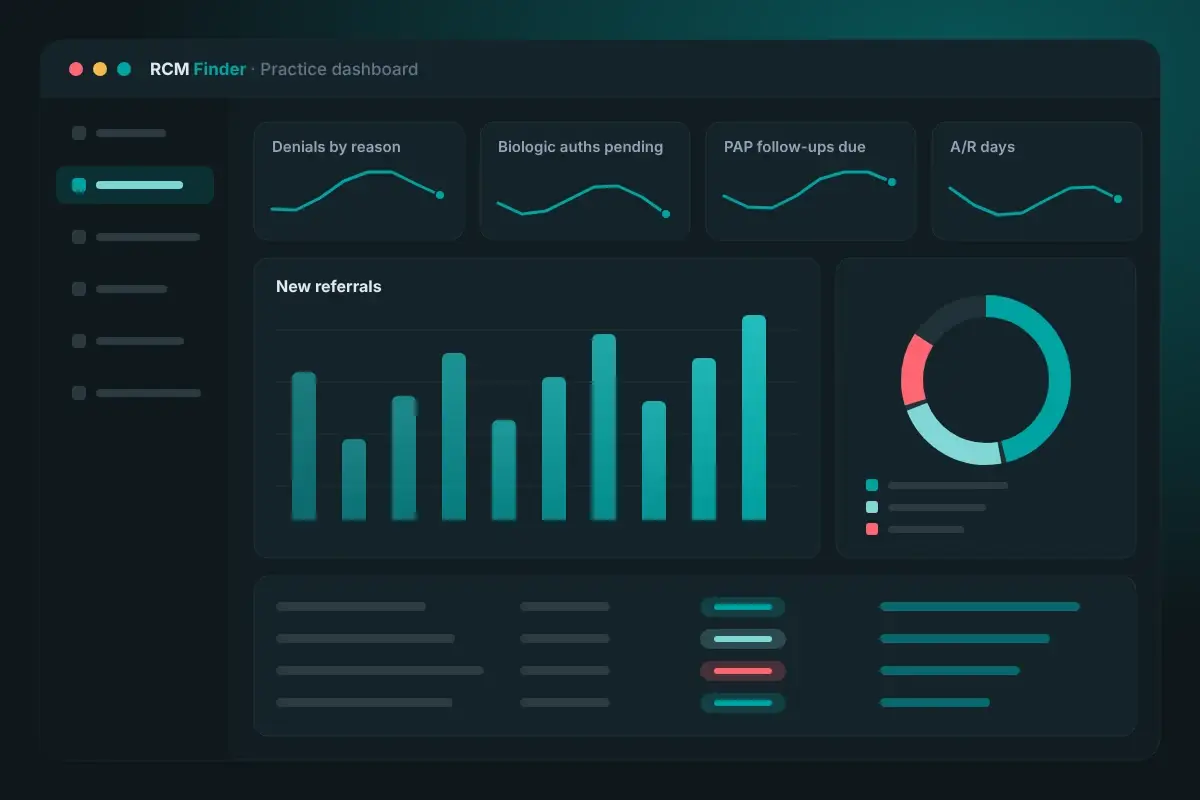
Pulmonology billing dashboard showing denials by reason, biologic authorizations, PAP follow-ups, A/R days and referrals

Quick answer

Pulmonology billing services manage the claims a lung and sleep practice creates: pulmonary function tests and their NCCI bundling, bronchoscopy, sleep studies, pulmonary rehab and chronic care management, plus biologic prior authorization and the notes CPAP and oxygen suppliers need. RCM Finder pairs that billing with front-desk assistants, patient marketing and a claims portal.

Disclaimer: This page is educational and is not legal, coding or compliance advice. National and local coverage determinations, billing articles, fee schedule rules and commercial payer policies change often and vary by contractor and plan. Verify every code, limit and rule against your Medicare contractor's and DME MAC's current documents, your payer contracts and the current CPT and HCPCS code sets before billing.

Why pulmonology billing is different

Pulmonology billing is different because one practice runs several billing systems: visits, a lung function lab, bronchoscopy, sleep testing, rehab and care management. CPAP and home oxygen are billed by a supplier, yet those claims rest on your notes.

Each service follows its own rulebook, from NCCI edits and global surgery rules to DME MAC policies and each plan's biologic criteria.

2026 payment and the 2027 proposal

Under CMS's CY 2026 Physician Fee Schedule fact sheet, the conversion factor is $33.40 for clinicians who are not qualifying APM participants, up from $32.35. A -2.5% efficiency adjustment applies to services that are not time-based; E/M and care management are exempt. Virtual direct supervision is now permanent for pulmonary rehab and diagnostic tests.

CMS's 2027 proposed rule fact sheet (July 14, 2026) proposes a $32.84 conversion factor for clinicians who are not qualifying APM participants. It also proposes that when the same physician or practice bills an office or outpatient E/M visit on the same day as a 0-, 10- or 90-day global procedure, only the most expensive service is paid in full and the rest at 50%. That would include visits on bronchoscopy days. Both are proposals, not final policy; check the final rule.

The four pillars, built for a pulmonology practice

A pulmonology practice needs referrals coming in, drugs and tests approved before the visit, claims coded to the edits, and software that shows every claim. Each pillar handles one.

Revenue leaks at the handoffs: a lapsed biologic approval, a CPAP follow-up on day 95, a nebulizer treatment billed on top of a bronchodilator study.

Pillar 1 · Healthcare Marketing

Healthcare Marketing for pulmonology practices

Our healthcare digital marketing builds demand from local patients searching for lung and sleep care and from the primary care offices that refer to you, through local SEO, Google Ads and reputation work.

  • Condition pages for COPD, asthma and sleep apnea
  • A simple referral path for primary care
  • Tracking kept off forms without a BAA
  • KPI: new referrals by source
Explore Healthcare Marketing
Pillar 2 · Virtual Medical Assistants

Virtual Medical Assistants for pulmonology front desks

Our virtual medical assistants for pulmonology work your front desk on your time zone. They verify eligibility, start biologic and sleep-study authorizations and book the follow-ups that CPAP and oxygen coverage depend on.

  • Biologic approvals and renewals tracked
  • Outside sleep tests and PFTs gathered
  • PAP and oxygen follow-ups booked at setup
  • KPI: approvals cleared before the visit
Explore Virtual Medical Assistants
Pillar 3 · End-to-End RCM

End-to-End RCM for pulmonology claims

Our end-to-end pulmonology revenue cycle management covers coding support, claim scrubbing, denial management and A/R follow-up, with added checks for NCCI lab pairs, bronchoscopy bundling, modifier 25 and rehab KX.

  • PFT and treatment pairs checked against NCCI
  • Same-day visits reviewed before submission
  • Appeals built from reports and orders
  • KPI: denials by reason and A/R days
Explore End-to-End RCM
Pillar 4 · Practice Management System

Practice Management System for pulmonology billing

Our practice management system tracks every claim by stage, applies specialty-aware billing logic per claim, checks data completeness before submission and flags payments below the expected amount.

  • Claims tracked by stage
  • Underpayment flags by claim
  • Rules that hold a sleep claim missing its order
  • Early access: booking with a calendar view
Explore Practice Management System

HHS tracking guidance says tracking on appointment pages can collect patient data and that a cookie banner is not a HIPAA authorization; a 2024 court order vacated part of it. We keep tracking off scheduling forms without a vendor BAA.

Find where your pulmonology claims leak

We review recent claims and your authorization log, then show what to fix first. Pricing is quoted after the audit.

Get a Free Practice Audit

Pulmonology service families: codes, bundling and denial triggers

The CMS documents we reviewed point to a few denial triggers: bundled tests, same-day visits on 0-day procedures, sleep tests outside coverage, and session or monthly limits. Codes are in our own words (the AMA owns CPT descriptors); check current code sets before billing.

Pulmonology service families: code examples, billing nuance and typical denial triggers
Service familyCode examples (our wording)Billing nuanceTypical denial trigger
Spirometry and PFT lab94010 (spirometry); 94060 (before and after bronchodilator); 94726 (lung volumes); 94729 (gas transfer, add-on)The bronchodilator dose is part of 94060; the drug is billable. Repeat efforts are one unit.94640 billed for the 94060 dose; extra units
Inhalation treatment and teaching94640 (nebulized treatment for acute obstruction); 94664 (inhaler teaching)94640 once per episode; a second episode the same day takes modifier 76Spirometry billed around an acute 94640; 94664 with 94640, same device
Exercise testing94618 (pulmonary stress test, such as a 6-minute walk); 94621 (cardiopulmonary exercise test)94621 includes its spirometry, oximetry and ECG monitoring94618 billed with 94621 in one encounter
Bronchoscopy and EBUS31622 (diagnostic); 31624 (lavage); 31628 (lung biopsy, one lobe); 31652, 31653 (EBUS, 1–2 or 3+ node stations); 31627 (navigation add-on)0-day global; fluoroscopy is integral; a same-day visit needs a significant, separate reason (modifier 25)31622 with a surgical bronchoscopy; fluoroscopy billed separately
Sleep testing95810 (in-lab study); 95811 (in-lab study with PAP titration); 95806, G0399 (home tests)Ordered by the treating practitioner; WPS requires credentialed readers and a sleep evaluation before home testsHome test despite moderate to severe lung disease, neuromuscular disease or heart failure (WPS); chronic insomnia
Pulmonary rehab94625 (without continuous oximetry); 94626 (with it); both replaced G0424 from January 1, 2022COPD GOLD II–IV, or COVID-19 with symptoms 4+ weeks; plan signed every 30 daysSessions past 36 without MAC approval or the KX your MAC asks for; unsigned plan
Chronic care management99490 (20 staff minutes); 99439 (each added 20); 99491 (30 practitioner minutes); 99424–99427 (principal care)2+ chronic conditions lasting 12+ months; consent; one practitioner per monthAnother practice billed CCM that month; no consent on file

Sources: CMS NCCI Policy Manual 2026, chapters V and XI; CMS MLN907166 (2025); WPS LCD L36839 (2025); AASM sleep codes; 42 CFR 410.47; CMS CR 12613 (2022); First Coast (2026); CMS MLN909188 (2025); AAPC code summaries. Rules vary by contractor and payer.

The PFT lab: what NCCI bundles

CMS's 2026 NCCI manual says 94060 already includes giving the bronchodilator, so billing 94640 for that dose is a misuse; the drug itself can be billed. When 94640 treats acute obstruction, spirometry around it is not billed separately. A limited exam tied to the test is not a separate E/M; a significant, separate visit takes modifier 25. For hospital reads, Noridian, a Medicare contractor, allows modifier 26 only on codes with a professional and technical split.

Bronchoscopy: 0-day global and same-day visits

Under the 2026 NCCI chapter on respiratory surgery, a diagnostic bronchoscopy (31622) is not billed with a surgical one, and fluoroscopy is part of the procedure. For 0-day procedures, the global surgery booklet includes a procedure-day visit unless it is significant and separately identifiable. Confirm each code's global days in the fee schedule look-up.

Diagnosis coding carries medical necessity

Coverage turns on documented severity: GOLD stage for COPD, AHI for sleep apnea, eosinophil counts for biologics. See our guides to COPD ICD-10 coding and obstructive sleep apnea ICD-10 code G47.33.

Sleep studies, CPAP and home oxygen: your notes decide the supplier's claim

For CPAP and home oxygen, the supplier bills Medicare, but the claim rests on your chart: the visit before the sleep test, the follow-up between day 31 and day 91, and an oxygen test done at the time of need.

Sleep testing

NCD 240.4.1 covers in-lab polysomnography and listed home test types ordered by the treating practitioner. WPS, the MAC for Indiana and Michigan among other states, adds rules in LCD L36839: home tests only after a comprehensive sleep evaluation, none for moderate to severe lung disease, neuromuscular disease or heart failure, and credentialed readers. Other MACs may differ. For sleep in neurology, see our neurology billing services guide.

CPAP and other PAP devices

The DME MAC PAP device LCD L33718 requires an in-person visit before the sleep test and an AHI or RDI of at least 15, or 5 to 14 with documented symptoms or conditions such as hypertension. Coverage starts as a 12-week trial under NCD 240.4. To continue, the practitioner re-evaluates the patient in person between day 31 and day 91 and documents benefit and use of 4 or more hours a night on 70% of nights in 30 consecutive days. Per policy article A52467, the supplier adds KX only when criteria are met; see our guide to DME billing modifiers.
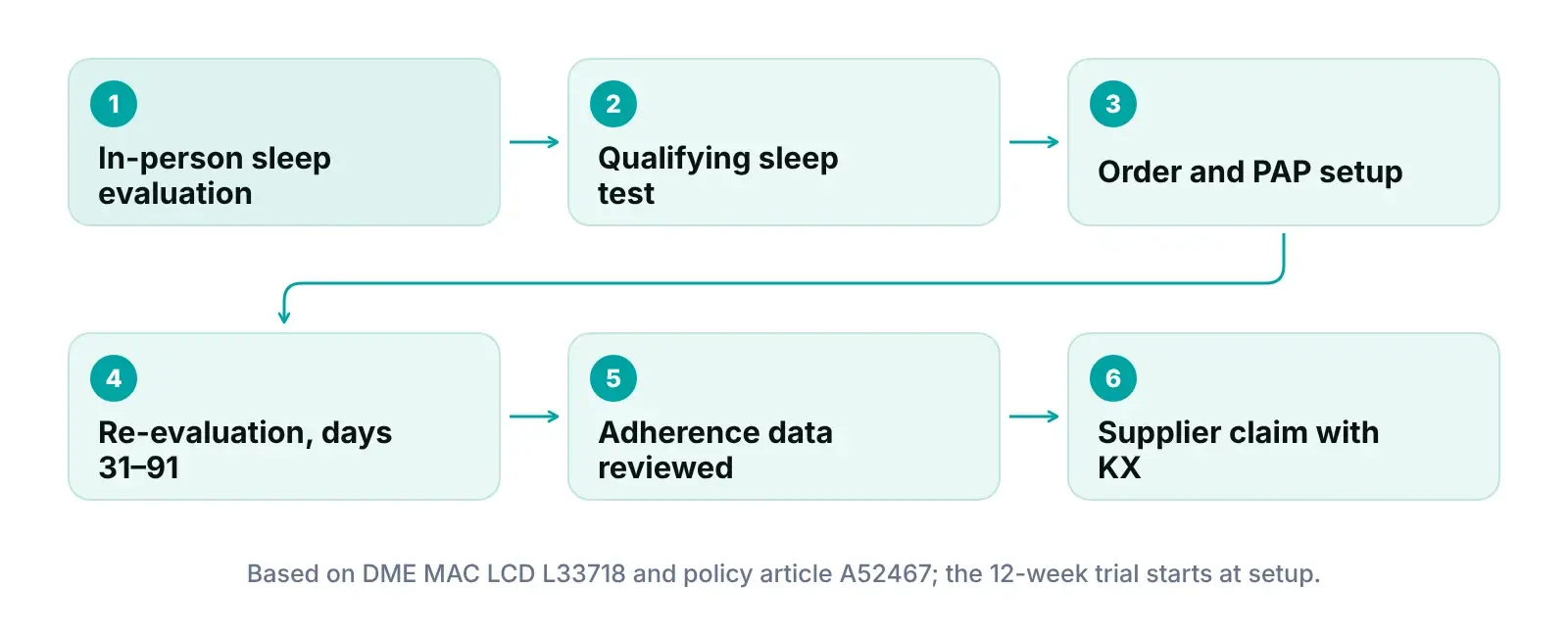
Diagram of the CPAP coverage path from in-person sleep evaluation and sleep test to the day 31 to 91 re-evaluation
The records a Medicare CPAP claim depends on, from the first visit to month 4.

Home oxygen

NCD 240.2 and the DME MAC oxygen LCD L33797 set Group I at an arterial PO2 at or below 55 mm Hg or saturation at or below 88% at rest, with sleep and exercise variants. Group II is 56 to 59 mm Hg or 89%, plus edema suggesting heart failure, pulmonary hypertension or a hematocrit over 56%. Test at the time of need (for inpatients, within 2 days of discharge), and never by the supplier. Under policy article A52514, Group II needs a retest on days 61 to 90 and a new order; suppliers report the group with N1, N2 or N3.

Prior authorization for biologics and sleep studies: what to check before the visit

Start prior authorization at scheduling. In pulmonology the heavy items are biologics for severe asthma and COPD, sleep studies and PAP, and each plan writes its own criteria.

UnitedHealthcare's commercial IL-5 inhibitor policy (effective October 1, 2026) is a typical example. For severe asthma it asks for poor control despite maximal inhaled therapy, blood eosinophils of at least 150 cells/μL and a pulmonologist or allergist prescriber. Approvals last up to 12 months; renewal needs a documented response.

Since January 1, 2026, the CMS-0057-F rule has required Medicare Advantage, Medicaid and CHIP plans to decide expedited requests in 72 hours and standard ones in seven calendar days. Drug prior authorizations are excluded, so biologics run on each plan's own clock.

For sleep, the AASM prior authorization toolkit checklist tells practices to document a failed or inadequate home sleep test, or a contraindication, when they request an in-lab study. In the AMA’s 2025 survey of 1,000 physicians (released May 2026), physicians averaged 40 prior authorizations and 13 hours of physician and staff time a week.

Pre-visit checklist: pulmonology prior authorization and coverage rules our VMAs check before scheduling
RuleSourceWhat the VMA checks
IL-5 biologics, severe asthma: eosinophils 150 cells/μL or more, maximal inhaled therapy, specialist prescriber; up to 12 monthsUHC policy 2026D0055AA (Oct 1, 2026)Eosinophil result, exacerbations, current inhalers; renewal date logged
Self-administered Fasenra and Nucala usually go to the pharmacy benefitUHC policy 2026D0055AAMedical or pharmacy benefit confirmed before the first dose
72-hour and 7-day decisions for MA, Medicaid and CHIP; drugs excludedCMS-0057-F (from Jan 1, 2026)Due date logged for test requests
In-lab study request: document a failed or inadequate home test, or a contraindicationAASM toolkit checklistPrior home test or contraindication on file
Medicare home test: sleep evaluation first; not with moderate to severe lung disease, neuromuscular disease or heart failureWPS LCD L36839 (2025)Evaluation note dated before the test
PAP: in-person visit before the test; re-evaluation on days 31–91DME MAC LCD L33718 (2024)Follow-up booked at setup
Oxygen: test at the time of need, not by the supplier; Group II retest on days 61–90NCD 240.2; LCD L33797; A52514Test date, performer and group recorded

Sources: UnitedHealthcare policy 2026D0055AA (2026); CMS-0057-F fact sheet (2024); AASM Prior Authorization Toolkit (undated); Medicare Coverage Database WPS L36839 (2025), L33718 (2024), L33797 and A52514 (2023), NCD 240.2 (2021). Always check the member's current plan.

For the full workflow, read our prior authorization guide for providers.

See what lapsed approvals and denials cost you

Enter your claim volume and denial rate to estimate what your pulmonology practice is losing.

Open the Revenue Calculator

Pulmonary rehab and chronic care management for COPD and asthma

Pulmonary rehab and chronic care management both run on a calendar: session counts, a plan signed every 30 days and care minutes counted per month.

Pulmonary rehabilitation

Under 42 CFR 410.47, Medicare covers pulmonary rehab for COPD in GOLD stages II to IV on the treating physician's referral, and for COVID-19 with respiratory symptoms lasting at least four weeks. A physician signs the plan every 30 days. Medicare allows two 1-hour sessions a day and 36 sessions, plus 36 more with MAC approval. A 2022 CMS transmittal (CR 12613) retired the older G0424 code after December 31, 2021 and added 94625 and 94626 from January 1, 2022. First Coast, a Medicare contractor, asks for the KX modifier on medically necessary sessions 37 to 72. Other MACs may set this differently, so check yours.
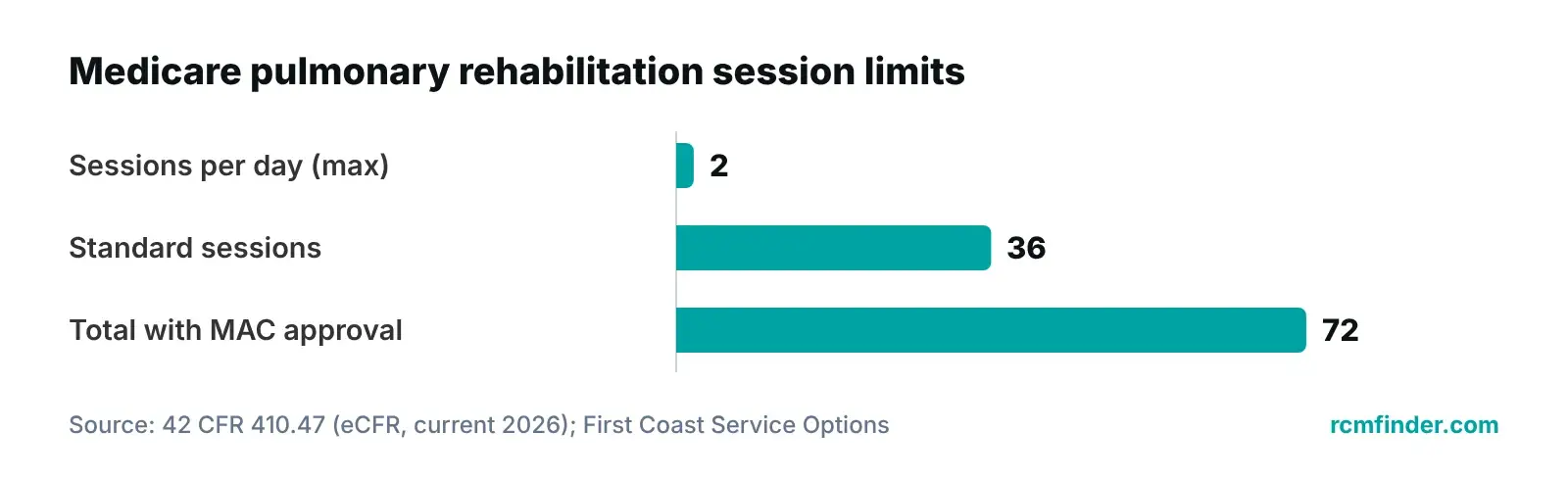
Bar chart of Medicare pulmonary rehabilitation limits: 2 sessions per day, 36 standard sessions and up to 72 with approval
Medicare pulmonary rehab limits. Sessions 37 to 72 need MAC approval; some MACs, such as First Coast, also ask for the KX modifier.

Chronic care management

CMS's chronic care management booklet (MLN909188, June 2025) requires two or more chronic conditions expected to last at least 12 months, consent, and an initiating visit for new patients or those not seen within a year. 99490 covers 20 minutes of clinical staff time a month; 99491 covers 30 minutes of the practitioner's own time. Only one practitioner can bill CCM a month, and some specialists may bill it.

Ask whether primary care already bills CCM. See our chronic care management coding guide, our telehealth billing guide and, for cardiac rehab, our cardiology billing services page.

In-house team, billing-only vendor or four-pillar partner?

Stay in-house if your coders know the lab and bronchoscopy edits and your front desk has time for approvals. Use a billing-only vendor if claims are the only gap. Choose a combined partner when problems span both.

Decision table: which model fits a pulmonology practice?
JobIn-house teamBilling-only vendorFour-pillar partner (RCM Finder)
Biologic and sleep-study approvalsFront desk, between callsUsually left to the practiceVMA starts each request and tracks renewals
PFT and bronchoscopy bundlingDepends on one coderFixed after the denialChecked against NCCI before submission
CPAP and oxygen notes for suppliersHandled when records are requestedUsually out of scopeFollow-ups and retests booked at setup
Rehab sessions and CCM monthsSpreadsheets or EHR remindersBilled when the practice sends dataVMA keeps the calendar; RCM bills on eligible dates
Referral growth and reviewsA separate agency, or nobodyNot includedMarketing pillar tied to booked consults
ReportingEHR reportsClaim reports onlyPortal and dashboards, referral to paid claim
Cost structureSalaries, benefits, turnoverVaries; ask how fees are setQuoted after a free practice audit

How it works

We start with a free audit and change nothing until you see the findings. We build our billing pipeline around how claims actually move through a practice: registration, charge entry, submission, payment and follow-up. For pulmonology, we add the checks on this page.

  1. 1

    Free practice audit

    We review recent claims, denial reasons and your authorization log.

  2. 2

    Business Associate Agreement and access

    We put a Business Associate Agreement in place before accessing patient data. Then we work inside your existing EHR (for example PrognoCIS, eClinicalWorks or athenahealth).

  3. 3

    Payer-rule map

    Your MAC, DME MAC, NCCI and biologic policy rules become a pre-visit checklist and portal workflow rules.

  4. 4

    Front desk and billing go live

    VMAs start approvals and book PAP and oxygen follow-ups. Claims are scrubbed, submitted and worked through denials and A/R.

  5. 5

    Weekly KPI review

    Each week we review denials by reason, A/R days, approvals cleared before the visit and new referrals.

Talk to us about your pulmonology practice

Tell us your lab and sleep mix and your hardest payer. We will tell you honestly whether we fit.

Call +1 (302) 556-2288

Compliance: what to ask any pulmonology billing company

Any billing vendor that handles your patients' data is a HIPAA business associate. Get a Business Associate Agreement before they have any access, and check how they limit and log that access.

HHS guidance names billing and claims processing as business associate work; subcontractors need their own agreement. The minimum necessary standard limits use of patient data to what each task needs. The Security Rule's technical safeguards are access control, audit controls, integrity, person or entity authentication and transmission security.

  1. Will you and your subcontractors sign a Business Associate Agreement before any access?
  2. Can we see the audit log of who accessed our claims?
  3. What current coding credential and pulmonology experience do your coders have?
  4. How do you check NCCI pairs for lab and bronchoscopy codes?
  5. Who tracks biologic renewals and CPAP follow-up windows?
  6. Can we export our data if we leave?

We use role-based access, audit logging and encrypted (HTTPS) connections, and we put a Business Associate Agreement in place before accessing patient data. For your own side, see our HIPAA compliance checklist for medical practices.

Who this is for, and who it is not for

We would rather tell you now than after you sign. Here is where we fit and where we do not.

A good fit if you are

  • Independent pulmonology and sleep practices with an in-office PFT lab
  • Groups doing bronchoscopy and EBUS in hospitals or ASCs
  • Practices with heavy asthma and COPD biologic approval volume
  • Practices running pulmonary rehab or chronic care management
  • Billing companies serving pulmonology clients from one portal

Probably not a fit if you are

  • Hospital-employed pulmonologists whose billing the hospital controls
  • Practices that want claims billed without changing front-desk steps
  • Practices looking for promised collection rates; we report measured KPIs
  • Groups that need a credentialing module or in-portal real-time eligibility today (coming next)

Expert recommendations from our operations team

What we would do first if we were running your practice's revenue cycle tomorrow.

  1. 01

    Set the PFT lab rules once, in the charge sheet

    We build the NCCI pairs into charge capture: no 94640 for the 94060 dose and one unit per test.

  2. 02

    Book the CPAP follow-up on setup day

    The re-evaluation must fall between day 31 and day 91. We book it when therapy starts.

  3. 03

    Write oxygen test notes for the reviewer

    Each note should show the test date, who performed it and the conditions. For Group II, we book the day 61 to 90 retest right away.

  4. 04

    Track biologic renewals like expiry dates

    Under UnitedHealthcare's IL-5 policy, approvals last up to 12 months. We log each renewal date and gather response data early.

  5. 05

    Ask who already bills CCM

    Only one practitioner can bill CCM in a month, so we check before your staff log a minute.

  6. 06

    Document COPD stage before rehab

    Rehab coverage depends on GOLD stage II to IV. We confirm the stage and referral are charted and flag sessions 37 and up for your MAC's approval and KX rules.

Frequently asked questions

What do pulmonology billing services include?

They cover coding support, claim scrubbing, submission, denial management and A/R follow-up for pulmonary visits, lung function tests, bronchoscopy, sleep studies, pulmonary rehab and chronic care management. A good service also handles biologic and sleep-study prior authorization and checks that your notes support the CPAP and oxygen claims suppliers file. We add front-desk assistants, patient marketing and a claims portal, so one team owns the process from referral to payment.

Can we bill a nebulizer treatment and spirometry on the same day?

Sometimes, but not for the same dose. CMS's 2026 NCCI manual says a before-and-after bronchodilator study (94060) includes giving the bronchodilator, so billing 94640 for it is a misuse; the drug can be billed. When 94640 treats acute airway obstruction, spirometry around it is not billed separately. 94640 is reported once per episode of care; a second episode the same day takes modifier 76.

What does Medicare need before it pays for a patient's CPAP?

Under DME MAC LCD L33718, the treating practitioner sees the patient in person before the sleep test, and the test must show an AHI or RDI of 15 or more, or 5 to 14 with documented symptoms or conditions. Coverage starts as a 12-week trial. To continue, the practitioner re-evaluates the patient between day 31 and day 91 and documents benefit and use of 4 or more hours a night on 70% of nights in 30 consecutive days.

Who can perform the test that qualifies a patient for home oxygen?

The treating practitioner orders and evaluates it, and the practitioner or another qualified provider or laboratory performs it. Under NCD 240.2 and the DME MAC oxygen LCD, a DME supplier is not a qualified provider, so supplier-run tests do not count. The test must be done at the time of need, which for a hospital inpatient means within 2 days of discharge.

Do asthma biologics need prior authorization, and do the 2026 CMS deadlines apply?

Usually yes, under each plan's drug policy. UnitedHealthcare's commercial IL-5 inhibitor policy, for example, asks for severe asthma with poor control, a baseline eosinophil count of at least 150 cells/μL and a pulmonologist or allergist prescriber, with approvals of up to 12 months. The CMS-0057-F deadlines of 72 hours and seven calendar days do not apply, because drug prior authorizations are excluded from that rule.

Can a pulmonologist bill chronic care management for COPD patients?

Yes. CMS says some specialists may bill CCM. The patient needs two or more chronic conditions expected to last at least 12 months, documented consent, and an initiating visit if new or not seen in the past year. Only one practitioner can bill CCM for a patient in a calendar month, so check whether the primary care office already does. For one high-risk condition, principal care management may fit instead.

No cost, no commitment

Get your free practice audit

Tell us about your practice. A member of our operations team replies within one business day.

  • A review of your recent claims, denials and A/R aging
  • Where your front desk and prior authorizations slow payment
  • A prioritized fix list you keep, whether or not you hire us

Pricing is quoted after the audit, based on your volume and the services you choose. Prefer to talk? Call +1 (302) 556-2288.

Tell us about your practice

RCMFinder Master Intake Form
AA

About the author: Awais Afzal

Healthcare Operations & Data Analyst, RCM Finder

Awais has spent more than 16 years in healthcare digital marketing and clinical operations management. He builds data-driven revenue cycle blueprints for high-ticket medical practices and leads product development of the RCM Finder portal. More about our team.

How we write: every figure, code and rule on this page was checked against the primary source listed below and independently fact-checked before publishing. We re-review this page every six months. Last reviewed October 12, 2026; next review April 12, 2027.

Sources

  1. National Correct Coding Initiative Policy Manual for Medicare Services, Chapter XI: Medicine, Evaluation and Management Services (CPT 90000-99999) — CMS (2026 (revision date 1/1/2026))
  2. National Correct Coding Initiative Policy Manual for Medicare Services, Chapter V: Respiratory, Cardiovascular, Hemic and Lymphatic Systems (CPT 30000-39999) — CMS (2026 (revision date 1/1/2026))
  3. Global Surgery Booklet (MLN907166) — CMS Medicare Learning Network (2025 (December 2025))
  4. Modifier 26 (JF Part B) — Noridian Healthcare Solutions (Medicare contractor) (2025 (last updated May 9, 2025))
  5. Calendar Year (CY) 2026 Medicare Physician Fee Schedule Final Rule (CMS-1832-F) fact sheet — CMS (2025)
  6. Calendar Year (CY) 2027 Medicare Physician Fee Schedule Proposed Rule fact sheet — CMS (2026 (July 14, 2026))
  7. NCD 240.4.1: Sleep Testing for Obstructive Sleep Apnea (OSA) — CMS Medicare Coverage Database (2009 (effective 03/03/2009))
  8. NCD 240.4: Continuous Positive Airway Pressure (CPAP) Therapy for Obstructive Sleep Apnea (OSA) — CMS Medicare Coverage Database (2008 (effective 03/13/2008))
  9. LCD L33718: Positive Airway Pressure (PAP) Devices for the Treatment of Obstructive Sleep Apnea — CMS Medicare Coverage Database (DME MACs: CGS, Noridian) (2024 (revision effective 01/01/2024))
  10. Article A52467: Positive Airway Pressure (PAP) Devices for the Treatment of Obstructive Sleep Apnea - Policy Article — CMS Medicare Coverage Database (DME MACs) (2021 (revision effective 08/08/2021))
  11. NCD 240.2: Home Use of Oxygen — CMS Medicare Coverage Database (2021 (version 2 effective 09/27/2021))
  12. LCD L33797: Oxygen and Oxygen Equipment — CMS Medicare Coverage Database (DME MACs: CGS, Noridian) (2023 (revision effective 04/01/2023))
  13. Article A52514: Oxygen and Oxygen Equipment - Policy Article — CMS Medicare Coverage Database (DME MACs) (2023 (revision effective 04/01/2023))
  14. LCD L36839: Polysomnography and Other Sleep Studies — CMS Medicare Coverage Database (WPS, J-05/J-08 incl. Indiana and Michigan) (2025 (revision effective 06/26/2025))
  15. Sleep Medicine Codes — American Academy of Sleep Medicine (2024 (page last modified September 20, 2024))
  16. Prior Authorization Toolkit — American Academy of Sleep Medicine (undated (file posted March 2026))
  17. 42 CFR 410.47 Pulmonary rehabilitation program: Conditions for coverage — eCFR (current (accessed 2026-10-10))
  18. Cardiac and pulmonary rehabilitation programs — First Coast Service Options (Medicare contractor) (2026 (page dated June 15, 2026))
  19. Transmittal 11426, Change Request 12613: An Omnibus CR (includes cardiac, intensive cardiac and pulmonary rehabilitation changes) — CMS (Medicare Claims Processing Manual transmittal) (2022 (May 20, 2022; effective January 1, 2022))
  20. CPT 94625 code summary — AAPC (secondary; used for plain-language code meaning only) (accessed 2026-10-10)
  21. Chronic Care Management Services (MLN909188) — CMS Medicare Learning Network (2025 (June 2025))
  22. Respiratory Interleukin-5 Inhibitor (Medical Benefit Drug Policy 2026D0055AA) — UnitedHealthcare (Commercial and Individual Exchange) (2026 (effective October 1, 2026))
  23. CMS Interoperability and Prior Authorization Final Rule (CMS-0057-F) fact sheet — CMS (2024 (January 17, 2024))
  24. AMA survey: Prior authorization reform pledge falls short with physicians — American Medical Association (2026 (May 13, 2026))
  25. Business Associates — HHS Office for Civil Rights (2026 (content last reviewed July 30, 2026))
  26. Minimum Necessary Requirement — HHS Office for Civil Rights (2013 (content last reviewed July 26, 2013))
  27. 45 CFR 164.312 Technical safeguards — eCFR (current (accessed 2026-10-10))
  28. Use of Online Tracking Technologies by HIPAA Covered Entities and Business Associates — HHS Office for Civil Rights (2024 (content last reviewed June 26, 2024))
  29. CPT 94010 code summary — AAPC (secondary; used for plain-language code meaning only) (accessed 2026-10-10)
  30. CPT 94060 code summary — AAPC (secondary; used for plain-language code meaning only) (accessed 2026-10-10)
  31. CPT 94726 code summary — AAPC (secondary; used for plain-language code meaning only) (accessed 2026-10-10)
  32. CPT 94729 code summary — AAPC (secondary; used for plain-language code meaning only) (accessed 2026-10-10)
  33. CPT 94618 code summary — AAPC (secondary; used for plain-language code meaning only) (accessed 2026-10-10)
  34. CPT 94640 code summary — AAPC (secondary; used for plain-language code meaning only) (accessed 2026-10-10)
  35. CPT 94664 code summary — AAPC (secondary; used for plain-language code meaning only) (accessed 2026-10-10)
  36. CPT 31622 code summary — AAPC (secondary; used for plain-language code meaning only) (accessed 2026-10-10)
  37. CPT 31624 code summary — AAPC (secondary; used for plain-language code meaning only) (accessed 2026-10-10)
  38. CPT 31628 code summary — AAPC (secondary; used for plain-language code meaning only) (accessed 2026-10-10)
  39. CPT 31652 code summary — AAPC (secondary; used for plain-language code meaning only) (accessed 2026-10-10)
  40. CPT 31653 code summary — AAPC (secondary; used for plain-language code meaning only) (accessed 2026-10-10)
  41. CPT 31627 code summary — AAPC (secondary; used for plain-language code meaning only) (accessed 2026-10-10)