
Rheumatology Specialty

Rheumatology Billing Services, Front Desk and Growth in One Plan

Biologic infusion and drug claims, prior authorization and step therapy, joint injections, referral marketing and a claims portal for rheumatology practices, built on CMS rules and your payers' own policies.
  • Works inside your current EHR
  • US practice time zone, every shift
  • Weekly KPI reporting, or on your schedule
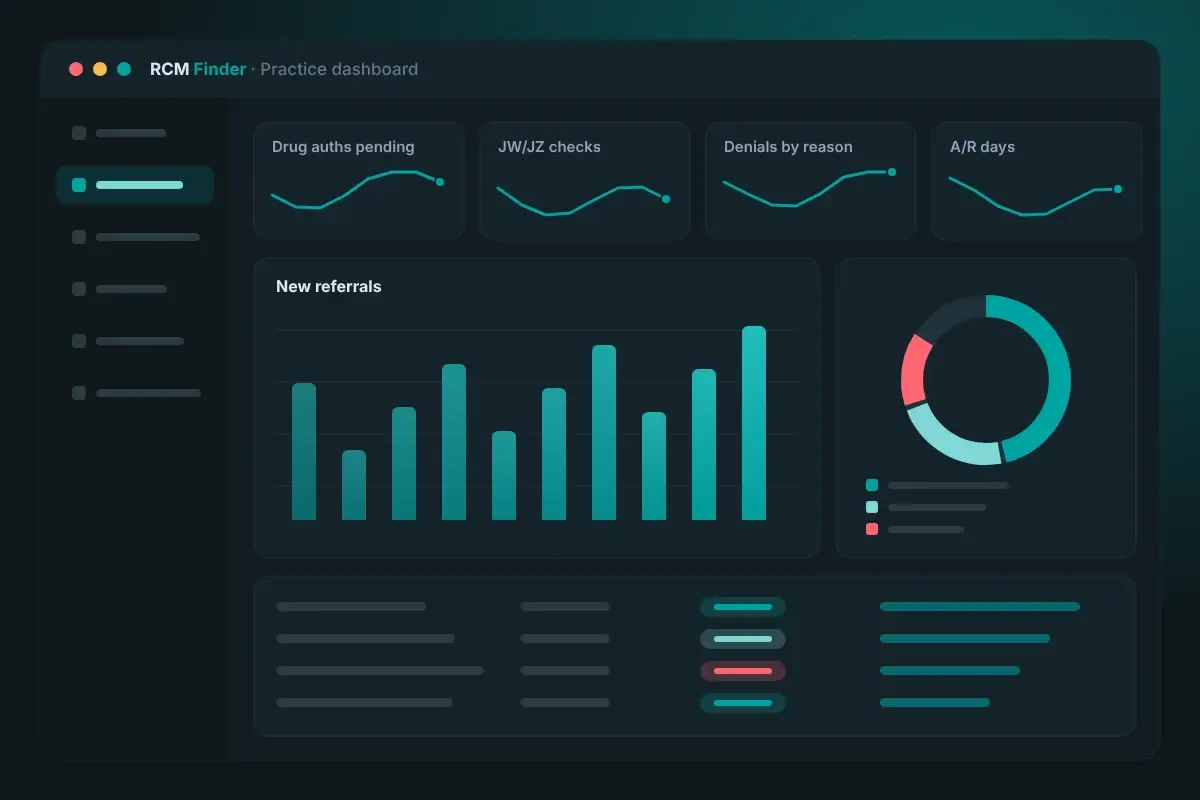
Rheumatology billing dashboard with drug authorizations, JW and JZ checks, denials by reason, A/R days and referrals

Quick answer

Rheumatology billing services manage the claims a rheumatology practice creates: biologic infusions billed with the right drug code, units, NDC and JW or JZ modifier, drug prior authorizations and step therapy, joint injections, same-day visits and DXA scans. RCM Finder pairs that billing with front-desk assistants, referral marketing and a claims portal, starting with a free practice audit.

Disclaimer: This page is educational and is not legal, coding or compliance advice. Medicare billing articles, self-administered drug lists, ASP payment limits, fee schedule rules and commercial payer policies change often and vary by contractor and plan. Verify every code, unit, modifier and rule against your Medicare contractor's current documents, your payer contracts and the current CPT and HCPCS code sets before billing.

Why rheumatology billing is different

Rheumatology billing is different because much of the revenue runs through drugs. When a practice buys and infuses a biologic, the claim must match the drug code, units, NDC and waste modifier to the vial used. One mismatch can hold up the costliest line.

Medicare pays most Part B drugs at 106% of average sales price (ASP) under 42 CFR 414.904, and pays separately for giving the drug, per MedPAC (2024). A biosimilar is paid at its own ASP plus 6% of the reference product's ASP (8% for qualifying biosimilars during a five-year period). CMS updates ASP payment limits quarterly.

Each biosimilar has its own code. J1745 covers infliximab but excludes biosimilars, while Inflectra (infliximab-dyyb) is billed with Q5103. A switch changes the code, the NDC and often the authorization.

Not every biologic belongs on a Part B claim

Each Medicare contractor lists drugs it considers usually self-administered, and those are excluded from Part B when given in the office. CGS's list (A52527) includes adalimumab (J0139), etanercept (J1438) and subcutaneous abatacept, and requires a JA (intravenous) or JB (subcutaneous) modifier where one code covers both routes. For covered office injections, see our 96372 injection billing guide.

Buy-and-bill, white bagging and brown bagging

In buy-and-bill, the practice buys the drug and bills the medical benefit. In white bagging, a specialty pharmacy ships the drug to the practice for one patient and bills the pharmacy benefit. In brown bagging, the patient brings the drug in. In both bagging models, the practice bills only for giving the drug, as a Mass General Brigham Health Plan explainer describes.

Some states, including Louisiana, Vermont and Virginia, limit or set standards for white bagging, per Triage Cancer's state-law chart (updated January 2024). The right model depends on your payer mix, cash flow and state rules.

We build our billing pipeline around how claims actually move through a practice: registration, charge entry, submission, payment and follow-up. For rheumatology, we add the drug, infusion and injection checks described on this page.

The four pillars, built for a rheumatology practice

A rheumatology practice needs referrals, approved drugs, clean drug claims and software that shows every claim. Each pillar handles one.

Revenue leaks at the handoffs: an infusion booked before step-therapy history is sent, an unnoticed biosimilar switch, a missing waste line. We run all four pillars on one set of payer rules.

Pillar 1 · Healthcare Marketing

Healthcare Marketing for rheumatology practices

Our healthcare digital marketing builds demand from referring primary care offices and local patients searching for help with arthritis, gout, lupus or osteoporosis, through local SEO, Google Ads and reputation work.

  • Condition pages for the diseases you treat
  • Referring-provider page with a simple referral path
  • Tracking kept off forms without a BAA
  • KPI: new referrals and booked consults by source
Explore Healthcare Marketing
Pillar 2 · Virtual Medical Assistants

Virtual Medical Assistants for rheumatology front desks

Our virtual medical assistants for rheumatology work on your practice's time zone. They confirm the benefit for each biologic, start prior authorizations and track re-authorization dates.

  • Medical or pharmacy benefit confirmed before ordering
  • Drug authorizations tracked to a decision
  • Prior drug trials gathered for step therapy
  • KPI: infusions cleared in advance
Explore Virtual Medical Assistants
Pillar 3 · End-to-End RCM

End-to-End RCM for rheumatology claims

Our end-to-end rheumatology revenue cycle management covers coding support, claim scrubbing, denial management and A/R follow-up, with extra checks on every drug and administration line.

  • Drug units and NDC matched to the infusion record
  • JW or JZ on every single-dose drug line
  • Same-day visit and injection coding reviewed
  • KPI: denials by reason and A/R days
Explore End-to-End RCM
Pillar 4 · Practice Management System

Practice Management System for rheumatology billing

Our practice management system tracks every claim by stage, applies specialty-aware billing logic per claim, checks data completeness before submission and flags payments below the expected amount.

  • Claims tracked by stage, per claim
  • Workflow rules that hold a drug line missing an NDC or modifier
  • Underpayment flags on drug and infusion lines
  • Early access: appointment booking with a calendar view
Explore Practice Management System

Find where your infusion claims leak

We review recent infusion, injection and DXA claims, denial reasons and authorization logs, then show what to fix first. Pricing is quoted after the audit.

Get a Free Practice Audit

Infusions, injections and DXA: codes, rules and where claims break

Most rheumatology claim problems trace to a few rules, mapped below. Codes are in our own words (the AMA owns CPT descriptors); check current code sets and your contractor's articles before billing.

Rheumatology services: code examples, billing rules and where claims break
ServiceCode examples (our wording)Billing ruleWhere claims break
IV infusion of a biologic96365, 96366 (first and added hours); 96413, 96415 (complex biologics)One initial code per encounter, set by the main reason; chemotherapy-level codes can apply to monoclonal antibodiesSecond initial code in one encounter without a two-IV-site protocol
Infused drugJ1745 (infliximab, per 10 mg); J0129 (abatacept, per 10 mg); J3262 (tocilizumab, per 1 mg)Units from dose and billing unit; JZ if none discarded, JW line if some isNo JW or JZ on a single-dose drug; claim may be returned
BiosimilarQ5103 (infliximab-dyyb, per 10 mg); J1745 excludes biosimilarsBill the product given; its own code and NDCReference code still billed after a switch
Subcutaneous biologic in the officeJ0139 (adalimumab); J1438 (etanercept)On contractor self-administered lists; JA or JB on shared-route codes (CGS)Billed to Part B and denied as a benefit exclusion
Joint aspiration or injection20600/20604 (small), 20605/20606 (intermediate), 20610/20611 (major); second of each pair adds ultrasoundOne unit per joint, even with nearby bursae; no separate ultrasound guidance codeSeparate ultrasound code; two units for one joint
Same-day visitE/M with modifier 25; G2211 add-onOnly if significant and separately identifiable; 99211 not paid with infusion or chemotherapy administration codes25 when the only decision was to inject; G2211 on a 25 visit
DXA bone density77080 (DXA of the trunk bones); 77085 (adds vertebral fracture assessment)Practitioner order; generally once per 23 monthsEarly repeat without a covered reason; two axial studies in one day

Sources: CMS Medicare Claims Processing Manual ch. 12, sections 30.5 and 30.6.6 (chapter rev. May 2026); CMS JW/JZ modifier FAQ (undated; cites CY 2026 rules) and Transmittal 12067 (June 2023); Medicare Coverage Database article A52527 (CGS, version effective 10/08/2026); 2026 NCCI Policy Manual ch. 4 and ch. 9; CMS MLN907166 (2025); MLN Matters MM13473 (2025); 42 CFR 410.31; AAPC code summaries. Rules vary by contractor and payer.
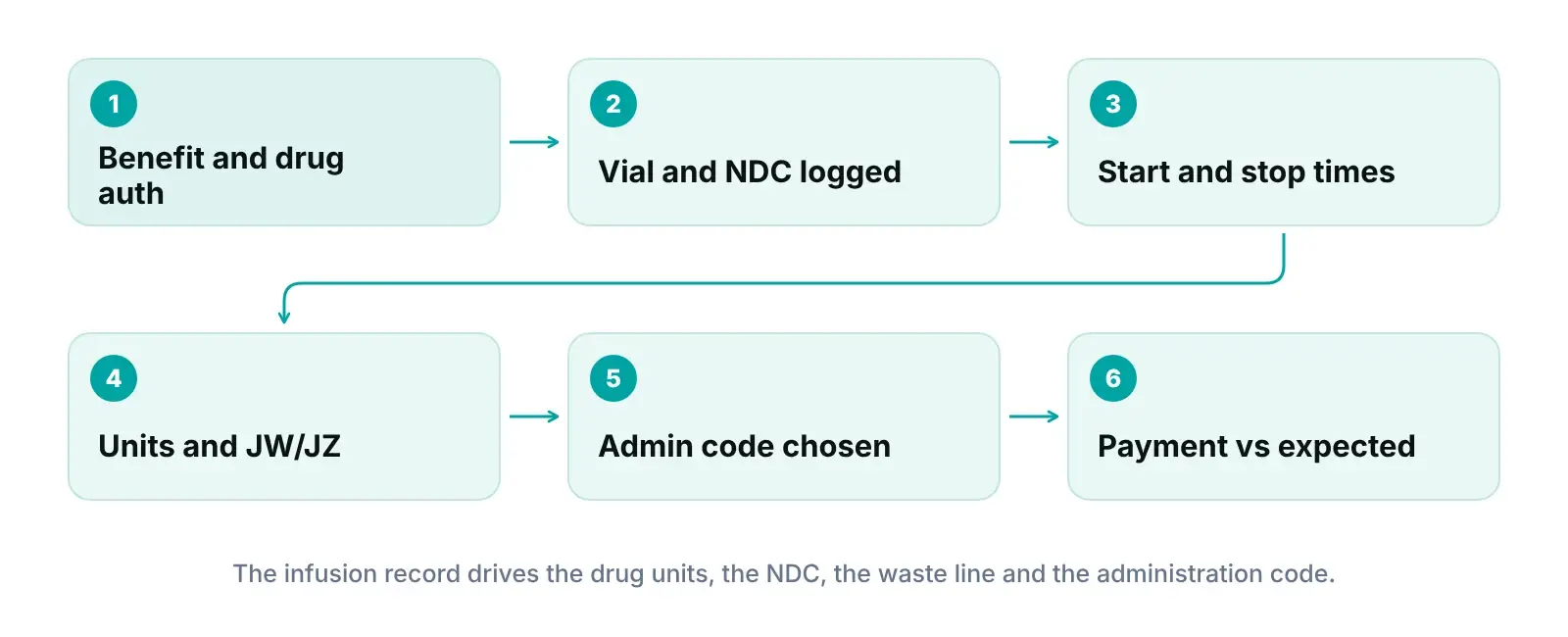
Diagram of a rheumatology biologic infusion moving from benefit check and drug authorization to claim and payment review
How one biologic infusion becomes a clean drug line and administration line.

Drug administration: one initial code per encounter

The Medicare Claims Processing Manual (chapter 12, section 30.5) allows one initial infusion or injection code per encounter unless the protocol requires two IV sites, and the initial code reflects the main reason for the visit. Fluid used only to give a drug is not paid separately. Chemotherapy administration codes can apply to monoclonal antibodies, though contractors weigh more than the drug name. Medicare does not pay 99211 with an infusion or chemotherapy administration code.

In its CY 2026 fee schedule final rule, CMS permanently allowed virtual direct supervision (real-time audio and video) for incident-to services other than those with 10- or 90-day global periods. See also our oncology billing services page and our home infusion and IVIG billing guide.

JW and JZ on every single-dose drug

CMS's JW and JZ modifier FAQ covers separately payable single-dose drugs, including those a physician office bills. The FAQ is undated, but the current version cites the CY 2026 rules. JW puts the discarded amount on its own line. JZ attests that nothing was discarded and has been required on applicable claims since July 1, 2023, per CMS Transmittal 12067 (June 2023). The FAQ says claims without correct modifiers on or after October 1, 2023 may be returned. Neither applies to multi-dose vials. Our J-code billing guide covers the code set itself.

NDCs on drug claims

Under 42 CFR 447.520, state Medicaid programs must require NDCs on physician-administered drug claims to collect rebates. The NUCC 1500 instructions (July 2025) place the N4 qualifier, the NDC without hyphens, a unit qualifier such as ME, ML or UN, and the quantity in the shaded area of item 24. Confirm each payer's rules.

Joint injections and ultrasound guidance

Joint injection codes come in pairs by joint size; the second of each pair includes ultrasound guidance with a permanent recording and report. The 2026 NCCI policy manual bars a separate guidance code when the procedure code includes guidance, and allows one unit per joint even when nearby bursae are injected. For knee injections, see our orthopedic billing services page.

Same-day visits: modifier 25 and G2211

CMS's global surgery booklet (December 2025) includes a same-day visit in a 0-day minor procedure unless it is significant and separately identifiable, billed with modifier 25. NCCI adds that the decision to do the procedure is part of it. A different diagnosis is not required, per the claims manual. Under MLN Matters MM13473, G2211 is not paid on a modifier 25 visit unless the other service is a Part B preventive service, a vaccine administration or an annual wellness visit. See modifiers 25 vs 59.

DXA scans run on a 23-month clock

Under 42 CFR 410.31, Medicare covers bone mass measurement for five groups, including people receiving, or expected to receive, glucocorticoids equal to 5 mg of prednisone or more a day for over three months. The treating practitioner orders it. Coverage is generally once every 23 months, more often when medically necessary, and scans that monitor an osteoporosis drug must use axial DXA. The NCCI radiology chapter allows one axial study per date. For denosumab (J0897), Wellpoint article A52399 requires documented calcium and vitamin D supplementation; other contractors may differ.

Biologic prior authorization, step therapy and payer deadlines

Clear the drug before the infusion is booked: confirm the benefit, send the step-therapy history and log the payer's deadline. Medicare Advantage deadlines are shorter for Part B drugs than for services.

Under 42 CFR 422.568 and 422.572, a Medicare Advantage plan must decide a standard Part B drug request within 72 hours and an expedited one within 24 hours, with no extension. The CMS-0057-F rule set 7-day standard and 72-hour expedited prior authorization deadlines from January 1, 2026, but those requirements exclude drugs.

Medicare Advantage plans may also use step therapy for Part B drugs. 42 CFR 422.136 limits it to new administrations, judged with a lookback of at least 365 days, and requires approval by a pharmacy and therapeutics committee. Send the past year's drug history with the first request.

Appeals pay off. In KFF's January 2026 analysis, Medicare Advantage insurers fully or partly denied 7.7% of 52.8 million prior authorization requests in 2024. Only 11.5% of denials were appealed, and 80.7% of appeals were partly or fully overturned. In the AMA's 2025 survey (published May 2026), physicians averaged 40 prior authorizations and 13 hours of staff and physician time weekly.
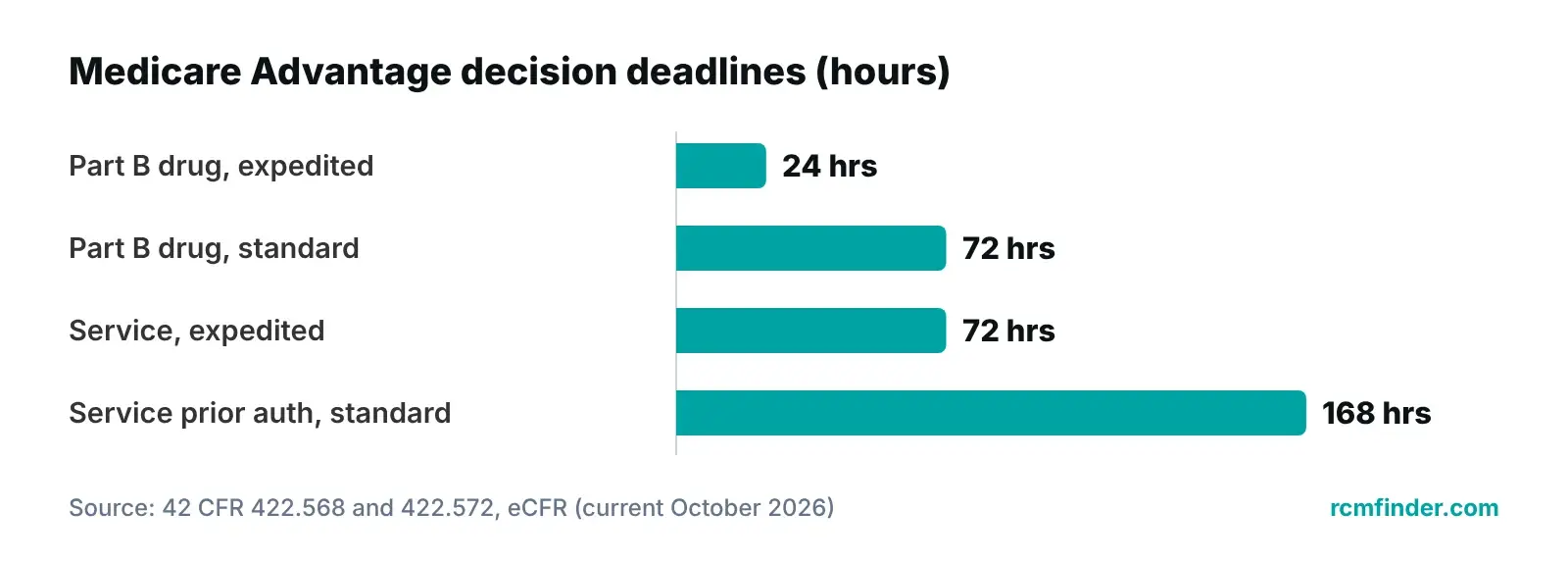
Bar chart comparing Medicare Advantage decision deadlines in hours for Part B drug requests and service requests
Longest allowed decision times for Medicare Advantage plans. The 7-day service deadline is shown as 168 hours; service deadlines can be extended in some cases, drug deadlines cannot.
Pre-infusion checklist: drug coverage and payer rules our VMAs check before the chair is booked
RuleSourceWhat the VMA checks before booking
Drugs on a contractor's self-administered list are excluded from Part B in the officeCGS A52527 (2026); other MACs publish their ownMedical or pharmacy benefit; specialty pharmacy route if self-injected
MA plans decide Part B drug requests in 72 hours, or 24 if expedited, with no extension42 CFR 422.568 and 422.572Request time logged; follow-up when the deadline passes
MA step therapy for Part B drugs: new administrations only, 365-day minimum lookback42 CFR 422.136Past year's drug history sent with the first request
CMS-0057-F's 72-hour and 7-day deadlines exclude drugsCMS-0057-F fact sheet (2024)Drug and service requests tracked on separate clocks
Medicaid requires NDCs on physician-administered drug claims42 CFR 447.520NDC of the stocked vial captured
Off-label rituximab: document failed prior treatments; re-treatment needs a documented responseCGS A58582 (2026)Treatment and response notes on file before a new course
DXA generally once per 23 months unless medically necessary42 CFR 410.31Last DXA date; reason for any early repeat

Sources: Medicare Coverage Database articles A52527 (CGS, version effective 10/08/2026) and A58582 (CGS, version effective 09/03/2026); eCFR 42 CFR 422.568, 422.572, 422.136, 447.520 and 410.31 (current October 2026); CMS-0057-F fact sheet (2024). Always check the member's current plan.

For the general workflow, see our prior authorization guide for providers and our tips to expedite prior authorization for medications.

See what slow approvals and denied drug lines cost you

Enter your claim volume and denial rate to estimate what your practice is losing, then bring the numbers to your audit.

Open the Revenue Calculator

Growing a rheumatology practice through referrals and search

Rheumatology growth starts with primary care referrals, then local search for conditions such as rheumatoid arthritis, gout, lupus and osteoporosis. Tracking must respect HIPAA.

We build location and condition pages and a simple referral path for primary care offices. Review responses never confirm someone is a patient.

HHS guidance on online tracking says tracking on appointment pages may collect protected health information, the vendor then needs a Business Associate Agreement, and a cookie banner is not a HIPAA authorization. A June 2024 court order vacated part of that guidance; we still keep tracking off forms unless the vendor signs a BAA.

  • Referral KPIs: new referrals by office; days from referral to first visit.
  • Patient KPIs: booked consults by source; missed calls.

In-house team, billing-only vendor or four-pillar partner?

Stay in-house if you have experienced infusion coders and front-desk time for drug authorizations. Use a billing-only vendor if claims are your only gap. Choose a combined partner when problems start before the claim.

Decision table: which model fits a rheumatology practice?
JobIn-house teamBilling-only vendorFour-pillar partner (RCM Finder)
Benefit check and drug prior authorizationFront desk, between callsUsually left to the practiceVMA checks the benefit and tracks the request
Drug units, NDC and JW or JZDepends on one billerFixed on the claim, after the factMatched to the infusion record before submission
Biosimilar switchesFound at the first denialUpdated when the practice reports itApproval, code and NDC updated together
Same-day visit and injection codingProvider habitCoded as sentChecked against the note before submission
Referral growth and reviewsA separate agency, or nobodyNot includedMarketing pillar tied to booked consults
Cost structureSalaries, benefits, turnoverVaries; ask how fees are setQuoted after a free practice audit

If you need only one pillar, the audit will say so. Our revenue cycle management services and virtual medical assistant services can be contracted separately.

How it works

We start with a free audit and change nothing until you see the findings.

  1. 1

    Free practice audit

    We review recent infusion, injection and DXA claims, denials and authorization logs against your infusion records.

  2. 2

    Business Associate Agreement and access

    We put a Business Associate Agreement in place before accessing patient data. Then we work inside your existing EHR (for example PrognoCIS, eClinicalWorks or athenahealth).

  3. 3

    Payer-rule map

    Your contractor's self-administered drug list and your plans' drug authorization and step-therapy rules become a checklist and portal workflow rules.

  4. 4

    Front desk and billing go live

    VMAs verify benefits and start drug authorizations. Claims are scrubbed, submitted and worked through denials and A/R.

  5. 5

    Weekly KPI review

    Each week we review denials by reason, A/R days, infusions cleared in advance and drug lines paid below the expected amount.

Talk to us about your infusion suite

Tell us your drug mix, chair count and hardest payer. We will tell you honestly whether we fit.

Call +1 (302) 556-2288

Compliance: what to ask any rheumatology billing company

Any billing vendor handling your patients' data is a HIPAA business associate. Get a Business Associate Agreement before any access, and check how access is limited and logged.

HHS guidance names billing and claims processing as business associate work; subcontractors need their own agreement. The minimum necessary standard limits use and disclosure to what each task needs. The Security Rule's technical safeguards require access control, audit controls, integrity controls, person or entity authentication and transmission security.

  1. Will you and your subcontractors sign a Business Associate Agreement before any access?
  2. How do you limit access, and can we see the audit log?
  3. Who codes our infusions, and what credential and rheumatology experience do they hold?
  4. How do you reconcile drug units, NDCs and JW or JZ with our infusion records?
  5. How do you track self-administered drug lists and new biosimilar codes?
  6. Can we export our data if we leave?

We use role-based access, audit logging and encrypted (HTTPS) connections, and we put a Business Associate Agreement in place before accessing patient data. For your side, use our HIPAA compliance checklist for medical practices.

Who this is for, and who it is not for

We would rather tell you now than after you sign. Here is where we fit and where we do not.

A good fit if you are

  • Independent rheumatology groups with an in-office infusion suite
  • Practices that buy and bill biologics and need every drug line reconciled
  • Practices with heavy prior authorization and step-therapy volume for biologics
  • Multi-specialty groups that share an infusion suite across specialties
  • Billing companies serving rheumatology clients from one portal

Probably not a fit if you are

  • Rheumatologists whose infusions are billed by a hospital outpatient department
  • Practices looking for drug purchasing or specialty pharmacy services; we do not buy or sell drugs
  • Practices that want a fixed price or a promised collection rate before any audit
  • Groups that need a credentialing module or in-portal real-time eligibility today (coming next)

Expert recommendations from our operations team

What we would do first if we were running your practice's revenue cycle tomorrow.

  1. 01

    Reconcile every vial to the claim

    We match each drug line to the infusion record: product, NDC, dose given and amount discarded. Units and modifiers come from that record.

  2. 02

    Check the benefit before the drug is ordered

    We confirm medical or pharmacy benefit, your contractor's self-administered drug list and any specialty pharmacy requirement first.

  3. 03

    Treat a biosimilar switch as a new drug

    A switch changes the code, the NDC and often the authorization. We update all three before the next infusion.

  4. 04

    Chart start and stop times on every infusion

    Infusion codes are billed by the hour, so times must be clear. We also flag any day with two initial administration codes.

  5. 05

    Save modifier 25 for real second work

    We check that the note shows work beyond the decision to inject, and we leave G2211 off those visits unless an exception applies.

  6. 06

    Appeal drug denials

    In KFF's 2024 Medicare Advantage data, most appealed denials were overturned, yet few were appealed. We appeal with the order, drug history and infusion record.

Frequently asked questions

What do rheumatology billing services include?

They cover coding support, claim scrubbing, submission, denial management and A/R follow-up for rheumatology visits, infusions, joint injections and bone density scans. A good service also checks drug claims line by line: the code for the exact product, units, NDC and the JW or JZ modifier. RCM Finder adds front-desk assistants for drug authorizations, referral marketing and a claims portal, so one team owns the process from referral to payment.

When do we use the JW and JZ modifiers on infusion claims?

Use them on separately payable drugs from single-dose containers. If part of the vial is discarded, bill the administered units on one line and the discarded units on a second line with JW. If nothing is discarded, add JZ to the drug line. CMS has required JZ since July 1, 2023, and says claims without correct modifiers on or after October 1, 2023 may be returned. Do not use either for multi-dose vials.

Can we bill an office visit and a joint injection on the same day?

Only when the visit is significant and separately identifiable from the injection. Medicare treats the decision to do a minor procedure as part of it. When there is separate work, such as managing another condition, bill the visit with modifier 25 and document it. Medicare does not pay G2211 on a modifier 25 visit unless the other service is preventive care, a vaccine administration or an annual wellness visit.

Does Medicare Part B pay for biologics we inject in the office?

It depends on the drug. Each Medicare contractor publishes a list of drugs it considers usually self-administered, and those are excluded from Part B when given in the office. CGS's list, for example, includes adalimumab, etanercept and subcutaneous abatacept. Infused drugs such as infliximab have their own Part B codes and are billed with an administration code. Check your contractor's list and the patient's pharmacy coverage before ordering.

How fast must a Medicare Advantage plan decide on a biologic prior authorization?

For a Part B drug, a Medicare Advantage plan must decide a standard request within 72 hours and an expedited request within 24 hours, and it cannot extend either deadline. Plans may use step therapy for Part B drugs, but only for new administrations, with a lookback of at least 365 days. The 7-day deadline that started in 2026 applies to service requests, not drugs.

How often will Medicare pay for a DXA bone density scan?

Generally once every 23 months for people in a covered group, such as estrogen-deficient women at clinical risk, people on long-term glucocorticoids, or people being monitored on an FDA-approved osteoporosis drug. More frequent scans can be covered when medically necessary, for example to monitor glucocorticoid therapy lasting more than three months or to confirm a baseline. The treating practitioner must order the scan, and scans that monitor an osteoporosis drug must use axial DXA.

No cost, no commitment

Get your free practice audit

Tell us about your practice. A member of our operations team replies within one business day.

  • A review of your recent claims, denials and A/R aging
  • Where your front desk and prior authorizations slow payment
  • A prioritized fix list you keep, whether or not you hire us

Pricing is quoted after the audit, based on your volume and the services you choose. Prefer to talk? Call +1 (302) 556-2288.

Tell us about your practice

RCMFinder Master Intake Form
AA

About the author: Awais Afzal

Healthcare Operations & Data Analyst, RCM Finder

Awais has spent more than 16 years in healthcare digital marketing and clinical operations management. He builds data-driven revenue cycle blueprints for high-ticket medical practices and leads product development of the RCM Finder portal. More about our team.

How we write: every figure, code and rule on this page was checked against the primary source listed below and independently fact-checked before publishing. We re-review this page every six months. Last reviewed October 12, 2026; next review April 12, 2027.

Sources

  1. Discarded Drugs and Biologicals – JW Modifier and JZ Modifier Policy: Frequently Asked Questions — CMS (undated (current version cites the CY 2026 PFS and OPPS final rules; accessed 2026-10-10))
  2. Transmittal 12067 (CR 13056): New Claims Modifier Requirement for Drugs and Biologicals from a Single-Dose Container or Single-Use Package — CMS (2023 (issued June 2, 2023))
  3. Medicare Claims Processing Manual, Chapter 12: Physicians/Nonphysician Practitioners — CMS (2026 (Rev. 13753, issued 05-07-26))
  4. 2026 Medicare NCCI Policy Manual, Chapter 4: Surgery: Musculoskeletal System — CMS (2026 (effective Jan 1, 2026))
  5. 2026 Medicare NCCI Policy Manual, Chapter 9: Radiology Services — CMS (2026 (effective Jan 1, 2026))
  6. Global Surgery Booklet (MLN907166) — CMS Medicare Learning Network (2025 (December 2025))
  7. MLN Matters MM13473: How to Use the Office & Outpatient Evaluation and Management Visit Complexity Add-on Code G2211 — CMS Medicare Learning Network (2025 (revised May 1, 2025))
  8. 42 CFR 410.31 Bone mass measurement: Conditions for coverage and frequency standards — eCFR (current (accessed 2026-10-10))
  9. 42 CFR 414.904 Average sales price as the basis for payment — eCFR (current (accessed 2026-10-10))
  10. Part B Drugs Payment Systems (Payment Basics) — MedPAC (2024 (revised October 2024))
  11. ASP Pricing Files (Medicare Part B Drug Payment Limit Files) — CMS (2026 (October 2026 files posted 09/17/2026))
  12. Self-Administered Drug Exclusion List and Biologicals Excluded from Coverage (A52527) — CMS Medicare Coverage Database (CGS) (2026 (version effective 10/08/2026, R66 annual review with no changes; 'Currently in Effect'; page shows a generic 'Draft Article' banner))
  13. Billing and Coding: Off-label Use of Rituximab and Rituximab Biosimilars (A58582) — CMS Medicare Coverage Database (CGS) (2026 (version effective 09/03/2026, R12; 'Currently in Effect'; page shows a generic 'Draft Article' banner))
  14. Billing and Coding: Denosumab (Prolia, Xgeva, Jubbonti) and biosimilars (A52399) — CMS Medicare Coverage Database (Wellpoint Federal) (2026 (version effective 10/01/2026; 'Currently in Effect'; page shows a generic 'Draft Article' banner))
  15. 42 CFR 422.568 Standard timeframes and notice requirements for organization determinations — eCFR (current (accessed 2026-10-10))
  16. 42 CFR 422.572 Timeframes and notice requirements for expedited organization determinations — eCFR (current (accessed 2026-10-10))
  17. 42 CFR 422.136 Medicare Advantage (MA) and step therapy for Part B drugs — eCFR (current (accessed 2026-10-10))
  18. CMS Interoperability and Prior Authorization Final Rule (CMS-0057-F) fact sheet — CMS (2024 (January 17, 2024))
  19. Medicare Advantage Insurers Made Nearly 53 Million Prior Authorization Determinations in 2024 — KFF (2026 (January 28, 2026))
  20. AMA survey: Prior authorization reform pledge falls short with physicians — American Medical Association (2026 (May 13, 2026))
  21. 42 CFR 447.520 FFP: Conditions relating to physician-administered drugs — eCFR (current (accessed 2026-10-10))
  22. 1500 Health Insurance Claim Form Reference Instruction Manual, Version 13.0 — National Uniform Claim Committee (NUCC) (2025 (July 2025))
  23. Calendar Year (CY) 2026 Medicare Physician Fee Schedule Final Rule (CMS-1832-F) fact sheet — CMS (2025 (October 31, 2025))
  24. 3 pharmacy terms you might not know — Mass General Brigham Health Plan (blog) (2018 (per URL; no date shown))
  25. White Bagging, Brown Bagging & Other Prescription Drug Laws — Triage Cancer (2024 (chart last updated 1/18/2024))
  26. Business Associates — HHS Office for Civil Rights (2026 (content last reviewed July 30, 2026))
  27. Minimum Necessary Requirement — HHS Office for Civil Rights (2003 (revised April 4, 2003; content last reviewed July 26, 2013))
  28. 45 CFR 164.312 Technical safeguards — eCFR (current (accessed 2026-10-10))
  29. Use of Online Tracking Technologies by HIPAA Covered Entities and Business Associates — HHS Office for Civil Rights (2024 (reviewed June 26, 2024))
  30. CPT 96365 code summary — AAPC (secondary; used for plain-language code meaning only) (accessed 2026-10-10)
  31. CPT 96366 code summary — AAPC (secondary; used for plain-language code meaning only) (accessed 2026-10-10)
  32. CPT 96413 code summary — AAPC (secondary; used for plain-language code meaning only) (accessed 2026-10-10)
  33. CPT 96415 code summary — AAPC (secondary; used for plain-language code meaning only) (accessed 2026-10-10)
  34. CPT 96372 code summary — AAPC (secondary; used for plain-language code meaning only) (accessed 2026-10-10)
  35. HCPCS J1745 code summary — AAPC (secondary; used for plain-language code meaning only) (accessed 2026-10-10)
  36. HCPCS Q5103 code summary — AAPC (secondary; used for plain-language code meaning only) (accessed 2026-10-10)
  37. HCPCS J0129 code summary — AAPC (secondary; used for plain-language code meaning only) (accessed 2026-10-10)
  38. HCPCS J3262 code summary — AAPC (secondary; used for plain-language code meaning only) (accessed 2026-10-10)
  39. CPT 20600 code summary — AAPC (secondary; used for plain-language code meaning only) (accessed 2026-10-10)
  40. CPT 20604 code summary — AAPC (secondary; used for plain-language code meaning only) (accessed 2026-10-10)
  41. CPT 20605 code summary — AAPC (secondary; used for plain-language code meaning only) (accessed 2026-10-10)
  42. CPT 20606 code summary — AAPC (secondary; used for plain-language code meaning only) (accessed 2026-10-10)
  43. CPT 20610 code summary — AAPC (secondary; used for plain-language code meaning only) (accessed 2026-10-10)
  44. CPT 20611 code summary — AAPC (secondary; used for plain-language code meaning only) (accessed 2026-10-10)
  45. CPT 77080 code summary — AAPC (secondary; used for plain-language code meaning only) (accessed 2026-10-10)
  46. CPT 77085 code summary — AAPC (secondary; used for plain-language code meaning only) (accessed 2026-10-10)