
J-codes in medical billing are HCPCS Level II codes that begin with J, and most identify drugs given by injection or infusion. A J-code names the drug and one billing unit. A clean drug claim also needs the right units, a JW or JZ modifier when it applies, and an NDC if the payer asks.
This guide is for practice owners, managers and new billers who see J-codes on a superbill and want to understand what the line means before they troubleshoot a denial. It explains what the code does, how to count units, how JW and JZ work, and when the NDC matters. Payer rules vary, so confirm each point against your payer’s current policy.
Key takeaways
- A J-code names a drug and one billing unit. It does not describe the injection or the dose given.
- Billing units come from the code descriptor, so divide the dose by the unit size.
- JW and JZ apply to separately payable Medicare Part B drugs from single-dose containers, and not to multiple-dose containers.
- NDC rules depend on the payer. Medicare requires it only for dually eligible patients, per one contractor.
- CMS updates the HCPCS file every quarter, so check drug codes on the same schedule.
What are J-codes in medical billing?
J-codes are HCPCS Level II codes that start with the letter J. Level II is the alphanumeric code set, one letter followed by four digits, that CMS maintains for products and services the CPT book does not cover (CMS, HCPCS overview, 2026). The J range is where most drugs given by injection or infusion are coded, so any practice that gives drugs in the office will see these codes on its claims.
A J-code names a drug and a billing unit. It does not say how the drug was given, who gave it, or how much was drawn into the syringe. That detail lives in the chart and in other parts of the claim. The J-code is one piece of a drug line, and most drug-claim problems come from the pieces around it.
| Item | What it is | What it tells the payer | Where it sits |
|---|---|---|---|
| CPT code (Level I) | Five-digit code maintained by the AMA | The procedure or service performed, such as giving an injection | Its own claim line |
| J-code (Level II) | One letter plus four digits, maintained by CMS | Which drug, and the size of one billing unit | The drug line |
| JW or JZ modifier | HCPCS Level II modifiers | Whether any drug was thrown away from a single-dose container | Added to the J-code line |
| NDC | Eleven-digit product number, reported with the N4 qualifier | The exact product and package that was used | Shaded area of Item 24 on paper, or the 2410 loop on electronic claims |
Source: CMS HCPCS overview (2026); CMS JW/JZ Modifier FAQs; First Coast Service Options, Reporting the national drug code (2026)
The injection or infusion itself is a separate service from the drug. For the administration side, see our 96372 CPT code guide, which shows how the injection line and the drug line sit together on one claim.
How is a drug claim line built?
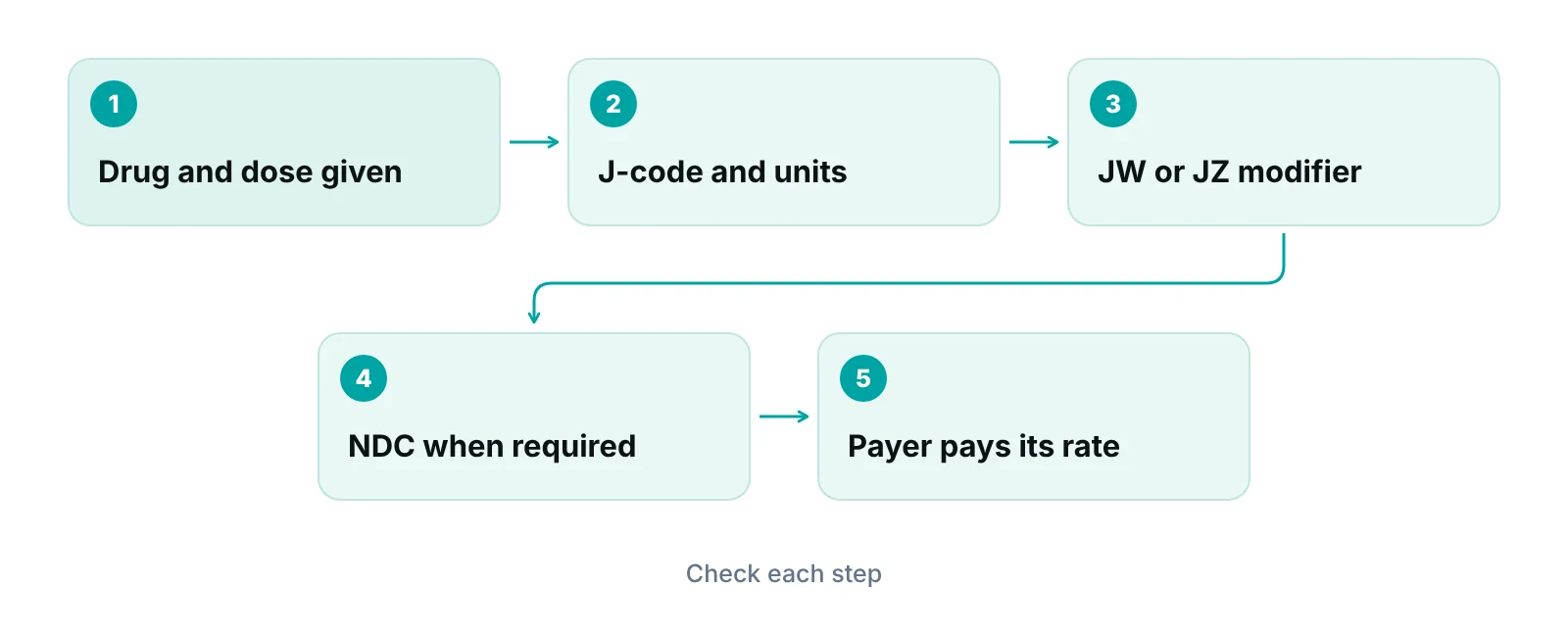
A clean drug line has four parts: the right code for the date of service, the right number of units, a JW or JZ modifier when the payer requires one, and an NDC when the payer asks for it. Each part has its own rule, and each is a common point of failure.
- Pick the code from the current file. Use the code that was valid on the date of service, not the one saved in an old superbill.
- Convert the dose to billing units. Read the code descriptor, which states the amount in one unit, and divide the dose by it.
- Add JW or JZ if the rule applies. This applies to separately payable Medicare Part B drugs from single-dose containers.
- Add the NDC if the payer requires it. Requirements differ by payer.
- Check coverage and payment. A correct code does not mean the payer covers the drug for that diagnosis or setting.
Charge entry is where most of these steps happen. Our guide to charge entry in medical billing explains how a charge becomes a claim line, and the clean claims guide covers the checks that catch errors before submission.
How do you count billing units for a J-code?
Billing units come from the code descriptor, not from the total amount in the syringe or vial. If the descriptor says a unit is 10 mg, a 60 mg dose is 6 units. A First Coast Service Options article makes the same point with a 30 mg dose billed under a 5 mg code, which is 6 units (First Coast Service Options, 2026).
Do not bill the milligrams
Entering the dose in milligrams as the unit count is a common reason a drug line pays far too much, far too little, or denies. Read the descriptor first, then divide.
The next table shows how units, JW and JZ combine. The drug, descriptor and vial sizes are made up for illustration. They show the method, not a real code.
| Situation | Dose and container | What goes on the claim | Why |
|---|---|---|---|
| Whole vial used | 50 mg given from a 50 mg single-dose vial | One line: 5 units with JZ | Nothing was discarded |
| Part of a vial used | 60 mg given from a 100 mg single-dose vial | Line 1: 6 units, no modifier. Line 2: 4 units with JW | Given units and discarded units go on separate lines |
| Dose smaller than one unit (unit set at 5 mg) | 4 mg given from a single-dose vial | One line: 1 unit with JZ | CMS says to bill the full unit, because fractional units are not used |
| Multiple-dose container | Any dose | Units given, no JW or JZ | The modifiers do not apply to multiple-dose containers |
Method source: CMS JW/JZ Modifier FAQs. Drug, dose and vial sizes are hypothetical.
“A J-code names the drug and the size of one billing unit. It does not name the vial, so the unit count has to come from the dose and the descriptor.”
What are the JW and JZ modifiers, and when are they required?
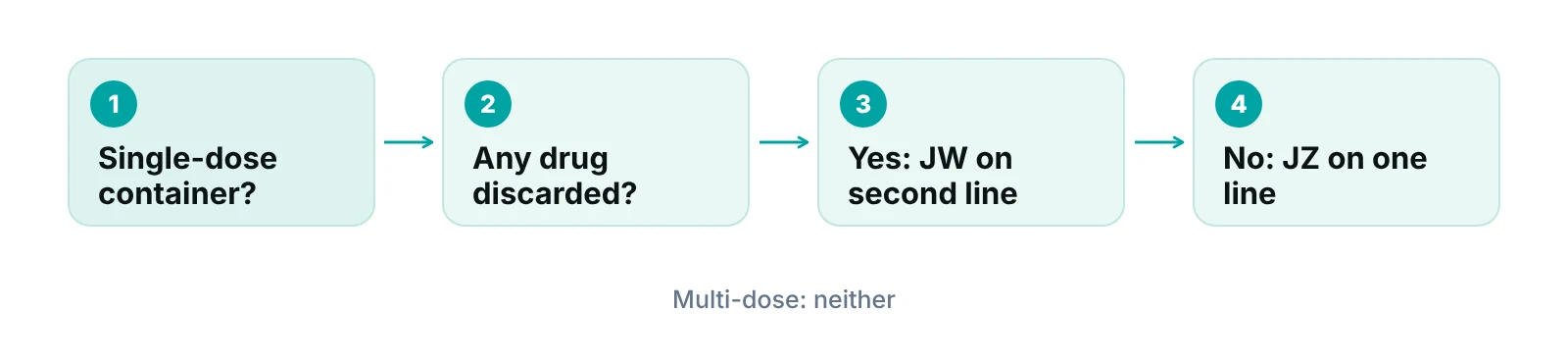
JW reports drug that was discarded and is eligible for payment. JZ states that no drug was discarded. Both apply to separately payable Medicare Part B drugs given from single-dose or single-use containers, and they are not used for multiple-dose containers (CMS JW/JZ Modifier FAQs).
Medicare pays for the discarded amount as well as the dose given, up to the amount stated on the container label. When some drug is discarded, the claim carries two lines with the same code: the given units with no modifier, and the discarded units with JW. When none is discarded, the claim carries one line with JZ.
When the modifiers do not apply
CMS lists several exclusions. Knowing them avoids adding a modifier where it does not belong:
- Drugs from multiple-dose containers.
- Drugs that are not separately payable, for example OPPS status indicator N or ASC payment indicator N1 drugs, and drugs in rural health clinics and federally qualified health centers.
- Drugs on inpatient IPPS claims, where drugs are not separately payable.
- Certain section 1861(s)(10) vaccines from single-dose containers.
- Overfill. JW must not be used to report it.
| Date | What changed |
|---|---|
| January 1, 2017 | JW required on claims for discarded drug |
| January 1, 2023 | JZ became available; refund calculations using JW and JZ data began |
| July 1, 2023 | JZ required; claims reporting neither modifier may be subject to provider audits |
| October 1, 2023 | Claims that do not report the modifiers as appropriate may be returned as unprocessed until corrected and resubmitted |
Source: CMS JW/JZ Modifier FAQs
For skin substitutes that are not BLA products, CMS says that from January 1, 2026, JZ is not appropriate when the entire product is administered, and discarded units cannot be billed. If your practice uses these products, read the FAQ section on them directly. Private payers may follow or ignore Medicare’s approach, so check each payer’s policy.
When does the NDC go on the claim?
The NDC identifies the exact drug product and package. Whether you must report it depends on the payer. First Coast Service Options states that NDCs are not required on Medicare claims unless the patient is dually eligible for Medicare and Medicaid, a requirement tied to Medicaid drug rebates (First Coast Service Options, 2026). Other payers set their own rules, so check the contract or provider manual.
When an NDC is needed, the same article describes the format. On a paper claim, the qualifier N4 is followed by the eleven-digit NDC with no hyphens, then the quantity and a unit qualifier. On an electronic claim, the NDC is reported in the 2410 loop, with LIN02 set to N4. If two NDCs apply to one drug, the second goes in Item 19 of the CMS-1500 rather than on a second drug line, because duplicate lines lead to duplicate denials. Our CMS-1500 claim form guide walks through the form fields.
The NDC and the J-code describe the same drug in two ways, so they must agree. CMS publishes a quarterly NDC-to-HCPCS crosswalk next to its payment files (CMS, ASP pricing files, 2026). A mismatch between the code and the NDC on the claim is worth checking before you submit.
How are drugs covered and paid, and how often do the codes change?
Medicare Part B covers drugs given incident to a physician’s service only if they are not usually self-administered. CMS manual text says each contractor decides this drug by drug, and contractors must publish how they decide and a list of excluded injectable drugs (CMS Benefit Policy Manual, Chapter 15, section 50.2). Check your contractor’s list before assuming an injectable is covered.
Payment is set by quarterly files. CMS posts Medicare Part B payment limit files and NDC-HCPCS crosswalks each quarter, and says a drug’s presence or absence in the file does not show whether Medicare covers it (CMS, 2026). A CMS transmittal from June 2026 states that the October 2026 file covers dates of service October 1 through December 31, 2026, and that contractors make no further payment calculations (CMS Transmittal 13831, 2026).
The codes themselves also move. CMS posts a new alphanumeric HCPCS file every quarter. The 2026 files are dated January, April, July and October, and the October 2026 file was posted on September 23, 2026 (CMS, HCPCS quarterly update, 2026). CMS also accepts applications for new drug and biological codes four times a year (CMS, 2026). A code that was valid in one quarter may be replaced in the next, so load each quarterly file into your billing system and your charge master, and review drug codes on the same schedule.
Where do J-code claims go wrong?
Most J-code denials trace to a handful of causes, and each one can be checked before the claim leaves the office. Use this as a pre-submission list:
- Wrong units. The dose in milligrams was entered where billing units belong.
- Missing JW or JZ. A single-dose Part B drug went out with neither modifier, which can lead to the claim being returned as unprocessed.
- Modifier on the wrong drug. JW or JZ was added to a multiple-dose container drug or to a drug that is not separately payable.
- Old code. The charge master still holds a code from a previous quarter.
- NDC mismatch or missing NDC. The NDC does not match the code, or it was left off for a payer that requires it.
- Coverage. The drug is on the contractor’s list of usually self-administered drugs, or the payer limits it by diagnosis.
Practices that give many drugs, such as oncology practices, feel these errors most, because one drug line can carry a large charge. Our oncology CPT codes guide covers the administration side for that specialty, and the home infusion and IVIG coding essentials post covers infusion billing at home. If a modifier decision is unclear on the same visit, our explainer on modifier 25 versus modifier 59 covers the two most-debated modifiers.
Not sure where your drug claims leak?
A free practice audit looks at your drug lines, units and modifiers against your denials, and shows where to fix the process first.
When a drug claim does deny, the reason code points to the cause. Our guide to medical billing denial management covers how to work denials by cause so the same error stops repeating, and our medical billing services page describes how outsourced billing can take this work on.
Our recommendations
- Build a quarterly code check into the calendar. We recommend one named person load each quarterly HCPCS file, compare it to the charge master, and sign off before the first claim of the quarter goes out.
- Store the billing unit next to every drug in the charge master. Record the descriptor’s unit size (for example, per 10 mg) beside each drug so staff convert the dose to units the same way every time.
- Record waste in the chart. Ask clinical staff to document the dose given and the amount discarded from each single-dose container, so JW and JZ lines can be built from the note.
- Make the modifier a claim-edit rule. Set the billing system to flag a single-dose Part B drug line that has neither JW nor JZ, and to flag a modifier on a multiple-dose or non-payable drug.
- Keep a payer sheet for NDC rules. List which payers require NDCs, the format they want, and where the second NDC goes. Update it when a contract or manual changes.
Bottom line
J-codes are simple to define and easy to get wrong in practice, because the code is only one part of a drug line. Get the units, modifiers and NDC right and most drug claims pay on the first pass. If drug denials are piling up, our denial management services can trace them to their causes, and a free practice audit is the quickest way to see where your drug lines leak.
Frequently asked questions
What is a J-code in medical billing?
A J-code is a HCPCS Level II code that begins with the letter J. It identifies a drug, usually one given by injection or infusion, and sets the size of one billing unit. The code does not describe the injection itself or the dose given. Units, modifiers and the NDC are added separately on the claim line.
Is a J-code the same as a CPT code?
No. CPT is Level I of HCPCS, maintained by the AMA, with five-digit codes for procedures and services. J-codes are Level II, maintained by CMS, with one letter and four digits. On a typical drug visit the claim carries a CPT code for the service and a J-code for the drug.
What do the JW and JZ modifiers mean?
JW means drug was discarded from a single-dose container and is eligible for payment. JZ means no drug was discarded. For Medicare Part B, one of them is expected on separately payable single-dose container drugs. Neither applies to multiple-dose containers. Check each private payer’s policy, since rules vary.
Do I need to report the NDC with a J-code?
It depends on the payer. A Medicare contractor article says NDCs are not required on Medicare claims unless the patient is dually eligible for Medicare and Medicaid. Other payers set their own rules. When required, the NDC uses the N4 qualifier and eleven digits with no hyphens.
How often do J-codes change?
CMS publishes an updated alphanumeric HCPCS file every quarter, in January, April, July and October, and takes drug code applications quarterly. Medicare Part B payment limits also update each quarter. Review your drug codes and charge master on that same schedule.
Why did my drug claim deny when the J-code was correct?
The code is only one part of the line. Common causes are the wrong number of units, a missing JW or JZ modifier, a modifier on a drug that does not take one, an NDC that does not match, or a drug the payer does not cover for that diagnosis. Read the denial reason code first.
Get your free practice audit
Tell us about your practice. We will contact you using the details you give.
- A review of your recent claims, denials and A/R aging
- Where your front desk and prior authorizations slow payment
- A prioritized fix list you keep, whether or not you hire us
Pricing is quoted after the audit, based on your volume and the services you choose. Prefer to talk? Call +1 (302) 556-2288.
Sources
- JW Modifier FAQs — CMS (2026)
- Healthcare Common Procedure Coding System (HCPCS) — CMS (2026)
- HCPCS Quarterly Update — CMS (2026)
- ASP Pricing Files — CMS (2026)
- Transmittal 13831, Change Request 14521 — CMS (2026)
- Reporting the national drug code — First Coast Service Options (Medicare Administrative Contractor) (2026)
- Medicare Benefit Policy Manual, Chapter 15, section 50.2 (transmittal R123BP) — CMS
Disclaimer: This article is for education only. It is not legal, coding or compliance advice. Coding and payer rules change often and differ by payer and state. Confirm current requirements with your payer, your Medicare Administrative Contractor and the official code sets before you bill.
