Denial management in healthcare is the process of tracking each denied claim, finding its reason code, correcting or appealing it before the payer’s deadline, and fixing the cause so it stops recurring. Every denied claim is work your practice already did and has not been paid for.
The scale is real. This guide covers the process, the reason codes that recur, appeal deadlines, and when to use in-house work, software, or outsourced services.
Denial vs. rejection. A rejection is stopped before adjudication, usually for a data error, and can be corrected and resubmitted without an appeal. A denial follows adjudication and needs a corrected claim or a formal appeal. Denial management in medical billing depends on tracking the two separately, which keeps your denial rate honest.
Educational content, not individualized advice. This article does not provide coding, legal, tax, or compliance advice. Codes, payer policies, and deadlines change. Verify current code definitions and rules against CMS and your own payer contracts before acting.
How Common Are Claim Denials? Benchmarks Physicians Should Know
Denial rates vary by payer, care setting, and how they are measured. A Premier survey of 280 hospitals found an initial denial rate of nearly 15 percent on 2023 claims, and KFF found that ACA marketplace insurers denied 19 percent of in-network claims in 2024. Neither is a physician-practice benchmark, so measure your own and compare it with HFMA’s published targets below.
| Metric | Figure | Population measured | Source and date |
|---|---|---|---|
| Initial denial rate | Nearly 15% | 280 U.S. hospitals, 2023 claims | Premier Inc., Feb. 24, 2025 |
| Denials overturned and paid | Approximately 70% | Same hospital survey | Premier Inc., Feb. 24, 2025 |
| Cost per appealed claim | $57.23 (up from $43.84 in 2022) | Same hospital survey | Premier Inc., Feb. 24, 2025 |
| Denied claims that had prior authorization | 10.4% (up from 3.2% in 2022) | Same hospital survey | Premier Inc., Feb. 24, 2025 |
| In-network claims denied | 19% | Insurers on HealthCare.gov, 2024 | KFF, Mar. 24, 2026 |
| Denials appealed internally | Less than 1% | Insurers on HealthCare.gov, 2024 | KFF, Mar. 24, 2026 |
| Appealed denials upheld by insurer | 66% | Insurers on HealthCare.gov, 2024 | KFF, Mar. 24, 2026 |
The two datasets disagree on appeal outcomes: Premier reports about 70 percent of hospital denials overturned, while KFF reports insurers upheld 66 percent of appealed marketplace denials. That gap is the reason your own appeal outcomes by payer matter more than any published average.
Both sources agree on one point. Few denials are appealed, and many that are appealed get paid.
| Metric | HFMA figure | Note |
|---|---|---|
| Denial rate | Industry average 5% to 10%; optimal under 5% | Defined as the dollar amount of denied claims divided by the dollar amount of claims submitted in the same period |
| Denial resolution | 85% of denials resolved within 30 days | Resolution target |
| Clean claims rate | 98% target | Higher is better |
| Days in accounts receivable (A/R) | Ideal range 30 to 40 days; A/R over 90 days under 10% | Average days for a provider to be paid for a service |
Source: HFMA, 7 KPIs providers should be tracking, published Apr. 6, 2023, updated Sept. 11, 2024. General guidance for provider organizations, not a specialty-specific benchmark.
HFMA’s 5 to 10 percent average is dollar-based, and Premier’s near-15 percent figure counts hospital claims, so the two are not directly comparable. Pick one formula, apply it every month, and compare your practice against its own trend first.
Here is illustrative arithmetic, not a benchmark. Consider a 6-provider group that submits 2,000 claims a month and sees a 10 percent denial rate. That is 200 denials to work each month. At Premier’s $57.23 per appealed claim, rework alone costs about $11,446 a month in staff time, before counting revenue never recovered.
Run the same arithmetic against your own claim volume and denial rate. The Revenue Calculator takes about two minutes and needs no account setup.
What Is the Denial Management Process in Medical Billing?
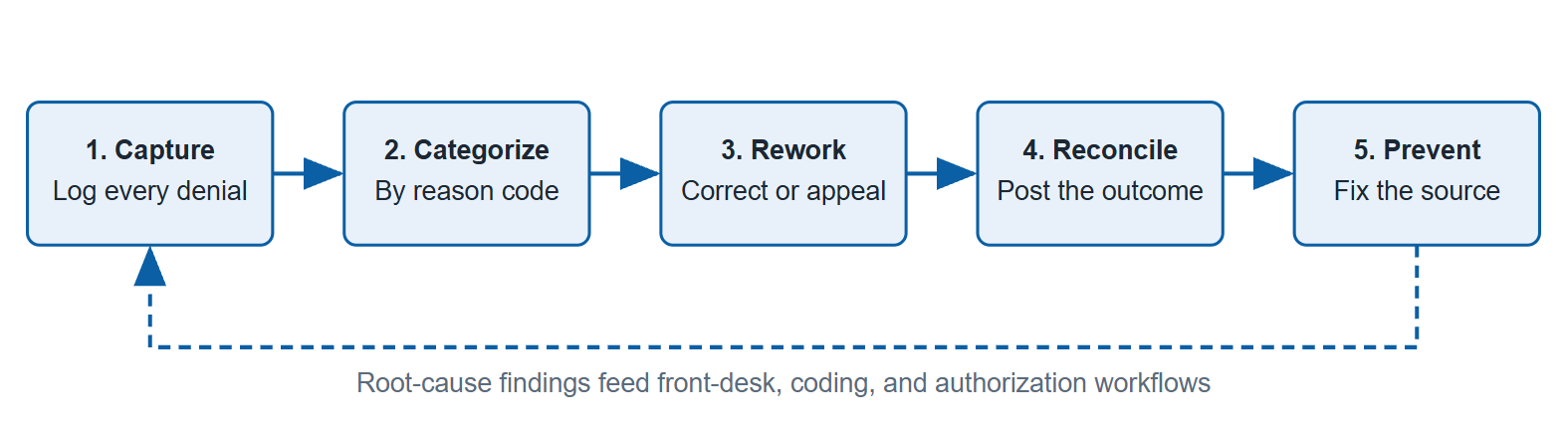
The denial process in medical billing runs in five stages: capture and track every denial, categorize it by reason code, rework or appeal it inside the payer’s deadline, post and reconcile the outcome, and fix the upstream cause. Most practices complete the first three and skip the last two, so the same denials return next month.
How do you capture and categorize denials?
Post the electronic remittance advice (ERA) the day it arrives and log each denial with payer, reason code, dollar amount, and the last date to appeal. Then sort by cause: front-end problems such as eligibility, registration, and prior authorization; coding and charge-capture problems; medical necessity; and timely filing. Categories decide who fixes the problem.
How do you rework and reconcile a denied claim?
Correctable errors go back as corrected claims. Disputed decisions go to appeal with the supporting documentation attached. Medical claim denial management works best when every rework has an owner and a due date. Post every result, including write-offs, so you can see appeal outcomes by payer at the end of each quarter.
How do you prevent repeat denials?
Prevention is where a denial program earns its keep. In Premier’s hospital survey, 10.4 percent of denied claims had been pre-approved through prior authorization in 2023, up from 3.2 percent in 2022, so even authorized services need a claim-level check. When one code keeps returning, the fix belongs at the source, whether that is a front-desk eligibility check, a coder edit, or an authorization step, rather than in another round of rework. RCM Finder’s guide to eligibility verification shows how one intake control protects revenue downstream.
Free Practice Audit
If your team already works denials but the same codes return every month, the Free Practice Audit starts with your last 30 days of claims and maps where revenue is leaking, before you change anything in your current workflow.
Why Are Claims Denied? Reason Codes and How to Prevent Them
Claims are denied for a short list of recurring reasons: registration and eligibility errors, missing authorization, coding and modifier conflicts, missing documentation, and expired filing limits. On the remittance, each appears as a Claim Adjustment Reason Code (CARC) paired with a group code such as CO (contractual obligation) or PR (patient responsibility).
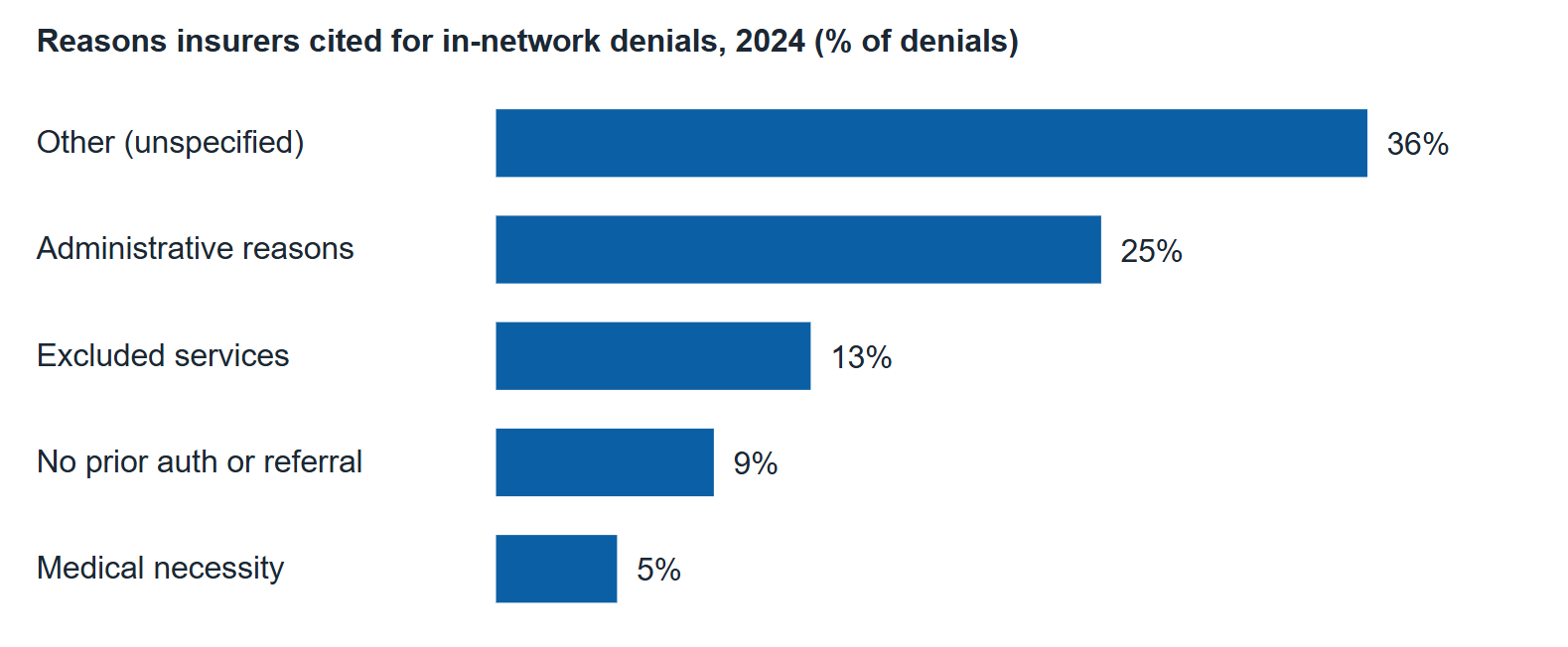
The largest bucket, 36 percent, is “other.” When payers label a third of denials that vaguely, your own CARC-level tracking becomes the only reliable view of why your claims fail. The table below lists CARCs that recur in physician billing, using X12’s published descriptions.
| CARC | X12 description | Common cause | Prevention tactic |
|---|---|---|---|
| 4 | “The procedure code is inconsistent with the modifier used.” | Missing or wrong modifier | Add a modifier edit to your claim-scrubbing step |
| 16 | “Claim/service lacks information or has submission/billing error(s).” | Blank or invalid fields | Scrub every claim before submission |
| 18 | “Exact duplicate claim/service” | Resubmission of a pending claim | Check claim status before resubmitting |
| 22 | “This care may be covered by another payer per coordination of benefits.” | Outdated insurance on file | Verify coverage and payer order at each visit |
| 29 | “The time limit for filing has expired.” | Late submission | Alert on unsent charges by days since service |
| 50 | Denied because “this is not deemed a ‘medical necessity’ by the payer.” | Documentation does not support the service | Check payer coverage policy before the visit |
| 97 | “The benefit for this service is included in the payment/allowance for another service/procedure that has already been adjudicated.” | Bundling conflict | Review code pairs and modifiers with a certified coder |
| 197 | “Precertification/authorization/notification/pre-treatment absent.” | Authorization not obtained | Confirm authorization before scheduling |
| 252 | “An attachment/other documentation is required to adjudicate this claim/service.” | Records not sent | Attach documentation on the first submission |
Source: X12 Claim Adjustment Reason Codes, retrieved Sept. 23, 2026. Common-cause and prevention columns are RCM Finder operational guidance, not X12 text.
Group codes change who bears the balance. CO adjustments are generally written off under the payer contract, while PR amounts shift to the patient. Confirm the treatment in your own contract. Coding denial management services, in-house or outsourced, should route denials such as CARC 4 and 97 to a certified coder; coding compliance audits are outside the scope of this article.
How Do You Work Denials and Appeal Before the Deadline?
Work denials by dollars at risk and days left to appeal, not by the order they arrived. Correctable errors go back as corrected claims. Disputed decisions go to appeal with documentation attached. Deadlines differ by payer, so the date on the denial notice and your contract control, not a rule of thumb.
For Original Medicare, the first appeal level, redetermination, must be filed by the deadline on the Medicare Summary Notice. The MAC and the QIC each have 60 days to decide, and later levels carry 180-day and 60-day filing limits. Medicare Advantage and commercial plans set their own appeal windows in the provider contract.
| Level | Appeal stage | Filing deadline |
|---|---|---|
| 1 | Redetermination by the Medicare Administrative Contractor (MAC) | Date shown on the Medicare Summary Notice (MSN) |
| 2 | Reconsideration by a Qualified Independent Contractor (QIC) | 180 days after the MAC decision letter or MSN |
| 3 | Hearing at the Office of Medicare Hearings and Appeals (OMHA) | 60 days after the QIC decision; $200 minimum amount in 2026 |
| 4 | Medicare Appeals Council review | 60 days after receiving the administrative law judge’s decision |
| 5 | Federal district court | 60 days after the Appeals Council decision; $1,960 minimum amount in 2026 |
Source: Medicare.gov (CMS), Appeals in Original Medicare, retrieved Sept. 23, 2026. Amounts and dates change; confirm on CMS.gov before filing.
Speed matters because appeals are rare. KFF found fewer than 1 percent of denied marketplace claims were appealed internally. A practice that sets an internal deadline at half the payer’s window, and appeals what it can document, is doing something most practices do not.
Free Practice Audit
To see how much denied revenue is sitting unworked in your queue, the Free Practice Audit reviews your last 30 days of claims and quantifies it, at no cost or commitment.
Should You Handle Denials In-House, Buy Denial Management Solutions, or Outsource?
Handle denials in-house when one trained biller can clear the queue inside the appeal window. Buy denial management solutions, meaning software, when volume outgrows manual tracking. Hire denials management services when denial follow-up competes with front-desk work you cannot drop. The deciding metric is how many denials age past 30 days unworked.
| Approach | Best when | Who owns the queue | Main limit |
|---|---|---|---|
| In-house team | One trained biller can clear the queue inside every appeal window | Your billing staff | Queue stalls when the biller is out or overloaded |
| Denial management solutions (software) | Volume outgrows spreadsheets and manual tracking | Your staff, using the software | Tracks and reports; does not call payers or write appeals |
| Denials management services (outsourced) | Denial follow-up competes with front-desk work | The service, with your oversight | Needs payer-by-payer reporting you can see |
| RCM Finder (analytics plus services) | You want our own practice management system visibility and hands-on denial work | Shared: RCM Finder works denials, you review dashboards | Scope and pricing are set in the Free Practice Audit |
Qualitative comparison based on RCM Finder’s operational experience; it contains no statistics.
What do denial management solutions do, and where do they stop?
Denial management software tracks, categorizes, and reports. It does not call payers, gather records, or write appeal letters, so someone on your staff still owns the queue. Manual rework compounds rapidly at Premier’s $57.23 per appealed claim (hospitals, 2023). That gap is why practices often add analytics and services together rather than choosing one.
What does RCM Finder provide for denial management?
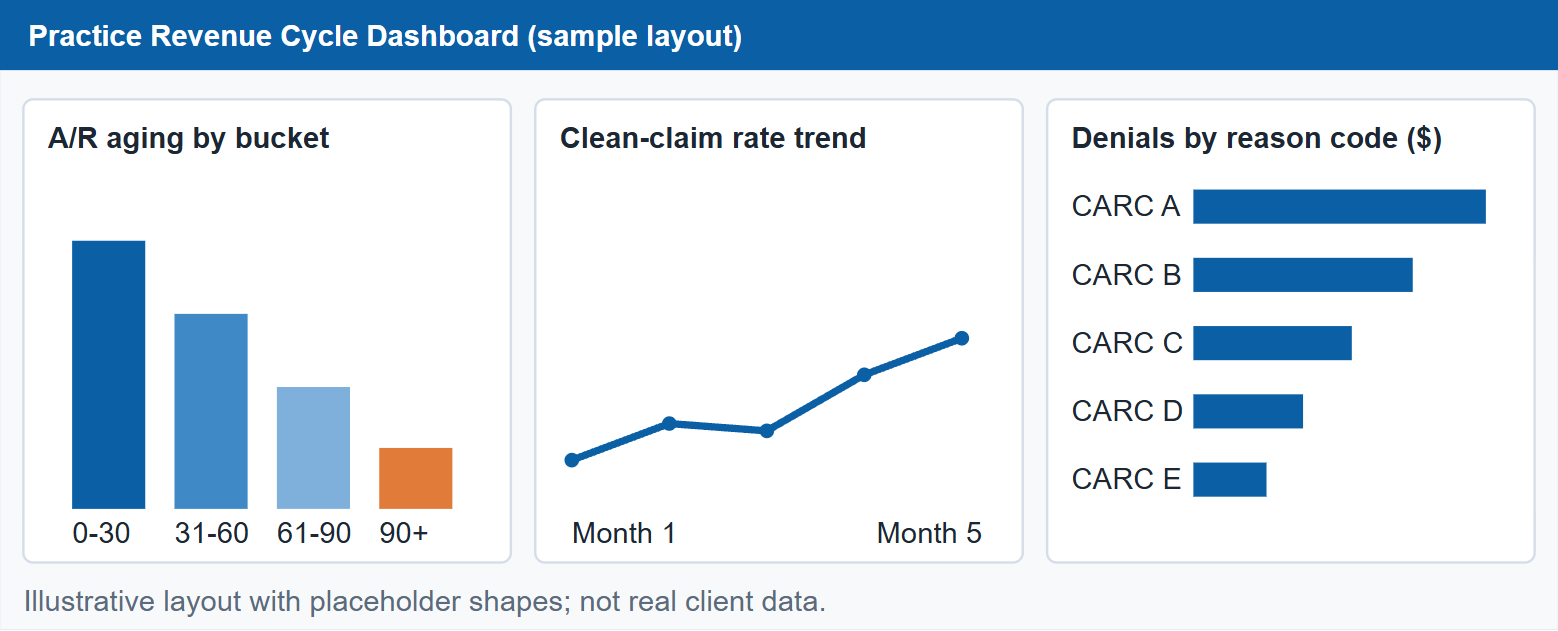
RCM Finder is an RCM Analytics and Workflow Automation Platform for medical practices. Its RCM denial management work sits inside a revenue cycle management service that covers billing, coding, denial management, claim scrubbing, and compliant follow-ups to reduce A/R days. Its dashboards in our own practice management system show the claim pipeline, collection metrics, and denials by reason code, and its Virtual Medical Assistants, who work under a Business Associate Agreement, handle prior authorizations and scheduling. See the full list of services and the specialties supported.
What questions should you inquire about to any denial management service in the United States?
Inquire about who controls each rejection from reception to resolution, how payers report appeal decisions, whether reporting is visible to you in real time, which EHRs the service works with, and what security attestations it has. RCM Finder’s answers: dashboard visibility, PrognoCIS, eClinicalWorks, and Athenahealth integration, and operations under a signed Business Associate Agreement. For a longer evaluation checklist, see the guide to choosing an RCM partner.
Expert Recommendations for Denial Management
These five steps for claims denial management work with or without RCM Finder. Each carries a cadence or threshold so your team can start this week.
- Run a denial reason-code report every month. Rank your top five CARCs by dollar volume, not by frequency. A few high-dollar codes usually outweigh many small ones.
- Set a hard follow-up threshold. Any claim more than 30 days past submission without a payer response gets a follow-up call the same week. HFMA’s target is to resolve 85 percent of denials within 30 days.
- Set the appeal deadline on the day the denial is posted. Set your internal deadline at half the payer’s window so documentation is never assembled in a rush.
- Give each top-five code one owner. Front desk owns eligibility codes, the coder owns modifier and bundling codes, and clinical staff own documentation requests. Review progress in a 30-minute huddle each month.
- Use appeal outcomes in payer negotiations. Renegotiate at least one payer contract per year, starting with your highest-volume commercial payer, and bring your denial and overturn data to the table.
“A denial queue is a list of problems your practice already knew how to prevent. The work is deciding which three to fix first.”
— Awais Afzal, Founder, RCM Finder
If benchmarking your practice against these steps reveals a gap, that is exactly what the Free Practice Audit quantifies, at no cost or commitment.
What RCM Finder Clients Report
These are reported client outcomes, not guarantees. A/R days means the average number of days claims sit in accounts receivable before payment. Results depend on claim volume, payer mix, specialty, and current workflow.
“We saw a 30% revenue increase in six months.”
— Dr. David Chen, Orthopedic Surgeon
RCM Finder is an RCM Analytics and Workflow Automation Platform. It signs a Business Associate Agreement before accessing patient data, reports through dashboards in our own practice management system, and integrates with PrognoCIS, eClinicalWorks, and Athenahealth.
Next Step: See Where Your Denials Come From
See Where Your Denials Come From
Revenue cycle denial management pays when someone owns the queue, tracks reason codes by dollar, and fixes causes at the source. Start with the numbers. The Revenue Calculator estimates the cost of your current denial rate, and the Free Practice Audit maps where your last 30 days of claims are leaking so you can get back to patients. More guides are on the RCM Finder blog.