
The 90836 CPT code is an add-on for psychotherapy lasting 38 to 52 minutes, reported with an E/M visit by the same clinician on the same day. The E/M level comes from medical decision making alone, the therapy minutes are counted separately, and the note must show both.
The code looks simple on a fee schedule. In practice it fails for three reasons: the clinician counts one block of time instead of two, the E/M level is picked by the clock, or the note cannot show that the therapy was a separate service. This guide explains the rules a prescriber or a billing manager needs to decide how to handle the code, and where payers add their own limits.
It sits next to our other behavioral coding posts, not on top of them. For the stand-alone psychotherapy codes, see our guide to CPT 90834 and 90837; for the wider picture, see coding and billing for mental health services.
Key takeaways
- 90836 is an add-on and needs an E/M service by the same clinician on the same date.
- The therapy band is 38 to 52 minutes; below 38 use 90833, from 53 minutes use 90838, under 16 report none.
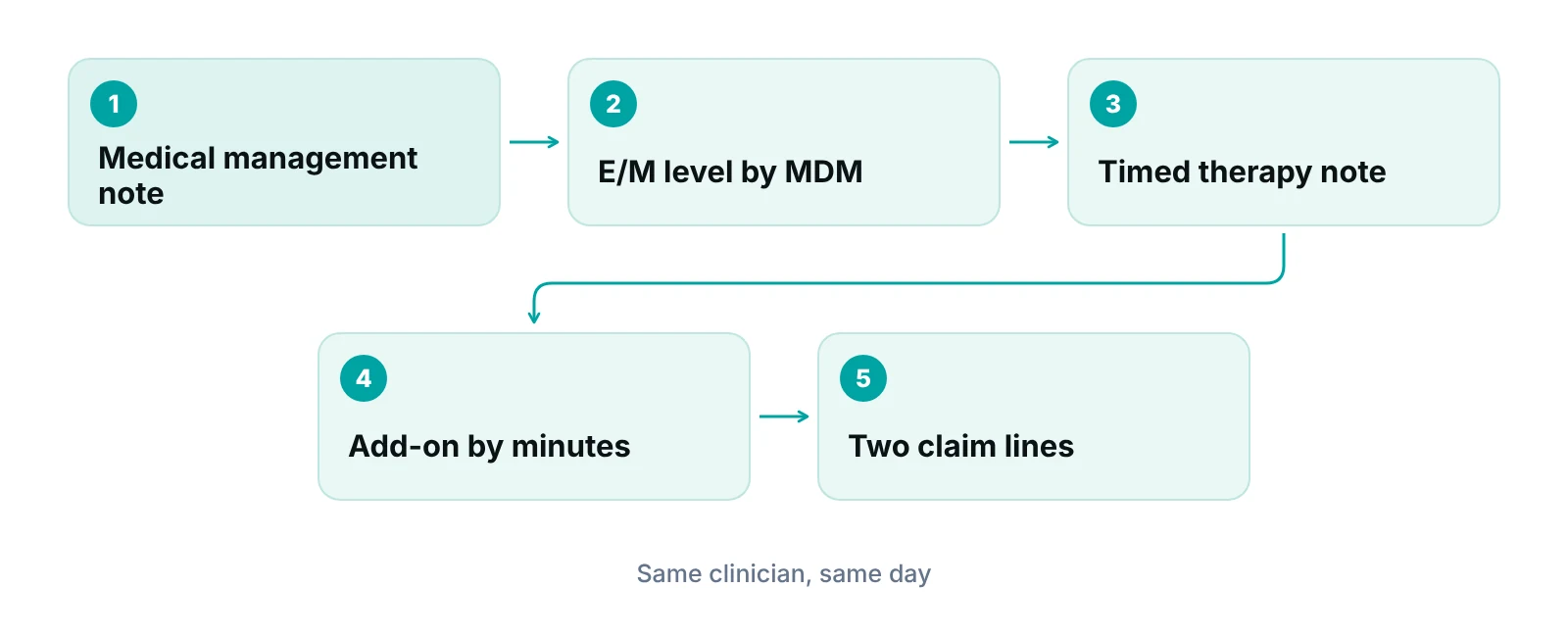
- With the add-on, the E/M level comes from medical decision making, not total time.
- Document therapy start and stop times or total minutes separately from the medical note.
- Payers add their own edits on prolonged services, high-level E/M pairings and telehealth, so keep a rule list per payer.
What is the 90836 CPT code, and what does it cover?
It is an add-on code for a psychotherapy session of roughly 45 minutes that happens in the same visit as a medical evaluation and management (E/M) service. It cannot be reported alone. The E/M code carries the medical work, and the add-on carries the therapy.
The AMA owns the official CPT wording, so we describe the code in our own words here. In short, the code stands for individual psychotherapy with the patient, with a time band of 38 to 52 minutes, performed together with an E/M service. The Medicare contractor First Coast lists it with its two siblings, 90833 and 90838, and applies the same time and documentation rules to all three (First Coast Service Options, page dated August 2026).
Think of one visit as two jobs done by one clinician: the medical job (symptoms, medication effects, risk, plan) and the therapy job (a planned intervention with its own measured block of time). The claim then carries two lines.
The code is built for clinicians who report E/M services, such as psychiatrists, other physicians, nurse practitioners and physician assistants. A Medicare contractor fact sheet says these add-on codes must be submitted with an E/M service by a physician or a nonphysician practitioner (CGS Administrators, 2021). A therapist who does not report E/M services uses the stand-alone psychotherapy codes instead.
The one rule that does not bend
No E/M service on the claim means no 90836. If the E/M is missing, dated differently, or billed by a different clinician, the add-on has nothing to attach to.
How long does the therapy have to be for 90836?
The psychotherapy part has to run 38 to 52 minutes. Three add-on codes split the range: 16 to 37 minutes, 38 to 52 minutes, and 53 minutes or more. Under 16 minutes, no add-on is reported (First Coast; Blue Shield of California Promise policy PI0061, 2025).
| Add-on code | Psychotherapy minutes | Rough label | What it means in practice |
|---|---|---|---|
| 90833 | 16 to 37 | 30-minute | Short therapy block after or alongside the medical work |
| 90836 | 38 to 52 | 45-minute | Standard therapy block; the code this post covers |
| 90838 | 53 or more | 60-minute | Long therapy block; the note should show the time was spent on therapy |
| None | Under 16 | Not reportable | Short supportive talk stays inside the E/M service |
Source: First Coast Service Options, Psychotherapy services (2026); Blue Shield of California Promise, policy PI0061 (2025).
The labels of 30, 45 and 60 minutes are only names. The band decides the code. Pick the code whose band holds the psychotherapy minutes you documented. A session of 37 minutes belongs in the lower band and a session of 53 minutes in the upper one.
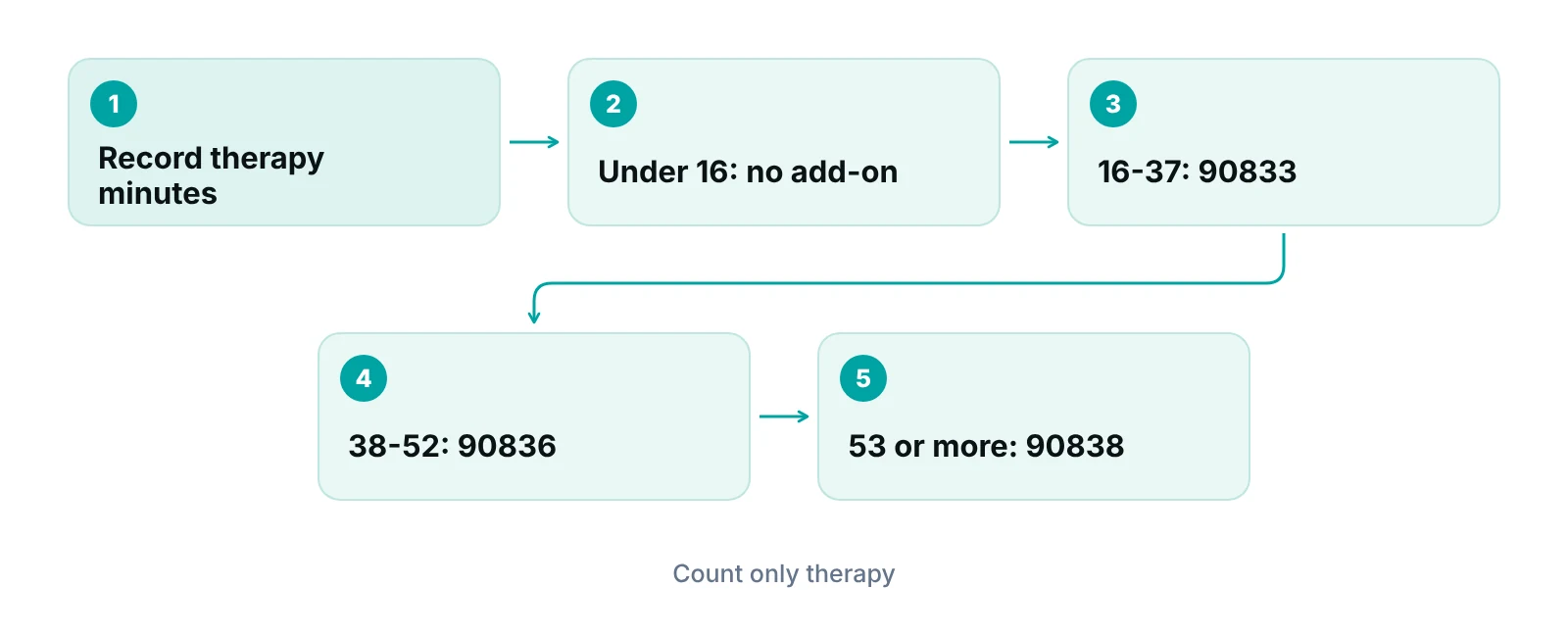
Which minutes count? The medical work does not. A payer policy states that the history, exam and decision making cannot be counted toward the psychotherapy time, and that the psychotherapy and E/M portions must be separately identifiable and must not overlap (Blue Shield of California Promise, 2025). The patient must be present for all or part of the psychotherapy. The American Psychiatric Association noted when the codes took effect in 2013 that time spent with the patient and/or a family member counts (American Psychiatric Association, 2013).
Which E/M code can you pair with 90836?
Any E/M code in the ranges the Medicare contractor lists can carry the add-on: 99202 to 99255, 99304 to 99337 and 99341 to 99350 (First Coast). Washington State’s Medicaid agency shows 99204, 99205 and 99213 to 99215 as examples in its code-selection chart (Washington State Health Care Authority).
What decides the level is the medical decision making (MDM). The American Psychiatric Association’s guidance on the 2021 office visit changes says that when psychotherapy is added, the E/M level must be set by MDM and time cannot be used (American Psychiatric Association, 2021). Its earlier CPT summary says the same thing in other words: the E/M code is not selected on the basis of time (APA, 2013).
The pairing does not follow the therapy length. It follows the medical complexity on that date: a 52-minute therapy block can sit beside a low-complexity medication check, and a 38-minute block beside a high-complexity one. For a refresher on what a mid-level visit needs, see our 99213 CPT code guide.
Two limits to check before you pair
- Intake codes. A Medicare contractor fact sheet says the diagnostic evaluation codes 90791 and 90792 cannot be reported on the same day as an E/M service by the same individual for the same patient (CGS Administrators, 2021). That is why an initial evaluation is not the place for 90836. Check your payer for newer wording.
- Prolonged-service codes. One plan’s policy says prolonged services may not be reported when E/M and psychotherapy are reported together (Blue Shield of California Promise, 2025). Other payers may differ, so look up each payer’s rule rather than assume.
Some payers add their own edits on pairings. The same Blue Shield policy denies a combined claim with a high-level office E/M (99204, 99205, 99214 or 99215) and an add-on when the member, provider and date match and the combined time is not enough. The Medicare contractor pages we reviewed do not state that edit, so keep a payer-by-payer list.
What are the same-day rules for E/M and psychotherapy?
The two services must be significant and separately identifiable. The Medicare contractor page puts it plainly: when the same physician or other health care professional provides an E/M service and psychotherapy on the same day, both must meet that test before both are billed (First Coast).
In plain terms that means four checks, each of which an auditor can test against the note:
- Same clinician. The E/M and the add-on come from the same physician or nonphysician practitioner, the same patient and the same date.
- Two time records. The therapy minutes are written down as their own figure. A start time and a stop time, or a total of therapy minutes, both work.
- No overlap. The minutes in the therapy block are not also counted toward the E/M service.
- Two clinical purposes. The note shows what was managed medically and what was treated through therapy. A separate diagnosis is not required, but separate documentation is (Blue Shield of California Promise, 2025).
| Part of the visit | Sets the E/M level? | Counts toward therapy minutes? | Where it belongs in the note |
|---|---|---|---|
| History, exam, medication review, decision making | Yes, through MDM | No | Medical management section |
| Psychotherapy with the patient, with a family member present if the patient is present for all or part | No | Yes | Psychotherapy section with time |
| Family discussion with no patient present | No | No, the patient must be present | Not part of this add-on; check family therapy rules |
| Total clock time of the whole visit | No, time is not used when the add-on is billed | No | Not a billing figure for this pairing |
Source: American Psychiatric Association (2021); Blue Shield of California Promise, policy PI0061 (2025); CGS Administrators LCD fact sheet (revised 2021).
Medicare contractors have recouped payments when a note showed one combined time. The American Academy of Family Physicians described a case from CMS’s own example in 2014: a 99213 plus 90836 claim was supported only by a note of 45 minutes total face-to-face time, with no separate psychotherapy time, and the contractor treated the payment as an overpayment (AAFP Family Practice Management, 2014). The code set has changed since then, but the documentation lesson still applies.
How should the note be written to support 90836?
Write the visit as two labeled sections and put the therapy time in the second one.
A Medicare contractor fact sheet lists what each psychotherapy encounter note should show: diagnosis, symptoms and functional status, a focused mental status exam, treatment plan, progress, the modality used and its frequency, and the name, signature and credentials of the person who provided the service (CGS Administrators, 2021). It also states that exact session times must be recorded.
- Medical section: medications reviewed, adherence, side effects, risk screening, assessment and the decision made. This supports the E/M level.
- Therapy section: start and stop times or total minutes, the clinical focus of the session, the technique used, and how the patient responded.
- One sentence of separation: state that the therapy was a distinct service from the medical evaluation that day.
- Signature and date on the whole record, with any late entries handled by your compliance process, not added silently.
A wording test
Read your note as an auditor would. Can you point to the exact minutes of therapy and to a different set of tasks that justified the E/M? If either answer is no, fix the template, not only this chart.
Who can report 90836, and what about telehealth?
Report it only when you are the clinician who provides both the E/M and the therapy. A payer policy states that the add-on must be billed by a qualified provider who delivers the psychotherapy and a medical evaluation during the same visit, naming the same physician or nonphysician practitioner (Blue Shield of California Promise, 2025). If a separate therapist sees the patient on the same day, that is a different service under that therapist’s own billing rules, and many payers apply their own same-day limits.
A Medicare contractor fact sheet also lists who can bill Medicare directly for psychiatric services: physicians, clinical psychologists, clinical social workers, nurse practitioners, clinical nurse specialists and physician assistants. It says counselors and marriage and family therapists cannot bill Medicare directly, though they may work under the incident-to provision (CGS Administrators, 2021). Incident-to rules are strict and payer-specific. Do not assume a therapist’s session can ride on a prescriber’s claim without checking the current rule.
On telehealth, the HHS telehealth site listed 90836 along with the other psychotherapy codes, including those described as done with a medical evaluation, under permanent Medicare telehealth coverage when it was last updated in July 2025, and it warns that Medicare policy keeps changing (HHS Telehealth.hhs.gov). CMS publishes a yearly file of eligible telehealth services (CMS list of telehealth services). Because modifiers, place of service and in-person visit conditions change often and differ by payer, we did not include a modifier rule here. Our telehealth billing guide covers the claim-form side.
Why do 90836 claims get denied, and how do you fix them?
Most denials trace back to one of five patterns, and each has a front-end fix. The table lists them with the part of the process that owns the fix.
| Pattern | What the payer sees | Fix | Owner |
|---|---|---|---|
| Add-on without an E/M line | A dependent code with nothing to attach to | Check that an E/M line for the same clinician, patient and date is on the claim before release | Billing |
| One combined time in the note | No separate therapy minutes | Record therapy start and stop, or total therapy minutes, as its own entry | Clinician |
| Wrong minute band | Therapy minutes outside 38 to 52 | Match the documented minutes to the band, not to the 45-minute label | Clinician and coder |
| E/M level chosen by total visit time | Level not supported by MDM | Set the E/M by MDM when the add-on is reported | Clinician and coder |
| Payer-specific edit on pairings or prolonged services | Combination barred or flagged for time | Keep a written rule list per payer and check it at claim scrub | Billing |
Source: First Coast Service Options (2026); American Psychiatric Association (2021); Blue Shield of California Promise, policy PI0061 (2025); AAFP (2014).
Our denial management services page explains how we sort denials by cause. For a practice doing this in-house, the cheapest change is a claim-scrubbing rule that stops an add-on line when no E/M line is present. If you want a view of how the whole behavioral claim path fits together, our behavioral health billing partner guide walks through it.
What do repeat denials cost your practice?
Use our revenue calculator to put a number on denied and delayed claims before you decide where to fix the process.
Should you manage 90836 billing in-house or hand it to a partner?
Keep it in-house if one coder knows each payer’s add-on rules and clinicians use a template with two timed sections. Consider outside help if denials on these lines repeat or your payer mix is wide. A partner should work inside your existing EHR (for example PrognoCIS, eClinicalWorks or athenahealth) and show you how it applies each payer’s rule. Our medical billing services cover charge entry, coding support and claim follow-up.
Our behavioral and mental health RCM operations page describes how our team approaches that work. Pricing is quoted after a free audit, so there is no number to compare until you see your own claims.
Want a second pair of eyes on your add-on claims?
Send us a sample of recent psychotherapy-with-E/M claims. We will check them against the rules above and show where the notes, codes or payer rules are creating denials.
Our recommendations
- Build the note template around two timers. We would add a therapy start and stop field to the template and make it required before the claim is released. It removes the single largest audit weakness at the source.
- Choose the E/M by MDM, then the add-on by minutes. Make this a two-step habit. Decide the medical complexity first, then read the clock for therapy only. Do not let the long therapy block pull the E/M level upward.
- Write a one-page payer rule list. List each payer’s position on prolonged services, high-level E/M plus add-on pairings and telehealth conditions. Update it each January and after each payer bulletin.
- Add a claim-scrub rule for orphan add-ons. Stop any claim that carries 90833, 90836 or 90838 without an E/M line for the same clinician and date. This is a cheap rule that prevents a common denial.
- Audit a small sample every quarter. Pull a handful of add-on visits per clinician and read the notes against the checklist above. Share patterns with the clinicians, not only the coder.
- Keep the rest of the portfolio in view. The add-on is one line of a larger claim. Pair this work with eligibility, authorization and denial tracking.
Bottom line
The 90836 CPT code pays for a separate therapy service, so the claim has to show two things at once: an E/M level built on medical decision making and a block of 38 to 52 documented therapy minutes. Fix the template and the scrub rule first, then audit a sample. If denials on these lines keep returning, our denial management services can work them by cause, or you can talk to our team or request a free practice audit.
Frequently asked questions
Can I bill 90836 without an E/M code?
No. It is an add-on, so it must appear with an E/M service by the same clinician on the same date. A Medicare contractor fact sheet says these add-on codes must be submitted with an E/M service by a physician or nonphysician practitioner. Without that line, the claim has no primary service to attach the add-on to.
What if my therapy lasted 37 minutes, or 53 minutes?
Use the band that holds your documented psychotherapy minutes. Thirty-seven minutes falls in the 16 to 37 band (90833). Fifty-three minutes falls in the 53-or-more band (90838). The 45-minute label does not change the bands. Record the exact minutes, because the note is what an auditor checks.
Do I choose the E/M level by time when I add 90836?
No. When psychotherapy is reported with an E/M service, the American Psychiatric Association’s guidance says the E/M level is set by medical decision making and time cannot be used. The therapy minutes are only used to pick the add-on code. Keep the two decisions separate in your coding workflow.
Can a therapist on my team provide the therapy while the prescriber bills the E/M?
Not as one add-on. The add-on belongs to the clinician who provides both the medical evaluation and the therapy. A separate therapist visit is a different service under that therapist’s billing rules, and payers limit same-day billing. Medicare incident-to rules are strict, so check the payer’s current wording first.
Can I use 90836 on the same day as an initial psychiatric evaluation?
A Medicare contractor fact sheet says 90791 and 90792 cannot be reported on the same day as an E/M service by the same individual for the same patient. The add-on needs an E/M service, so it does not fit with an intake evaluation. Confirm your payer’s current policy before billing.
Is 90836 covered by telehealth?
The HHS telehealth site listed 90836 among psychotherapy codes with permanent Medicare telehealth coverage when it was last updated in July 2025. Medicare telehealth policy changes, and modifiers, place of service and other conditions differ by payer. Check CMS’s current telehealth list and each payer’s policy before you schedule video visits.
Get your free practice audit
Tell us about your practice. We will contact you using the details you give.
- A review of your recent claims, denials and A/R aging
- Where your front desk and prior authorizations slow payment
- A prioritized fix list you keep, whether or not you hire us
Pricing is quoted after the audit, based on your volume and the services you choose. Prefer to talk? Call +1 (302) 556-2288.
Sources
- Psychotherapy services — First Coast Service Options (Medicare Administrative Contractor) (2026)
- Psychotherapy with E/M Add-On: Policy PI0061 — Blue Shield of California Promise (2025)
- Outpatient Psychiatry and Psychology Services fact sheet (LCD L34353) — CGS Administrators (Medicare Administrative Contractor) (2021)
- Update on 2021 office/outpatient E/M billing and documentation — American Psychiatric Association (2021)
- CPT Code Changes for 2013 (overview) — American Psychiatric Association (2013)
- Potential pitfall in Medicare billing: psychotherapy in conjunction with an E/M service — AAFP Family Practice Management (2014)
- Billing for telebehavioral health — HHS Telehealth.hhs.gov (2025)
- Code selection algorithm (behavioral health) — Washington State Health Care Authority
- List of Medicare telehealth services — CMS (2026)
Disclaimer: This article is educational and is not legal, coding, billing or compliance advice. CPT codes are owned by the AMA, and code descriptors, payer policies and federal rules change and vary by payer and state. Verify current requirements with the official CPT manual, your payers and your counsel before you act.
