
Telehealth modifiers are two-character codes added to a claim line to tell the payer how a visit was delivered: 95 for real-time audio and video, 93 for audio-only, GT and GQ for narrow Medicare cases, FQ for rural health clinics and FQHCs, and FR for virtual supervision. Which ones you need depends on the payer.
Search for this topic and you will find the same list repeated: GT, GQ, 95, CS. Some of it is out of date, and some of it was never meant for the claims a practice sends today. This guide sorts the modifiers by what they describe, shows where Medicare has changed its rules, and marks every point where a commercial plan or state Medicaid program may differ. It also explains the place-of-service codes that travel with them. For the wider billing picture, see our telehealth billing guide.
Key takeaways
- A modifier describes how the visit was delivered. It does not raise the payment.
- 95 means real-time audio and video; 93 means audio-only; FQ is the audio-only version for rural health clinics and FQHCs.
- For Medicare professional claims, GT has not been required since 2018, and GT is now limited to critical access hospital Method II institutional claims.
- GQ is paid by Medicare only for providers tied to a federal telemedicine demonstration in Alaska or Hawaii.
- CS is a COVID-19 testing modifier, not a telehealth modifier. Build a payer-by-payer rule sheet before you bill.
What do telehealth modifiers do on a claim?
A telehealth modifier is a short code added to a procedure line. It tells the payer the technology used for the visit, so the claim can be priced and checked against that payer’s telehealth policy. The visit itself is still reported with the usual CPT or HCPCS code.
Two ideas are worth holding onto. First, the modifier describes the service. It does not make a service payable that the payer does not cover, and it does not raise the amount. Second, modifiers are not universal. Medicare, each commercial plan and each state Medicaid program publish their own telehealth policies, and the same visit can need a different code string from each of them.
A practical way to organize the codes is by question. Was the visit audio and video, or audio-only? Was it live or recorded and sent later? Who is billing, a professional or a hospital or clinic? Was a supervisor watching by video? Each question points to a different modifier.
Telehealth and telemedicine
Older posts treat telehealth and telemedicine as different billing topics. For claims, the question is not the label. It is the technology used for the visit and the payer’s rule for that technology.
Which modifier goes with which type of telehealth visit?
Match the visit to the technology first, then check the payer. The table below uses the descriptions on a Medicare Administrative Contractor’s telehealth modifier page (First Coast Service Options, 2026) and the CMS transmittal that ended routine GT use (CMS Transmittal 3929, 2017). Payers other than Medicare may apply them differently.
| Modifier | What it describes | Where Medicare uses it | Check before using |
|---|---|---|---|
| 95 | Real-time interactive audio and video | Listed for specific cases, such as acute hospital care at home, hospital-employed outpatient therapy by telehealth and opioid treatment program services | Many other payers ask for it on every video visit |
| 93 | Telephone or other real-time audio-only service | Audio-only services in listed situations, including some home visits and opioid treatment programs | Whether the payer covers audio-only for that code |
| FQ | Audio-only technology | Only rural health clinics and FQHCs | Use 93 or FQ as the payer directs |
| GT | Interactive audio and video | Only institutional claims from critical access hospitals under Method II | Some payers and Medicaid programs still ask for it |
| GQ | Asynchronous (store-and-forward) service | Only for providers tied to a federal telemedicine demonstration in Alaska or Hawaii | Skip it unless a payer policy names it |
| FR | Supervising practitioner present by real-time audio and video | Virtual supervision of a trainee | Payer rules on teaching settings and supervision |
| G0 | Telehealth for acute stroke diagnosis or treatment | Listed distant-site codes with POS 02, CAH Method II revenue codes or Q3014 | Rare in most office settings |
Sources: First Coast Service Options, Telehealth service modifiers (2026); CMS Transmittal 3929 (2017); University of Washington Behavioral Health Institute, TeleBH 101 transcript (2025) for FR.
Read the third column as a Medicare snapshot. The same MAC page notes a few other uses, and the table is not a full list of every Medicare telehealth rule. Treat it as a starting point and confirm with your own MAC and each commercial payer.
When do you use modifier 95 or GT for audio and video visits?
Use 95 when the payer asks you to mark a real-time video visit. Use GT only where a payer or program still requires it, and not as a default.
Modifier 95 describes a synchronous service delivered over a real-time interactive audio and video system. On the First Coast Medicare page, the listed Medicare uses are narrow: physician telehealth to acute hospital care at home patients (reported with POS 21), hospital-employed outpatient therapy by telehealth, and opioid treatment program audio-video services (First Coast Service Options, 2026). That does not mean 95 is optional everywhere. Commercial plans and Medicaid programs set their own rules, and many publish a requirement for it.
GT is different. CMS told contractors in Transmittal 3929 that, from January 1, 2018, they would no longer require GT on professional telehealth claims when POS 02 certifies that the telehealth requirements are met. GT stays required on institutional claims from critical access hospitals that chose Method II (CMS, 2017). The First Coast page repeats that GT is allowed only on those institutional claims.
Older posts claim 95 and GT can be used interchangeably. That is not safe. A payer that wants 95 may reject GT, and a program that requires GT may reject 95. The only dependable source is the payer’s own billing policy for the plan on the claim.
Do not guess from the payer name
Rules differ by plan, product and state. Keep the check at the plan level: look up the exact policy for the plan that is printed on the patient’s card, not a general rule for the carrier.
How do audio-only visits change the modifier?
Audio-only visits use 93, or FQ for rural health clinics and FQHCs. Most older guides leave these out, even though phone-based visits are common in behavioral health and in follow-ups for patients with limited video access.
The First Coast page describes 93 as a service rendered by telephone or another real-time interactive audio-only system. It says rural health clinics and FQHCs may report either 93 or FQ, and that FQ is used only by those two clinic types (First Coast Service Options, 2026). A separate training transcript from the University of Washington Behavioral Health Institute makes the same distinction (UW BHI, 2025).
The coverage question matters as much as the code. A law firm memo on H.R. 7148 states that Congress passed the bill on February 3, 2026, and that it extends Medicare telehealth flexibilities, including audio-only services, through December 31, 2027 (Hobbs Straus Dickson & Boyd memo, 2026). This is a time-limited extension. Other payers set their own audio-only rules, so confirm them before you bill a phone visit.
For therapy and counseling practices, audio-only is often a daily question. Our behavioral and mental health billing page covers how the rest of the billing cycle works for those services.
Where do GQ, FR and CS fit?
GQ and FR are narrow, and CS is not a telehealth modifier at all. Treat each as an exception to confirm, not a routine add-on.
GQ: asynchronous services
GQ describes a service delivered through an asynchronous system, such as recorded video or images reviewed later. CMS Transmittal 3929 says contractors pay GQ-coded services only if the physician or practitioner is tied to a federal telemedicine demonstration in Alaska or Hawaii (CMS, 2017). Outside that setting, a Medicare practice should not expect GQ to apply. Some other payers may have their own store-and-forward policies.
FR: virtual supervision
FR is used when a supervising practitioner is virtually present by real-time audio and video. The UW BHI transcript gives the example of a teaching psychiatrist reporting an E/M with 25 and FR, with supervisor and trainee on separate devices (UW BHI, 2025). On the Medicare side, the CY 2026 fee schedule rule permanently defines virtual direct supervision as real-time audio and visual interactive telecommunications, excluding audio-only, for services that require direct supervision (CMS, CY 2026 PFS final rule summary). It does not extend that virtual presence to all teaching settings.
CS: not a telehealth modifier
Older posts list CS as a telehealth modifier because of its pandemic-era link to COVID-19 testing and cost-sharing. It does not describe how a visit was delivered, and it does not appear on the Medicare telehealth modifier page cited above. We could not confirm a current rule for it from a primary source, so check the payer before using it on any claim.
Modifier 25 and modifier 59 are also commonly mentioned alongside telehealth. They describe separate or distinct services, not delivery method. Our modifier 25 versus modifier 59 and modifier 59 essentials posts explain when each applies.
How do place of service codes 02 and 10 work with the modifier?
The place of service code tells the payer where the patient was. The modifier tells the payer how the visit was delivered. They answer different questions, and a telehealth claim often needs both.
A common source of confusion is whose location the code describes. In the UW BHI training, POS 10 is used when the patient is at home, and POS 02 when the patient is somewhere other than home, such as a hospital, a skilled nursing facility or another provider’s office (UW BHI, 2025). The code follows the patient, not the clinician’s desk.
| Question | POS 02 | POS 10 |
|---|---|---|
| Where is the patient? | Not at home, for example a hospital, skilled nursing facility or another provider’s office | At home |
| Who bills the professional service? | The distant-site clinician, for the professional portion | The distant-site clinician |
| Is there an originating site fee? | The hosting site may bill HCPCS Q3014 | No originating site fee in this setting |
| Medicare payment level | Check the fee schedule for your MAC | Described in the training as the non-facility rate |
| Patient is driving | End the visit, as the training advises | End the visit, as the training advises |
Source: University of Washington Behavioral Health Institute, TeleBH 101 Part 3 transcript (2025); verify against the current CMS POS code set and your payer policy.
For the Q3014 originating site fee, CMS lists the CY 2026 payment as 80% of the lesser of the actual charge or $31.85, with the patient owing any unmet deductible and Medicare coinsurance (CMS, CY 2026 PFS final rule summary). Our POS 10 telehealth code guide goes deeper on home-based visits.
What has changed in Medicare telehealth rules, and what is still open?
Medicare’s modifier rules changed slowly, but its coverage rules changed often. Check the date on any guide, including this one.
| Date | What changed | Why it matters for the claim | Source |
|---|---|---|---|
| Jan 1, 2018 | GT no longer required on professional telehealth claims when POS 02 is used; still required for critical access hospital Method II institutional claims | Professional claims rely on POS, not GT | CMS Transmittal 3929 |
| CY 2026 | CMS ends the separate provisional and permanent categories for telehealth services and focuses on whether a service can be furnished by an interactive 2-way audio-video system | Which codes can be billed by telehealth is reviewed under one test | CMS CY 2026 PFS final rule summary |
| CY 2026 | Virtual direct supervision is permanently defined as real-time audio and visual communication, excluding audio-only | Supervised services by video need a clear rule | CMS CY 2026 PFS final rule summary |
| Feb 3, 2026 | Congress passed H.R. 7148; telehealth flexibilities, including audio-only, extended through Dec 31, 2027 | Audio-only visits stay covered for now under Medicare | Hobbs Straus memo (2026) |
Sources: CMS Transmittal 3929 (2017); CMS CY 2026 Physician Fee Schedule final rule summary; Hobbs Straus Dickson & Boyd memo GM-26-005 (2026).
Two limits apply to this table. It covers Medicare only, and it reflects the sources we could read on the date of this update. A law that sets an end date also invites a new extension debate before that date, so build a calendar reminder to re-check the rules each quarter.
How can a practice get telehealth modifiers right on every claim?
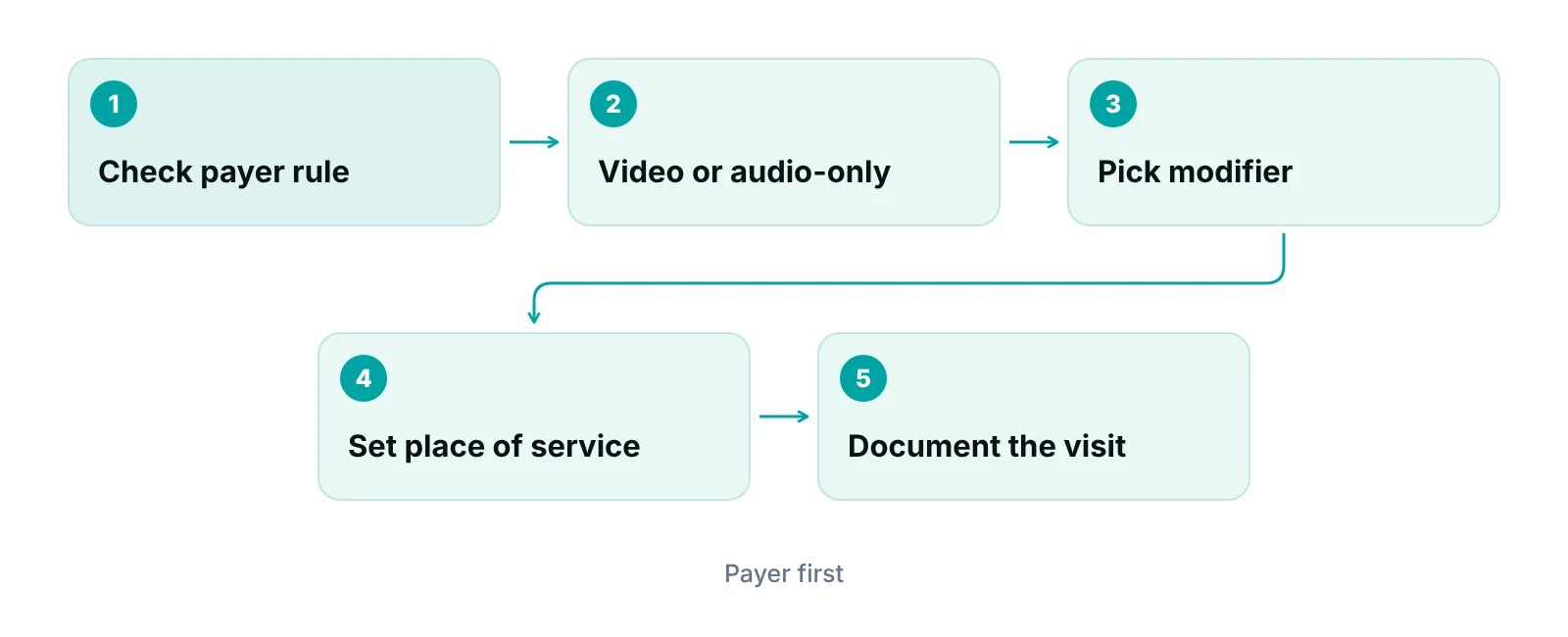
Capture the visit type at scheduling, not at billing. By the time a biller sees the claim, nobody remembers whether the visit dropped to a phone call halfway through.
- Record the technology used. Add a field for video, audio-only or recorded, filled in by the clinician or front desk.
- Record where the patient was. The patient’s location drives the place of service. A home visit and a visit from another clinic use different codes.
- Look up the plan. Match the plan on the patient’s card to a one-page rule sheet showing the modifier, POS and covered codes.
- Check the code against the telehealth list. Not every procedure code can be billed for a telehealth visit under every payer.
- Scrub before submitting. A claim with 93 on a plan that wants 95 should be caught before it goes out.
“A telehealth claim is only as clean as the visit record behind it. If the technology and the patient's location are not captured at the visit, the modifier becomes a guess.”
A good way to catch mistakes is a pre-submission check. Our clean claims guide explains what that check should look at. A a practice management system that tracks claims by stage can hold the claim at a stage and assign an owner when a required field is missing, which fits this kind of rule well.
Do not switch modifiers to chase payment
If a claim is denied, change the code only when the visit record supports the change. Swapping 95 for GT, or 93 for 95, to get a claim paid without a matching record is a compliance risk.
What should the visit note say to support the modifier?
The note should show the technology, the patient’s location and the clinician’s location, along with the usual clinical content. The modifier on the claim must match what the note says.
- The type of connection: real-time audio and video, or audio-only.
- Where the patient was at the time of the visit, in plain words.
- Where the clinician was, since some payers ask about it.
- The platform used. For privacy rules on video tools, see our guide to HIPAA-compliant video conferencing.
- Whether a supervising practitioner joined by video, when FR applies.
- A clear record if the visit changed mid-call from video to audio-only.
Some payers also ask for patient consent to a telehealth visit, and requirements differ by state. Treat consent as a payer and state question, and document it the way your policy says.
Not sure which modifier your payers expect?
A free practice audit looks at your recent telehealth claims, the modifiers and POS codes on them, and how payers responded.
What do telehealth modifier errors look like in denials?
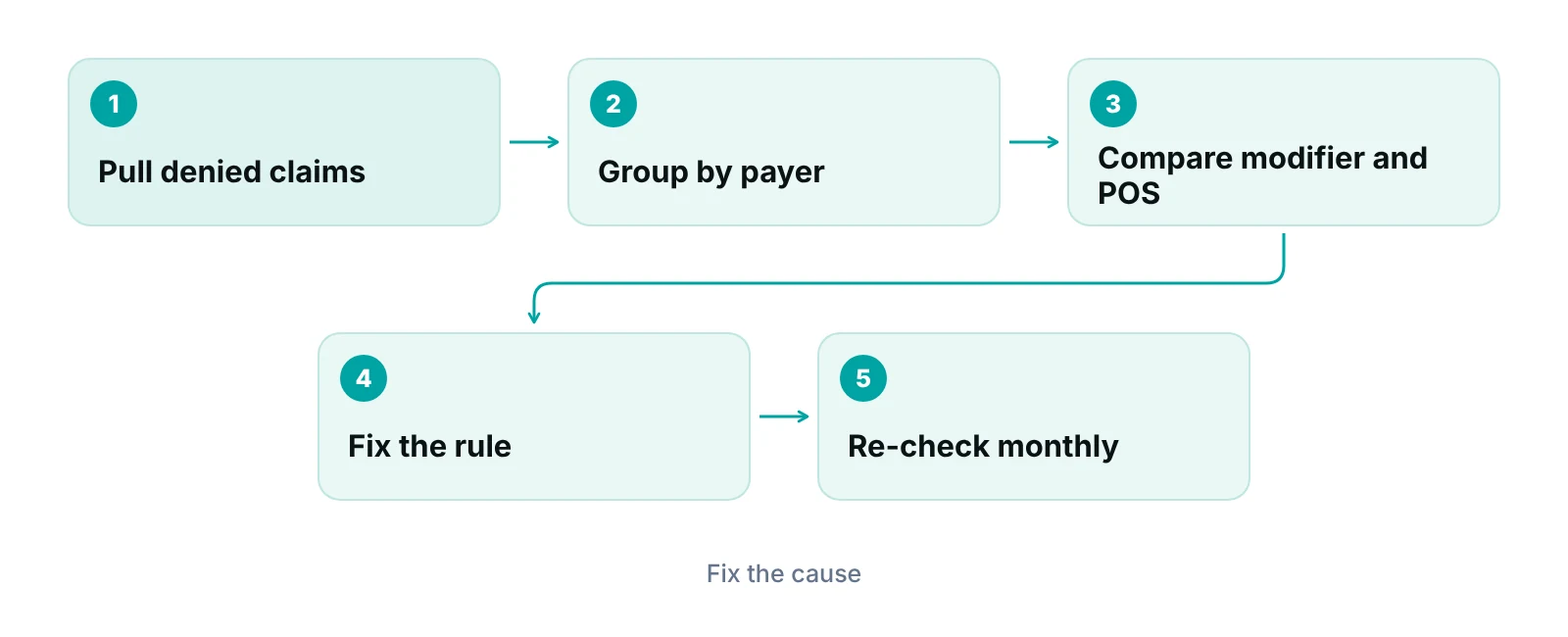
Most modifier problems show up as a pattern, not a single claim. Group denials by payer, modifier and POS, and the cause is usually visible within a handful of rows.
- Modifier mismatch. The claim has 95 where the payer wants GT, or 93 where it wants 95.
- POS conflict. A POS that says the visit was in the office, on a claim billed as telehealth.
- Audio-only not covered. A phone visit billed with a code the payer does not accept by audio-only.
- Missing technology record. The note does not say how the visit was delivered.
- Wrong clinic modifier. A non-clinic practice using FQ, which is only for rural health clinics and FQHCs.
Each of these is fixable at the front of the process. Our denial management services team can review a denial sample by payer and modifier, and our medical billing services cover the claim side. The how telehealth affects the revenue cycle post shows where telehealth touches the other revenue cycle steps.
How do you measure whether telehealth claims are paid correctly?
Track telehealth denials as their own line, not inside the overall denial rate. A single blended number hides a modifier problem that affects only one payer or one visit type. If you want a rough sense of what a denial pattern costs, you can put your own volumes into our revenue calculator.
Start with three counts per month: telehealth claims sent, telehealth claims denied, and the top three denial reasons by payer. Review them with the clinicians who deliver the visits, since they often know why a call switched to audio-only.
Our recommendations
- Build a one-page rule sheet per payer. We recommend one page per major plan showing the modifier, place of service and covered codes for video and audio-only visits, with the date it was last checked.
- Capture technology and patient location at the visit. Add two fields to the visit workflow so the biller never has to guess whether a visit was video, audio-only or recorded.
- Use GT and GQ only when a payer names them. For Medicare, GT is limited to critical access hospital Method II claims and GQ to the Alaska and Hawaii demonstration. Do not add them by habit.
- Re-check Medicare dates each quarter. Telehealth flexibilities carry end dates. Put the current end date on the calendar and review it before it arrives.
- Review denials by modifier and POS. A monthly look at the top denial reasons for telehealth claims is usually enough to find the rule that is wrong.
Hold telehealth claims for a missing modifier or place of service before they go out.
RCM Finder's practice management portal tracks each claim by stage with an owner, runs data-completeness checks before submission and flags claims for review under workflow rules.
See how the RCM Finder portal works · Create a portal account
Disclosure: RCM Finder builds and sells this portal. It is a practice management system, not an EHR.
Bottom line
Telehealth modifiers describe the technology of the visit: 95 for audio and video, 93 for audio-only, FQ for rural health clinics and FQHCs, and GT, GQ and FR for narrow cases. Confirm each payer’s rule, capture the visit details at the time of care, and review denials by modifier. If telehealth claims keep coming back, our denial management services team can look at a sample, and you can talk to our team to start.
Frequently asked questions
What are modifiers in telehealth billing?
Modifiers are short codes added to a procedure line to tell the payer how a service was delivered. In telehealth they separate real-time audio and video (95), audio-only (93 or FQ) and a few narrow cases such as GT, GQ and FR. They describe the service and do not change what a payer will pay for it.
What is the difference between GT and GQ?
GT describes interactive audio and video and GQ describes an asynchronous, store-and-forward service. Under Medicare, GT is limited to critical access hospital Method II institutional claims, and GQ is paid only for providers tied to a federal telemedicine demonstration in Alaska or Hawaii. Other payers may differ.
Can modifier 95 be used in place of GT?
Not safely. Both describe audio and video visits, but a payer that requires one may reject the other. Medicare dropped the GT requirement for professional claims in 2018, while many commercial plans and Medicaid programs set their own rule. Check the payer’s published policy before choosing.
What is the difference between modifier 93 and FQ?
Both describe audio-only visits. Modifier 93 covers telephone or other real-time audio-only services. FQ is used only by rural health clinics and FQHCs, which may report either 93 or FQ on Medicare claims. A non-clinic practice should not use FQ.
Is the CS modifier a telehealth modifier?
No. CS is tied to COVID-19 testing and cost-sharing, not to how a visit was delivered, and it is not on the Medicare telehealth modifier page we reviewed. Check the payer’s current policy before using it, and do not add it to routine telehealth visits.
Do telehealth modifiers affect reimbursement?
Indirectly. A modifier does not raise the rate, but it tells the payer which telehealth policy and fee rules apply. A missing or mismatched modifier can lead to a rejection or a lower payment. The place of service code can also change the Medicare payment level, so confirm both.
Get your free practice audit
Tell us about your practice. We will contact you using the details you give.
- A review of your recent claims, denials and A/R aging
- Where your front desk and prior authorizations slow payment
- A prioritized fix list you keep, whether or not you hire us
Pricing is quoted after the audit, based on your volume and the services you choose. Prefer to talk? Call +1 (302) 556-2288.
Sources
- Transmittal 3929, Pub. 100-04, Change Request 10152 — CMS (2017)
- Telehealth service modifiers — First Coast Service Options (Medicare Administrative Contractor) (2026)
- Medicare Physician Fee Schedule final rule summary, CY 2026 (MM14315) — CMS (2026)
- Memo GM-26-005 on H.R. 7148 — Hobbs, Straus, Dickson & Boyd (2026)
- TeleBH 101 Part 3: Telehealth Modifiers (transcript) — University of Washington Behavioral Health Institute (2025)
Disclaimer: This article is educational. It is not legal, coding or compliance advice. CPT is owned by the AMA, and payer and state rules vary and change, so confirm each rule in your current code book, your MAC's guidance and each payer's policy before billing.
