The core RCM KPIs follow a claim from visit to cash: insurance verification rate, charge lag, late charges, clean claim rate, denial rate, days in A/R, aged A/R, net collection rate, bad debt and cost to collect. HFMA's MAP Keys define most of them. Keep one written definition for each and track the trend monthly.
Most lists of RCM KPIs give you a round target for every metric. Very few say where the number came from. This guide takes the opposite approach: it uses the published definitions, shows the ranges that can be verified, and says clearly when no standard target exists.
Use it to decide what to measure and how. If you only need the five A/R-side metrics in detail, our accounts receivable metrics guide goes deeper on those.
Key takeaways
- HFMA’s MAP Keys give formulas for 29 keys across five categories, but they publish no targets.
- AAFP publishes ranges for days in A/R, adjusted collection rate and denial rate. Treat them as guardrails, not promises.
- The same KPI name can have different formulas. Pick one definition and do not change it mid-year.
- Track KPIs by stage and by payer. A single practice-wide average hides the problem.
- Include every cost, including software and outsourced fees, when you calculate cost to collect.
What are RCM KPIs, and where do the standard definitions come from?
RCM KPIs are the numbers that show how well a practice turns a visit into cash. The most widely used definitions come from HFMA’s MAP Keys, with additional formulas and ranges from the AAFP and MGMA.
HFMA’s 2023 edition of the MAP Keys lists 29 keys in five categories: Patient Access, Pre-Billing, Claims, Account Resolution and Financial Management. HFMA says the keys apply to hospitals and systems, ambulatory providers, physician organizations and post-acute care. The document states no benchmark, target or best-practice figure for any key. The 3-day late-charge window and the 3-month averaging periods are part of the definitions, not targets.
That matters for how you use this guide. When a vendor says “the industry standard clean claim rate is 98%”, ask where it is defined. In the MAP Keys, it is not.
Same name, different formula
Days in A/R has at least three published formulas. The AAFP divides total receivables by average daily charges. MGMA divides total accounts receivable by adjusted fee-for-service charges times 1/365. HFMA’s FM-1 divides net A/R by average daily net patient service revenue over the latest three months. All three are valid. They give different answers. Choose one and stay with it.
Which 10 RCM KPIs should a practice track?
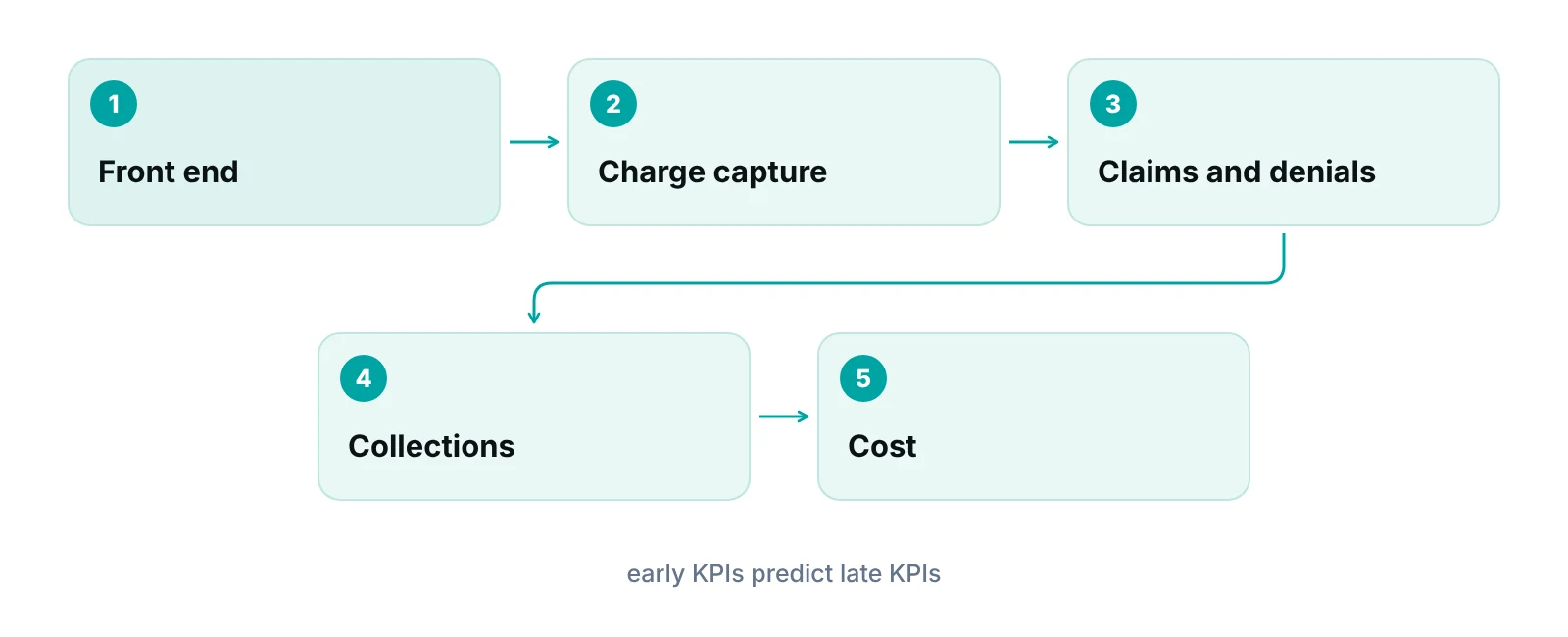
Track one or two KPIs for every stage of the revenue cycle: front end, charge capture, claims and denials, collections, and cost. The table lists ten that cover the full cycle, with the formula in plain words and the HFMA key where one exists.
| KPI | How it is calculated | HFMA MAP Key |
|---|---|---|
| Insurance verification rate | Encounters with verified insurance divided by registered encounters | PA-3 |
| Charge lag | Average days from date of service to charge posting, counted per charge or CPT code | PB-4 |
| Late charges | Gross charges posted more than 3 days after service divided by total gross charges | CL-2 |
| Clean claim rate | Claims that pass edits with no manual work, counted the first time scrubbed, divided by claims accepted into the claims tool | CL-1 |
| Remittance denial rate | Actionable denied claims divided by claims remitted (HFMA); dollars denied divided by dollars submitted (AAFP) | AR-5 |
| Days in A/R | Net A/R divided by average daily net patient service revenue (HFMA); other formulas by AAFP and MGMA | FM-1 |
| Aged A/R | Billed A/R in each age bucket divided by total billed A/R | AR-1 |
| Net (adjusted) collection rate | Payments net of credits divided by charges net of approved contractual adjustments, times 100 (AAFP) | No direct key |
| Bad debt | Bad debt provision on the income statement divided by gross patient service revenue | AR-7 |
| Cost to collect | Total revenue cycle cost divided by total patient service cash collected | FM-6 |
Source: HFMA, MAP Keys 2023 Edition; AAFP, practice finances page; MGMA DataDive Definitions Glossary (2025)
Which KPIs show problems before the claim is sent?
Insurance verification rate, charge lag and late charges are the early-warning KPIs. They measure work done before a claim reaches the payer, so a miss here turns into a denial or a slow payment later.
Insurance verification rate
HFMA’s PA-3 is the share of registered encounters where insurance was verified. If it is low, expect eligibility denials. Read our insurance verification guide for the process behind the number.
Charge lag
HFMA’s PB-4 averages the days between the date of service and the posting date, counted per charge or CPT code. It is a count of codes, not a total of dollars. MGMA calls the same idea charge-posting lag time: the days between the visit and when the claim was posted. A rising charge lag usually means unsigned notes, missing superbills or a coding backlog. See our charge entry guide for the causes.
Late charges
HFMA’s CL-2 divides gross charges posted more than 3 days after service by total gross charges. Late charges start on day 4. HFMA includes charge corrections and modifier changes in the numerator, so a high rate can mean coding clean-up as well as slow posting. HFMA gives no target for it.
Which KPIs show claim quality and denials?
Clean claim rate and denial rate show whether claims are right before and after the payer sees them. Clean claim rate measures your own edits. Denial rate measures what the payer rejected.
Clean claim rate
In HFMA’s CL-1, a claim is clean if it passes your edits with no manual intervention the first time it is scrubbed. The denominator is claims accepted into the claims processing tool. Claims that raise a warning needing staff action are not clean. This is an internal measure of your scrubber and your data, not a payer acceptance rate. Our clean claims guide covers how to raise it.
Denial rate
There are two common ways to count denials, and they do not match. HFMA’s AR-5 divides the number of actionable denied claims by the number of claims remitted, and it counts initial and appeal denials together. The AAFP divides denied dollars by submitted dollars. A practice with a few large denied claims will look different under each. The AAFP calls a 5% to 10% denial rate the industry average and says keeping it below 5% is more desirable.
Whatever you choose, split denials by reason and by payer. The rate tells you there is a problem. The reason code tells you where it is. Our denial management guide walks through that work.
Which KPIs show whether you are getting paid?
Days in A/R, aged A/R and net collection rate show how fast and how completely you collect. We keep this section short because our accounts receivable metrics guide covers these in detail.
Days in A/R
The AAFP says days in A/R should stay below 50 days at minimum, with 30 to 40 days preferable. Its formula is total receivables divided by average daily charges, where average daily charges are total charges minus credits, divided by days in the period. Remember that HFMA and MGMA use different formulas, so do not compare your result to a range built on a different one.
Aged A/R
Aged A/R shows what share of your open balance sits in each age bucket. HFMA’s AR-1 uses 0-30, 31-60, 61-90, 91-120 and over 120 days, aged from the date of service for physician and ambulatory practices. The buckets must add up to 100% of billed A/R. HFMA excludes discharged-not-final-billed accounts, in-house accounts and credit balances from this key.
| Age bucket | Billed A/R | Share of total |
|---|---|---|
| 0-30 days | $62,000 | 44.3% |
| 31-60 days | $38,000 | 27.1% |
| 61-90 days | $21,000 | 15.0% |
| 91-120 days | $12,000 | 8.6% |
| Over 120 days | $7,000 | 5.0% |
| Total | $140,000 | 100.0% |
Example amounts are illustrative. Buckets follow HFMA, MAP Keys 2023 Edition (AR-1).
Net collection rate
The AAFP defines this as payments net of credits divided by charges net of approved contractual agreements, times 100, measured over 12 months. It says the rate should be 95% at minimum, describes the average as 95% to 99%, and says top performers reach at least 99%. MGMA’s adjusted fee-for-service collection percentage, also called net collection percentage, divides net fee-for-service revenue by adjusted fee-for-service charges.
If you want help working the older buckets, our accounts receivable management services cover follow-up on aged claims.
Which KPIs show cost and loss?
Bad debt and cost to collect show what the revenue cycle loses and what it costs to run. Both are easy to calculate wrongly, so define them first.
Bad debt
HFMA’s AR-7 divides the bad debt deduction shown on the income statement for the month by gross patient service revenue. HFMA says explicitly that this is not the amount written off from A/R. MGMA defines bad debt differently, as the difference between adjusted fee-for-service charges and the amount collected, including accounts written off as not collectible. If your accountant and your biller each report “bad debt”, ask which one.
Cost to collect
HFMA’s FM-6 divides total revenue cycle cost by total patient service cash collected. The cost includes salaries and benefits, subscription fees, outsourced arrangements, purchased services, software maintenance, contingency fees and transaction fees. It excludes capitalized IT hardware, rent and physical space. This is the fairest basis for comparing in-house billing with a billing partner, as long as you include every cost on both sides.
“A KPI you cannot trace to a list of claims is only a number on a slide. Build the drill-down first, then the dashboard. — Awais Afzal”
— Awais Afzal, Healthcare Operations & Data Analyst
Not sure which of your numbers to trust?
Our free practice audit reviews how your KPIs are defined and whether the data behind them is complete. Pricing, if any service fits, is quoted after the audit.
What targets are actually published for RCM KPIs?
Only a few RCM KPIs have a published range that we could verify. The AAFP gives ranges for days in A/R, adjusted collection rate and denial rate. HFMA’s MAP Keys define the rest but give no targets. Ranges also vary by specialty. A surgical group, a behavioral health practice and a family medicine clinic each have a different claim mix, so review the billing patterns for your specialty before you set a target.
| KPI | Published reference | Source and note |
|---|---|---|
| Days in A/R | Below 50 days at minimum; 30 to 40 days preferable | AAFP. Formula: total receivables divided by average daily charges |
| Adjusted collection rate | 95% at minimum; average 95% to 99%; top performers 99% or more | AAFP. Measured over 12 months |
| Denial rate | 5% to 10% average; below 5% more desirable | AAFP. Dollar-based; HFMA counts claims |
| Clean claim rate | No benchmark published in the MAP Keys | HFMA CL-1. Set your own baseline |
| Charge lag | No benchmark published in the MAP Keys | HFMA PB-4. Track the trend |
| Late charges | No target. The 3-day window is part of the definition | HFMA CL-2 |
| Bad debt and cost to collect | No benchmark published in the MAP Keys | HFMA AR-7 and FM-6 |
Source: AAFP, practice finances page (undated; page copyright 2026); HFMA, MAP Keys 2023 Edition
HFMA’s own article on provider KPIs adds a caveat that applies to every range: benchmarks are general guidelines, and actual numbers vary by specialty, geography and payer mix (HFMA, updated 2024). Use the ranges above as guardrails, and your own twelve-month trend as the real target.
How do you run a monthly RCM KPI review?
Pull the same ten numbers each month, split them by payer, find the cause behind any shift, assign a fix and recheck it next month. Keep the meeting short and the definitions fixed.
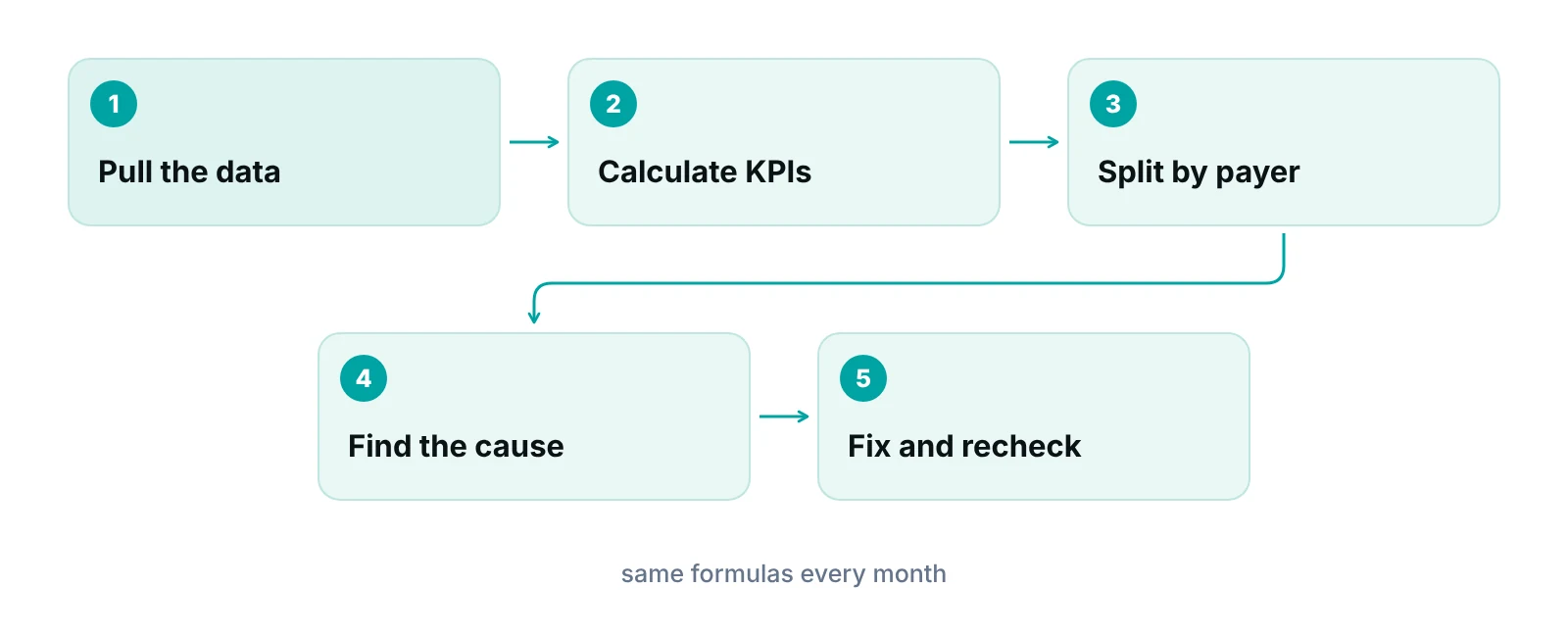
- Pull the data. Use the same report, date range and filters each time.
- Calculate with the written definitions. Do not change the formula mid-year. If you must, restate the history.
- Split by payer and stage. A worsening average usually traces to one payer or one step.
- Open the claims behind the number. Read the denial reasons, the oldest A/R and the claims that failed edits.
- Assign an owner and a date. Recheck the same KPI next month.
If you want these on a live view instead of a spreadsheet, our Power BI reporting service builds dashboards on your own claim data. To see what a slower cycle may cost in cash, try the revenue calculator.
See what slow days in A/R cost your practice
Enter your own figures in our revenue calculator to see how collection speed and denials affect cash flow.
Our recommendations
- Write one definition for every KPI. We recommend a one-page definition sheet: numerator, denominator, time window, what is excluded and who owns the number. When the formula changes, the trend line stops meaning anything.
- Start with the KPIs you can pull today. Begin with days in A/R, denial rate, clean claim rate and charge lag. Your billing system or clearinghouse reports usually hold the data. Add the rest as your reporting matures.
- Split every KPI by payer. A practice-wide average hides a single payer that is slow or denies often. We build our reports so each KPI can be cut by payer and by claim stage.
- Trace each number back to claims. A KPI is only useful if you can open the list of claims behind it. In the portal we built, claims are tracked by stage so a number on a dashboard leads to the claims that created it.
- Count every cost in cost to collect. Include salaries, software, clearinghouse fees and outsourced billing fees, as the HFMA definition does. Only then can you compare in-house and outsourced billing fairly.
- Compare yourself to yourself first. Use published ranges as guardrails. Your best benchmark is your own last twelve months, split by payer and by specialty.
Tracking ten metrics is easier from one place.
The portal's reporting dashboards show claim status by stage and owner, which gives you the inputs for several of the numbers above.
See how the RCM Finder portal works · Create a portal account
Disclosure: RCM Finder builds and sells this portal. It is a practice management system, not an EHR.
Bottom line
RCM KPIs only help when each one has a single definition, a clear owner and a list of claims behind it. If your numbers are hard to pull or hard to trust, our accounts receivable management services and end-to-end revenue cycle management team can set up the reporting and work the queues it exposes. Start with a free practice audit.
Frequently asked questions
What are the most important RCM KPIs for a small practice?
Start with days in A/R, denial rate, clean claim rate and charge lag. They show whether claims go out on time, whether they pass, and how long cash takes to arrive. Add net collection rate and aged A/R once those four are stable and trusted.
What is a good days in A/R?
The AAFP says days in A/R should stay below 50 days at minimum, with 30 to 40 days preferable. Its formula is total receivables divided by average daily charges. HFMA and MGMA use different formulas, so compare only against your own history using one formula.
What is a good clean claim rate?
HFMA’s MAP Keys define the clean claim rate but publish no target. In the HFMA definition, a clean claim passes your edits the first time with no manual work. Set your own baseline, track it by payer and look for the edit that fails most often.
How often should we review RCM KPIs?
Monthly is the minimum. Several of HFMA’s keys are defined on a monthly reporting period. Many teams also watch charge lag and denials weekly, since those problems grow quickly if left alone. Keep the review short and end it with an owner and a date for each fix.
Why do my KPIs differ from my billing company's report?
Usually because the formulas differ. Days in A/R, denial rate and bad debt each have more than one published definition. Ask for the numerator, denominator and time window of every KPI in writing, and then pick one definition for both sides.
Do HFMA MAP Keys apply to physician practices?
Yes. HFMA says the keys apply to hospitals and systems, ambulatory providers, physician organizations and post-acute care. Some keys are hospital-only, such as Case Mix Index. Several others, like discharged-not-final-billed, were written with hospital accounts in mind, so adapt the wording to visits.
Get your free practice audit
Tell us about your practice. We will contact you using the details you give.
- A review of your recent claims, denials and A/R aging
- Where your front desk and prior authorizations slow payment
- A prioritized fix list you keep, whether or not you hire us
Pricing is quoted after the audit, based on your volume and the services you choose. Prefer to talk? Call +1 (302) 556-2288.
Sources
- MAP Keys 2023 Edition — HFMA (2023)
- Practice finances: indicators — American Academy of Family Physicians (2026 (undated page, copyright 2026))
- MGMA DataDive Definitions Glossary — MGMA (2025)
- 7 KPIs providers should be tracking — HFMA (2024)
Disclaimer: This post is general educational information about revenue cycle operations. It is not legal, coding, billing-compliance or financial advice. Metric definitions, published ranges and payer rules vary by organization, specialty and payer, and they change over time. Confirm what applies to your practice with qualified advisors.