
The urgent care billing mistakes that cost the most are unverified coverage, skipped patient balances, one-size S-code rules, outdated E/M leveling, habitual modifier 25, lost charges, late submission and untracked denials. Each can be prevented with a fixed check-in routine, a payer sheet and regular reviews.
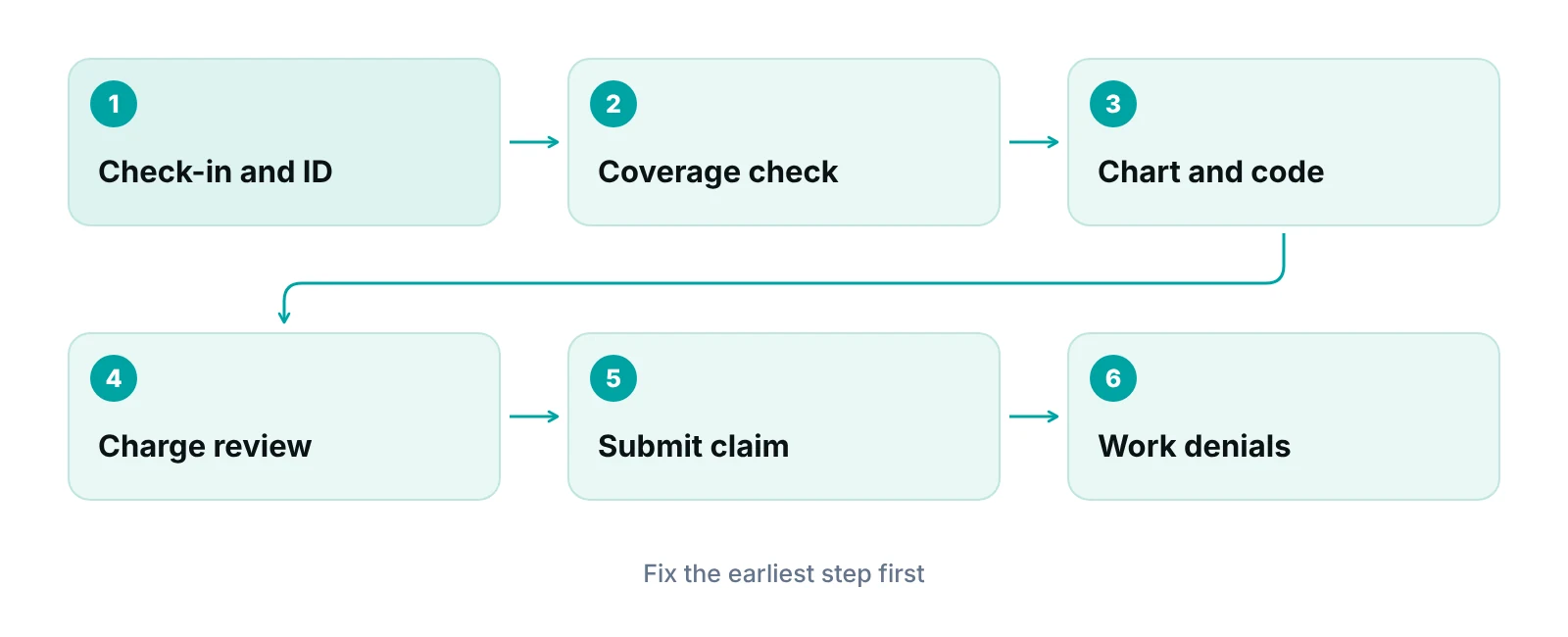
Urgent care is built on walk-in volume, which leaves little time to catch errors before the claim is created. The sections below follow the claim from check-in to follow-up. They show what the rule is, where centers go wrong, and what to put in place.
Key takeaways
- Most errors start at check-in or in charge entry, not in the exam room.
- Medicare claims must be filed within one calendar year of service, and a timely filing denial has no appeal rights.
- Level office E/M visits by medical decision making or total time, not by counting exam elements.
- Use modifier 25 only when the note shows a separate, documented E/M service.
- Payers differ on S9083, so keep a payer sheet and review denials by reason each month.
Why walk-in care creates billing risk
Most urgent care billing errors start before a clinician sees the patient or after the visit is over. They rarely start in the exam room. A walk-in patient hands over an insurance card at a busy desk, and one visit can include an evaluation, a procedure, an X-ray and supplies. Each part has to land on the right claim line with the right payer.
This guide covers eight mistakes in the order a claim travels: front desk, coding, submission and follow-up. For code-level detail on place of service, E/M levels and S-codes, read our companion urgent care billing and coding guide. This post is about the process errors that turn correct coding into unpaid claims.
What we could and could not source
We did not find a reliable public figure for how many urgent care claims are denied for each reason, so this post gives no denial percentages. The rules below come from CMS, a Medicare contractor and one payer policy, each linked where used. Your own denial reports are the best data you have.
Front desk mistakes: coverage and patient responsibility
Mistake 1: Capturing incomplete or unverified coverage
A claim built on the wrong subscriber, the wrong plan or an inactive policy fails no matter how well it is coded. Walk-in volume makes this easy to miss, because there is no pre-visit call to check coverage.
The fix is a short, fixed check-in routine. Scan the card front and back, confirm the patient’s name and date of birth match the card and photo ID, and check active coverage before or during the visit. Ask whether the injury happened at work or in an accident, because a different payer may be responsible. Our patient insurance verification guide walks through the steps.
“A claim is only as clean as the first thing captured at the front desk.”
Mistake 2: Skipping or waiving patient responsibility
Patient balances that are not collected at the visit are harder to collect later. Centers also create risk when staff waive copays or coinsurance as a courtesy. A statement from the HHS Office of Inspector General’s counsel in 1999 noted long-standing concern that routinely waiving Medicare coinsurance or copayments can implicate the federal anti-kickback statute and the False Claims Act.
Write down a collection policy: what is collected at check-in, what is estimated from the benefit check, and who may approve a financial-hardship exception. Have your compliance adviser review it. Our post on patient collection strategies covers the workflow side.
Coding mistakes: place of service, E/M level, modifier 25 and charge capture
Mistake 3: Treating S9083 and place of service the same for every payer
Payers do not agree on how to handle urgent care S-codes. Premera’s urgent care payment policy, last approved in November 2025, says S9083 and S9088 are informational only and are not reimbursed, whether billed alone or with other services. The same policy says the service itself should be reported with an appropriate CPT or HCPCS code and place of service (POS) 20, the urgent care facility code. Another payer may handle the code differently. The contract decides, so keep a one-page payer sheet. Details are in the coding guide.
Mistake 4: Leveling the visit with old E/M rules
For office and outpatient E/M visits, Medicare’s contractor Noridian lists the 2021 changes: providers may choose the level by medical decision making or by total time, history and exam are documented as medically appropriate but are not used to pick the code, time spent separately by clinical staff is not counted, and CPT code 99201 was deleted. Centers that still level by counting exam bullet points can land on the wrong code in either direction. Undercoding loses revenue, and overcoding invites audit risk. Review the 99213 CPT code guide for a worked example of one common level.
Mistake 5: Using modifier 25 by habit
Modifier 25 tells the payer that an E/M service on the same day as a procedure was significant and separately identifiable. In a 2006 transmittal to its Medicare Claims Processing Manual, CMS said carriers deny an E/M service billed with a global-period procedure unless modifier 25 is added. It also said the work must be above and beyond the usual work of the procedure, that both services must be documented in the record, and that carriers may screen providers whose modifier 25 use is high. The same transmittal said different diagnoses are not required for Medicare. Payers may apply their own rules, so check each one. See our comparison of modifiers 25 and 59.
Do not append modifier 25 automatically
If every injury visit that includes a procedure carries modifier 25, a payer reviewer will see the pattern. Add it only when the note shows a separate, medically necessary evaluation, and keep that documentation easy to pull.
Mistake 6: Losing charges for procedures, X-rays and supplies
A single injury visit may involve a laceration repair, a splint, an X-ray and supplies. If the clinician documents it but the charge never reaches the claim, the center is paid for the visit and not the service. The reverse also happens: a charge is entered with no matching documentation. Compare each day’s encounter forms or charge tickets with the claims created that day, and confirm with each payer how it wants X-ray and supplies reported. A clean claim needs a reviewed charge before it leaves the building, which is the point of our guide to clean claims.
The eight mistakes at a glance
Use this table as a checklist for a staff meeting. The first column is the mistake, the second is the point where it usually starts, and the last two are the consequence and the control.
| Mistake | Starts at | What it can cause | Control |
|---|---|---|---|
| 1. Unverified or incomplete coverage | Check-in | Rejected or denied claim, wrong payer billed | Fixed check-in routine; coverage check each visit |
| 2. Skipped or waived patient balance | Check-in or checkout | Uncollected balances; compliance risk | Written collection policy reviewed by your adviser |
| 3. One S-code rule for all payers | Fee schedule setup | Unpaid or incorrectly billed S9083 lines | Payer sheet listing S-code and POS rules |
| 4. Visit levelled with old E/M rules | Coding | Under- or overcoding | Level by MDM or total time; spot audits |
| 5. Modifier 25 by habit | Coding | Denials, payer review | Modifier 25 only with documented separate E/M |
| 6. Missing or unmatched charges | Charge entry | Lost revenue or unsupported lines | Daily charge ticket to claim reconciliation |
| 7. Late submission | Billing queue | Timely filing denials | Submission goal of a few days; aging report |
| 8. No denial tracking | Follow-up | Same errors repeat | Denials grouped by reason, reviewed monthly |
Source: RCM Finder summary of the controls discussed in this article; rules cited in the sections above.
Submission and follow-up mistakes
Mistake 7: Letting claims sit until the filing deadline is close
Medicare sets one calendar year from the date of service. Under 42 CFR 424.44 as summarized by Noridian Healthcare Solutions, claims for services on or after January 1, 2010 must reach the contractor within 12 months of the date of service or Medicare denies them. Noridian also states that a claim denied for timely filing has no appeal rights and that rejected claims must be corrected and resubmitted within the same one-year window. That last point matters in urgent care. A claim rejected for a data error and left in a queue can age past the deadline.
Commercial payers set their own limits in the contract. Do not assume a limit; read each contract and put the shortest one on your payer sheet. Then set an internal submission goal well inside it. We recommend submitting claims within a few days of the visit and tracking any claim that stays unsubmitted or rejected beyond that.
Mistake 8: Treating denials as one-off problems
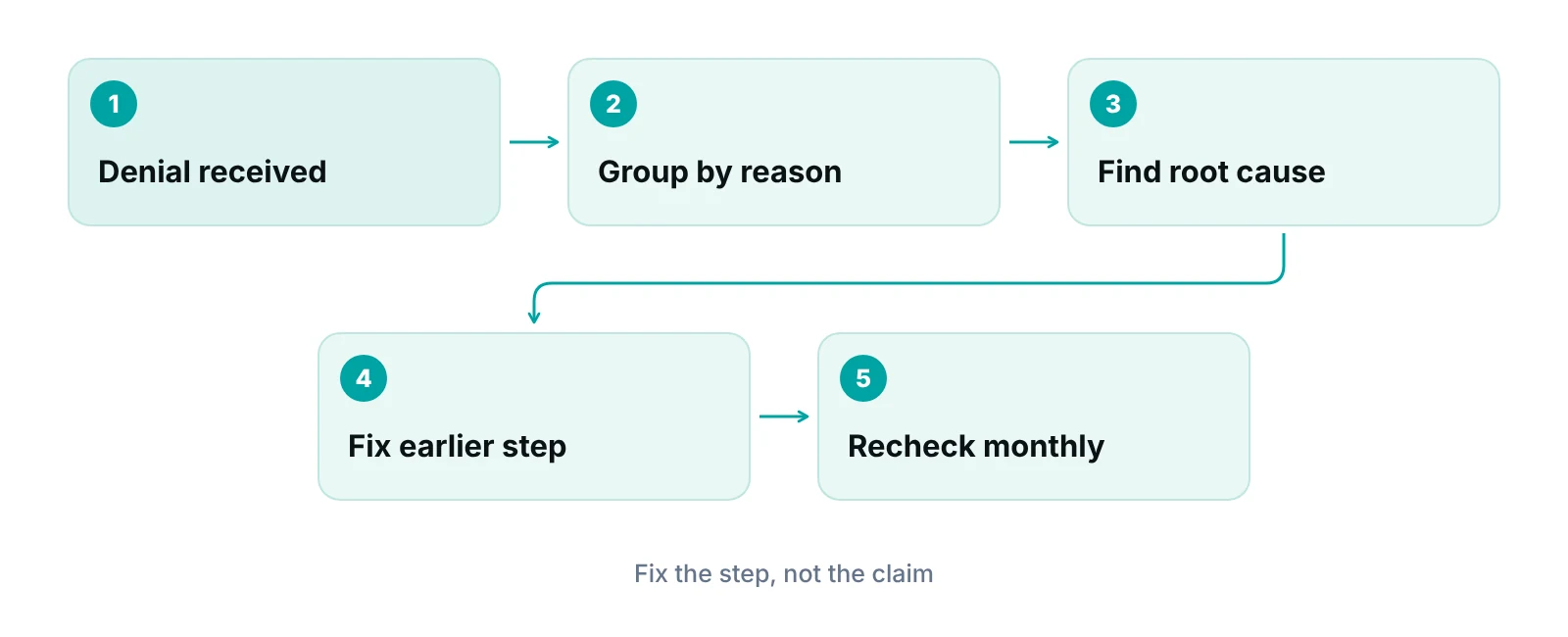
A denial fixed on one claim does nothing for the next one. The pattern lives in the reasons. Group denials by reason code and by payer, find the step that created each cluster (check-in data, coding, charge entry or submission), and fix that step. Our guides to medical billing denials and denial management explain how to read and prioritise them.
| Topic | What the source says | Source |
|---|---|---|
| Medicare timely filing | Claims for services on or after Jan 1, 2010 must reach the contractor within one calendar year of the date of service | Noridian, summarizing 42 CFR 424.44 |
| Timely filing denial | No appeal rights; rejected claims must be corrected and resubmitted within the window | Noridian |
| Office E/M level (since 2021) | Choose by medical decision making or total time; clinical staff time not counted; 99201 deleted | Noridian E/M page |
| Modifier 25 (Medicare) | Needed on an E/M billed with a global-period procedure; work must be separately identifiable and documented | CMS Transmittal 954 (2006) |
| S9083 and S9088 (one payer) | Informational, not reimbursed; report CPT/HCPCS code with POS 20 | Premera policy, approved Nov 2025 |
Source: Noridian Healthcare Solutions (2026); CMS Transmittal 954 (2006); Premera Blue Cross payment policy CP.PP.369 (2025).
Controls that keep these mistakes from repeating
Training helps, but a short set of recurring checks works better because it does not depend on memory. The table below suggests a cadence. It is our recommendation, not a regulatory requirement, so adjust it to your volume and staffing.
| Control | Who owns it | How often |
|---|---|---|
| Compare charge tickets with claims created | Billing lead | Daily |
| Review unsubmitted and rejected claims | Billing lead | Weekly |
| Review denials by reason and payer | Billing lead and practice manager | Monthly |
| Spot-check E/M levels and modifier 25 against notes | Coder or compliance lead | Monthly, plus after payer policy changes |
| Update the payer sheet (S-codes, POS, filing limits) | Practice manager | Quarterly and at contract renewal |
| Front desk coverage and ID audit | Front desk lead | Monthly sample |
Source: RCM Finder suggested cadence; not a regulatory requirement.
Software can carry some of this. A practice management system that tracks claims by stage lets a billing lead see which claims are unsubmitted, rejected or waiting on a payer, with an owner on each one. It can also hold a claim that is missing required data before it goes out. It does not replace the front desk routine or a coder’s judgment.
Want a second reader on your urgent care process?
Our free practice audit looks at where claims stall in your current workflow, from check-in to follow-up. Pricing for any service is quoted after the audit.
When to get outside help
If denials keep returning for the same reasons, or one person is covering the front desk, coding and follow-up, a second set of eyes can help. That can be a coder review, a billing partner or both. Our post on why centers outsource urgent care billing lays out the trade-offs. For broader mistakes that apply to every specialty, see common medical billing mistakes.
If you ask any billing vendor for help, ask who owns each claim, how quickly rejections are worked, whether they will sign a Business Associate Agreement before seeing patient data, and how they report on denials. Our urgent care billing support page and medical billing services show what we offer, and the Revenue Calculator can help you size the cost of delayed claims.
Our recommendations
- Build a one-page payer sheet. List each payer you bill with its S-code treatment, POS 20 requirement and timely filing limit, and note where you found each rule. Update it at every contract renewal.
- Make the check-in routine identical for every walk-in. Scan both sides of the card, match it to photo ID, check coverage and ask about work or accident injuries. Fixed steps beat memory on a busy day.
- Write a patient-balance policy and have it reviewed. Decide what is collected at the visit, who can approve exceptions, and how waivers are documented. Ask your compliance adviser to review it.
- Spot-check E/M levels and modifier 25 each month. Pull a small sample of visits, compare the level and modifier to the note, and correct the pattern, not only the claim.
- Reconcile charges with claims every day. Compare the day’s charge tickets or encounter forms with the claims created. A missing X-ray or procedure line is easiest to catch the same day.
- Review denials by reason every month. Group by payer and reason, name the step that caused each cluster and change that step. Share the result with front desk and clinical staff.
Hold an urgent care claim until its data is complete.
Our portal tracks each claim by stage with an assigned owner and checks that required data is present before submission. Workflow rules can flag a claim for review or hold it at a stage.
See how the RCM Finder portal works · Create a portal account
Disclosure: RCM Finder builds and sells this portal. It is a practice management system, not an EHR.
Bottom line
Urgent care billing mistakes are mostly process problems with process fixes: a fixed check-in routine, a payer sheet, honest E/M and modifier 25 review, daily charge matching and a monthly look at denials. If you want help, see our urgent care billing specialty page or our denial management services.
Frequently asked questions
What is the most common urgent care billing mistake?
We could not find a reliable public ranking, so we will not name one. In practice, errors cluster at check-in (incomplete or unverified coverage), in coding (E/M level and modifier 25) and in follow-up (denials not tracked). Your own denial report by reason code will show which applies to your center.
Does Medicare have a timely filing limit?
Yes. For services on or after January 1, 2010, Medicare claims must reach the contractor within one calendar year of the date of service under 42 CFR 424.44, as Noridian describes. A claim denied for timely filing has no appeal rights. Commercial payers set their own limits by contract.
When is modifier 25 appropriate in urgent care?
Modifier 25 is for an E/M service that is significant and separately identifiable from a procedure done the same day. CMS guidance for Medicare says the work must go beyond the usual work of the procedure and both must be documented. Payers vary, so check each payer’s policy.
Does every payer pay S9083?
No. Premera’s policy treats S9083 and S9088 as informational and does not reimburse them. Other payers may handle the code differently under contract. Keep a payer sheet and confirm each payer’s rule before you set up your charge master.
Should urgent care centers collect copays at check-in?
Collecting the patient’s estimated share at the visit is a common practice, and your payer contracts and benefit check should guide the amount. Avoid routinely waiving copays or coinsurance. Have your compliance adviser review your policy, especially for Medicare patients.
How often should an urgent care center audit its billing?
There is no single required schedule. We suggest daily charge reconciliation, weekly review of rejected claims, and monthly reviews of denials, E/M levels and modifier 25 use. Increase the sample size after any payer policy change or a spike in denials.
Get your free practice audit
Tell us about your practice. We will contact you using the details you give.
- A review of your recent claims, denials and A/R aging
- Where your front desk and prior authorizations slow payment
- A prioritized fix list you keep, whether or not you hire us
Pricing is quoted after the audit, based on your volume and the services you choose. Prefer to talk? Call +1 (302) 556-2288.
Sources
- Claim Submission Timeliness (Medicare timely filing) — Noridian Healthcare Solutions (Medicare Administrative Contractor) (2026 (accessed 2026-10-17))
- Evaluation and Management (E/M) page — Noridian Healthcare Solutions (Medicare Administrative Contractor) (2026 (accessed 2026-10-17))
- Urgent Care Center Services (CP.PP.369) — Premera Blue Cross and affiliated plans (2025 (last approved 11/04/25))
- Transmittal 954, Payment for E/M Services Provided During Global Period of Surgery (CR 5025) — CMS (2006)
- Statement of Kevin G. McAnaney, Practicing Physicians Advisory Council — HHS Office of Inspector General (1999)
Disclaimer: This article is educational and is not legal, coding, billing or compliance advice. CPT is a trademark of the American Medical Association. Payer rules and contracts vary and can change, so confirm current CMS, AMA and payer sources before you bill.
