
Medical billing denials are claims a payer has processed and refused to pay, in whole or in part, with a reason code on the remittance. Most trace back to missing or wrong data, missing authorization, coverage problems or coding errors. Read the code, fix the cause, resubmit or appeal inside the payer's deadline, and track reasons every month.
This guide is for practice owners, managers and billers who see denied claims on the remittance and want a clear way to read and work them. It covers the definitions, the common causes, how to work a denial and how to prevent the next one. Rates and rules cited here come from named sources with the year given, and anything that varies by payer is marked.
Key takeaways
- A denial comes after adjudication; a rejection is stopped before it, and each needs its own fix.
- Denial rates differ by source: nearly 15% in a 2023 hospital survey, 19% for ACA Marketplace in-network claims in 2024.
- The CARC and remark code on the remittance tell you the cause and whether to correct or appeal.
- Medicare allows 120 days to request a redetermination and one calendar year to file a claim.
- Track denial reasons monthly and fix the front-end cause.
What is a denial in medical billing, and how is it different from a rejection?
A denial happens after the payer has accepted the claim into processing, reviewed it and decided not to pay all or part of it. The decision appears on the electronic remittance advice (the 835, or ERA) and on the paper explanation of benefits, with a reason code attached. Whether the denied amount can be billed to the patient depends on the group code on the remittance, which is covered below.
A rejection is different. A rejected claim failed a front-end edit at the clearinghouse or the payer, for example because of invalid or missing data, and it never reached adjudication. There is no ERA for it. Mixing the two up is the most common reporting mistake, because each needs a different fix and each affects your denial rate differently. Our guide to clearinghouse rejection codes covers the rejection side in detail.
| Rejection | Denial | |
|---|---|---|
| When it happens | Before adjudication, at the clearinghouse or payer front end | After adjudication, when the payer decides on payment |
| Where you see it | Acknowledgment or claim status report (277CA) | Remittance advice (835 ERA) and explanation of benefits |
| Typical cause | Invalid or missing data the system can detect | Coverage, authorization, medical necessity, coding, filing limits and more |
| Usual fix | Correct the data and send a new claim | Corrected claim or an appeal, depending on the reason |
| Appeal rights | Medicare treats unprocessable claims as not appealable; resubmit instead | Appeal rights depend on the payer and plan |
Source: Stedi claim responses overview; First Coast Service Options, claims returned unprocessable; Noridian Medicare, timely filing (current pages).
"Hard" and "soft" denials are billing-office shorthand
Many billing teams call a denial soft when it can be corrected and resubmitted, and hard when it needs an appeal or is final. These are not official payer categories, and a denial should not be treated as final just because of its reason. An authorization denial, for instance, can still carry appeal rights under the plan. Read the remittance, then check the payer’s own policy. For the retro-authorization question see our retro-authorization guide.
How common are denials, and what do they cost?
Published rates vary by payer, setting and how the denial rate is defined, so no single number fits every practice. In Premier‘s survey of 280 hospitals in 23 states, covering 2023 claims, the initial denial rate averaged nearly 15%, and about 70% of denied claims were ultimately overturned and paid. That is hospital data, not physician-practice data, but it shows that most denials are recoverable and that the cost is in the rework.
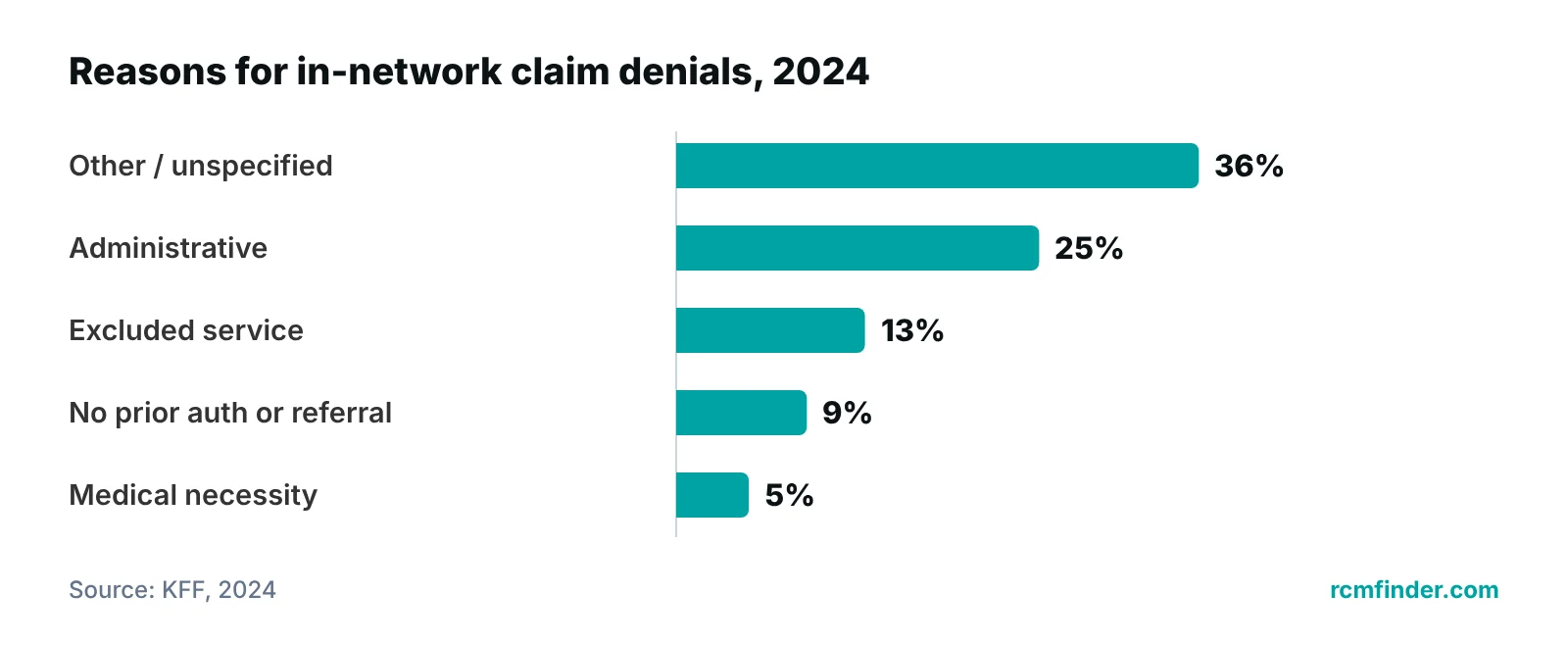
On the health-plan side, KFF reported that ACA Marketplace insurers denied 19% of in-network claims in 2024. Fewer than 1% of those denials were appealed, and insurers upheld 66% of the appeals that were filed. For a practice, the lesson is that a denial left alone is almost always lost revenue.
For a working benchmark, HFMA defines the denial rate as denied dollars divided by submitted dollars for the same period, and cites an industry average of 5% to 10%, with under 5% as optimal. HFMA also advises resolving 85% of denials within 30 days. Treat these as general guidelines. Specialty, payer mix and geography move them.
Cost per denial is also worth knowing, with a caution. Premier’s hospital survey put the cost of fighting a denied claim at $57.23 per claim in 2023, up from $43.84 in 2022. Those are hospital figures. Your own number is more reliable, and the revenue calculator can help you estimate what a lower denial rate is worth to your practice.
Why claims get denied: the common causes
Most denials fall into a short list of causes. The table pairs each with the Claim Adjustment Reason Code (CARC) the payer often uses and the first thing to check. CARC wording below is paraphrased from the X12 code list.
| Cause | Related CARC | First thing to check |
|---|---|---|
| Missing or invalid claim information | 16 | The remark code (RARC) on the remittance; correct the field and resubmit |
| Authorization absent | 197 | Whether an authorization existed, its dates and units, and the payer’s appeal route |
| Another payer may be primary | 22 | Coordination of benefits: who is primary, and update the patient record |
| Filing time limit expired | 29 | Date of service versus the payer’s filing limit; proof of timely filing |
| Not medically necessary per the payer | 50 | Diagnosis-to-procedure match and the payer’s coverage policy; documentation |
| Service bundled into another service | 97 | Code pairing, modifiers and whether the payer’s bundling edit applies |
| Coverage ended or not covered by payer | 27, 109 | Eligibility on the date of service; network status and plan benefits |
| Exact duplicate claim | 18 | Whether the first claim was paid or still pending; do not resend blindly |
| Attachment or documentation required | 252 | What the payer asks for and how to submit it |
Source: X12 Claim Adjustment Reason Codes (code wording, current list); X12 Remittance Advice Remark Codes.
Registration, eligibility and coverage
Errors captured at the front desk travel all the way to the claim: a misspelled name, a transposed member number, an old insurance card. Premier’s survey cited misspelled names, missing information and transposed identifiers among the clerical errors insurers use to deny claims. Verify coverage before the visit and again when anything about the patient’s plan changes. Services a plan does not cover, and out-of-network care, are also reasons payers cite. Tell patients their likely responsibility before the service, not after the denial.
Authorization and referrals
When a service requires authorization and none is on file, the payer may deny with CARC 197. Our CO-197 guide explains the code. Premier’s survey also found that denials are not limited to claims without authorization: 10.4% of denied claims in 2023 had received prior authorization, which insurers often attributed to minor clerical or data errors. An approval is not a guarantee of payment, so match the claim to what was authorized.
Coding, medical necessity and bundling
A diagnosis that does not support the procedure, a missing modifier, or two codes the payer bundles can all produce a denial. The fix starts with the clinical note and the payer’s coverage policy, not with changing codes until the claim passes. Codes must reflect what the documentation shows. Changing a code to fit a payer edit, with no documentation behind it, is a compliance problem, not a denial fix.
Timely filing, duplicates and coordination of benefits
Every payer has a filing limit. Under Medicare, a claim must be filed no later than one calendar year after the date of service, and a claim denied for timely filing has no appeal rights. Commercial and Medicaid limits are set by each payer’s contract or rules, so load each payer’s limit into your worklist. Duplicate-claim denials usually come from resending a claim that is still pending; check claim status first. Coordination of benefits denials come from a wrong or out-of-date primary payer in the patient record.
How to read a denial on the remittance
The remittance tells you who owns the amount and why. Each adjustment has a group code, a CARC and, often, a remark code. Group code CO means Contractual Obligation, PR means Patient Responsibility, OA means Other Adjustment and PI means Payer Initiated Reductions. Group codes generally assign responsibility for the adjustment amount, which is why a CO denial is not billed to the patient while a PR amount may be.
The CARC explains why the claim or line was paid differently than billed. A remark code (RARC) adds detail to that adjustment or conveys processing information. CARC 16 (the claim lacks information or has a billing error) is a good example: the remark code is what tells you which field to fix. See our CO-16 guide for how to work it. Medicare Administrative Contractors publish which remark codes allow a corrected resubmission, such as invalid patient name or invalid Medicare Beneficiary Identifier, and which, like the timely-filing remark, have no appeal rights. Check your MAC’s denial resolution page for the code in front of you.
What to do when a claim is denied
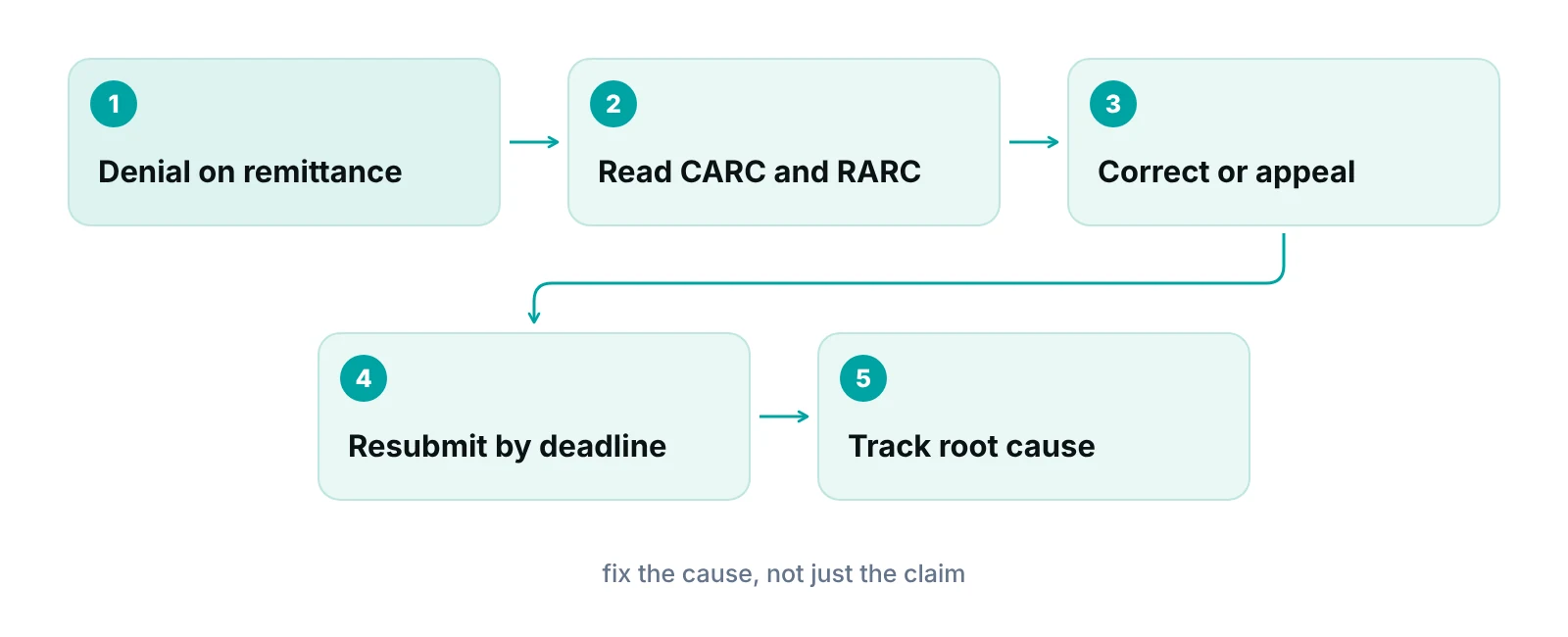
Work the denial in a fixed order: read the codes, decide whether it is a correction or an appeal, act before the payer’s deadline, and record the cause. Do not appeal a claim that the payer treats as unprocessable; it will not be processed, and the delay can cost you the filing window.
- Read the remittance. Note the group code, CARC and RARC for each line, and the date of the notice.
- Check the facts. Eligibility on the date of service, authorization, patient record, codes billed and documentation.
- Choose the route. If the payer wants missing or corrected data, send a corrected claim. If you disagree with the payer’s decision, file an appeal with the supporting records.
- Mind the deadlines. Appeal and filing clocks run from the payer’s notice, not from when you open the remittance.
- Record the cause against a reason category so the pattern shows up in your monthly report.
For Medicare, a First Coast notice says unprocessable claims “are not appealable” and that an appeal can lead to a timely-filing denial if the corrected claim does not arrive in time. See the First Coast guidance. The denial management guide goes deeper on appeal letters and the monthly review.
| Level | Appeal body | Filing window | 2026 minimum amount |
|---|---|---|---|
| 1 | Redetermination (Medicare Administrative Contractor) | 120 calendar days from receipt of the notice; receipt is presumed 5 days after the notice date | None stated |
| 2 | Reconsideration (Qualified Independent Contractor) | 180 days after you receive the MAC decision | None stated |
| 3 | Office of Medicare Hearings and Appeals (Administrative Law Judge) | 60 days after the QIC decision | $200 |
| 4 | Medicare Appeals Council | 60 days after the ALJ decision | None stated |
| 5 | Federal district court | 60 days after the Appeals Council decision | $1,960 |
Source: Medicare.gov, appeals in Original Medicare (2026 amounts); eCFR, 42 CFR 405.942.
A late redetermination request can be considered if the contractor finds good cause, which must be explained in writing. Private plans set their own steps. A CMS overview of internal claims and appeals rules gives claimants 180 days from receipt of a denial to file an internal appeal, and lets the plan decide post-service appeals within 60 days. Contracts and plan types can differ, so confirm the window in each payer’s denial letter.
Not sure which denials are worth chasing?
A free practice audit reviews your denial reasons and shows where the same cause keeps repeating.
How to prevent denials before the claim leaves
Prevention is front-end work: capture clean data, confirm coverage and authorization, and check the claim before it is sent. Most prevention steps sit before the claim, which is why billing is not the only team that owns denials.
- Verify coverage before the visit and re-check for recurring services.
- Confirm authorization requirements per payer and service, and match the units and dates on the claim to the approval.
- Check data completeness before submission: names, member IDs, dates, rendering provider, diagnosis pointers. A clean claim starts at registration.
- Watch filing and appeal clocks with a payer-by-payer list of limits.
- Code from the note and train staff on payer-specific edits.
- Review denials by reason every month and fix the process that caused them.
Denial patterns also differ by specialty, because the services, authorizations and modifiers differ. See the specialty billing pages for how those patterns look in a given specialty. If your team lacks the time to work denials and A/R every week, a denial management service can take that queue.
“A denial is information about a process. Fixing the claim recovers one payment; fixing the cause recovers the rest.”
A tracking tool helps too. A practice management system that tracks claims by stage shows which denials are open, who owns each, and which reason categories keep returning. It is not an EHR, and it works alongside the EHR you already use.
Want denials worked every week?
See how denial follow-up and appeals are handled so your team can stay on the front end.
Our recommendations
- Separate rejections from denials in every report. We recommend counting them separately. A rejection that is fixed before adjudication should not inflate the denial rate, and a hidden denial should not be filed as a rejection.
- Rank denial reasons by dollars, not count. A few high-dollar CARCs often outweigh many small ones. Review the top five each month and assign a named owner to each.
- Load every payer's filing and appeal limit. Put the limit next to the payer name in the worklist, so the oldest-deadline claim is worked first.
- Fix the front end first. Eligibility, registration and authorization errors are cheaper to prevent than to appeal. Give front-desk staff a short checklist and the denial feedback that relates to their work.
- Appeal on evidence, and only what is worth the effort. Compare the amount at stake with the time to appeal. Attach the records that answer the payer’s stated reason.
- Never change codes to fit an edit. Codes must match the documentation. If the note does not support the code, correct the note process or the code, not the claim alone.
Track every denied claim by stage, with a named owner.
The RCM Finder portal is a claim-centered practice management system, not an EHR. It tracks claims by stage with an owner, and uses workflow rules, role-based permissions, an audit log and reporting dashboards so managers can see which denials are open and who holds them.
See how the RCM Finder portal works · Create a portal account
Disclosure: RCM Finder builds and sells this portal. It is a practice management system, not an EHR.
Bottom line
Denials are information about your process. Read the codes, fix or appeal before the deadline and track the cause. If your team needs help, see our medical billing services or ask for a free practice audit.
Frequently asked questions
What is a denial in medical billing?
A denial is a payer’s decision, made after processing a claim, not to pay all or part of it. It appears on the remittance with a group code and reason code. It differs from a rejection, which is stopped before processing for data errors and has no remittance. Track the two separately, because each needs a different fix.
What are the most common reasons claims are denied?
Common causes are missing or incorrect claim data, absent authorization, coverage or eligibility problems, coordination of benefits, medical necessity, bundled services, duplicate submission and missed filing limits. The reason code on the remittance, not a general list, tells you which one applies to your claim. Rank them by dollars each month to find the few that matter most.
Can a denied claim be resubmitted, or must it be appealed?
It depends on the reason. If the payer needs missing or corrected information, a corrected claim is usually the route. If the payer made a decision you dispute, such as medical necessity, you appeal with records. Medicare says unprocessable claims are not appealable; check your payer’s rules.
How long do I have to appeal a denial?
Original Medicare allows 120 calendar days from receipt of the initial determination to request a redetermination, with receipt presumed five days after the notice date. A CMS overview gives 180 days for many private plans. Your contract and the denial letter control, so check the date on the notice.
Do hard and soft denials mean different things to payers?
No. These are internal billing terms for denials that can be corrected and resent versus denials that need an appeal or are final. Payers use reason codes and appeal rights instead. Even a denial that looks final, such as for authorization, may carry appeal rights.
How can patients help prevent denials?
Patients can bring current insurance cards, report plan changes before a visit, give accurate names and dates of birth, and tell the office about any other coverage. They should also ask about authorization for planned services. Clear coverage information at registration prevents many avoidable denials, and a quick call to the office is better than a surprise bill.
Get your free practice audit
Tell us about your practice. We will contact you using the details you give.
- A review of your recent claims, denials and A/R aging
- Where your front desk and prior authorizations slow payment
- A prioritized fix list you keep, whether or not you hire us
Pricing is quoted after the audit, based on your volume and the services you choose. Prefer to talk? Call +1 (302) 556-2288.
Sources
- Claims adjudication costs providers $25.7 billion (Premier hospital survey) — Premier Inc. (2025)
- Claims Denials and Appeals in ACA Marketplace Plans in 2024 — KFF (2024)
- 7 KPIs providers should be tracking — HFMA (current)
- Appeals in Original Medicare — Medicare.gov (2026)
- 42 CFR 405.942 Time for filing a request for redetermination — eCFR (current)
- 42 CFR 424.44 Time limits for filing claims — eCFR (current)
- Timely filing — Noridian Medicare JF Part B (current)
- Denial resolution — Noridian Medicare JF Part B (current)
- Claim Adjustment Reason Codes — X12 (current)
- Remittance Advice Remark Codes — X12 (current)
- Claims returned as unprocessable — First Coast Service Options (current)
- Claim responses overview — Stedi (current)
- Internal claims and appeals and external review process overview — CMS (current)
Disclaimer: This post is general educational information about revenue cycle operations. It is not legal, coding, billing-compliance or financial advice. Code definitions, payer rules, filing limits and appeal rights vary by payer and plan and change over time. Confirm requirements with the payer and qualified advisors before acting.
