
ABA billing companies should prove three things before you sign: they code the adaptive behavior family correctly (97151-97158 today, six new codes from January 1, 2027), they track payer authorization hours, and they handle clinician credentialing. Ask each vendor the questions below and check every answer against your payers' own manuals.
Many billing pitches for ABA clinics are general medical billing with the word ABA added. That is a problem, because ABA claims depend on 15-minute units, authorized hours, who delivered each unit, and notes that account for every billed unit. This guide is for clinic owners and managers choosing between in-house billing and an outside team. It covers the codes, the authorization and credentialing points that decide whether claims pay, the 2027 code changes, and a question list you can use on any vendor, including us. If you want the code-by-code reference first, start with our ABA therapy CPT codes guide.
Key takeaways
- Every code in the 97151-97158 family is reported in 15-minute units, so unit counting, authorization hours and session notes drive ABA claim accuracy.
- Six new adaptive behavior codes start January 1, 2027, 97151-97158 get new descriptor wording, and Category III codes 0362T and 0373T are deleted.
- Medicare pricing and telehealth status for the new codes are still proposed. The final rule is expected in November 2026.
- Medicaid, commercial plans and state rules set authorization limits and credential requirements, so a vendor must show how it tracks them per payer.
- Any vendor that touches patient data must sign a Business Associate Agreement and bind its subcontractors, and no honest vendor promises a revenue lift.
What an ABA billing company does that general billing does not
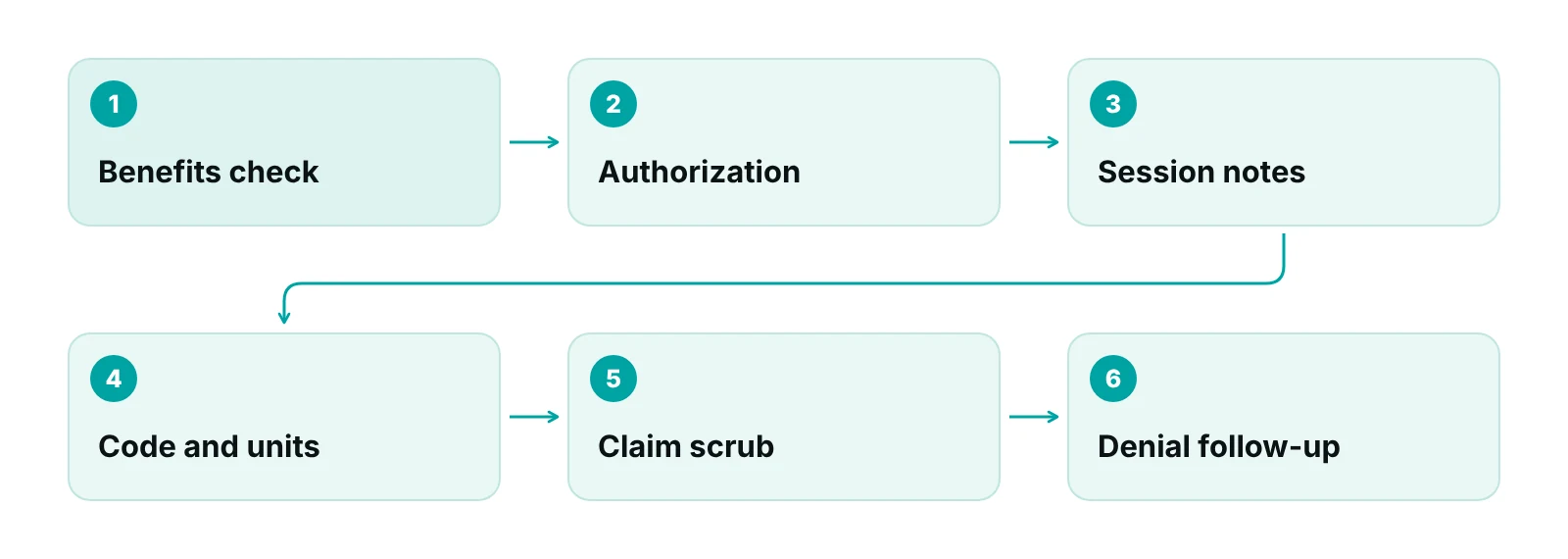
A good ABA billing company runs the whole claim path for adaptive behavior services: benefits checks, authorization requests and tracking, charge entry by 15-minute unit, claim submission, payment posting, denials and A/R follow-up. What sets ABA apart is how tightly those steps are linked. Each code in the 97151-97158 family is reported per 15 minutes of service (ABAI billing codes page), most payers want hours approved in advance, and the credential of the person delivering a unit can change the code, the rate or both.
Authorization is where the difference shows. One Massachusetts state prior authorization form for ABA asks for hours requested by code and setting, the assessment tools used and proof of diagnosis for initial requests, and states that an authorization period may not exceed six months (Mass.gov). A state Medicaid fee schedule can also cap hours. Alaska’s schedule, effective July 1, 2023, lists 97151 at one per six-month period and 97155 at 52 hours per six months (Alaska Medicaid). Those are examples, not national rules. Your billing team has to know each payer’s version.
The reader context matters too. CDC’s ADDM Network estimated that 32.2 per 1,000 eight-year-olds, about 1 in 31, had autism spectrum disorder in 2022 surveillance data, published in April 2025 (CDC MMWR). That is a prevalence estimate, not a count of ABA demand, but it is the latest figure we found and it is higher than the older numbers some web pages still quote.
The ABA codes your billing company must know today (97151-97158)
The adaptive behavior family has eight Category I codes in use through December 31, 2026. The table gives our plain-language summaries, not the AMA’s official wording, so check the CPT book before you build a charge master.
| Code | What it reports | Who delivers it | Billing note |
|---|---|---|---|
| 97151 | Behavior assessment and treatment-plan work, including non-face-to-face time | Physician or qualified health care professional (QHP) | 15-minute units; face-to-face and non-face-to-face time both count |
| 97152 | Supporting assessment work with the patient | One technician, under QHP direction | 15-minute units, face-to-face |
| 97153 | One-on-one treatment following a set protocol | One technician, under QHP direction | 15-minute units, face-to-face |
| 97154 | Group treatment following a set protocol | One technician, under QHP direction | 15-minute units; two or more patients |
| 97155 | Treatment with protocol changes; may include directing a technician | QHP | 15-minute units, face-to-face |
| 97156 | Guidance for family or caregivers; patient may or may not be present | QHP | 15-minute units, with caregivers |
| 97157 | Guidance for several families together, without the patients | QHP | 15-minute units; Louisiana says not to report if more than eight patients’ caregivers attend |
| 97158 | Group treatment with protocol changes | QHP | 15-minute units; Louisiana says not to report above eight patients |
Source: ABAI Behavior Analysis Billing Codes page; Louisiana Department of Health ABA documentation chart (undated).
Category III codes 0362T and 0373T cover assessment support and treatment for patients with destructive behavior, with a QHP on site and two or more technicians (ABAI). They are deleted at the end of 2026, as the next section explains.
Documentation rules vary by payer. Louisiana’s Medicaid chart, for example, requires daily documentation to be kept for seven years and says session notes do not have to cover each 15-minute unit but every billed unit must be accounted for (Louisiana Department of Health). A billing company should be able to show you the equivalent rule for each of your payers, not a generic answer.
The 2027 ABA code changes: what is final and what is still proposed
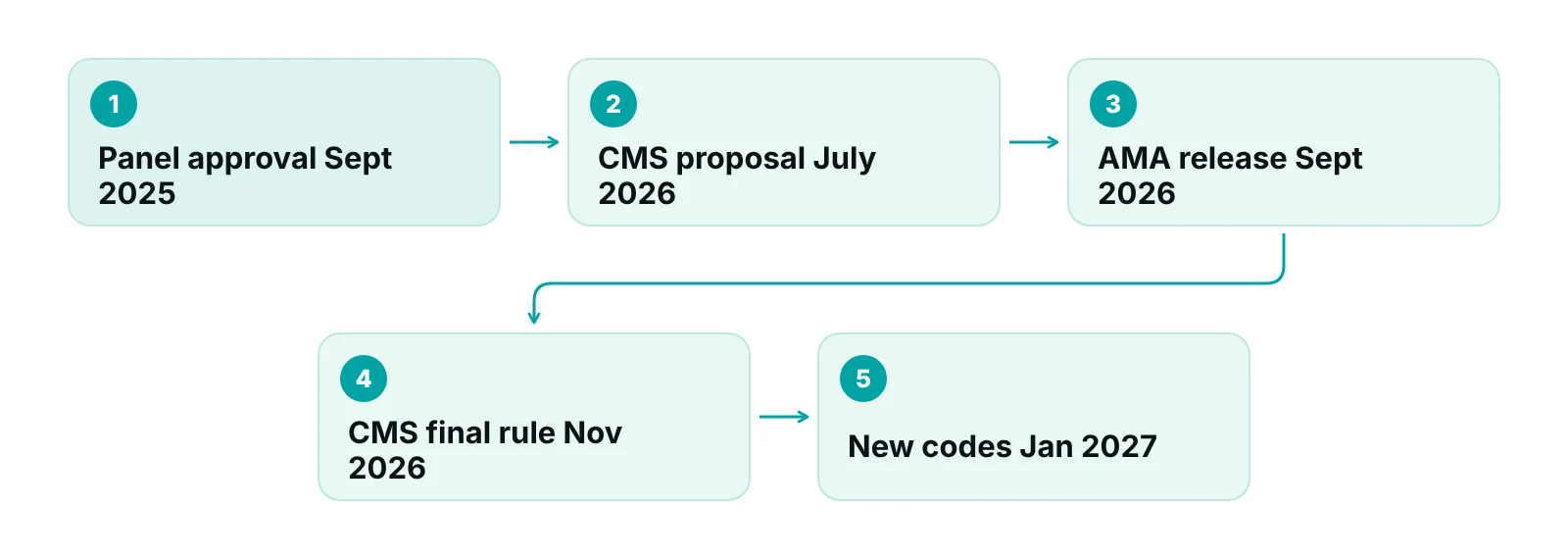
Six new adaptive behavior codes take effect in 2027. The AMA released the CPT 2027 code set on September 9, 2026, with 299 new codes overall (AMA), and the Council of Autism Service Providers (CASP) confirms that six of them are in the adaptive behavior family (CASP). The code numbers, the revisions to 97151-97158 and the deletion of 0362T and 0373T are listed by CASP (CASP). The CPT Editorial Panel approved the changes in September 2025.
| Change | Code(s) | What it means for billing |
|---|---|---|
| New | 97148 and add-on 97149 | Assessment support for harmful behavior with two technicians; the add-on covers extra technicians |
| New | 97159 and add-on 97160 | Treatment of harmful behavior with two technicians; the add-on covers extra technicians |
| New | 97173 | Treatment with analysis, delivered face-to-face by a physician or QHP to one patient |
| New | 97180 | Non-face-to-face QHP work such as data review and technician training; reported to be counted in 15-minute units across a week |
| Revised | 97151-97158 | New descriptor wording, including “analysis” in place of “protocol modification” in several codes |
| Deleted | 0362T and 0373T | Cannot be reported for dates of service on or after January 1, 2027 |
Source: Council of Autism Service Providers (2026); ABA Resource Center and Camber summaries for descriptor detail (secondary). Confirm wording in the CPT 2027 codebook.
Two parts are not final. CMS proposed in its July 14, 2026 physician fee schedule rule to keep carrier pricing for the adaptive behavior codes, including the six new ones, through 2027, so there is no national Medicare rate and you negotiate rates with payers (CASP). CMS also proposed keeping 97151-97158 on the permanent Medicare telehealth list, but said nothing about the new codes (ABA Coding Coalition). The final rule is expected in November 2026.
Ask every vendor about the transition
A new CPT code does not guarantee a payer will cover it or pay a set rate. Authorizations written under 0362T, 0373T or old descriptors may need to be converted, and payers will do this on their own schedules. A billing company should already have a payer-by-payer 2027 checklist.
Where ABA claims go wrong: authorization, credentials and Medicaid rules
Most avoidable ABA denials start before the claim: hours that were never authorized, units billed beyond the approved amount, or a clinician who was not enrolled or credentialed with that payer. A billing company cannot fix those after the fact, so check how it prevents them.
Authorization tracking
Ask who requests authorizations, who tracks remaining units by code, and how you are warned before hours run out. Our prior authorization services page explains how we handle requests, and any vendor, including us, should be able to show you a sample tracker. Reauthorization periods and the clinical summary payers want differ, as the Massachusetts and Alaska examples above show.
Credentialing and who delivers the unit
Payers decide which credentials may bill which code. Louisiana’s chart, for instance, lists technicians for 97152 and 97154, a technician or a licensed analyst for 97153, and licensed analysts for the QHP-level codes (Louisiana Department of Health). Ask a vendor whether it handles payer enrollment and how it keeps rendering and supervising provider information correct on claims. Our insurance credentialing guide for group practices explains the enrollment process.
Medicaid and children's coverage
Medicaid covers autism treatment services for children. CMS’s 2014 guidance says states decide medical necessity, that CMS does not require any specific treatment modality for autism, and that states must follow EPSDT obligations for individuals under 21 (Medicaid.gov). For under-21 members those services go through the state plan rather than a 1915(c) waiver. In practice your Medicaid rules, forms and codes are state-specific. Check that the vendor has handled your state’s program, and run a benefits check before the first session using the steps in our behavioral health eligibility verification guide.
Questions to ask ABA billing companies before you sign
Use the table on your vendor calls. A strong answer is specific to ABA and to your payers. A weak answer is a general claim about “expertise”. For broader vendor questions that apply to any specialty, see our guide to questions to ask when choosing a medical billing company.
| Ask | Why it matters | What a good answer sounds like |
|---|---|---|
| Which codes do you bill most for ABA clients? | The 97151-97158 family and the 2027 changes are the core of ABA coding | Names the codes, explains 15-minute units, and has a 2027 transition plan |
| How do you track authorized hours? | Billing beyond approved units causes denials | Describes a per-code tracker with warnings before units run out |
| Who requests authorizations and reauthorizations? | Gaps in this step stop revenue before the claim | Names the role and the payer lead time, and shows a sample report |
| How do you handle payer enrollment and credential rules? | Rendering and supervising provider data must match what the payer has on file | Explains how provider data is checked on each claim, or says plainly what you must handle |
| What happens to a denial? | Denials need a reason code review and a timed follow-up | Describes who works it, how appeals are tracked and how root causes reach you |
| Will you sign a BAA, and who are your subcontractors? | HIPAA requires a written agreement with any vendor that handles patient data for you | Signs before accessing data and lists any subcontractors that touch PHI |
| What reports will I see, and how often? | You need to catch problems yourself | Shows claim status, A/R aging and denial reasons by payer, on a set schedule |
On the BAA row: HHS says a business associate agreement must require safeguards for electronic patient data, reporting of impermissible uses and breaches, subcontractors bound to the same restrictions, and return or destruction of data at termination (HHS). A billing company that uses offshore or third-party staff should say so before you sign.
Estimate what your A/R is costing you
Enter your own numbers into our revenue calculator to see where the gaps may be before you talk to any vendor.
Red flags in an ABA billing pitch
Be cautious if a pitch includes any of the following.
- A promised revenue increase, denial rate or days-in-A/R number. No vendor can guarantee those, because payer rules, authorizations and your own documentation drive the result.
- No mention of the adaptive behavior codes, 15-minute units or authorization hours.
- Reference clients you cannot call, or testimonials with no verifiable detail.
- Reluctance to sign a BAA or to name subcontractors that handle patient data.
- A plan to change how you document sessions without asking which payers’ rules you bill under.
- No answer on what happens when the 2027 codes start.
“If a billing company cannot explain your authorization limits in plain words, it will not manage them well when the first denial arrives.”
— Awais Afzal, Healthcare Operations & Data Analyst
When outsourcing fits, and how we approach ABA billing
Outsourcing fits when your biller is overloaded, authorizations are slipping, or nobody tracks units by payer. It fits less well if you have one payer, a stable in-house team and no backlog, or if you want to keep full control of every claim. A hybrid works for many clinics: keep scheduling and notes in-house and hand off claims, denials and A/R. Our medical billing services can be scoped that way.
Our team works inside your existing EHR (for example PrognoCIS, eClinicalWorks or athenahealth), and we track every claim by stage in our own portal with role-based access and an audit log. For therapy and behavioral clinics we start from our behavioral health billing support, then map your payers, authorizations and provider credentials before anything is billed. We put a Business Associate Agreement in place before accessing patient data. Pricing is quoted after a free practice audit. If you want to talk it through, talk to our team.
Denials still happen with any vendor, so ask to see how they are worked. Our denial management guide shows the steps we expect.
Want a second opinion on your ABA claims?
We review a sample of your claims, denials and authorizations, then tell you what we would fix first. Pricing is quoted after the audit.
Our recommendations
- Review your last 100 claims before you shop. We start by listing denials by reason and payer, and by checking billed units against authorized units. That tells you whether you have a billing problem or an authorization problem, and it gives vendors something concrete to answer.
- Put every payer's ABA rules in one sheet. For each payer, record the codes it accepts, the credential it requires per code, its authorization period and its group-size and hour caps. Hand the sheet to any vendor you consider.
- Make the vendor explain 2027 in your payers' terms. Ask which payers have announced an adoption date for the new codes, which will accept 0362T and 0373T until the end of 2026, and how authorizations will convert. Treat vague answers as a warning.
- Keep notes that account for every billed unit. Whatever your payer’s note rule, make sure the unit count on the claim can be traced to a note. Fix this before you hire anyone, because a billing company cannot invent documentation.
- Get the BAA and subcontractor list in writing. Ask for both before you share any patient data. If the vendor will not name who touches PHI, do not proceed.
- Pilot on one payer first. Start with a single payer and review claim status weekly. Expand when the reports match what your own records show.
Ask any ABA billing company what you will be able to see.
The RCM Finder portal gives each practice a client portal with claim status by stage and owner, plus reporting dashboards.
See how the RCM Finder portal works · Create a portal account
Disclosure: RCM Finder builds and sells this portal. It is a practice management system, not an EHR.
Bottom line
Choose ABA billing companies by what they can show: correct 15-minute unit coding for 97151-97158, a plan for the 2027 changes, a way to track authorized hours and a signed BAA, not a promised percentage. If you want a second look at your claims and authorizations, see our medical billing services and prior authorization services, or ask for a free practice audit.
Frequently asked questions
What do ABA billing companies do?
ABA billing companies handle benefits checks, authorization tracking, charge entry by 15-minute unit, claim submission, payment posting, denial work and A/R follow-up for applied behavior analysis providers. The ABA-specific part is knowing the 97151-97158 codes, payer authorization limits and credential rules. Ask any vendor to show how it handles each step for your payers.
What CPT codes do ABA clinics bill?
Through December 31, 2026, ABA clinics bill 97151-97158 for assessment, technician-delivered treatment, QHP treatment with protocol changes, group treatment and caregiver guidance. Each is reported in 15-minute units. Category III codes 0362T and 0373T also exist until the end of 2026. See our ABA therapy CPT codes guide for code-by-code detail.
What changes in ABA billing in 2027?
Six new adaptive behavior codes start January 1, 2027: 97148, 97149, 97159, 97160, 97173 and 97180. Codes 97151-97158 get revised descriptors, and 0362T and 0373T are deleted. CMS has proposed carrier pricing and has not said whether the new codes join the telehealth list. Check the final rule expected in November 2026.
Should an ABA clinic outsource billing or keep it in-house?
It depends on volume, payer mix and who tracks authorizations. Outsourcing helps when billing is overloaded or hours are slipping past authorization. In-house can work for a stable team with few payers. A hybrid is common: keep scheduling and notes in-house and outsource claims, denials and A/R. Get any arrangement in writing.
What should I ask an ABA billing company about HIPAA?
Ask whether it will sign a Business Associate Agreement before it sees patient data, and who its subcontractors are. HHS says the agreement must require safeguards, breach reporting, subcontractors bound by the same terms and return or destruction of data at termination. Also ask about role-based access and audit logs.
Can a billing company guarantee higher revenue or fewer denials?
No honest billing company can guarantee a revenue lift or a denial rate. Results depend on your payers, authorizations, documentation and staffing. Be cautious of percentages in sales pitches, especially without a named source. Ask for a review of your own claims and a clear description of the process instead.
Get your free practice audit
Tell us about your practice. We will contact you using the details you give.
- A review of your recent claims, denials and A/R aging
- Where your front desk and prior authorizations slow payment
- A prioritized fix list you keep, whether or not you hire us
Pricing is quoted after the audit, based on your volume and the services you choose. Prefer to talk? Call +1 (302) 556-2288.
Sources
- Prevalence and Characteristics of Autism Spectrum Disorder Among Children Aged 8 Years, ADDM Network, 2022 — CDC MMWR Surveillance Summaries (2025)
- AMA releases CPT 2027 code set — American Medical Association (2026)
- AMA Releases 2027 CPT Codeset — Council of Autism Service Providers (2026)
- New ABA CPT Codes: What Payers and Regulators Need to Know — Council of Autism Service Providers (2026)
- CMS Releases Proposed 2027 Medicare Physician Fee Schedule — Council of Autism Service Providers (2026)
- ABA Coding Coalition: CMS Announces 2027 New and Revised CPT Codes for Adaptive Behavior Services — ABA Coding Coalition (via APBA) (2026)
- Billing Codes — Association for Behavior Analysis International (n.d.)
- ABA Required Documentation per Code — Louisiana Department of Health (n.d.)
- Autism services procedure codes and limits — Alaska Department of Health (2023)
- ABA prior authorization form — Mass.gov (n.d.)
- Medicaid and CHIP FAQs: Services to Address Autism — Medicaid.gov (CMS) (2014)
- Sample Business Associate Agreement Provisions — HHS Office for Civil Rights (n.d.)
- 2027 ABA CPT Codes Are Official: Here Are the Six New Codes — ABA Resource Center (2026)
- The 2027 ABA CPT Code Changes Are Confirmed — Camber (2026)
Disclaimer: This article is educational and is not legal, coding or compliance advice. CPT is a trademark of the American Medical Association, and the code descriptions here are our own summaries. Payer rules, state Medicaid rules and Medicare proposals described here vary and may change. Check current AMA, CMS and payer sources before you bill.
