
ABA therapy CPT codes are the Category I codes 97151 through 97158, which report adaptive behavior assessment, protocol-guided treatment, protocol modification and caregiver guidance, mostly in 15-minute units. Each code has its own provider level and rules, so match the note to the code and check payer policy first.
Most ABA billing problems begin with a code that does not match the session: a technician session billed as a supervisor service, a Category III code used as a progress note, or units that exceed the authorization. This guide maps each code, shows where payer rules change the answer and flags what is still pending for 2027.
Key takeaways
- The Category I ABA set is 97151-97158; it has eight codes, not three or five.
- 97155 reports QHP treatment with protocol modification, not general supervision.
- 0362T and 0373T are Category III codes for severe behavior, not progress-tracking codes, and some payers no longer allow them.
- Payer unit caps, provider levels and modifiers decide payment as much as the code does.
- Six new adaptive behavior codes are proposed for 2027 but are not official until the AMA publishes them.
What are ABA therapy CPT codes?
ABA therapy CPT codes are the five-digit Category I codes 97151 through 97158, which report adaptive behavior assessment, treatment and caregiver guidance. They are not one “ABA code.” They are a family of eight, and each one describes a different service, a different kind of provider and a different way of counting time. A claim is only as accurate as the match between the code and what actually happened in the session.
CPT is owned by the American Medical Association, so read exact descriptors and guidelines in your current CPT book. The AMA groups the family under adaptive behavior assessments (97151, 97152) and adaptive behavior treatments (97153, 97155, 97156, 97157, 97158), and its overview page also lists the two Category III codes that sit alongside them, 0362T and 0373T (AMA, adaptive behavior services overview). The summaries below are our own wording, drawn from payer policies that publish the descriptors in plain terms.
This guide is for owners, billers and clinical directors who need a reliable map of the code set before they build charge entry, authorizations and claim checks. If you run a billing company or want the wider revenue picture, our guide to ABA billing companies and revenue cycle management covers the operations side. This post stays on the codes themselves.
What does each code from 97151 to 97158 report?
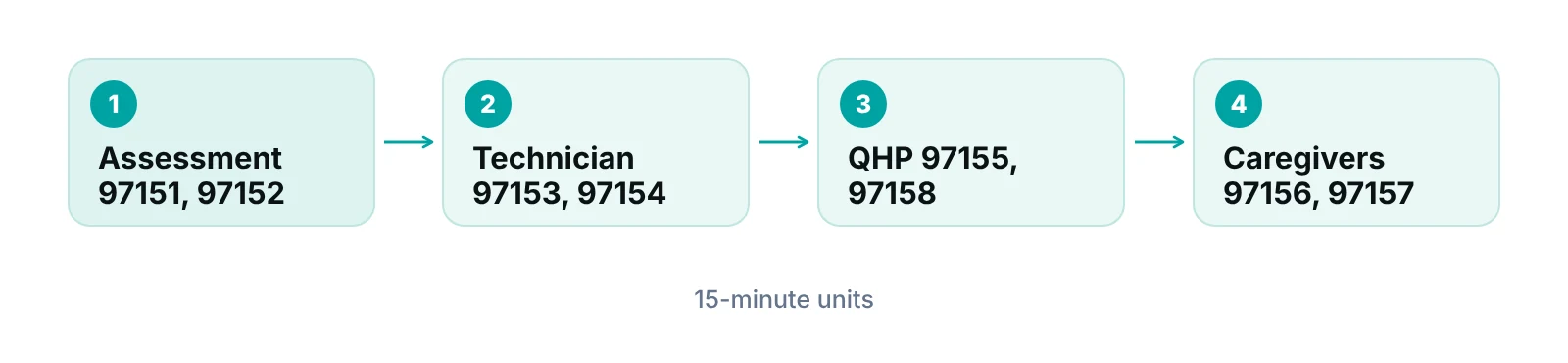
Each code reports one service, usually in 15-minute units. Two codes report assessment, three report treatment delivered by protocol or protocol modification, and three report family or group services. The table summarizes them; the unit and provider notes follow the policy summary published by PerformCare, a Pennsylvania behavioral health managed care plan. Your payer may differ.
| Code | What it reports (our summary) | Typically delivered by | Unit and key note |
|---|---|---|---|
| 97151 | Behavior identification assessment or reassessment, including record review, scoring and writing the treatment plan or report | Physician or other qualified health care professional (QHP) | 15 minutes; includes non-face-to-face time, unlike most of the family |
| 97152 | Supporting assessment in which a technician collects data face-to-face with the patient | Technician, under QHP direction | 15 minutes face-to-face; technician does not assess independently |
| 97153 | Treatment delivered by protocol, one-on-one | Technician, under QHP direction | 15 minutes face-to-face |
| 97154 | Group treatment delivered by protocol | Technician, under QHP direction | 15 minutes; one claim line per patient attending; group size set by payer policy |
| 97155 | Treatment with protocol modification, one-on-one | Physician or QHP | 15 minutes face-to-face; may include directing a technician at the same time |
| 97156 | Family guidance: the QHP trains guardians or caregivers, with or without the patient present | Physician or QHP | 15 minutes face-to-face with the caregivers |
| 97157 | Multiple-family group guidance, without the patient present | Physician or QHP | 15 minutes; reported once per set of caregivers, not per attendee |
| 97158 | Group treatment with protocol modification | Physician or QHP | 15 minutes; one line per patient attending; not reported with 97154 |
Source: PerformCare, ABA CPT supplemental guidance (IBHS 21-100 attachment); AMA, adaptive behavior services overview. Descriptors are paraphrased; CPT is a trademark of the AMA.
Assessment: 97151 and 97152
97151 is the QHP’s assessment code. Its unit is unusual because non-face-to-face work, such as scoring and writing the plan, counts toward the time, so the note should show both parts. 97152 is the supporting assessment a technician performs with the patient under QHP direction. A technician reports it only as a supplement to the QHP’s work, not in place of it.
Treatment: 97153, 97154, 97155 and 97158
97153 is the workhorse for most ABA claims: a technician running the treatment protocol one-on-one. 97155 is different. It reports a QHP delivering treatment while modifying the protocol, either alone with the patient or alongside a technician. It is not a generic “supervision” code. Time a supervisor spends planning, reviewing data or writing protocol changes away from the patient is bundled and is not billed on its own.
When a QHP joins a technician’s session to direct a new or modified protocol, the policy summary has the technician time reported as 97153 and the QHP time as 97155 for the overlapping minutes, if both descriptors are met. The same QHP may not report both for the same time. Group treatment follows the same split: 97154 is technician-led by protocol and 97158 is QHP-led with protocol modification, and the two are not reported together.
Guidance: 97156 and 97157
Caregiver guidance is its own service. 97156 covers guidance to one family, and it can be reported while the patient is receiving treatment elsewhere. 97157 covers a group of families without patients present. Payers define who counts as a caregiver, so check the definition before building a session template around these codes.
What happened to 0362T and 0373T?
0362T and 0373T are Category III codes for adaptive behavior services delivered to patients with severe, exposure-type behavior. They are not progress-tracking codes, and they are not part of the 97151-97158 set. Category III codes are temporary, and payers cover them at their own discretion.
Their history is easy to garble. ASHA’s notice of the original Category III adaptive behavior codes lists an effective date of July 1, 2014, and describes 0362T as an exposure behavioral follow-up assessment and 0373T as exposure adaptive behavior treatment with protocol modification requiring two or more technicians (ASHA). Carelon Behavioral Health’s crosswalk shows that when the Category I codes took effect on January 1, 2019, most of the earlier Category III codes were replaced by 97151-97158, while 0362T and 0373T stayed as Category III codes with revised descriptions (Carelon crosswalk).
| Date | Event | Source |
|---|---|---|
| July 1, 2014 | Original Category III adaptive behavior codes take effect, including 0362T (follow-up assessment) and 0373T (treatment with protocol modification) | ASHA |
| January 1, 2019 | Category I codes 97151-97158 take effect; most earlier Category III codes are crosswalked to them; 0362T and 0373T stay as Category III with revised wording | Carelon crosswalk |
| July 1, 2023 | Arizona’s Medicaid agency (AHCCCS) stops allowing 0362T and 0373T for reporting and points providers to 97151-97158 or another valid code that fits the service | AHCCCS memo dated June 21, 2023 |
Source: ASHA; Carelon Behavioral Health; Arizona Health Care Cost Containment System (2023). Other payers set their own dates.
The practical point is simple. Do not use 0362T or 0373T as a stand-in for progress notes or reassessments, and do not assume your payer still accepts them. Some payers have stopped allowing them and others never covered them. Ask each payer in writing which of the two it accepts, if either, and what authorization it requires.
Why do payer rules matter as much as the codes?
Codes tell you what happened; payer policy tells you what will be paid. Authorization units, daily and weekly caps, approved provider levels and modifiers vary by plan, and these limits cause many denials that have nothing to do with a wrong code. The TRICARE Autism Care Demonstration billing page is a clear example of how specific a payer’s limits can be (TRICARE ACD billing details).
| Code | Limit or rule shown on the payer page | Why it matters |
|---|---|---|
| 97151 | Initial assessment: 32 units per authorization period; reassessment: 24 units | Authorized units are a cap, so track them against the plan |
| 97152 and 97154 | Stated as not approved under the demonstration | A code can be valid in CPT and still not payable |
| 97153 | Up to 32 units a day and 160 a week; 15 minutes per unit | Weekly units do not roll over |
| 97155 | Up to 8 units a day; one supervisor session a month required | Schedule QHP time so the monthly requirement is met |
| 97156 and 97157 | 97156: 8 units a day; 97157: 6 units a day, clinic or office only | Setting and group size limits can apply |
Source: TRICARE Autism Care Demonstration billing page (hnfs.net). Shown as an example only; other payers set different limits.
The same page lists modifiers for particular situations, such as GT or 95 for remote caregiver sessions and HR or HS for concurrent family sessions. Modifier rules are payer-specific, so build a payer sheet rather than relying on a single national rule. Our guides to the telehealth modifiers and the behavioral health coding cheat sheet help with the wider modifier picture.
Authorization is the other half. Most ABA programs need a treatment plan and an approved number of units before treatment starts, and many ask for reassessment before renewal. Our prior authorization guide explains the process, and the prior authorization services page describes the support we offer.
Are the ABA therapy CPT codes changing in 2027?
Yes, but nothing is final yet. The ABA Coding Coalition reports that the CPT Editorial Panel approved six new adaptive behavior codes in September 2025, with a 2027 effective date, and that the existing codes 97151-97158 were not described as changed (APBA / ABA Coding Coalition summary). The six placeholder codes cover technician assessment and treatment of harmful behavior delivered by two technicians in a customized environment, an add-on for each additional technician, non-face-to-face QHP services, and QHP treatment with analysis.
CMS included the codes in its 2027 Medicare Physician Fee Schedule proposed rule, issued July 14, 2026, which also proposes keeping 97151-97158 on the permanent Medicare telehealth list and extends carrier pricing for the existing and new codes through 2027 (CAS summary of the proposed rule). A final rule is expected in November 2026, and the new codes are not official until the AMA publishes them in the 2027 CPT book.
Do not rebuild templates yet
The new codes still carry placeholder numbers. The coalition advises providers and payers not to change EMR systems until the AMA publishes the official codes. Plan the change, then act once the final numbers and your payers’ policies are known.
Where the new codes will probably matter is any program that today uses 0362T or 0373T for severe behavior. If that is your program, start asking payers now how they plan to cover the new codes.
What should be checked before an ABA claim goes out?
Check the service, the provider level, the units and the authorization before submission. Most ABA claim problems come from a mismatch between the note and the code, not from the code list itself. A short, repeatable check catches most of them.
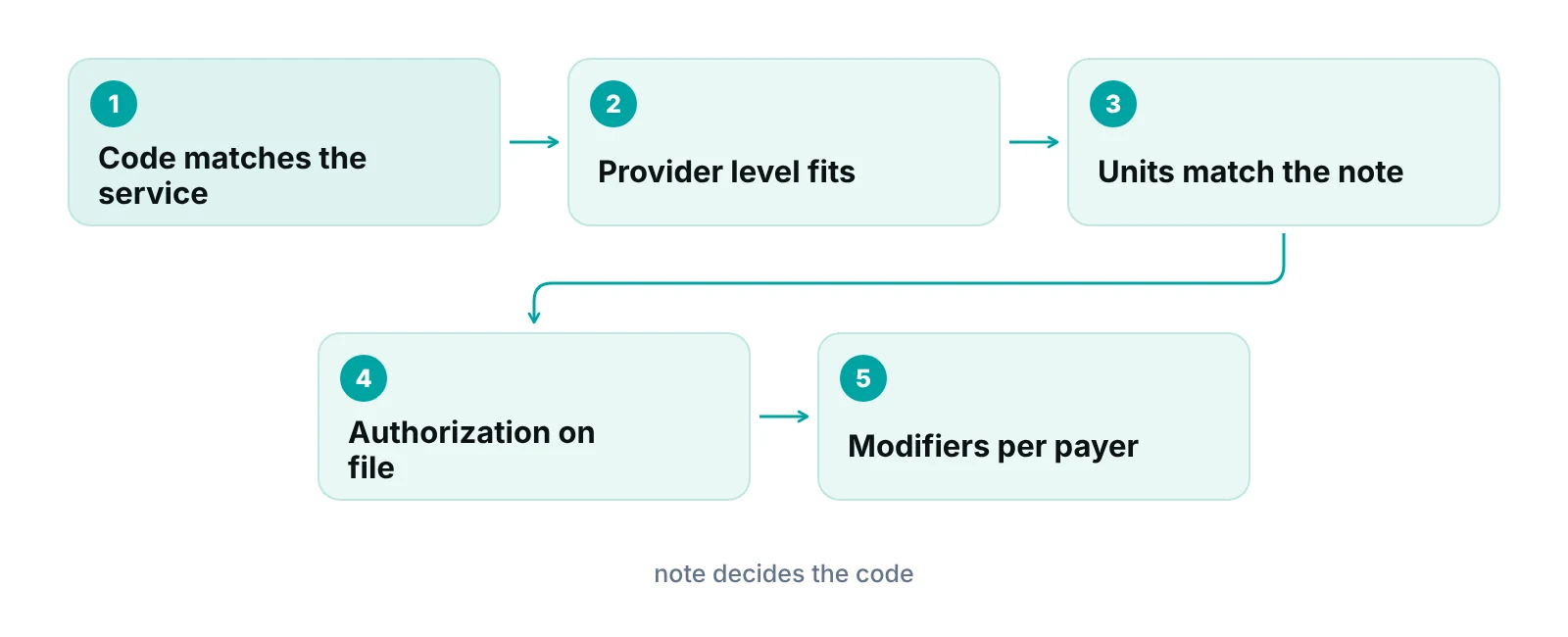
- Code to service. A technician session is 97153, not 97155. A QHP protocol-modification session is 97155, not a supervision charge.
- Provider level. Confirm the rendering provider type is allowed for that code under the payer’s policy.
- Units to minutes. Each unit is 15 minutes. The note should show start and stop times or total minutes for the service.
- Authorization. Compare units billed with units approved, and the date span of the approval with the date of service.
- Group and overlap rules. Do not report 97154 with 97158, and do not report two services by the same provider for the same time.
“A clean ABA claim is a note, a code and an authorization that all say the same thing.”
Claims that fail these checks tend to come back as denials or underpayments, which are slower and costlier to fix than a catch before submission. Our clean claims guide covers how a pre-submission review works in general.
How does this fit your billing operation?
ABA is a behavioral health service line with its own coding, authorization and payer rules, so it works best when billing staff know both the code set and the plans you contract with. Our behavioral and mental health billing support page explains how we approach therapy practices, and our medical billing services include charge entry, claim review and follow-up.
Enrollment is a separate bottleneck. New ABA providers often wait on payer enrollment before they can bill at all, and Medicaid plans add their own steps. See our Medicaid credentialing guide for how that process works.
Tracking is the other piece. A practice management system that tracks claims by stage lets you see which claims are waiting on a note, an authorization or a payer response, and assign each to an owner. Coding and unit decisions still stay with your clinicians and billers.
Want a second reader on your ABA claims?
Request a free practice audit. We review a sample of recent claims and denials and show where codes, units or authorizations may be costing you. Pricing is quoted after the audit.
Our recommendations
- Build a one-page code map. List 97151-97158 with the provider level allowed, the unit definition and the payer rules next to each. Put it where charge entry happens.
- Keep a payer sheet. Record each payer’s authorization units, daily and weekly caps, accepted modifiers, telehealth rules and the status of 0362T and 0373T. Review it each January.
- Make minutes a required field. Add start time, stop time and total minutes for each service so units can be checked against the note.
- Compare billed to authorized units weekly. Run a short report of units used against units approved so a cap is not discovered on a denial.
- Hold template changes until 2027 codes are final. Watch the CMS final rule and the AMA’s 2027 CPT release, then update templates once official numbers and payer policies exist.
Track ABA claims by stage with an owner on each.
Our portal tracks each claim by stage with an assigned owner, runs data-completeness checks before submission and lets workflow rules hold a claim for review. Code and unit decisions stay with your clinicians and billers.
See how the RCM Finder portal works · Create a portal account
Disclosure: RCM Finder builds and sells this portal. It is a practice management system, not an EHR.
Bottom line
The ABA therapy CPT codes are easy to list and easy to misuse. Match each session to the right code and provider level, keep units tied to minutes in the note, and check every payer’s caps and authorizations. If you want a second pair of eyes, see our medical billing services and prior authorization services, or estimate the gap with the revenue calculator.
Frequently asked questions
What are the ABA therapy CPT codes?
The Category I set is 97151 through 97158. 97151 and 97152 are assessment, 97153 and 97154 are technician-delivered treatment by protocol, 97155 and 97158 are QHP treatment with protocol modification, and 97156 and 97157 are family guidance. Units are generally 15 minutes, but payers set their own rules, so check each plan’s policy before you bill.
Is 97155 a supervision code?
Not in the general sense. 97155 reports a QHP delivering treatment with protocol modification, alone with the patient or while directing a technician. Time spent on planning, data review or writing protocol changes away from the patient is bundled and not billed separately. Check the payer’s policy on when 97155 can overlap with 97153.
What are 0362T and 0373T?
They are Category III codes for adaptive behavior assessment and treatment for severe, exposure-type behavior. They stayed Category III when the Category I codes took effect in 2019. Some payers have stopped allowing them, for example Arizona’s Medicaid agency from July 1, 2023. Ask each payer whether it accepts them and what it requires.
Can a technician bill 97151?
The payer policy summarized here has 97151 performed by a physician or QHP, including both the face-to-face and non-face-to-face work. A technician supports assessment through 97152 under QHP direction. Rules on who may render which code vary by payer and state, so confirm your plan’s provider-level list.
Are the ABA CPT codes changing in 2027?
Six new codes were approved by the CPT Editorial Panel in September 2025 for 2027, according to the ABA Coding Coalition, and CMS has proposed rules for them. They are not official until the AMA publishes the 2027 CPT book, and the final Medicare rule is expected in November 2026. Do not change systems before then.
Does Medicare cover ABA therapy codes?
The 2027 proposed rule keeps 97151-97158 on the permanent Medicare telehealth list and extends carrier pricing, which means rates are negotiated with payers rather than set on a national fee schedule. Most ABA claims go to Medicaid, TRICARE or commercial plans, whose policies differ. Always verify coverage with the specific plan.
Get your free practice audit
Tell us about your practice. We will contact you using the details you give.
- A review of your recent claims, denials and A/R aging
- Where your front desk and prior authorizations slow payment
- A prioritized fix list you keep, whether or not you hire us
Pricing is quoted after the audit, based on your volume and the services you choose. Prefer to talk? Call +1 (302) 556-2288.
Sources
- Adaptive behavior services (CPT overview) — American Medical Association (2024)
- ABA CPT supplemental guidance (IBHS 21-100 attachment) — PerformCare Pennsylvania (n.d.)
- Autism Care Demonstration: Billing — TRICARE (hnfs.net) (n.d.)
- ABA code crosswalk: Category III to Category I — Carelon Behavioral Health (n.d.)
- Memo: 0362T and 0373T code closure — Arizona Health Care Cost Containment System (2023)
- New Category III codes for adaptive behavior assessment and treatment — ASHA (n.d.)
- ABA Coding Coalition: 2027 new and revised CPT codes — Association of Professional Behavior Analysts (2026)
- CMS releases proposed 2027 Medicare Physician Fee Schedule — Council of Autism Service Providers (2026)
Disclaimer: This article is educational and is not legal, coding, billing or compliance advice. CPT is a trademark of the American Medical Association, and the code descriptions here are our own summaries. Payer rules, state Medicaid policies and contracts vary, and the 2027 changes are proposed and may change. Check current AMA, CMS and payer sources before you bill.
