
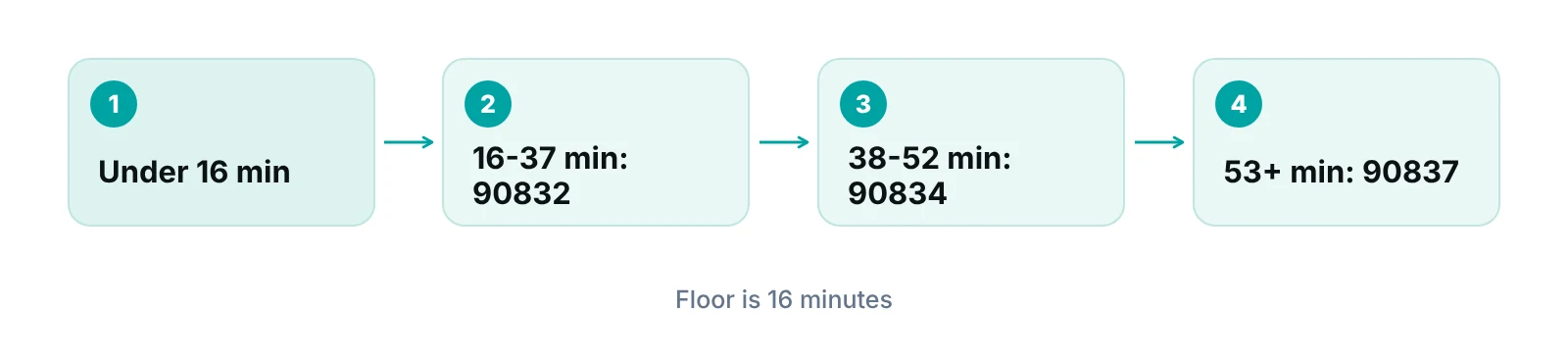
A behavioral health coding cheat sheet should list each psychotherapy CPT code with its time range, the add-on codes used beside E/M visits, and the telehealth place of service and modifiers your payers expect. Session length decides the code: 16 to 37 minutes is 90832, 38 to 52 is 90834, and 53 or more is 90837.
Most denials on mental health claims trace back to a small set of repeatable errors: the wrong time band, an add-on billed as a stand-alone code, or a telehealth claim with the wrong place of service. A one-page reference prevents those errors only if every line on it is accurate and current. The time ranges and definitions below come from a Medicare contractor and from HHS, and each is marked so you can verify it. For code-by-code explanations, see our mental health CPT codes guide. Payer rules differ, so treat this as a starting reference and confirm anything that affects payment with each payer’s current policy before you print and post it.
Key takeaways
- Psychotherapy codes are chosen by minutes: 90832 is 16 to 37, 90834 is 38 to 52, 90837 is 53 or more, and nothing under 16 minutes is reportable.
- Add-on codes 90833, 90836 and 90838 ride with an E/M visit; they are not billed alone and the E/M must be separately identifiable.
- Telehealth coding turns on place of service (02 away from home, 10 at home) and modifiers, and both vary by payer.
- A cheat sheet only protects revenue if it is dated, sourced and checked against each payer’s current policy.
- Pair the sheet with a pre-submission check on time documentation, diagnosis match and authorization.
What belongs on a behavioral health coding cheat sheet
Five groups of codes and rules belong on the sheet: individual psychotherapy by time, add-on psychotherapy with E/M, evaluation and special services, telehealth place of service and modifiers, and a short list of payer-specific checks. Anything longer stops being a cheat sheet and turns into a manual nobody opens.
A good test is whether a front desk or biller can answer three questions in under a minute. Which code does a 41-minute session map to? Can this therapy be billed beside a medication visit? What place of service goes on this video visit? If the sheet answers those, it is doing its job.
Keep descriptors in your own words. The AMA owns the official CPT descriptors, so a sheet shared outside the practice should paraphrase them and point staff to the current AMA CPT code set for exact wording. Put a revision date at the top and re-check the sheet each January and whenever a payer announces a policy change.
Scope of this reference
The time ranges below follow Medicare contractor guidance. Commercial plans and state Medicaid programs often follow CPT time ranges but may add their own limits, so confirm with each payer before you rely on a line.
Individual psychotherapy codes and time ranges
Pick the code that matches the minutes of psychotherapy actually delivered. A Medicare contractor, First Coast Service Options, lists 90832 for 16 to 37 minutes, 90834 for 38 to 52 minutes and 90837 for 53 minutes or longer, and says psychotherapy codes must not be reported for sessions under 16 minutes (page dated August 6, 2026).
| CPT code | Session length | Reportable range | Notes for the sheet |
|---|---|---|---|
| 90832 | About 30 minutes | 16 to 37 minutes | Shortest reportable session |
| 90834 | About 45 minutes | 38 to 52 minutes | Common stand-alone therapy code |
| 90837 | About 60 minutes | 53 minutes or longer | Documentation should support the time and the clinical need |
| None | Under 16 minutes | Not reportable | Do not bill a psychotherapy code |
Source: First Coast Service Options, Psychotherapy services (August 2026)
The 16-minute floor
A 15-minute session cannot be reported as 90832. The floor is firm, so time must be recorded in the note, not rounded in the clinician’s favor. Auditors compare the documented start and stop times with the code billed, which is why many practices require a start and end time on every psychotherapy note.
One unit per session
The same contractor says 90832 to 90834 and 90836 to 90838 should not be reported with more than one unit, except in a Medicare partial hospitalization setting (POS 52), and that claims with more than one unit have been denied since July 1, 2022 outside that setting. If a long session seems to need two units, choose the single code that fits the time.
A note on 90837
Because 90837 is the highest-paying stand-alone therapy code, payers tend to review it more closely. We recommend that every 90837 note state the minutes and show why the session needed that length. The contractor page also says G2212 prolonged services can only accompany E/M codes, not 90837, so do not stack it there.
Evaluation, crisis, family and group codes
These codes cover work that is not a standard individual session. The HHS telehealth site lists them as Medicare telehealth-eligible with permanent coverage, which is a useful checklist of the less common codes (page last updated July 29, 2025, so confirm current status with CMS).
- 90791: psychiatric diagnostic evaluation without medical services, used at the start of care.
- 90792: psychiatric diagnostic evaluation with medical services, for prescribers.
- 90839: psychotherapy for crisis. CPT sets its own time rules for crisis work and an extension add-on, so copy those from the current AMA CPT code set.
- 90846: family psychotherapy without the patient present.
- 90847: family psychotherapy with the patient present.
- 90853: group psychotherapy.
The contractor page notes that family psychotherapy (90846, 90847) may be reported on the same date as 90832 to 90838 only when it is a separate, distinct service in a separate time interval. Our 90846 family therapy billing guide goes deeper on that code.
How often can an evaluation be billed?
Limits on repeat diagnostic evaluations are set by payer and by Medicare contractor policy, not by one universal rule. Check each payer’s frequency limit and record it on the sheet instead of assuming a once-per-year rule.
Add-on codes: therapy on the same day as an E/M visit
When a prescriber also provides psychotherapy during a medication visit, bill one E/M code plus one psychotherapy add-on, not a stand-alone therapy code. The add-ons are 90833, 90836 and 90838, matched to the minutes of therapy delivered.
| Add-on code | Therapy time | Billed with | Rule to remember |
|---|---|---|---|
| +90833 | 16 to 37 minutes | An E/M visit | Add-on only; never the primary code |
| +90836 | 38 to 52 minutes | An E/M visit | Choose by therapy minutes only |
| +90838 | 53 minutes or longer | An E/M visit | Choose by therapy minutes only |
| E/M families | Per CPT | 90833, 90836, 90838 | Contractor lists 99202 to 99255, 99304 to 99337 and 99341 to 99350 |
Source: First Coast Service Options, Psychotherapy services (August 2026)
The contractor states the E/M and the psychotherapy must each be significant and separately identifiable, and that you should choose the add-on that most closely matches the time spent. In practice, that means the note needs two clearly separate parts: the medical management and the therapy, each with its own content.
The practical risk is double counting. Time spent on the medical work cannot also be counted toward therapy minutes, so the note should record therapy minutes separately. Where a modifier is needed to show a distinct service, our guide to modifiers 25 and 59 explains the difference.
“A code is only as defensible as the note behind it: if the minutes and the clinical content are not in the record, the code should not be on the claim.”
Telehealth place of service and modifiers
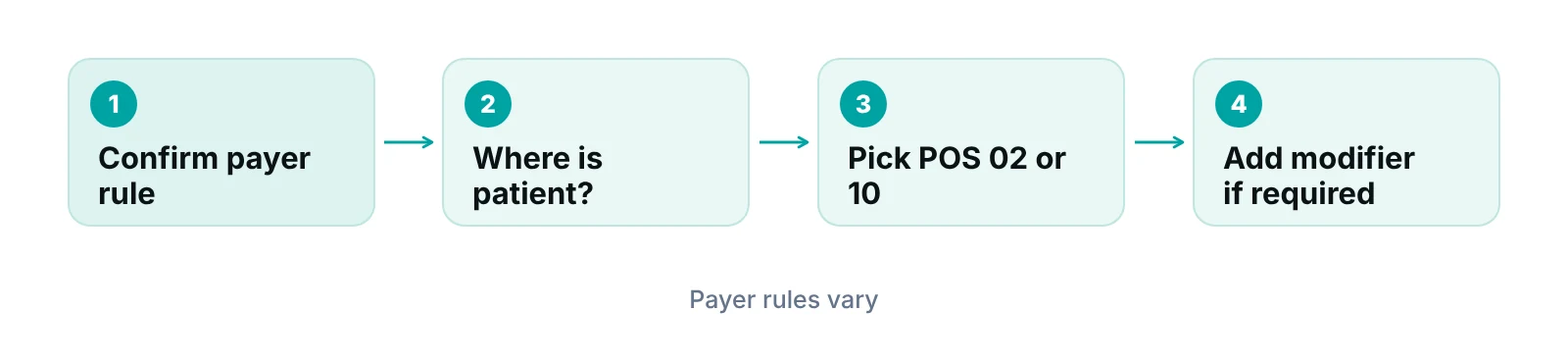
For video and phone therapy, the two questions are where the patient is and which modifier the payer wants. HHS telehealth.hhs.gov defines POS 02 as telehealth provided somewhere other than the patient’s home and POS 10 as telehealth provided in the patient’s home (page last updated January 17, 2025).
| Item | Meaning | When it applies | Check with |
|---|---|---|---|
| POS 02 | Telehealth outside the patient’s home | Patient at another location, such as a clinic or facility | Each payer |
| POS 10 | Telehealth in the patient’s home | Patient at home | Each payer |
| Modifier 95 | Synchronous audio and video service | Medicare use is narrow; commercial plans often use it for video | Each payer |
| Modifier 93 | Synchronous audio-only service | Audio-only for a patient at home when video is not available | Each payer |
Source: HHS telehealth.hhs.gov (2025); First Coast Service Options, Telehealth service modifiers (2026)
The contractor’s modifier page defines 95 as a synchronous service by real-time audio and video and 93 as a synchronous audio-only service. It also describes narrow Medicare uses for modifier 95, such as certain hospital-at-home and hospital-employed therapy situations, so do not assume Medicare wants it on every video visit.
Payers differ on both place of service and modifiers, and telehealth rules have changed repeatedly, so the safest sheet lists the rule for each major payer you bill. Our telehealth billing guide covers the wider policy picture.
Why behavioral health claims get denied and how the sheet helps
The most common avoidable denials come from a mismatch between what was billed and what the record or the payer’s rules support. A cheat sheet fixes the first, and a pre-submission check fixes the second.
- Time and code disagree. The note shows 34 minutes but the claim says 90834. Check start and stop times against the band before submitting.
- Add-on billed alone. Codes 90833, 90836 and 90838 have no meaning without an E/M visit on the claim.
- Wrong place of service or modifier on telehealth. Confirm where the patient was and what that payer requires.
- Diagnosis does not support the service. The diagnosis should explain why the service was needed; if it does not, expect medical necessity edits.
- Authorization or eligibility gaps. Some services and levels of care need prior authorization with some payers. Verify first; see our behavioral health eligibility verification guide.
A practice management system that checks claim data for completeness before submission and tracks each claim by stage helps catch these before the payer does. RCM Finder’s practice management system that tracks claims by stage includes data-completeness checks and underpayment flags against expected amounts. It is a claim-centred system, not an EHR.
When denials do arrive, work them by reason code and fix the cause upstream. Our clean claims guide explains how a clean claim is defined and measured, and RCM Finder’s denial management services handle appeals when volume gets ahead of the team.
How to turn this reference into a desk sheet your team uses
Build the sheet as a controlled document, not a pasted list. That means one owner, a revision date, and a source noted beside every line that affects payment.
- List the codes your practice actually bills, by role: therapists, prescribers, group programs.
- Copy exact descriptors and time rules from the current AMA CPT code set and note the year.
- Add each major payer’s rules where they differ: telehealth POS, modifiers, frequency limits, authorization.
- Add a documentation line for each code, such as start and stop times for psychotherapy.
- Date the sheet, name an owner, and review it every January and after any payer notice.
Specialty context matters too. Behavioral health billing mixes time-based codes, E/M add-ons and often group or intensive programs, which is why a specialty-aware process works better than a generic one. RCM Finder’s behavioral health revenue cycle support page describes how that is set up, and our behavioral health billing and RCM guide covers the wider workflow.
Want a second set of eyes on your behavioral health claims?
A free practice audit reviews how your codes, documentation and payer rules line up, and shows where claims are likely to stall.
Our recommendations
- Make time documentation non-negotiable. Require start and stop times on every psychotherapy note, and have billing check them against the code band before claims go out.
- Put one owner and a date on the sheet. A single named person updates the sheet each January and after payer notices, so staff know it is current.
- Separate payer-specific lines from general ones. Mark which lines follow CPT or Medicare guidance and which are one payer’s rule, so nobody applies a payer quirk to every claim.
- Teach add-ons as add-ons. Train prescribers and billers that 90833, 90836 and 90838 only exist beside an E/M visit, and that therapy minutes are recorded apart from medical management time.
- Review denials by code, not by claim. Group denials by CPT code and reason each month. Repeats show which line on the sheet is wrong or ignored.
- Check payer policy before you rely on a telehealth line. Telehealth place of service and modifier rules change. Re-confirm them with each payer at least once a year.
A claim-centred practice management system can check claim data before submission and flag underpayments.
RCM Finder's portal tracks each claim by stage with an owner, runs data-completeness checks before submission and flags underpayments against expected amounts. It is a practice management system, not an EHR.
See how the RCM Finder portal works · Create a portal account
Disclosure: RCM Finder builds and sells this portal. It is a practice management system, not an EHR.
Bottom line
A behavioral health coding cheat sheet works when each line is sourced, dated and checked against the payers you bill. Start with the time bands and add-on rules above, then add your payers’ telehealth and frequency rules. If you want help turning the sheet into a working billing process, RCM Finder’s medical billing services cover charge entry, claim submission and follow-up, and you can estimate the revenue at stake with the revenue calculator.
Frequently asked questions
How many minutes do I need to bill 90832?
A Medicare contractor lists 90832 for 16 to 37 minutes of psychotherapy and says psychotherapy codes must not be reported for sessions under 16 minutes. Record the actual minutes in the note. Other payers usually follow CPT time ranges, but check each one’s current policy.
Can I bill an E/M code and a therapy code on the same claim?
Yes, in the right form. When a prescriber provides both services, you report the E/M visit plus one psychotherapy add-on (90833, 90836 or 90838) matched to the therapy minutes. The two services must be separately identifiable in the note, and time cannot be counted twice.
Is 90837 harder to get paid than 90834?
Payers often review the longest stand-alone therapy code more closely, so the note should show the documented minutes and why a session of that length was needed. Rules differ by payer, so ask each one whether it applies extra review or limits to 90837.
What place of service do I use for telehealth therapy?
HHS describes POS 02 as telehealth provided somewhere other than the patient’s home and POS 10 as telehealth provided in the patient’s home. Payers vary on both place of service and modifiers, so confirm each payer’s current requirement before billing.
How often can I bill a psychiatric diagnostic evaluation?
There is no single rule that applies everywhere. Frequency limits for 90791 and 90792 come from each payer or Medicare contractor policy, so look up the limit for the plan on the claim and record it on your cheat sheet instead of assuming a fixed interval.
Should I use a downloadable cheat sheet from another site?
Use any outside sheet only as a starting point. Check each time range and rule against a primary source, such as the current AMA CPT code set, your Medicare contractor and your payers’ policies, then date the version your team uses.
Get your free practice audit
Tell us about your practice. We will contact you using the details you give.
- A review of your recent claims, denials and A/R aging
- Where your front desk and prior authorizations slow payment
- A prioritized fix list you keep, whether or not you hire us
Pricing is quoted after the audit, based on your volume and the services you choose. Prefer to talk? Call +1 (302) 556-2288.
Sources
- Psychotherapy services — First Coast Service Options (Medicare contractor) (2026)
- Billing for telebehavioral health — HHS telehealth.hhs.gov (2025)
- Billing and coding Medicare fee-for-service claims — HHS telehealth.hhs.gov (2025)
- Telehealth service modifiers — First Coast Service Options (Medicare contractor) (2026)
Disclaimer: This article is educational and is not legal, coding, billing or compliance advice. CPT is a registered trademark of the American Medical Association. Payer rules, Medicare contractor policies and telehealth flexibilities change, so confirm every code, time range and modifier against the current AMA CPT code set and each payer's policy before billing.
