
Online reputation management for doctors means keeping your listings accurate, asking every patient for an honest review, and replying in general terms only. Never confirm that a reviewer is a patient, never pay or pressure for reviews, and never hide bad ones. HIPAA, the FTC and Google each set rules.
This update replaces the old tactic list and its untraceable statistics with what a practice manager needs: how to ask for reviews, how to reply without a HIPAA problem, and what to do about reviews you think are unfair.
It is written for owners and managers. If you read one section, read how to reply to reviews under HIPAA.
Key takeaways
- Ask every patient for a review in the same way, and give nothing in return. Google bans incentives, and the FTC bans buying reviews that must be positive.
- A public reply must not confirm the reviewer is a patient, and a patient’s own post does not give you permission to share anything.
- HHS OCR has settled with practices over HIPAA-violating review replies (a dental practice in 2022, a New Jersey psychiatry practice in 2023).
- You can flag a review that breaks Google’s policy, but you cannot delete one, and you cannot threaten reviewers or push them to take reviews down.
- A written reply policy and one named owner prevent most mistakes.
What does online reputation management for doctors involve?
It is the routine work of keeping what patients find about your practice accurate, asking for honest feedback, and answering that feedback safely. It is mostly three jobs: keep your listings correct, collect reviews in an approved way, and reply in a way that protects patient privacy.
Three rule sets shape those jobs. HIPAA limits what you can say about a patient. The FTC’s Consumer Reviews and Testimonials Rule, effective October 21, 2024, limits how you can get, buy, display and suppress reviews. Google’s own Maps content policy limits incentives and selective requests, and Google can remove content that breaks it.
This work sits inside wider healthcare digital marketing; for search visibility see our healthcare SEO guide.
Where should you check your reputation first?
Start where patients look before they call: Google search and Maps, your website, and the review sites that rank for your name. Check each one for accuracy before you try to change what people say.
Google has rules for how a practice may appear on Maps. Per Google’s business profile guidelines, the name should be your real-world name, the address should be a real location (not a P.O. box or virtual office), and a practitioner who works in a public-facing role at your location can have their own profile, but should not have multiple profiles for different specialties.
| Where | What to check | Suggested owner |
|---|---|---|
| Google Business Profile | Name, address, hours and practitioner listings match the guidelines; all reviews have a reply decision | Practice manager |
| Your website | Phone, address and hours match the profile; no testimonials without a documented sign-off | Marketing lead or vendor |
| Other review sites | Profile claimed and details correct; new reviews noticed within a set time | Front desk lead |
| Social pages | Comments and messages checked; no patient details in any public reply | Practice manager |
| Search for your name | Read the first page of results; note outdated or wrong listings | Practice manager |
Source: Google Business Profile Help, Guidelines for representing your business on Google. Owners are our suggestion.
Write down what you find, with dates; that is your baseline. Our small-practice marketing overview covers where reputation fits among the other tactics, and the medical website design post covers the site itself.
How can a practice ask for reviews without breaking the rules?
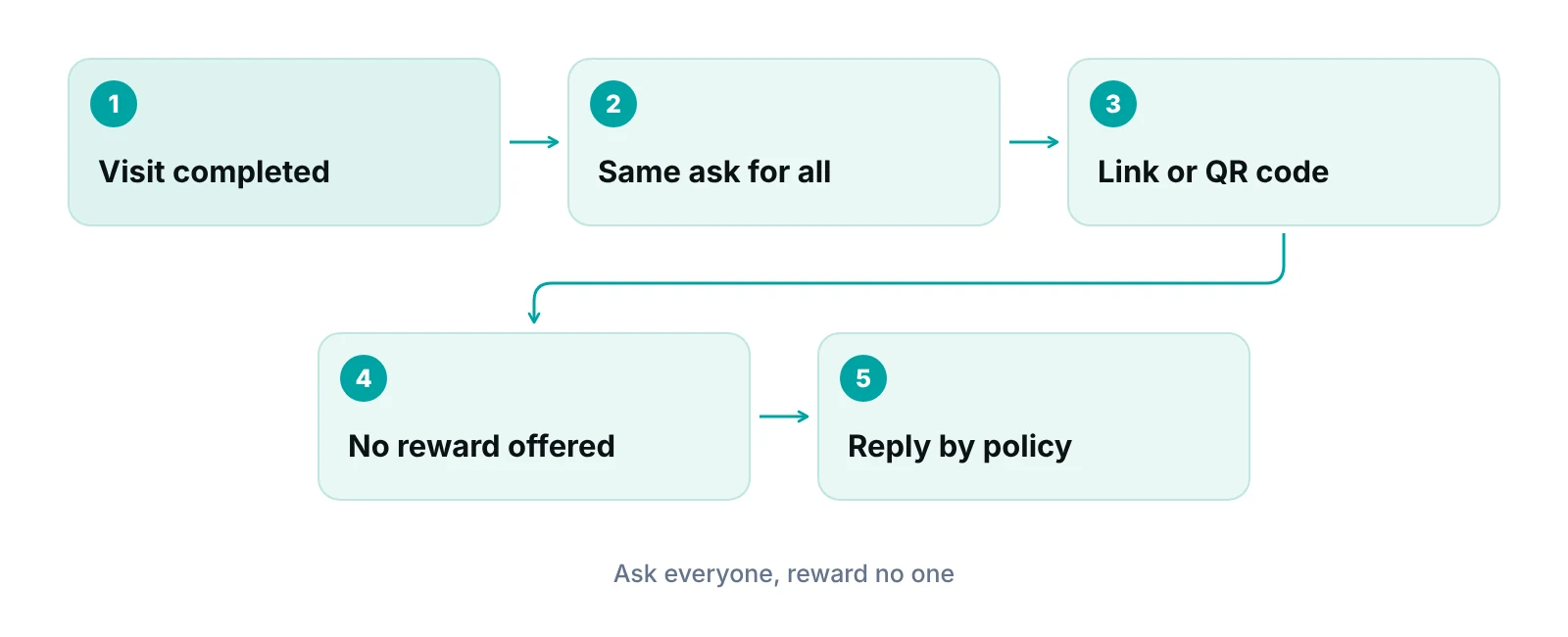
Ask every patient the same way, make it easy, and offer nothing in return. Google says merchants can encourage genuine reviews as long as they do not try to influence the rating or the content, and the FTC treats generalized requests to all customers as outside its rule.
Google’s help page says customers can leave a review by following a Google link or scanning a QR code, and that customers must be signed in to a Google Account.
| Practice | Lower risk or risky? | Why |
|---|---|---|
| Send the same review link to every patient | Lower risk | Google allows asking for genuine reviews; the FTC rule excludes generalized requests to all purchasers |
| Ask only patients who seem happy | Risky | Google bars selectively soliciting positive reviews; the FTC says excluding negative reviews can be deceptive |
| Give a gift card, discount or free service for a review | Risky | Google prohibits incentives; the FTC bans paying for reviews that must express a particular sentiment |
| Set a review quota for staff | Risky | Google says merchants may not ask staff to solicit a set number of reviews |
| Write reviews yourself or have staff or relatives post them | Risky | Google treats conflict-of-interest and fake reviews as prohibited; the FTC rule bans fake reviews and requires insider reviews to disclose the relationship |
| Pressure patients to post before they leave the office | Risky | Google says staff should not require or pressure users to leave reviews on the premises |
Sources: Google Maps user-generated content policy; Google Business Profile Help (tips to get more reviews); FTC, Consumer Reviews and Testimonials Rule: Questions and Answers.
Where staff do the asking, the front desk matters. A virtual medical assistant working inside your EHR can handle the calls and intake that shape the experience patients later describe; see our virtual medical assistant service and our post on the front desk’s effect on the revenue cycle.
Do not tie any discount or gift to a review
Google prohibits incentives for reviews. For Medicare and Medicaid patients, gifts and waived cost sharing can also raise separate federal fraud-and-abuse questions that your attorney should review.
How do you reply to reviews without breaking HIPAA?
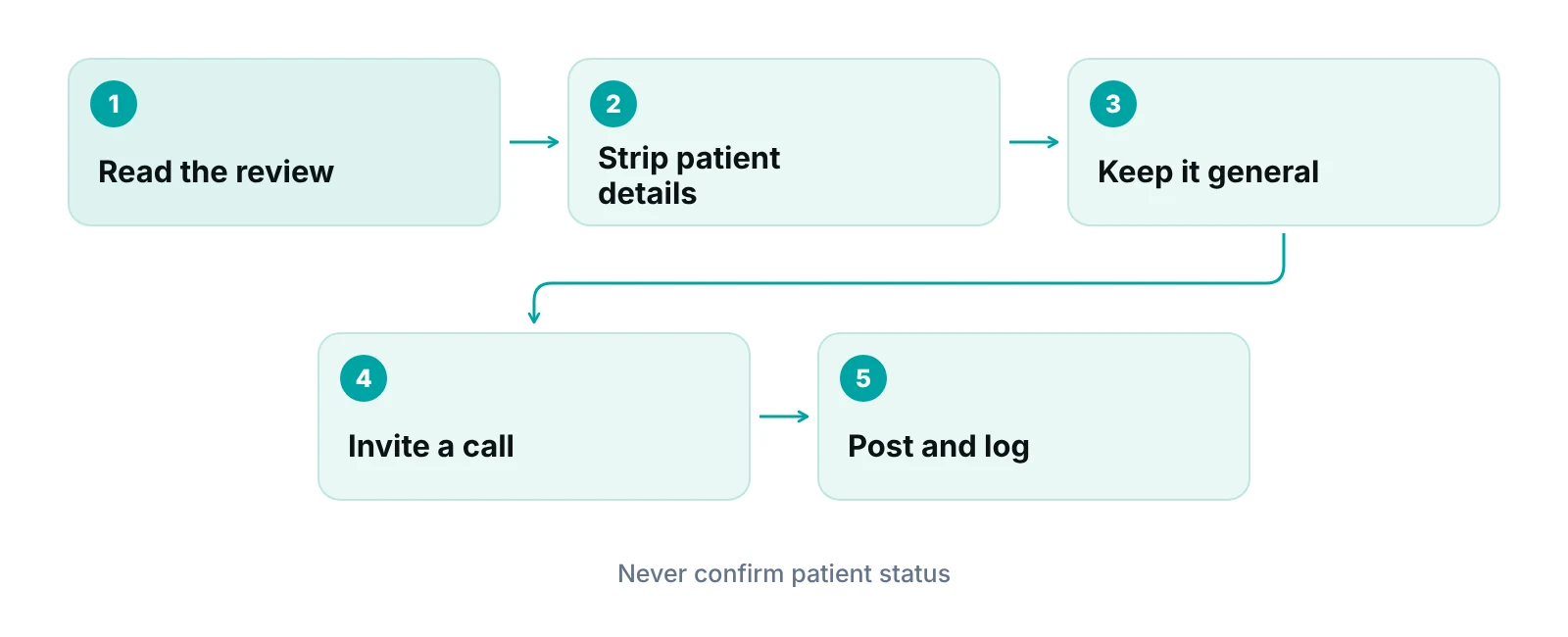
Reply in general terms and never confirm that the reviewer is a patient. The AMA advises physicians not to acknowledge in a public reply that the person is a patient, and says a patient’s own online disclosure is not permission for you to disclose anything.
The AMA notes that no federal law prohibits responding; the risk is in the content. Under the HIPAA Privacy Rule, protected health information is health-related information that identifies a person, and it includes demographic data such as name and address. A reply that names the reviewer, a visit date, a diagnosis or a treatment is likely to qualify.
HHS OCR has acted on this. In 2022 it settled with a California dental practice for $23,000 over replies to patient reviews that disclosed protected health information. In 2023 it announced a $30,000 settlement with a New Jersey psychiatry practice that answered a negative review with details of the patient’s diagnosis and treatment; OCR also found disclosures about three other patients and that the practice lacked HIPAA privacy policies and procedures. The 2023 agreement carries two years of OCR monitoring.
The risk is sharper in behavioral health practices, where merely confirming a patient relationship can reveal sensitive care. The same caution applies in every specialty.
| Situation | Safer reply | Do not say |
|---|---|---|
| Positive review | Thank you for taking the time to share your feedback. We are glad it was helpful to you and your family. | Anything about the visit, provider, condition or date |
| Negative review about wait time | We aim to see everyone on time and take this seriously. Please call our office manager so we can learn more. | “We saw you on Tuesday and you arrived late” |
| Review about billing or a claim | We would like to look into this. Please call our office and ask for the manager. | The balance, the insurer, a claim number or a denial reason |
| Review that describes treatment | We take every concern seriously and would welcome a direct conversation. | Confirmation or correction of any detail of the care |
Reply wording is our suggestion, written to follow AMA guidance to avoid acknowledging the person is a patient. Have your privacy officer approve your final templates.
Google’s guidance says to keep replies brief and honest, avoid deals or promotions, and never share a reviewer’s private information. The reviewer is notified when you reply and can change their review afterward.
“A review reply is a public letter signed by your practice. If your privacy officer would not read it aloud in a meeting, do not post it.”
— Awais Afzal, Healthcare Operations & Data Analyst
Put the rule in writing: who may reply, which templates are approved, and what must be escalated. Our HIPAA compliance checklist for medical practices and the post on HIPAA at the front desk cover staff training and policies that a reply policy should sit alongside.
What can you do about negative or unfair reviews?
You can reply, you can flag a review that breaks Google’s policy, and you can fix the problem it describes. You cannot delete a review yourself, and you cannot threaten or pressure the reviewer.
On Google, owners can flag a review from the Business Profile. Google says to report only reviews that violate its policies, not reviews you simply dislike, and that it does not get involved in conflicts between businesses and customers. Evaluation typically takes several days. If your report is rejected, you can submit a one-time appeal for up to 10 reviews. See Google’s page on reporting inappropriate reviews.
The FTC rule adds limits. It bars suppressing reviews through false accusations, intimidation or unfounded legal threats, so do not send threatening letters or demand removal. Google also prohibits offering an incentive to a reviewer to revise or remove a review.
- Read it as feedback first. The AMA suggests waiting before responding and reading the criticism from the patient’s side to see whether anything should change.
- Take it offline. Invite the person to call the manager. A private conversation can use patient information, because the patient is the one talking to you; a public reply cannot.
- Document the problem. If the cause is a long hold time or a billing confusion, fix that process. Reviews are an early signal.
- Flag only real violations. Spam, fake accounts, off-topic content or a conflict of interest are valid reasons; a low rating is not.
Can you show patient reviews and testimonials on your website?
Yes, if they are real, you did not buy or edit them to mislead, and nothing identifies the patient without a documented sign-off. The FTC rule bans fake reviews and buying reviews that must express a particular sentiment, and it applies to reviews on your own site as well as on other platforms.
The FTC says hosting consumer reviews on your own site is generally not covered by the fake-review provision unless you wrote or bought them. Show the range of reviews you receive; the FTC cautions that excluding reviews because they are negative can be deceptive.
On HIPAA, HHS’s marketing guidance defines marketing and requires written authorization for most marketing uses of protected health information, with exceptions for face-to-face communications and promotional gifts of nominal value. That page does not mention testimonials. Our cautious practice is a signed HIPAA authorization before publishing any patient story, photo or detail that identifies someone or describes care, with a healthcare attorney confirming your state’s rules.
Do not publish treatment outcomes or promise results. Some state medical boards add their own testimonial rules, so check yours.
What else builds a reputation beyond reviews?
Accurate listings, a website that answers patient questions, and a front desk that answers the phone. These create the experiences reviews describe.
- Consistent listings. Keep name, address, phone and hours the same across your profile, website and directories.
- Useful education content. Explain how your practice works, which insurance you accept and what to bring. Do not promise results or give individual medical advice.
- Careful social media. Treat every comment and message as a place where a privacy slip can happen, and keep symptoms out of public threads.
We deliberately give no percentage lift from reviews; the old post’s figures came from non-healthcare studies we could not trace to primary sources. For how to tie new-patient calls to their source, see our medical marketing ROI guide.
Should you handle reputation in-house or hire a vendor?
Handle replies in-house or under a written approval process, and consider a vendor for monitoring, review-request workflow and listings. The more patient information a vendor sees, the more careful your contract must be.
Under the HIPAA Privacy Rule, a business associate is an outside person or organization that performs services for a covered entity involving the use or disclosure of identifiable health information, and the covered entity must have a written business associate agreement in place. A review-request tool that receives patient names, phone numbers and visit dates is the kind of arrangement to run past your privacy officer.
Ask any reputation vendor:
- Do you send the same request to every patient, or do you filter by sentiment first?
- Do you offer rewards for reviews? (If yes, walk away.)
- What patient data do you receive, and will you sign a Business Associate Agreement before you receive it?
- Who writes replies, and can they post without our approval?
- Do you ever publish reviews on our site, and how do you choose which ones?
Not sure where your reputation stands?
Our free practice audit reviews your listings, website, phone handling and intake path, and shows where patients may be getting a poor first impression.
How do you know the work is paying off?
Track a few counts monthly against your own baseline: reviews received, average rating, time to reply, and new-patient calls by source. That shows whether the routine works without borrowed industry statistics.
- Reply coverage. The share of reviews with an approved reply inside your target window.
- Themes. Wait times, billing questions, phone access. Bring them to your monthly staff meeting.
- New patients by source. Record how each new patient found you.
To size what a new patient is worth when you set a budget, use our revenue calculator with your own numbers.
Want help running this routine?
See how our team supports listings, review workflows and local visibility for medical practices.
Our recommendations
- Name one owner and one backup. We recommend one person owns reviews and replies, with a named backup. Without an owner, reviews sit unread for weeks.
- Write a reply policy before the first reply. We recommend a one-page policy with approved templates, a rule against confirming patient status, and an escalation path to your privacy officer.
- Ask everyone, reward no one. We recommend the same request for every patient, a Google link or QR code, and no gift, discount or quota attached.
- Take hard cases offline. We recommend replying once, in general terms, with a phone number for the office manager, and doing the real conversation privately.
- Get authorization before publishing patient stories. We recommend a signed authorization and attorney review before any identifiable patient testimonial goes on your site or social pages.
- Review the vendor contract. We recommend asking any reputation vendor about gating, incentives, data access and a Business Associate Agreement before you sign.
- Review monthly. We recommend a 15-minute monthly review of volume, ratings, response time and themes, with one process fix chosen from what patients say.
Bottom line
Reputation work is a routine, not a campaign: accurate listings, honest requests, careful replies and a monthly review. If you want help building that routine, see our healthcare digital marketing services, start with the free practice audit, or reach us on the contact page. For the wider plan, read our guide to patient privacy in the revenue cycle.
Frequently asked questions
Can a doctor respond to a negative online review under HIPAA?
Yes. The AMA says no federal law prohibits responding to online reviews. But you must not disclose protected health information, and the AMA advises not to acknowledge that the reviewer is a patient. Use a general reply about your policies, give a phone number, and move the conversation offline.
If the patient shares details in the review, can I confirm or correct them?
No. The AMA says a patient’s own disclosure is not permission for you to disclose anything. Do not confirm, correct or add detail in public. Reply in general terms and invite the person to call the office, where a private conversation is possible.
Can we offer a discount or gift card for a Google review?
No. Google’s policy prohibits offering incentives for reviews, and the FTC rule bans buying reviews that must express a particular sentiment. Do not tie a gift, discount or free service to a review. Ask all patients the same way with a link or QR code, and offer nothing in return.
Can we ask only happy patients to leave a review?
It is risky. Google’s policy bars selectively soliciting positive reviews, and the FTC says excluding negative reviews can be deceptive under the FTC Act. Send the same request to every patient, using a link or QR code, and accept the full range of feedback.
Can I remove a bad review from Google?
Not yourself. Owners can flag a review that violates Google’s policies, and Google decides whether to remove it. Google says it does not get involved in conflicts between businesses and customers. A low rating alone is not a violation. Reply professionally and fix any process problem the review reveals.
Can we put patient testimonials on our website?
Only real ones, shown honestly, and none that identify a patient without a signed HIPAA authorization. HHS marketing guidance does not mention testimonials, so this is our cautious practice. Have a healthcare attorney confirm what your state and medical board allow before you publish.
Get your free practice audit
Tell us about your practice. We will contact you using the details you give.
- A review of your recent claims, denials and A/R aging
- Where your front desk and prior authorizations slow payment
- A prioritized fix list you keep, whether or not you hire us
Pricing is quoted after the audit, based on your volume and the services you choose. Prefer to talk? Call +1 (302) 556-2288.
Sources
- HHS OCR reaches agreement with New Jersey provider that disclosed patient information in response to negative online reviews — HHS Office for Civil Rights (2023)
- HHS Civil Rights Office enters settlement with dental practice over disclosures of patients' PHI — HHS Office for Civil Rights (2022)
- Summary of the HIPAA Privacy Rule — HHS Office for Civil Rights (n.d.)
- Marketing (HIPAA Privacy Rule guidance) — HHS Office for Civil Rights (2013 (last reviewed July 26, 2013))
- Are physicians prohibited from responding to online patient reviews? — American Medical Association (n.d.)
- Responding to Online Patient Reviews: Debunking the Myth — American Medical Association (n.d.)
- The Consumer Reviews and Testimonials Rule: Questions and Answers — Federal Trade Commission (2024)
- Maps user-generated content policy — Google (current)
- Manage customer reviews — Google Business Profile Help (current)
- Tips to get more reviews — Google Business Profile Help (current)
- Report inappropriate reviews on your Business Profile — Google Business Profile Help (current)
- Guidelines for representing your business on Google — Google Business Profile Help (current)
Disclaimer: This article is general educational information about online reputation management and is not legal, compliance or medical advice. HIPAA, FTC, Google and state rules vary by situation and change over time. Have a healthcare attorney or your privacy officer review reply templates, authorization forms and testimonials before you use them.
