
Before outsourcing OB/GYN billing, confirm five things: the vendor tracks every open pregnancy until delivery, applies each payer's global-versus-itemized obstetric rules, codes annual exams and in-office procedures correctly, signs a business associate agreement before seeing patient data, and sends reports you can check.
Most checklists for outsourcing OB/GYN billing could be written for any specialty. They ask about experience, price and software. They skip the parts that make obstetrics and gynecology different: a pregnancy that runs for months before the main claim is paid, payers that disagree on how to bill it, and a visit mix of preventive exams, ultrasounds, procedures and devices.
This checklist is for the decision stage. It shows what to ask, what a solid answer looks like and what to expect after you sign. Each rule comes from a payer policy, a state Medicaid manual or a federal source, so you can read it yourself. If you want the specialty-neutral version first, see our ten questions to ask any billing company.
Key takeaways
- A global obstetric claim is usually submitted at delivery, so a vendor that only watches submitted claims cannot see the pregnancies you are still working on.
- Payers differ on global versus itemized obstetric billing and on visit-count rules, so ask for a payer-by-payer rule sheet, not a single policy.
- Z01.4 is a category header; the billable annual-exam codes are Z01.411 and Z01.419.
- Devices such as IUDs and implants are reported on their own lines from the insertion procedure, and ultrasound often sits outside the global package.
- Get a signed business associate agreement, named reports and exit terms in writing before any patient data moves.
Why is OB/GYN billing different from other specialties?
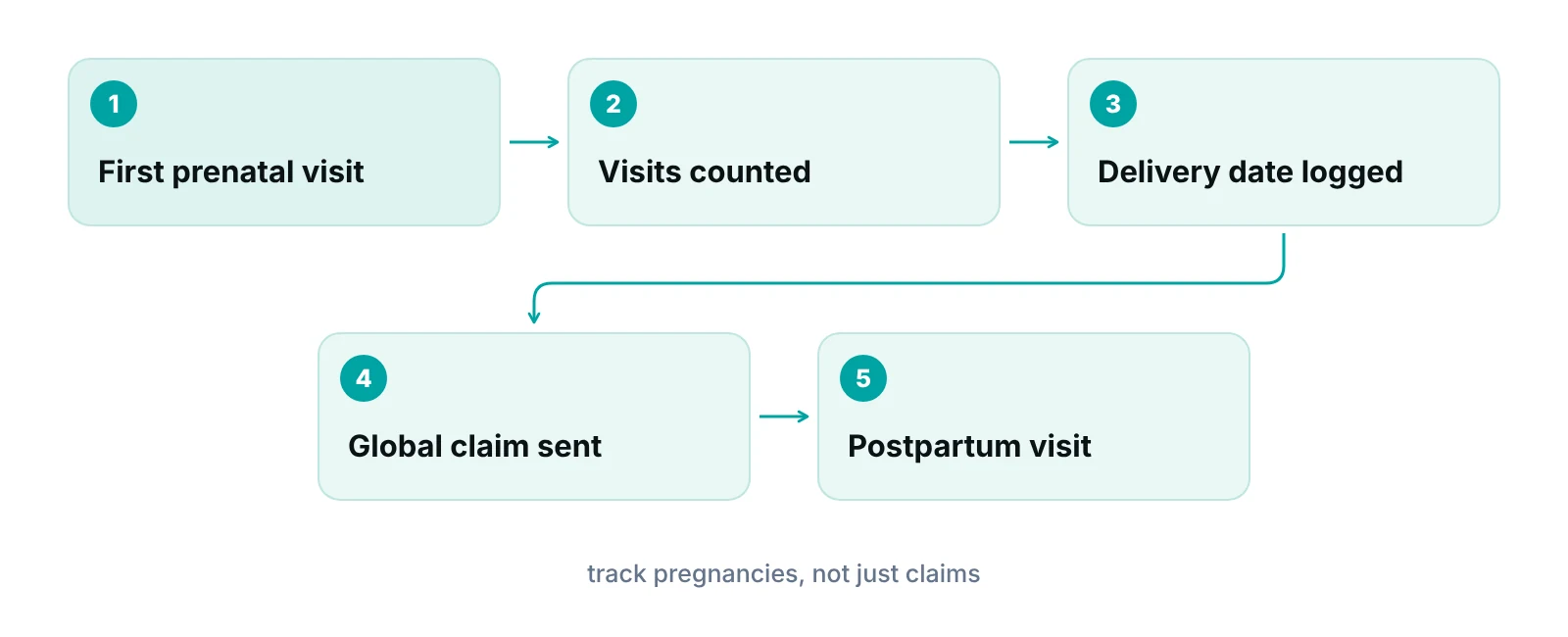
Because one pregnancy can run for months and often ends in a single claim. When the same practice provides prenatal care, delivery and postpartum care, many payers expect one global claim, and that claim is submitted at delivery. A vendor that is used to billing each visit as it happens will not behave the way your payers expect.
Two payer documents show the pattern. Blue Cross and Blue Shield of Oklahoma’s 2026 maternity policy says the pregnancy-confirmation visit is submitted when it happens, while the later prenatal visits and the delivery go on a global claim submitted at delivery. South Dakota Medicaid’s obstetrical services manual tells providers to use the delivery date as the date of service on a global claim. Sources: Blue Cross and Blue Shield of Oklahoma and South Dakota Medicaid.
That timing changes what you should expect from a vendor. A report built on submitted claims will not show the pregnancies you have been working on for months, and a patient who moves practices or changes insurance mid-pregnancy can turn a global claim into a split one. At OB/GYN practices, your vendor needs a running list of open pregnancies, not just a queue of claims.
The table shows how one payer treats common services. Other payers differ, so use it to shape your questions, not as a rule for your contracts.
| Service | Inside the global package? | What to ask your vendor |
|---|---|---|
| Routine prenatal visits (monthly to 28 weeks, every two weeks to 36 weeks, weekly after) | Yes | Do you count visits per patient and per payer? |
| Uncomplicated labor, vaginal or cesarean delivery, placental delivery | Yes | Which delivery code families do you use for each payer? |
| Postpartum hospital and office visits | Yes | How do you handle a postpartum visit that happens at another practice? |
| Diagnostic obstetric ultrasound and fetal biophysical profile | No, billed separately | Who checks these lines are added to the claim? |
| Non-stress tests and amniocentesis | No, billed separately | Do your charge-capture checks include these? |
| Medical complications of pregnancy, such as hypertension or diabetes | No, coded separately | How are extra visits documented and billed? |
| Repair of a third- or fourth-degree perineal laceration | No, billed separately | Do your coders review operative notes for it? |
Source: Blue Cross and Blue Shield of Oklahoma, Policy RP044, Global Obstetrical/OB Maternity Services (effective May 22, 2026)
How should a billing company handle global and split obstetric care?
It should know which situation applies to each patient, then apply that payer’s own rule. Payers publish different visit counts and modifiers, so one set of rules for every payer will cause errors.
| Situation | Code family commonly reported | Check with the payer |
|---|---|---|
| Your group provides prenatal, delivery and postpartum care | Global codes 59400 (vaginal), 59510 (cesarean), 59610 (vaginal after prior cesarean), 59618 (cesarean after attempted vaginal birth) | Single claim at delivery; whether the payer accepts global billing at all |
| Your practice provided prenatal care only (patient delivers elsewhere) | E/M visits for 1 to 3 visits, 59425 for 4 to 6 visits, 59426 for 7 or more | Whether the visit count includes the first visit |
| Your practice delivered but did not provide the prenatal care | Delivery-only codes such as 59409, 59514, 59612, 59620 | Whether postpartum care is bundled into the delivery code |
| Postpartum care only | 59430 | Whether the payer covers it after the patient’s coverage ends |
| Patient transfers, miscarries or changes insurer mid-pregnancy | Itemized billing instead of a global code | Which date and which visits belong to which payer |
Sources: Blue Cross and Blue Shield of Oklahoma, Policy RP044 (2026); South Dakota Medicaid, Obstetrical Services manual
Payer rules also change over time. South Dakota Medicaid’s manual says global codes remain valid for dates of service through December 31, 2026, and allows an interim option of billing prenatal and postpartum visits per encounter with a TH modifier. It also sets its claim deadline at six months after the month of service. Blue Cross and Blue Shield of Oklahoma lets a practice bill extra visits only when a high-risk patient is seen for more than 13 prenatal visits and the chart supports it. Ask who keeps each payer’s rule sheet current.
For the gynecology side of the code set, our gynecology CPT code guide goes deeper than this checklist can.
Pregnancy diagnosis coding
A vendor also needs to code the pregnancy correctly. ICD-10-CM chapter 15 codes carry a final character for the trimester. The Tabular List defines the first trimester as less than 14 weeks 0 days, the second as 14 weeks 0 days to less than 28 weeks 0 days, and the third as 28 weeks 0 days until delivery, counted from the first day of the last menstrual period. It also says to add a code from category Z3A, if applicable, to identify the week of pregnancy when known. Your providers must document the weeks or trimester, because coders cannot assign what the chart does not say. Source: ICD-10-CM Tabular List entry O09.9.
A good vendor sends documentation queries back to your providers. A poor one guesses.
What should a vendor know about annual exams, procedures and devices?
It should code the annual gynecologic exam with the right ICD-10-CM code, add modifier 25 only when a separate problem visit is documented, and report devices and procedures on their own lines.
Z01.4 is not a billable code
Some older OB/GYN billing checklists tell practices to use Z01.4 for the annual exam. Z01.4 is a category header. The billable codes under Z01.41 are Z01.411 (gynecological exam with abnormal findings) and Z01.419 (without abnormal findings). Sources: ICD-10-CM entry Z01.411 and ICD-10-CM entry Z01.41.
- Annual exam plus a problem. The AMA says physicians are not barred from billing both a preventive service and a problem-focused E/M service at the same visit. Modifier 25 goes on the E/M when it is significant, separately identifiable and documented. Ask how the vendor reviews notes before adding it. Source: AMA (updated December 2025).
- Preventive coverage. HHS says non-grandfathered group health plans and insurers must cover the preventive services in the HRSA women’s guidelines without cost sharing, and the guidelines recommend at least one preventive care visit per year. Coding must separate a preventive visit from a diagnostic one. Source: HHS, Women’s Preventive Services Guidelines.
- IUDs and implants. Maryland’s Medicaid fact sheet lists IUD insertion as 58300 and contraceptive implant insertion as 11981, with the devices reported under separate HCPCS J-codes, and notes that the CPT insertion codes do not include supply cost. Ask the vendor to confirm the device line sits on the claim next to the procedure. Source: Maryland Department of Health, LARC fact sheet (August 2023).
- Ultrasound and testing. As Table 1 shows, one large payer treats obstetric ultrasound and fetal testing as outside the global package. A vendor that bills only what appears on the superbill will miss them.
For procedure-heavy schedules, ask for a charge-capture check that matches the procedure log, supply invoices and claim. Our post on OB/GYN billing technology covers the tools.
What questions should you ask an OB/GYN billing vendor?
Ask for the open-pregnancy list first, then work through the OB/GYN questions below. A confident vendor will show you its process. A vendor that answers in general terms may not have one for obstetrics.
| Question | A solid answer includes | Warning sign |
|---|---|---|
| How do you track a pregnancy from first visit to delivery? | A list of open pregnancies with due dates, visit counts and payer, plus alerts for transfers and insurance changes. | “We bill when the claim is ready.” |
| Which payers get global billing and which get itemized? | A payer-by-payer rule sheet with the date it was last checked. | One rule for every payer. |
| Who adds ultrasound, testing and complication lines? | A named charge-capture step that compares the visit note to the claim. | “The practice sends us a superbill.” |
| How do you handle an annual exam with a problem visit? | A review of the note before modifier 25 is added. | Modifier 25 on every exam. |
| How do you capture IUD and implant claims? | Insertion and device lines matched to your supply log. | No answer on supplies. |
| How do trimester and weeks of gestation get coded? | Documentation queries sent back to the provider. | Coders choose a trimester when the chart is silent. |
| What do I see every month? | Named reports: unbilled deliveries, denials by reason, A/R by payer, with written formulas. | A dashboard you cannot export or check. |
“If a vendor cannot show you a list of open pregnancies, it is billing what has already happened. In obstetrics, the work you should worry about has not been billed yet.”
— Awais Afzal, Healthcare Operations & Data Analyst
Ask for a test on your own claims
A vendor that is confident in its process should review a sample of your own claims, including a delivery, a split-care case and an annual exam with a problem visit. A testimonial from someone else’s practice tells you nothing about yours.
For the questions that apply to every specialty, such as fee models and exit terms, use our guide to the ten questions to ask any billing company.
Which privacy, contract and deadline terms matter before you hand over claims?
Settle three things in writing: a business associate agreement, who receives payer payments, and how filing deadlines are tracked.
Business associate agreement. HHS lists billing, claims processing and practice management among the activities a business associate may perform. A covered entity may share protected health information once it has satisfactory assurances in a contract or other written arrangement, called a business associate agreement. Read the contract provisions HHS describes, which include safeguards, reporting of breaches, support for individual rights, subcontractor flow-down, return or destruction of PHI at termination if feasible, and the right to terminate for a material violation. Sources: HHS Office for Civil Rights, Business Associates and HHS Business Associate Contracts. Our guide to HIPAA compliance in medical billing covers what to check.
Payment flow. For Medicare, 42 CFR 424.73 allows payment to an agent that provides billing services only if conditions are met, including that the agent’s pay is not related in any way to the dollar amounts billed or collected and does not depend on actual collection. Payment to an agent is made in the provider’s name. One way to stay clear of the issue is to have payments land in an account in your practice’s name. Have your attorney review the contract against this rule. Source: 42 CFR 424.73.
Filing deadlines. For services furnished on or after January 1, 2010, Medicare claims must be filed no later than the close of the period ending one calendar year after the date of service, with listed exceptions. Other payers set their own limits. South Dakota Medicaid, for example, uses six months after the month of service. Ask how the vendor tracks each payer’s deadline, and see our state-by-state billing time limits. Sources: 42 CFR 424.44 and South Dakota Medicaid.
Curious how much revenue is waiting in open claims?
Use the revenue calculator to put a rough number on delayed claims before you compare vendor quotes.
What should you expect after you sign?
Expect an ordered setup, not a jump straight to live billing. Our team works inside your existing EHR (for example PrognoCIS, eClinicalWorks or athenahealth), and any vendor you hire should be clear about which system it will use and who has access.
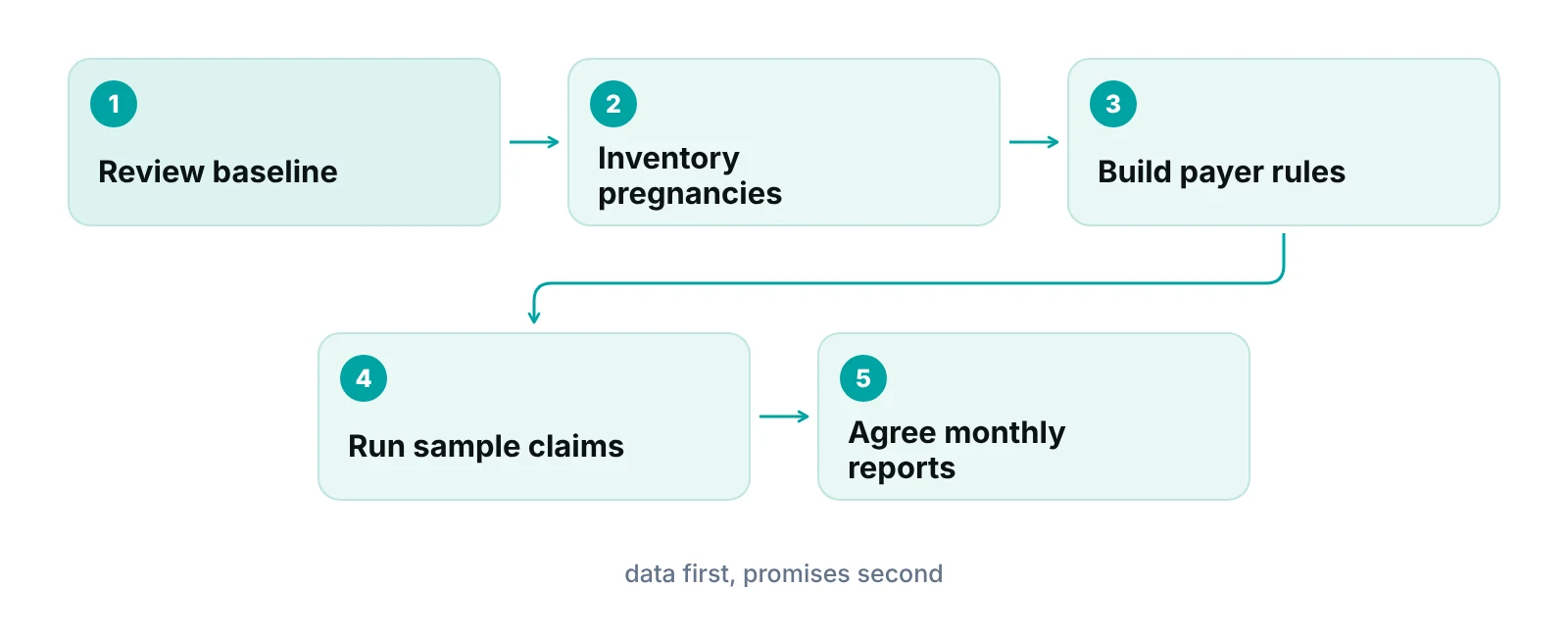
- Review your baseline. Pull 12 months of denials, A/R aging and payer mix so you can test the vendor’s claims against your own data.
- Inventory open pregnancies. List every patient with an open obstetric episode, with expected delivery dates, visit counts and payer.
- Build the payer rule sheet. Record global versus itemized rules, visit-count thresholds and filing deadlines for each payer.
- Run a sample. Have the vendor work a small set of claims, including a delivery and a split-care case, and compare the results with your own coders.
- Agree the reports. Name each report, its formula and the day you receive it, then review the first month together.
When might outsourcing OB/GYN billing not fit?
Outsourcing does not fit every practice. If your in-house team already tracks open pregnancies, keeps a payer rule sheet and reports on denials each month, a vendor may add cost without adding capability. A hybrid model, where you keep charge entry and hand over denials and A/R follow-up, can also work.
It may fit better if one person covers billing and the front desk, turnover has left gaps in payer knowledge, or no one can say how many deliveries are waiting for a claim.
Want a baseline before you compare vendors?
Our free practice audit reviews a sample of your claims, denials and A/R aging, so you have numbers to hold any billing company to, including us.
Our recommendations
- Ask for the open-pregnancy list on the first call. We would not trust any OB/GYN billing process until we had seen how it tracks pregnancies before the global claim exists.
- Write the payer rules down. List global versus itemized rules, visit thresholds and filing deadlines for each payer. Date the sheet, and decide who updates it.
- Fix your documentation first. Coders cannot assign a trimester or weeks of gestation that the note does not state. Give providers a short template before you outsource.
- Test on your own cases. Include a delivery, a split-care patient and an annual exam with a problem visit in the sample. Judge the answers against your own coders.
- Sign the BAA before data moves. No patient data should leave your system until the business associate agreement is signed. Read the breach-notice and subcontractor clauses yourself.
- Define every report. Agree on named formulas, so a good month means the same thing to both sides.
Outsourcing works better when you can see the work.
The portal gives an OB/GYN practice a client view of claim status by stage and owner, with specialty-aware billing logic applied per claim.
See how the RCM Finder portal works · Create a portal account
Disclosure: RCM Finder builds and sells this portal. It is a practice management system, not an EHR.
Bottom line
The right vendor for an OB/GYN practice is the one that can show how it tracks pregnancies, applies each payer’s obstetric rules and reports in terms you can check. If you want a baseline first, start with our free practice audit. You can also read how our end-to-end revenue cycle management service works, learn about our medical billing services, or talk to us through our contact page.
Frequently asked questions
Should an OB/GYN practice outsource its billing?
It depends on how well your in-house team tracks open pregnancies, payer rules and denials. If it does, a vendor may add little. If one biller carries everything or no one knows how many deliveries are unbilled, outsourcing may help. Test any vendor on your own claims first.
What is the global obstetric package and why does it matter to a vendor?
It is a single claim covering routine prenatal care, delivery and postpartum care when the same group provides all three. Many payers expect it at delivery, so a vendor must track pregnancies for months before billing. Payers differ, so ask for a rule sheet for each payer.
Which ICD-10-CM codes are used for an annual gynecologic exam?
The billable codes are Z01.411, for a gynecological exam with abnormal findings, and Z01.419, for one without. Z01.4 is a category header and cannot be billed on its own. Confirm current code sets and payer policy with your coder.
How long do we have to file claims?
It varies by payer. Medicare’s general limit is one calendar year after the date of service, with exceptions. South Dakota Medicaid uses six months after the month of service. Because a global claim is dated at delivery, ask how a vendor tracks each payer’s limit.
Do we lose control of billing if we outsource?
You can keep control with a few written terms: payments land in an account in your name, you get named monthly reports with formulas, and you have export and exit terms. Review the contract with your attorney before signing.
How much does OB/GYN billing outsourcing cost?
It depends on the fee model, your volume, payer mix and scope, so we do not quote a number here. Pricing is quoted after a free practice audit. Whatever the model, get the fee, scope and any pass-through charges on one page.
Get your free practice audit
Tell us about your practice. We will contact you using the details you give.
- A review of your recent claims, denials and A/R aging
- Where your front desk and prior authorizations slow payment
- A prioritized fix list you keep, whether or not you hire us
Pricing is quoted after the audit, based on your volume and the services you choose. Prefer to talk? Call +1 (302) 556-2288.
Sources
- Policy RP044: Global Obstetrical/OB Maternity Services (Professional Provider) — Blue Cross and Blue Shield of Oklahoma (2026)
- Obstetrical Services (Professional billing manual) — South Dakota Department of Social Services (Medicaid) (2026)
- ICD-10-CM Tabular List entry O09.9 — Kodex (ICD-10-CM reference) (current)
- ICD-10-CM entry Z01.411 — Kodex (ICD-10-CM reference) (current)
- ICD-10-CM entry Z01.41 — RapidClaims code reference (current)
- Can physicians bill for both preventive and E/M services in the same visit? — American Medical Association (2025)
- Women's Preventive Services Guidelines — HHS / HRSA (2019)
- Long-Acting Reversible Contraception (LARC) fact sheet — Maryland Department of Health, Medicaid (2023)
- Business Associates (HIPAA guidance) — HHS Office for Civil Rights (current)
- Business Associate Contracts — HHS Office for Civil Rights (current)
- 42 CFR 424.44 Time limits for filing claims — eCFR (current)
- 42 CFR 424.73 Prohibition of assignment of claims by suppliers — Legal Information Institute (Cornell Law School), reproducing 42 CFR (current)
Disclaimer: This article is general educational information for medical practices. It is not legal, HIPAA-compliance, coding or billing advice. Payer policies, state Medicaid rules and code sets vary and change. Confirm requirements with your payers, your coder and qualified counsel before acting.
