
OB/GYN billing technology should track each pregnancy, not just each visit. It needs to count prenatal visits, apply payer-specific global package rules, check claims for missing delivery and quality data, and show held claims by age. Judge any tool on those four jobs.
Obstetric billing breaks the usual one-visit, one-claim pattern. This guide explains what to look for, using two published payer policies as examples, so you can decide whether your current setup is enough. It is written for practice managers and owners comparing options, not for coders.
Key takeaways
- Obstetric care is billed by pregnancy, so tools must track visits across months.
- Payers differ on visit thresholds and on when to send the global claim.
- OB-specific claim checks catch missing delivery dates and quality codes before submission.
- Held global claims need age and filing-deadline tracking.
- Test any vendor with a messy pregnancy and ask for a BAA before sharing data.
What OB/GYN billing technology has to do differently
Most billing software is built around one visit, one claim. Obstetric care is one pregnancy, many visits, and often one claim at the end. That gap is where OB/GYN practices lose track of charges. The tools worth paying for are the ones that follow a pregnancy from the first visit to the postpartum check, not the ones with the longest feature list.
A general-purpose system will happily send a claim for every prenatal visit. For a patient covered by a global package, that can be wrong. A system built for the specialty holds those visits against the pregnancy, keeps count, and tells staff what to bill and when. For a wider view of how this specialty works, see our OB/GYN billing and revenue cycle page.
Four jobs to test any tool against
- Track every prenatal visit against one pregnancy, by patient, payer and delivering provider.
- Hold or release the right claim at the right time: global, interim, or split into prenatal, delivery and postpartum.
- Check each claim for required fields and payer-specific codes before it leaves the practice.
- Show which claims are waiting, who owns them and how old they are.
The global OB package: why tracking comes first
A global obstetric code bundles prenatal care, delivery and postpartum care into one claim, but payers differ on when you can use it. The codes most practices know are 59400 (vaginal delivery), 59510 (cesarean), 59610 (vaginal birth after cesarean) and 59618 (cesarean after a prior cesarean). When the same practice does not provide all three parts of care, the rules shift.
Two published payer policies show how much the details vary. The Health First Colorado obstetrical care billing manual says a global code applies when one practitioner, or practitioners in the same group, provide all three components with at least four prenatal visits. The Blue Cross and Blue Shield of Oklahoma obstetric services payment policy describes antepartum visits as billable separately only beyond 13 visits. Neither is a national rule. They are examples of why a tool needs payer-level logic rather than one setting for every patient.
| Question | Health First Colorado (Medicaid) | Blue Cross and Blue Shield of Oklahoma |
|---|---|---|
| Global package codes | 59400, 59510, 59610, 59618 | 59400, 59510, 59610, 59618 |
| Prenatal care billed alone | Fewer than 4 visits: E/M codes with modifier TH; 4 to 6 visits: 59425; 7 or more: 59426 | 1 to 3 visits: E/M codes; 4 to 6 visits: 59425; 7 or more: 59426 |
| When to send the global claim | Not before the postpartum visit has been provided; an interim claim is voided first | Upon delivery |
| Quality codes on the claim | 0500F or 0501F (first prenatal visit) and 0503F (postpartum visit) | 0500F or 0501F for the first visit and 0503F for postpartum; last menstrual period date in Box 14 |
| Postpartum care alone | 59430 with 0503F | 59430 when another provider delivered |
Source: Colorado Department of Health Care Policy and Financing, Obstetrical Care Billing Manual (accessed 2026); Blue Cross and Blue Shield of Oklahoma, Obstetric Services policy RP044 (effective May 22, 2026). Always confirm against the policy of each payer you bill.
Notice the third row. One payer wants the global claim at delivery. The other says not to send it until postpartum care has happened. A practice with both payers needs software that treats those as different rules, not a single reminder.
Charge capture across a pregnancy
Charge capture in obstetrics means counting visits and events that may not be billed for months. A missed prenatal visit is easy to overlook when no claim goes out that day. A good system logs it anyway, so the count is right when the delivery claim is finally built. Without that record, staff end up rebuilding a pregnancy from appointment history, which is slow and error-prone.
- Visit count per pregnancy. The count decides whether a payer treats care as global or as separate prenatal codes.
- First prenatal visit date. The Colorado manual says the prenatal-only code’s date of service must match the first prenatal visit.
- Delivery date and delivering provider. The Colorado manual says the date of delivery must be reported on global OB codes.
- Hospital events. Delivery services are billed by the delivering clinician, and complications or unrelated services are coded separately under the Oklahoma policy.
- Postpartum visit. The date the visit actually happened, recorded where billing can see it.
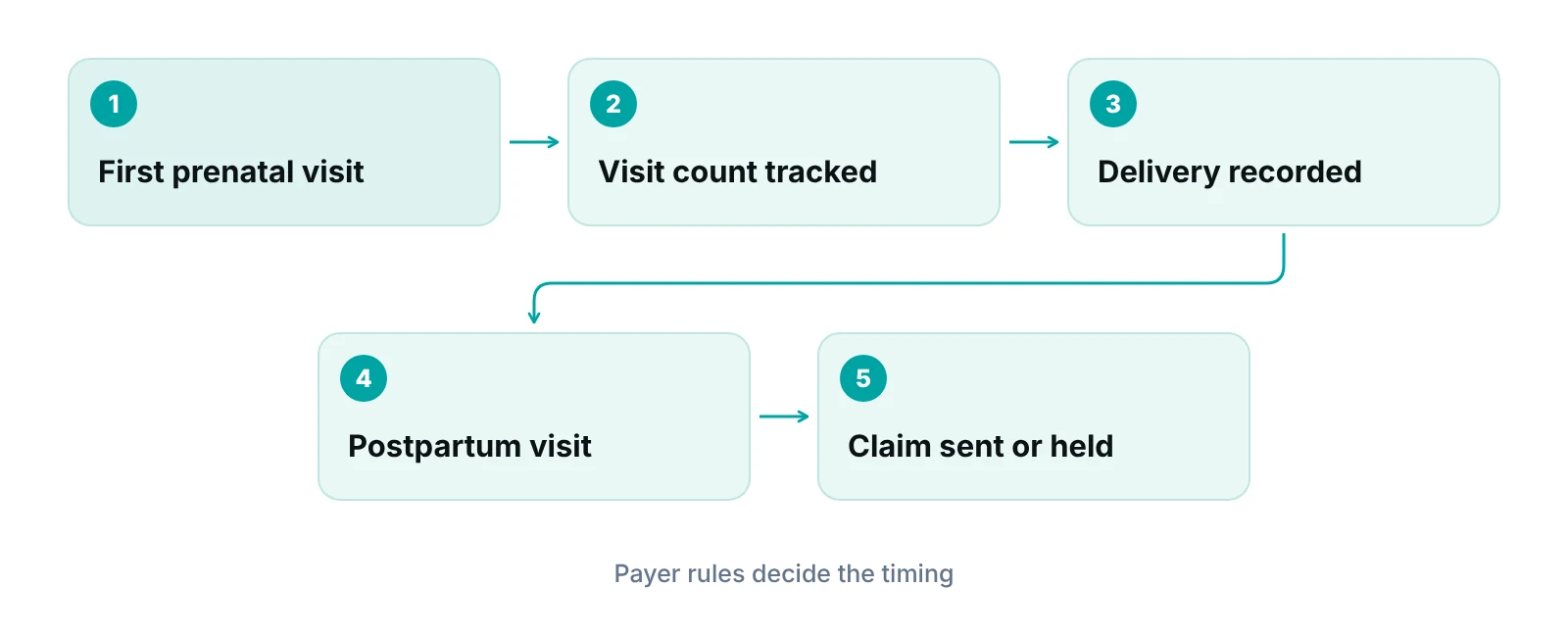
The diagram is deliberately simple. The point is the order: the visit count and the delivery record come first, and the claim type follows from them. Tools that reverse that order tend to push staff into manual workarounds.
Other gynecology work, such as procedures and well-woman visits, follows normal single-visit billing. If your team needs a refresher on that side, our guide to gynecology CPT codes covers it.
Claim checks to run before submission
A claim check catches missing or mismatched data before the payer does. Claim scrubbing is not new, but in obstetrics the useful checks are specific. Our claim scrubbing guide explains the general process. The table below lists the OB-specific checks to ask any tool about.
| Check | What it catches | Why it matters |
|---|---|---|
| Delivery date present on global code | Global claim sent without the date | The Colorado manual requires the delivery date on global OB codes |
| Quality code present | Missing 0500F, 0501F or 0503F | Both example policies ask for these on the claim |
| Visit count matches the code | 59425 billed with fewer than 4 visits, or 59426 with fewer than 7 | The visit ranges are tied to the code in both example policies |
| One prenatal code per pregnancy | A second prenatal-only claim for the same pregnancy | The Colorado manual allows only one prenatal code per pregnancy |
| Same group provided all care | Global code used when another practice delivered | Both example policies limit global billing to the same practitioner or group |
| Multiple births | Second baby billed on a cesarean code, or without modifier 59 on a vaginal delivery-only code | The Oklahoma policy reports only one cesarean code and uses modifier 59 on later vaginal deliveries |
Source: Colorado Department of Health Care Policy and Financing, Obstetrical Care Billing Manual; Blue Cross and Blue Shield of Oklahoma, Obstetric Services policy RP044 (effective May 22, 2026). Other payers may differ.
Missing data is also the root of many front-end denials. Our guide to the CO-16 denial code explains the common causes, and the clean claims guide covers how to measure first-pass quality.
Timely filing: the risk of the long wait
When a global claim is held until postpartum care is complete, the filing clock keeps running. For Medicare, 42 CFR 424.44 says a claim must be filed within one calendar year after the date of service, with limited exceptions. Commercial and Medicaid limits vary by contract and state, so check each one.
Waiting on a postpartum visit that never happens, or a delivery claim sitting in a queue, can turn a routine payment into a write-off. Ask your tool whether it can show held claims by age and by payer deadline. Do not rely on someone remembering to check. A simple weekly review of held claims, sorted by payer deadline, is a low-cost habit that works with almost any system.
Check each payer's filing limit
The one-year Medicare rule is not a universal limit. Record the filing limit for every payer contract in your system, and confirm how each treats a delayed global claim.
Tracking denials and unpaid claims
Denials in obstetrics often come back months after the baby is born, so tracking needs to hold the full history. A denial on a global claim may involve prenatal visits that were billed separately a year earlier. Staff need the pregnancy history on one screen, not scattered across encounters.
Useful reports for an OB/GYN practice include claims waiting for postpartum visits, held global claims by age, denials by reason, and unpaid claims by payer. Our revenue cycle KPI guide explains how to define and read the standard measures, and our denial management guide covers the appeal side.
“Technology helps most when it makes the next step obvious: which claim is waiting, why, and who owns it.”
RCM Finder offers a practice management system that tracks claims by stage, with an owner on each claim, data-completeness checks before submission and underpayment flags against expected amounts. It is claim-centred, not an EHR, and it works alongside the EHR you already use.
How to evaluate OB/GYN billing technology
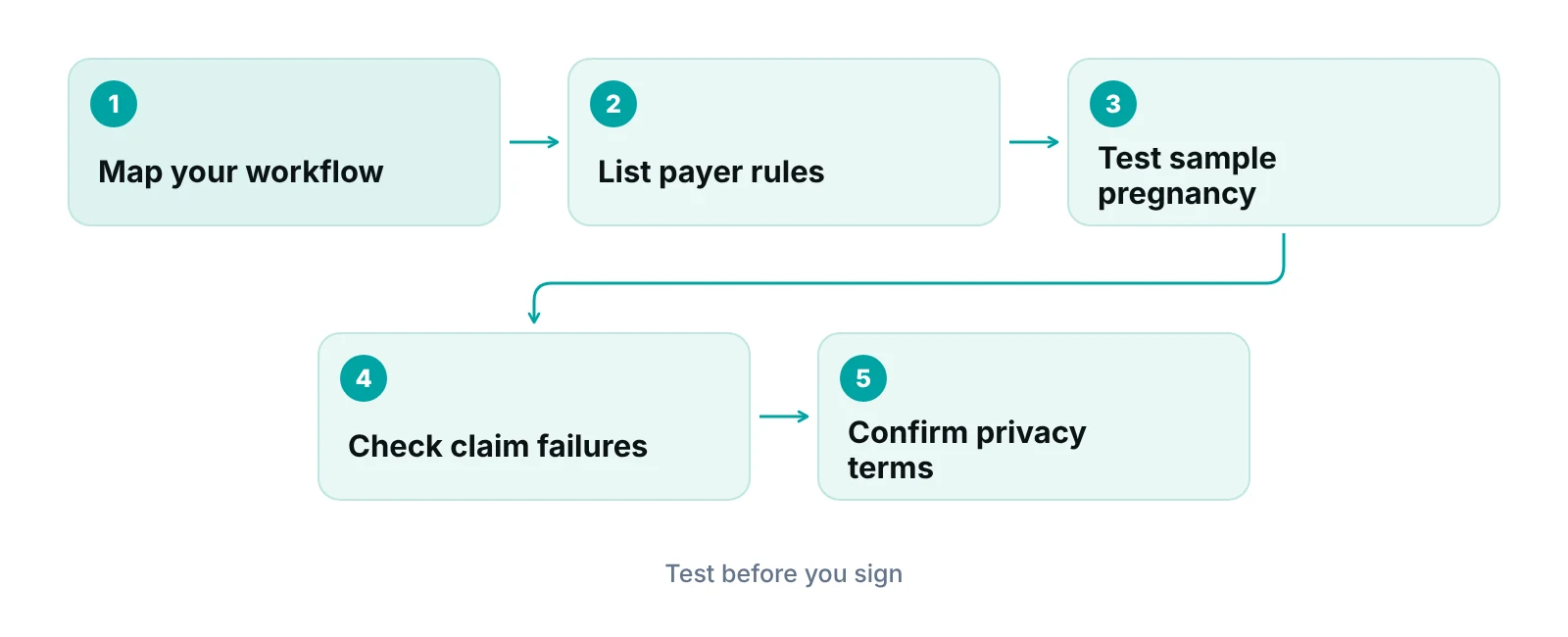
Judge a tool by how it handles a real pregnancy, not by a feature list. Ask for a demonstration using a sample pregnancy that has a transfer of care or a twin delivery, and watch what staff would do at each step.
| Area | What to ask | What a good answer looks like |
|---|---|---|
| Pregnancy tracking | How does the tool count visits across a pregnancy? | Visits sit under one pregnancy record, not just single encounters |
| Payer rules | Can global versus split billing be set by payer? | Rules are configurable per payer, and changes are logged |
| Claim checks | Which checks run before submission, and who sees the failures? | A clear list of checks, with failures sent to a named owner |
| Held claims | Can you see held global claims by age and filing deadline? | A report that shows age and the payer’s limit |
| EHR fit | How does it work with the EHR we already use? | Data comes from your current system without double entry |
| Privacy | Will you sign a Business Associate Agreement? | Yes, before any patient data is shared |
Source: RCM Finder editorial checklist. The BAA expectation reflects the HHS principle that covered entities need contracts with business associates.
The privacy row is not optional. According to the HHS Office for Civil Rights, covered entities and business associates must have contracts with their business associates, so a billing vendor that handles patient information should be willing to put that agreement in place. If you are weighing software against outsourcing, our OB/GYN outsourcing checklist compares the two, and our practice management software overview covers the software side.
Not sure where your OB/GYN claims stall?
A free practice audit looks at how your charges, held claims and denials move today, and where a tool or a billing partner would help.
Our recommendations
- Map your payers before you buy anything. Write down how each major payer wants global OB care billed and when. Software cannot apply rules you have not defined.
- Count visits where billing can see them. Whatever system you use, the prenatal visit count should be visible to billing staff, not locked inside the clinical record.
- Set a rule for held global claims. Decide how long a global claim may be held, who reviews it and what happens when the postpartum visit does not occur.
- Record each payer's filing limit. Put the timely filing deadline next to each payer in your system so held claims can be sorted by deadline.
- Test with a messy pregnancy. Ask any vendor to walk through a transfer of care, a twin delivery or a complication, not just a clean vaginal delivery. Exceptions are where weak systems fail, and they are common enough in obstetrics to matter.
- Ask for a Business Associate Agreement first. Get the agreement in place before any patient data is shared with a vendor.
RCM Finder's practice management system tracks claims by stage, with an owner on every claim.
It adds data-completeness checks before submission and underpayment flags against expected amounts, and it works alongside the EHR you already use.
See how the RCM Finder portal works · Create a portal account
Disclosure: RCM Finder builds and sells this portal. It is a practice management system, not an EHR.
Bottom line
Good OB/GYN billing technology counts visits, applies payer rules, checks claims and shows what is waiting. If denials are the main pain, see our denial management services and medical billing services, or estimate what delays cost you with the revenue calculator.
Frequently asked questions
What is the global OB package in medical billing?
It is a single claim that covers prenatal care, delivery and postpartum care when the same practice provides all three. Common global codes are 59400, 59510, 59610 and 59618. Payers set their own rules for visit counts and claim timing, so check each policy.
When can prenatal visits be billed separately?
It depends on the payer. In the Health First Colorado manual, fewer than four visits are billed as E/M codes, four to six use 59425 and seven or more use 59426. Blue Cross and Blue Shield of Oklahoma lists a similar range and adds that extra visits are billable only beyond 13.
Should a global OB claim be sent at delivery or after postpartum care?
Payers differ. The Oklahoma policy says claims should be submitted upon delivery. The Colorado Medicaid manual says global codes should not be billed until the postpartum visit has been provided. Confirm each payer’s rule, record it in your billing system, and review it whenever the payer updates its policy, since these rules change.
How long do we have to file a Medicare claim?
Under 42 CFR 424.44, a Medicare claim must generally be filed within one calendar year after the date of service, with limited exceptions. Other payers set their own limits, so track them by contract.
Can software replace a biller in an OB/GYN practice?
Software can count visits, run claim checks and show aging claims, but staff still decide how to handle exceptions, appeals and payer disputes. Most practices combine a good system with trained people, in-house or outsourced. The right balance depends on volume, payer mix and how much billing expertise you already have on staff.
What should I ask a billing vendor about patient data?
Ask whether they will sign a Business Associate Agreement before accessing patient information, who can see records, and whether activity is logged. HHS says covered entities need contracts with their business associates.
Get your free practice audit
Tell us about your practice. We will contact you using the details you give.
- A review of your recent claims, denials and A/R aging
- Where your front desk and prior authorizations slow payment
- A prioritized fix list you keep, whether or not you hire us
Pricing is quoted after the audit, based on your volume and the services you choose. Prefer to talk? Call +1 (302) 556-2288.
Sources
- Obstetrical Care Billing Manual — Colorado Department of Health Care Policy and Financing (2026)
- Obstetric Services payment policy RP044 — Blue Cross and Blue Shield of Oklahoma (2026)
- 42 CFR 424.44 Time limits for filing claims — eCFR (2026)
- Business Associate Contracts — HHS Office for Civil Rights (2026)
Disclaimer: This article is educational and is not legal, coding or compliance advice. Payer policies change and vary by contract and state; confirm current rules with each payer before billing.
