
AI in medical billing and coding suggests codes, flags claim errors, drafts appeals and sorts denials, but a trained person should approve what is billed. Start with one narrow task, a signed Business Associate Agreement and a side-by-side test against your own staff before anything reaches a payer.
Articles on this topic often mix vendor forecasts with tools that really exist, so it is hard to tell what is in use and what is a pitch. This guide separates the two. It covers where AI sits in the revenue cycle, what it can and cannot decide, what payers and regulators have said in 2025 and 2026, and how a practice can test a tool without risking claims or patient data.
Key takeaways
- AI gives suggestions, scores and drafts; a person or a payer rule makes the decision.
- Many tools sold as AI are rules and RPA, which are easier to test than machine learning.
- Accuracy depends on the note, so measure a tool on your own claims in shadow mode first.
- A vendor that handles PHI is a business associate and needs a signed BAA before data is shared.
- Payers use AI too, so track denials by reason and keep records that support an appeal.
Where is AI used in medical billing and coding today?
AI appears at six points in the claim lifecycle: suggesting codes from documentation, checking data before submission, predicting denials, drafting appeals, answering patient billing questions and spotting unusual billing patterns. At each point it produces a suggestion, a score or a draft. A person, or a payer rule, decides what happens next.
Coding tools usually rely on natural language processing, which is software that reads free-text notes and matches the wording to diagnosis and procedure codes. Other tools use machine learning on past claims to score the risk of denial. A newer group uses generative AI to write text, such as an appeal letter or a summary of a long chart. They are different tools with different risks, so it helps to name which one is being offered.
| Step | What the software does | Who checks it | Main risk |
|---|---|---|---|
| Coding | Reads the note and suggests diagnosis and procedure codes | A trained coder compares the code to the note | Suggests a code the note does not support |
| Charge capture and data entry | Pulls patient, insurance and visit details into the claim | Billing staff spot-check against registration | One wrong field copied across many claims |
| Pre-submission checks | Flags missing or mismatched data before the claim goes out | The biller fixes each flag | Over-flagging that slows claims, or silent misses |
| Denial prediction and triage | Scores claims by denial risk and sorts denials by reason | A denial specialist | Scores built on old payer behavior |
| Appeals | Drafts an appeal letter from the denial reason | Staff confirm facts and attach records | A letter that cites facts not in the chart |
| Patient billing questions | A chatbot answers balance and payment-plan questions | Staff handle disputes and exceptions | A wrong answer about coverage, or a privacy lapse |
| Pattern monitoring | Flags unusual billing patterns for review | The compliance lead | False alarms, or real patterns missed |
The rest of this guide follows that table. It explains what each tool can decide, what payers and regulators have said in 2025 and 2026, and how to test a tool without putting claims or patient data at risk. For the wider technology picture, see our post on medical billing trends and technologies.
What is the difference between AI, automation and RPA?
Rule-based automation follows fixed if-then rules, robotic process automation (RPA) repeats screen steps like a staff member, machine learning finds patterns in past data, and generative AI writes new text. Only the last two guess. The first two do the same thing every time, which makes them easier to test.
| Type | What it does | Billing example | How you check it |
|---|---|---|---|
| Rule-based automation | Applies fixed rules to every claim | Hold any claim that is missing a referring provider | Run sample claims through and confirm the same result each time |
| Robotic process automation (RPA) | Repeats clicks and copy steps across screens | Copy a payer’s claim status into a tracking sheet | Review the bot log and the exception list |
| Machine learning | Learns patterns from past claims | Score a claim’s denial risk | Compare scores with your own denial outcomes |
| Generative AI | Writes or summarizes text | Draft an appeal letter or summarize a chart | Read every output against the source record |
Many tools sold as AI are mostly rules and RPA. That is not a flaw. Rules are predictable, easy to explain to an auditor and cheap to fix when a payer changes a requirement. The tools that guess need more oversight, because a confident wrong answer looks the same as a right one.
Can AI code a claim accurately?
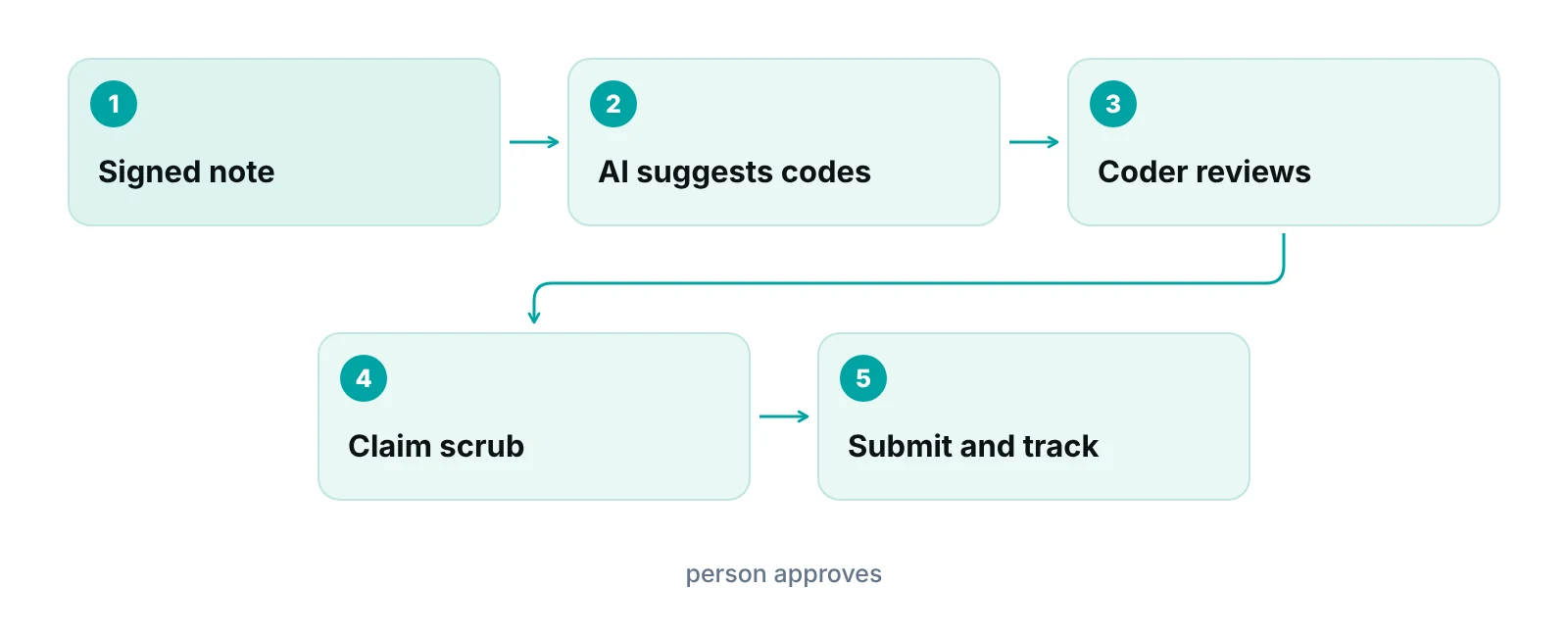
AI can draft codes quickly, but accuracy depends on the note. The software reads what is written. It cannot know what the clinician did and left undocumented, and it can suggest a code that sounds right but is not supported. Treat every suggestion as a draft and keep a trained coder as the approver.
No source we fetched gives a reliable accuracy rate for AI coding across practices, so we do not quote one. Accuracy varies with the specialty, the template and how consistently clinicians write. The only number that matters is the one measured on your own notes, which is why a side-by-side test comes first.
The HHS Office of Inspector General published its General Compliance Program Guidance in November 2023. It is voluntary, and it recommends regular internal billing and coding audits (HHS-OIG, 2023). The same habit fits AI output: sample the codes the tool suggested, compare each one with the note, and log the errors by type. Our guide to medical coding audits covers how to set that up.
Three checks for any suggested code
- Does the signed note support the code, in the clinician’s own words?
- Is the code as specific as the note allows, without going beyond it? A tool that drifts toward higher-paying codes is a compliance risk.
- Does the claim pass a scrub for payer edits, modifiers and missing data before it leaves? See our guide to claim scrubbing.
“A suggested code is a draft. The signed note is the evidence.”
Are payers using AI to review claims and authorizations?
Yes. Health plans and now Medicare use automated tools to review prior authorization and coverage requests, and physicians and regulators have both responded. A practice cannot control a payer’s software, but it can document well, track denials by reason and appeal with the record.
In a survey of 1,000 practicing physicians reported by the American Medical Association in 2025, 61% were concerned that health plans’ use of AI is increasing prior authorization denials, and physicians and their staff spent an average of 13 hours a week on prior authorization work (AMA press release, February 2025; AMA, March 2025). That is a survey of physician opinion, not a measure of how often AI caused a denial.
Original Medicare is testing the same idea. The Wasteful and Inappropriate Service Reduction (WISeR) model starts on January 1, 2026 and runs through December 31, 2031, in Arizona, New Jersey, Ohio, Oklahoma, Texas and Washington. The Congressional Research Service reports that contractors use technologies such as AI to review requests, that a human clinician must review every denial, and that providers can resubmit, ask for peer review and then use the regular Medicare appeals process (CRS, updated May 2026).
The services on the model’s list include steroid injections for pain and nerve stimulation, so pain practices in those states should watch it closely. Our pain management billing page covers how those claims are usually built. CMS may change the list, and the model’s status may have changed since the CRS update, so confirm it on CMS.gov before you plan around it.
| Development | What the source says | Where it applies | What a practice can do |
|---|---|---|---|
| AMA physician survey (2025) | 61% of 1,000 physicians were concerned that plan AI increases prior authorization denials | Prior authorization, all plans | Track denials by reason and payer; appeal with the chart |
| WISeR model (2026 to 2031) | AI-assisted prior authorization in six states; a human clinician must review every denial | Original Medicare, listed services, six states | Check the service list; document medical necessity before the request |
| CMS Medicare Advantage guidance (2024) | Plans may use algorithms, but coverage decisions must reflect each patient’s circumstances, per a law-firm summary of the CMS FAQs | Medicare Advantage plans | Cite the patient’s own record in an appeal |
| HHS HIPAA guidance on business associates and cloud services | A vendor that handles ePHI for you is a business associate and needs a written agreement first | Any practice using an outside tool | Get a signed Business Associate Agreement before sharing data |
| HHS-OIG General Compliance Program Guidance (2023) | Voluntary guidance that recommends regular internal billing and coding audits | Any billing operation | Schedule recurring audits that include AI-suggested codes |
Sources: AMA (2025); Congressional Research Service (updated May 2026); Norton Rose Fulbright summary of CMS Medicare Advantage FAQs (secondary); HHS Office for Civil Rights (HIPAA guidance); HHS-OIG (2023).
For the practice side of this, our guides to prior authorization and denial management show how to build the paper trail that an appeal depends on, whether a person or a program made the first decision.
What HIPAA rules apply when a vendor's AI touches patient data?
A vendor that creates, receives, maintains or transmits protected health information (PHI) for your practice is a business associate. You need a written Business Associate Agreement (BAA) before any PHI is shared. HHS lists billing firms and cloud storage providers among business associates, and an AI billing tool that receives PHI fits the same definition (HHS, business associate guidance).
HHS says the agreement must describe permitted uses of PHI, prohibit other uses, require the vendor to follow the Security Rule and report security incidents, and that a business associate needs its own agreement with any subcontractor that handles PHI. In its cloud computing guidance, HHS adds that lacking an encryption key does not exempt a cloud provider from business associate status, and that using a cloud provider without a BAA violates the HIPAA Rules (HHS, cloud computing guidance).
Do not paste PHI into a tool you have no agreement with
A general-purpose chat tool is not a billing system. Unless your practice has a BAA with that vendor, keep notes, claims and patient details out of it, and write a staff rule that says so.
Questions to ask any AI vendor
- Will you sign a BAA before we share any PHI?
- Which subcontractors, such as cloud hosts or model providers, can see our data?
- Is our data used to train models that other customers use?
- How long is data kept, and how is it deleted when we leave?
- Do you offer role-based access and an audit log of who saw what?
- Where does a person review the output before it reaches a payer or a patient?
- Can we export our data and our audit trail if we end the contract?
Our HIPAA guide for medical billing goes deeper on access controls and risk analysis.
How can a practice test an AI billing tool safely?
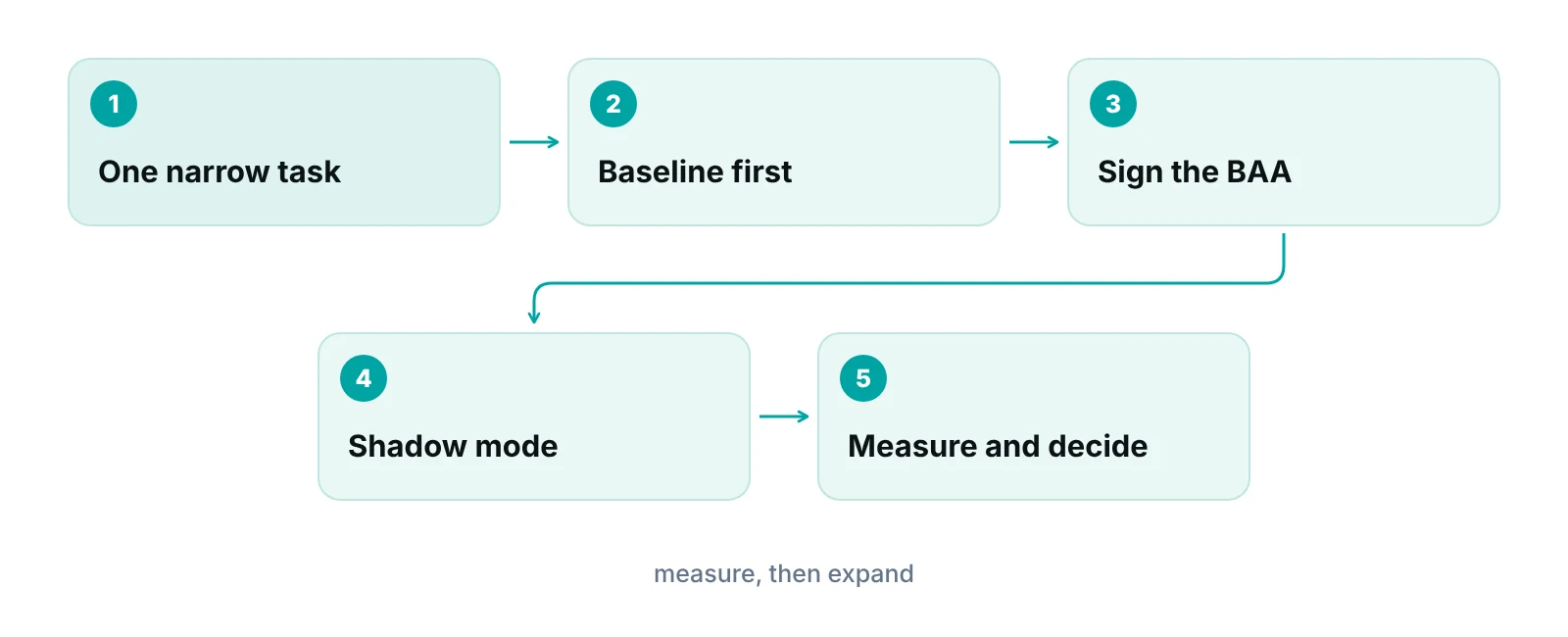
Test one narrow task, in shadow mode, against your own staff. Run the tool alongside your current process, compare its output with the approved result, and only let it influence real claims once you have measured how often it is wrong and why.
- Pick one task. Denial triage or pre-submission checks are lower risk than automated coding.
- Set a baseline first. Record your current first-pass rate, denial rate by reason and days in A/R before the pilot starts.
- Get the BAA and the questions answered before any real data is shared.
- Run in shadow mode. The tool suggests; your staff still decide, and every disagreement is logged with a reason.
- Review results on a set schedule. Expand, adjust or stop based on your own numbers, not the vendor’s.
What to measure
Track how often staff override the tool, how many claims are accepted on first submission, denial rate by reason, days in accounts receivable, and minutes of staff time per claim. Our guide to revenue cycle KPIs defines each one.
Whatever tool you test, each claim still needs an owner and a stage. A practice management system that tracks claims by stage gives every claim a named owner, so a suggestion from software always has a person accountable for the decision.
See what denials may cost your practice
Use the revenue calculator to estimate what denied and delayed claims could be costing you before you decide where automation would help.
Should a practice use AI chatbots for patient billing questions?
A chatbot can answer routine questions such as office hours, accepted payment methods and how to read a statement. It should not decide coverage, quote what insurance will pay or handle disputes. Route those to a person, and make it easy to reach one.
- Limit the bot to questions the practice can answer the same way every time.
- Never let it state what a plan will cover or what a patient owes before the claim is processed.
- Check that the vendor will sign a BAA if the bot can see account or visit details.
- Ask your counsel whether your state has rules about telling patients when a message is AI-generated.
- Review a sample of conversations each month for wrong answers.
Should a practice buy AI tools or outsource billing?
It depends on volume and staff time, not on the technology. A practice has three realistic routes: use the automation already built into its current systems, buy a standalone tool for one task, or hand billing to a company that uses automation and owns the process. Each still needs human review and a signed BAA.
- Built-in features: the lowest-risk start, because the vendor is usually already approved and under agreement.
- A standalone tool: useful when one task, such as denial triage, is the clear bottleneck and you can measure it.
- An outsourced team: fits when staff time, not software, is the constraint. Ask who reviews AI output, how errors are reported and how you see claim status.
If outsourcing is on the table, our medical billing services page explains how a managed billing team works inside your existing EHR. Pricing is quoted after a free practice audit, and the audit also shows where automation would help most.
Which AI statistics in billing articles should you treat with caution?
Treat any single percentage that promises fewer denials or fewer coding errors as unproven until you see the study, the year, the sample size and what it was compared with. Several widely repeated figures could not be traced to a primary source when we checked, so none appear in this guide.
Figures we left out on purpose
Market-size forecasts for AI in healthcare, claims that AI cuts denials by a fixed percentage, claims that a fixed share of denied claims can be recovered, and claims of a set cost saving from outsourcing. They are vendor or trade-press numbers without a verifiable original. Ask any vendor for the source behind each one.
Want a second look at your claim flow?
Request a free practice audit. We review how claims move through your office and where a rule, a bot or a better handoff would help.
Our recommendations
- Start with one narrow task. We recommend denial triage or pre-submission checks before automated coding, because a wrong flag is easier to catch than a wrong code.
- Keep a trained coder as the approver. Make human sign-off a written step. A suggestion is a draft until a person has compared it with the signed note.
- Sign the BAA before sharing data. Ask any vendor to sign a Business Associate Agreement before it sees PHI, and ask which subcontractors can see the data.
- Measure on your own claims. Set a baseline, run in shadow mode and log every disagreement. Your own override rate matters more than any published average.
- Audit AI-suggested codes on a schedule. Sample suggested codes each month, compare them with the notes and sort errors by type, in line with OIG’s advice on regular billing and coding audits.
- Track denials by reason and payer. Payer-side AI is changing prior authorization. A clean denial log shows where it affects you and supports appeals.
- Check dated claims before you act. Programs such as the WISeR model can change. Confirm the current rule on the source site before you build a process around it.
Give every claim an owner and a stage, whatever tool suggests the next step.
Our portal tracks claims by stage with an assigned owner, runs data-completeness checks before submission, flags underpayments against expected amounts and keeps a role-based audit log. It uses workflow rules, and it does not assign codes or replace a coder's review.
See how the RCM Finder portal works · Create a portal account
Disclosure: RCM Finder builds and sells this portal. It is a practice management system, not an EHR.
Bottom line
AI in medical billing and coding works best as a set of drafts and flags with a person in charge: one narrow task, a signed BAA, a baseline and a side-by-side test on your own claims. If you want to automate repeatable steps first, our medical billing automation and RPA work covers rule-based tasks that are easier to test than AI. A free practice audit shows where your claims lose time before you spend on any tool.
Frequently asked questions
What is the role of AI in medical billing and coding?
AI helps with drafting and checking. It can suggest codes from a note, flag missing data before a claim goes out, predict which claims may be denied, draft appeal letters and answer simple patient questions. It does not replace the responsibility of the practice, so a trained person should approve what is billed.
Can AI replace medical coders?
Not safely today. AI reads documentation and suggests codes, but it cannot confirm what the clinician did beyond the note, and it can suggest unsupported codes. Coders shift toward reviewing suggestions, handling exceptions and auditing. HHS-OIG’s compliance guidance recommends regular billing and coding audits whoever picks the code.
Does AI improve coding accuracy?
It can, but the gain depends on your specialty, templates and note quality, and no reliable cross-practice rate was verified for this guide. Measure it yourself: run the tool beside your coders on the same notes, count disagreements, and review the reasons before you let it affect real claims.
Is it HIPAA-safe to use AI tools with patient data?
Only with the right agreements and controls. A vendor that handles PHI for you is a business associate, and HHS says a written agreement must be in place first. Ask for a signed BAA, the list of subcontractors, retention terms and access logs. Do not paste PHI into tools you have no agreement with.
Are insurers using AI to deny claims?
Insurers use automated tools in prior authorization and coverage review. In a 2025 AMA survey of 1,000 physicians, 61% were concerned that plan AI is increasing prior authorization denials. Medicare’s WISeR model also uses AI-assisted review in six states from 2026, with a human clinician reviewing every denial.
Are AI chatbots effective for patient billing questions?
They can handle routine questions, such as accepted payment methods or how to read a statement. They should not state coverage or what a patient owes. Send disputes and unusual cases to staff, confirm the vendor will sign a BAA, and review a sample of conversations each month.
Get your free practice audit
Tell us about your practice. We will contact you using the details you give.
- A review of your recent claims, denials and A/R aging
- Where your front desk and prior authorizations slow payment
- A prioritized fix list you keep, whether or not you hire us
Pricing is quoted after the audit, based on your volume and the services you choose. Prefer to talk? Call +1 (302) 556-2288.
Sources
- Overview of the Medicare Wasteful and Inappropriate Service Reduction (WISeR) Model (IF13133) — Congressional Research Service (2026)
- Physicians concerned AI increases prior authorization denials — American Medical Association (2025)
- How AI is leading to more prior authorization denials — American Medical Association (2025)
- Business Associates — HHS Office for Civil Rights (n.d.)
- Guidance on HIPAA & Cloud Computing — HHS Office for Civil Rights (n.d.)
- General Compliance Program Guidance — HHS Office of Inspector General (2023)
- CMS clarifies Medicare Advantage organizations' use of AI and algorithms in coverage decisions — Norton Rose Fulbright (summary of CMS FAQs) (2024)
Disclaimer: This article is educational. It is not legal, coding or compliance advice, and it does not describe any one payer's rules. Rules and programs such as the WISeR model can change, so confirm each point with the source and with your compliance counsel before you act.