
SLPs bill individual speech, language, voice and communication treatment with CPT 92507 through December 31, 2026. Medicare Part B claims also need the GN modifier, plus KX once a patient's combined PT and SLP therapy passes the annual threshold ($2,480 in 2026). On January 1, 2027, 92507 is deleted and replaced by ten timed codes.
Most SLP billing trouble starts before the claim: a plan of care that was never certified, a missing modifier, or a code that does not match the diagnosis. This guide covers what to bill today, the Medicare Part B rules that apply, and the 2027 code change that every speech practice now has to plan for. It is written for practice owners and billing leads in rehabilitation and therapy practices. Where a rule comes from Medicare, we link the source. Medicaid and commercial plans set their own policies, so check each payer before you rely on any of this.
Key takeaways
- Through December 31, 2026, 92507 (individual treatment) and 92508 (group treatment) are the core SLP treatment codes. Both are untimed.
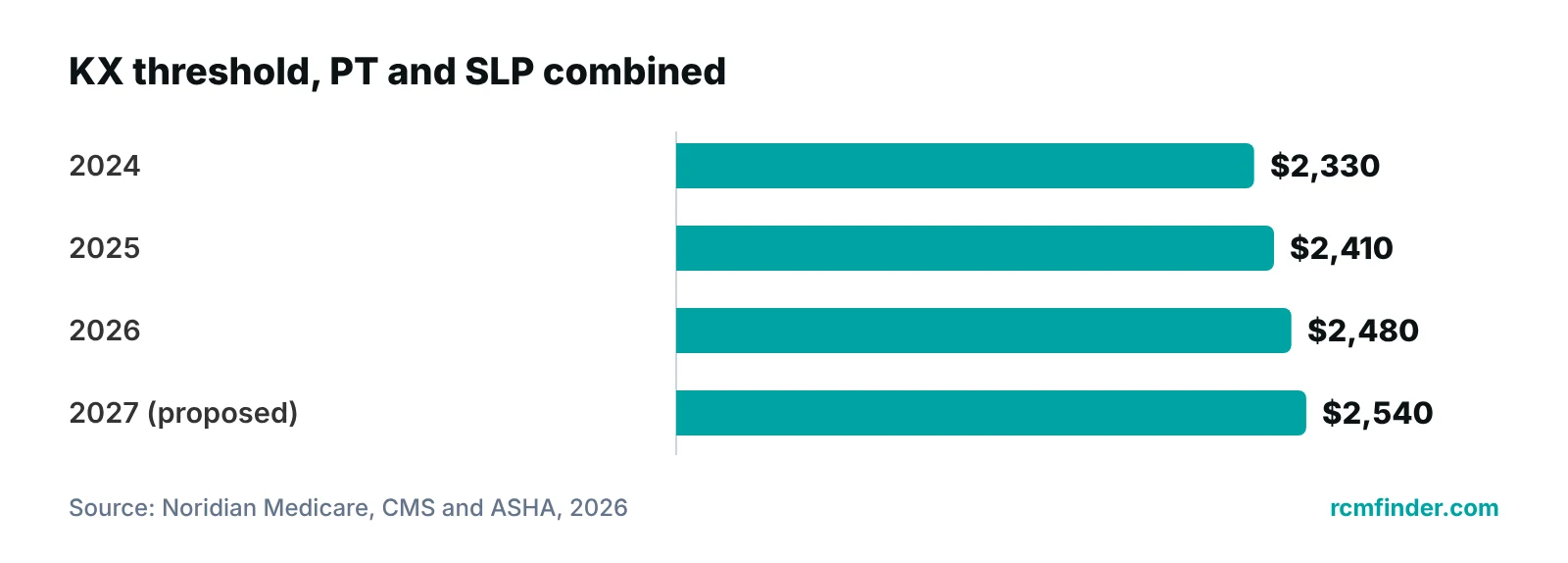
- On Medicare Part B, SLP claims need the GN modifier. Add KX once combined PT and SLP charges pass the yearly threshold ($2,480 in 2026).
- Do not stack a cognitive code (97129/97130) on top of 92507 for the same treatment time.
- From January 1, 2027, 92507 is replaced by ten timed codes in five clinical categories. The Medicare final rule and official code numbers still need to be checked.
- Payers adopt code changes on their own schedules, so build a payer-by-payer 2027 checklist now.
What CPT 92507 covers and which SLP codes sit around it
CPT 92507 reports one-on-one treatment of a speech, language, voice, communication or auditory processing disorder. It is untimed, so it is reported once per session whatever the length, and generally once per patient per day (ClinicNote, ASHA). That is different from physical and occupational therapy, where most codes are billed in 15-minute units. If your front desk also handles PT claims, our physical therapy billing units guide shows the contrast.
The table lists the codes SLP claims usually touch today. Descriptions are our own summaries, not the AMA’s wording, so check the current CPT book before you build a charge master.
| Code | What it reports | Billing note |
|---|---|---|
| 92507 | Individual speech, language, voice, communication or auditory processing treatment | Untimed; one unit per session. Medicare Part B needs GN. |
| 92508 | The same kind of treatment delivered to a group of two or more | Untimed; not normally billed with 92507 for the same patient on the same day. |
| 92526 | Treatment of swallowing or oral feeding function | Separate service from 92507. Documentation has to show it was distinct. |
| 92521-92524 | Evaluation codes for speech fluency, sound production, language and voice | Evaluations are not billed as treatment. Match the code to what was assessed. |
| 97129 / 97130 | Therapeutic interventions that focus on cognitive function | Medicare allows them, but not together with 92507 for the same treatment. |
Source: ClinicNote (2026), CodingAhead (2026), ASHA Medicare FAQ for SLPs. Secondary sources; confirm in the current CPT book and your payer’s policy.
Diagnosis coding has to line up too. Medicare contractor guidance lists the ICD-10-CM codes that support medical necessity for 92507 and 92508, and it requires the record to support the code you picked (CMS Medicare Coverage Database, Novitas draft article). That article applies to Novitas jurisdictions only, so look up your own contractor’s policy.
If you code more than one therapy discipline, our physical therapy evaluation and treatment CPT guide and CPT versus HCPCS explainer help keep the code families straight. You will need that distinction in 2027, when a HCPCS G-code enters the picture.
Medicare Part B rules every SLP claim has to meet
SLPs can bill Medicare Part B once they are enrolled as Medicare providers, and the treatment must follow a certified plan of care. Medicare does not require a physician referral, but the plan has to be certified (ASHA Medicare FAQ). The old post on this URL said a physician only needed to “validate” the plan within 30 days. The accurate version has more moving parts, shown below.
| Checkpoint | What the rule says | What to check before the claim goes out |
|---|---|---|
| Plan of care | Either the physician or the SLP may write it. If the SLP writes it, the physician must certify it within 30 days. | Is the plan dated, signed and certified in the chart? |
| Recertification | ASHA’s Medicare FAQ says outpatient plans are recertified every 90 days from the start of treatment, or sooner after a significant change. | Is a recertification date on the calendar for each patient? |
| Referral | A physician referral is not required for Medicare patients. | Do not let a missing referral hold a covered claim. |
| GN modifier | SLP services are still reported with GN. | Is GN on every Part B SLP line? |
| KX modifier | Attests that services above the annual threshold are medically necessary and documented. The 2026 threshold is $2,480 for PT and SLP combined. | Track year-to-date charges across both disciplines. |
| Targeted review | A $3,000 threshold for PT and SLP combined triggers targeted medical review, not automatic denial. It holds through 2028. | Is the record ready if a records request arrives? |
Source: CMS therapy services page (2026); Noridian Medicare (2026); ASHA Medicare FAQ and Part B review page. Chapter 15 of the Medicare Benefit Policy Manual covers plan of care, certification and documentation in sections 220.1.2, 220.1.3 and 220.3.
The KX threshold is a combined PT and SLP figure per beneficiary per calendar year, and occupational therapy has its own. A patient who also sees a physical therapist in another clinic can cross the line sooner than your own records suggest. ASHA says KX can be added before the trigger because other providers’ claims are unknown, but it warns that routine early use may bring extra review (ASHA).
Check the number each January
Older articles still quote a $2,230 trigger (ASHA’s review page does). Use the current year’s CMS figure. The 2026 amount is listed by CMS at $2,480.
Same-day coding: 92507, 92508, swallowing and cognitive codes
Pick one treatment code per distinct service and let the documentation show why. Most same-day SLP denials come from billing two codes for one block of treatment time.
92507 and 92508
These are generally mutually exclusive for the same patient on the same day (CodingAhead). The old post told readers to add modifier 59 to 92508 whenever both were billed. We removed that advice. Modifier 59 is not a fix for an edit; it is a statement that two services were distinct, and the chart has to prove it. Our guide to modifiers 25 and 59 explains the audit risk. Check the current NCCI procedure-to-procedure table before you use it.
92507 and cognitive codes
CMS officials treat 92507 as a comprehensive code that includes the parts of speech-language treatment, and ASHA says Medicare permits 97129 and 97130 for cognitive treatment but not together with 92507 for the same treatment (ASHA Medicare FAQ). Choose the code that matches the main focus of the session. Do not split one session across both.
92507 and swallowing treatment
A separate swallowing session may be reported with 92526 when the notes show it was a distinct service and the payer allows it. Modifier 59 or XS only belongs on a clearly separate service. If two treatments ran back to back with no clear break, expect questions.
“If you need a modifier to get two SLP codes past an edit, ask first whether the chart shows two separate services.”
— Awais Afzal, Healthcare Operations & Data Analyst
Documentation and denials: where SLP claims go wrong
SLP denials usually trace to the same few gaps: a missing GN, a diagnosis that does not match the code, an uncertified plan of care, or notes that do not show skilled care. Fixing them at charge entry is cheaper than appealing later.
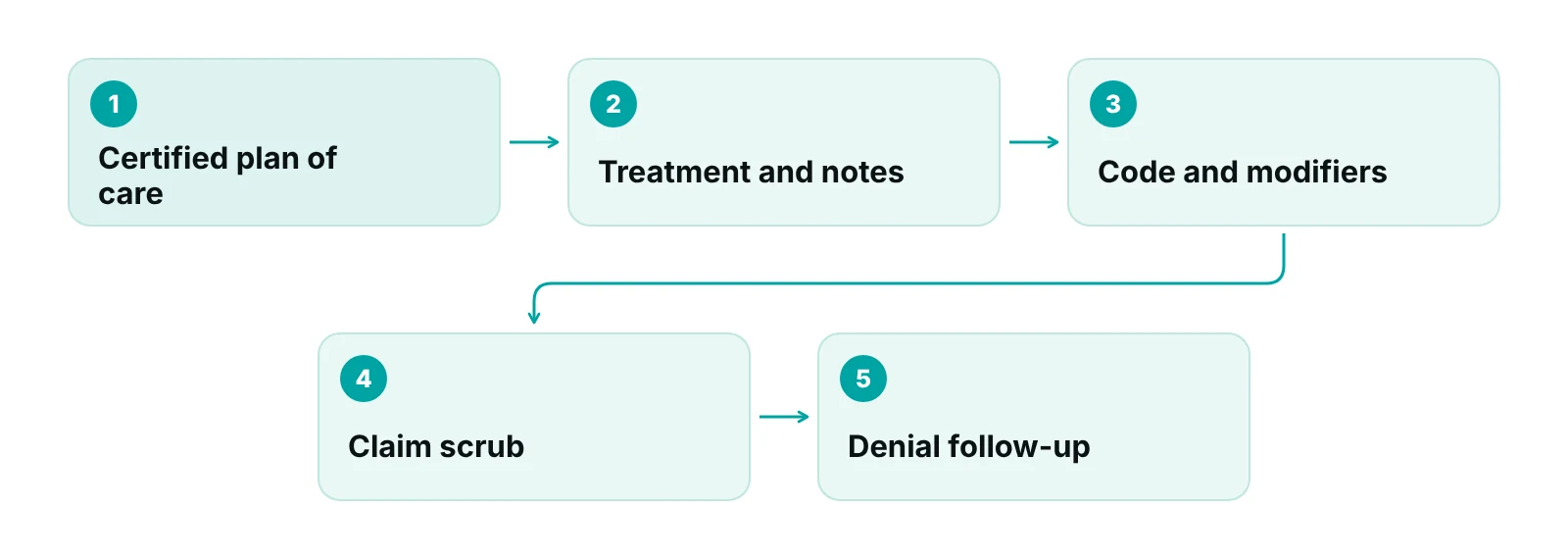
- Skilled care shown. For Medicare, the record has to show either that the patient is expected to improve in a reasonable time, or that skilled care is needed to maintain function, for example in a degenerative neurological condition (ASHA).
- Measurable goals. Each note should tie the session to goals in the plan of care and say how the patient responded.
- Legible signatures and dates. Medicare contractor guidance requires patient identification and a legible signature on each page of the record (CMS Medicare Coverage Database).
- Diagnosis that fits. A swallowing diagnosis on a 92507 claim is a mismatch. Match each ICD-10-CM code to the service on that line.
When a claim bounces for missing information, our guide to CO-16 denials explains the code. Practices that catch errors before submission use a scrubber; see our claim scrubbing guide and clean claims guide. For appeals and trend tracking, denial management services are the usual next step.
The 2027 change: 92507 is replaced by ten timed codes
CPT 92507 stays valid through December 31, 2026. On January 1, 2027 it is deleted and replaced by ten time-based codes, according to ASHA. Each of five clinical categories gets a base code for the first 30 minutes of direct one-on-one treatment and an add-on code for each additional 15 minutes. Group treatment (92508) stays as an untimed stand-alone code.
CMS flagged 92507 in 2024 after Medicare use grew by more than 100% between 2017 and 2022, and the code was last valued more than 15 years ago on a typical 60-minute session (ASHA). ASHA also says most SLPs provide medically necessary services and bill appropriately.
| Clinical category | Base code, first 30 min | Add-on, each 15 min |
|---|---|---|
| Fluency | $54.55 | $23.97 |
| Speech sound production | $66.01 | $23.97 |
| Language comprehension and expression | $49.92 | $22.99 |
| Speech sound and language combined | $71.59 | $27.91 |
| Voice, upper airway and/or resonance | $54.84 | $23.97 |
| Group treatment (92508) | $19.71 | Not applicable |
Source: ASHA analysis of the CMS CY 2027 proposed rule (2026), using a $32.8409 conversion factor. Proposed figures, not final; local rates differ. Placeholder code numbers were used in the proposal.
CMS also proposed a Medicare-only HCPCS code, GSLPP, for individual pediatric treatment. It would be valued like the old 92507 and would require 60 minutes of personally performed treatment (ASHA). The proposal is published in the Federal Register (docket CMS-1848-P) and the comment period closed September 14, 2026. A final rule is expected in early November 2026, so treat all of this as pending.
What to do now
Under the usual CPT timing convention, a base code can be reported after 16 minutes of direct treatment, and note-keeping will need to show minutes. Payer rules and CMS policy may differ (ASHA). Update templates so each note records direct one-on-one time per service.
CMS also proposes a 2027 KX threshold of $2,540 for PT and SLP combined, a $3,000 targeted-review threshold, and a conversion factor 1.68% below 2026 (ASHA). Medicaid and commercial payers are not required to adopt the new codes or Medicare’s rates, and some may keep accepting 92507 for a time.
When it makes sense to bring in billing support
A small speech practice can run its own billing, but the 2027 switch adds work: new charge codes, new note templates, new payer-by-payer rules, and a possible split between CPT codes and GSLPP for pediatric Medicare patients. If that is more than your front desk can absorb, medical billing services can take on charge entry, claim submission and follow-up while your clinicians keep treating. Our team works inside your existing EHR (for example PrognoCIS, eClinicalWorks or athenahealth).
Enrollment problems can also stall a new clinician’s claims. See our insurance credentialing guide if you are adding therapists. And if you are not sure how much revenue is stuck in denials, the revenue calculator gives a quick estimate.
Not sure where your SLP claims are leaking?
We review a sample of your claims and denials, then tell you what we would fix first. Pricing is quoted after the audit.
Our recommendations
- Audit GN and KX on every Medicare line. We start every SLP review with a report of Part B lines missing GN, and of patients near the combined PT and SLP KX threshold. It is a quick check that finds avoidable denials.
- Put plan-of-care dates in a tracker. Track the certification date and the next recertification date for each patient. A lapsed plan is a coverage problem, not a coding problem, and a coder cannot fix it later.
- Never bill two codes for one block of time. Decide the main focus of the session and bill the code that matches it. Keep 59 and XS for services that were truly separate and documented that way.
- Rebuild note templates for minutes before January. The 2027 codes depend on direct one-on-one time. Add a time field per service now so your clinicians are not retrofitting notes in the first week of the year.
- Build a payer-by-payer 2027 sheet. List each payer, whether it has announced an adoption date, and whether it will accept 92507 for a time. Update it as final rules and payer bulletins appear.
- Look up rates from the CMS fee schedule, not from articles. Rates vary by locality and change with the conversion factor. Use the CMS lookup for your locality and treat any dollar figure in a blog post as an example.
Bottom line
The core of SLP billing is simple to state: one treatment code per distinct service, GN and KX on Medicare Part B when they apply, a certified plan of care, and notes that show skilled care. The harder part is 2027, when 92507 goes away and every note needs minutes. If you want a second pair of eyes on your claims, see how our denial management services and rehabilitation billing support work, or ask for a free practice audit.
Frequently asked questions
What is CPT 92507 used for?
CPT 92507 reports one-on-one treatment of a speech, language, voice, communication or auditory processing disorder. It is untimed and reported once per session. It is valid through December 31, 2026. After that, ten timed codes replace it, so claims for 2027 dates of service need the new codes.
Can SLPs bill Medicare directly?
Yes, once they enroll in Medicare as providers. Treatment must follow a plan of care that the physician certifies within 30 days if the SLP wrote it. Medicare does not require a physician referral. Part B claims carry the GN modifier. Check your Medicare contractor for enrollment and documentation details.
Do SLP claims need the GN and KX modifiers?
On Medicare Part B, SLP services are reported with GN. KX is added once a patient’s combined PT and SLP therapy passes the yearly threshold, which is $2,480 for 2026. KX attests that the services are medically necessary and documented. Other payers may have different modifier rules.
Can I bill 92507 and 92508 on the same day?
They are generally treated as mutually exclusive for the same patient on the same day. Do not assume modifier 59 solves it. Check the current NCCI table and your payer’s policy first. If two distinct services really occurred, the chart must show that clearly.
Can 92507 be billed with cognitive codes 97129 or 97130?
Medicare allows 97129 and 97130 for cognitive treatment, but not together with 92507 for the same treatment, according to ASHA’s Medicare FAQ. Choose the code that matches the main focus of the session. NCCI edits can also block the pair on the same day.
What happens to 92507 in 2027?
It is deleted on January 1, 2027 and replaced by ten timed codes across five categories, each with a 30-minute base code and a 15-minute add-on. CMS has proposed payment rates and a pediatric code called GSLPP. As of this writing the final rule is still pending, so confirm before you update charge masters.
Get your free practice audit
Tell us about your practice. We will contact you using the details you give.
- A review of your recent claims, denials and A/R aging
- Where your front desk and prior authorizations slow payment
- A prioritized fix list you keep, whether or not you hire us
Pricing is quoted after the audit, based on your volume and the services you choose. Prefer to talk? Call +1 (302) 556-2288.
Sources
- Therapy services (KX and targeted review thresholds) — CMS (2026)
- Per-beneficiary KX modifier thresholds — Noridian Medicare (2026)
- Medicare Part B review process for therapy claims — ASHA (2026)
- Medicare FAQs: speech-language pathology — ASHA (2026)
- CMS proposes Medicare payment for new SLP treatment codes — ASHA (2026)
- 2027 Medicare Part B proposed rule: coding, payment and policy analysis — ASHA (2026)
- Speech-language pathology treatment codes replacing 92507 — ASHA (2026)
- Update on CPT code 92507: valuation review underway — ASHA (2026)
- CY 2027 Physician Fee Schedule proposed rule (CMS-1848-P) — Federal Register (2026)
- Understanding timed and untimed CPT codes — ASHA (2026)
- Billing and Coding: SLP Services, Communication Disorders (A54111) — CMS Medicare Coverage Database (Novitas) (2025)
- CPT code 92507: the 2026 billing guide for SLPs — ClinicNote (2026)
- CPT 92507 — CodingAhead (2026)
Disclaimer: This article is educational and is not legal, coding or compliance advice. CPT is a trademark of the American Medical Association, and the code descriptions here are our own summaries. Payer rules vary, and Medicare proposals described here may change in the final rule. Check current CMS, AMA and payer sources before you bill.
