
Choose among medical billing companies near me by testing four things, not the zip code: how they handle your specialty and payers, what you will see each week, what the contract says about data, fees and exit, and who is accountable when a claim stalls. A remote team can match a local one if all four hold.
Searching for medical billing companies near me usually means you want someone you can call, meet and hold accountable. That is a fair instinct. But distance tells you little about whether claims go out clean, whether denials get worked, or whether you can leave without losing your data. This guide is for the decision stage: you have a short list and need to know how to compare it. For the wider set of questions, see our companion article on essential questions to ask when choosing a medical billing company.
Key takeaways
- Proximity is a convenience, not a quality signal. Test specialty fit, reporting, contract terms and accountability instead.
- Ask to see a sample monthly report and a named contact before you sign anything.
- Read the contract for data return, termination rights, subcontractors and a signed Business Associate Agreement.
- Be careful with percentage-of-collections fees on Medicare claims: federal rules limit how an agent who receives payment can be paid.
- Walk away from guarantees, vague scope, and any vendor that will not put its answers in writing.
Does a local medical billing company matter?
Usually less than people expect. Billing is done on a computer against payer portals, clearinghouses and your EHR. A team in your city and a team in another state do the same work. Where location can matter is narrower: state-specific payer rules, a Medicaid program you bill heavily, or a preference for in-person meetings.
What matters more is whether the people on your account know your specialty, work in your time zone, and answer when something breaks. A local office with a rotating junior staff is a worse bet than a remote team with a named biller and a clear escalation path. The table below sets out how the three common models compare.
| What you care about | Local office | Remote team | Hybrid (remote work, local contact) |
|---|---|---|---|
| Face-to-face meetings | Easy to arrange | Video calls, scheduled | Occasional visits plus video |
| State and payer knowledge | Depends on the team, not the address | Depends on the team, not the address | Ask which states and payers each biller handles |
| Coverage when someone is out | Often a small bench | Often a larger bench, if staffed that way | Ask who covers and how fast |
| Time zone overlap | Same day, same hours | Confirm overlap in writing | Confirm overlap in writing |
| Data handling | Ask where PHI is stored | Ask where PHI is stored and who can access it | Ask where PHI is stored and who can access it |
| Main risk to check | Thin staffing, key-person dependence | Slow response, unclear accountability | Unclear who owns what |
Our view is simple: pick on specialty fit, transparency and contract terms first. If two vendors tie, then let proximity break the tie. If you want a broader view of how outsourced teams are structured, our guide to medical billing and coding companies explains the models.
What to ask a medical billing company before you sign
Ask questions that force a specific, checkable answer. A vague answer such as “we handle everything” is itself information. Use the table below on every call and write down the replies. Then compare the notes side by side, not the sales decks.
| Topic | Ask this | A solid answer sounds like | Red flag |
|---|---|---|---|
| Specialty fit | Which specialties and payers do your billers handle today, and who would work my account? | Names the team and the specialty rules they apply (modifiers, authorization, documentation) | “We bill every specialty the same way” |
| Scope | Which tasks are included: charge entry, claim submission, payment posting, denials, A/R follow-up, patient statements? | A written list with what is excluded, such as credentialing or prior authorization | Scope described in general terms only |
| Reporting | Can I see a sample monthly report, and how often will I get one? | Shows denials by reason, A/R by age, and clean-claim rate, delivered on a set schedule | No sample, or only a collections total |
| Denials | What happens to a denied claim, and by when? | A named step, an owner and a time frame for correct-and-resubmit or appeal | “Denials are rare for us” |
| Systems | Do you work in my EHR and practice management system, or ask me to switch? | Works with the EHR you already use; explains how data moves | Requires a platform change without a reason |
| Staffing | Who is my main contact, and who covers when they are out? | A named contact and a named backup | One shared inbox |
| Exit | If I leave, what do I get and when? | Full claim and payment history in a usable format within a stated period | Data is “available on request” with no timeline |
Two follow-ups are worth the time. First, ask how they measure performance and which numbers they will report. Our guide to revenue cycle KPIs lists the measures worth tracking. Second, ask how they keep claims clean before submission. A vendor that cannot explain its pre-submission checks will push the cost into denials later. See our explainer on clean claims for what good looks like.
“A billing company should be able to show its work. If it cannot explain how a claim moves from charge to payment, the practice cannot check it.”
Want a second opinion on your short list?
A free practice audit looks at your current claims workflow and gives you a neutral view before you commit to any vendor.
Match the scope to what your practice actually needs
Decide what you want outsourced before you talk to vendors. Some practices need full end-to-end revenue cycle management. Others only need denial work or A/R cleanup while front-desk tasks stay in house. Buying more than you need is a common mistake; so is buying a narrow service and finding a gap later.
- Claims and charge entry. Core billing work. See our medical billing services page for what this covers.
- Denials and appeals. If denials are your main pain point, look for a team with a written follow-up process. Our denial management services describe one.
- Aged A/R. Older balances need a separate working plan. See accounts receivable management services.
- Payer enrollment. New providers cannot bill until they are enrolled. Ask whether credentialing services are included or priced separately.
- End to end. If you want one accountable team across the cycle, compare revenue cycle management options.
Specialty matters too. Billing rules, modifiers and authorization patterns differ across behavioral health, orthopedics, cardiology and others. Browse our specialty billing pages to see how requirements differ, then ask each vendor how their team handles yours. If a vendor lists dozens of specialties but cannot describe how it handles yours, treat that as a gap.
Contract terms to read line by line
The contract tells you more than the sales call. Do not sign until you have read the term, the termination clause, the data clause, and the Business Associate Agreement. Have your attorney review it. The table below covers the clauses that most often cause trouble.
| Clause | What to look for | Why it matters |
|---|---|---|
| Business Associate Agreement (BAA) | A signed BAA in place before the vendor touches patient data | HHS says a covered entity needs a written contract with a business associate that sets permitted uses and safeguards |
| Breach and incident reporting | A duty to report unauthorized uses, breaches and security incidents, with a time frame | HHS lists reporting of breaches of unsecured PHI and security incidents as a required element |
| Subcontractors | A promise that any subcontractor handling PHI agrees to the same restrictions | HHS lists this as a required element; it matters if work is sent to other companies or other countries |
| Return or destruction of data | What happens to your records when the contract ends, and by when | HHS says PHI should be returned or destroyed at termination, if feasible |
| Termination | Your right to end the contract for a material violation, plus a notice period for convenience | HHS says the contract must allow the practice to terminate if the vendor breaches a material term |
| Fees | Exactly what is charged, on what base, and what is billed extra | Hidden add-on fees are the most common source of disputes |
| Scope and service levels | Written tasks, response times and reporting schedule | Without them you cannot hold the vendor to anything |
Source: HHS, Business Associate Contracts sample provisions (copy hosted by NACo; HHS guidance on 45 CFR 164.502(e), 164.504(e) and 164.410). Fee, scope and exit rows are practice advice, not HHS requirements.
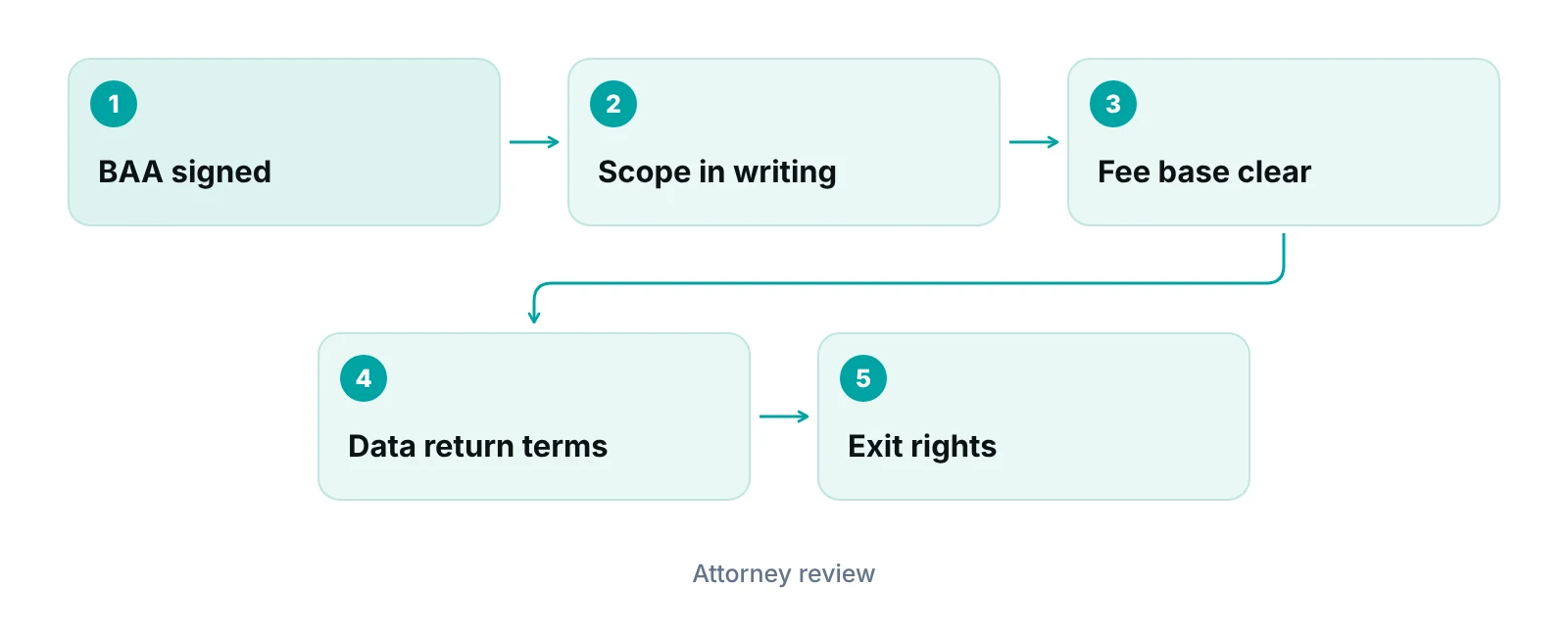
For a fuller view of what privacy law expects of any vendor that handles patient data, read our HIPAA compliance guide for medical billing. As a rule, ask any vendor to sign a BAA before sharing a single record, and ask where data is stored and who can see it.
How billing fees are structured and why the details matter
Ask how the fee is calculated and on what base, and have counsel check it against the rules for your payers. Billing companies commonly charge a percentage of collections, a flat monthly fee, or a per-claim fee. We do not quote prices here; they vary by specialty, volume and scope. What deserves your attention is the structure.
For Medicare, federal rules set conditions on paying an agent who receives payment on your behalf. Under 42 CFR 424.73, the agent’s compensation must not be related in any way to the dollar amounts billed or collected, and must not depend on actual collection of payment. An article from the Healthcare Billing and Management Association (2026) notes that percentage-based fees can be prohibited in Medicare and Medicaid payment arrangements, and may conflict with state fee-splitting rules for commercial claims. The HHS Office of Inspector General has also said that percentage billing arrangements may increase the risk of upcoding and similar abusive practices.
None of this means a percentage fee is always unlawful. Whether it is depends on who receives the money, which payers are involved and your state. It does mean you should not accept “everyone does it” as an answer. Ask the vendor to explain in writing how the fee complies for your payer mix, and ask your attorney to confirm.
Fee questions to put in writing
What is the fee base? Are payments deposited into an account the practice owns? What is billed extra (statements, appeals, credentialing, setup)? What happens to the fee if a payment is later recouped?
Red flags that should end the conversation
A few warning signs justify walking away, however good the price. They fall into promises, opacity and pressure.
- Guarantees. No honest vendor can guarantee a denial rate, a collection increase or a payer outcome. Payers, documentation and patient mix all affect results.
- Quoted statistics with no source. “Our clients see X% more revenue” is marketing. Ask for the method and the period, or ignore it.
- No sample report. If you cannot see what you will receive each month, you cannot judge it.
- No BAA, or reluctance to sign yours. A vendor handling patient data without a BAA puts the practice at risk.
- Payments routed to the vendor’s account with no clear agency terms. Ask where funds land and who controls the account.
- Long lock-in and no data-return clause. If leaving is hard, performance problems become expensive.
- No named contact. Escalation through a ticket queue only is a sign you will wait.
- Pressure to sign this week. A sound vendor will let your attorney review the contract.
Also ask how backlog is handled at the start. Medicare generally requires a claim to be filed within 1 calendar year after the date of service (42 CFR 424.44), with exceptions, and your commercial payer contracts set their own limits. Ask which claims the new team works first and how it tracks filing deadlines.
A practical process for making the final choice
Run the same checks on every vendor, then decide on the evidence.
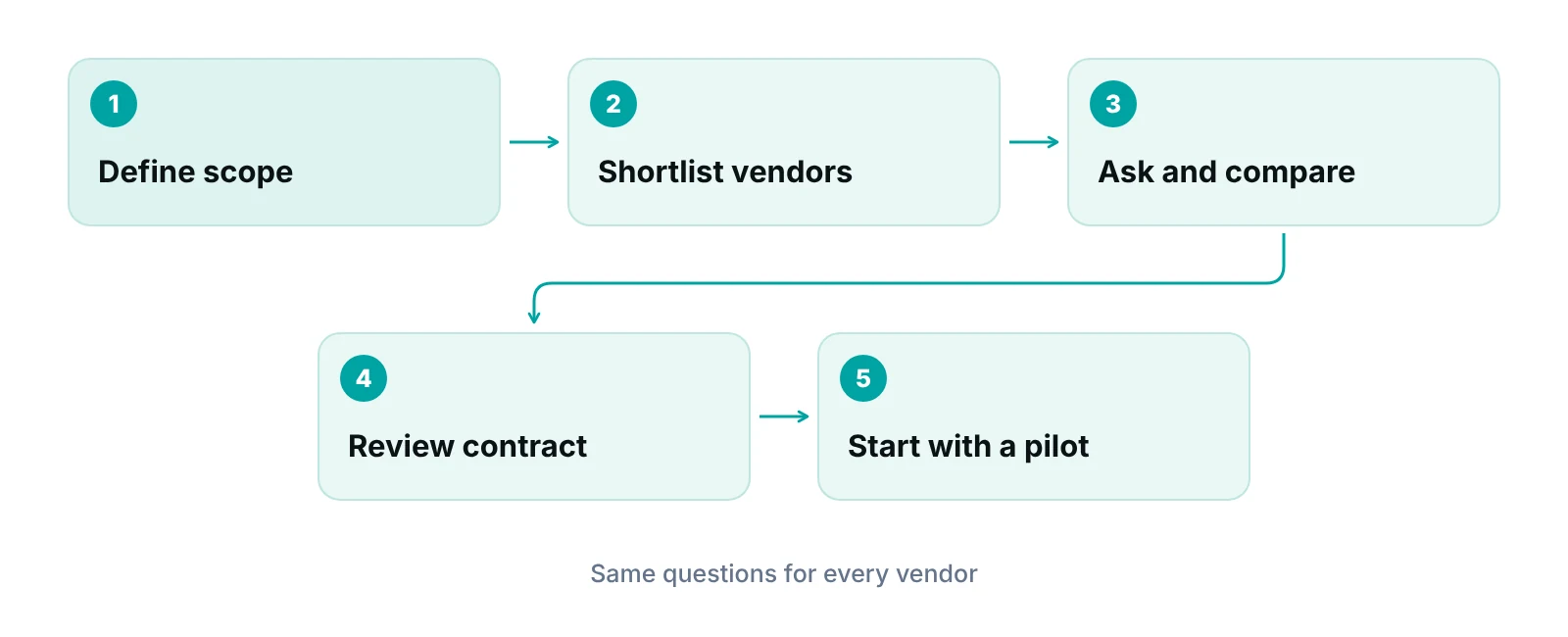
- Define scope. Write down which tasks you want outsourced and which stay with your team.
- Shortlist two or three vendors. More than that slows you down without adding insight.
- Ask the same questions of each. Use the table earlier in this guide and record answers.
- Review the contract. Send it to your attorney. Resolve data, exit and fee questions before signing.
- Agree on a review point. Set a date, such as the end of the first quarter, to review reports and decide whether to continue.
If you are a smaller practice, our article on medical billing services for small practices covers the trade-offs of outsourcing at your size.
One more point on visibility. Whoever you choose, you should be able to see where each claim stands. Some practices pair an outsourced team with a practice management system that tracks claims by stage, so the status of every claim is visible without calling anyone. Whatever the tool, insist on an audit trail of who changed what.
When keeping billing in house is the better call
Outsourcing is not right for every practice. A practice with a stable, experienced biller, clean reports and a low denial backlog may gain little from switching. The risk of a transition, including the loss of institutional knowledge, can outweigh the benefit.
- You have a skilled biller and a documented backup, and your reports are reliable.
- Your volume is low enough that a vendor’s minimum would exceed what you now spend.
Before deciding either way, check your own numbers. If you cannot say what share of claims is denied on first submission or how old your A/R is, start there. A vendor evaluation is much easier once you know your baseline. Our guide to medical billing audits explains how to establish one.
Our recommendations
- Decide scope before you call anyone. List the tasks you want outsourced. It stops vendors from defining the scope for you.
- Ask every vendor the same questions. Use the table in this guide and write the answers down. Differences become visible quickly.
- Request a sample monthly report. Look for denials by reason, A/R by age and clean-claim rate. If there is no sample, treat it as a warning.
- Have an attorney review fees and exit terms. Fee structure rules differ by payer and state. Confirm that the BAA, data return and termination clauses are in the contract.
- Start with a review date. Agree on when you will review results, and what you will look at, before the contract begins.
- Establish your baseline first. Record your current denial rate, A/R by age and days to payment so any change can be measured fairly.
See every claim, by stage, whichever team does the billing.
RCM Finder's practice management portal tracks claims by stage with an owner, checks data completeness before submission, flags underpayments against expected amounts and keeps an audit log. It is a claim-centred system, not an EHR.
See how the RCM Finder portal works · Create a portal account
Disclosure: RCM Finder builds and sells this portal. It is a practice management system, not an EHR.
Bottom line
The right billing partner is the one that is specific, transparent and willing to put its answers in the contract. Compare vendors on the same questions, read the data, fee and exit clauses with an attorney, and agree on a review date. If you want a neutral look at your own claims before you decide, ask for a free practice audit, or read how our revenue cycle management service works.
Frequently asked questions
Is it better to hire a local medical billing company?
Not necessarily. Billing is done through payer portals, clearinghouses and your EHR, so location rarely affects the work. A local office helps if you want in-person meetings or depend on a specific state program. Judge on specialty fit, reporting and contract terms first, and use proximity as a tiebreaker.
What should I ask a medical billing company before signing?
Ask which specialties and payers the team handles, who your contact and backup would be, what a sample monthly report looks like, how denials are worked, how fees are calculated, and what you receive if you leave. Ask for the answers in writing and compare them across vendors.
Do I need a Business Associate Agreement with a billing company?
Yes. A billing company handles protected health information on your behalf, and HHS says a covered entity needs a written contract with its business associates that sets permitted uses, safeguards, reporting duties and what happens to data at termination. Ask for the BAA before sharing any patient records.
Are percentage-of-collections fees allowed?
It depends. Under 42 CFR 424.73, an agent who receives Medicare payment on your behalf cannot be paid in a way that is related to the dollar amounts billed or collected. Commercial payers and state law add their own rules. Ask the vendor to explain in writing and have your attorney confirm for your payer mix.
How do I know if a billing company is overstating its results?
Be cautious of guarantees, unsourced percentages and claims that every client improves. Ask for the method, the time period and the type of practice behind any number. If the vendor will not explain it, disregard it and judge on the sample reports and contract instead.
What happens to my claims and data if I leave a billing company?
That is set by the contract, so read the exit clause before signing. Look for the return of your claim and payment history in a usable format by a stated date, and for a clear handover of open claims. Without those terms, a switch can stall payment on claims in progress.
Get your free practice audit
Tell us about your practice. We will contact you using the details you give.
- A review of your recent claims, denials and A/R aging
- Where your front desk and prior authorizations slow payment
- A prioritized fix list you keep, whether or not you hire us
Pricing is quoted after the audit, based on your volume and the services you choose. Prefer to talk? Call +1 (302) 556-2288.
Sources
- 42 CFR 424.73 Prohibition of assignment of claims by suppliers; payment to agent — Cornell LII (reproducing the Code of Federal Regulations) (current)
- 42 CFR 424.44 Time limits for filing claims — eCFR (current)
- OIG Compliance Program Guidance for Third-Party Medical Billing Companies — HHS Office of Inspector General, Federal Register (1998)
- Percentage-Based Medical Billing — Healthcare Billing and Management Association (RCM Advisor) (2026)
- Business Associate Contracts: sample provisions — HHS (copy hosted by NACo) (n/a)
Disclaimer: This article is for general education. It is not legal, coding or compliance advice. Payer rules and state laws vary, so have your attorney review any billing contract before you sign.
